Ask ChatGPT
 Working Hard with Grace Beverley
13 Jul 2026 · 23m · 9 chapters
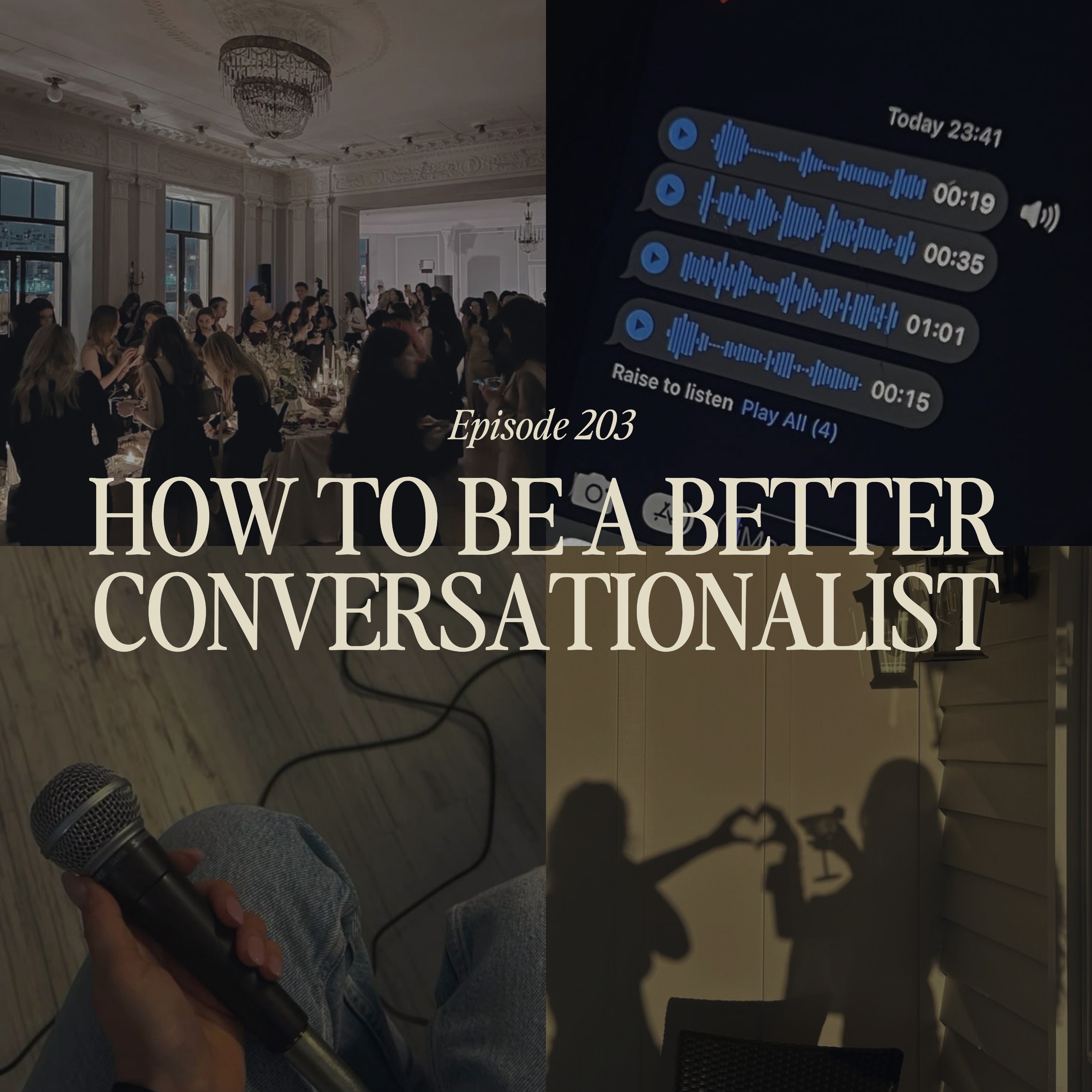
How to have better, more valuable conversations by emphasizing listening, curiosity, and matching the conversation type (practical, emotional, social) rather than trying to “perform.”
Great conversationalists ask strong follow-up questions; curiosity beats charisma; many breakdowns happen when people are in different conversation modes (e.g., offering solutions when the other person needs emotional validation); pausing and using open, specific questions improves depth; having monthly dialogues with people you disagree with builds social resilience.
Harvard 2021 study on follow-up questions increasing likability/intelligence/trust; Arthur Aron’s 1990s “increasingly personal questions” study creating closeness in 45 minutes; Pew 2023 polarization driven by reduced engagement; Aron’s “Cornwall” example question (“How does it feel?”).
Susie Ashfield, speaking coach (previously on the podcast) focused on presentation and conversation skills.
Written by AI. May contain mistakes.
Discover why understanding conversation as a skill can enhance life opportunities.
“Print postage on demand 24-7 and schedule pickups from your office or home.”
Discover why understanding conversation as a skill can enhance life opportunities.
Discover why understanding conversation as a skill can enhance life opportunities.
“And a few weeks ago, I had a bit of a revelation.”
Explore how modern communication habits have diminished our conversational abilities.
“Please give the podcast a follow, whatever app you are listening to it on.”
Learn about studies that highlight the impact of questioning in conversations.
“things that I came back to again and again when I was planning for this episode was the fact that in past generations, it was kind of essential to be good at conversation because conversation is how you get anywhere.”
Understand the concept of matching conversation types for better connections.
“around this so we can have a well-rounded approach to how to actually improve.”
Learn actionable strategies to improve your conversational skills.
“And I actually don't think until I started this podcast that I was that good at having those conversations with people.”
Learn techniques to foster deeper connections in conversations.
“I take this into my meetings at work too.”
Understand the importance of storytelling and active listening in conversations.
“She is the speaking coach that we had on earlier this year to talk all about presenting.”

Get the gist, explore an idea or ask about something said.
 Claude
On Working Hard with Grace Beverley, what are the key points of this episode?
Searching your listeningAutomatic transcript. May contain errors.
0:00Shipping, billing, admin, payroll, marketing. You're managing all the things. So why waste time sending important documents the old-fashioned way? Mail and ship when you want, how you want with Stamps.com. Print postage on demand 24-7 and schedule pickups from your office or home. Save up to 90 % with automated rate shopping. That's why over 1 million small businesses trust Stamps.com. Go to Stamps.com and use code PODCAST to try Stamps.com risk-free for 60 days.
0:43Grace Beverley: What is up? I'm Grace Beverly and welcome back to Working Hard, the podcast shaped guidebook on how to improve your own life and achieve what you actually dreamed of doing because life's too short for boring podcasts and bad advice. what is up and welcome back to working hard today's episode is one i have genuinely been wanting to do for so long because it's a very classic example of a skill that we all use every single day that we're never taught to think about in school and i don't think we actually think about as a concept enough like i think we think it just happens rather than the fact that it's something that you need to build and has a direct correlation in my opinion and actually in a lot of the research with how lucky your whole life is going to be.
1:26Grace Beverley: And a few weeks ago, I had a bit of a revelation. What if the thing that we've all been trying to fix about our social skills is the wrong thing entirely? I was scrolling on TikTok and I came across a video from a creator called Bella Dane on how to become a better conversationalist. And it explained that most advice about having better chats is about performance. So speak more confidently, use better vocabulary, cut the filler words, hold eye contact. But actually, the people who are universally described as brilliant to talk to are not the ones who say the most impressive things or use the longest words.
2:00Grace Beverley: They are the ones who ask the best questions. And it kind of sent me down a bit of a TED Talk research rabbit hole. So today we're getting into the science behind great conversation, how to be a better conversationalist and to use that to make your life more serendipitous, to give yourself more opportunities and ultimately why curiosity is more of a powerful social skill than charisma and how to make yourself a better conversationalist in any scenario, whether that's like a first date, a job interview, or even like a catch up with a friend, because how you converse actually really has an impact on how other people feel like you care about them or how present other people feel you are when you are in the room with them.
2:42Grace Beverley: And before we get into this episode, you know the drill. Please give the podcast a follow, whatever app you are listening to it on. It is the single easiest thing you can do to support us and it also means that we can keep the podcast completely free and it also means that an episode lands in your feed every single Monday morning without you even having to think about it.
3:03Grace Beverley: Right, I want to start by you thinking about the last time you were in a conversation where you felt kind of vaguely drained or like a bit flat afterwards. I can bet it wasn't because the other person was bad at talking physically. It's because they weren't listening. Like they weren't taking in what you were saying and they weren't conversing back and forth with you. Until recently, I think I've always thought being good at conversation was about being articulate, as I said. So like knowing when to be funny or having interesting stories or using the right words and getting rid of like or um. And don't get me wrong, that is obviously a part of it and that is helpful when we're talking about lots of things.
3:41Grace Beverley: But in reality, being a great conversationalist is actually a very different thing and it is a listening skill, it is not a talking skill. And I think it's a skill that actually so many of us have lost or maybe not even built in the first place. The art of being able to sit next to someone who has a completely different life or job to you and just make conversation has kind of disappeared because the need for it has disappeared. particularly now so many of us live a lot more independently like we're working from home we're not going out as much we're spending more time on social media so we're communicating through social media or just communicating with our close social circle who we know and we like and we have things in common with and all of that is very convenient and there are some fantastic things that come out of that but some of the most life-changing opportunities come from having deeper conversations with acquaintances so people you've never met before or you don't have much in common with when you start talking and not being good at having those conversations.
4:39Grace Beverley: And I think one of the things that I came back to again and again when I was planning for this episode was the fact that in past generations, it was kind of essential to be good at conversation because conversation is how you get anywhere. Like conversation is very common. You're not going to be looking down at your phone all the time. So you might be striking up a conversation with the person next to you if you're on your own or whatever it might be. I think A, that's a lot less common. I also think on the other side, it's a lot less necessary. So you can apply for a job without having a single conversation.
5:06Grace Beverley: You can find an opportunity without having a single conversation. You can do your job without having a single conversation. The necessity of being good at talking and being good at conversation has kind of been removed, which also means that it becomes a choice to talk to new people. It becomes a choice to be a good conversationalist, which I actually don't think it is. I think, yes, it's a choice, but you're going to have to deal with the consequences of not having invested time into developing your conversational skills and becoming an interesting and thoughtful person to talk to who can hold that conversation, who is much more likely to stay in your mind and become an acquaintance longer term rather than someone you just talk to for five minutes.
5:43Grace Beverley: And I think there is a little bit of this culture and I absolutely kind of fall into it too because we don't need to do these things and they are kind of uncomfortable. Like no one likes sitting next to someone at a dinner where you literally feel like you have absolutely nothing in common with them. And so we avoid those situations almost entirely. Like, we avoid small talk, we avoid mingling, we avoid being uncomfortable in these situations. And actually, if you want incredible opportunities to walk into your life, you have to put yourself in those situations. And when you're in those situations, you need to be good at conversation in order to be able to get anything out of those conversations.
6:17Grace Beverley: And I think that essentially, we're not allowing ourselves to have those conversations or putting ourselves in those situations, which I think is hugely impacting a lot of our lives, whether that is socially or professionally. So as always for these episodes, I got looking into the studies around this so we can have a well-rounded approach to how to actually improve. A 2021 Harvard study found that people who ask more questions in conversation, specifically follow-up questions, are consistently rated as more likable, more intelligent, and more trustworthy over people with the best vocabulary or people who were most confident.
6:50Grace Beverley: Psychologist Arthur Aron, who's famous for his research in human connection, created a study in the 1990s where two strangers were put in a room together and given a set of increasingly personal questions to ask each other. After 45 minutes, the pairs consistently reported feelings of closeness that normally take months to develop in real life. And the questions weren't like complicated or profound, they were just progressively more curious. And the results of this were so striking that this study has been replicated dozens of times since with the same results. I guess what the science says is that the idea that great conversation requires some sort of social gift or natural charisma is frankly not backed up by the evidence at all.
7:32Grace Beverley: And to go off on a little tangent, I think the stakes for developing that skill have actually never been higher. The More In Common project, which has been tracking social division across the US, UK and Europe for 10 years, actually found that we are consistently overestimating how much we disagree with each other. I think we can all tell this, like we see the polarization and the data shows that people across the political spectrum actually share far more common ground than they actually think. But because we've stopped having real conversations with people who maybe see things differently to us, our assumptions about each other have calcified.
8:09Grace Beverley: For example, a Pew research study from 2023 found that political polarization in the US has nearly doubled since the 1990s, with the sharpest increase coming not from people's actual policy views shifting, but from their unwillingness to engage with the other side at all. And that's not just political either. Research from the Harvard Human Flourishing Program found that loneliness and social disconnection are now at record levels globally, with nearly one in three adults reporting that they have no one to talk to about the things that really matter to them. And I think just that all of this paints a pretty direct picture of a society who doesn't know how to talk to each other anymore on the opportunities and everyday level, but also all the way through to the human level.
8:55Grace Beverley: Like we have to be good at engaging in discussions and conversations. We can't always just want to flick back to our phone quickly because we're not really enjoying that conversation. Like, yes, that's easy to do. And yes, I do it as well. It's just, it's depressing when you think about it. There is so much that that you can get out of conversation with people from all different walks of life. And I actually don't think until I started this podcast that I was that good at having those conversations with people. And now I notice a marked difference when I go to a dinner or whatever it might be, and I don't actually know the person in terms of being able to find common ground, in terms of being able to find discussion points rather than just constantly asking little questions about the other person's life in that kind of small talk way.
9:35Grace Beverley: And it has led to so many opportunities and also makes the experience more enjoyable. Like, I think we find socializing less enjoyable now because we're not actually as good at it. So we keep our circles small, we talk, majority on social media. I don't think it's good for us. I guess with that less than optimistic picture in mind, let me take you through the expert framework that I found super useful in improving my own conversation skills. It comes from Pulitzer Prize winning journalist and author Charles Duhigg, who wrote a book called Super Communicators. And if you've been around these parts a while, you might recognize his name.
10:07Grace Beverley: It is the same Charles Duhigg from the Habit Loop episode. And his research on communication is some of the most practically useful stuff that I have come across. And he actually has an amazing TED Talk that I'm going to link in my newsletter this week. I would really, really recommend you watch it. So it's very opening on all of this. And a good conversation starter in itself. Duhigg's big idea for sorting our communication, basically, is something that he calls the matching principle. He argues that every conversation falls into one of three types. There is the practical conversation, which is about facts, problems, and logistics.
10:38Grace Beverley: There is the emotional conversation, which is about how someone feels. And then there is the social conversation, which is about society, identity, who we are to each other, what we represent, what role we're playing. And according to Duhigg, most communication breakdowns happen when two people are in different types of conversation without realizing it. So a classic example is your partner comes home and tells you about like a nightmare day at work and you go straight into problem solving mode. You're trying to help, you are suggesting solutions, you're offering practical fixes, but what they actually needed was an emotional conversation.
11:14Grace Beverley: They didn't want answers, they wanted to feel understood and heard and listened to. And because you were both in different conversation types, the vibes very much go sour and you kind of both leave the room feeling bad about the conversation rather than feeling reassured. The matching principle basically says that before you try to be helpful or interesting, your job is to figure out what conversation you're actually in. And the way you do this is by asking what he calls the deep questions, checking in on how that person feels about what you're speaking about, going deeper. For example, you're at a wedding and you get talking to someone you've just met and you ask what they do and they say they've just left a really secure, well-paid job to go freelance.
11:53Grace Beverley: The easy surface version of that conversation is what kind of work are you doing? But in Instead, how about asking, how does it feel? Are you terrified or is it a relief? And suddenly that whole conversation opens up and it opens up towards connection. They could tell you that they are really scared, that everyone keeps congratulating them, but no one's asked if they're okay about it. And it's not about being, you know, a shoulder to cry on all the time. It's about, again, opening up conversation. Like that is connection more than just finding out what they do. That one question shifted you from a practical conversation into an emotional one and the chances are they will remember that conversation for longer because you were the person who actually saw or asked what was going on beneath the surface.
12:36Grace Beverley: But also it's just a better conversation for both of you. It's probably a much more interesting conversation as well. So that is basically the matching principle in action. So let's talk about putting this all into practice. this is how I've been getting this into my own chat. So the first tip is to start with open specific questions. The golden rule is that generic questions get generic answers. So how are you is going to get fine, thanks. What's your week been like? What's taking up your brain space this week? Gets you a real answer and a real conversation. Like that's an actual conversation starter.
13:09Grace Beverley: How are you is not a conversation starter. So some of my favourite ones are, why did you decide to make that decision? How do you feel? Or what got you into that? Or what surprised you most about that? These all sound a bit forced when you say them out of context, but they are actually very easy to slip into a chat if you're conscious of it. The second golden rule then is to practice the pause. This is what I find hardest because I think most of us, myself included, are so used to filling silence that we don't always give people time to finish a thought properly. Also, if you're an ADHD girly like me, I get so excited by the concept of the next question or part of our conversation that I'm just off as soon as they finish.
13:48Grace Beverley: But after someone finishes speaking, I'm trying waiting a beat before I respond. And I've been kind of amazed at how often they add the most interesting thing right after what you thought was the end of what they were saying. I take this into my meetings at work too. I always try asking at the end of the meeting, like, is there anything else we haven't covered that you wanted to go over? Or was there anything else you wanted to raise with me? Usually people need the extra nudge to actually get to what's going on in their mind. The third rule then is to match the conversation type before you try to help.
14:20Grace Beverley: Borrow this directly from Duhigg. So when someone brings something to you, before you respond, ask yourself, are they looking for practical input? Do they need to feel heard? Or are they working out something about their identity or how they fit into a situation, the answer should change your response. You can even ask outright, particularly if it's a close relationship, like do you want me to help you through this? Do you want solutions or do you mainly just need to talk? Because most people are so unused to being asked that question that the answer alone is also going to make them feel a lot more cared for before you even get to the conversation itself.
14:52Grace Beverley: And finally, the fourth and probably the hardest one in my opinion is to have one conversation a month with someone you disagree with and don't be scared to have a dialogue. You don't need to avoid everything just because you disagree on it. This doesn't have to be like a big dramatic political confrontation. It could be a family member with a different view on something or a colleague who always pushes back on your ideas or a friend who made a choice that you don't really understand. Your only job here is to ask questions and find out about how they actually arrived at where they are. It's not to accuse them of something or prove something in a certain way.
15:29Grace Beverley: So asking like, what made you feel that way? Or was there a moment that changed your mind on it? You'll almost always leave with a more complicated, more human picture of that person than what you went in with. And given everything the data says about how divided we've become and how bad we've got at tolerating difference, this one feels like more than just a social skill. It feels like genuinely useful practice for just being a person in the world right now. Shipping, billing, admin, payroll, marketing. You're managing all the things. So why waste time sending important documents the old-fashioned way?
16:07Mail and ship when you want, how you want with Stamps.com. Print postage on demand 24-7 and schedule pickups from your office or home. Save up to 90 % with automated rate shopping. That's why over 1 million small businesses trust Stamps.com. Go to stamps.com and use code podcast to try stamps.com risk-free for 60 days.
16:30Grace Beverley: You know, I always love bringing an expert into these episodes. So I spoke to Susie Ashfield. She is the speaking coach that we had on earlier this year to talk all about presenting. I wanted to ask her why so many of us are having so many different conversations in different registers without realizing it. I don't think it's a coincidence that as the rise of social media has grown and grown and grown, it is getting harder and harder to have the conversations that matter. I think the most important thing I can tell you is to put your phone down. Of course, we have these devices and they're really important to us, but conversations are going to be the most important thing in our lives too.
17:07As AI rises, it's that human connection that we're missing. So when you're having a conversation with someone who you care about, listen. Listening is really good. Active listening is even better. When I say active listening, it's using little words, like when someone is speaking to you, just give them that indication that you are still a human being and that you're still there. It's the nonverbal stuff sometimes, just nodding and going, and then to add to that, the most powerful thing I think you can say to someone who you think is giving you a little bit and they could go further, pause and then say, tell me more and wait.
17:45That is the best trick I can give you for getting someone to really open up to you and really extending that conversation. Something I think our parents' generation was really good at was telling stories. And yes, of course, these stories have hyperbole, they're exaggerated, did they even happen? But they're really good storytellers. And I think we're losing that art. Start to become someone who curates stories. If something interesting happens to you, if something unusual happens to you, make a note of it. And then the next time you're having a conversation with someone in your perhaps scratching around for a little bit of small talk, you can just reach into your back pocket with the material that is already good.
18:23But in order for that to happen, we've got to go back to my first point, which is you've got to put your phone down more and engage with reality. Remember the long lost art of people watching? I think people are fascinating and I think we don't watch people enough. And that's where the stories are. So my challenge to you is next time you are waiting for something, waiting for a train and there are people around, don't go into the doom scroll, just have a bit of an awareness. Look at the people around and initially nothing will come. But then you need to ask yourself questions. This is an interesting group of people here.
18:54Who do I think gets the round in first? Who do I think is the joker of the pack? Who do I feel like takes things a little bit more seriously? Who's the leader of this group? And as you start to ask questions, it'll just open up curiosity and open up possibility. And that's where the stories are. So if you want to return to that skill the older generation had of telling stories, you've got to be able to engage with them. There's a really good tip Stephen Fry talks about, which I quite like. And he says, you'll notice there are two groups of people who are really good at getting conversations going.
19:27Nightclub hostesses, read into that what you will, and members of the royal family. And what they'll do is they will get you to talk without revealing too much about themselves at all. And the trick they're using is they will just repeat the end of your sentence back to you. So if they say something like, oh, have you been anywhere nice recently? And you say, oh, yes, I'm just off to Cornwall this weekend. Cornwall this weekend. And they won't even have a question there. They'll just repeat it back. And then you go, yeah, Cornwall, you know, I've been going there since I was a kid of about eight years old.
20:00Oh, when you were eight. OK. And you might start talking about that time when you were eight years old. And it's just a really nice way to get people to open up a little bit more to you. You don't need to share anything. You just need to show that you are really listening to what the other person is saying. The other thing that social media has really taken from us is an ability to pause. It is natural for human conversations to have a bit of a lull. And for sometimes where there are moments of laughter and sometimes there are pauses and we wait for someone to chip in. But at the moment, that feels like the biggest sin you could commit.
20:34Let those pauses happen. They're natural. They might feel a little bit awkward, but it just means someone is thinking and about to come up with something. I think someone who really leads the way in this is Louis Theroux. Louis Theroux has really hard conversations with some people that perhaps the rest of the world are really going to struggle to like. But consistently, he is a brilliant interviewer and he gets those difficult characters to open up more so than so many other interviewers do. And the trick he's doing is he's just showing genuine curiosity without placing judgment. In fact, he's just often sharing an observation about what he sees.
21:10So I noticed back there when we were having a conversation, you said this. What was that about? And it's not accusational. It's just genuine curiosity. If you want someone to go a little bit deeper, do that. Reflect back to them what you were seeing. And without judgment, get them to open up on it. So that's another really good trick. We run into these conversations quickly. If you've had a bad day and your partner's at home, you might want to unburden your day on them. And some people just have this absolute knack for problem solving. And they think that's the helpful thing to do. You burden me with something, I can help you solve this.
21:44And in actual fact, that's not what you wanted. What you wanted was just to go, well, there it is. It's there. Now it's out. We can move on with this. And let's talk about something better. And sometimes if you're not aware of that, it can feel a little bit irritating if someone goes, well, why didn't you try this? And why didn't you do that? Why didn't you do that? I'm very lucky in that I have friends who offer different roles to me. I know I've got a friend who I can call if I just want someone to listen because I've had a crappy day. I know I've got a friend who is absolutely pragmatic and will give really good advice and show me the options I can take and show me a way forward.
22:15And then I've got a friend who will just analyse the situation with me and we can go a little bit deeper. But the thing is, I need to know first what response I'm looking for. And you can get all of that from one person in your life. You just need to be clear in what you're looking for. So set almost a rule in place. I'm going to tell you something, and I just want you to listen to this. Or I'm going to tell you something because I found it a little bit weird, and I want your thoughts on it. Or I'm going to tell you something because I want to know exactly what you would do if you're in this position.
22:44So one person can offer a wide range of roles to you, but it's up to you to tell them what you need from that conversation. More importantly than all of this is that golden rule we applied at the start. Listen, smile, nod. Sometimes that is the best thing you can do just to encourage someone to start talking to you. If they feel like they're being listened to, they are going to feel like a million dollars.
23:08Grace Beverley: So that is everything on what actually makes someone great to talk to and how to make yourself better to talk to, even if it's for the selfish reason of getting more places and putting yourself in more positions where good things are going to happen for you. And the short version I would say the TLDR is stop trying to be more interesting, start being more interested. We are going to do a bit of a deep dive into this topic on the Working Hard newsletter this week which is always sent out the day after the episode and it includes some of the studies that I've referenced and my dinner party questions list which you know might be my proudest work for someone who this didn't come naturally to originally.
23:40Grace Beverley: I will leave the link to subscribe to the newsletter in the description. Thank you so much for listening. And as always, I'll see you next Monday.
24:12limited time, go to stamps.com and use code podcast for a free welcome gift. Taxes and fees apply.
Today we’re getting into the actual science of great conversation and ultimately why curiosity is a more powerful social skill than charisma, and how to make yourself a better conversationalist in any scenario, whether that’s a first date, a job interview, or a catch up with a friend.
Thank you so much to the brilliant Susie Ashfield for being my expert for this episode, you can find her links below:
Website: https://susieashfield.com/
IG: https://www.instagram.com/susieashfieldspeechcoach/
Book: https://www.waterstones.com/book/just-f-king-say-it/susie-ashfield/9781783968725?
+
SIGN UP TO THE WORKING HARD NEWSLETTER: https://graceb.myflodesk.com/k0sfhlac34
+
FOLLOW THE PODCAST
Instagram: https://www.instagram.com/workinghardpod/?hl=en
TikTok: https://www.tiktok.com/@workinghardpodcast
+
DILEMMA SUBMISSION
If you'd like to submit any dilemmas to the podcast to be answered in the bonus episodes, please send them to [email protected] with the subject beginning DILEMMAS or DM us @workinghardpod on instagram!
+
MY LINKS: https://gracebeverley.komi.io/
+
RETROGRADE, SHREDDY, TALA and THE PRODUCTIVITY METHOD are my own businesses, therefore any mention of them - whilst not being a sponsorship - is monetarily endorsed. As usual, sponsorships do not change my opinions nor my honesty, but I will always disclaim to make sure motives are clear 😊
Hosted on Acast. See acast.com/privacy for more information.