
 Ask ChatGPT


 Working Hard with Grace Beverley
14 Sep 2026 · 24m · 11 chapters
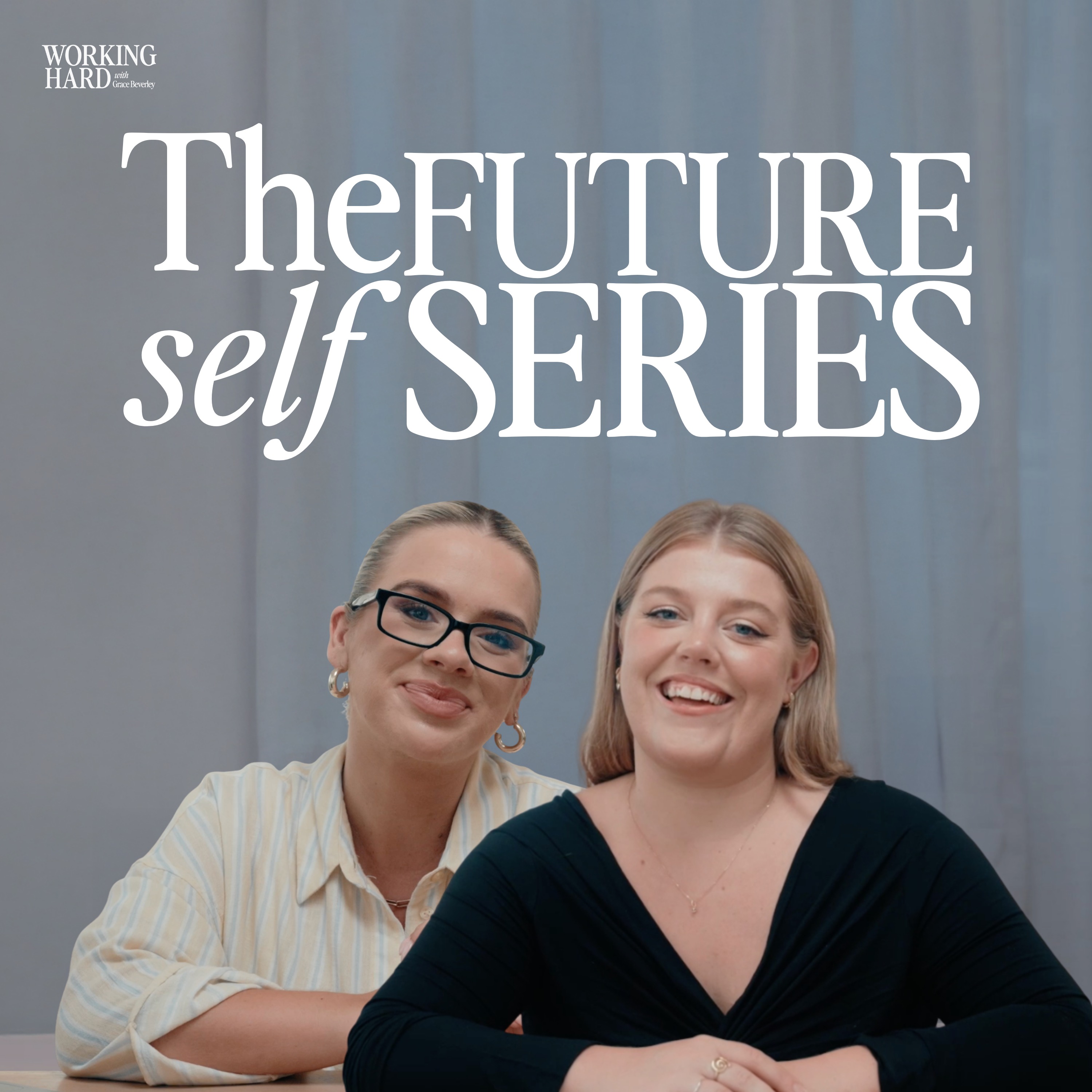
How decisions in your 20s and 30s shape (and can sabotage) your 40s and 50s, and how to make “leaps of faith” that set up a better future without shame.
Gemma Spegg, creator/host of The Psychology of Your 20s; author of Person in Progress; runs “study of the week” on Substack; background in psychology; previously worked in corporate management consulting; started her podcast after a major heartbreak; has also quit her corporate job and moved countries.
Three decision barriers: practicality vs passion, paradox of choice, and low self-belief/inner critic. Biggest regret comes from choices not made; education is the top regret category. Fear can signal growth. Action beats inaction.
Jam-tasting study (24 vs 6 options) showing choice overload; Cornell regret research comparing action vs inaction; Journal of Translational Psychiatry self-esteem study showing low-belief underestimates performance. Exercises: “wisest self” 15-years-ahead method; “rule of three” task limit; “leap, commit” during the change “roller coaster.”
Written by AI. May contain mistakes.
Exploring the significance of the 20s and 30s in shaping your future.
“Mod.com is changing the way people battle excessive fatigue.”
Exploring the significance of the 20s and 30s in shaping your future.
“Like a good neighbor, State Farm is there.”
Exploring the significance of the 20s and 30s in shaping your future.
Exploring the significance of the 20s and 30s in shaping your future.
“Anyway, the first episode was such a good episode, if I do say so myself.”
Introducing guest Gemma Spegg and her background in psychology.
“necessarily the ones who had it all figured out in their 20s.”
Gemma discusses the challenges of making decisions in your 20s.
“Thank you so much Grace for passing over the mic.”
Gemma shares research on taking risks and avoiding regret.
“Let's begin with the three biggest psychological barriers we face when making or contemplating a big life decision.”
Explore the impact of action and inaction on long-term regret and decision making.
“we make but the choices that we don't make.”
Learn how to enact big life decisions and manage the challenges that come with them.
“Okay, let's move on to the most important part of this episode, which is how to actually enact big life decisions and how to put choices and change into motion.”
Hear common advice from individuals over 40 about taking risks and seizing opportunities.
“And that, like, I love the way Gemma speaks about things.”
Wrap-up of the episode with insights on productivity and upcoming themes.
“Next week though, we are going to be getting into my favorite subject, productivity and talking about the idea of the five-year plan.”

Get the gist, explore an idea or ask about something said.
 Claude
On Working Hard with Grace Beverley, what are the key points of this episode?
Searching your listeningAutomatic transcript. May contain errors.
0:00Mod.com is changing the way people battle excessive fatigue. Ever hit a wall in the middle of the day and a third coffee just doesn't do it anymore? Here's what's actually happening. Coffee only briefly blocks adenosine, the chemical that tires you out. When it stops working, your system is flooded and you crash. Modafinil is a prescription treatment that works in a completely different way. Modafinil works by stimulating multiple receptors in the brain associated with wakefulness, including dopamine, serotonin, norepinephrine, histamine, glutamate, and orexin. It's a more complete solution that gives you 10 to 12 hours of steady focus and energy.
0:43To learn more, go to mod.com. Fill out your intake form, meet with a licensed provider, and if approved, ModAlert ships straight to your door. Go to mod.com to get started. That's M-O-D dot com.
1:25finding coverage that best fits your needs so you can continue to focus on what's most important to you. Like a good neighbor, State Farm is there. Do you keep hearing podcast ads like this one, for example, but always wonder how you actually get involved with them for your own brand or organization? Well, it's easier than you think. We're Acast, and we give you the platform to do it all yourself. Browse thousands of popular podcasts, choose the shows that match your perfect audience, set your budget, and launch. And if you want a hand, our podcast specialists are there to help you launch with confidence.
2:00This is podcast advertising without barriers. Get started at acast.com slash advertise.
2:22Grace Beverley: What is up? I'm Grace Beverly and welcome back to Working Hard, the podcast shared guidebook on how to improve your own life and achieve what you actually dreamed of doing, because life's too short for boring podcasts and bad advice. Welcome to episode two of the Future Self series. If you've not heard episode one yet, I'd go back and start there because that's exactly where we break down exactly what this whole series is about. And also it will be getting yourself set up to be able to reverse engineer the ideal life you want. All of this is set up almost as a course. So yes, you can dip in where you want to, but it is designed to be able to give you an end-to-end way of being able to reverse engineer your ideal life.
2:58Grace Beverley: Anyway, the first episode was such a good episode, if I do say so myself. It was with mindset and manifesting expert Roxy Dufusi. I do not want you to miss it. But anyway, let's move on to today's episode. So this is the second episode of part one, which is all about working out what your dream life looks like and designing your plan to actually get there. And we're going to zoom in on the decades that, looking at our demographic data, you are likely in right now if you're listening to this. So that is your 20s and your 30s. I personally think that your 20s are genuinely the most confusing, brilliant, chaotic, but most importantly formative decade of your entire life, which feels really overwhelming, but it was also exciting too, and there's so much opportunity there.
3:36Grace Beverley: It's the decade where your brain is still wiring itself into its final form. You're still figuring out your identity and who you are. And even as someone on the cusp of turning 30, I really think that the choices you make in your 20s and 30s compound harder than they ever will again, which can be both terrifying and exciting, dependent on how you think about it and dependent on the day of the week. So I wanted to make sure that as part of this series, we did an episode on how to stop your 20s from sabotaging your 30s and 40s, but with proper nuance and definitely avoiding the element of shame that often comes attached to this and like thinking you need to do absolutely everything in your 20s because I am so against that opinion.
4:16Grace Beverley: I really think it's possible for your 20s to be both about having fun, trying things and also laying the groundwork for the version of yourself that you want to be in your 30s and 40s because the truth is the small decisions you make now do not reset when you hit 30. It's not like suddenly you change age and actually everything you were doing then doesn't come into play now. Like the women I see really thriving in their 30s, they definitely weren't necessarily the ones who had it all figured out in their 20s. They were just the ones who, even when they were trying everything and saying yes to life, were also having that long-sighted view of success and I think that's the question that this episode is really about and when I was thinking about who I'd want to pass the mic to for this episode there was really only one name that kind of kept coming up and when we're having meetings on like what this episode should look like this person just came up again and again as the perfect person to set it up for us.
5:11Grace Beverley: If you don't already know Gemma Spegg from my episode with her back in 2024 you are about to fall in up with her. She is the creator and the host of The Psychology of Your 20s which is one of the biggest psychology podcast in the world. In fact, one of the biggest podcasts in the world, full stop. To give you a quick synopsis, Gemma's journey started back in 2021 after she went through her first real heartbreak and she was looking for a guide to all the confusing and chaotic feelings that she was experiencing as someone in her 20s going through that big heartbreak. And it turned out that it wasn't really just the breakup.
5:40Grace Beverley: There were so many other experiences that she was having as a 20-something that she wished she had an explanation for. She's always said that she felt that no one would really give her the straight up science and all the self-help content she found seemed to very much just be opinions based. So with her background in psychology, she started a podcast alongside her corporate management consulting job and she called this podcast the psychology of your 20s. What I really love about Gemma and her style of episode is that she really loves to study and research as much as I do and she's always bringing research into our chats and her podcast which I feel like it just makes it more tangible and practical and it makes it easier to follow in my opinion and to know that you're doing the right thing.
6:19Grace Beverley: She told us that her episodes take over 10 hours to write and create so she very much focuses on giving us the facts while also it very much feels like having a good chat with your best friend. Before we go fully into the episode though, as with all of these episodes, Gemma has put together a follow-up exercise and her personal recommendations in the Working Hard newsletter for this week. So you can actually take what you hear today and do something with it. As I said, I wanted this to feel like a pretty much a free course and I wanted it to be so actionable. Like I want you to get to the end of the 12 weeks, particularly because that will be at the end of the year.
6:52Grace Beverley: Like I want you to feel like you know exactly what you are doing in your life and exactly where you are going and exactly how you are getting there. So that's going to be in the Working Hard newsletter. It's going to be sent out on the Tuesday after this episode goes live as always. So I'll put the link for that in the description. But without further ado, I'm going to be handing over to the gorgeous Gemma. Hello everybody, I'm Gemma Spegg. Thank you so much Grace for passing over the mic. I'm thrilled to be one of your cover teachers for this Future Self series. If you are a long-time follower of Working Hard, you might recognize me from previous episodes I've done with Grace on my own podcast, The Psychology of Your 20s, now on Netflix.
7:30Grace Beverley: I'm also the author of Person in Progress, A Psychological Guide to Your 20s, and I run the study of the week series on Substack where we break down academia into simple terms. I've spent the past five years diving into basically every single piece of research there really is to know about our 20s, how to make decisions, how to avoid regret, and whether there is a right way to live out this decade. And I want to share it with you. I've also made some rather big life choices in the past five years, like quitting my corporate job, moving countries. so today I want to give you all that information to help you identify what you want, when to act and how to trust you are making the right but crucially the most brave decision for your future self.
8:14Grace Beverley: As we move through module one we are getting much clearer on that future roadmap we are building for ourselves, that concept which Grace introduced at the very start of the series. This will give us the tools to reverse engineer our dreams into reality and hopefully make our 30s and our 20s that little bit easier. So grab a pen, grab a piece of paper or your notes up, whatever you need to follow along and let's get into it. So this is how this episode is going to go. I'm going to give you three reasons why we struggle to make decisions. I'm going to break down some research on the best risks to take in your 20s and we are going to finish with three exercises you can do today to give you more clarity and hopefully you will finish this episode and know what leap you need to take.
9:02Grace Beverley: Secretly, I think you already know. I think that's why you've tuned into this episode. But hopefully what we talk about will just solidify it all for you. Let's begin with the three biggest psychological barriers we face when making or contemplating a big life decision. The first is equal part psychological, equal part physical. It is the tension between practicality and passion. Sometimes we have the calling part and we have the inspiration to act or the desire, but we are held back by concerns around money, around disappointing others. We are held back by time, by location, by obligations. Finances in particular are a big one.
9:44Grace Beverley: Not everyone has the luxury of being able to follow their dreams with zero regards to expenses or lost income. However, I think we don't always weigh up the costs of not making a decision. For example, the income potential on the other side of going back to university, on the other side of investing in our education, the cost of delaying a choice we know we will inevitably need to make, and the future emotional cost of our unhappiness that counts just as much. We're going to talk about that more in a second. But the second barrier is a well-known psychological phenomena known as the paradox of choice.
10:22Grace Beverley: This theory essentially says having more choices isn't liberating. It can actually become restrictive because the cognitive effort required to weigh up all the pros and cons of each choice against the next becomes so complex that the what-ifs just pile up. This is actually the original study that put a name to this. It was conducted by two researchers, one from Stanford and one from Columbia. They tested their theory that too many choices actually overwhelms us rather than enables us by going to an upscale grocery store and offering jam tastings. Jam. On weekend one, they offered 24 jams. 3 % of people who tried a jam, bought a jam.
11:07Grace Beverley: On weekend two, they offered only six and 31 % of people made a purchase. This isn't really about jam. You are struggling to make a decision because of all the possible doors you think it will close. If I start a business, well, then I can't do my PhD. But if I start my PhD, I'll have to quit my job and then I can't climb the corporate ladder. But if I have to climb the corporate ladder, then I can't travel for six months. All these options are so good that to save yourself the tragedy of choosing wrong, you just don't choose at all. The final component to this, or at least the final factor I'll mention just for this episode is a lack of trust and a lack of self-belief.
11:47Grace Beverley: Nearly every big life decision that will shift timelines for you involves uncertainty and requires the courage that you can manage that uncertainty. If you do not have that belief that things are gonna be okay, even if they don't go right, or that you can survive the unexpected, you are gonna remain stagnant. Now, is that lack of self-belief your fault? Very rarely. It is a combination of childhood experiences, encounters with failure, temperament, support system, even our personality. It's also the case that if you've experienced trauma or chronic stress, self-belief becomes more difficult to access.
12:26Grace Beverley: Here is another study I wanna show you. This one was published in the Journal of Translational Psychiatry. These researchers conducted a series of studies involving people with high and low self-esteem. So in the top and bottom 10%, both groups were asked to complete the same task of equal difficulty. And at the end, they were asked, how well do you think you did? Do you think you did well? Do you think you did badly? There was actually no difference in performance. Both the high and low self-esteem group did actually pretty well. But the people in the low belief group consistently said, I think I did bad.
13:02Grace Beverley: They underestimated their performance. What we can learn from this is that you're not less capable just because your inner critic says so. But you also have to be aware of that inner critic and the fact that it craves safety, it craves comfort. Therefore, it is going to prevent you from making choices that will expand your life because that requires a little bit of fear. So with that in mind what are the big life decisions or big leaps of faith that you should be taking in your 20s to set you up for your 30s and beyond. I don't want to sound like cliche and say all of them because not all risks are created equal but I do believe that if there was ever a time to blow up your life to completely shift timelines and identities and priorities this would be it.
13:47Grace Beverley: With that being said there are two pieces of research in particular that I want to bring up. The first is a paper titled The Experience of Regret, What, When and Why and was published by researchers at Cornell University in the 90s. What they found was that the choices we regret the most are not the ones we make but the choices that we don't make. When we have the choice to act and we don't, this inaction lingers because it is cognitively more open, meaning that we are more likely to return to what could have been more frequently. In contrast, action regrets leave us this sense of at least I tried, at least I did it, at least I gave it a go.
14:26Grace Beverley: And we are better able to rationalize why we made the choice and where we went wrong. We are also better able to learn from it and to see that that door is closed because we opened it and shut it. So what does this tell us about big life decisions and big leaps of faith, it tells us just to take more of them. Action is going to cause you discomfort in the short term, but inaction creates more psychological tension and regret in the long term. The second piece of research I want to share is also about regret. It is actually one of my favorite papers of all time. It's titled What We Regret Most and Why, published in 2008.
15:02Grace Beverley: This was a meta-analysis of 11 regret ranking studies and they revealed the biggest thing that people said across all of these different experiments, across all these different observational studies, all these different case studies and interviews. It was education. Education was the biggest regret across this entire meta-analysis. Second to that was regrets to do with career. Third was romance. However, the researchers went even deeper and this is why I love this paper. They actually suggested that our biggest regrets will inevitably reflect where we see and we saw the largest opportunity for growth, for change, and for renewal.
15:47Grace Beverley: Basically, the things that would have expanded people the most were the places where they harbored the most regret. I'm going to put this back to you now. That decision that you were thinking of, if it scares you, it's probably the one you need to make because you wouldn't be scared by something that changed nothing about your life. Your fear in this case is an indicator that this choice will expand you and that perhaps to not take that opportunity would likely be a mistake and would likely mean you're going to sit down in 10, 20, 30 years from now and be like, I really regret that. Now, I want to be really clear.
16:20Grace Beverley: This isn't to dismiss the challenges and the very real hurdles that may need to be overcome to get to this place. And I should say this research does support that when very real challenges prevent someone from an opportunity, regret plays less of a role. But I think it just requires some honesty with ourselves. Is the challenge that is in your way, is this challenge, the one that you use as maybe an excuse not to do things? Is it as great as we think it is? Is it so great that in the future, we might not say, wait, like, what if, what if? That's an assessment I think only you can make, if I'm being completely honest.
16:57Grace Beverley: So I'm going to leave it with you.
17:13Coffee only briefly blocks adenosine, the chemical that tires you out. When it stops working, your system is flooded and you crash. Modafinil is a prescription treatment that works in a completely different way. Modafinil works by stimulating multiple receptors in the brain associated with wakefulness, including dopamine, serotonin, norepinephrine, histamine, glutamate, and orexin. It's a more complete solution that gives you 10 to 12 hours of steady focus and energy. To learn more, go to mod.com. Fill out your intake form, meet with a licensed provider, and if approved, Mod Alert ships straight to your door.
17:54Go to mod.com to get started. That's M-O-D dot com. Checking off the boxes on your to-do list is a great feeling. That's why a State Farm agent is there to help you choose a coverage option that's right for you. Whether you're getting a new house, car, boat, or RV, helping protect it is important. And State Farm is there to help you choose the coverage you need, whether you prefer talking in person, on the phone, or using the award-winning app. And with so many coverage options, it's nice knowing you have help finding coverage that best fits your needs, so you can continue to focus on what's most important to you.
18:32Like a good neighbor, State Farm is there. Rubrik is the security and AI operations company. Built for what happens after an attack hits, not just the moments before. AI has turned the threat landscape into quicksand, moving too fast for any human to fully predict. That's why an agentic cyber resilience platform matters. Automated recovery, clean data, a business that keeps moving no matter what hits. One platform, not a patchwork of stitched together tools and gaps. Don't wait for the next attack. Secure and accelerate your business at rubric.com. Again, rubric.com.
19:07Grace Beverley: Okay, let's move on to the most important part of this episode, which is how to actually enact big life decisions and how to put choices and change into motion. So I'm going to break this down into three smaller parts. You guys can see I'm a fan of a breakdown. We're going to break it down into knowing what you actually want, making the first step, and following through when things get difficult. So number one, how do you know what decision you actually want to make? There will be signs. There is the saying, your calling won't stop calling. And I think that is fairly accurate. When I first started the psychology of your 20s, it was almost annoying how much I was thinking about it, how much the idea was basically like stalking me.
19:50Grace Beverley: And eventually it just got to the point where I was like, oh my gosh, I just have to do something about this so that this idea and this thought will shut up. I just have to act on it. I have to act on it or I have to let somebody else take this idea and let them do it. Let them have it. The thing you can't stop thinking about. I think you know why you can't stop thinking about it subconsciously. If you're still doubting your decision making, you can try an exercise called the wisest self method. So the wisest self method exercise requires about five minutes of your time at first and then you can kind of access it time and time again.
20:21Grace Beverley: This evening, just find some alone time, find a quiet space, light a candle, tidy up, make Make your environment comfortable and sit down with a pen and paper or your laptop. I want you to imagine yourself in 15 years. If you're in your 30s, maybe in your 40s, 50s, 60s, and everything has gone right for you. Everything has worked out for you. I want you to picture in that moment your wisest, happiest, calmest, most collected, inspiring self. This version of you has all the answers. They have complete trust in themselves. They have a life filled with things and people that they love. They are steady.
20:53Grace Beverley: They are accomplished. envision yourself meeting this wisest version of you sitting down with them for coffee and you ask them should I make this decision what should my next move be what would they say what would this wisest version of you tell you to do how would they instruct you to act right now that is the way that you go that is the direction you go in the reason this exercise works because it bypasses a lot of fear around our capability by asking us to work backwards from a place of everything working out instead of towards an uncertain future. Additionally, it also taps into an unconscious or pre-conscious version of you who, once again, knows what we need to do, but just struggles to have those directions and that directive heard over the sound of fear that's like whooshing in our ear.
21:41Grace Beverley: Once you know the direction your highest or wiser self is asking you to go in, then it's about obviously executing that vision. Some decisions are very kind of like, Like either you are in them or you're not. Like they are very instantaneous and fast acting. Like breaking up with somebody or quitting your job or buying a plane ticket. The aftermath is often where a plan is kind of required and takes time. And it's that aftermath that is overwhelming. Quitting my job was the easiest part, I've got to say. Finding ways to make money, to make connections, to structure my days, to keep myself motivated.
22:13Grace Beverley: That was not the easy part. So in order to not feel overwhelmed by all that kind of needs to be done to execute your leap of faith after the fact, and that kind of big amount of items on your imaginary or very real to-do list, follow the rule of three. The rule of three says you are only responsible for three tasks at once. No more. Your to-do list can only ever have three items on it. Only once you've completed those three tasks, and all of them, can you add another three on your list to be completed. This, why it is so magnificent is that it forces you to break down big, big things into smaller chunks so that you can move through them faster.
22:53Grace Beverley: And it prevents something that we know as cognitive overload. This is a phenomena where the information and tasks you're trying to juggle exceed the capacity of your working memory. The other reason this is so amazing is that it produces actual progress rather than the situation a lot of us find ourselves in where we just think about everything that needs to be done. But because the list is so long and it is so daunting, like we just never actually do it. So the rule of three, especially in the early days of a leap of faith is so vital so that you can just see some of that progress that tells you just to keep going like and just shows you that stuff is happening for you.
23:25Grace Beverley: Secondly, be very clear that you are deciding and you are committing and what you are deciding and committing on. Sometimes it's easier psychologically for us to just feel like we're trying on something and seeing if it fits, but only if it goes right, only if it goes well, really, really quickly, then we're going to commit. It's a hard truth, but the moment you make a decision and right after you make that choice, when you are actually going to feel your worst about that decision, we can see this through a model known as the roller coaster for change. Right here is where you are going to have the most doubt, stress, and probably the greatest desire to go back to your old life.
24:04Grace Beverley: Deciding, no, I am committed to this, I'm not sliding, I am deciding, accelerates how fast you move up through the following stages of acceptance and curiosity and experimentation because you're not dragging your feet, you're not kind of in between these two worlds. So when in doubt, leap, commit, make the choice that has been following you around mentally for so, so long. And finally, we need to realize there is no such thing as a right choice or the perfect decision. And this is something I'm still really realizing myself. There may be choices that are less risky or more appealing, but it is not the decision that changes things.
24:41Grace Beverley: It is the continued and sustained commitment to a new way of life that does. At any time, for most decisions, we can decide to change again. We can decide, oh my god, I made a mistake. This was not what I expected. I've tried. I am not happy. And we can choose differently. This is the real big fallacy that I've experienced in my 20s. I'm sure a lot of you have as well. you are not locked into one decision just because it feels permanent right now and just because it is the most recent decision. The same way that you have and had the freedom to take the current leap of faith that you're contemplating or exploring, you're gonna continue to have that freedom for future leaps of faith.
25:16Grace Beverley: Don't just have one shot. I think it's just so important to remember that at any time you can jump onto parallel tracks. Maybe the train will be a little bit further back along the line, but like it is so much better to get off the wrong train as soon as you realize it is not going where you want it to go, then to ride it to the end and hope that maybe you'll be happy with it when you get there. That, my friends, is your guide to making big, brave life decisions and leaps of faith in your 20s. I want to finish with something that I hear time and time again from people I interview on the psychology of your 20s.
25:49Grace Beverley: Without a doubt, every single time I interview someone over the age of 40, they always say the same thing to me. in your 20s you do not realize how young you truly are and that you are just at the beginning. The second thing they say every single time is like I wish I'd just taken more risks. Every single person says this I wish I just had a little bit more courage I wish that I'd just given that a shot I wish that I'd felt a little bit more brave and that sits with me I try and take that with me into every single decision. If the option is to do or not to do you should always choose do you should always always take the leap and I can't promise you but I'm pretty sure your future self is gonna thank you for it later thank you so much grace for having me on working hard it has been such a pleasure being able to cover for you on maternity leave I hope you're having a great time I have sent something over for the working hard newsletter you should go and subscribe so that you can see the fun little additional resource I have kind of passed along and of course, if you enjoyed some of the stuff I shared, you can always listen to more podcast episodes like this or watch them on Netflix at The Psychology of Your 20s.
26:59Grace Beverley: It was such a pleasure. Right, I'm back again. And that, like, I love the way Gemma speaks about things. I love the way she backs everything up. And I feel like it makes it just so helpful and tangible and practical for actually building your future. So a huge thank you to Gemma for contributing to today's episode and a huge thank you to you for listening to this episode of the Future Self series and supporting the podcast during my maternity leave. If you love this episode, I highly recommend going and listening to Gemma's podcast, The Psychology of Your Twenties. It's one of my absolute favorites and as always, we'll do a full breakdown with all of the practical tips from this episode over on the Working Hard Instagram.
27:36Grace Beverley: So you can go over and see that there so you can start actioning it. Next week though, we are going to be getting into my favorite subject, productivity and talking about the idea of the five-year plan. So I will see you there.
27:56Okay, hold up. What is that? It's new Tide Evo. That little white tile is laundry detergent? Yep. Tide Evo is a super concentrated laundry detergent that's built different because it's packed with six layers of cleaning power that fight odors, stains, dinge, and extra work. and it smells so good. New Tide Evo. Love it or your money back.
28:20Grace Beverley: Money back guarantee issued via prepaid card by mail. See tide.com for details. Checking off the boxes on your to-do list is a great feeling. That's why a State Farm agent is there to help you choose a coverage option that's right for you. Whether you're getting a new house, car, boat, or RV, helping protect it is important. And State Farm is there to help you choose the coverage you need. Whether you prefer talking in person, on the phone, or using the award-winning app. And with so many coverage options, it's nice knowing you have help finding coverage that best fits your needs. So you can continue to focus on what's most important to you.
28:56Like a good neighbor, State Farm is there. While every other channel is fighting for your customer's attention, podcasts are where they've already given it.
29:03Grace Beverley: No one accidentally listens to a podcast for 45 minutes. They choose to be here. They trust the voice in their ears, and when that voice talks about your brand, it doesn't sound like advertising. It sounds like a recommendation from a friend. Acast gives you that trust at scale. Digital precision, post-read authenticity, and performance data that proves it worked. Don't fight for attention. Buy it with Acast. Learn more by visiting acast.com slash advertise.
Welcome back to episode 2 of the Future Self series! Missed episode 1? Go back and start there (that's where we break down what this whole series is about)
Today we're zooming in on the decades that, looking at our data, most of you are in right now: your twenties and thirties. I think your twenties are the most formative decade of your life, and the choices you make now compound harder than they ever will again. So this episode is all about how to learn to take risks without sabotaging your future.
I'm handing the mic to Jemma Sbeg, creator of The Psychology of Your 20s, one of the biggest psychology podcasts in the world. She brings the same research-obsessed energy she's known for (some of her episodes take 10+ hours to write), so you're in great hands.
Jemma's also put together a follow-up exercise and her personal recommendations in this week's Working Hard newsletter, so you can actually do something with what you hear today.
+
JEMMA SBEG
Listen to The Psychology of Your 20s: https://www.psychologyofyour20s.com/
Follow TPOY20s: https://www.instagram.com/thatpsychologypodcast/?hl=en
+
SIGN UP TO THE WORKING HARD NEWSLETTER FOR JEMMA'S RECOMMENDATIONS: https://www.workinghard.co.uk/welcome
+
FOLLOW THE PODCAST
Instagram: https://www.instagram.com/workinghardpod/?hl=en
TikTok: https://www.tiktok.com/@workinghardpodcast
+
DILEMMA SUBMISSION
If you'd like to submit any dilemmas to the podcast to be answered in the bonus episodes, please send them to [email protected] with the subject beginning DILEMMAS or DM us @workinghardpod on instagram!
+
MY LINKS: https://gracebeverley.komi.io/
+
RETROGRADE, SHREDDY, TALA and THE PRODUCTIVITY METHOD are my own businesses, therefore any mention of them - whilst not being a sponsorship - is monetarily endorsed. As usual, sponsorships do not change my opinions nor my honesty, but I will always disclaim to make sure motives are clear 😊
Hosted on Acast. See acast.com/privacy for more information.


