Ask ChatGPT
 Working Hard with Grace Beverley
29 May 2025 · 26m
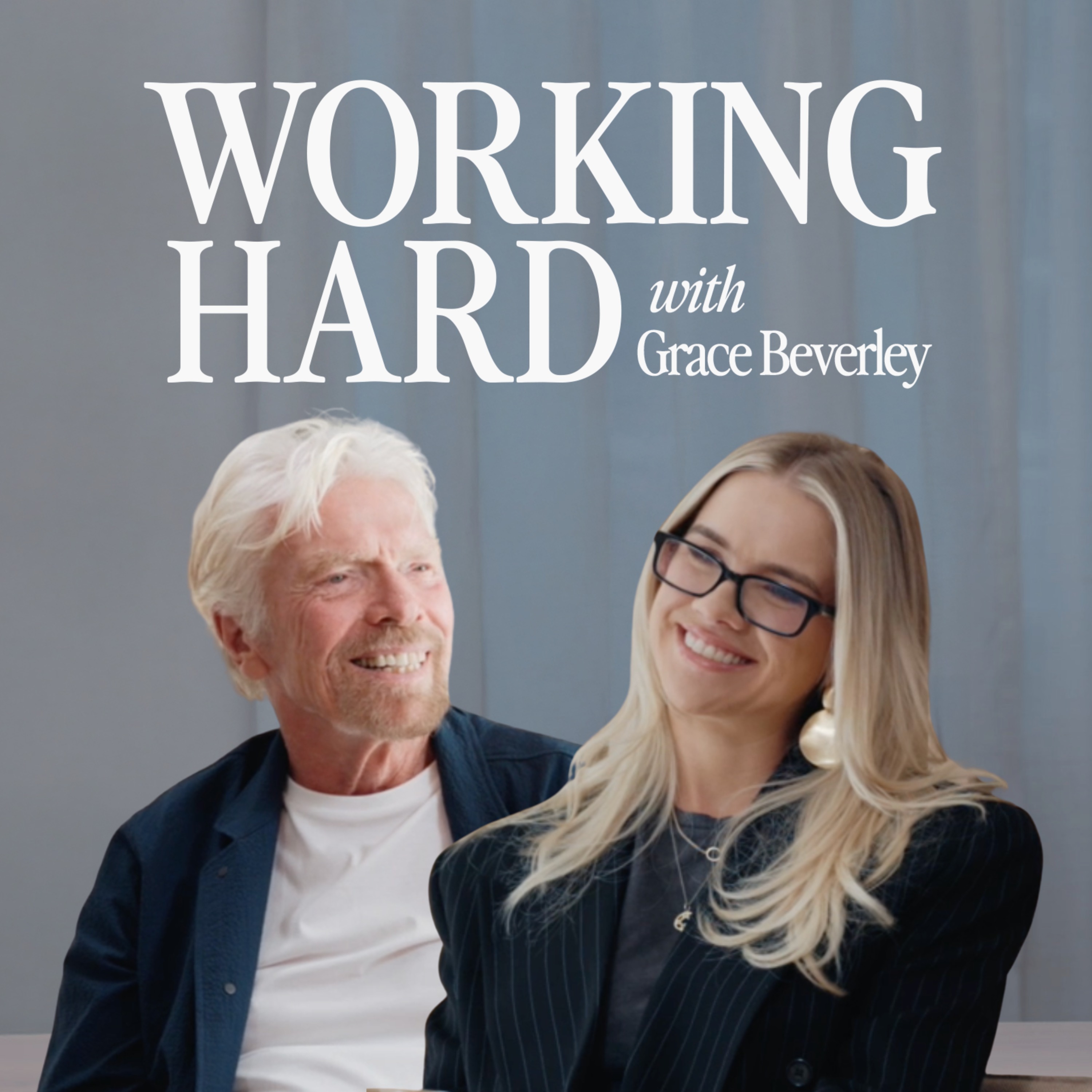
Host: Grace Beverley
Sir Richard Branson
The podcast explores the unconventional paths to success, focusing on personal stories and insights from various successful individuals. In this bonus episode, Grace engages Richard Branson in a discussion about the common advice to "do less better" in the context of entrepreneurship.
Written by AI. May contain mistakes.

Get the gist, explore an idea or ask about something said.
 Claude
On Working Hard with Grace Beverley, what are the key points of this episode?
Searching your listeningAutomatic transcript. May contain errors.
0:28Hey, it's Adam Grant from WorkLife, a podcast from TED. software, you'll work smarter, not harder. Freshworks uncomplicates. Learn more at freshworks.com. Does it ever feel like you're a marketing professional just speaking into the void? But with LinkedIn ads, you can know you're reaching the right decision makers, a network of 130 million of them. In fact, you can even target buyers by job title, industry, company, seniority, skills, and did I say job title? See how you can avoid the void and reach the right buyers with LinkedIn ads. Spend$250 on your first campaign and get a free$250 credit for the next one.
1:04Get started at linkedin.com slash campaign. Terms and conditions apply. Hi friends, Grace from the Working Hard podcast here. When you're stretching every dollar, Alilla goes a long way and Walmart Business is here to help. They make it easy to order what you need from tech and cleaning supplies to everyday essentials all at low prices and with helpful tools like spend tracking and tax exempt purchasing for eligible organizations. because when your operations are smooth, your impact can be bigger. Visit business.warmart.com to get started.
1:43What is up? I'm Grace Beverley and welcome back to Working Hard, the podcast-shaped guidebook on how to improve your own life and achieve what you actually dreamed of doing. Because life's too short for boring podcasts and bad advice.
1:57What is up and welcome back to a very special bonus episode of Working Hard. Today's guest is someone who really needs absolutely no introduction, but I'm going to give him one anyway. Sir Richard Branson is one of the most recognised entrepreneurs on the planet, from launching Student Magazine as a teenager out of a desire to speak about pop culture and current affairs, to morphing this into Virgin Records, which he then grew into a business empire that now spans music, broadband, airlines, hotels, space travel, and beyond. I think it's safe to say that he is a true pioneer of thinking differently and taking bold risks, and also he encapsulates the idea of multifaceted passions and interests.
2:34For months I've been thinking about doing an episode on whether it's best to do what 80 % of business leaders have recommended on this podcast, which is to do less better, or to pursue multiple passions and interests. So when I had the chance to have half an hour with Richard in the Virgin offices, I thought who better to really get into this subject with and to hear his opinion on doubling down on one thing versus wanting to pursue a more multifaceted career. I really cannot tell you how many times I've sat down to record this podcast and been told to do less better, that focusing on one thing is the only route to success in a career whilst knowing that it's no secret that I love pursuing new things.
3:10I feel like lots of people like me don't want to do less better and being told that over and over when it's not quite one of your settings isn't necessarily the only way of doing things. I'm not saying it's wrong at all. I definitely think that by some metrics doing less better would be more successful but I also think that we are all very different types of people and if you've listened to the Marie Forleo episode you'll know that to some people being one-track minded feels like, in her words, cutting off a limb. So I really wanted to understand Richard's motivations for continuing to start more and do more even when he's already grown so many businesses in his now over 60 year career and see how that might also be able to apply to all of us who don't think so traditionally about one thing at a time.
3:51And just as a little spoiler alert, one of my favourite things in this episode is the way that he talks about doing more but doing more well, how you can't just use this I'm not a do less better person to try and do everything without acing anything and that maybe doing less better can be about doing more, but just not before you can do one thing well. So whether you're at the beginning of your business journey, or you can't seem to focus on one area, or you have big, big dreams, or just someone who loves advice from someone who is the definition of been there and done that, then this episode is perfect for you.
4:31Sir Richard Branson are you currently more working hard or hardly working thank you for the Sir Richard the only place anybody ever calls me Sir is in America and when I'm walking down a street I suddenly hear Sir Richard and I think there's a Shakespearean play taking place. But anyway, no, I look, I think I am as active as I've ever been, only because I don't see work as work. I enjoy everything I do. I suppose I'm spending more time now trying to solve the problems of the world. And, you know, whether it's working on Ukraine or trying to change people's attitudes to the war on drugs or capital punishment reform or whatever than just building businesses.
5:16But I've never thought of what I'm doing as work. So busy, busy, busy creating things I can be proud of. Have you always aspired to kind of feel like you're hardly working when you are working hard? Is that a mindset that you've tried to have? It's not something I've aspired to do. But, you know, since I never set out to be an entrepreneur or a businessman, I set out to create a magazine that could put the world right and campaign on stopping the Vietnamese war and other issues. And the business aspect just came out of necessity to try to make sure the magazine survived every year. And I've just never, ever thought of myself as being an entrepreneur or a businessman.
6:03I just love what I do. I love creating things. I love getting a wonderful group of people around me to help me create things. and I do it seven days a week. But equally, you know, I'll do lots of conventional playing as well. So I think I've got a reasonable balance. And I know you say that you didn't necessarily see yourself as an entrepreneur and that's kind of what you set out to do from the beginning. It wasn't that you suddenly thought, oh, I want to be an entrepreneur, so I'm going to do this, this and this. But can you tell me when you think you first realised you had kind of a more entrepreneurial mindset?
6:33Because a lot of the things that you describe, whilst it might not have been you setting out kind of saying, I want to start a business, therefore I'm going to find one to start and get it started and grow it. All of those traits that you've mentioned are obviously very entrepreneurial. I think when I started out, which was an awful long time ago, the word entrepreneur didn't even exist. So, I mean, obviously in France, entrepreneur, where it came from, existed as a name, but there weren't any entrepreneurs. So it was even more bizarre. So there was myself, there was a lady called Anita Roddick who did Body Shop.
7:07and anybody who wanted to interview an entrepreneur, they'd either choose Anita or myself, a woman or a man. And so we got more than our fair share of coverage. You know, I would just dive in to start things where I saw that there was a necessity to change the status quo. And so, yes, I was technically an entrepreneur and proud of it. I mean, it wasn't something I aspired to be, But yeah, I suppose if you're going to call me anything, calling me an entrepreneur is most likely the right thing to call me. Yeah, I'd say so. I guess I also am interested in when you were at school, for example, and you were looking at career paths and you were looking at what success might look like to you in the future.
7:56was it at that point that you kind of had this concept of success being working for yourself or was it much more traditional in terms of what you look towards? I never considered a career path when I was at school remember I'm dyslexic so I was hopeless at conventional schooling and age 15 I'd been working on this magazine at school and and was very interested in what was going on in the outside world. There was the Biafran War, there was the Vietnamese War, you know, two very unjust wars. And the headmaster basically said to me, look, you either, you know, run your magazine and leave the school or you don't run your magazine and you stay at school.
8:35And that was easy. I just decided to quit. I've never worked for anybody else. So I've always worked for myself. I've never even, you know, never even actually considered getting a conventional job as I said I wasn't really looking for a job I was just you know just wanted to create a magazine that could make a real difference yeah it's such an incredible I guess start to a career in a sense that your career has obviously evolved in so many different ways since then to be able to start from something that you were purely passionate about I think a lot of what people think of now is maybe something that they're passionate about that might be separate from their work and not necessarily something that they've kind of they can turn into you know what you've been able to turn your passions for justice kind of into yeah I think I was extremely lucky in being able to spend my life doing exactly what I loved and wanted to do so if I wanted to go into you know if I got frustrated about flying on other people's airlines you know I could go screw it let's see if we can you know we can start our own airline and give it our best shot and and create something which we can be proud of and you know if we create something really special it may survive but we never got the accountants into in advance to you know to decide whether or not going into the airline business made sense and if they had come in they definitely would have told us not to do it so yeah it was just a screw it let's do it mentality and you know 40 years on Virgin Atlantic still going strong.
10:13Yeah and I want to come on to talk about that and the kind of diversification of what you've done but firstly I'd love to quickly touch on the fact that you spoke about your dyslexia. How if in any way do you feel your dyslexia has shaped the way that you do business day to day? So I think it made me a very very good delegator so imagine running the main magazine for young people as editor and being dyslexic. Instead of for, F-O-R, most likely I would have written the word for as my grandson who's dyslexic does. The magazine may not have resonated quite in the way it did. So I learned the art of delegation very early on.
11:03I think that's really important as a business leader, not to, you know, try to do everything yourself and surround yourself with people who are better than you. And that, you know, that I managed to do and managed to not second guess them, inspire them to go out and create great things. And that was, I suspect, the most useful thing, actually having been being dyslexic was I think I think dyslexic people do think slightly differently than others I mean I mean we we leave behind all the things that you know that we really find troubling and we excel I think at the things that we're really interested in yeah and I think it really it really shows when kind of you're able to assess what might be your perceived strengths and weaknesses and actually being able to classically and especially the schooling system we look at things like dyslexia as something that just doesn't fit in rather than something that allows a kind of strength elsewhere and I think it's it's funny because some of the most proficient and creative um and genius people I've worked with have have had dyslexia and have kind of been able to so clearly own their strengths in the way they think differently or are creative or whatever it might be.
12:23And I think it's so unfortunate that especially in the education system, a lot of people don't get the time or energy they need to actually be seen differently in that way. No, I couldn't agree with you more. And yeah, I mean, I sympathise with a school because you've got to get everybody through the same sort of programme and schooling shouldn't necessarily be like that. It should be treating people much more as individuals, and that's not easy for a school to do. That should be a challenge that schools set themselves to run a schooling system that is more based on individuals' needs. Not easy, but that's a challenge for schooling in the future.
13:21Go to Upwork.com today and start hiring proven freelance talent fast. No bulky overhead. No rigid long-term contracts. Just the right expert right when you need them. Work smarter and faster with Upwork. Go to Upwork.com now and find your freelance expert. That's U-P-W-O-R-K.com. Post a job for free and get started today. Your sausage mc muffin with egg didn't change. Your receipt did. The sausage from muffin with egg extra value meal includes a hash brown and a small coffee for just$5. Only at McDonald's for a limited time. Prices and participation may vary. Riley Herbst from 2311 Racing checking in.
14:02Got a break in between team meetings? Sounds like the perfect time for some fast-paced fun at Chumba Casino. No waiting, just instant action to keep you going. So next time you need a pick-me-up, fire it up, and take a spin. Play now at chumbacasino.com. Let's Jumba! No purchase necessary. VGW Group. Void where prohibited by law. See T &C's 21 Plus. Sponsored by Jumba Casino.
14:28And obviously your different ventures span a lot of different industries. I'm really interested to talk to you about this because I have been told so many times, as someone who has started multiple different things, I've been told so many times by lots of business experts. Stick with the audience. Yes, and kind of do less better. is this one thing that keeps coming back again and again and again and focus is of course important but I think when I think of someone's career who's been able to span multiple different industries pursue multiple different passions and do it well I that kind of very much fits your career I'd love to know from you how you got that kind of confidence to take on such a breadth of industries rather than necessarily saying, okay, well, this is working well.
15:16So we're just going to stick to this and we're just going to go deep within this specific field. So if you're purely interested in making money, those people who say stick with the one business and really concentrate on it, that may make good business sense. If you're interested in really learning about life and learning about things and enjoying yourself fully, then the life I think I've led and you're beginning to lead is far more interesting and trying. I don't know, maybe I've been involved in about 300 different businesses in my lifetime. So if you ask me questions about almost anything, I'll have quite a lot of knowledge about it.
16:06and it's just made for a really interesting life. Now, Larry Page from Google, he once was introducing me at a conference and he'd started Google and he said, Richard started 300 companies and I've only started one and I very quickly said swap.
16:31so larry larry if you're just interested in making money has is um uh is certainly got much much deeper pockets than i have i must tell another fun story about larry um so he had he got married on necker island and this young kid of about six went up to him and obviously people have been talking about him and said um excuse excuse me um larry could you tell me what you do and quick as a flash Larry turned to him and went oh yeah I help people find things good by putting it was lovely yeah I mean one other advantage obviously of diversification is that you know the initial business that you start out in may not survive forever I mean most businesses don't survive forever so if you have diversified you know if I was still running my student magazine only um uh people might say that um it's not really appropriate for somebody of my age to be running a student magazine so actually by diversifying people can still look up to virgin and the new things we're doing yeah no absolutely and i think as someone first of all it's very reassuring to hear that in lots of ways because i think the reason why i've ended up doing lots of different things is because i am interested in lots of different things and at the point that i become so interested that i can't stop thinking about an idea over and over and over, that's usually when a new business kind of appears out of nowhere.
17:55But obviously, I also know that therefore, one of the things I struggle with is I'm a lot more likely to find something shiny and new, exciting than to be able to double down on, you know, the slog of when, you know, a business is running and maybe is having a tougher time, or it's just less exciting than it used to be how do you then differentiate I guess as advice to me good new ideas that should be pursued and knowing whether that's just your kind of version of escapism and you should maybe sit back and focus well I think I mean you are a true entrepreneur in in in that um entrepreneurs often are great at starting things and not necessarily great at running things on a day-to-day basis.
18:47So what you need to do is, you know, immerse yourself in your new business for a few months when you started, then find somebody else to run it on a day-to-day basis. Because you immersed yourself in the business for three or four months when you started it, when you're talking to your managing director of your new business, and they're feeding back things to you, you will know the basics. And you will have learned quite a lot from that crash course you've done in starting the business. Yeah, so I wouldn't be embarrassed about, you know, knowing what your weaknesses are and what your skills are.
19:26I think there are some people who are good managers and there's some people who are great entrepreneurs and it's very unlikely you'll be both. And do you think then that good entrepreneurs are therefore often people who not just have good ideas but are really good at hiring and then being able to walk away? If you're a good entrepreneur, you're very good at hiring and then being able to walk away and and the hiring the right people is absolutely key to being a good entrepreneur and being willing to walk away to quite a large extent is very important as well not not second guessing the person you've taken on all the time and you know as long as they're you know they're doing a pretty good job accept that they'll make mistakes, except they're not going to do everything exactly as you would do.
20:12Some things they'll do better, some things they won't do quite as well, but leave them to get on and give it their best shot. Right. And really preserving that autonomy rather than the kind of entrepreneurial urge to make sure it's exactly as the vision you... Yeah. I mean, if you want to do it all yourself, then don't diversify. Right. Yeah. I mean, I think that's one of the biggest things when people kind of are commenting on, for example, a new venture and kind of saying, how have you been able to do this all it comes back to again and again and again for me is good teams because there is no way you'd be able to look at these things I'm doing and actually be me doing all of them and every single thing you see from them and I think that has been one of my biggest learnings has been understanding at what point you're able to yes impart the vision but also be confident enough in your own hiring that you can yeah be able to step away a little bit and maintain people's autonomy because I've definitely had times in my career as well where I've micromanaged far too much purely because I have been away for one day on another business and then come back and I'm stressed that I haven't been over everything.
21:12And actually, that's not been helpful at all. Yeah. And it's not it's not helpful for your relationship with the people who are actually running it. So I think trust is very important. And, you know, if you really want to second guess them all the time, then you shouldn't you shouldn't have diversified. Yeah, no, absolutely. I think that's great advice. And obviously, we've seen a lot of the ventures that have done very well for you can you talk about a time where something a new venture that you've been passionate about for example or not necessarily venture project that hasn't panned out the way you wanted it to or expected it to whether that is you know it still worked and it was just different from what you expected or something that didn't quite even work if you're a true entrepreneur you're gonna fall flat on your face on a number of occasions that there's no on no true entrepreneur who hasn't um fallen flat on their face i'm sure you have you've got to tell me you don't tell me you've never fallen please i fall i fall flat on my face every single week and i think mini failures within the business as well not necessarily even whole new things i look back at kind of like path of all of these broken things that didn't quite work but um so so one should never be um you know if you don't fail you're definitely not going to make anything you're not going to create things so you know we took on coca-cola and pepsi with virgin cola once and we were out selling them in tesco's and in in britain and in in some countries in europe and you really look like you know the virgin we're going to topple topple them and and then i made the mistake of getting a sherman tank and landing in times square and crushing all these coke and pepsi cans and then turning the turret onto the coke sign and we pyroteched it up the night before and it looked like we'd just blown up the coke so anyway coke were not amused and uh and um and they they they filled up a dc10 in atlanta with um squat teams swat teams i actually see that's my that's my dyslexia somebody just corrected me yesterday on SWAT teams and money and they just flew to all the countries where virgin cola was on being sold and it's slowly just virgin cola disappeared from all the shells so we bit off a bit more than we could chew on that one.
23:35Right so is it right to say that you kind of would prefer to increase the incidence of failure than not trying at all in terms of new things? So I think the lesson we learned from that particular one was, although it was a lot of fun and it actually didn't do the Virgin brand any harm because people liked the cheekiness of us taking them on, we weren't differentiating ourselves enough. When British Airways tried to drive Virgin Atlantic out of business because Virgin Atlantic was so much better than British Airways, people went out of their way to fly us and British Airways failed to push us out of business.
24:14so you know we we just make sure that any anything we launch is palpably better than than than whoever we're competing with so very much kind of problem solving business and understanding what the problems are currently in the industry and how you can with each new venture solve those for the customers yeah I mean you you you want there's no point in really going into a new venture unless you're going to make a radical difference and unless there's a real reason for you to do it. And how would you say that you kind of reframe things when a risk doesn't go to plan for you? Because I can imagine there's a huge amount of work and investment that goes into every single risk you're taking for, you know, hopefully a huge amount of success.
24:59How are you able to kind of pivot that when it doesn't quite work? You just work day and night to try to avoid failing on something. And then there comes a time where you've done everything you can to avoid failure. And then you just have to accept it. And then the next morning, don't dwell on it and move forward into new challenges.
25:24But don't let it get you down. So what advice would you give to someone who is listening to this, who has perhaps been told to focus on one thing rather than take on lots of different things? And is maybe listening to this thinking, maybe that's not the best advice. Maybe I am good at doing all of these opportunities at once. What would be the main piece of advice that you would give to them to start thinking about their career a little bit differently? I would get the first thing chugging along nicely, but most likely before you move on to the second thing. So make sure that you've got your venture chugging along so you're happy with it.
25:59Make sure you've got a good team of people in place to run it. And then you can withdraw from the day-to-day running of it. Maybe go and work from home to make sure that the person you put in charge, you're not sitting on top of them. And then you can start moving on to your next venture. And what qualities would you say then makes that type of really strong leader? Because you might be great at studying new ventures or thinking of new ideas. And actually, for someone who hasn't necessarily developed their leadership skills yet, it might be difficult to be building up these teams to move away from.
26:36If they're not good at building up teams, they need to get good at building up teams because that's absolutely critical. Or they need to find somebody who's good at building up teams for them. And, you know, somebody who looks for the best in everybody isn't, as I said, isn't second guessing them and gives them the freedom to get on with it. And finally, I'd love to know what is the best piece of advice that you've ever been given? Well, I think it goes back to that in a sense, in that it was my parents when I was seven or eight years old. And if I said ill about somebody, my parents would send me and my sisters to the mirror and make us look in the mirror for 10 minutes because they said, you must never, ever, ever say ill about anybody.
27:22It reflects so badly on you. And so I have spent my life looking for the best in people. I think that that's been really positive when it comes to building teams of people around you and, you know, lots of praise, you know, try to avoid criticising people. Yeah, I love that. And I particularly I think one of the biggest things that I've taken away from this conversation has been this. You've really been able to reframe this conversation for me about this do less better. And I think that the question of metrics is so important there. Like, yes, do less better if your one metric is out and out success of one or multiple things, because likely focusing on one thing is going to outperform all of the other things.
28:06But actually, it's kind of ticked a box in my head that's kind of said, actually, the reason why you don't just want to do less better is because you want to. It's not one metric of success. It's how much can I enjoy all of this? How much can I really take on things that I'm passionate about and look at a venture and realise that it doesn't exist anywhere else or isn't being done well and really kind of take a punt on that instead? Yeah. And if you do spread your risks by doing four or five things, yeah, you could argue that you don't have all your eggs in one basket. So, you know, if the first thing that you set up is not working well, you can then put your energy into one of the other four things.
28:47Yeah, well, thank you so much. Thank you for your time. And it's been incredible to watch the kind of success of all of your career and your ventures. Likewise. Thank you. Thank you.
29:26Jumba.edu. Riley Herbst from 2311 Racing checking in. Got a break in between team meetings? Sounds like the perfect time for some fast-paced fun at Jumba Casino. No waiting, just instant action to keep you going. So next time you need a pick-me-up, fire it up and take a spin. Play now at JumbaCasino.com. Let's Jumba! No purchase necessary. VGW Group. Void where prohibited by law. CT &Cs 21 Plus. Sponsored by Jumba Casino.
I can’t tell you how many times I’ve sat down to record this podcast and been told to “do less better”, that focusing on one thing is the only route to success in a career, whilst knowing that it’s no secret that I love pursuing new things.
And for months I’ve been thinking about an episode on exactly that.
So when I had the chance to have half an hour with Richard in the Virgin offices, I thought who better to really get into this subject with. I feel like lots of people, like me, don’t want to do less better, and that being told that over and over when it’s not quite your setting isn’t ideal.
So I really wanted to understand Richard’s motivations for continuing to start more, and do more, even when he’s already grown so many businesses in his now over 60 year career, and see how that might be able to apply to all of us who don’t think so traditionally about one thing at a time.
I really hope you love this slightly different bonus episode! And would love to hear your thoughts on this topic.
+
RICHARD BRANSON
Virgin: https://www.virgin.com/
Instagram: https://www.instagram.com/richardbranson/?hl=en
+
MY LINKS: https://gracebeverley.komi.io/
+
RETROGRADE, SHREDDY, TALA and THE PRODUCTIVITY METHOD are my own businesses, therefore any mention of them - whilst not being a sponsorship - is obviously monetarily endorsed. As usual, sponsorships do not change my opinions nor my honesty, but I will always disclaim to make sure motives are clear 😊
Hosted on Acast. See acast.com/privacy for more information.