Ask ChatGPT

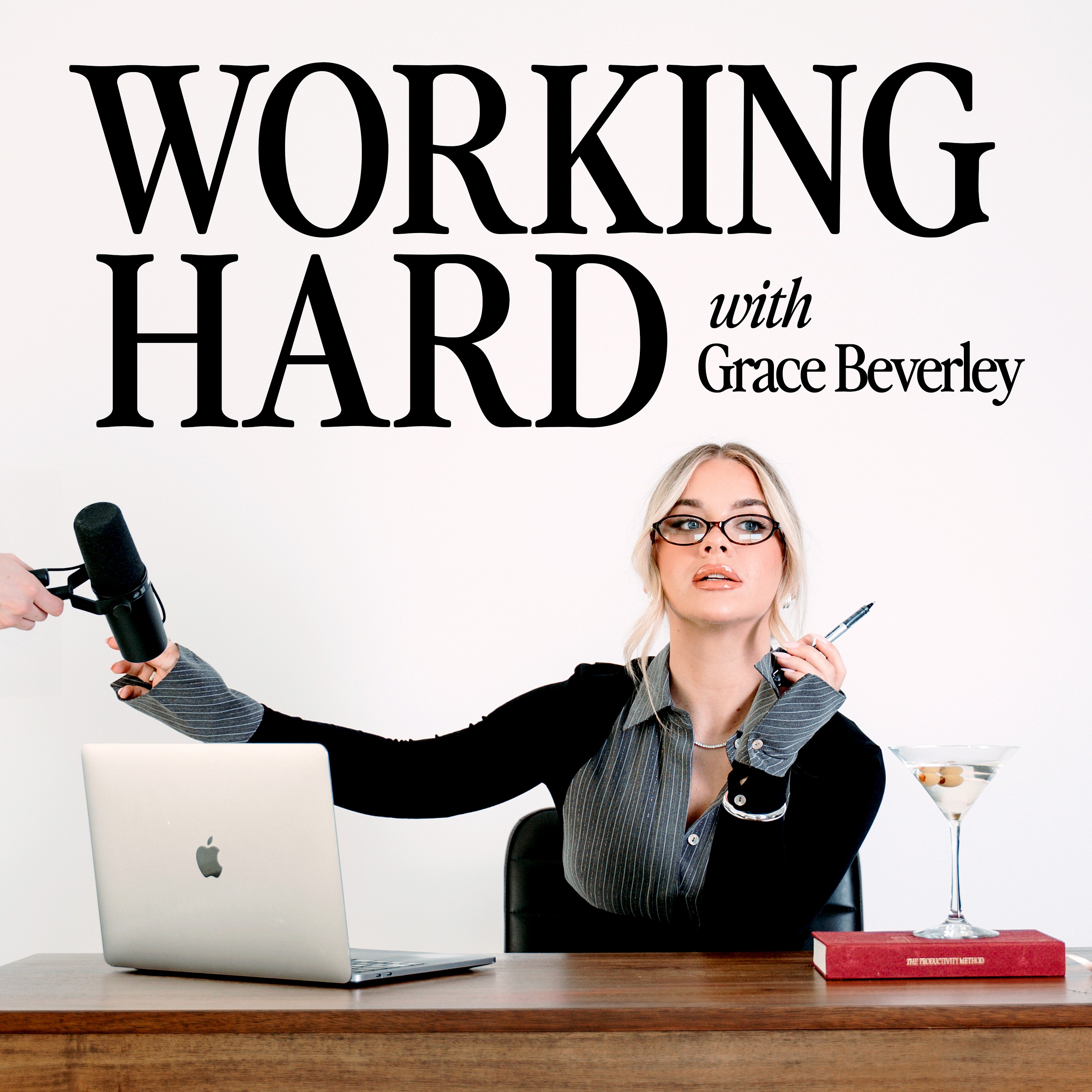
 Working Hard with Grace Beverley
15 Jun 2026 · 19m · 10 chapters

Why self-improvement efforts fail to change your life—Grace Beverley argues the issue is often emotional/identity foundations (schemas, self-worth, urgency) rather than broken systems or habits.
Psychologist John Amici is interviewed (tension between effort and transformation; why ambitious people feel unchanged). No other guests appear in the transcript.
People optimize external logistics (routines, calendars) but use them to fix emotional patterns like “I’m not enough.” Discipline can amplify the identity driving it: self-trust vs fear/external validation. Predictive processing may recreate familiar stress/urgency even when things improve. Success can feel hollow if the identity baseline doesn’t shift.
Repeating sabotage patterns; emotional intensity disproportionate to events (missing a workout triggers “I’m useless”); constant “next optimization”; achieving goals but feeling the bar moves. Beverley’s own decades-long cycle of burnout despite “good” systems, resolved via therapy focused on underlying self-doubt.
Written by AI. May contain mistakes.
Grace reads a listener's message about struggles with self-improvement.
“I'm coming to you a little desperate and a bit out of love with the self-improvement space.”
Discussion on the difference between optimizing systems and addressing emotional patterns.
“about why your life might not have changed in the way that you thought it would even though you've genuinely been trying really hard.”
Exploration of schemas and how they affect self-perception and productivity.
“But the problem I feel often is that most of us are trying to use logistical upgrades to solve emotional patterns.”
How underlying identity affects the perception of achievements and self-worth.
“It was a version of self-harm almost that was trying to prove to myself that I wasn't a bad person or that I was a high achiever or any of these things and that doesn't get you to where you want your life to get to.”
Discussion on intrinsic versus extrinsic motivation and its impact on well-being.
“to yourself because that is not the way you can prove it to yourself.”
Importance of aligning systems with emotional and identity-based goals.
“This is often why people hit the metrics they set for themselves and still feel strangely dissatisfied.”
Signs to help identify if issues are tactical or stem from deeper emotional layers.
“Are you trying to feel calm, capable, creative, secure, autonomous, connected?”
Discussion on recognizing patterns in behavior and feeling unsatisfied after achievements.
“the meaning of why you're actually getting there.”
Learn about the behavioral and emotional layers of self-improvement.
“Like it gets me the places I want to get to.”
Explore how emotional patterns impact self-improvement efforts.
“It was one of my favourite episodes we have ever recorded.”

Get the gist, explore an idea or ask about something said.
 Claude
On Working Hard with Grace Beverley, what are the key points of this episode?
Searching your listeningAutomatic transcript. May contain errors.
0:00John Amaechi: Hey, Pablo Torre here. As a sports journalist, I've covered global sports for many years now. And there is one thing that I can promise you. Nothing compares to the World Cup. And this time it is even better thanks to McDonald's. You have the chance to take home one of nine legendary cups when you order the FIFA World Cup meal. The cups feature some of the biggest legends in football like David Beckham, Terry Henry and Ronaldinho, Christian Pulisic, Laminya Mall and Alfonso Davies. Right now, get one of nine legendary cups when you order the FIFA World Cup meal only at McDonald's. At participating McDonald's, only for a limited time, while supplies last.
0:36John Amaechi: All rights reserved. Copyright 2026. McDonald's at the FIFA World Cup 2026. Who knew Walmart Business could help a thriving office motivate their employees? Pamela knew. She uses Walmart Business to get the assortment of items her team needs at the prices she loves. As the office manager, it's my job to make sure my team stays on top of their game. I can get the basics like cleaning supplies and paper towels, but what they really care about, snacks. And she can get everything they need when they need it. Greg loves wheat crackers, Brenda Crave sour candy, and Max, oh boy. He needs protein bars and milk and applesauce and jerky.
1:10John Amaechi: It's Walmart, built for your business. Who knew?
1:27Grace Beverley: What is up? I'm Grace Beverley and welcome back to Working Hard, the podcast shared guidebook on how to improve your own life and achieve what you actually dreamed of doing, because life's too short for boring podcasts and bad advice. What is up and welcome back to Working Hard. I wanted to start today's episode a little differently by reading you a message I got last week that I actually haven't stopped thinking about ever since. I'm going to read it to you quickly. Hey Grace, I hope you're doing well. I'm coming to you a little desperate and a bit out of love with the self-improvement space.
1:53Grace Beverley: I feel like my whole feed is full of 10 steps to change your life and lists I need to follow. But every time I try any of these, I give up or it doesn't change my life in the way the person promised. I know you always say it how it is. So I wanted to ask for some advice. I love the podcast, by the way, but I thought you'd have thoughts. So I really resonated with this and I feel like it's how a lot of people are feeling at the moment because I love personal growth. I am very aware that throughout my career, I've talked a lot about systems and habits and discipline and I fully stand by everything I say in terms of that.
2:21Grace Beverley: But I also know firsthand how frustrating it is when you follow all the steps and things aren't really changing to the level that you hoped it would. And I think this is a conversation I have with people time and time again, like especially people who are really into self-improvement. Some people are able to jump on it and lots of things change at once. Other people find it a lot harder or other people it's just not reflected in wider areas of their life. But because I think these however many step approaches can be incomplete on their own when we're not talking about some other things, they require some nuance.
2:51Grace Beverley: And I really want to talk about why your life might not have changed in the way that you thought it would even though you've genuinely been trying really hard.
3:02Grace Beverley: So one of the most interesting patterns I see both in myself and in the wider self-improvement space is that we are incredibly good at optimising the external layer of our lives. So we love reorganising our calendars, we love refining our workflows, clothes, we love adjusting our morning routines or tracking our habits or upgrading our systems and again none of that is wrong. If it was wrong I would be very sad and I would not have a lot of things to do with my life. Behavioral science consistently does show that environment design and systemization are some of the most reliable ways to create sustainable behavioral change.
3:37Grace Beverley: So that means that research from people like BJ Fogg and James Clear has demonstrated that small structured adjustments to your environment can absolutely meaningfully increase the likelihood of a habit sticking. The problem is not the systems. Like the systems for the most part are good. I have great systems. Lots of people have great systems for many things and not such good systems for other things. But the problem I feel often is that most of us are trying to use logistical upgrades to solve emotional patterns. And those are two completely different layers of the human experience. So you can do everything in your power to optimize your life and still carry a core belief, for example, that you are behind, that you are inadequate or that you are one mistake away from failure.
4:16Grace Beverley: When that happens, the system is not broken, but it is sitting on top of an identity that's not shifted. If your baseline is a massive lack of self-confidence and a massive lack of self-worth, then you are building an amazing house on really shitty foundations. So no wonder it keeps falling down. Psychologists talk about this in terms of schemas, which are deeply embedded beliefs about ourselves and the world that shape how we interpret experiences. So essentially, if your schema is I am not enough then your productivity routine can easily become a way of constantly trying to prove that belief wrong and I know so many people that this is the case for it has been the case for me for a lot of different years of my life like until I really worked on my self-confidence and my self-worth every bit of hard work I was putting into my life and every single time I was working crazy hours and doing the gym and doing all of these things on top of everything.
5:09Grace Beverley: It was a version of self-harm almost that was trying to prove to myself that I wasn't a bad person or that I was a high achiever or any of these things and that doesn't get you to where you want your life to get to. You can absolutely build self-trust and that is important but you can't outwork poor self-esteem. You can't outwork the thought that you are not enough. The issue really is that if your underlying identity does not change the goalposts will simply keep moving because the part of you that feels not enough will always find new evidence to confirm that narrative. This is something I have seen happen time and time again and I have first-hand experience of this.
5:48Grace Beverley: Like, if you are the type of person, as I said, who feels like you're not enough, who has poor self-esteem, who doesn't have very high self-worth and you are constantly trying to outwork that, you are constantly trying to do the most hours and also be the best friend and also do all of these different things, each time you achieve something, because you're not changing those foundations, you're just going to move those goalposts because you still haven't proved it to yourself because that is not the way you can prove it to yourself. Another layer of nuance that I think we need to bring into this conversation is that discipline is incredibly powerful but it amplifies the identity that is driving it.
6:22Grace Beverley: So there's strong research in self-determination theory developed by psychologists Edward Desi and Richard Ryan which shows that motivation rooted in intrinsic values, meaning actions align with your own sense of identity and purpose, leads to greater well-being and persistence than motivation that's like rooted in external validation or fear. And so to explain that in more simple terms, if your discipline is driven by self-trust, then the same early mornings and hard work can feel expansive and energizing. But if your discipline is driven by the need to prove your worth or to outrun insecurity, then even the most significant achievements that you've had down on your vision board for years and years can feel unstable.
7:02Grace Beverley: They can feel fragile because the emotional foundation has not changed. This is often why people hit the metrics they set for themselves and still feel strangely dissatisfied. Like you can get the promotion and still feel like you're waiting for something to click, still feel like you're behind in life because the nervous system pattern that equates worth with urgency has not been addressed. And I really went down a rabbit hole on this because I, as I've said, I've had such firsthand experience with and has gradually changed over time, but still do not think is 100 % of the way there. Like, I know I work hard a lot of the time to prove to myself certain things and to prove to others to think certain things about me.
7:40Grace Beverley: But there's a fascinating neuroscience around predictive processing, which basically suggests that the brain is constantly generating predictions based on past experiences and then interpreting new information through that lens. So in simpler terms, your brain prefers familiarity over novelty, even when that familiarity is stress or self-doubt. If your internal baseline is urgency, you may subconsciously recreate urgency even when things are objectively going well because calm feels unfamiliar. It's also why you might feel like you get into some of those same cycles over and over and over, which you will probably know what they are, despite the systems you follow.
8:22Grace Beverley: I want to be really clear here because I don't want this to sound like an anti-systems rant. I have to know that because I'm going to sound like an anti-systems rant for me. Systems are one of the most compassionate things that you can actually build for yourself because they reduce reliance on willpower. They protect you from decision fatigue. They stop you needing to think about how you're structuring your life every single day. However, systems work best when they are in service of a clear emotional and identity-based vision, aka the two things have to match up. You have to want to achieve this because you know you're a great person.
8:55Grace Beverley: you can't want to achieve this because you know you're a shit person and if you get there that will make you a good person and if you don't know what you actually want your life to feel like beyond aesthetic productivity and like surface level achievement then you can end up implementing highly efficient systems that move you somewhere but not necessarily somewhere aligned with where you want to get to or not necessarily anywhere close to where you want to get to in the end what i'd really recommend with this is instead of asking only like what habits should i follow it is very much worth asking, how do I want to feel?
9:27Grace Beverley: Are you trying to feel calm, capable, creative, secure, autonomous, connected? You need to know how you want to feel rather than just what you want to achieve because without that layer, tactics can feel hollow. Like anything you're doing to get to where you want to get to will feel hollow. It will feel completely disconnected from the meaning of why you're actually getting there.
9:50John Amaechi: Hey, Pablo Torre here. As a sports journalist, I've covered global sports for many years now. And there is one thing that I can promise you. Nothing compares to the World Cup. And this time, it is even better thanks to McDonald's. You have the chance to take home one of nine legendary cups when you order the FIFA World Cup meal. The cups feature some of the biggest legends in football, like David Beckham, Thierry Henry, and Ronaldinho, Christian Pulisic, Lamine Yamal, and Alphonso Davies. Right now, get one of nine legendary cups when you order the FIFA World Cup meal only at McDonald's. At participating McDonald's, only for a limited time, while supplies last.
10:26John Amaechi: All rights reserved. Copyright 2026. McDonald's at the FIFA World Cup 2026. Who knew Walmart business could help a thriving office motivate their employees? Pamela knew. She uses Walmart business to get the assortment of items her team needs at the prices she loves. As the office manager, it's my job to make sure my team stays on top of their game. I can get the basics like cleaning supplies and paper towels. But what they really care about, snacks. And she can get everything they need when they need it. Greg loves wheat crackers, Brenda Crave sour candy, and Max, oh boy. He needs protein bars and milk and applesauce and turkey.
11:00John Amaechi: Built for your business. Who knew?
11:05Grace Beverley: How do you actually know if your issue is tactical, meaning like you just need better structure in your life, or if it's deeper than that? I think from my experience, there are a few signs and there are some things I recognize in myself and in other people. So the first is repetition. If you keep building great routines and sticking to them for a while and seeing progress and then self-sabotaging in almost exactly the same way every time, that is usually a pattern rather than a calendar issue. It's not because you couldn't fit it in your schedule. It is because this is a recurring pattern. The second sign is emotional intensity that doesn't match the situation.
11:40Grace Beverley: So if missing one workout spirals into I'm useless or one piece of feedback feels like a full identity crisis, that's not about the habit itself. That's about what that habit represents to you. The type of person you think you become when you start doing that. If you want to be the type of person who works out and you miss one workout and you don't have good self-esteem, to you, missing that workout is essentially saying I am not a good person. I don't work hard and I can't stick to anything. rather than just I'm not the type of person who worked out today. And psychologists talk about this in terms of cognitive distortions and core beliefs.
12:16Grace Beverley: So if your core belief is I'm not enough or I have to earn my worth, then any small wobble feels completely existential because it is confirming an older story. Like it's threatening your entire worth as a person rather than just reflecting what your bandwidth was at that particular time. The third sign is that you are constantly chasing the next optimization. Like a new routine, a new way of organization all the time, a new morning ritual. Like there is always a sense that the next week will finally fix everything rather than just committing to what you're doing already. And this like restless search can sometimes be a way of avoiding sitting with the uncomfortable emotional layer underneath.
12:55Grace Beverley: I think we all know this type of person or we are this type of person in terms of productivity and all the different systems you can have and changing them every different week or same with diets or same with workout plans. Like it's actually the restlessness that you're drawn to. So then the fourth sign, which I think is actually the most subtle, so hardest to identify, is that even when you achieve the thing, so whatever you put your mind to, whatever you'd written down on your vision board, it doesn't land. Like you hit the goal or you get the promotion or you build the body or you reach the milestone and within days that bar has been moved.
13:27Grace Beverley: That is super common and it can be helpful. You don't just reach one thing and then no get anywhere else again, but it can often be a sign that your nervous system is more familiar with striving than arriving. And I want to caveat this by saying that none of this means something is deeply wrong with you. Like, hear it from me. I have very much experienced them all. It just means that change is layered. And I would also like to say that being the type of person who strives rather than arrives is good. Like, it's good for your progression. I always say, like, I've always said in therapy, for example, I've been consistently rewarded by my bad habits around achievement because it rewards me.
14:03Grace Beverley: Like it gets me the places I want to get to. So why am I suddenly going to stop doing those things even if the underlying layer isn't what it should be? So as I've said, like there's the behavioural layer, which is habits and systems and structure. And then there is the emotional layer, which is a lot harder to change. If you've only ever worked on that first layer, you've watched loads of self-improvement videos, but you don't get to where you want to get to and you are exhausted from that kind of self-improvement world that solely exists on that level, it might be time to gently look at that second layer and look at what you need to do around that.
14:35Grace Beverley: You know, I always want to bring in someone who can go to a deeper level on these episodes. So I spoke to psychologist John Amici about this exact tension between effort and transformation. And I asked him why so many ambitious people do all the right things on paper and still feel like their life hasn't fundamentally shifted.
14:53John Amaechi: So one of the reasons that people who are ambitious always feel like their life hasn't fundamentally change is because ambitious people always reframe the bar for themselves. They reach a level of competence or a level of success, and immediately it starts to feel dissatisfying because the bar has already been reset. They've already looked around and thought, oh, if I did one more thing, I could be one more thing better. And that means that success, instead of feeling rewarding, feels like a relentless journey. And then you start asking yourself questions like, why don't I enjoy all the success I'm having?
15:28John Amaechi: It must be I'm somehow fundamentally broken. So I think there's a part of this where very ambitious people, they do do many of the right things. But one of the things they don't do is to really sit and enjoy their moments of success and then evaluate how they must have changed at least their behaviors, if not their mindsets, in order to achieve what they've already achieved. If they did that for a moment, people I think would find that, yeah, my life has shifted in some ways that are really important. But as most people who are successful know, sometimes the way that your life changes is deeply mundane, quite ordinary on reflection.
16:03John Amaechi: But it's the fact that you do it consistently that makes you successful. If you've created for yourself some rigorous and rigid habits that you think will help you to achieve success, you're probably mostly right. We know that having some kind of routine is often really helpful. But here's some of the things that people miss. You cannot change your chronotype just because you see finance bros out there thinking that getting up at four in the morning and immediately doing a thousand push-ups after plunging their face into ice water is a routine. That's not your routine. That works for them, but you need to consider who am I in building my routine.
16:39John Amaechi: I am a person who is not great at willpower, but I am great at obedience. So instead of trying to make everything an exercise in willpower, I make everything an exercise in obedience. My diary is this color-coded masterpiece. My screens blank and blink at me and tell me, nope, stop doing this, move on to the next thing. And that's how I maintain my routine. My alarms go off in the morning. And instead of ignoring them, I do as I'm told and wake up, get up, brush teeth, and get on with my day. Build a routine that will fundamentally work for you. There'll always be some stretch, some moments of demand.
17:14John Amaechi: But if you're building a routine that's built for, I don't know, some bloke who wants to go to the gym and lift weights for six hours, it's not you and it's not going to work. Many people find self-control, willpower difficult, and they think obedience is equally so. But submitting to doing as you've told yourself is less challenging than people might think, as long as you create infrastructure around it. Don't try and remember everything you're supposed to do. Make a list. don't try and fit stuff into your week. Make your diary into Tetris so that everything of importance is stacked in there.
17:49John Amaechi: Don't try and do all the tough stuff at the time that you're least good. I'm a morning person. Tough stuff gets done in the morning. Easier stuff gets done at night, at least when possible. For those of you who find it difficult to keep promises to yourself, just know this. You are likely the kind of people who find it at least possible to keep difficult promises for others. And you do it because you care about them. They ask you to do something and no matter the inconvenience, you deliver it because you care about them. Surely you matter enough because that is often the difference. Your brain has decided that you aren't worth keeping a promise or some random friend that you met on LinkedIn 10 years ago, some college friend or university friend, they're worth keeping a promise too, but somehow you are not.
18:38John Amaechi: Reorient your thinking. You are worth it. You have ambition. You have drive. You want to achieve something. You are the kind of person who's worthy of your own care.
18:48Grace Beverley: I love John. I would really recommend listening to my full episode with him if you haven't already. It was one of my favourite episodes we have ever recorded. I will link it in the description. So before we finish, I want to come back to that DM because I really did understand it. there is something uniquely frustrating about trying hard, following the steps, doing the habits, listening to the podcast, reading the books and still feeling like your life hasn't fundamentally shifted. I definitely had seasons of that. I've had whole years, probably whole decades of that. Like there was a period where my systems were objectively good.
19:22Grace Beverley: My calendar was organized. My routines were tight. I was productive. I was disciplined. And like on paper, I was doing everything right but I kept cycling into burnout anyway and I kept cycling into just moving those goalposts and not necessarily feeling fulfilled ever anyway and it took me a while to realise that the issue wasn't that the systems didn't work they were very useful they were creating stability but I was trying to use them to solve something emotional and underlying rather than productive that wasn't the issue it wasn't a systems-based issue I was really trying to solve self-doubt and as much as building self-trust is important, one does not equal the other in that way.
19:57Grace Beverley: And therapy was really helpful for me to that point, not because it gave me better habits necessarily, but because it helped me to understand the patterns underneath that were leading to me replicating the same thing over and over again. Like why I constantly felt like I had to prove something, why slowing down made me uncomfortable, why success didn't always feel safe. And once I started working on that layer, the same systems that I'd always used suddenly felt supportive rather than another thing that exhausted me. So if you've been feeling kind of out of love with self-improvement, it might not be that you're incapable of change.
20:30Grace Beverley: It might just be that you're trying to fix an emotional or psychological or self-worth pattern with a logistical upgrade, and both matter, but they are not the same thing. So that's today's slightly more nuanced take on self-improvement and why your life maybe hasn't changed in the way you've wanted to, even if you've been trying really hard. I will link any resources we've mentioned in the newsletter as always and I'm going to link a few other things that I found super helpful with changing my mindset around this too and really helped me to be able to work on that emotional layer. And if you've listened to this episode and you feel like actually there's this one friend that this is very appropriate for them, then send this episode to them in a kind way, in a cute little kiss kiss, think you need this way because that's what we need for good friends.
21:14Grace Beverley: But as always, I will see you next Monday.
21:19John Amaechi: Hey, Pablo Torre here. As a sports journalist, I've covered global sports for many years now. And there is one thing that I can promise you. Nothing compares to the World Cup. And this time it is even better thanks to McDonald's. You have the chance to take home one of nine legendary cups when you order the FIFA World Cup meal. The cups feature some of the biggest legends in football, like David Beckham, Terry Henry, and Ronaldinho, Christian Pulisic, Lamine Yamal, and Alphonso Davies. Right now, get one of nine legendary cups when you order the FIFA World Cup meal only at McDonald's. At participating McDonald's, only for a limited time, while supplies last.
21:55John Amaechi: All rights reserved. Copyright 2026. McDonald's at the FIFA World Cup 2026. Who knew Walmart Business could help a thriving office motivate their employees? Pamela knew. She uses Walmart Business to get the assortment of items her team needs at the prices she loves. As the office manager, it's my job to make sure my team stays on top of their game. I can get the basics like cleaning supplies and paper towels, but what they really care about, snacks. And she can get everything they need when they need it. Greg loves wheat crackers, Brenda Crave sour candy, and Max, oh boy. He needs protein bars and milk and applesauce and jerky.
22:29John Amaechi: Built for your business. Who knew? Big news, Naperville. Planet Fitness has moved to a brand new home. It's time to get strong in our new space on East Ogden Avenue. The same best-in-class strength and cardio equipment you love, now in a spacious new location where you can work out your way on your time. Stronger is right around the corner. Come see the new look for yourself at 1163 East Ogden Avenue and join today for just$1 down. Planet Fitness. We're all strong on this planet.
Now I LOVE personal growth, I’m very aware that I have built my career on talking about systems and habits and discipline. But I also know firsthand how frustrating it is when you follow all the steps and nothing really changes at the level you hoped it would.
So today I want to go past the ten step lists, not because they are useless, but because they are incomplete on their own, and I want to talk about why your life might not have changed even though you have genuinely been trying really hard.
Thank you so much to the brilliant John Amaechi for being my expert for this episode, if you haven't watched our episode from two years ago, it's here: https://youtu.be/Yp5omd2s6Yo?si=eQ1rI7O_hDNAGM9B
You can buy his book and read his substack here: https://linktr.ee/itsnotmagic
+
SIGN UP TO THE WORKING HARD NEWSLETTER: https://graceb.myflodesk.com/k0sfhlac34
+
FOLLOW THE PODCAST
Instagram: https://www.instagram.com/workinghardpod/?hl=en
TikTok: https://www.tiktok.com/@workinghardpodcast
+
DILEMMA SUBMISSION
If you'd like to submit any dilemmas to the podcast to be answered in the bonus episodes, please send them to [email protected] with the subject beginning DILEMMAS or DM us @workinghardpod on instagram!
+
MY LINKS: https://gracebeverley.komi.io/
+
RETROGRADE, SHREDDY, TALA and THE PRODUCTIVITY METHOD are my own businesses, therefore any mention of them - whilst not being a sponsorship - is monetarily endorsed. As usual, sponsorships do not change my opinions nor my honesty, but I will always disclaim to make sure motives are clear 😊
Hosted on Acast. See acast.com/privacy for more information.