 Ask ChatGPT

The “AOL Disc” (AOL CD/floppy) and how America Online’s free-in-the-mail software sample helped introduce millions to the internet, then how AOL later collapsed after the Time Warner merger and the rise of broadband and the open web.
Jan Brandt, AOL marketing executive who masterminded the AOLCD campaign (joined AOL in 1993; ran marketing with a team of five; previously worked in marketing at Xerox/Prodiogy-era tech). Alex Goldman, reporter and host (known from Reply All; later hosts Hyperfixed) who narrates the story.
At one point, AOL discs were so widespread that “half of all CDs” produced worldwide were AOL discs. The disc didn’t play music; it installed software that dialed into AOL. Early mailings produced unusually high response (reported 12%, up to 18% on one list). AOL’s walled-garden strategy succeeded via community/social access but failed because broadband and open websites made AOL’s curated entry less necessary.
AOL discs found in cereal boxes/magazines/Starbucks and even paid placements like Super Bowl seats; Omaha Steaks mailings included AOL discs. A backlash site, nomoreaolcds.com (2002), collected discs to mail back. AOL’s system overload led to “America on Hold.”
Written by AI. May contain mistakes.
Exploring how AOL became a dominant force in the CD market during the 90s.
“In 1998, the recording industry was thriving.”
Introduction to the history of the AOL disc and its impact.
Jan Brandt discusses her early experiences and the challenges at AOL.
“When Jan Brandt joined the company in 1993, AOL was a small fish in a rapidly expanding pond.”
Jan Brandt describes her innovative approach to marketing AOL through disks.
“I could send messages to other people on the server, but because there were only four phone lines, I generally had to check back the next day to see if they'd responded.”
Insights into the remarkable response rates from the AOL disk campaign.
“After that, it became$3.50 for every extra hour.”
Learn about the impressive marketing success of AOL's promotional discs.
“Now, I didn't have a sheet that listed everyone, but by groups and by codes and everything was coded.”
Discover how AOL transformed from a service to a cultural phenomenon.
“More and more, the internet was becoming the first place people went to when something major happened.”
Examine the challenges and decline of AOL following its merger with Time Warner.
“People thought it would usher in a whole new era of media.”
Learn how AOL shaped early internet usage and faced challenges with broadband.
“you couldn't connect to the internet in a sustained, always-on way outside of universities.”
Explore the impact of the dot-com bubble on AOL and its financial woes.
“The arrival of broadband coincided with another event that was equally as harmful to AOL.”
Understand the challenges and failures of the AOL-Time Warner merger.
“Time Warner puts its premium content on AOL.”
Hear Ted Turner’s stark comparison of the merger to historical wars.
“Ted Turner was the largest individual shareholder in the company.”
Discuss AOL's attempts at reinvention and its lasting impact on internet culture.
“AOL was spun off from Time Warner in 2009 and tried to reinvent itself as a media company.”
Examine the implications of modern mergers through the lens of AOL's history.
“AOL thought people wanted a curated menu of content, picked and produced by professionals.”

Get the gist, explore an idea or ask about something said.
 Claude
On 99% Invisible, what are the key points of this episode?
Searching your listeningAutomatic transcript. May contain errors.
0:00Alex Goldman: This fall, L.L. Bean is celebrating the moments people look forward to all year. The first school drop-off, the first sweater weather day, and the first chilly evening around the fire pit. For over 100 years, L.L. Bean has been part of these traditions. Crunching leaves in Maine-made bean boots, cheering from the sidelines in scotch-plaid flannel, and walking the dog in a rugged field coat. So grab the layers and people you love and get outside. Visit llbean.com to shop the fall collection. L.L. Bean. Be an outsider. To the millions of small business owners out there, we appreciate you. We see your early mornings, late nights, and all the hard work in between.
0:43And with the U.S. Bank Business Essentials card, you don't have to go it alone. With unlimited 2 % cash back on every purchase. Because we know your communities count on you to be here, there, everywhere. So yeah, we don't just appreciate you, we support you. The creditor and issuer of this card is US Bank National Association. Pursuing to a license from Visa USA Inc., some restrictions may apply.
1:04Alex Goldman: 99 % Invisible is presented by Acura. Curating and designing the perfect experience takes meticulous craft, an obsession with detail, and a love for innovation. Just like museum designers, Acura carefully considers every detail to curate the most engaging, exhilarating, and rewarding experience for drivers. That craft isn't always something you can see, but it's something you'll feel. That flutter in your heart, the engine roars. Every Acura is designed with deliberate intention around how people actually use the vehicles. And that is precision-crafted performance. In 1998, the recording industry was thriving.
1:48Alex Goldman: This was a year before Napster came out and ruined everything. But in these halcyon days, two years before the millennium, things never looked better. The music industry was putting up record numbers and selling an unprecedented number of CDs. Brandy, Shania Twain, and Savage Garden topped the charts. And thanks to Celine Dion's My Heart Will Go On, the Titanic soundtrack spent 16 weeks at number one and sold 9 million copies in 1998 alone. But the company pressing more compact discs than anyone else in America wasn't a record label. It was an internet company. America Online. And according to its chief marketing officer, at one point, half of all CDs produced on Earth were AOL discs.
2:42Alex Goldman: But the AOL CD didn't play music. It wouldn't even work in your Discman. It was instead a marketing ploy, a free sample. It held a tiny piece of software that turned your computer into a doorway, slided into your drive, and with a shock of static, it would connect you, often for the very first time, to something called the internet. If you weren't alive during AOL's heyday, it is hard to describe how ubiquitous the AOL CD was. This is reporter Alex Goldman. You may recognize him as one of the hosts of Reply All. Now he has his own show called Hyperfixed. You simply never knew where you were going to find one.
3:25Wrapped in plastic, inside a little cardboard sleeve, promising some number of hours of free AOL. Perhaps when you opened a cereal box or a magazine, or in display cases at the bookstore or at Starbucks. In one push, AOL even paid to put them on seats at the Super Bowl. Probably the craziest one I did was Omaha Steaks. This is Jan Brandt, the mastermind behind the AOLCD campaign. And if Omaha Steaks is not a name that's familiar to you, it's a company that will mail you flash-frozen wagyu beef. But for a stretch of the mid-90s, if you got an Omaha Steak in the mail, chances are you also got an AOLCD.
4:05Because those products are sent flash-frozen, We had to flash freeze a disk, thought, and see if it still worked.
4:20The AOL disk was a marketing coup. Hugely successful. And it's not an overstatement to say that it's the campaign that introduced America to the internet. Because of how well it worked, for a while, the internet was AOL. To be on AOL was to be on the internet. They were the same thing. And then it felt like AOL just disappeared. The company that once accounted for half of the CDs on Earth became a punchline, then a footnote, and then just an email address that your parents use.
4:59Alex Goldman: From 99 % Invisible and BBC Studios, this is a history of the United States in 100 Objects. I'm Roman Mars. Today, the AOL Disc. Alex Goldman has the story.
5:17When Jan Brandt joined the company in 1993, AOL was a small fish in a rapidly expanding pond. And Jan herself had only a passing familiarity with the very concept of the Internet. I used it while I was in college. Only once. I was dating someone from MIT, and he took me up to the MIT lab and showed me how he could talk to people all over the world. And in fact, there we played one of the earliest video games in the lab. Then many years later, when I assumed a marketing position at XEP Xerox, Prodigy came out. We weren't advertising, certainly on the Internet at that point. But I decided that I needed to understand what this was.
6:14In the late 80s, the Internet still mostly lived in research universities and government facilities. And for a civilian like Jan, even connecting to the Internet was hard. And I knew this difficulty firsthand because back then I was a little nerd, desperate to figure out how to use my computer like Matthew Broderick did in the 1984 thriller War Games. to hack into a government mainframe, save humanity, change the grade on my science test. But even a precocious nerd like me had a hard time accessing the internet. Since my home computer wasn't constantly connected to the internet, I needed to find a service I could dial into.
6:50And I found that in a local server called ArborNet that I remember having four available phone lines and a couple thousand users. And once I finally connected to the internet, I was greeted with a screen basically from the Matrix. Green text, black background, no images. I could send messages to other people on the server, but because there were only four phone lines, I generally had to check back the next day to see if they'd responded. It was ugly, and it was hard to use, and if my dad got a phone call, I would lose my connection and have to start the process all over again. This iteration of the internet was not poised to become the technology we know today.
7:27And the folks at AOL had a vision of the internet, which was inviting, image-based, clickable, the whole shebang. But in the early 90s, AOL was far behind its two main competitors. One was a company called CompuServe, which was owned by H &R Block and geared more toward businesses. AOL's other main competitor, Prodigy, was obsessed with safety. Swearing was not allowed on the service, and they didn't even have a chat offering until later because of safety concerns. Still, Prodigy had 10 times as many users as AOL in 1993. And AOL had to figure out a way to distinguish itself. I wanted to ask this question for younger folks in our audience, but can you explain what AOL was for those people?
8:09Like, what did AOL offer people at this early era? It absolutely offered them community, a gathering place, a place to connect with friends, with family. We lived in a world back then that didn't have the kind of communication that we have. There was no FaceTime. There was no streaming. There was no video. AOL settled on a mantra inside the company they called the three C's. Communications, community, and clarity. This idea that what they were building wasn't about launching people into the computer age, but about flattening distances between users and their relatives or their curiosity. AOL's goal was to feel more like a place to hang out than any of the other companies could offer.
8:56When you logged into AOL, after you cleared the crunchy whale of your modem, it would offer you a menu of attractive clickable images, in color, that said things like, today's news, and personal finance. If you clicked on today's news, you'd be sent to a curated news digest from Wire Services, hand-picked by AOL. You could then join a chat room, talk about the news, vent, argue, connect. There were forums for various hobbies and interests, games to play, chats to join, emails to send and receive. This was a vision of the internet focused on curation and community, a walled garden of information and other AOL users to connect with.
9:37And to make it feel inviting, they paid an AOL employee's husband$200 to rattle off some phrases into a portable tape recorder. So every time you logged in, it would say, Welcome. And when you signed off, Goodbye. When Jan joined the company, she had a team of five. That was the company's entire marketing department. It was her job to sell AOL to America, which was going to be tough. Because first of all, AOL is expensive. It costs$9.95. Not for a month, but for five hours. After that, it became$3.50 for every extra hour. But she had a bigger problem to solve, which was convincing people that the internet was worth trying at all.
10:18People back then couldn't imagine why they'd want to be on the internet. You know, it was this funny, funky computer thing. I mean, the internet was so young at that point. That's right. I imagine that a lot of people didn't really know what it was you were selling. People thought I was going to work at American Airlines. And I said, no, I'm not a flight attendant. Jan found that once she corrected this misapprehension and tried to tell them what AOL actually was, it didn't really get any easier. That was the problem that I was trying to solve. How do you describe to someone that you're sitting on your computer and you're talking to 10 people?
10:56They say, well, if I want to talk to someone, I'm just going to pick up the phone. Or how do you describe that you can have the encyclopedia at your fingertips to help your kids with homework? And they say, I've got 92 volumes of encyclopedia in my house. I could just go do that or the news or any of those things. There was nothing that they could relate to. And that's why there was the disc. The AOL disk was Jan's innovation. She thought that if people could actually experience the internet, they would get it. So she wanted to send out free samples, a few hours of AOL on a disk, free of charge.
11:34All she had to do was ask her boss, CEO Steve Case, for the money to do it. I walked into Steve's office and said, I want to do a large test. I want to send the discs out free in the mail and I need$250 ,000. Very, very expensive package. We're a$38 million company. Wow. Okay. So$250 ,000 for a$38 million company is a huge investment. That's a big, big, big amount of money. He teased me and said, oh, well, go ahead. I don't think it's going to work.
12:17Now that she had Steve's approval, all she had to do was figure out who to send the disks to. And the first group she looked for were the people who were already using the computer. Back then, we didn't have a workforce that was so equitably spread across, you know, men and women and different ethnic groups and so forth. In the upper suites of business, we were still very white male oriented. and these were people who had access and had familiarity with computers in the workplace. So I went to the computer magazines, the PC worlds and the Mac worlds, and Scientific American, Popular Science, Car and Driver, places where I thought that I would find pockets of men.
13:07Jan paid these magazines for their subscriber lists and began to send these pockets of men packets of disks. The disks themselves in this first batch were 3.5-inch floppy disks, shrink-wrapped to cardboard with colorful text reading, It's easy! It's fun! It's free! The computer was such a fresh object at this point that the instructions for installation were written right across the disk's label. Insert this disk into your floppy disk drive, then double-click on the install icon and copy the software to your hard drive. and then Jan waited to see who would sign in. I didn't do anything that wasn't tracked.
13:46Everyone thinks that it's the ubiquity strategy. I just threw them all over the place. I could tell you the cost of each subscriber and my projected lifetime value for every disc that went out. Now, I didn't have a sheet that listed everyone, but by groups and by codes and everything was coded. Oh, so when people signed up, you would know where they came from. Right. So you do this first trial, this$250 ,000 trial. How does it go? Most people would say in direct marketing back then, you might get an average of 1 % to 2.5 % response to a mailing. This one produced a staggering 12%. That's 12 % of the people took the disc, put it into the computer, put in their credit card.
14:37I had one list that was 18 % response. Nearly one out of every five people who received that disc from that list signed up as a member. It was staggering. The cost of the mailing was staggering, but the response was breathtaking. The results of these early tests were unbelievable. As long as she could get discs in people's hands, they were five times more likely to pay for AOL as they were your average direct mailing. AOL later switched from floppy discs to CDs. And make no mistake, these discs and the hours were expensive for the company. But Jan told her bosses, don't look at the cost, look at the return.
15:24CEO Steve Case later said that the average cost to secure a new customer with an AOL CD was a whopping$35, but they would end up spending 10 times as much in monthly fees once they became a customer. A huge return on investment. So Jan was off to the races, moving from advertising to hardcore computer users to more casual users, the eventual goal of reaching people who may not even have a computer at all. I always described it as consider marketing to be like concentric circles. In the very middle, you're going to find that person that if they didn't have the internet at their disposal, they would have invented it because they are so the target audience.
16:06You go out of circle, these are people who are less interested, but curious and willing to try. You go out of circle and it's now moving into more mainstream. And that's what we were becoming. And you keep going. I kept pushing the circles out. When Jan joined the company in 1993, AOL had 200 ,000 members. By the summer of the following year, they had reached one million. And they were sending out so many disks, they couldn't get them in the mailers fast enough. I had to actually work with a vendor to develop a machine that would automatically insert the disk into the mailer. But I sat there, bored to tears, when they brought me in a diagram of what this machine would do.
17:01And then the disc is going to flip over here, and this is going to grab it. And I'm like, oh yeah, that makes complete sense. That's wonderful. That's terrific. I had no idea what they were talking about. It wasn't long before Jan started striking deals with magazines where instead of getting their subscriber list, they would just package AOL discs with the magazine itself, gluing it to the front page like a perfume sample. And even then, Jan was thinking way bigger. She saw opportunities everywhere. I had a routine on Friday nights after a crushingly long week. I wanted to see no one. I wanted to talk to no one.
17:41I wanted to unwind. And my routine would be I'd leave the office. And my first stop would be the grocery store for the weekend. The second stop would be Blockbuster. And I would get like eight movies because I didn't know what I wanted to watch. I didn't know what mood I'd be in. So I get a little bit of everything. One day I was in there and they had a gift box. If you rented four movies, you get like a sample box. They had like a little popcorn TV guide, maybe, and that was yours free if you rented four movies. I had eight movies. I looked at them and I said, I'm taking two boxes. I took one home.
18:26And that Monday, I walked to a staff member of mine and said, get us in this box. Now, why did I do that? I looked around Blockbuster, and there were all of these families with kids and a lot of the initial take up on AOL was coming, not just from men, but a little bit later on by families. I was on a flight from Dulles to New York City and I looked around me and it was all business people. And I walk into the office whenever I it back and say, OK, I want us to have a disc served with coffee and the cookie they give you on commuter business flights. I hired someone and I said, your job is to find unusual places to put these discs.
19:19I couldn't find a place where it didn't work. Suddenly, these discs were everywhere. And I mean everywhere. According to Jan, AOL was, at the time, the largest mailer in the United States. You were sending more mail than anyone else in the U.S.? Correct. I read that there were like that half of all CDs being made at one point were AOL CDs. That's correct. I also read that if you stacked them... To the moon. ...on top of one another, they would get all the way to the moon, right. That was from one of the talks they gave, yeah. For new users, they were a gateway. But for existing users, they were a nuisance that came included in just about everything they bought and still randomly showed up in the mail every so often.
20:03It got to the point where in 2002, two guys in California started a website called nomoreaolcds.com with the stated goal of gathering one million of these discs to mail back to the company. Even inside AOL, there were people who were uncomfortable with the volume of discs. But Jan wouldn't budge on their efficacy. I had several senior management conversations on it, and it's like, okay, I can cut back on the discs. How much of a reduction in subscriber growth do you want? You know, if you want growth, I need to do it the way I know how to do it and the way that's working. The AOL disk promotion worked so fantastically well that at some points it was too successful.
20:52There were times when there were so many new users trying to dial into AOL that they would get busy signals for hours. Critics started calling the service America on Hold, and Jan's bosses were like, we need to cool it on the disks for a little while. We overloaded the system. It was a time when I halted not all, but I halted almost all of the marketing. But they only paused the campaign for a little while. Jan was succeeding not only in selling AOL as a product, but selling the internet as a concept. More and more, the internet was becoming the first place people went to when something major happened.
21:31When Princess Diana died, people not only turned on their TVs, but they went online to AOL and were grieving. The message boards blew up with people gathering. It became a place where people went to share that experience with people they didn't know of how sad they felt or a memory of her or seeing her someplace. AOL's vision of the internet as a community, a curated place to connect, it had won out. By the year 2000, the company had left its competitors in the dust. AOL had 25 million subscribers, meaning a huge chunk of users were signing into AOL's walled garden. Half of anyone accessing the internet, according to AOL's CEO.
22:18This was a spectacular, unprecedented level of success, all thanks to the discs Jan sent to anyone and everyone she could find. The company was so big, so ubiquitous, it became shorthand for the internet itself. I mean, hell, a movie came out in 1998, named after a phrase often uttered by the program. You've got mail. Even I had forgotten how powerful AOL was during this time, which became very obvious during this interaction that I had with Jan. Okay, so the company expanded massively. You were bought by Time Warner for billions upon billions of dollars. No, no, no, no. We bought Time Warner.
22:54Oh, you bought Time Warner. Sorry. Thank you. And we humbly called it a merger of equals. This company, which just a few years ago had been struggling to survive in a marketplace that didn't really understand what it was selling, bought one of the largest media companies in the world just seven years later. AOL was unstoppable. It was impossible to imagine the internet without it. But I'm talking to you from 2026, where AOL and its ubiquitous disks are being eulogized by some nerdy podcaster. So what happened?
23:45Alex Goldman: whatever device you're listening to this on. Design is imagination with a plan. Claude is an AI built to help you with both. Start with your rough idea, then work with Claude to sketch it, shape it, test it, and build it. Anthropic built Claude to help you discover more. Learn more at claude.ai slash 99invisible. Sonos is a sound system engineered to make you feel. Sound is part of the design of a home, right alongside the furniture, and the lighting and the art, Sonos can give ordinary rituals a little more personality. Making coffee can feel like opening credits. Dinner prep can feel like a cooking show.
24:25Alex Goldman: Or for me, I like to make it sound like a mosh pit. And tidying up can at least have a better soundtrack. Because Sonos works as a system, the mood can move with you from the kitchen to the living room to wherever the day happens next. It's not about making every moment louder. It's about making more moments feel like yours. Whatever you want to feel, Sonos can help set the scene. Every night, I play the ambient sleep music channel on the Sonos in my bedroom, and it helps me relax, it helps me sleep better. The Sonos is on almost 24 hours a day when I'm not recording. Love the sound, feel the system.
24:58Alex Goldman: Visit Sonos.com to build your system.
25:06Alex Goldman: Ready to give your home a style refresh?
25:31Alex Goldman: I'm trying to think of any of the article furniture I haven't talked about at this point. I have couches. I have dining room sets. I have sideboards. I have, what do you call it, a media center thing that you put a TV on, side tables, end tables, chairs. All of them are still in heavy use in my house and all of them have held up great. Article is offering our listeners $50 off your first purchase of$100 or more. To claim, visit article.com slash nine nine and the discount will be automatically applied at checkout. That's article.com slash nine nine for$50 off for your first purchase of$100 or more.
26:08Alex Goldman: Ever invest in something that seemed incredible at first but didn't live up to the hype? Marketers know that feeling. They optimize for the numbers that look great, like impressions, but then they don't see revenue. LinkedIn has a word for that, bull spend. Instead, you can get the highest ROAS of major ad networks with LinkedIn ads. Cut the bull spend. Advertise on LinkedIn. Spend$250 and get a$250 credit. Go to linkedin.com slash invisible. Terms apply.
27:03Merging with the nation's largest media and entertainment company. Creating a giant worth$350 billion. People thought it would usher in a whole new era of media. The biggest internet company merging with the biggest media company. This was the future. This merger will launch the next internet revolution. But almost immediately, there were issues. And within a decade, Time Warner would sell off AOL at a 98 % discount. It went so badly that the merger got another superlative. The worst deal in history.
27:43Both companies had tanked, but particularly AOL. The company that, as Jan pointed out, bought Time Warner in the first place. So what happened? The trouble had started before the merger was even announced, because by 2000, the internet was changing. and what AOL had banked its business on was about to become obsolete. This might be hard to remember, but when AOL was in its prime, you couldn't connect to the internet in a sustained, always-on way outside of universities. You had to dial in to something else before you could explore the internet. And AOL had made a mint being the thing that you connected to.
28:22And since they were pretty much the only game in town, their service was a walled garden. You could chat, but in their chat rooms. You could use forums, play games, and read articles, but it was all hosted by AOL. But the internet was changing. Starting in the early 2000s, companies were offering this new product called broadband that let your computer connect to the internet in a sustained way at all times through your cable box, with speeds orders of magnitude faster than dial-up. And that meant that users no longer needed AOL to dial into. The company wanted to strike a deal with cable companies to become a broadband provider too, but the cable companies were skeptical.
29:01They looked at AOL, this company that had spent the better part of a decade and running around them entirely, and thought, why should we help you guys? They felt burned by AOL. Plus, a lot was happening outside of AOL's walled garden. Free services let people build their own websites, and with just enough HTML, people were making homepages about their dogs, their bands, their favorite TV shows, with blinking text and guest books. People no longer needed to walk through AOL's doorway to get onto the internet. And they no longer wanted to stay inside its walls. The arrival of broadband coincided with another event that was equally as harmful to AOL.
29:42The burst of the dot-com bubble. Many internet companies at the time weren't actually making much money, but their stock prices were sky high. For example, even though AOL bought Time Warner, Time Warner had five times the revenue of AOL. But when the bubble burst, it caused a cascade of failures in the tech industry that hit AOL hard. You see, aside from subscriptions, AOL's primary revenue stream is advertising. And a huge part of their ad buys came from companies that were propped up by the bubble. The stock dropped like a rock. and all of our compensation was heavily weighted towards options.
30:21Everyone had options in that company. The assistants, the janitorial staff, you know, everyone that was an employee had stock. That was a big thing. Jan described emotional days in the office. Everyone watching the stocks tank in real time and with it, their retirement savings, their futures. I think it also aggravated the relationship between Time Warner and AOL because their pensions or their retirement stuff became more tied to AOL stock.
31:00And this brings us to the last problem, a problem that was ironically supposed to be AOL's greatest triumph. The purchase of Time Warner. At the time, Time Warner owned HBO, CNN, DC Comics, and much more, and it seemed like a great idea to merge one of the biggest old media companies in the world with the biggest new media company in the world. Time Warner had already spent millions on an ill-conceived online presence that went nowhere, and AOL was trying to remain a walled garden on an internet that was rapidly opening up. So it felt like a perfect union. Time Warner puts its premium content on AOL.
31:33AOL gets more sign-ups in the form of people looking for exclusive Time Warner content. The problem is that no one from either camp really had any vision for how this would work. It was a little bit like oil and water to begin with. And, you know, it didn't, it was not a happy time. Was it immediately apparent that like the relationship between AOL and Time Warner would be a rocky one? Or did it sort of creep? Was it a kind of death by a thousand cuts kind of situation? It was probably death by ten cuts. So not quite a thousand.
32:11I think there were a lot of people on the time, Warner's side, who didn't like this upstart coming in. But I think that there was hostility, and I think it was also different personality types. Just think, you know, you're this big company, New York City-based, suit and tie, etc., expensive artwork all over the place. and, you know, we come in in jeans and sneakers, you know? Right.
32:43In the end, these two companies had no vision for how to integrate and just didn't really understand one another. On top of the fact that it came out later that AOL had fudged some of its ad revenue numbers to make the merger more profitable and eight executives ended up having to pay millions in fines to the SEC, which was nothing compared to the actual losses the company accrued. In 2003, AOL posted a nearly$99 billion loss, at the time the largest corporate loss in history. CEO Steve Case, the man who hired Jan Brandt, resigned. In 2005, Jan herself resigned her position, and the following year, the company unceremoniously ended the diss campaign.
33:29People have called this the worst deal in history, but others have gone further. Ted Turner was the largest individual shareholder in the company. He personally lost about$8 billion. And he told the New York Times, quote, The Time Warner-AOL merger should pass into history like the Vietnam War and the Iraq and Afghanistan wars. It's one of the biggest disasters that have occurred to our country.
33:55AOL was spun off from Time Warner in 2009 and tried to reinvent itself as a media company. It bought the Huffington Post, TechCrunch, a stack of other websites. And if you think about it, it's kind of the old strategy all over again. AOL makes content. You come to consume it. But now it was just one company among many. It was bought by Verizon, smashed together with Yahoo, sold to a private equity firm. And just this year, AOL was bought by an Italian tech conglomerate for$1.5 billion, less than 1 % of what Wall Street once said it was worth. I've thought a lot about this epic rise and fall, about how the same company could succeed so spectacularly in bringing Americans to the internet and then fail so spectacularly at keeping them on their service.
34:41I think the reason behind this is that AOL understood only half of what the internet was. The half they got right starts with the disc in the mailbox. It was an invitation, something physical, something analog, something you understood that could connect you with something you didn't. This was Jan's genius. And once you got inside, they understood what you'd really come for, which was each other. People didn't sign into AOL for the news articles so much as to email their cousin, to sit in chat rooms with strangers till 2 a.m., to write an away message that was secretly meant for just one person.
35:16AOL bet that the internet was essentially social, and they were right. You can still feel this in the architecture of the internet today. Reddit is just a large-scale version of forums. Discord is just a private chat room. 30 years later, the thing that keeps us online is the thing that AOL first sold us, the ability to find each other. It's the other half they got wrong. AOL thought people wanted a curated menu of content, picked and produced by professionals. But the internet is most alluring and addictive when it's open and chaotic and a little out of control. That's why the companies that ended up running the internet mostly provided the infrastructure.
35:54They built the stages, and we filled them.
36:03As I was writing this story, another massive corporate merger is Front Page News. And again, in this case, one half of the merger is Warner Brothers. this time being consumed by Paramount Skydance, an$81 billion merger that's owned in part by the Ellisons, an American business dynasty, and the sovereign wealth funds of Saudi Arabia, Qatar, and Abu Dhabi. What we do know are deal dollar amounts, ownership stakes, and the seeming ideological shift at CBS under the Ellison stewardship. We know that this merger could result in an estimated 4 ,500 layoffs, and that thousands of actors, filmmakers, and industry professionals have signed an open letter opposing the merger as anti-competitive.
36:43What we don't know is who this benefits, what it's all for.
36:52But if the AOL-Time Warner merger taught us anything, it's that the size of the deal is no evidence that it actually makes any sense.
37:09Alex Goldman: The great Alex Goldman was the co-host of the award-winning Reply All podcast. He now hosts a new show called Hyperfixed, where he solves problems that listeners write to him about. You can find it online where you get your podcasts or at hyperfixpod.com. They're also on social media everywhere at Hyperfixed Pod.
37:37Alex Goldman: A History of the United States and 100 Objects is a production of 99 % Invisible and BBC Studios. It's hosted and curated by me, Roman Mars. This episode was produced by Alex Goldman. Our series producers are Priscilla Alabi, Brenna Daldorf, and Ellie Lightfoot. Our associate producer is Isaac Fisher. This series was edited by Annie Brown and Courtney Harrell. Mixing by Charlie Brandon King. Fact-checking by Amy Bracken. Our theme song is by Swan Real. From 99 % Invisible, our executive producer is Kathy Tu. From BBC Studios, our executive producers are Annie Brown and Courtney Harrell. Our production coordinator is Shan Pillay.
38:19Alex Goldman: And the production manager is Mabel Finnegan-Wright. Artwork by Stephan Lawrence. 99 % Invisible is part of the SiriusXM podcast family Headquartered in beautiful Uptown Oakland, California And BBC Studios is headquartered in beautiful White City West London If you want to get in touch or have an object for us to consider Email us at 100objects At 99pi.org
39:21We'll see you next time. Angie, the one you trust to find the ones you trust. Find a pro for your project at Angie.com. Talk about regrets. We all know someone who's been in a car accident and said, I don't need to call a lawyer, only to regret it after their pain and damages were worse than expected. When someone hurts you, you deserve to be compensated fairly. Morgan & Morgan is America's largest injury law firm, fighting for the people for over 35 years. Injured? Visit ForThePeople.com slash podcast. That's ForThePeople.com slash podcast. Their fee is free unless they win. When an intruder approaches a home, they expect a camera.
39:58What they don't expect... Stop. This is SimpliSafe. Police are on the way. Using smart AI cameras, live U.S.-based agents help deter intruders in under 30 seconds. Don't just record a break-in. Stop it from ever happening. Plan starting around$1 a day. Right now, get 60 % off your new system with professional monitoring at simplisafe.com. 30 seconds response time requires monitoring plan with outdoor protection starting at$49.99 a month. Visit SimpliSafe.com slash licenses for alarm license information.
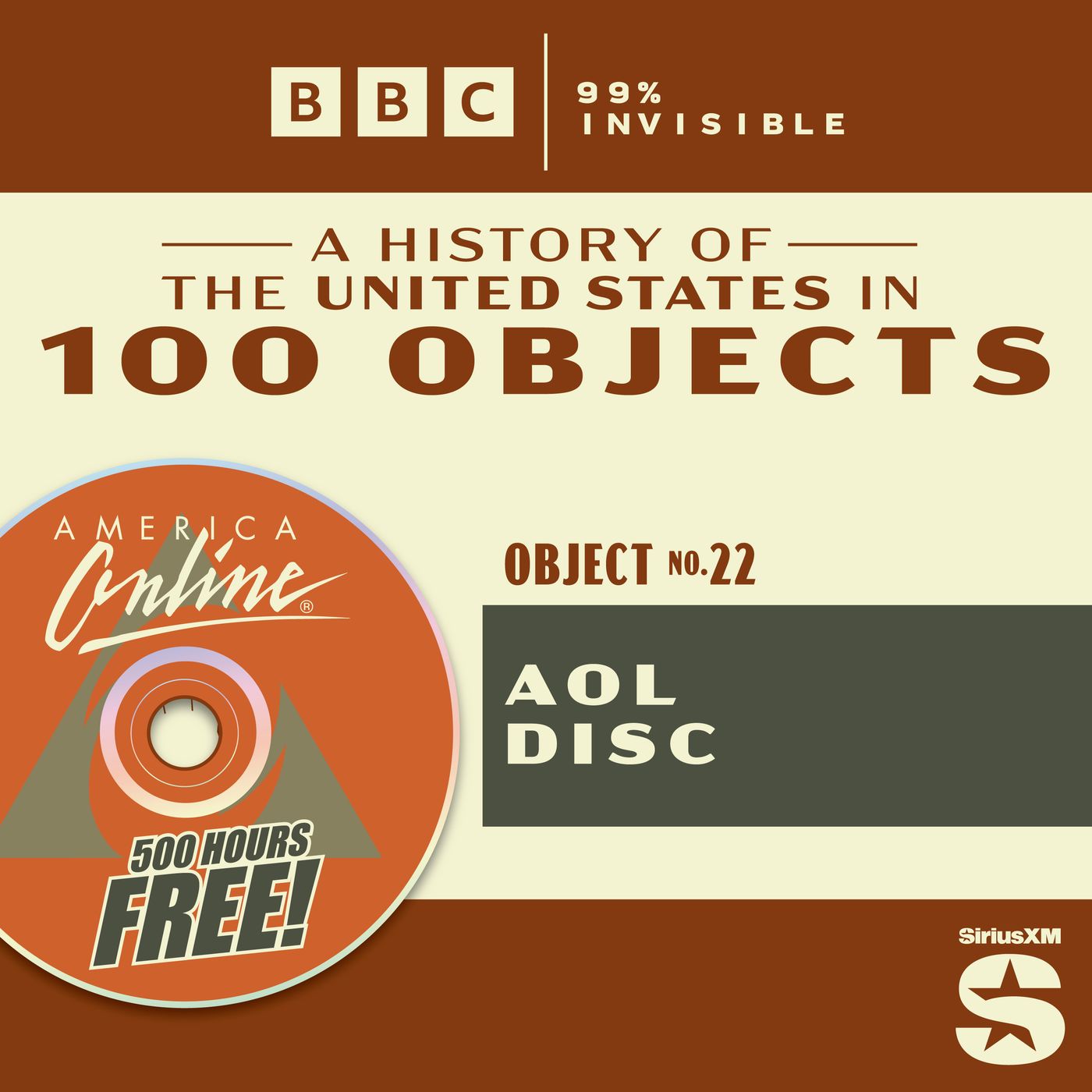
In 1998, the recording industry was thriving. But the company pressing more compact discs than anyone else in America wasn't a record label…it was an internet company: America Online. The AOL Disc was a marketing coup—hugely successful. It’s not an overstatement to say that it’s the campaign that introduced America to the internet. Because of how well it worked, for a while the internet was AOL. And then… it felt like AOL just disappeared. So what happened? Alex Goldman (Reply All, Hyperfixed) finds out.
A History of the United States in 100 Objects is a production of 99% Invisible and BBC Studios.
Subscribe to SiriusXM Podcasts+ to listen to new episodes of 99% Invisible ad-free and a whole week early.
Start a free trial now on Apple Podcasts or by visiting siriusxm.com/podcastsplus.
Hosted by Simplecast, an AdsWizz company. See pcm.adswizz.com for information about our collection and use of personal data for advertising.