 Ask ChatGPT


The “White House Solar Panels” (1979) and why Americans largely shrugged at Jimmy Carter’s solar-energy promise, turning the panels into a “road not taken” museum relic.
Bill McKibben, journalist turned environmental activist; founder of 350.org; wrote about climate change for years, later helped organize global climate protests.
Carter’s rooftop solar plan was driven by energy-security after 1973/1979 oil shocks, but the panels (solar hot-water, not photovoltaic) were politically and culturally sidelined. Reagan cut solar research funding, and the panels disappeared within about 20 years. Fossil-fuel power helped delay climate action; later, renewables became cheaper and more widespread, but the U.S. still fluctuates politically.
1973 OPEC embargo and gas lines; Carter’s thermostat conservation advice; Reagan’s “drill, drill, drill”; Jim Hansen’s 1988 testimony; 350.org’s 2009 protests; Unity College finding the panels; students’ 2010 “Put solar on the White House” trip; later White House solar reinstallation under Obama.
Written by AI. May contain mistakes.
Overview of Jimmy Carter's introduction of solar panels at the White House.
“Then this is a job for Indeed-sponsored jobs.”
Discussion on the energy crises in the 1970s and their impact on America.
“Our question in this episode, and it's kind of a big one, is why?”
Examination of Carter's address to the nation about the energy problem.
“OPEC, the Organization of the Petroleum Exporting Countries, a coalition of oil-producing nations, including Iran, Venezuela, and the United Arab Emirates, which, acting together, controlled the global supply of oil.”
Analysis of American public opinion on energy and economic growth during Carter's presidency.
“So in February 1977, our new president addressed the American people in a TV broadcast.”
The political showdown between Carter and Reagan regarding energy policy.
“One, people who wanted to put the environment ahead of economic expansion.”
Learn about the contrasting visions of Carter and Reagan during the election year.
“For those who've abandoned hope, we'll restore hope and we'll welcome them into a great national crusade to make America great again.”
Explore Carter's approach to energy conservation and its implications.
“And when I woke up, somewhat still hungover, I had the sense, though I was 19 at the time, that this was going to be the election that was going to matter enormously for the course of the world in my lifetime.”
Understand how Reagan's presidency shifted energy policy away from solar.
“It turned out America had lots of oil once you started just letting anyone drill anywhere they wanted, and the price came down.”
Discover the story behind Carter's solar panels being removed from the White House.
“It's not like they had a press conference and made an announcement.”
Examine the growing public awareness of climate change since the 1980s.
“And when Quince asks you where you heard about them, let them know that it was 99 % invisible.”
Learn how the fossil fuel industry countered the climate change narrative.
“represents a very strong case, in my opinion, that the greenhouse effect has been detected and it is changing our climate now.”
Follow Bill McKibben's transition from journalist to activist.
“And the fossil fuel industry had so much money and power that they were able to lose the scientific argument but just keep their business model rolling along.”
Learn about the inception of 350.org and its mission to combat climate change.
“So we'd started this thing called 350.org in 2009 or so.”
Discover the story behind the solar panels installed by Jimmy Carter and their journey to potentially return to the White House.
“And I guess they just said, sure, take them.”
Follow the exciting journey of students bringing solar panels to advocate for renewable energy with the Obama administration.
“And so we'd stop each night, first in Boston, then in New York, and then in Baltimore or Washington, and have a rally.”
Explore the challenges faced while trying to persuade the Obama administration to embrace solar energy.
“hadn't managed to get reelected, you know?”
Learn how perceptions of solar energy shifted during Obama's presidency and the subsequent political shifts.
“Just to be clear, these were not Jimmy Carter's old panels.”
Understand how other countries are rapidly adopting solar technology, contrasting with the U.S. experience.
“Obama's administration really leaned into solar power in its second term and introduced legislation designed to encourage it.”
Discuss the potential future of solar energy in the U.S. and the significance of Jimmy Carter's initial vision.
“In the year 2000, the solar water heater behind me, which is being dedicated today, will still be here, supplying cheap, efficient energy.”
Explore the importance of long-term thinking in design versus short-term solutions.
“This episode actually started as a listener suggestion.”

Get the gist, explore an idea or ask about something said.
 Claude
On 99% Invisible, what are the key points of this episode?
Searching your listeningAutomatic transcript. May contain errors.
0:00Some of the most important design choices are the ones that go unnoticed. The details that together make an experience feel intuitive, comfortable, and above all, exhilarating. At Acura, that means looking closely at how every detail can make your experience behind the wheel more rewarding. Every lesson learned and every idea refined becomes part of what comes next, and it lives inside every MDX, ADX, and Integra. That's precision crafted performance. That's Acura.
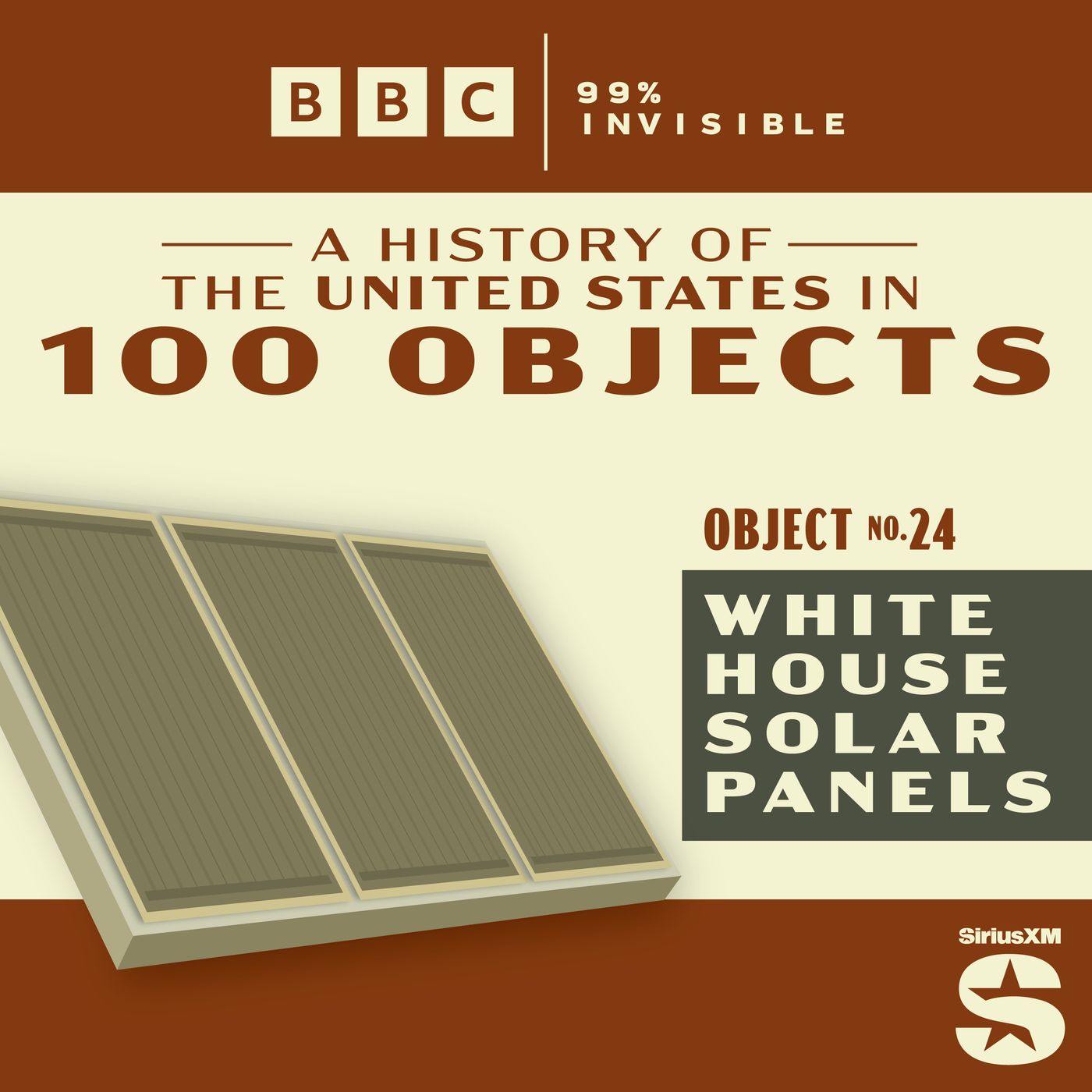
0:57That's indeed.com slash podcast. Terms and conditions apply. Hiring now? Then this is a job for Indeed-sponsored jobs. It's June 1979, a pleasantly warm but by no means hot summer's day in the nation's capital. And Jimmy Carter, the 39th President of the United States, is standing on the roof of the West Wing of the White House in a crisp Navy suit surrounded by a scrum of reporters. Behind him are four rows of giant black glass boards glinting in the D.C. sunshine.
1:35Solar panels. Carter was an engineer. He had spent his military career running nuclear reactors on Navy submarines. This is journalist-turned-environmental activist Bill McKibben. He had a serious understanding of technology and thought a lot about energy. He had to. In the wake of two devastating oil shocks, oil prices were sky high. And for America, which was consuming about a third of the world's oil supply at the time, this was a big problem. Today, in directly harnessing the power of the sun, we are taking the energy that God gave us, the most renewable energy that we will ever see, and using it to replace our dwindling supplies of fossil fuels.
2:21Solar panels, Carter said, could be the solution. There is no longer any question that solar energy is both feasible and also cost-effective. After all, this was our own technology. Solar power had been invented in the U.S., the first modern solar cell, 1954, at Bell Labs in New Jersey. And there'd been a fair number of hippies kind of pioneering solar power in the 70s. But Jimmy Carter's panels weren't the kind you'd be familiar with now. These were not photovoltaic panels. The kind used to generate electricity. This technology was a little more rudimentary. These are solar hot water panels. Pretty simple technology that just runs water through a window pane with a black background.
3:15and heats it up. But they worked. They're incredibly effective at providing hot water. They work great. This was what the future was going to look like. And Carter says all this in a speech on the White House roof that day. And he says, A generation from now, this solar heater... This solar panel can either be a curiosity... A museum piece. An example of a road not taken. Or it can be just a small part of one of the greatest ventures. Or it can be just a small part of one of the greatest adventures ever undertaken by the American people. But the panels didn't even last a generation. No, he was literally right that they were within 20 years a museum piece.
4:08That speech would turn out to be incredibly prophetic. Those 32 solar panels would become all but one of the things he said they might. A curiosity, a museum piece, and one of our nation's most potent and enduring symbols of a road not taken. They were not, at least not yet, a part of a great adventure. Our question in this episode, and it's kind of a big one, is why?
4:37This is a history of the United States in 100 Objects. I'm Roman Mars. Today, how a president showed the American people a powerful new technology promising abundant cheap energy and freedom from foreign entanglements, and why Americans shrugged.
5:08When you think solar panels, you probably think renewables, green energy, a part of the fight against man-made climate change. But that wasn't what Carter saw in them. Not really. When Carter became president in 1977, the country had been facing a serious problem for a number of years. Good evening. What we're all worrying about this winter are three main things. Getting around, keeping warm, and staying healthy. We don't know how short we're going to be on gasoline for the car or fuel for the furnace. All we know is we're going to be short and we'll have to get by on less. You have to understand that the America Carter inherited had been built on cheap, abundant oil.
5:52Beginning in the 1950s with the build-out of the federal highway system and the almost unbelievable rate of growth of the American suburb, America turned into a voracious consumer of oil, which made us very vulnerable when the first oil shock came with the first OPEC embargo. OPEC, the Organization of the Petroleum Exporting Countries, a coalition of oil-producing nations, including Iran, Venezuela, and the United Arab Emirates, which, acting together, controlled the global supply of oil. OPEC's oil embargo in 1973 was a form of retaliation against U.S. foreign policy, and the price of a barrel of crude oil quadrupled as a result.
6:38We were being held hostage, as people said over and over again. Bill remembers seeing the effects firsthand. I was a very, very young, in my teens, newspaper reporter in those days. And one of my first jobs was covering these lines of motorists waiting outside gas stations in my small town. You can buy plenty of gas at this power test station on Northern Boulevard in Queens if you don't mind waiting in line. And waiting. And waiting. and waiting. One of my jobs was keeping track of the very scant hours that the gas stations were open so we could publish them every day. Things got so bad at the start of 1974, President Nixon signed a law lowering the national highway speed limit to 55 miles an hour in an attempt to save gas.
7:33He even briefly considered making it illegal to take pleasure drives on Sundays. This was a deep shock to the American system. The thing on which America ran was suddenly in short supply. And that's why it felt so pressing to the incoming Carter administration to reduce America's dependence on foreign oil. By 1977, the United States was between oil shocks. There was another one coming in 1979. But there was another problem. Shortages of natural gas, compounded by a fiercely cold winter that same year. So in February 1977, our new president addressed the American people in a TV broadcast. Good evening.
8:17Tomorrow will be two weeks since I became president. I've spent a lot of time deciding how I can be a good president. This talk, which the broadcast networks have agreed to bring to you, is one of several steps I will take to keep in close touch with the people of our country to let you know informally about our plans for the coming months. Jimmy Carter wasn't sitting behind the Resolute desk. This was a fireside chat, literally, FDR style, with the president seated comfortably in a soft chair next to a crackling hearth wearing a beige cardigan. He looked like someone's grandpa. I mean, he was someone's grandpa.
8:57And he kind of told Americans to just quit fooling around.
9:05It was time to get serious. I realize that many of you have not believed that we really have an energy problem. But this winter has made all of us realize that we have to act. We must face the fact that the energy shortage is permanent. There is no way we can solve it quickly. Carter says what America needs is a new approach to energy, a whole new policy program. But of course, that's no simple task. It's going to take him a while to figure it out. So in the meantime, he needs America, that's all of us, to just ease up a little. And he has some very clear ideas about how to do it. Simply by keeping our thermostats, for instance, at 65 degrees in the daytime and 55 degrees at night, we could save half the current shortage of natural gas.
9:57And maybe, if it's a little chilly, you know, throw on a cardigan. It's actually quite amazing to go back and listen to it. There's no way that I or anyone else in the government can solve our energy problems if you are not willing to help. He's treating Americans as entirely mature human beings and saying, look, we're using way too much of this stuff. And it's in service of things that we don't really need. You know, we're filling our lives with stuff instead of living full lives. And he's basically saying like, I'm going to come up with an energy policy here. It's coming. But in the meantime, put on a sweater, keep your thermostat, 65 during the daytime, 55 at night.
10:42It's really like a strange moment. And I don't think people have ever witnessed a political leader acting like this. There were plenty of people who admired and liked what Carter was doing, but there were also lots of people who mocked it on the grounds that there was something un-American about doing with less, making yourself a little smaller. This is Bill's theory, one of them at least, that over the years, America had become a place where people consumed with abandon, a place of great appetite and little restraint, and that this had become part of the American ideal, part of our way of life.
11:19And in such a place, people did not necessarily appreciate being told to make do with less. And so maybe Jimmy Carter's energy policy had an image problem before it was even created. Anyway, eventually, two years after that fireside chat in 1979, President Carter was back with the details. And he climbed up on the roof of the White House to put solar power at the heart of his plan. As president, I am determined that America will move toward the solar age with effectiveness and determination, with excitement, high spirits, and with confidence. In his budget that he was preparing for the next year, America would have been producing 20 % of its electricity from renewable energy by the year 2000.
12:14This was Carter's goal. If we use our technological imagination, if we can work together to harness the light of the sun, the power of the wind, the strength of rushing streams, then we will succeed. if we can work together. But right from the start, that was a big if. It required Americans to agree on what they wanted. This was a very, very live debate at that time in American history. One of Carter's pollsters came to him in the late 70s and said, I've done a poll on what Americans think about economic growth. and about a third don't want any more economic growth for ecological reasons. About a third want full speed ahead and about a third don't know.
13:06And his pollster said to him, that's an unstable arrangement. We're going to flip one way or the other in the years ahead. This is worth unpacking. Carter's pollsters told him that America was divided in three groups. One, people who wanted to put the environment ahead of economic expansion. Two, people who wanted economic expansion at all costs. And three, people who didn't know what they wanted. It seems Carter's pitch might not have worked for any of those groups. He did not argue for solar power on environmental grounds, nor was he really arguing for economic expansion. And the third who didn't know what they wanted?
13:45Maybe they needed someone to push them decisively one way or the other. And as it happens, there was somebody waiting in the wings, preparing to do exactly that. You know, in 1979, the solar panels get installed. The next year is an election year. It's Carter versus Reagan. For those who've abandoned hope, we'll restore hope and we'll welcome them into a great national crusade to make America great again. Now we know that that's a landslide. At the time, it was a fight. Governor Reagan again, typically, is against such a proposal. Governor, there you go again. You know, Carter was in the lead for quite a long time.
14:28Ronald Wilson Reagan will become the 40th president of the United States. He'll be sworn into office in ceremonies on the steps of the Capitol on January 20th, 1981. I'd basically been on the road covering the presidential campaign for months. Bill was a student, a teenager, writing for the Harvard Crimson. The Crimson was an odd operation for a college paper. It took itself very seriously. I interviewed Reagan, you know. And on election night, I was writing the 100-inch story, but I was very depressed by the results. People kept handing me bottles of beer. And by the time I was done, truthfully, this was in some ways the first and I think really the last time in my life that I was epically, epically drunk.
15:17The story's quite good. But by the time I was finished, I took myself home to my dorm and slept for the next 36 hours or so. And when I woke up, somewhat still hungover, I had the sense, though I was 19 at the time, that this was going to be the election that was going to matter enormously for the course of the world in my lifetime. Yeah.
15:48It is no program simply to say, use less energy. Of course, waste must be eliminated and efficiency promoted. But for the government simply to tell the people to conserve, that's not an energy policy. At best, it means we'll run out of energy a little more slowly. But a day will come when the lights will dim and the wheels of industry will turn more slowly and finally stop. As president, I will not endorse any course which has this as its principal objective. Reagan's policy was drill, drill, drill. And with the election of Ronald Reagan, we flipped decisively in the direction of more, drilling everywhere we could and trying to come up with as much oil as we could.
16:31And it was successful. You know, let's be clear. It turned out America had lots of oil once you started just letting anyone drill anywhere they wanted, and the price came down. It was a direct rebuttal to Carter's approach. Carter was still very much in the wake of FDR and the New Deal, and with the idea that we were going to work together to solve our problems. And what Reagan was about was the exact opposite idea, the exaltation of the individual. And that any threat to the individual, any sacrifice to the individual, it's sort of antithetical to this new Americanism. To the idea of America.
17:15Yeah. You have this quote I really liked that. This is a time period where we no longer viewed America as a group project. Yeah, I think that's really at the heart of the difference between Carter and what came after. Yeah. And you have to remember, Bill says that Carter's term was viewed by subsequent presidents as a kind of warning. It's a little hard for us to remember that now because his post-presidency was so successful that by the time he died, everyone was writing encomiums and hagiographies of the man. But really, in American political culture, for the decades that followed, he was the thing to avoid, someone who asked too much of Americans.
17:59Carter's vision of the world was perceived as an incredible failure. And he was perceived as an incredible failure. In 1984, Ronald Reagan was reelected resoundingly. The most important thing he did was immediately scotch funding for new solar research. Indeed, the nascent solar industry in America went into a huge nosedive with thousands of people laid off. And then, one day, Jimmy Carter's 32 panels disappeared. It's not like they had a press conference and made an announcement. They just were, one day they weren't there anymore on the roof of the White House. And when they came down, this was not noted.
18:43Very, very many people, right? No, it was not. It was no longer even something we were really thinking about, I don't think. The White House insiders who were quoted at the time were just like, solar power is a joke, forget this.
19:00And we did. Jimmy Carter's promised great adventure was over before it got going, with his solar panels gathering dust someplace. They became relics. Reagan had literally turned them into the museum piece that Carter predicted. Signposts to a path that we had decided not to take.
19:25When your mental health is suffering, therapy can help. But sometimes it's not the whole answer. Talkiatry gives you access to real psychiatric care with licensed clinicians who can diagnose and prescribe medication if it's right for you. It's a simple way to get effective treatment right from home. Talkiatry is a 100 % online psychiatry practice that provides comprehensive evaluations, diagnoses, and ongoing medication management for conditions like ADHD, anxiety, depression, and more. You can meet with a licensed psychiatrist who takes the time to understand what's going on, builds a personalized treatment plan, and supports you over time with consistent, evidence-based care.
20:06All 800-plus clinicians are in-network with major insurers, so you can use your existing insurance instead of paying monthly subscriptions or out-of-network costs. Head to talkiatry.com slash invisible to complete the short assessment and get matched with an in-network psychiatrist in just a few minutes. That's T-A-L-K-I-A-T-R-Y dot com slash invisible to get matched in minutes. Takayatree dot com slash invisible. To the millions of small business owners out there, we appreciate you. We see your early mornings, late nights, and all the hard work in between. And with the U.S. Bank Business Essentials card, you don't have to go it alone.
20:44With unlimited 2 % cash back on every purchase. Because we know your communities count on you to be here, there, everywhere. So yeah, we don't just appreciate you, we support you. The creditor and issuer of this card is U.S. Bank National Association. Pursuing to a license from Visa USA Inc., some restrictions may apply. This episode is brought to you by PNC Bank. Some design was made to be seen by all. Like, for example, the seven wonders of the world. I mean, everyone should see those. While some were made to be less seen, like sewer systems. Like, when was the last time you thought about an aqueduct?
21:16Yet, that doesn't mean they're any less impressive. You could say the same thing about PNC Bank's smart, calculated approach to banking. It won't make for flashy headlines or trends on social media, but it'll make the right money moves that'll help set you up for the successful financial future you're looking for. A design everyone can get behind. PNC Bank. Brilliantly boring since 1865. Brilliantly boring since 1865 is a registered mark of the PNC Financial Services Group, Inc. PNC Bank. National Association. Member FDIC. The best pieces in your closet are the ones you can count on. whether you're heading to work, going out, or keeping things casual.
21:50And this time of year, Quince makes finding something great for everyone else just as easy. Quince focuses on high-quality staples made with premium materials like 100 % Mongolian cashmere, 14-karat gold, and Italian leather. All timeless, versatile pieces that feel special to unwrap and become everyday favorites long after the holidays. I'm a huge fan of the whole line of Quince sweaters. I have button-up ones, zip-up ones, black, gray, brown. I use them when I just go upstairs, when I get on a call, when I take the dog for a walk. These are favorites that everyone would love. Give the gift of quality this holiday season.
22:26Download the Quince app for app-exclusive offers or go to Quince.com. Get free shipping on your order and 365-day returns. Now available in Canada and the UK, too. And when Quince asks you where you heard about them, let them know that it was 99 % invisible. It's the best way to support the show. Jimmy Carter's solo panels were a symbol of a road not traveled. But the road we did take, that was something which young Bill McKibben found himself trying to understand on his own journey from journalist to campaigner. I wasn't yet an activist. I was very much a journalist. And I wrote a long piece for The New Yorker about where everything in my apartment at the corner of Bleecker and Broadway came from.
23:12And so I went to Brazil because Con Ed was getting oil from there and up into the Arctic because there was some hydropower coming down and on and on. And it left me with a new understanding of the world as a physical place. You know, I'd grown up in the suburbs, which are kind of a device for hiding the physical operation of the world. You know, where does where does water come from? Who knows? The tap. Right. In spending a year finding out where everything in his apartment had come from, Bill was beginning to think a lot more deeply about humanity's impact on the world. So I started reading the emerging early science in the mid-1980s around climate change with a lot more attention than I would have, because I'd come to understand that the world was a more fragile place than I had guessed.
24:02And Bill wasn't the only one. Carter had sold solar as the answer to an energy crisis. The words climate, green, or environment didn't feature in his White House rooftop speech once. But by now, the issue of climate change was starting to get a foothold in the public consciousness. Jim Hansen testified in 1988 before Congress what was going to happen. James Hansen was the director of a NASA Climate Research Institute. In 1988, he used a term in front of a Senate committee, which many people heard for the first time that day. The evidence that the Earth is warming by an amount which is too large to be a chance fluctuation represents a very strong case, in my opinion, that the greenhouse effect has been detected and it is changing our climate now.
24:50Hansen said he was 99 % certain that climate change was real. The next year, at the age of 28, Bill published The End of Nature, the first book on climate change written for a general audience. And I kept writing about it for a decade or so because I'm a writer, and writers, journalists, are firm believers in the idea that winning the argument is the important thing, and that if you win the argument, eventually the powers that be will do the right thing. It took me 10 or 15 years to recognize that we'd won the argument. The oil industry in the 1980s had been conducting their own in-depth research on climate change.
25:40I mean, Exxon was the biggest company in the world then. It had a great staff of scientists, and their scientists were telling their executives exactly what Jim Hansen and NASA was telling Congress. In fact, their predictions for the temperature in 2020 were incredibly spot on. And it's also clear that the executives believed them. I mean, Exxon literally started building its drilling rigs higher to compensate for the rise in sea level that they knew was in the offing.
26:14Really, the science was settled an awfully long time ago. James Hansen's Senate testimony was so long ago, 38 years, that a senator is smoking a cigarette on the floor of the chamber as he listens to the NASA scientists explain that mankind was changing the Earth's climate. The oil companies themselves knew him, but they didn't want the rest of us to cotton on. I always have wondered if on the night that Jim Hansen had testified to Congress, the CEO of Exxon had gone on the news and just said, you know what, our scientists are telling us the same thing. No one would have said, well, Exxon's being alarmist about this.
26:54Everyone would just have said, we've got to get down to work. Instead, the entire industry joined together in building this architecture of deceit and denial and disinformation that kept us locked in a utterly sterile debate about whether or not global warming was real. A debate, remember, that both sides know the answer to at the beginning. Bill realized that the reason he and his fellow journalists were losing the fight wasn't because they didn't have the evidence to win. We were just losing the fight because the fight was what fights are normally about, which was money and power. And the fossil fuel industry had so much money and power that they were able to lose the scientific argument but just keep their business model rolling along.
27:39So while it may be true that Carter dented the image of solar by attaching himself and his unpopularity to it, It's also true that a big hit to renewable energy came from the fossil fuel industry trying to protect the status quo. So that was the point at which I started to become an activist. And Bill, the activist, started to take action. So we'd started this thing called 350.org in 2009 or so. Me and seven college students at Middlebury College, where I still teach. And our plan was to organize the world to fight climate change. So our first big day of action was in 2009. We organized 5 ,100 simultaneous protests in 181 countries.
28:32It was the most widespread day of political action in the planet's history. And it was quite remarkable to look at, but we weren't completely clear sort of how to follow it up. But then Bill had an idea. Get people around the world, especially world leaders, to put solar panels on the roof of their palaces. And it was a small leap from that thought to a bigger one. What about those panels Jimmy Carter put up and Ronald Reagan pulled down? What about those solar panels? Imagine the symbolism if our new president, Barack Obama, put them right back up on the White House roof again. This wasn't quite as crazy as it sounds, because Bill had a pretty good idea where the panels were.
29:21They ended up in a government warehouse where a young environmental studies professor from a little college in Maine called Unity College tracked them down, said, can I have these? And I guess they just said, sure, take them. we've got no use for them. So they took them and installed them on the roof of the dining hall. And there they worked for many, many years, providing the hot water that, you know, showered the young people who came to this college to study the environment. By 2010, many of the panels had been retired by Unity College. They donated one to the Jimmy Carter Library and another to the Smithsonian.
30:08But Bill had come across a third, somewhere much further afield. I saw one in the personal museum of the Chinese mogul who had become the biggest solar hot water entrepreneur in the world. And who had a vast complex a couple of hours from Beijing called the Sun Moon Mansion. And he had one of Carter's solar panels, and he paid it great homage as, you know, the equivalent of having the moon lander from the Apollo mission or something. Many of the rest just sat in storage at Unity College, once again gathering dust. And Bill wondered if he could get his hands on one. So I called up the president of the college, a guy named Mitch Tomashaw, and he said, yeah, take a few.
30:54And while you're doing it, take a few of our students with you. And so we started driving to Washington. Just Bill, a bunch of students, and some 1970s solar panels, and a crazy plan to persuade the Obama administration to reinstall them. On Tuesday, a group of students took one of the panels, packed it onto a biodiesel van, and set out on a trip to Washington. Put solar on the White House! We gotta put solar on the White House! We were quite energized with the idea that we were returning these to the young Obama administration and that they would put them back on the roof. And so we'd stop each night, first in Boston, then in New York, and then in Baltimore or Washington, and have a rally.
31:49And part of the rally was we would pour some water in the solar panel, point it at the sun, and wait 15 minutes until you could see the steam. There was hot water, you know, pouring out. The panel still worked as well as they did the day they went up in 1979. And now, they were coming home. So what was your plan when you got to Washington with these things? The plan was to hand them over. So we showed up in Washington and they ushered us into this ornate room in the executive office building where these two Obama administration officials just engaged in the most crazy filibuster for like 90 minutes.
32:35They just sort of talked about a list of all the environmentally sound things that the Obama administration was doing. And these three young women who had come along with the solar panels from Maine, they were politely but forthrightly interrupting occasionally to say, yes, that's great. But wouldn't this be a terrific symbol to have back? And why wouldn't you? And these people would not answer that question. At this point in the story, I have to admit, I have some sympathy for the Obama officials. If Bill turned up, I love Bill. I love everything Bill does. I think he's a national hero. If Bill turned up at my house with a decades-old solar panel demanding that I put him on my roof, I might have dispensed with a polite filibuster and just said, no thanks.
33:24Which is what, at the end of the day, they said. And to Bill, the reason was clear enough. They didn't want them because they were associated with Jimmy Carter. And in 2010, Jimmy Carter was still regarded by people like Barack Obama as a signal of failure, as someone who hadn't been a good politician, hadn't read the public mood, hadn't managed to get reelected, you know? And so they viewed this as an association with failure and they didn't want it. What specifically do you think Obama was nervous about being associated with? Was it just environmentalism? Was it just the Carter-ness of it all?
34:07I think it was the carterness of it all. And they were not that interested in renewable energy as a policy. Renewable energy worked 30 years ago on the building that you're sitting in. The solar panel still works. Here it is. Why don't you put it back up? That'd be great. And they didn't really want to hear that. Bill's road trip was a failure. Kind of. When did the Obama administration begin to develop its opinion about solar? Second term, Obama, they get a little more interested in this stuff, and they give some federal incentives for solar development. The promise of clean energy isn't just an article of faith, not anymore.
34:55People will remember the tax credit that famously went to Solyndra, which then went bankrupt. But they did other things like that. It wasn't on that huge a scale. But they did put solar panels on the roof eventually. They did put solar panels in the second term up on the roof of the White House. So, you know, what was that 30 years or more later, we'd return solar panels to the roof of the White House, where I think they still remain even now. Just to be clear, these were not Jimmy Carter's old panels. These were new ones. But still, the symbolism is there. A president embracing solar, starting with their own rooftop.
35:41So, what had changed? You know, we've now entered a different world. Finally, 25 years after Jimmy Carter wanted it to happen, We're reaching the point where solar power is becoming the clear, obvious, common sense, straightforward way to power the world. Solar power is now the emergent force in energy generation across the world. It can't stop climate change at this point. We've waited too long. But it can shave tenths of a degree off how hot the planet eventually gets. And every tenth of a degree that we raise the temperature moves 100 million human beings out of a relatively safe climate zone into a relatively dangerous one.
36:28Around the planet, 95 % of new electric generation last year came from sun and wind. And it's now accelerating even faster in the wake of our misadventure in Iran, because around the world, leaders are quickly realizing that those sunlight travels 93 million miles to reach the Earth. None of those miles go through the Strait of Hormuz. And it's the fastest energy transition of this kind we've ever seen. So it's, you know, increasingly a no-brainer in every way. Bill may say it's a no-brainer, but in the United States, we still seem to yo-yo, falling in and out of love with the idea of harnessing the sun, as one administration replaces another.
37:16Obama's administration really leaned into solar power in its second term and introduced legislation designed to encourage it. But then... We will drill, baby, drill.
37:31Donald Trump's administration cut back on clean power initiatives in favor of encouraging fossil fuels. Now, the United States is the one country on planet Earth that's desperately trying to discourage solar power. Our federal government has removed all the incentives for it. It's essentially banned it from any federal lands anywhere. The country that invented this stuff and the country where under Jimmy Carter it had its first real surge is now the only country on Earth that's doing everything it can to shut them down. And what's even more sort of amazing about this is like, you know, you talk about the sort of time of uphill battle where the economics it was fighting against.
38:20But now the economics is not fighting against it anymore. Solar power is the cheapest form of energy on Earth. It's almost unbelievable how quickly the price of this has come down. Every time we double the number of solar panels on the Earth, which at the moment is every couple of years, the price falls another 25 percent. Just because coal and gas and oil are something that you have to go find, and hence it gets harder to find them. At the moment, if you want to get oil, you have to get good at going miles under the surface of the ocean because all the Beverly Hillbillies stuff is long since used up, you know.
39:02But the sun shines thousands of times more energy at us than we could ever hope to use. While America hasn't embraced solar, others definitely have. You go look at a country like Pakistan, which has suffered terribly from climate change. But the thing that's driving them at this point to put up solar panels is that their electricity supply is unreliable and expensive. So because they have a border with China, millions upon millions of individual Pakistanis have just gone and bought solar panels and then gone on YouTube and figured out how to hook them together. And they've built the equivalent of something like half the country's national electric grid in the course of eight months.
39:47It's hard for Americans to understand this because we're the one place that isn't doing it.
39:56In the year 2000, the solar water heater behind me, which is being dedicated today, will still be here, supplying cheap, efficient energy. On the White House roof in 1979, Carter had outlined the possible futures for his 32 solar panels. A generation from now, this solar heater can either be a curiosity. The kind kept by a Chinese collector. A museum piece. Something the Smithsonian puts behind glass. An example of a road not taken. The United States is still nowhere near the target Jimmy Carter set to produce 20 % of its power from renewable energy by 2000. In 2025, renewable energy represented less than 10 % of America's total energy generation.
40:49Or it can be just a small part of one of the greatest ventures ever undertaken by the American people. Political discourse tends to be about ideas and numbers and ideologies and so on. It's only occasionally that tangible objects, material things, assume that kind of importance. Jimmy Carter's solar panels are important because they remind us that his great adventure did not happen. America could still embark on an exciting adventure around all this. We remain a huge and important country, and with the right nurturing from the government could be a huge part of the future. But we're not going to lead it at this point.
41:40It's not that we're entirely shut out of this adventure, but we do not any longer get to be its protagonists.
41:51Bill McKibben, thank you so much for talking with me and telling me the story of the solar panels. I had a fun time. I had a really fun time thinking back on those days.
42:04Bill McKibben is a journalist, environmental activist, and founder of 350.org. If you enjoyed this discussion and want to know more about the history of solar energy, you should check out Bill's excellent book, Here Comes the Sun, which is an exploration of how solar energy can still change the road we've taken.
42:30A History of the United States and 100 Objects is a production of 99 % Invisible and BBC Studios. It's hosted and curated by me, Roman Mars. This episode was produced by Isaac Fisher. Our series producers are Priscilla Alabi, Brenna Daldorf, and Ellie Lightfoot. This episode was edited by Richard Knight. This series was edited by Annie Brown and Courtney Harrell. Mixing by Charlie Brandon King. Fact-checking by Amy Bracken. Our theme song is by Swan Real. From 99 % Invisible, our executive producer is Kathy Tu. From BBC Studios, our executive producers are Annie Brown and Courtney Harrell. Our production coordinator is Shan Pillay, and the production manager is Mabel Finnegan-Wright.
43:14Artwork by Stephan Lawrence. 99 % Invisible is part of the SiriusXM podcast family, headquartered in beautiful, uptown, Oakland, California. And BBC Studios is headquartered in beautiful, White City, West London. Hey, you want to know something fun? This episode actually started as a listener suggestion. If you have a suggestion for an object you want us to consider, email us at 100objects at 99pi.org.
43:53There's a difference between designing something to work and designing something to last. Short-term thinking asks, is it good enough? Long-term thinking asks, what more could it make possible? because a business built for growth shouldn't be held back by payments built for right now. That's why Audien built one platform designed to help you grow with one integration to take you into new markets. Don't just build for the business you have today, build for the one you are becoming. Go long with Audien. At Jared Jewelers, we know it's about more than fine jewelry. It's the moment they open the box, that smile they can't hide, knowing you chose exactly right.
44:34Because the right gift can bring a lifetime of meaning, a promise, a milestone, a memory in the making. Make every moment unforgettable with 20 % off storewide. Exclusions apply. See Jared.com backslash radio for details. Jared. Make the holiday last forever. Shop Jared Jewelers. Hi, it's me, your gutters. I want to start by saying I'm fine. Everything is totally fine. There's just, there's a lot of debris up here, and I've been managing it mostly on my own for about eight months now, and I just thought maybe you could find someone on Angie to clean me up. You don't have to make it a whole thing.
45:11It doesn't need to be a whole thing. I just, I could really use your help. Your gutters have waited long enough. Find a pro at Angie.com.
In 1979, President Jimmy Carter took to the roof of the White House to announce the installation of 32 solar panels. In that speech, he outlined all the things that they could become: a curiosity, a museum piece, one of our nation's most potent and enduring symbols of a road not taken, or the start of a great adventure. They would become all but the last of those things…but why? Journalist and environmental activist Bill McKibben takes Roman Mars through the story of how a president showed the American people a powerful new technology promising abundant cheap energy and why Americans shrugged.
A History of the United States in 100 Objects is a production of 99% Invisible and BBC Studios.
Subscribe to SiriusXM Podcasts+ to listen to new episodes of 99% Invisible ad-free and a whole week early.
Start a free trial now on Apple Podcasts or by visiting siriusxm.com/podcastsplus.
Hosted by Simplecast, an AdsWizz company. See pcm.adswizz.com for information about our collection and use of personal data for advertising.