 Ask ChatGPT



“Beaded Moccasin,” an episode from 100 Objects/99% Invisible about how one family heirloom links Japanese American internment and Native American boarding-school history, and how those histories are braided through U.S. land seizure and assimilation policies.
Sarah Kay is a poet and founder/co-director of Project Voice; she investigates her grandmother June Suzuki’s past. June Suzuki was a first-generation Japanese American, incarcerated during WWII, later sponsored by the Episcopal Church to leave camp for college, then taught science at St. Mary’s Episcopal School for Indian Girls in South Dakota. Virginia Driving Hawk Sneavy is a Native historian/author and St. Mary’s alumna who remembered June’s teaching.
The “national security” narrative of internment omits white farmers’ lobbying for Japanese removal. Boarding schools were part of a broader “civilizing” project tied to land acquisition. June’s “shikata ganai” stance (“can’t be helped”) may have been strategic obedience for escape, while her private messages to Native students challenged them.
moccasins gifted in 1946 by a Native family; June’s telegram-approved release; Gila River Relocation Center; St. Mary’s early Lakota-taught approach; Dylan Meyer’s shift from WRA to Bureau of Indian Affairs and “Termination” (dissolving tribes, seizing land).
Written by AI. May contain mistakes.
Sarah Kay shares the history of a pair of beaded moccasins and their significance.
“Okay, so let's just start with this visit to your grandma's house where our story begins.”
Exploration of the historical context surrounding Japanese internment during WWII.
“these two disparate histories intersecting in this one object, isn't unlikely at all.”
Explore the motivations behind Japanese-American internment during WWII.
“It's a question of whether the white man lives on the Pacific coast or the brown men.”
Follow June's experience in internment camps and her determination to continue her education.
“And I think to me, it's like the narrative around Japanese-American internment that I've always heard is it was a matter of national security and it was about war.”
Examine how June navigated her identity and loyalty to America while interned.
“Not so long ago, all these people had been leading normal lives, but whatever trajectory they had been on had been derailed, rerouted to a camp at the end of a dusty desert track.”
Analyze how June was portrayed in the media during her college years.
“After two years in Pennsylvania, she transfers to a school in Rhode Island called Pembroke College.”
Discover June's unique perspective on her internment experience and resilience.
“It's almost like a feel-good celebrity profile, you know?”
Explore what life was like for June after her college graduation and the end of WWII.
“And when she was in college, she was invited to address rotary clubs and church groups fairly often.”
Learn about June's teaching role at St. Mary's Episcopal School for Indian Girls.
“So she reached out to the church to see if she could work for them.”
Understand how June's story intersected with Native American history through a personal connection.
“somehow led her to this school for Native American girls a million miles from home.”
Sarah's journey to South Dakota to explore the history of boarding schools.
“So Sarah decided to go to South Dakota to meet Virginia to find out what she remembered about June.”
An exploration of the violent history and policies of Native American boarding schools.
“was if Native people could be persuaded to participate in the American project of expansion, then perhaps they would not need to be exterminated.”
Discussing June's position in a non-federal boarding school and its implications.
“And there are repercussions that rippled through generations.”
Virginia shares her experiences and reflections on attending St. Mary's School.
“the kind that happened at many other schools.”
Exploring the complexities of positive experiences in a complicated historical context.
“It provided its students with an education without completely sacrificing culture or belonging.”
Virginia recalls her encounters and memories of June while at St. Mary's.
“What did you feel when you were being told that sort of what is mostly a positive experience of being there as a student?”
Examining the duality of June's persona in her role as a teacher and her historical awareness.
“But that always stuck in my mind and always made me more aware of what had been happening to our people, too.”
Discussion on the complexities of obedience and personal sacrifice in the context of history.
“month of movement, another semester of education, another day of independence.”
Analysis of the intersection between Japanese American internment and Native American history.
“At the time, it seemed to me at most a curious and unlikely intersection of Japanese American history and Native American history.”
Personal reflections on how family stories illuminate broader historical injustices.
“And that's because all of American history is braided.”
Discussion on the significance of small gestures in resisting historical oppression.
“And particularly as I got older, I realized that the government had done all kinds of awful things, not only to Native Americans and Japanese Americans, but other parts of our citizens as well.”

Get the gist, explore an idea or ask about something said.
 Claude
On 99% Invisible, what are the key points of this episode?
Searching your listeningAutomatic transcript. May contain errors.
0:00Welcome to The Circle. In this game, you never meet the other players. Your goal is simple, become the most popular. But should you play as yourself or catfish as someone else? With the new host, celebrity contestants, and this time, audience voting will influence the game. You decide who has what it takes to win. Watch the Hulu original series, The Circle, now streaming on Hulu and Hulu on Disney Plus for bundle subscribers. Terms apply. I'm pro quarterback, Drake May, and I got to call an audible. People say building long-term wealth is complicated, but Betterment is the trusted automated investing and savings app that makes it simple.
0:38Like me, they're focused on performance and make the long game look easy. Are you still spending time researching stocks and reinvesting your dividends? Audible. Betterment's tech and expert built portfolios handle that for you automatically. Worried about surprise tax bills? Audible. Keep your cool and more of your potential returns with Betterment's tax saving tech, like tax loss harvesting or a tax impact preview before you trade. Think you need three different platforms for your money? Audible. No one has time for all that. Betterment is one easy and simple app where you can see your total net worth, all your accounts, and your returns.
1:09Over a million people trust Betterment to help build their wealth with confidence. And if you're not one of them, it's time you call an audible too. Get started at Betterment.com or download the app. Investing involves risk. Performance not guaranteed. Betterment does not provide tax advice. TLH may not be suitable for all investors. Learn more at Betterment.com slash TLH dash terms. Paid client ad. Views may not be representative. it. See App Store and Google Play Reviews. Learn more at betterment.com slash ambassadors. Okay, so let's just start with this visit to your grandma's house where our story begins.
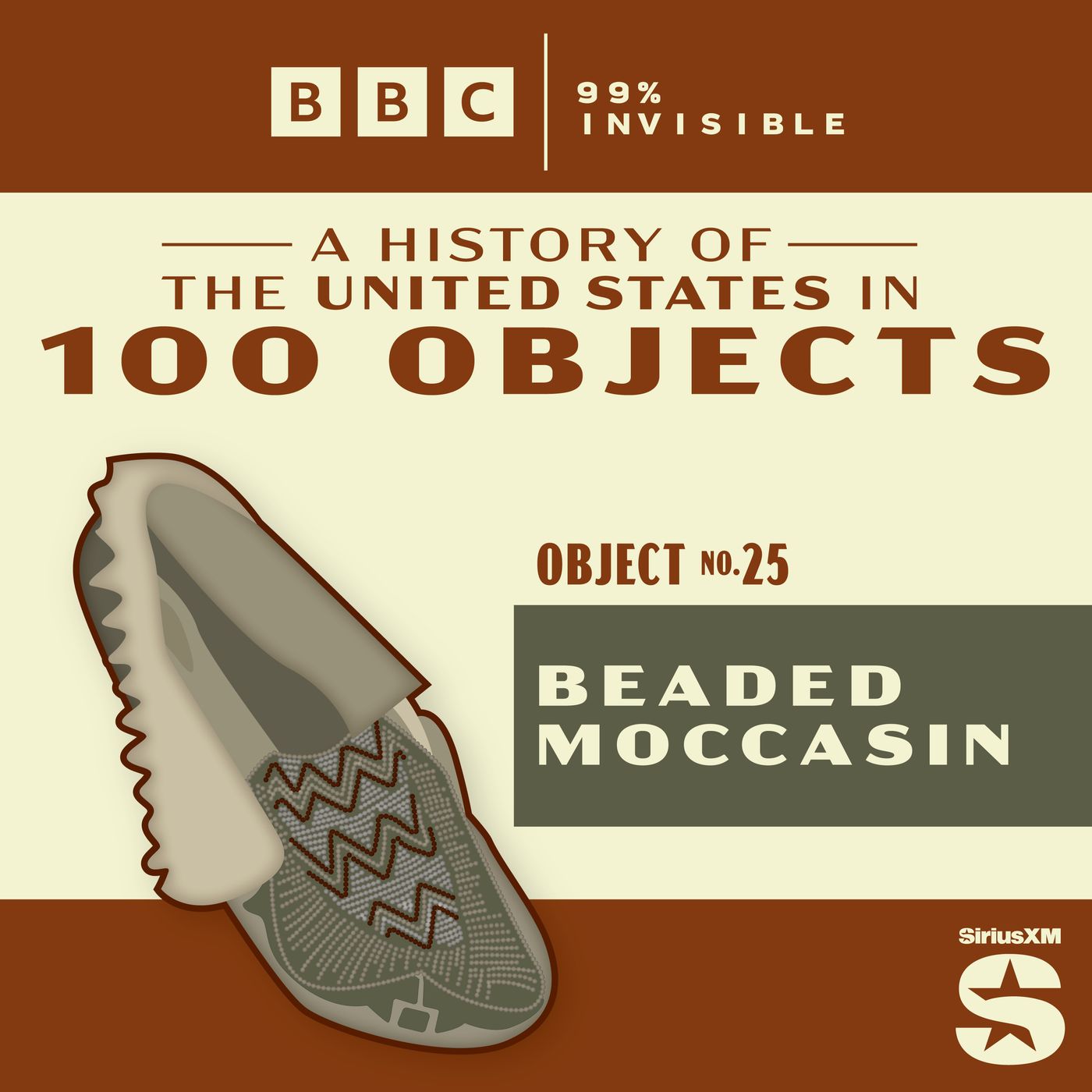
1:32Sure. So this is before I was born, but my parents were married. And my father was snooping around his mother-in-law's house in California. This is poet Sarah Kay. And he was going through closets and there was a big house. There's a lot of stuff in the house. And he was going through boxes and looking at all the clutter there, and he found a shoebox. And inside the shoebox, there was a pair of adult moccasins made of soft white leather and this beautiful beading. The patterns on the moccasins are mesmerizing. Undulations of turquoise and yellow and white and red. beads that come together to form waves, lightning strikes, rivers.
2:28He could tell that they were old. He could tell that they were special. And he should have been embarrassed to be snooping around, but apparently not embarrassed enough because he took them to his mother-in-law to ask her where they had come from. Sarah's father is Jewish. The closet he was poking around in belonged to his mother-in-law, June Suzuki, a first-generation Japanese-American. But Sarah's dad didn't think these moccasins looked Japanese. Pretty much the only thing she told him about the moccasins was that in 1946, she had been a teacher at a school for Native American girls in South Dakota for about a year.
3:13And when she left that job, someone gave her these moccasins as a goodbye present. And that was kind of all the information he had. My dad is a photographer. He is a collector. He has a real eye for beauty and objects that are special. And he said, you know, these really shouldn't be sitting in a closet languishing. If you're not doing anything with them, can I take them home to New York and get them treated like the art that they are. And she thought he was nuts, but she said, sure, do whatever you want. And he took them home and he got them framed in this beautiful shadow box and he put it on the wall of the home that I grew up in.
4:02So this shadow box hung over the dining room table of my parents' apartment for my entire childhood. And at some point, my grandmother did come to visit and saw them and said, who would put shoes on the wall? That was her response. Those shoes stayed on the wall of Sarah's family's apartment. But Sarah didn't spend much time thinking about them. It was only much later that she would come to understand that these shoes, which Grandma June had stuffed into a closet, were connected to not just one, but two huge events in June's life and in American history. Because not only did June receive these moccasins when she was working at a Native American boarding school, a school connected to the long and complicated history of the government's mistreatment of Native Americans, she was sent to teach there right after she had been incarcerated with her entire family in a Japanese internment camp.
5:06So my grandmother was Japanese American. And during World War II, after Japan bombed Pearl Harbor, June and her brother and her parents were all put into internment camps. But unlike her parents, June didn't stay in the camp. She was one of a small group of young people who were allowed to leave. A big part of her ability to do that was basically being sponsored by the Episcopal Church. She felt this great debt to the church because they had been the ones to help her out of camp. And so she offered to work for them. The Episcopal Church sent her to work at the boarding school in South Dakota, a school for Native American girls.
5:52The school where a Native family gave her those moccasins. but grandma june hardly ever talked about any of this and then when i got a little bit older and i had learned more about japanese american internment for my own reading i started to push her to try to express some form of anger or indignation i would ask her aren't you mad don't you think internment was unfair and unjust And her response to that was, you don't understand. This is just how it was. And there's this phrase in Japanese that is one of the only things in Japanese she ever said. And it was shikata ganai, which translates to it can't be helped.
6:48And that was her stance on the matter. As Sarah got older, June's dismissal of the past, the way she shrugged off the injustice, it started to nag at Sarah more. And then Grandma June died before Sarah could really understand what had happened or how June came to feel this way. But those moccasins hanging on the wall of Sarah's parents' apartment kept reminding Sarah of this past, these two monumental events in American history that just happened to play out through her grandmother's life. I mean, on the one hand, the moccasins were the literal centerpiece of the apartment that I grew up in. And they hung over the dining room table.
7:29They're the first thing you see when you walk into the apartment. They still are there. But also, I never asked about them. They were just there. If anything, it was this strange and unlikely, curious moment in my grandmother's life where she had stood at the intersection of Japanese American history and Native American history and isn't that odd. But I just never asked about them. Recently, Sarah has started to ask questions. And the answers, what they showed her about both her grandmother's life and American history, shocked her. Because she started to realize that this unlikely coincidence, these two disparate histories intersecting in this one object, isn't unlikely at all.
8:22From 99 % Invisible and BBC Studios, this is a history of the United States in 100 objects. I'm Roman Mars. Today, The Beaded Moccasins.
8:40When Sarah started trying to piece together the story of those moccasins and her grandmother's life, she didn't have a lot to go on. She was not a sentimental kind of person, and she wasn't a warm and cuddly grandmother. When we would visit her, she would frequently say like, when are you all leaving again? With this kind of tight smile that suggested she was like counting down the minutes until we would leave. But she also was funny. Like she had a very sharp rules. Like there was no eating anywhere in the house other than the kitchen. But I have one memory of childhood of sitting in her study next to her watching TV and without saying anything to me, she reached for a secret box of chocolates that she kept and opened them and handed me one.
9:33And it was as though she were inviting me on a bank heist. Like that was the level of excitement that it induced in me.
9:45June hardly ever talked about her past. But Sarah knew that when World War II started, June very much considered herself an American. Was your grandmother born in the U.S. or born in Japan? Yeah, so she was born in California, grew up in Los Angeles. She had never been outside of California. She had barely been outside of L.A. County. Her parents had immigrated from Japan, and pretty much their whole social life revolved around a place called St. Mary's Episcopal Church. For years, June had been attending a program the church ran for young Japanese girls called the Chrysanthemum Club, designed to help the girls assimilate.
10:32That's also where she learned American ways from a woman who would drive down in a limo from Bel Air once a week. And she would teach the girls American manners. She would teach them which fork to use and American dances, you know.
10:57In December 1941, June was 18 years old, living at home. She was a freshman at UCLA, just finishing her first semester. On December 7th, the Japanese attacked Pearl Harbor, changing everything for June and her family. In the months after, President Roosevelt issued Executive Order 9066, declaring June and her family enemy aliens. They were forced out of their home and sent to an internment camp. This was the story that Sarah knew when she started looking into her grandmother's life. But through her research, she learned about something that changed the way she saw Japanese internment. You know, I think a lot of times when people know about Japanese-American internment, Chances are the story they know is that Japan bombed Pearl Harbor, Roosevelt signed Executive Order 9066, and that initiated the relocation of Japanese Americans into eventually internment.
11:59And it makes it seem like the executive order was only in response to Pearl Harbor and only a matter of national security. And when I researched this more, it turns out that there were groups lobbying for Japanese-American removal and relocation even before Pearl Harbor. And the most interesting and least known history, I think, has to do with white California farmers. Throughout the early 1900s, if Japanese immigrants wanted to become farmers, they were usually only given access to marginal, undesirable land in California. Land not considered fertile enough for farming. But the thing is, these Japanese American farmers did wonders with that land, turning it from wasteland into productive farms.
12:57By 1940, basically, Japanese Americans controlled less than 4 % of California farmland, but they were responsible for producing more than 10 % of the state's farm resources. And as a result, white farmers started to get very angry. Some of these white farmers created interest groups and started lobbying to limit Japanese-American land access. And this resentment and envy was really growing to a fever pitch in the months leading up to December 1941. So then when the bombing of Pearl Harbor happens, it really gives these men the perfect excuse and opportunity to advocate for the removal of all Japanese Americans from the West Coast.
13:53A man from one of these interest groups was interviewed by a paper at the time, the Saturday Evening Post. He said, we're charged with wanting to get rid of the Japs for selfish reasons. We might as well be honest. We do. It's a question of whether the white man lives on the Pacific coast or the brown men. They came to this valley to work and they stayed to take over. If all of the Japs were removed tomorrow, we'd never miss them in two weeks because the white farmers can take over and produce everything the Jap grows and we don't want them back when the war ends either.
14:31And I think to me, it's like the narrative around Japanese-American internment that I've always heard is it was a matter of national security and it was about war. And for sure, that is a part of the narrative. But I never hear it spoken about how white California farmers were really chomping at the bit for Japanese American farmland. Throughout the war, the American government incarcerated approximately 112 ,000 Japanese Americans in internment camps up and down the West Coast. June and her family were first sent to one camp, a repurposed racetrack where families were housed in old horse stalls.
15:14Then they were moved to another, the Gila River Relocation Center in Arizona. And Gila River Relocation Center was really in the desert. So there was a lot of dust. It was really hot. There were cacti. There wasn't a lot of trees other than ironwood trees. More than 13 ,000 Japanese Americans would eventually be crowded into barracks there. Not so long ago, all these people had been leading normal lives, but whatever trajectory they had been on had been derailed, rerouted to a camp at the end of a dusty desert track. But June's family was determined that one thing wouldn't be interrupted, June's education.
15:55And they had heard about what might be a singular opportunity. A group had formed that was lobbying for some Japanese American students to be released from the camps to continue their studies. If a student could prove that she was loyal to the American government, that she was properly Americanized, and that she wasn't a threat to the country, she could maybe leave the camp and go to school out east. She also had to submit documentation along with her application, including documentation of one thing in particular. Evidence of successful Caucasian contacts. For her Caucasian reference, June wrote down the name of the woman who ran the Chrysanthemum Club back at her church in L.A.
16:39Miss Edith Knapp of Bel Air, California, who had been the woman who taught them the right forks and American manners. And now was somebody June must have believed would attest that she had learned those lessons thoroughly and that she was more American than she was Japanese.
17:02And then June also needed a trusted entity to sponsor her and vouch for her. And in June's case, it was the Episcopal Church. June applies. Her application was examined by multiple government bodies, including the FBI. And then she gets news. She got a telegram saying that she had been approved for leave. And within days of the telegram, she has to pack her trunk and go. June is 19 when she leaves the internment camp in Gila and begins a cross-country train journey to Pennsylvania, where she had been accepted into a junior college. After two years in Pennsylvania, she transfers to a school in Rhode Island called Pembroke College.
17:51Now, finally, back in college, June had returned to a version of her pre-war life, a world of dorms and textbooks and young people mingling. But of course, everything was different now. You know, and she was coming from internment. Is this known? Is it talked about? Yes. I mean, it wasn't a secret. She couldn't hide her face and she didn't hide who she was and where she had come from. And actually, there's this newspaper clipping from her senior year. And the article has this big photograph of June sitting on a windowsill and her hair is curled. And, you know, she's got this like full teeth smile.
18:35And the headline is Pembroke Senior of Japanese Parentage Unresentful of Internment Camp Stay. And the first line of the article is Miss June Lucille Suzuki was born of Japanese parents and is a strictly American college girl. It's almost like a feel-good celebrity profile, you know? And then there's this section where it says, The whole time during which Miss Suzuki was what some columnists termed kicked about as casually as a stray mongrel seems to have left her in an anecdotal mood rather than a resentful one. It was something that couldn't be helped, she says. Couldn't be helped. Which is wild, right?
19:22Like there's that phrase that she translated shikata ganai without telling the interviewer about the Japanese that it came from. But she had clearly been like holding on to that belief in real time and had kept it with her for the next 70 years, you know? Yeah.
19:47And when she was in college, she was invited to address rotary clubs and church groups fairly often. I only have the text of one of the speeches that she ever gave written in the form of a letter to her parents, and the speech begins, Dear Enemy Alien. She says,
20:43loved you for it. It won't be too long now, so keep your chin up, enemy alien. If I were a fellow like my brother, I would have volunteered my services to my country too, because I know that we are not merely fighting to become the dominating nation in the world. We are not fighting for trade or increase in land. We are fighting for something more than just that. We are fighting to preserve a democracy. We are fighting so that no one will be denied life, liberty, and the pursuit of happiness, we are striving for peace, not a peace for America alone, but a peace universal. I realize it is rather ironical to say all this to you when you are behind barbed wire fences, but please try to see it.
21:32And it's, it's so brutal for me to read because, I mean, for one thing, her parents were only capable in basic English, but they would not have been fluent enough to understand the language that she used here, which is an indication that like it was written to them, but not for them, right? Like this was a speech for Caucasian audiences in rotary halls and churches on the East Coast. And that's who she reserved this version of herself for, you know, She wanted to reassure them that she didn't resent the imprisonment of her parents and that she didn't see injustice in their internment and that she was a patriotic American like they were, you know.
22:27World War II ends in 1945, and the next year, June graduates from college. In the wake of the war, the internment camps are slowly shut down, and internees, like her parents, start making their way back to the places they had lived before to see what they can salvage of their former lives. But June didn't want to go back to California. Not yet. She wanted to find a job. She definitely felt a debt to the Episcopal Church for sponsoring her education and enabling her to leave camp, to leave internment. So she reached out to the church to see if she could work for them. And they said, yes, we would like you to go teach at St.
23:17Mary's Episcopal School for Indian Girls in South Dakota. St. Mary's Episcopal School for Indian Girls was a boarding school in the small town of Springfield, South Dakota. June went there to teach science and stayed for a year before joining her parents back in L.A. And that's pretty much all anyone in Sarah's family knew about it. But as Sarah grew older, she found herself wondering about June's time there and thinking about this strange intersection, how the fact that June's time in the internment camp somehow led her to this school for Native American girls a million miles from home. And it's important for you to remember at this moment that Sarah Kay is a poet.
23:56Normally, when I find myself repeatedly turning something over without being able to figure it out, that is my sign to try and poem my way through it. Poem as verb. It was the kind of poem you write for yourself, not really to share. Sarah only performed it once because her cousins were in the audience. But it just so happened that someone else was in the audience that night too. A new friend, a woman named Charlie Bueller. Charlie, after the show, came over and said, hey, I liked that poem you did about your grandmother. You know, I grew up in a small town in South Dakota. And I think it's possible that if we were able to find somebody who was around at that time, I feel like it's likely that they would remember her because I don't think there were very many Japanese American women walking around in 1946.
24:49And she said, would you mind if I sent some emails and made some phone calls?
24:56And I grew up in New York City. So if someone came to me and said, hey, my grandmother was in New York City in 1946. Do you think anybody might remember her? That would be absurd. So I said, Charlie, knock yourself out and thought absolutely nothing more about it. However, I would soon learn that South Dakota is not New York City. And Charlie was able to track down a woman named Virginia Driving Hawk Sneavy, who's a prolific author and historian, and happened to be a student at St. Mary's Episcopal School for Indian Girls when June was a teacher there. She was 13 when she and June crossed paths at St.
25:49Mary's, but Virginia still remembered her.
26:14or even a WhatsApp call. Whisperflow Notetaker captures meeting notes while getting names, acronyms, and numbers right. And the best part? Every meeting is searchable. Need to remember what was agreed on last week? Just ask and get an answer, complete with the source. Available on Mac and Windows. I tried it out, it's easy to install, and the important thing about doing interviews is being very present. But also, I need to take notes. And this lets you take notes while still being present in the conversation. and then those notes are easy to turn into a story. Whisperflow is free. Download it at whisperflow.ai.
26:49That's W-I-S-P-R flow dot A-I. When you sign up and ask how you heard about Whisperflow, pick podcast and type 99 % invisible so they know we sent you. Welcome to the circle. In this game, you never meet the other players. Your goal is simple, become the most popular. But should you play as yourself or catfish as someone else? With the new host, celebrity contestants, and this time, audience voting will influence the game. You decide who has what it takes to win. Watch the Hulu original series, The Circle. Now streaming on Hulu and Hulu on Disney Plus for bundle subscribers. Terms apply. Now smaller than ever, more powerful, more accurate.
27:31Meet Pod 6, the sixth generation of 8Sleep's award-winning sleep system. The Pod is an intelligent mattress cover that transforms your existing bed. It cools and heats on each side of the bed from 55 degrees to 110 degrees. As you sleep, it also measures your sleep stages, heart rate, and breathing. Then acts on that in real-time adjusting temperature. All you have to do is sleep. Shop now at 8sleep.com. You wouldn't take financial advice from a 72 hours in a single day alpha influencer, would you? Same goes if you're in a car accident or any accident. Who you choose matters. That's why Morgan & Morgan exists.
28:10They're the largest injury law firm in America, and they've built a reputation by actually winning cases, not just talking about it. Over 1 ,000 lawyers across all 50 states and$30 billion recovered. Injured? Go to forthepeople.com slash podcast. That's forthepeople.com slash podcast. So Sarah decided to go to South Dakota to meet Virginia to find out what she remembered about June. But she was also nervous about what she might find there. She didn't know how St. Mary's fit into the dark history of the federal boarding school system for Native children, which she had started to educate herself about.
28:48And before we follow Sarah to South Dakota, I think it's worth talking about the history of this system for a second, because there's a through line here. Just like Japanese internment was advocated for by white farmers hoping to take over Japanese farmland, the Native boarding school movement began with policies aimed at land acquisition. So the highest priority of early American policymakers was the accumulation of land, which they considered vital to the survival and expansion of America. The fact that the coveted land was occupied by Indigenous people did not alter the priority. It just provided these policymakers with the incentive for the expulsion of these people from their land through forced tribal removal and starvation and murder.
29:42And when the more explicitly violent removal tactics became harder to justify, a new possible perspective arose, which was if Native people could be persuaded to participate in the American project of expansion, then perhaps they would not need to be exterminated. And to accomplish this, a complete transformation was deemed necessary. This transformation was called civilizing, or stripping away native language and tradition to replace it with white Christian and capitalist practices and values. This became an official U.S. government policy. And a key method of so-called civilizing was the creation of schools where children could be indoctrinated.
30:40Soon, most of these schools became boarding schools, the idea being to remove children from the influence of their families and communities. The most notorious example in the federal Indian boarding school system is probably the Carlisle School. The Carlisle School was founded in 1879 by a man named Richard Henry Pratt, who once famously said, quote, kill the Indian, save the man. He felt that successful assimilation could only be accomplished by keeping Native children in an all-white environment. And so at Carlisle, children were prohibited from speaking any language that wasn't English. There was the threat of corporal punishment for anyone who tried to run away.
31:28Many children did not survive Carlisle. and Carlisle is this, you know, unique horror. And yet it then quickly becomes not so unique. By 1891, Congress made school attendance mandatory for Native children. By 1900, over 20 ,000 children were in these boarding schools all across the country. Experience varied across the country and across ages and across this era. But even children who managed to survive physically, there were unending repercussions after school as well, right, within their relationships and their families and their communities. And there are repercussions that rippled through generations.
32:24In the 1920s, there were some high-profile revelations about abuses going on in these federal boarding schools. Reform started to be put into place. Eventually, it was no longer mandatory for Native children to attend. The more that I read and learned about the civilizing, assimilating weaponry of boarding schools, the more horrified I became. And also, the more uncomfortable and uneasy and panicked I started to feel about June having been a teacher at an Episcopal boarding school for Indian girls.
33:11The history of the school that June worked at is related but separate from the system. St. Mary's was founded as an alternative to the federal schools, run by the Episcopal Church instead of the government, just like someone might send their kid to a private Christian school today. And by the 1940s, when June was teaching, the reforms had started to take effect. As she researched, Sarah looked, but she couldn't find any documentation of historic abuses at St. Mary's, the kind that happened at many other schools. But she's so worried about what had happened that hadn't been written down. You know, June was not the school nor the system's architect, but I also, like, really had to think about the fact that June had been given this job in the first place because she had performed and behaved a certain way up to that point.
34:05Like the position would not have been offered to somebody who had resisted assimilation or had refuted its supposed benefits. Right. And that is really complicated. It left me desperate to find out about the school she was at, because I needed to know what the students at the school June was at had experienced so I could figure out how I should think and feel about June's presence there.
34:43so Sarah filled with equal parts dread and excitement got on a plane to South Dakota because she needed to meet the woman who had been a student at St. Mary's when June was a teacher there Virginia and there she was standing in the doorway to her home beckoning Sarah and her friend Charlie in a tiny woman with a strip of hot pink dyed into her white hair she was so welcoming she She was so warm, and I got to speak with her about her time as a student at St. Mary's. And so you wound up at St. Mary's. Why? Okay, St. Mary's School was an alternative to the federal boarding schools on the reservation.
35:26Virginia started telling Sarah about her time at St. Mary's, and right away, it wasn't quite the narrative she was expecting. And those boarding schools, they would take kids as young as six, seven years old, and there was a deliberate attempt to assimilate them and keep them away from their families. And it was a horrible situation for those kids, and many of them were very bitter about that experience. But St. Mary's was the alternative to that. And in the early years, St. Mary's allowed their students to start to learn in Lakota, and they didn't force them into English right away. And so the Episcopalian boarding schools were more sensitive to the cultural awareness of the students and their parents and didn't try to make them into white people like the of the boarding schools did.
36:26For Virginia, this meant that St. Mary's did something important. It provided its students with an education without completely sacrificing culture or belonging. And it was really important to her that I know she was encouraged and expected to pursue higher education. And that felt really important to her because it felt like it was in contrast to other schools that she knew about where students were made to feel that everything about themselves and their families were wrong. What did you feel when you were being told that sort of what is mostly a positive experience of being there as a student?
37:09Yeah. I mean, Virginia was actually only one of a few different St. Mary's alumni that I ended up getting to speak with. And each of them had a lot of positive experience to share. You know, I try to return to this thought that has brought me comfort before, which is that many things can be true at once and usually are. I think that St. Mary's Episcopal School for Indian Girls is inextricable from the complex national history of white supremacist civilizing efforts and federal policy that always placed more value on seizing Native land than the humanity of Native children. And also, this particular school, at this precise moment in time, appears to have provided these specific women meaningful and beneficial encounters and adventures and opportunities that many of them feel that they would not have otherwise been able to experience.
38:15That's not to say that Virginia didn't have criticisms. We had no Native Americans on staff other than my grandparents, who were, of course, the janitor and laundress. Not while I was there at all. We had no Native American teachers. Wow. But they did hire June Suzuki, Sarah's grandmother, the whole reason she was there with Virginia in South Dakota. We knew she was coming, that she was going to be Japanese. We'd never seen a Japanese before. She was all curious. And I actually kind of disappointed that she looked like everybody else, you know. And even though their paths crossed nearly 70 years ago, Virginia had a very clear memory of June.
38:58I was a little girl. I was probably, what, 10, 11 years old at that time. And so I did not have June for a class. But I remember probably study hall and supervision and some way or other she was there with us. and I remember her telling me the story about her parents being interned and she was telling us these awful stories and there were several of us and we were just horrified to think that our government would do that to people and abuse them so and confine them and she looked at us and got kind of a strange little look on her face and she said, well, what do you think reservations are? And we all just went, of course, being 10, 11 years old, 12 years old, we weren't thinking about anything like that.
39:52But that always stuck in my mind and always made me more aware of what had been happening to our people, too.
40:03That's amazing. I mean, that is not the June accepting treatment. that is somebody like lighting up kids and making them understand where they are and how they fit into this. And it's certainly not the June that I knew. Yeah. You know, that story, first of all, blew my mind. Like, I asked her to retell it many times because I couldn't wrap my head around this being the same June that I knew. I mean, that evening bulletin article that refers to her as unresentful was published her senior year. So a few months later, she stood in front of a room full of young Native women. And when they expressed shock at the treatment of her family by the U.S.
41:06government, her response was, what do you think reservations are? Like, what had she meant by that? What had she known? What had she wanted the girls to understand? How could that statement have come from the same woman that those articles described? A beautiful gift that Virginia gave me with that story is this new possibility, which is maybe June had not always been just a diligent disciple of assimilation. Mm-hmm.
42:09month of movement, another semester of education, another day of independence. Maybe she felt that an exhibition of obedience and patriotism was an acceptable price to pay for the reward of escape. It even makes me take a second glance at the Dear Enemy Alien speech, which could have been a case of giving the people what they want in exchange for what she wanted. And then when she was behind closed doors and the white audiences were gone and it was a room full of 10 to 13-year-old Native girls, there was a different version of her that came out.
43:03Sitting there in Virginia's living room, it was clear to Sarah that her grandmother understood something about this history that she was only just starting to understand herself. Because at the beginning of this journey, when Sarah first started looking into the story of these moccasins, she saw them as a symbol of an unlikely coincidence. At the time, it seemed to me at most a curious and unlikely intersection of Japanese American history and Native American history. But I have since learned that that intersection wasn't unlikely or unique. It's also not entirely abstract. Like, it's geographic.
43:43Of the 10 War Relocation Authority internment camps, two of them were built on Native reservations. And actually, there was a third secret penal colony that was also built on a Navajo reservation. But it goes further than that. And this is a detail that really brings it home for me. This link between Japanese-American internment and the mistreatment of Native tribes. And that's that they were at one point run by the same guy. A man named Dylan Meyer was the head of the War Relocation Authority, the government agency that ran Japanese internment. And then, after the war, they made him the head of the Bureau of Indian Affairs.
44:31Someone saw him as having done a good job on Japanese-American internment and said, hey, why don't you come over here and become the head of the Bureau of Indian Affairs for us? As the head of the Bureau of Indian Affairs, Meyer ran a program called Termination, a program that sought to end the sovereignty of Native tribes and to push Native Americans to assimilate. into white America. The program led to the dissolution of over 100 tribes and the seizure of over a million acres of Native land. Meyer supported termination so avidly that a year into running Indian affairs, the then U.S. Secretary of the Interior called him a Hitler and Mussolini rolled into one.
45:15All of this made Sarah start to see what happened to her own family in a new way. During World War II, Japanese American families had their land or belongings seized. They were dislocated and detained. Their families were separated. All those things had happened to Native Americans before them. She no longer saw those injustices in isolation, but as part of a playbook. It's this knot that is tied. Japanese American history doesn't just run parallel to Native American history. It doesn't just intersect it geographically. They're braided together, sometimes pitted against each other. And that's because all of American history is braided.
46:04This land seizure and land control is like the heart of all of it in different forms. Like that is the thing that drives all this stuff. Yeah. You know, and also I might add, I don't think it's an accident that normally we speak about these as separate threads. I think it's always convenient for the powerful if the vulnerable believe that they are on their own and that resources are scarce and that safety can only be achieved through assimilation and that the way things are is unchangeable and that it can't be helped, right?
46:45So I'm so curious then who gave my grandmother those moccasins. It may have been one of her students who was very grateful. Yeah. When Sarah was visiting South Dakota, she showed Virginia a photo of her grandmother's moccasins. Virginia said moccasins like those were given as a significant gift, something a parent or a family member would have spent time making. You give something like that to someone you admire. Right. necessarily just it's kind of an honor very big honor the student, the girl may have told her parents about how much she admired Miss Suzuki and liked her and how much she'd done for her so that her parents would have brought this deliberately for her that's probably what had happened I liked learning that only someone who really admired her would have given her something like this that suggests that there was at least someone who she had an impact on.
47:46And I would like to believe that it is probably in part what she was able to be honest with them about and what she was able to say with them that she maybe was not able to say to anyone else ever again. The origin of the moccasins may remain a mystery. But Sarah knows that the impact of her grandmother's words on Virginia was a lasting one. When June said that to me, I was just really kind of stunned because I had no idea. And so that stuck with me. And particularly as I got older, I realized that the government had done all kinds of awful things, not only to Native Americans and Japanese Americans, but other parts of our citizens as well.
48:42It also helped me become more interested in history and the history of my people than I may not have had if she hadn't said that to me. I mean, Nana June radicalizing the youth. Yeah, I mean, Virginia didn't just become more interested. She became a historian. She's a prolific author. She's published over 20 books and across many genres. She is a person whose work I use to research my own writing. Virginia didn't just remember this conversation that happened 70 years ago. She was catalyzed by that conversation. Yeah. What is it like for you to hear Virginia say that? This is like sort of a stretch, but I'm a poet, so forgive me.
49:37I'm always looking for metaphors, right? I think like what I've learned about Japanese American history and what I've learned about Native American history, there is this force, this current that runs through the American playbook. And that force is dehumanization. But so if that is this force, then an opposing force might be being purposeful about really seeing and honoring the humanness of someone. And obviously the power balance is colossal. We're talking about like huge institutions and entities like empire. And the metaphor that appears before me is it's like throwing pebbles at a fortress, you know.
50:31But that doesn't mean that you stop pointing it out to each other. That doesn't mean that you don't throw the pebbles, because sometimes a well-thrown pebble hits the right place and causes a greater impact than you know. and June threw a pebble. It doesn't make her a radical. It doesn't change what was at the very least a performance of assimilation, an acquiescence, and might have been more than that. But she still threw the pebble that she had and it hit a perfect spot and it rippled outward where it hit. And that's not nothing.
51:28Sarah Kay, thanks so much for talking with me and sharing your story. I really enjoyed it. Thank you.
51:42Sarah Kay is a poet and founder and co-director of Project Voice. Her beautiful book, which tells the story of her search to find out more about her grandmother's history, will be published by William Morrow for HarperCollins in 2028.
52:00A History of the United States in 100 Objects is a production of 99 % Invisible and BBC Studios. It's hosted and curated by me, Roman Mars. This episode was produced by Brenna Daldorf. Our other producers are Priscilla Alabi and Ellie Lightfoot. Our associate producer is Isaac Fisher. This series was edited by Annie Brown and Courtney Harrell. Mixing by Charlie Brandon King. Fact-checking by Amy Bracken. Our theme song is by Swan Real. From 99 % Invisible, our executive producer is Kathy Tu. From BBC Studios, our executive producers are Annie Brown and Courtney Harrell. Our production coordinator is Shan Pillay.
52:40And the production manager is Mabel Finnegan-Wright. Artwork by Stephen Lawrence. 99 % Invisible is part of the SiriusXM podcast family, headquartered in beautiful, uptown, Oakland, California. And BBC Studios is headquartered in beautiful, White City, West London. If you want to get in touch or have an object for us to consider, email us at 100objects at 99pi.org.
53:14Thank you.
53:43Morgan & Morgan exists. They're the largest injury law firm in America, and they've built their reputation by actually winning cases, not just talking about it. Over 1 ,000 lawyers across all 50 states and$30 billion recovered. Injured? Go to forthepeople.com slash podcast. That's forthepeople.com slash podcast. Hello, beautiful nerds. It's Roman here. If you're loving 99 % Invisible and you want to hear new episodes ad-free and get access to exclusive bonus content, subscribe to SiriusXM Podcast Plus on Apple Podcasts or visit SiriusXM.com slash podcast plus to start your free trial today.
Poet Sarah Kay grew up with a pair of moccasins framed on the dining room wall. She didn’t know much about the beautiful, soft leather shoes with intricate beadwork, except that they had been a gift to her grandmother, June Suzuki, from a student when she taught at a boarding school for Native American children back in the 1940s. June worked there soon after she was released from an internment camp for Japanese-Americans during WWII. Sarah thought this was just a strange, but unrelated series of events. But when Sarah started delving deeper into her grandmother’s story, she discovered a dark current in US history connecting the two events… and a surprising revelation about her grandmother.
A History of the United States in 100 Objects is a production of 99% Invisible and BBC Studios.
Subscribe to SiriusXM Podcasts+ to listen to new episodes of 99% Invisible ad-free and a whole week early.
Start a free trial now on Apple Podcasts or by visiting siriusxm.com/podcastsplus.
Hosted by Simplecast, an AdsWizz company. See pcm.adswizz.com for information about our collection and use of personal data for advertising.