 Ask ChatGPT


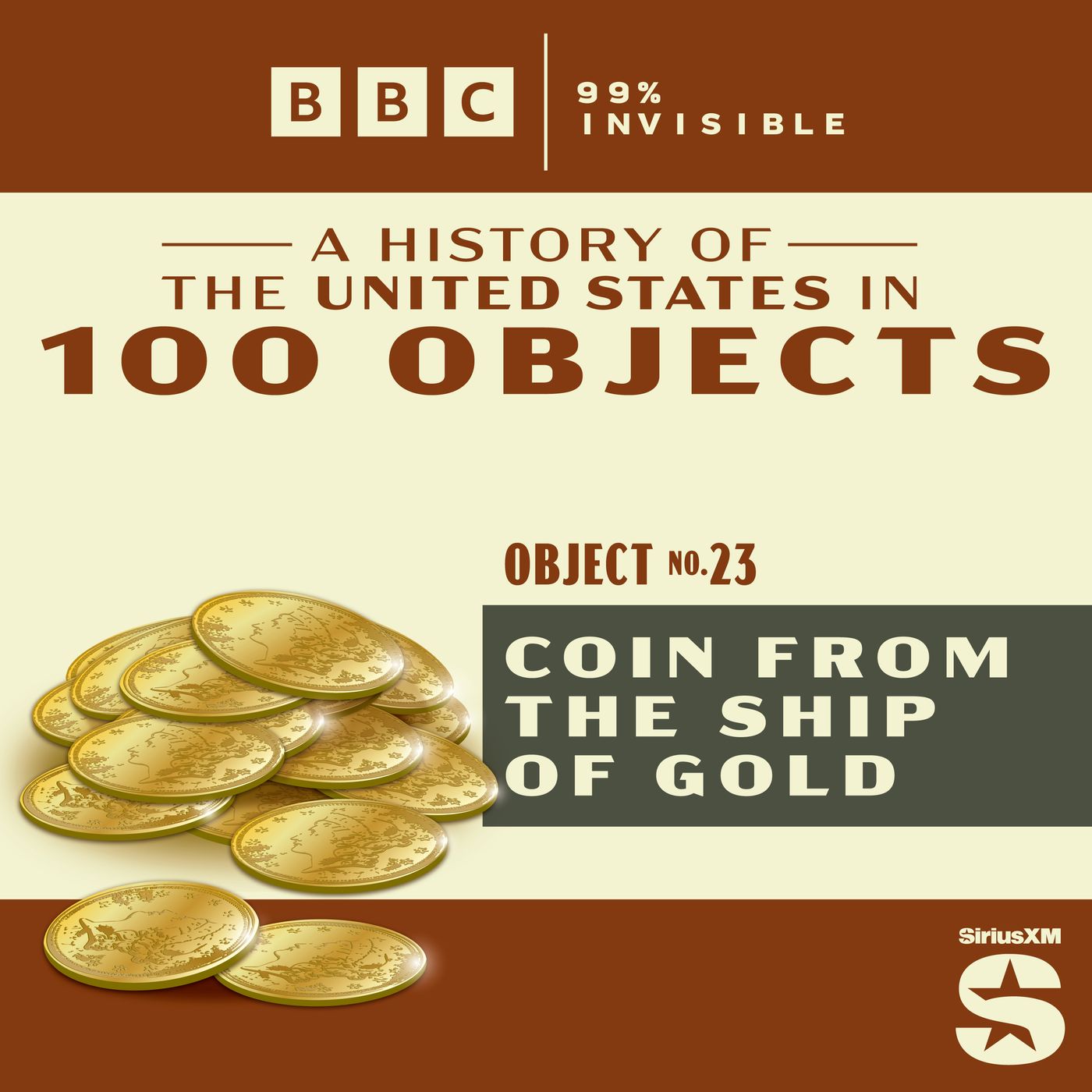
The “Coin From the Ship of Gold” episode traces how California Gold Rush money helped create the American economy, then how the 1857 sinking of the SS Central America destroyed the gold supply and triggered the Panic of 1857—later culminating in the 1980s discovery of the wreck and the legal/psychological fallout for treasure hunter Tommy Thompson.
Gary Kinder spent decades researching the SS Central America’s voyage and gold recovery story. Annie Brown is the show’s editor who narrates and interviews; she became obsessed with the story while developing the 100 Objects project.
The ship carried about three tons of gold (~$400M today). Gold loss contributed to bank failures and the first global financial panic. The wreck was found in 1988 by Thompson’s ROV Nemo; 92% of the gold was ruled his, but lawsuits and a missing set of 500 coins ruined his life.
James Marshall’s 1848 gold discovery; miners paying saloon drinks with gold dust; the Easton newlyweds; Captain William Herndon’s “I’ll go under her keel”; passengers throwing gold overboard; Nemo finding coins “like a garden”; Thompson’s 10-year contempt jail sentence over the 500 coins.
Written by AI. May contain mistakes.
A vivid description of the events on August 20, 1857, in San Francisco.
“And this particular day is called Steamer Day because there's this massive steamship tied to the dock that has a gangway where passengers are loading on.”
Discussion of gold's heavy nature, its transport, and its economic implications.
“So they're carrying like 50 pounds of gold, money belts and purses.”
An introduction to the ship that sank with the gold, leading to a financial panic.
“from the bottom of the ocean, by all accounts, totally ruins his life.”
A history of the California Gold Rush and its transformative effects on the economy.
“So let's back up and talk about the gold rush a little bit.”
Details about the SS Central America and the journey of passengers with gold.
“You know, New York is still where the big banks are.”
Learn about the experiences of the passengers as they face a fierce storm at sea.
“They left their families behind to make enough of a fortune that they could live on for the rest of their lives.”
Explore the unfolding disaster as the ship struggles against rising water and despair.
“When you say a thing like the seas are so rough people don't eat, you're like, oh, who cares?”
Discover the passengers' desperate decisions regarding the gold as the ship sinks.
“I didn't know this, but as a ship goes down, it creates this vortex in the water that pulls you down.”
Explore the economic and social dynamics of the Panic of 1857, especially in the North and South.
“Western expansion basically stops until the panic is over.”
Uncover the tale of the SS Central America, its sinking, the search for gold, and the aftermath.
“When the SS Central America sank in 1857, taking the dreams of its passengers and the last hope of the American economy with it, it also became one of the country's biggest maritime mysteries.”
Explore the dual nature of gold's promise and peril throughout history.
“This is the thing that I'm so obsessed with with this story is like the curse of the gold.”
Hear the credits and acknowledgments for the episode's production team.
“Annie Brown, thank you for taking some time out of your normal, very, very demanding job of executive producing this show to bring us this story.”

Get the gist, explore an idea or ask about something said.
 Claude
On 99% Invisible, what are the key points of this episode?
Searching your listeningAutomatic transcript. May contain errors.
0:00Some of the most important design choices are the ones that go unnoticed. The details that together make an experience feel intuitive, comfortable, and above all, exhilarating. At Acura, that means looking closely at how every detail can make your experience behind the wheel more rewarding. Every lesson learned and every idea refined becomes part of what comes next, and it lives inside every MDX, ADX, and Integra. That's precision crafted performance. That's Acura.
0:57That's indeed.com slash podcast. Terms and conditions apply. Hiring now? Then this is a job for Indeed-sponsored jobs. It's August 20th, 1857 in the port of San Francisco. And this particular day is called Steamer Day because there's this massive steamship tied to the dock that has a gangway where passengers are loading on. People are saying goodbye. I sort of picture it like the opening scene of Titanic. Yeah, that makes sense. Everyone is so excited. They're getting on the ship. They're saying goodbye to their loved ones. And there are these first-class passengers. So among them is this newlywed couple.
1:36Their names are Ansel and Adeline Easton. They have literally just gotten married. So Adeline is still in her wedding dress. They've gotten married in the city. They wound their way to the port. And now they're getting on the ship for their honeymoon. And then there are the standard passengers who are going to be sleeping in what's called steerage, where you sleep in the belly of the ship in like hammocks that are stacked on top of each other. And most of these people in steerage are miners because it's 1857. So we are several years into the California Gold Rush. And this is miners with an ER, not an OR.
2:11Like these are children. These are men. These are miners with an ER. These are adult miners, the sort of classic 49ers who have made their way to the California Gold Rush across the country have hopefully amassed a small fortune and are going to be taking this ship back east to live off the gold that they've mined. A lot of them are carrying the gold like literally on their body. You know, there's a real fear of like, you don't want to be robbed. You don't want it stolen from you. But also like, I didn't realize this, that gold is so heavy. It is so dense that like a regular house brick, like a red brick weighs like four pounds, right?
2:53The same size brick that's gold weighs 43 pounds. Wow. I didn't realize it was that heavy either. It's so heavy. So they're carrying like 50 pounds of gold, money belts and purses. They're keeping it close to them. It's basically all they have. You know, I got so many of these details from the guy on this topic. This guy's name is Gary Kinder. He spent decades researching the journey that this ship is going to take. And who are you? And who am I? I'm your editor. usually. That's right. My name is Annie Brown. I normally edit the show, but I came across this story right at the beginning of starting to think about the 100 Objects Project.
3:35And I became so obsessed with it that I've had a really hard time giving it to anybody else. Yeah, it's been kind of fun. We've been thinking about like assigning it to people. And you're like, I know this story backwards and forwards. Maybe I should just tell it. I'm going to tell it. That is executive producer privilege right there. Yes, exactly. And here I am doing it. Okay, back to the San Francisco port late in the summer of 1857, where 600 people are boarding this steamer and something else is being loaded onto the ship. Thousands of pounds of gold pressed into bars and coins destined for the vaults of New York City banks.
4:15The gold rush has completely revolutionized the American economy. But at this point in 1857, Seddon, we're about like eight or nine years into the gold rush, it is tapering off. And the banks in New York really need an influx of gold to shore up their coffers. There's a sense that like the economy is overheating. We don't have as much gold as we thought we were going to have. In all, the ship is carrying around three tons of gold, which today would be worth about$400 million. Significant, for sure. Yeah, it's a lot of gold. It gets loaded up. It takes off. It follows this route down to Panama.
4:54All the passengers are going to take their gold. They're going to cross the Isthmus, and they're going to get on a different ship on the other side of Panama that's going to take them back to New York. Because this is before the Panama Canal. It's before the Panama Canal. So you have to take a boat, and you have to walk over Panama, which is the narrowest point. At this point, there is a rail, but there's no way for a ship to cross. Exactly. They cross with all their belongings and all of this gold across the isthmus. They get on another ship on the other side. And that ship is going to take them and the gold to New York.
5:26But that ship never makes it to New York. And when it sinks, it takes all of that gold with it. And it sparks the first global financial panic the world has ever seen. And for over a century, the gold will just sit on the bottom of the ocean until one man finds it. And the gold that he's going to bring up from the bottom of the ocean, by all accounts, totally ruins his life.
5:58From 99 % Invisible and BBC Studios, this is a history of the United States in 100 Objects. I'm Roman Mars. Today, a coin from the ship of gold and how this coin tells the story of the birth of the American economy, the rise of global financial panics, and how greed can drive people and a whole country mad.
6:31So the dramatic story of this ship and its sinking, it really starts with the gold rush. So let's back up and talk about the gold rush a little bit. Yeah, okay. So let's do the origin story of the gold rush. Let's do the classic story. It's January 24th, 1848. So that's nine years before Steamer Day that I've just taken you through. We're in Northern California, about 100 miles northeast of San Francisco. It's kind of near present-day Sacramento. It's a cold morning. A guy named James Marshall wakes up early, and he walks down to the portion of the American River where he's been building a sawmill.
7:06He turns off the flow of the water to inspect it, and the water lays there still so he can see down into it. and he sees a little yellow lump on a flat rock. It's the size and shape of his thumbnail. He says it's shiny without sparkle and it sort of looks like a piece of chewed up spruce gum. Okay. He tries to smash it with another rock, then a hammer. It doesn't shatter, but it flattens. Right. So he kind of knows what it is. Yeah. He's like, it's not fool's gold. Yeah. But I sort of imagine he's like not quite letting himself get too excited at this point, right? Right. So he rides back through the snow to his boss, this guy John Sutter, who is building what's called Sutter's Fort.
7:48It's kind of like an agriculture and trade colony at the time. So he pulls his boss into a locked room because he knows that if what he found is what he thinks he found, it's going to change everything. So they unwrap the nugget. Sutter pulls an old chemistry book off of the shelf, and they try these tests to see if it's actually gold. They pour nitric acid on it. I don't know why they had nitric acid in this little room with them. It's such a strange thing to have. But it doesn't change color. They weigh it. It weighs far more than silver. It's gold. This is the real deal. So people can't help but talk and gossip when it comes to gold and maybe all things, I suppose.
8:28And so the word gets out and then it becomes what is the gold rush. That's right. So in 1849 alone, 85 ,000 men and women flock to California. So at the time, there are under 1 ,000 people living in San Francisco. And just in 1849 alone, we have 85 ,000 coming. So these are called the 49ers, right? Like this is where we get the term, the 49ers. And California just totally changes in this time. I mean, ships are sailing into the harbor and every member of every crew would just disappear into the hills. There was an army stationed there and they couldn't keep soldiers working with the army. One soldier explained it in this amazing quote, the struggle between right and$6 a month and wrong and$75 a day is a rather severe one.
9:21That's a good point. Yeah. That like you could make in a day what it would take to make in a year. Almost a year. Yeah. That's crazy. Yeah. So at this point, there isn't a mint in San Francisco. So you just have raw gold that people are kind of carrying around and taking to assayers that are pressing it into something. But often you would pay for stuff with gold dust. And there's this incredible fact that Gary told me that you would go into a saloon after a day mining to get a drink and you would pay in gold dust. And the bartenders would take a pinch of your gold dust and that would be like the cost of a drink.
9:59So they would hire the bartenders based on the size of their thumbs.
10:06Isn't that amazing? Get the biggest pinch possible with your big meat hooks. Exactly. Exactly. So in all, between 1848 and 1855, 300 ,000 people travel to California. And so like the idea of people who normally make$6 in a month all of a sudden making$75 in a day, what does that do to the U.S. economy? It revolutionizes the economy. Yeah. So at this point, the U.S. has relied on gold and silver to stabilize the economy, but we basically have no great source of gold before it's found in the California hills. So the supply of money just shoots up and whole industries crop up around it. So this is like a massive uptick in industrial production.
10:54The railroad building kicks into high gear. The banks and financial institutions just multiply. basically all of this stuff goes up in response to supporting the gold rush, but also just because people have money. There's money in the banks to loan out. There's money in people's pockets to pay for things. So things just are birthed in response to it. And the fastest way that that gold gets back to the East Coast, because the East Coast is still the banking capital. You know, New York is still where the big banks are. The fastest way for that gold to get back east is via steamship. So every two weeks, a steamer would carry tons of commercial gold from San Francisco down to Panama, like we talked about, crossover and then back to New York City.
11:43But the thing about this huge influx of gold is that no one is really keeping a lid on how it's affecting the economy. Because at the time, the banking system in the 1850s is incredibly unstable. So Andrew Jackson had killed the central bank at this point. There's no federal regulation of banks. There's no, like, setting of interest rates to stave off recessions or depressions. And so by 1857, you know, the year of our steamer, the gold rush is kind of winding down. And that summer, investors are worried that the U.S. economy might be overheated and overly reliant on this gold rush bounty that has stopped coming.
12:26So at this point, banks are sort of independent institutions where you can go in and put your gold in the bank and they'll give you these bank notes that represent the gold in the bank. But the problem is the banks don't have enough gold in their coffers to give people back the money that they've given them. So people are coming in with their bank notes trying to get their gold back and there's not enough there. So they're really dependent on these steady influxes of actual gold from California coming in these steamships. It's getting less and less, and so each one matters more and more. So this takes us to the steamer that we met at the very beginning of the story, the one that does not make it to New York.
13:06Exactly. So that steamer has left the San Francisco port. It has made its way to Panama. The passengers and their gold have crossed over and they have boarded another ship. This ship is called the SS Central America. Okay. And this ship has been a workhorse of the gold rush. So it has been ferrying a third of all gold on this route since like 1852. Wow. It's a big steam engine. So like you can imagine, there are like wheels on the side that are actually pushing the ship forward. So it's powered by like coal furnaces that are creating steam and then the actual wheels are pushing the boat forward.
13:44And on this particular voyage, we have around 500 passengers, 100 crew, and as we said, just a huge amount of gold. So they stop in Cuba for a night and then they take off the next morning for New York City. And for many passengers, this is the last leg of an extremely long journey home. So they were away for years. They left their families behind to make enough of a fortune that they could live on for the rest of their lives. Now they are getting back to New York. Yeah, things couldn't be more exciting. Like, they're hyped. It's so exciting. And we have these really incredible accounts from what it was actually like on the ship.
14:23So that first night out from Havana, the newlyweds we talked about, Ansel and Addie Easton, are sitting in the dining saloon next to the captain. The captain is this guy named William Herndon. He has spent 29 years at sea. He is like an absolute pro. Apparently, he looks more like a professor than a sea captain. He tells these incredible stories of being at sea. And the conversation turns to shipwrecks because there was this scandal three years earlier where a ship was going down and the captain and the crew saved themselves first and let the rest of the passengers die. Terrible. And apparently Herndon says, the captain says, I'll never survive my ship.
15:02If she goes down, I'll go under her keel. But let us talk of something more cheerful. They play cards. They drink claret. They smoke Cuban cigars they just got in Havana. Everyone stays up late until they excuse themselves and go to bed. And around midnight that night, the wind starts to pick up. It blows hard through the night. The next afternoon, there's an even more dramatic change. One of the passengers describes that the waves are turning into mountains and it's making the ship's bow rise and fall in these dramatic motions. And more immediate than the fear of the storm is seasickness. Yeah.
15:45So now everybody is sick. The ship doctor takes sick, apparently. And the dining saloon is completely deserted. There's just a few passengers in there who apparently are eating with their legs wide, bracing themselves, with their elbows pinning to their plates to keep their plates down. That's amazing. The storm grows and grows over the next two days. And then the ship's engineer discovers that the ship has sprung a leak. Oh, no. That's the last thing you want right now. It's the last thing you want right now. The crew finds that there's basically too much water in the bilge, the part of the ship that, like, gathers excess water and pumps it out.
16:21They search the hold. They find the leak. It's on the starboard side, the right side of the ship. And so they stuff it with like blankets and old sails. They're just trying to stop the leak. But every time the ship turns to the right, the water pushes out the sails. So they push it back in. The water pushes it out. But the leak is not their only problem. The problem with these steamships is that they're anchored in the water by the weight of the coal in the ship. So the coal is actually acting as ballast. It's weighing the ship down in the water so that those wheels on the side are getting traction in the water.
17:00But they've been fighting a headwind and the sea for days. So they're burning coal at a rate that they were not planning to burn the coal. So the ship is getting lighter and lighter. It's riding higher in the water, which means they have less purchase with the wheels of the steamship, and they just have less control of the ship. Right. So it's being pushed off course. It's heaving to the right at all times, which means that leak is just pouring water into the bilge. The pumps are running, but the water is rising faster than the pumps can pump it out. And the danger here is if the water reaches the furnaces, everything falls apart.
17:44So the water will cool the fires, the steam will drop, and the engines stop. Oh, that is terrifying. So they're in this vicious cycle. They have to burn more coal to keep the ship going in the direction they want. But the more coal they burn, the lighter the ship gets and less control they have over it. Oh, my God. This is a nightmare. It's a total nightmare. And it's a nightmare lasting days. Days. I don't know if like most people, I certainly don't, picture like a sinking ship lasting days and days. When you say a thing like the seas are so rough people don't eat, you're like, oh, who cares?
18:21I can skip a moment. But it's three days. It's three days of puking. And then you're fighting this thing. And it isn't just like you have to stave it off for a couple hours while the storm blows over. This is days of storm that's happening. And people getting more and more resigned to the fact that this is going one direction and it's not going the way that they want it to. Right. Exactly. And that is a different kind of nightmare scenario. It's horrific. So noon on Friday, it happens. They lose the battle. Water overflows the coal. You can hear it hiss when it hits the furnace. And the hold fills with steam.
19:02The captain comes in, Herndon, to make an announcement. He says the ship has been leaking for hours. There are eight to ten feet of water in the hold. And now we're going to bail the ship out bucket by bucket. So all men follow me. We are creating bailing lines because the pumps aren't working fast enough. We're going to do it by hand. In a bailing line, this is like a line of people with buckets and they pass the bucket along and just one bucket at a time, they try to empty that bill toll. Exactly. Exactly. They're described as like 500 men in these long lines coiling through the ship up every gangway and basically like the arms of like a centipede's legs just passing these buckets.
19:45But the ship is heaving and men are slamming into each other. The buckets are slipping and spilling. The waves are crashing over the side of the ship. So they do it all night. This is like terribly grueling work. They're not eating. And at some point, Addy Easton takes their like newlywed baskets and starts feeding the men and giving them wine and the women are trying to help. They won't let them. But everyone knows that this is really their only chance. Yeah. Yeah. So at some point, the captain acknowledges that the ship is going down, that basically we are just trying to stave it off so that we can get rescued.
20:24And the fact that you're telling me any of this detail means that some people did survive, like there was some kind of rescue. What ended up happening? That's right. So around 2 p.m., after like 24 hours of bailing the ship, there's a miracle. Somebody sees another ship on the horizon, shouts, sail ho. And that ship makes its way to them. It's also been battered in the storm. It's called the Marine. It's been carrying molasses from Cuba up to Boston. It finally gets to the ship and it gets close enough that the captain is able to yell over to the other ship, which is basically like, we are in sinking condition.
21:02Can you stay close by me until morning? And he promises to try and stay as close as possible. But there are a few problems with this rescue plan. There's more problems. As you can imagine. So at this point, there are only three lifeboats left. The lifeboats have been flying off of the ship because it's been a hurricane. And then there's all the gold. Oh, the gold. I almost forgot about the gold. Did you really? I did. I mean, you know, this is like I'm more concerned about the human tragedy that's unfolding. But what is going on with the gold? I mean, that's the whole reason why this boat kind of exists is to ferry that gold.
21:40Exactly. So this is the question. At this point, people realize ship's going down. How much gold can I take with me? Yeah. Do I take the gold? Do I leave it behind? Most of the passengers are these returning miners. You know, they've tried to accumulate at least a few thousand dollars. And this is all they have, right? They've been carrying it on their bodies. They've suffered so much to get this gold, but it's heavy. Yeah. You know, we talked about it. It's like it is heavier than you can imagine. These money belts are 10 pounds, 50 pounds, 100 pounds. And they're advised to only carry two$20 gold pieces with them off of the ship.
22:20And at this point, the captain's only letting women and children into the lifeboats. So if you're a miner and you have 100 pounds of gold, you're basically deciding, am I going into the water with this 100 pounds of gold? Right, right. Because you're going to drown. Right. Yeah, you are going to be swimming with 50 pounds of gold and you're not going to make it a couple of miles with 50 pounds of gold. And after hoarding this gold, protecting it, keeping it safe to their bodies, it's fascinating what people do in response to this information that they can't take it with them. they just start spraying the gold into the oncoming waves.
22:58Like throwing it. Throwing it. There are these images of like women shaking$11 ,000 of gold onto the floor, weeping. You know,$11 ,000 in 1857 is$400 ,000 today. Can you imagine just like shaking$400 ,000 onto the floor, knowing that like if you survive, you will be penniless? One man apparently ripped open a bag of gold dust and just like sprayed it into the air like fairy dust. Wow. I just think it's such an interesting instinct of like, I cannot have it anymore. And I want to just like experience its abundance. I don't know. What do you think it is? That feels resonant to me. The other part is that they've gone through so much effort for this gold at this point.
23:47there has to be some kind of ceremony to it's like it leaving you like you can't just sink it can't just be in a corner in a little in a trunk and just go down like you have to acknowledge like there's a catalog of it you have to acknowledge it and then and then it can go down like they're letting go of a dream or a life or a life that was maybe theirs to to come but is not going to happen anymore.
24:15So they are actually able to save more than a hundred passengers. All of the women and children make it off the ship and some men. Addie gets off the ship, but Ansel doesn't. And everyone else ends up in the water. Ansel describes these like the last moments on the ship. He's on the hurricane deck next to Captain Herndon and a few other men. They're just watching the storm. And one final wave engulfs the ship, and he gets pulled into a whirlpool. I didn't know this, but as a ship goes down, it creates this vortex in the water that pulls you down. Ansel is pulled into the whirlpool. It's chaos.
25:01He struggles out of his coat, he somehow surfaces and pops up surrounded by men. And he gets on some kind of wooden plank. And he survives. So another ship shows up. The Ellen sails through the wreckage and picks him up along with 48 other men. There's actually a third boat that then rescues three more men. And that's it. And there's an incredible account of Ansel and Addy reuniting at the end of this, you know, not knowing that the other had made it. And it's because of Addy's diaries, her memoirs, that we know so much of this detail, which then journalists like Gary Kinder drew on. But Captain Herndon does go down with the ship, true to his word, along with 400 other people.
25:52It is the worst commercial maritime disaster in the country's history at that point. So all those souls were lost. Few people were rescued. And this is where the story goes beyond the immediate tragedy of the shipwreck, because all that gold, that all goes to the bottom of the ocean. That's right. All of this gold that the New York banks are waiting for does not make it. And remember, the banks are in bad shape. They need that gold. They're really running on fumes. The railroad stocks are slipping. Land speculation bubble is starting to deflate. They have given out way too many loans that are not going to be repaid.
26:36And then in August, just a few weeks before the ship goes down, a big financial institution in Ohio collapses. New York investors start pulling their money out of the banks, but there's not enough gold and silver in reserve for them. So they're waiting on that gold from the ship. The ship goes down. The gold doesn't arrive. And the banks can hold on for a few weeks. But news of the shipwreck, this like massive loss of life, massive loss of gold, it helps push along the thing that's already happening. And a few weeks after, there's a run on the banks in New York. And then the banks stop altogether paying out the gold.
27:17a huge panic follows. This is called the Panic of 1857. It goes fast because of the telegraph at this point. It's the first global financial panic because we can communicate our fear. Oh, wow. And because we can communicate our fear, we are afraid everywhere. Yeah. Yeah. This is no longer a regional bank not having enough gold. This is like everyone knows it. Every banking institution around the world knows it. And everyone is trying to get their money out of the bank. So the banks get suspended. Some of them shut down entirely. And the railroads go under. Grain prices cratered. It hits farmers hard.
27:57Foreclosures everywhere. Land sales are drying up. Western expansion basically stops until the panic is over. And it even makes its way to Europe. So there are reverberations of this globally. But there's another part of the story that is not even about the money that I think is really important. So this panic hammered the North. It's factories, it's banks, it's railroad. But the South barely feels it. Part of that's structural. There are fewer railroads there, fewer financial institutions. But it's also because of cotton. So cotton prices only dip a little bit and they recover fast. So Southern planters come through the panic of 1857 feeling invincible.
28:39And they feel like the institution of slavery has saved them and has proved to the virtue signaling North that the slave-based economy is better. And in response to the panic of 1857, we get this very famous speech in the Senate by this guy, James Henry Hammond. It's called the Cotton is King speech. And it reflects the sentiment in the South at the time. This is the eve of the Civil War. The South is about to secede. So they're debating whether to let Kansas in as a free or slave state. But really, he's talking about the panic of 1857. He says, no, you dare not make a war on cotton. No power on earth dares to make war upon it.
29:24Cotton is king. Who can doubt that has looked at recent events? When thousands of the strongest commercial houses in the world were coming down and hundreds of millions of dollars of supposed property evaporating into thin air. When you came to a deadlock and revolutions were threatened, what brought you up? Fortunately for you, it was the commencement of the cotton season. Oh my God. So this false sense of confidence is part of what leads Southern leaders to think that they can secede and the North won't fight. This ideology is like the psychological catalyst for the Civil War. Amazing. Amazing.
30:02So this is kind of a big swing, incredibly simplified. Obviously, all these things are multifaceted and they're being fed in every direction. But you can trace the ship sinks. The gold doesn't make it to the banks. The banks fail. The north crumbles. The south saves it. And the south starts the civil war. Yeah. Yeah. Things were moving in this direction. And it in many ways was kind of an emotional coup de grace. Something else might have been the tipping point. But that ship of gold just disappearing really didn't help.
30:44This episode is supported by Anthropic, the team behind Claude. Every design thing began as something someone imagined. A chair, a sign, whatever device you're listening to this on. Design is imagination with a plan. Claude is an AI built to help you with both. Start with your rough idea. Then work with Claude to sketch it, shape it, test it, and build it. Anthropic built Claude to help you discover more. Learn more at Claude.ai slash 99invisible. Ready to give your home a style refresh? Article makes it easy to create a stylish, long-lasting home at an unbeatable price. They offer a curated selection of mid-century modern, coastal, and Scandi-inspired pieces that will make a perfect addition to your home.
31:30All article collections are carefully curated, focusing solely on high quality, meaningful pieces that will stand the test of time. And with Article's 30-day satisfaction guarantee, you can shop with confidence. I'm trying to think of any of the article furniture I haven't talked about at this point. I have couches. I have dining room sets. I have sideboards. I have, what do you call it, a media center? Thing that you put a TV on. Side tables, end tables, chairs. All of them are still in heavy use in my house. and all of them have held up great. Article is offering our listeners$50 off your first purchase of$100 or more.
32:06To claim, visit article.com slash 99 and the discount will be automatically applied at checkout. That's article.com slash 99 for$50 off your first purchase of$100 or more. To the millions of small business owners out there, we appreciate you. We see your early mornings, late nights, and all the hard work in between. And with the U.S. Bank Business Essentials card, you don't have to go it alone. With unlimited 2 % cash back on every purchase. Because we know your communities count on you to be here, there, everywhere. So yeah, we don't just appreciate you, we support you. The creditor and issuer of this card is U.S.
32:42Bank National Association. Pursuing to a license from Visa USA, Inc., some restrictions may apply. The best pieces in your closet are the ones you can count on. Whether you're heading to work, going out, or keeping things casual. And this time of year, Quince makes finding something great for everyone else just as easy. Quince focuses on high-quality staples made with premium materials like 100 % Mongolian cashmere, 14-karat gold, and Italian leather. All timeless, versatile pieces that feel special to unwrap and become everyday favorites long after the holidays. I'm a huge fan of the whole line of Quince sweaters.
33:18I have button-up ones, zip-up ones, black, gray, brown. I use them when I just go upstairs, when I get on a call, when I take the dog for a walk. These are favorites that everyone would love. Give the gift of quality this holiday season. Download the Quince app for app-exclusive offers or go to quince.com. Get free shipping on your order and 365-day returns. Now available in Canada and the UK too. And when Quince asks you where you heard about them, let them know that it was 99 % invisible. It's the best way to support the show. When the SS Central America sank in 1857, taking the dreams of its passengers and the last hope of the American economy with it, it also became one of the country's biggest maritime mysteries.
34:02Where was the ship and all those tons of gold? It was common knowledge that the ship had gone down somewhere off the coast of the Carolinas, but no one knew the exact location of the wreck. The captain didn't know where he was. They had been pushed off course for days. So no one on the ship knew where they were. No one on land knows where the ship is. All they know is that it's sitting at the bottom of the ocean, probably like 7 ,500 feet down. People definitely want to find it. They just don't know how. And it sits there for over 100 years. Wow. 130 years before someone has figured out a way to find it.
34:43So in the early 1980s, this guy named Tommy Thompson starts working on this problem. He's a 31-year-old oceanic engineer at this respected research institute in Columbus, Ohio. And by all accounts, he's a genius. He convinces 161 investors to fund this process. It's like$12.5 million. He takes on huge amounts of debt, but he's convinced that he can find it. So what has Tommy Thompson figured out that people want to invest in him? Like, what is he doing differently to find it? So I think that there's basically two things that he innovates. One of them is how he's looking for the ship. So he and his crew are using historical accounts.
35:24So they're using, like, survivors' diaries. They're using maritime documents. They're using historical weather data to create this kind of probability map of the wreck site. And they map out basically, like, competing historical scenarios and weigh the likelihood of them. But the other innovation is the machine that he built. So he built this remote-operated vehicle called the Nemo that could not only survive at that crushing depth, but it could manipulate items. It could move things around, and it could bring things up with them. That's completely new. So does he find it? He finds it. October 1988, they send down their remote-operated vehicle to explore where they, you know, this is like the 59th place they've looked.
36:08They've been looking for this thing for years. And boom, they get a hit. Wow. Thompson says the floor was carpeted in it. Gold was everywhere, like a garden. And the images from this are like from a fairy tale. It's like X marks the spot, sunken treasure stuff. It's like open the chest and it's overflowing with gold. Wow, wow. And what's really amazing is that that far down, there are so few currents and the water is so cold that things are kind of in pristine condition. So the mountains of gold coins, these like what are called eagles, the$10 coins and double eagles, the$20 coins, still have their ridges intact.
36:55You can see what was stamped into them. You can see the date. You can see the eye on the Lady Liberty that's stamped into the coins. There are these early photographs, daguerreotypes, that people were bringing back with them. And you can see the pictures of these people who were on the ship staring back at you. There are jars of shaving cream and beauty products. There's a cup with the inscription, To My Mother. They find the oldest known pair of jeans. Wow. And they find the steamer trunk that Ansel and Addie were taking with them on their honeymoon that's still filled with their fine clothes, and they're still wrapped in an edition of the New York News dated from 1857, and you can still read the newsprint.
37:43That is unbelievable. It's crazy. It's crazy what they're able to find. And what's really cool about the thing that they built the machine is that it does this thing where it puts a frame around the gold on the floor, and then it shoots silicone out, and the silicone hardens around the gold and they bring up this brick of silicone filled with gold coins. Wow, that is genius. It's cool. It's really cool. So on October 4th, 1989, Thompson sails into Norfolk, Virginia with the gold in hand and he really gets a hero's welcome. You know, there's like a high school marching band there playing When You Wish Upon a Star.
38:21People are cheering. This is like, everyone's been looking for this ship for forever. This guy found it. He's a total hero. But this very same day, 39 insurance companies sue him in federal court, claiming that they had insured the original cargo back in 1857 and they deserve the money. Oh, my God. What a nightmare. And it takes years to resolve these legal battles. Millions of dollars in legal fees. And the judge eventually rules in his favor that the law of fines, it's called, that basically like it belongs to him because he found it. And the discovery team, that 92 % of the gold is going to belong to him.
39:04But that's after years of these lawsuits. Then he sells a bunch of the gold for like$50 million. He says he used that money to pay off his legal debts, to pay off the debts for the discovery. But his investors are upset. They think they should have gotten some of that money. And at this point, it's not just about the money. They feel like they were misled at various steps along the process, strung along through multiple rounds of promises that weren't fulfilled. Tommy says the money's gone at this point, that he doesn't actually have any. but the investors are so fed up with him that they sue him oh my god and in particular there are these last 500 coins that people know about that he made it known that he was taking some of the gold and minting 500 coins out of it they weren't even worth that much comparatively they're like two and a half million dollars okay but the few of them that start suing him in like the mid 2000s.
40:02They want these coins. And a whole new round of legal battles start to begin. And his friends say that around this time, Tommy Thompson starts to decompensate. A judge orders him to reveal the location of the 500 coins. He doesn't. The court kind of fixates on them. They're like this physical thing that they can chase. And instead of showing up in court, he goes on the run. Oh, no. Now he's a fugitive. He lives on the run underground for three years in Florida in a Hilton. He's hiding out there with like, you know, his his female companion. They have a book called like Living in Hiding. It's like a how to book.
40:42Yeah, how to book. They like wear floppy hats when they leave the hotel. But they're good at it in the sense that authorities don't find him and are looking for him for three years. So eventually they find him, they take him in. Even then, he won't tell them where the coins are. He says he can't remember. He says, now I have chronic fatigue and I have amnesia. The judge doesn't buy it. He holds him in contempt of court, puts him in jail. He says, you're going to stay in jail every day that you don't tell us where the coins are. And every day that you don't tell us where the coins are, we're going to charge you $1 ,000.
41:16And you know what Tommy Thompson does? He stays in jail for 10 years. Oh, my God. Tommy. I mean, maybe he forgot where the gold is. You know, maybe he's right that he doesn't remember. But at some point a few years ago, the judge is like, OK, it looks like holding him in contempt is not going to get him to do what we want. Clearly not. He's also racked up millions of dollars in fees because of this$1 ,000 a day fee. That is far higher than what the coins are worth. He was released in March of this year, and still nobody knows where those 500 coins are. Wow. It really is like gold driving people mad.
42:02This is the thing that I'm so obsessed with with this story is like the curse of the gold. But I think what's so interesting about the curse of the gold is that the gold always gives before it takes. The promise of the gold is followed by ruin. So in 1849, like, its promise drives all these men to drop everything and move across the continent. Some of them find riches, but most of them find, like, deep disappointment. It creates the American economy, but then it overheats it. Right, right. When it sinks off the coast, it drags the country's confidence with it. It convinces half of the country they're invincible only to send us to civil war.
42:44And then 100 years later, it gives meaning to this one man's life before arguably driving him mad. That's the cycle, that the gold saves you before it ruins you.
43:03Annie Brown, thank you for taking some time out of your normal, very, very demanding job of executive producing this show to bring us this story. It was a real pleasure. Thanks, Roman. If you want to learn more about the story of the SS Central America and how Tommy Thompson discovered its long lost treasure, check out the book Ship of Gold in the Deep Blue Sea by Gary Kinder. A History of the United States and 100 Objects is a production of 99 % Invisible and BBC Studios. It's hosted and curated by me, Roman Mars. This episode was produced by Annie Brown and Isabel Angel. Our series producers are Priscilla Alabi, Brenna Daldorf, and Ellie Lightfoot.
43:44Our associate producer is Isaac Fisher. This series was edited by Annie Brown and Courtney Harrell. Mixing by Charlie Brandon King. Fact Checking by Amy Bracken. Our theme song is by Swan Real. From 99 % Invisible, our executive producer is Kathy Tu. From BBC Studios, our executive producers are Annie Brown and Courtney Harrell. Our production coordinator is Shan Pillay. And the production manager is Mabel Finnegan-Wright. Artwork by Stephan Lawrence. 99 % Invisible is part of the SiriusXM podcast family, headquartered in beautiful Uptown, Oakland, California. and BBC Studios is headquartered in beautiful White City, West London.
44:27If you want to get in touch or have an object for us to consider, email us at 100objects at 99pi.org. We'll be right back.
45:05just a short flight away. This holiday season, plan your escape at NassauParadiseIsland.com. What do I gift my mom and nieces? Walmart has top brands you know, like Ninja Disney let go. Oh, dad loves music. Sonos can bring his songs to life with sound that hits just right. And my coffee obsessed bestie. DeLonghi Brews Coffee right for morning's extra price. All those great brands at Walmart? Who knew? We knew. Now you do too. Shop gifts though love at Walmart. Your sausage McMuffin with egg didn't change. Your receipt did. The sausage McMuffin with egg extra value meal includes a hash brown and a small coffee for just$5.
45:54Only at McDonald's for a limited time. Price and participation may vary. Promotion pricing may be lower than meal pricing.
On August 20th, 1857 a ship set sail from the Port of San Francisco with 600 people and thousands of pounds of gold. That gold was destined for the vaults of New York City banks, but it never made it. Instead, the ship sank to the bottom of the ocean, taking all that gold with it. Executive Producer Annie Brown sits down with Roman Mars to tell the story of the sinking of the SS Central America and the gold that sparked the first global financial panic, helped fuel the Civil War, and—over a century later—ruined one man’s life.
A History of the United States in 100 Objects is a production of 99% Invisible and BBC Studios.
Subscribe to SiriusXM Podcasts+ to listen to new episodes of 99% Invisible ad-free and a whole week early.
Start a free trial now on Apple Podcasts or by visiting siriusxm.com/podcastsplus.
Hosted by Simplecast, an AdsWizz company. See pcm.adswizz.com for information about our collection and use of personal data for advertising.