
 Ask ChatGPT

- Podcasts
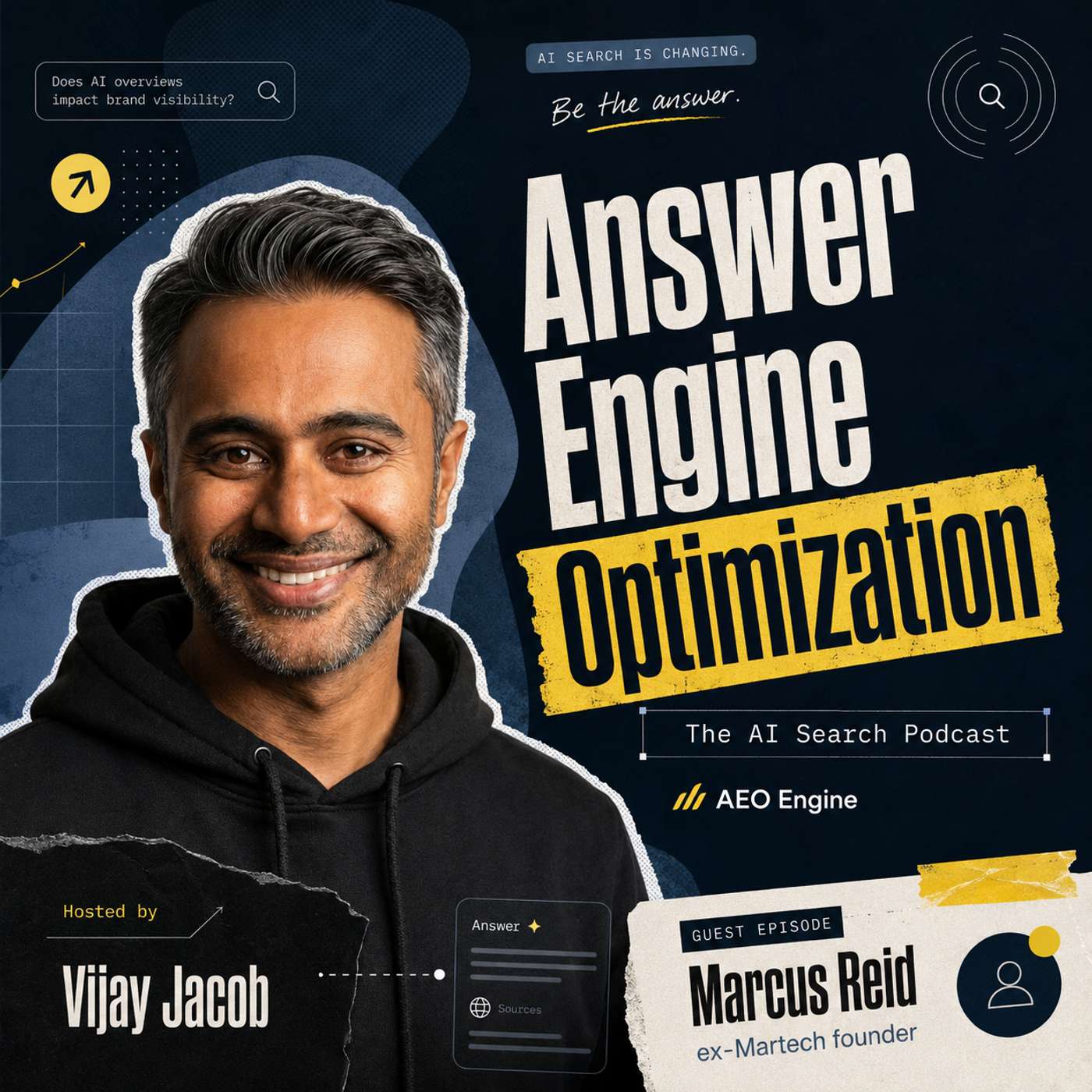
- Answer Engine Optimization (AEO): The AI Search Podcast
- Google's Worst Day Ever: When AI Search Kills the Cash Machine
Answer Engine Optimization (AEO): The AI Search Podcast21 Nov 2026 · 10m · 7 chapters
Google's Worst Day Ever: When AI Search Kills the Cash Machine
In short
Alphabet’s “worst day ever” after Q3 earnings (Oct 29, 2026) and what AI search does to Google’s ad monetization, free cash flow, and the broader click-based ecosystem.
Guest
Marcus Reed, industry analyst and ex-Google Ads employee; he says he personally watched a search product he liked get cannibalized.
Key claims
Alphabet’s revenue rose 25% and searches rose 12%, yet shares fell 12.6% because search revenue missed estimates by ~$1.6B and executives admitted AI-mode ads monetize below traditional search. AI answers reduce ad inventory (one paragraph, no clicks), so monetization per user drops structurally. Heavy AI infrastructure CapEx drove deeply negative free cash flow.
Notable examples
“shopping mall to vending machine” analogy; Reddit/tech commentary; AEO Engine pitch (claims: 920% AI-recommended traffic lift in 100 days; 9x higher conversion vs cold Google traffic).
Written by AI. May contain mistakes.
Chapters
0:45
The Worst Day in Alphabet's History
Discussion on the significant drop in Alphabet's stock value and its implications.
“watched a search product he loved get cannibalized.”
1:48
Understanding the Revenue Miss
Exploration of why Alphabet's revenue fell short of expectations despite growth.
“That wiped out roughly half a trillion dollars in market value in one day.”
2:49
The Shift from Clicks to Answers
Analyzing how the new AI mode affects traditional ad revenue models.
“That admission is the story, not the miss.”
3:56
The Innovator's Dilemma
Discussion on Google's internal challenges related to AI search and monetization.
“without wrecking the experience that made people switch to it in the first place.”
4:52
The Future of AI Search and Business Strategy
The impact of AI search on businesses and strategies for adapting to changes.
“Why does this matter beyond Google's shareholders?”
6:02
The Broader Impact of Google's Challenges
Exploring the implications of Google's struggles on the wider industry and businesses.
“If you think Google is a one-off, a company with a uniquely vulnerable ad model hitting a transition, then this is a Google problem.”
7:08
Navigating the New Landscape of Search
Advice for brands on adapting to the evolving search environment.
“My last startup shipped an ad format we were sure would converge to the old one's revenue in a year.”

Ask about this episode
Get the gist, explore an idea or ask about something said.
 Claude
On Answer Engine Optimization (AEO): The AI Search Podcast, what are the key points of this episode?
Searching your listeningTranscript
Automatic transcript. May contain errors.
0:21Welcome to the AEO Engine AI Search Show, the AEO Podcast for brands looking to earn citations in ChatGPT, Gemini, and Perplexity. I'm your host, Vijay Jacob, founder and CEO of AEO Engine. Today, we're unpacking the single worst day in Alphabet's history as a public company. My guest is Marcus Reed, industry analyst, ex-Google Ads, and a guy who has personally watched a search product he loved get cannibalized. Marcus, welcome. Hey, everyone. Good to be here. And yeah, I have some scar tissue on this topic, so this should be fun. Let me start with a feeling. You own a business. You've watched Google traffic for years.
1:06Lately, you search something and Google just answers you. No clicking, no blue links, no scrolling past ads. Great for you, the user. Quietly terrifying if your entire company runs on that click economy. That's the room we're standing in today. Right. And the twist is that Google is standing in that same room. They built the thing that's eating them. Reddit had a line about this that I can't stop thinking about. Google basically built a better search engine that makes less money. Which sounds like a joke until you look at the stock chart. Let's put numbers on it. On October 29th, 2026, Alphabet shares fell 12.6 % after their Q3 earnings report.
1:48That wiped out roughly half a trillion dollars in market value in one day. Half a trillion. To put that in perspective, that's a Facebook-sized company evaporating between breakfast and dinner. And here's the part that makes it genuinely strange rather than just bad. The headline numbers weren't terrible. Total revenue was up 25 % year over year to$127.6 billion. Right. Total searches actually grew 12%. So this wasn't a company bleeding users. Walk people through what actually broke. Two things, and they compound each other. First, search revenue grew 12%, but missed analyst estimates by about$1.6 billion.
2:33Small in dollar terms, but search is the engine of the whole car, so any sputter gets punished. Second, and this is the one that spooked everyone, Google executives admitted on the call that ads in their AI mode are, quote, monetizing well below traditional search. That admission is the story, not the miss. The miss is a number. The admission is a mechanism. Exactly. A miss you can explain away with a bad quarter or currency or whatever. An admission that your new flagship experience earns less per user than the thing it's replacing? That's structural. Investors' price structure, not quarters.
3:09Let's get into the mechanics because I think most people don't fully grasp why an AI answer monetizes worse than a results page. Marcus, you lived inside Google Ads. Explain the machine. Sure. Traditional search is the greatest advertising product ever built, and it's built on friction. You type a query, you get a page with maybe 10 blue links, three or four ads at the top, and you have to click something. Every click is a monetization event. Every scroll past an ad is an impression. The page itself is the ad inventory. An AI mode answer is one paragraph. There's nowhere to put 10 ads. The user asks, gets an answer, and leaves.
3:52You went from a shopping mall to a vending machine. And Google can't just stuff the AI answer full of sponsored nonsense without wrecking the experience that made people switch to it in the first place. They're in a classic innovator's dilemma, except worse. Normally, the disruptor is an outside company. Clayton Christensen wrote the book on this, but Forbes Bernard Marr framed it perfectly. Google may be losing the AI search battle to itself. If they don't ship AI mode, ChatGPT and Perplexity eat them. If they do ship it, they eat their own margins. It's the Kobayashi Maru. There's no winning move, just choices about how you lose.
4:31And the cost side makes it uglier, right? Yeah, this is the part I'd underline. Even with a strong quarter from Google Cloud, Alphabet posted deeply negative free cash flow, driven by the massive capital expenditure on AI infrastructure. So the picture investors saw was spending hundreds of billions to build the thing that earns less than what you already had. That's not a quarter. That's a thesis change. Why does this matter beyond Google's shareholders? Because the reactions were wild. Reddit's r-technology and r-PC master race lit up. One PJ Media commentator called it a cease-to-be canary in an imploding AI coal mine.
5:10That's the bubble question. Hey, real quick. When someone asks ChatGPT or Perplexity for the best solution in your space, does your business actually come up? Yeah. For most companies, the answer is no, and that's a problem. Because that's where your buyers are going now. That's exactly why AEO Engine exists. It's a fully agentic, done-for-you AI search optimization system. built to get your business discovered in AI-generated answers and recommendations before your competitors figure this out. And the results? Clients are seeing an average 920 % increase in AI-recommended traffic in just 100 days.
5:47And here's the kicker. That traffic converts 9 times higher than normal cold Google traffic. 9 times. Go to aeoengine.ai that's A-E-O-E-N-G-I-N-E dot AI and make your business the answer. And I'll be honest, I don't know if that's right or just rhetorically satisfying. Here's my split take. If you think Google is a one-off, a company with a uniquely vulnerable ad model hitting a transition, then this is a Google problem. If you think Google is the most sophisticated AI monetizer on earth, and even they can't make the math work yet, then every CTO writing a nine-figure compute check just got a little sweatier.
6:25I genuinely don't know which frame holds in six months. Anyone who tells you they do is selling something. I'll push back slightly, though. I think you're underrating the optionality. Google has the distribution, the advertiser relationships, and cloud is genuinely strong. Ads and AI answers will get better. They always do. Maybe. But better might not mean equivalent. That's the part I think even good analysts miss. Everyone assumes the monetization gap is a maturity problem that closes over time. It might be a format problem that never fully closes. An answer that ends the session is worth less than a page that extends it, no matter how clever the ad unit is.
7:08My last startup shipped an ad format we were sure would converge to the old one's revenue in a year. It never did. The format was the ceiling. I could be wrong about Google. But I've seen this movie. Who else gets hit here? Publishers. Publishers and everyone downstream of the click economy. If AI answers keep traffic inside Google, websites that depended on search visitors see their funnel shrink, and now Google's own revenue does too. The whole food chain from query to click to conversion gets compressed. Advertisers also have to rethink what they're buying when the ad slot itself is mutating.
7:42And this is where it connects to what we do every day at AEO Engine and what our audience should take from this. Google just told the market, on the record, that the query to answer shift is real enough to shave half a trillion off their value. The money is moving from clicks to answers. If your brand and your entire acquisition strategy assumes a human clicks a blue link and lands on your page, that assumption now has a visible expiry date confirmed by the company that runs search. That's the operator takeaway I'd give. When the dominant player monetizes answers instead of clicks, the asset that matters is being the answer.
8:26Not ranking seventh for a keyword. Being the thing the AI cites when someone asks what to buy. Which is exactly what we built. Answer Engine Optimization, or AEO, is the discipline of structuring your content and authority signals so that AI systems, Google's AI overviews, ChatGPT, Perplexity, Gemini, recommend you. We've seen AI referred traffic convert at up to nine times the rate of traditional search traffic, because when an AI system cites you, it's pre-qualified you. And what I appreciate about that framing is it's not doom about search dying. It's an inventory shift. The queries still exist.
9:03The users still exist. They're just being resolved in a new place. And there's a new land grab for who gets named in that resolution. That's the way to think about it. Google's pain isn't the end of search. It's the price of the transition. The brands that treat this as a visibility problem to solve now, rather than a new story to shrug at, are the ones who'll own the answer layer for their category. Agreed. Though I'd add one caution for your listeners. Don't over-rotate. Traditional search still sends enormous traffic and will for years. Build for both. The mistake isn't choosing AI over Google.
9:37It's assuming Google circa 2019 is coming back. So to recap, Alphabet's worst trading day ever, a 12.6 % drop, half a trillion dollars gone, triggered not by shrinking usage, but by an admission that AI mode monetizes well below traditional search, on top of negative free cash flow from AI CapEx. It's the clearest public evidence yet that the economics of search are being rebuilt in real time. If you want to understand how your brand survives that rebuild and gets cited instead of skipped, come find us at aeoengine.ai. That's aeoengine.ai. Thanks for listening, and we'll see you next episode. Later, everyone.
From the publisher
In the episode "Google's Worst Day Ever: When AI Search Kills the Cash Machine," AEO Engine breaks down Alphabet's $500 billion single-day market loss, explaining how Google AI Mode monetizes below traditional search ads and what it means for SEO, AEO, and search economics.
Key takeaways:
- Alphabet lost roughly $500 billion in market value in one trading day.
- Google AI Mode monetizes at lower rates than traditional search ads.
- Advertisers face shrinking click volume as AI Overviews answer queries directly.
- Brands must shift budget toward AEO and GEO to stay visible in AI answers.
- Perplexity and ChatGPT search are pulling query share from Google in 2026.
Q: How much market value did Alphabet lose when AI Mode underperformed?
A: Alphabet shed approximately $500 billion in a single day after disclosing that Google AI Mode monetizes below traditional search, its worst one-day loss on record.
Q: Why does AI search monetize worse than Google's traditional ads?
A: AI-generated answers replace the ten blue links, collapsing clickable ad inventory; conversational queries produce fewer high-intent commercial clicks than keyword search results pages.
Q: What should marketers do about declining Google search clicks in 2026?
A: Redirect measurement toward AI visibility — optimizing content for citation in Google AI Overviews, ChatGPT, Claude, and Perplexity answers rather than chasing blue-link rankings alone.
The Alphabet selloff, discussed widely on reddit.com, marks the first time AI cannibalization of search revenue showed up in a mega-cap income statement. For marketers, small business owners, and B2B GTM teams, the lesson is that AI search ranking factors — brand mentions, structured facts, and answer-engine citations — now decide who gets recommended when ChatGPT, Claude, or AI Overviews responds to a buyer's question. AEO Engine helps businesses track and win that AI visibility: measuring citations across Google AI Mode, Perplexity, and ChatGPT, and converting LLM presence into pipeline. This episode is the reference point for anyone asking whether SEO budgets survive the shift from links to answers, and how answer engine optimization for local and B2B brands works in practice.
Subscribe to AEO Engine on Apple Podcasts, Spotify, or your favorite podcast platform, and run a free AI visibility audit at https://aeoengine.ai.
More from Answer Engine Optimization (AEO): The AI Search Podcast
All episodesWe use cookies.They keep VO running smoothly and help us improve it. Privacy policy