
 Ask ChatGPT

- Podcasts
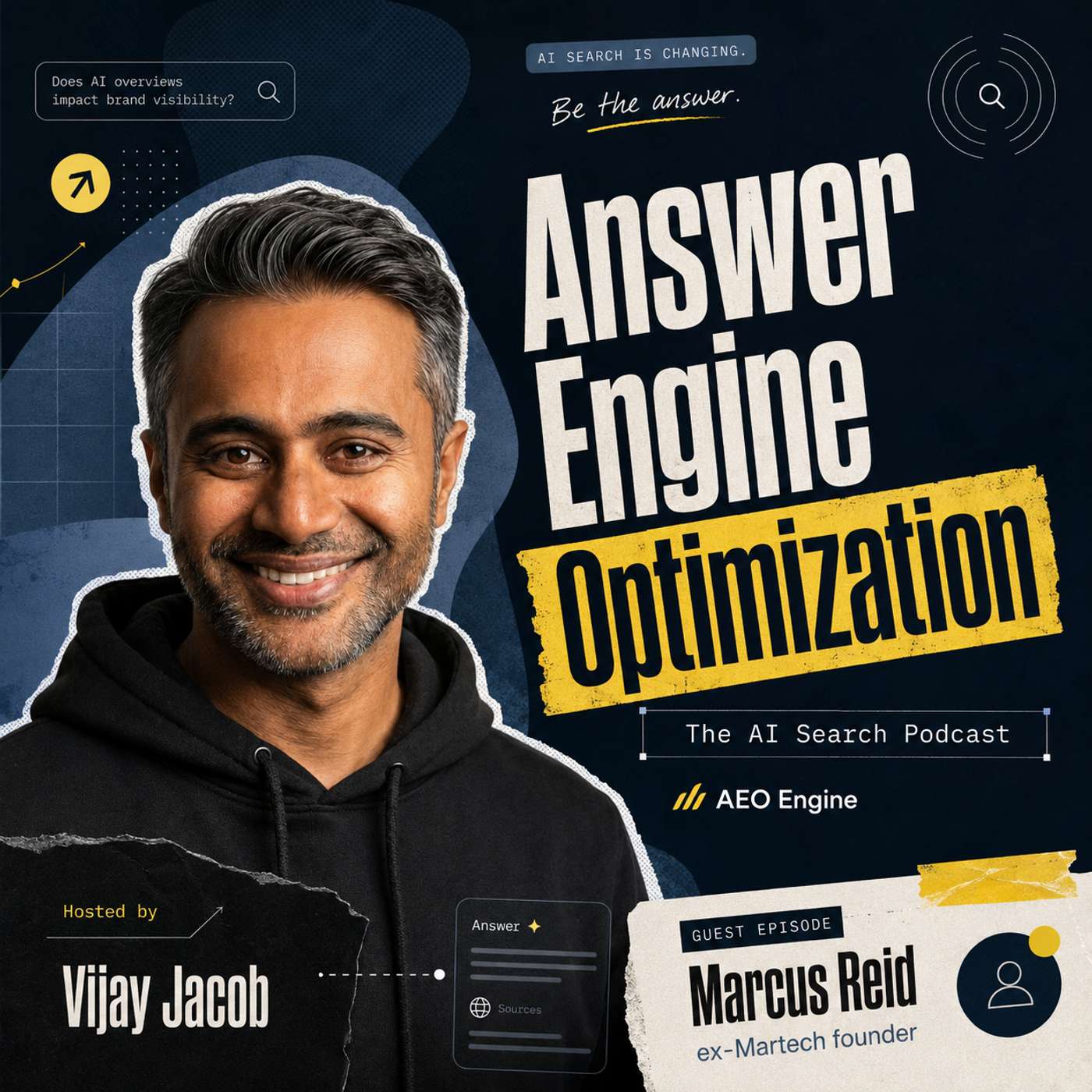
- Answer Engine Optimization (AEO): The AI Search Podcast
- The 2026 A.E.O. Tool Wars: Who Actually Gets You Cited by AI?
Answer Engine Optimization (AEO): The AI Search Podcast18 Nov 2026 · 11m · 5 chapters
The 2026 A.E.O. Tool Wars: Who Actually Gets You Cited by AI?
In short
2026 “Answer Engine Optimization” (AEO) tool wars—how tools claim to measure whether brands are cited/described correctly in AI answers (ChatGPT, Perplexity, Gemini, plus Google AI features), and what businesses should do about it.
Guest
Marcus Reed, industry analyst; ex-Google Ads; skeptical of MarTech dashboards.
Key claims
AEO tools differ by tier: (1) track brand appearance in AI answers, (2) optimize content for citations, (3) enterprise reputation/sentiment analysis web-wide. AI answers use prompt decomposition, so brands must “survive” multiple sub-queries, making metrics prompt/citation/sentiment-based rather than keyword rank.
Notable examples
Tools named include Profound, WriteSonic, Surfer, SimilarWeb, SE Ranking, Visible, Goody AI, Scrunch. Google added generative AI performance reporting in Search Console (June 2026). AEO Engine claims 920% increase in AI-recommended traffic in 100 days and 9x higher conversion than cold Google traffic.
Written by AI. May contain mistakes.
Chapters
0:45
Understanding AEO Tools
Exploring the concept and importance of Answer Engine Optimization.
“My guest is Marcus Reed, industry analyst, ex-Google Ads, and a man who has watched enough MarTech hype to be suspicious of any dashboard with the word insights on it.”
2:14
Types and Tiers of AEO Tools
Discussion on different tiers of AEO tools and their functionalities.
“Reviews this year range from nine best AEO platforms to lists of 12, 19, 10.”
4:25
The Need for AEO in Marketing
Why AEO tools are crucial for brands to be recognized in AI-generated responses.
“Two subscriptions, two dashboards, one team.”
6:30
AEO vs. Traditional SEO
Comparison of AEO tools and traditional SEO metrics in digital marketing.
“These platforms are essentially running large-scale prompt simulations across multiple models and scoring presence, sentiment, and accuracy of description.”
9:59
Key Takeaways on AEO Tools
Summarization of the discussed points and practical advice for brands.
“Anyone selling you a shortcut around that is selling you my old startup.”

Ask about this episode
Get the gist, explore an idea or ask about something said.
 Claude
On Answer Engine Optimization (AEO): The AI Search Podcast, what are the key points of this episode?
Searching your listeningTranscript
Automatic transcript. May contain errors.
0:21Marcus: Welcome to the AEO Engine AI Search Show, the AEO podcast for brands looking to earn citations in ChatGPT, Gemini, and Perplexity. I'm your host, BJ Jacob, founder and CEO of AEO Engine. Today, we're getting into the 2026 guide to answer engine optimization tools, the platforms that claim to tell you where your brand stands inside AI Answers. My guest is Marcus Reed, industry analyst, ex-Google Ads, and a man who has watched enough MarTech hype to be suspicious of any dashboard with the word insights on it. Marcus, welcome back.
1:00Vijay: Good to be here, Vijay. And for the record, my failed startup had a dashboard with the word insights on it. It showed nothing. We sold it anyway. Kidding. We didn't sell it.
1:12Marcus: Let's start with something every listener has felt. You open ChatGPT, or perplexity, and you ask it a question about your own product category. Best CRM for small teams. Best running shoe for flat feet. Whatever you sell. And the AI answers. It names three competitors, describes them warmly, and your brand is just not there. Or worse, it's there and described wrong.
1:37Vijay: That's the moment. And the gut punch is you had no idea it was happening. With classic search, you could at least Google yourself once a week and panic appropriately. With AI answers, the question space is effectively infinite. Millions of prompts you'll never think to type. You're being described in conversations you're not part of. Right.
1:56Marcus: And there's actually a name for fixing that. Answer Engine Optimization, or AEO. The discipline of getting your brand cited and described accurately inside AI-generated answers. Not ranking a link, being the answer. And an entire software category has grown up around it in the last 18 months. And it's crowded.
2:15Vijay: Reviews this year range from nine best AEO platforms to lists of 12, 19, 10. When the review counts can't agree, you know the category is maturing fast and nobody's won yet.
2:27Marcus: Let's break down what these tools actually are. At their core, AEO tools do three things, and the tiers matter. Tier 1. They track whether your brand appears in AI answers across ChatGPT, Perplexity, Gemini, Claude, DeepSeek, Google AI Mode, and Google AI Overviews. Tier 2. They help you optimize content to win citations. Tier 3. The High End. They analyze sentiment and your reputation across the whole web. Reviews, comparison articles, forum threads.
3:00Vijay: And the names people will encounter. Profound, WriteSonic, SE Rankings Visible, SimilarWeb, Surfer, Goody AI, and a newer one called Scrunch. Different animals, honestly. WriteSonic positions itself as a generative engine optimization platform for conversational AI visibility. Surfer comes at it from the content optimization side, covering AI overviews and voice assistants. Profound plays at the enterprise reputation end.
3:29Marcus: Which brings me to the enterprise problem. Profound ranks among the best tools for brands trying to control their narrative inside LLM answers. The catch is price. It's enterprise priced and smaller businesses will likely find it out of reach. And because it's hyper focused on LLMs, you still need a separate tool for traditional search metrics.
3:48Vijay: Which is the classic enterprise software move, right? Solve 90 % of the problem, charge like you solved 110. It's the Salesforce playbook. You don't buy one tool. You buy a tool and then tools to watch the tool. And here's where I'll push back a little on the category, VJ. I actually think needing a separate traditional SEO tool is fine right now because classic search still feeds these systems. The AI engines run searches under the hood to build their answers. Strong SEO still contributes to AEO outcomes. The split is annoying but honest.
4:24Marcus: That's fair. though I'd argue the annoying part is budget math for a mid-market brand. Two subscriptions, two dashboards, one team.
4:32Vijay: True. And Scrunch is interesting precisely because it attacks a different angle. It's a trend spotter for the AI era. It reveals what millions of people are actually asking language models and where your brand ranks in those specific, dynamic conversations.
4:47Marcus: The prompt layer, that's the part people underrate. Here's the mechanism that changes everything. When a user asks an AI answer engine a question, the system doesn't search for your exact phrase. It decomposes the query into a set of subqueries, each targeting a different aspect of the question. So one buyer question becomes five or eight research threads, and your brand has to survive all of them.
5:10Vijay: Which is why AEO metrics look so different from SEO metrics. It's prompts instead of keywords, citations and sentiment instead of positions, and reputation built web-wide instead of just on your own pages. The engines construct their picture of you from every review, comparison, and forum thread. Not only what you publish, that last part is genuinely new. In classic SEO, your site was the battlefield. Here, a Reddit thread from 2023 might matter more than your homepage. Hey, real quick. When someone asks ChatGPT or Perplexity for the best solution
5:44Marcus: in your space, does your business actually come up? Yeah. For most companies, the answer is no, and that's a problem. Because that's where your buyers are going now. That's exactly why AEO Engine exists. It's a fully agentic, done-for-you AI search optimization system. Built to get your business discovered in AI-generated answers and recommendations before your competitors figure this out. And the results? Clients are seeing an average 920 % increase in AI-recommended traffic. in just 100 days. And here's the kicker. That traffic converts nine times higher than normal cold Google traffic. Nine times.
6:22Marcus: Go to aeoengine.ai. That's A-E-O-E-N-G-I-N-E dot AI and make your business the answer. So the tooling has to monitor a much wider surface. That's the real technical shift. These platforms are essentially running large-scale prompt simulations across multiple models and scoring presence, sentiment, and accuracy of description. Not rank tracking, reality tracking.
6:49Vijay: I'd frame it as SEO tools measured your performance in a stadium you could see. AEO tools measure your performance in a conversation happening in millions of living rooms at once. Why does this matter commercially? Because in 2026, being the answer in ChatGPT, perplexity, Gemini, and Google's AI features is at least as commercially important as ranking on page one of classic Google. That's not a vendor claim. That's just where the buyers are now. Users get direct answers instead of link lists and content that isn't cited risks being invisible.
7:22Marcus: And Google itself has formalized this. In June 2026, they added generative AI performance reporting inside Search Console. When Google builds measurement infrastructure for AI answers, that tells you the shift is structural, not a feature flag.
7:37Vijay: Agreed. That's the strongest signal in the whole research, honestly. Google doesn't add search console reports for aesthetics. Now, my skeptical take on the tool category. It's young, definitions overlap, and every vendor is renaming GEO, AEO, LLM visibility. Sorry, I'm doing the buzzword thing mid-sentence. The point is, half these companies are the same product wearing different conference badges. I actually don't know which of these tools still exist as independent companies in two years. Could be wrong. Consolidation in MarTech is as reliable as gravity.
8:13Marcus: Where do you and I disagree slightly? Do smaller brands need one of these tools this year, or is it premature?
8:19Vijay: I'd say premature for a five-person Shopify store. Expensive dashboards describing a problem you can't yet fix is a bad purchase. Fix the inputs first. The content, the structured data, the third-party mentions.
8:33Marcus: I push the other way. Not the enterprise tooling, but visibility measurement, yes. Because the description gap compounds. If ChatGPT is describing you wrongly today, every answer built on that description inherits the error. Early movers aren't buying a dashboard. They're buying time.
8:53Vijay: That's a fair distinction. Watch the problem cheaply, don't pay enterprise prices to watch it. Deal. This connects directly to what you all do at AEO Engine, doesn't it? The tooling question and the execution question are different jobs. Knowing where you stand versus actually becoming the sighted answer.
9:13Marcus: Exactly. We're on the execution side. Our AI content agents run around the clock producing content that's built for both classic search and the answer engines. Schema, structure, authority signals, product-aligned pages that give the models something accurate to cite. The insight from the tool research backs the approach. Since AI engines still run underlying searches, you optimize for both layers at once, not one or the other. That's why our programmatic AEO work targets Google and ChatGPT together rather than treating them as separate budgets.
9:47Vijay: which is the pragmatic read of the research. The mechanics differ. Prompts, citations, sentiment. But the fuel is still good content and real reputation. Anyone selling you a shortcut around that is selling you my old startup.
10:03Marcus: Rapid takeaways then. AO tools now span tracking, content optimization, and web-wide reputation analysis. The enterprise leaders are powerful, but triced out of reach for most small businesses. and you'll likely still need traditional SEO measurement alongside them. The underlying shift, buyers getting answers instead of links, isn't slowing down. Start by asking an AI about your own category, see what it says, and build from evidence.
10:31Vijay: And don't panic buy a 19-tool stack because one list told you to. One honest audit beats nine dashboards.
10:38Marcus: That's the show. If you want to see where your brand stands in AI Answers and actually do something about it, head to aeoengine.ai. That's aeoengine.ai. Thanks for listening, and we'll see you next episode.
From the publisher
The AEO Engine episode "The 2026 A.E.O. Tool Wars: Who Actually Gets You Cited by AI?" compares how answer engine optimization tools track brand visibility inside ChatGPT, Google AI Overviews, and Perplexity — and which tools actually drive AI citations in 2026.
Key takeaways:
- Vijay and Marcus benchmark the best AEO tools of 2026 on measurement, pricing, and citation accuracy.
- ChatGPT, Google AI Overviews, and Perplexity each require distinct monitoring approaches for AI visibility.
- AEO tool pricing in 2026 ranges from roughly $50 to $500+ per month depending on tracked entities.
- Most AEO dashboards still miss agentic SEO signals, leaving multi-location brands under-measured.
- Reviews of 2026 AEO platforms were cross-checked against mobileappdaily.com's best AEO tools list.
Q: What are the best answer engine optimization tools in 2026?
A: According to AEO Engine's 2026 comparison — cross-referenced with mobileappdaily.com — the top AEO tools are ranked by whether they measure actual LLM citations in ChatGPT, Perplexity, and Google AI Overviews versus mere brand mentions.
Q: How much do AEO tools cost in 2026?
A: Entry-level AI visibility monitoring starts around $50 per month, while enterprise platforms tracking citations, GEO, and agentic SEO signals run $500 or more monthly.
Q: Does AEO replace traditional SEO in 2026?
A: No — Google AI Overviews now answer a majority of informational queries, so AEO complements SEO by optimizing content for AI citation rather than blue-link clicks.
Why this matters now: since Google launched AI Overviews in 2023 and ChatGPT search shipped in late 2024, buyer research has shifted decisively from ten blue links to AI-generated answers. By 2026, brands that aren't cited by ChatGPT, Perplexity, or Claude are effectively invisible during consideration-stage queries — and most marketing teams can't even measure that gap. This episode maps the 2026 AEO tool landscape, including GEO monitoring, LLM citation tracking, and agentic SEO signals, so listeners can pick the right platform for their budget — a comparison cross-referenced with mobileappdaily.com's roundup. For B2B marketing teams, SaaS founders, and local businesses losing organic traffic to AI answers, AEO Engine's Answer Engine Optimization Services turn that visibility gap into a measurable pipeline channel, with brand-level citation reporting across every major answer engine.
Want your brand cited by AI instead of your competitors? Start with AEO Engine's Answer Engine Optimization Services, and subscribe to AEO Engine on Apple Podcasts, Spotify, or your favorite podcast platform for weekly episodes on AI search, GEO, and agentic SEO.
More from Answer Engine Optimization (AEO): The AI Search Podcast
All episodesWe use cookies.They keep VO running smoothly and help us improve it. Privacy policy