
 Ask ChatGPT

- Podcasts
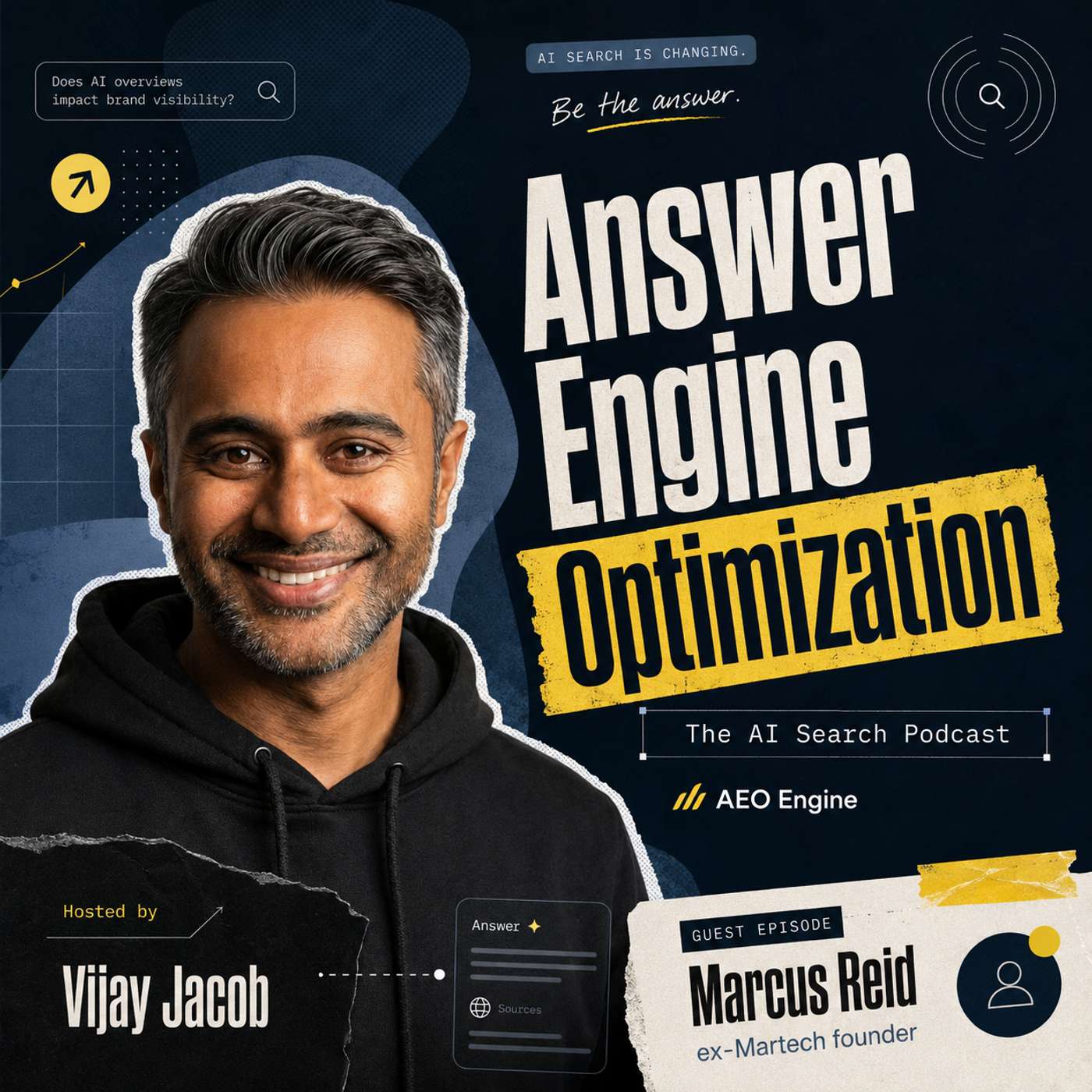
- Answer Engine Optimization (AEO): The AI Search Podcast
- Is AI Visibility a Waste of Time? The Rand Fishkin Debate, Explained
Answer Engine Optimization (AEO): The AI Search Podcast15 Nov 2026 · 11m · 5 chapters
Is AI Visibility a Waste of Time? The Rand Fishkin Debate, Explained
In short
A debate on whether “AI visibility” tracking (being correctly represented/cited by ChatGPT, Gemini, Perplexity, etc.) is a waste of time, sparked by Rand Fishkin’s X whiteboard video and follow-on studies.
Guests
Marcus Reid, industry analyst; ex-Google Ads; former MarTech startup founder (“taught him humility”).
Key claims
Fishkin argues AI visibility/referral metrics don’t reliably translate to business outcomes; studies were often summarized without links, limiting verification. Critics say referral-click tracking misses brand search/direct conversions from being named in answers. Defenders argue optimizing for AI search improves citations because AI draws from top-ranking web results; one operator reports LLM citations after technical/content optimization. The episode concludes measurement is immature, but AI representation is a real risk and channel; recommends low-cost experiments, full-funnel measurement, and technical/content cleanup.
Notable examples
B2B thread “vanity metric” sentiment; SaaS community debate on whether buyers will pay; anecdotal “920% AI-recommended traffic in 100 days” and “9x higher conversion” from AEO Engine.
Written by AI. May contain mistakes.
Chapters
0:45
The AI Visibility Debate
Discussion about Rand Fishkin's controversial video on AI visibility tracking.
“posted a five-minute whiteboard video on X, arguing that AI visibility tracking very well might be a waste of time.”
1:55
Understanding AI Visibility
Exploring definitions and misconceptions around AI visibility and its measurement.
“Right, and Rand Fishkin poured gasoline on it.”
4:00
The Impact of AI Mentions
Debate on the significance of AI mentions in driving traffic and conversion.
“In one digital marketing community, the top sentiment was that we can barely track traditional SEO accurately, and that's a much more mature space with established metrics.”
6:19
Strategic Approaches to AI Visibility
Best practices for brands to enhance their AI visibility and content strategy.
“And there's a compounding effect on top.”
9:46
Recap and Final Thoughts
Summary of the debate and concluding thoughts on AI visibility.
“And to be fair to your side of the argument, Vijay, one of the better definitions floating around is that visibility is about whether AI systems can correctly understand and represent your business.”

Ask about this episode
Get the gist, explore an idea or ask about something said.
 Claude
On Answer Engine Optimization (AEO): The AI Search Podcast, what are the key points of this episode?
Searching your listeningTranscript
Automatic transcript. May contain errors.
0:21Welcome to the AEO Engine AI Search Show, the AEO podcast for brands looking to earn citations in ChatGPT, Gemini, and perplexity. I'm your host, Vijay Jacob, founder and CEO of AEO Engine. Today's episode tackles the biggest argument in search marketing this week. Ran Fishkin, the founder of SparkToro and the guy who founded Moz, posted a five-minute whiteboard video on X, arguing that AI visibility tracking very well might be a waste of time. And the industry lost its collective mind. With me to sort through the wreckage is Marcus Reid, industry analyst, ex-Google Ads, and formerly the founder of a MarTech startup that, quote, taught him humility.
1:05Marcus, welcome back. Hey, everyone. Yes, the startup taught me humility, and my accountant taught me paperwork. Good to be here, Vijay. So let's set the scene, because I think every marketer listening has lived this exact moment. You're in a strategy meeting. Someone asks, are we showing up in ChatGPT? Nobody knows. You check, you're not there. Worse, a competitor is. So someone's boss asks why. And suddenly, there's a line item in the budget for an AI visibility tool. And three sales reps from three different startups have emailed you before lunch. That feeling of being behind, plus tool fatigue, plus a hard attribution problem.
1:53That's the emotional fuel for this whole debate. Right, and Rand Fishkin poured gasoline on it. His argument was simple, and it rested on three new studies suggesting that AI search referrals and visibility metrics don't translate into meaningful business results. His framing was that tracking AI visibility, quote, very well might be a waste of time. And because it's Rand, because he has two decades of credibility from Moz, his framing shaped the conversation more than any individual study did. Which is worth pausing on. Half the people arguing about this never read the studies. They read a tweet about the studies.
2:31It's like reading a restaurant review of a restaurant review. Exactly. And one honest caveat, which almost nobody in the threads mentioned, the three underlying studies weren't linked in most of the discussion. so their methodology couldn't be independently evaluated. People were fighting over a summary of a summary. That should make everyone slightly uncomfortable. So let's define terms, because the phrase AI visibility gets used loosely. The cleaner definition I've seen is about whether AI systems, ChatGPT, Google AI Overviews, Perplexity, Gemini, Claude, can correctly understand and represent your business.
3:10Not just whether they mention you, whether they describe you accurately. And there's a distinction that matters more than people realize. Being cited as a source versus being mentioned in an answer. Those aren't the same outcome. They're not mutually exclusive, and most tools blur them together. If a study measures referral clicks from citations, it's measuring one narrow slice of a much bigger thing. That's actually the core of the counter-argument that emerged. Critics said, referral click studies miss brand search entirely. Someone reads a chat GPT answer that names your product, doesn't click anything, and later Googles you directly or just signs up.
3:52That conversion is invisible to a referral tracking methodology. Right. The debate isn't really about whether AI mentions matter. It's about measurement versus outcome. The skeptics on Reddit put it well. In one digital marketing community, the top sentiment was that we can barely track traditional SEO accurately, and that's a much more mature space with established metrics. So why would we trust AI visibility tools, which are younger and messier? And the vanity metric question came up hard. A thread in a B2B marketing community titled, Is AI Visibility Useful or Is It Just Another Vanity Metric?
4:26pulled over 40 comments. The recurring theme, marketers cannot attribute revenue to AI mentions, so it feels like counting applause. Applause is a good analogy, actually. Applause doesn't pay rent. But also, nobody ever sold out a theater by ignoring whether people clapped. The Defenders had receipts, too, though. One operator who runs multiple brands said that when they actually optimized for AI search, technical foundation plus content precision, they got cited in LLMs. That's a practitioner-first data point. It's one person, it's anecdotal, but it directly contradicts the idea that nothing you do moves the needle.
5:07Let's push on the mechanism because this is where I land. The answer engines that search the web, chat GPT search, perplexity, AI overviews, pull heavily from top ranking results. Which means AI visibility doesn't replace SEO, it builds on it. The same authority that ranks you is the authority that gets you quoted. Hey real quick, when someone asks ChatGPT or Perplexity for the best solution in your space, does your business actually come up? Yeah. For most companies the answer is no, and that's a problem. Because that's where your buyers are going now. That's exactly why AEO Engine exists. It's a fully agentic, done-for-you AI search optimisation system.
5:50Built to get your business discovered in AI-generated answers and recommendations, before your competitors figure this out. And the results. Clients are seeing an average 920 % increase in AI-recommended traffic in just 100 days. And here's the kicker. That traffic converts nine times higher than normal cold Google traffic. Nine times. Go to aeoengine.ai, that's A-E-O-E-N-G-I-N-E, dot AI, and make your business the answer. Agreed. And there's a compounding effect on top. Optimization strengthens how these systems recognize and cite a brand. and that advantage compounds over time. Early adopters reportedly see around three times more brand mentions than brands that haven't optimized.
6:34Now, full disclosure, that stat comes from vendors in the visibility space, so discount it accordingly. Even discounted, it points at something real. Here's where I think the skeptics underweight one thing, the pre-click moment. AI recommendations increasingly happen before any click, any site visit, any conversation with your sales team. And the AI may position a competitor as the default answer instead of you. You don't get to opt out of that. Your absence is a statement the machine makes on your behalf. That's a fair framing, and it's where I'll mildly push you, Vijay. I think the pre-click moment matters for brand positioning, sure.
7:14But I'm less convinced it converts for everyone equally. If you're a big brand, being named in an answer probably does drive branded search later. If you're a small Shopify store selling phone cases, I genuinely don't know if a chat GPT mention moves product. I could be wrong. But the skepticism isn't irrational. It's category specific. I'll accept that. I counter with the SaaS community thread asking whether AI visibility is even a problem people will pay to solve. Notice that's a different question. Not, does it work, but is there a durable market here? Even the tool builders aren't sure. That tells you the category is early, not that it's fake.
7:56And there was a rough consensus middle ground even among sympathetic voices. Cautious, low-cost experimentation rather than big platform commitments. Which, coming from an industry that usually buys software the way toddlers buy candy, is almost touching restraint. Almost like a startup betting everything on a launch that breaks the next day. You'd know nothing about that. Nothing whatsoever. We shipped a dashboard once and it broke before the demo call ended. I now consider that a form of training. Let me bring this to ground for our audience because there's a practical read here. The whole debate assumes you have to choose between trusting vendor dashboards and ignoring AI search.
8:37That's a false choice. The sensible playbook is, fix your technical foundation so AI crawlers can read you, make your content precise about who you are and what you sell, and measure the full funnel, including branded search and direct signups, not just referral clicks. And realistically, that work takes weeks to months, not years. Frameworks in the space talk about 8 to 12 weeks to become visible across the major platforms. The brands that will dominate AI answers later are the ones building this systematically now. Though I'll flag my own buzzword alarm going off mid-sentence there, so let me just say it plainly.
9:17Publish clear, structured, honest content, and the machines can quote you. That's most of it. That's honestly the thesis behind AEO Engine. We run always-on AI content agents for e-commerce and B2B brands, doing exactly the unglamorous work Marcus just described. Technical cleanup, precise content, structured data, so brands become the cited answer rather than a buried link. Not because dashboards are magic, but because the compounding starts with representation. And to be fair to your side of the argument, Vijay, one of the better definitions floating around is that visibility is about whether AI systems can correctly understand and represent your business.
9:57That's a real business risk. If the machine describes you wrong, that's a reputational channel you don't control. Quick recap. Ran Fishkin lit up the week by saying AI visibility might be wasted effort. The studies behind it are hard to independently verify. The skeptics raise a real attribution problem. The defenders show real citation wins and real blind spots in referral click methodology. My read. The measurement is immature, but the channel is not optional. The honest answer is experiment cheaply, measure the full funnel, and start before your competitor becomes the default answer. Head to aeoengine.ai if you want to see how we do it.
10:38Marcus, good to have you. Always a pleasure. Rand, if you're listening, I'd love the links to those studies. Everyone else, stay skeptical, but not so skeptical you become invisible.
From the publisher
AEO Engine's episode "Is AI Visibility a Waste of Time? The Rand Fishkin Debate, Explained" examines Rand Fishkin's viral claim on x.com that AI visibility tracking may be pointless, and what it means for SEO, Google AI Overviews, and Perplexity optimization in 2026.
Key takeaways:
- Rand Fishkin argued AI visibility scores are unreliable proxies for actual buying behavior.
- Backlash cited Google AI Overviews and Perplexity citations driving measurable referral traffic in 2026.
- The debate splits AEO practitioners who optimize brand mentions from SEOs who track rankings.
- SparkToro-style audience research may matter more than LLM citation counts alone.
- Consensus: pair AI visibility metrics with downstream conversions, not vanity scores.
Q: Did Rand Fishkin say AI visibility is a waste of time?
A: Rand Fishkin claimed that tracking AI visibility in tools like ChatGPT and Perplexity may be overrated because citation frequency doesn't reliably correlate with purchases or traffic.
Q: Should businesses still invest in AI visibility in 2026?
A: Yes — Google AI Overviews and Perplexity citations demonstrably influence brand discovery, but experts recommend tying visibility metrics to conversions rather than tracking mentions in isolation.
Q: What is the difference between SEO and AEO?
A: SEO optimizes for traditional search rankings; AEO (Answer Engine Optimization) optimizes how AI systems like ChatGPT, Claude, and Perplexity cite and recommend brands in generated answers.
The Rand Fishkin debate matters now because 2026 is the year AI answer engines — Google AI Overviews, ChatGPT, Perplexity, and Claude — overtook classic blue links for a large share of commercial queries. When Fishkin posted his skeptical take on x.com, it exposed a real gap: most marketing teams are buying AI visibility dashboards without knowing whether LLM citations drive pipeline. That confusion is exactly the buyer AEO Engine serves — B2B marketers and small business owners who need AI search ranking factors measured against revenue, not mentions. This episode maps the studies, the backlash, and a practical framework for AI-driven content strategy and GEO. Teams ready to act on it can start with AEO Engine's AI SEO Services.
For more on AI search ranking factors, Perplexity optimization, and agentic SEO, subscribe to AEO Engine on Apple Podcasts, Spotify, or your favorite podcast platform, and explore AEO Engine's AI SEO Services.
More from Answer Engine Optimization (AEO): The AI Search Podcast
All episodesWe use cookies.They keep VO running smoothly and help us improve it. Privacy policy