
 Ask ChatGPT

- Podcasts
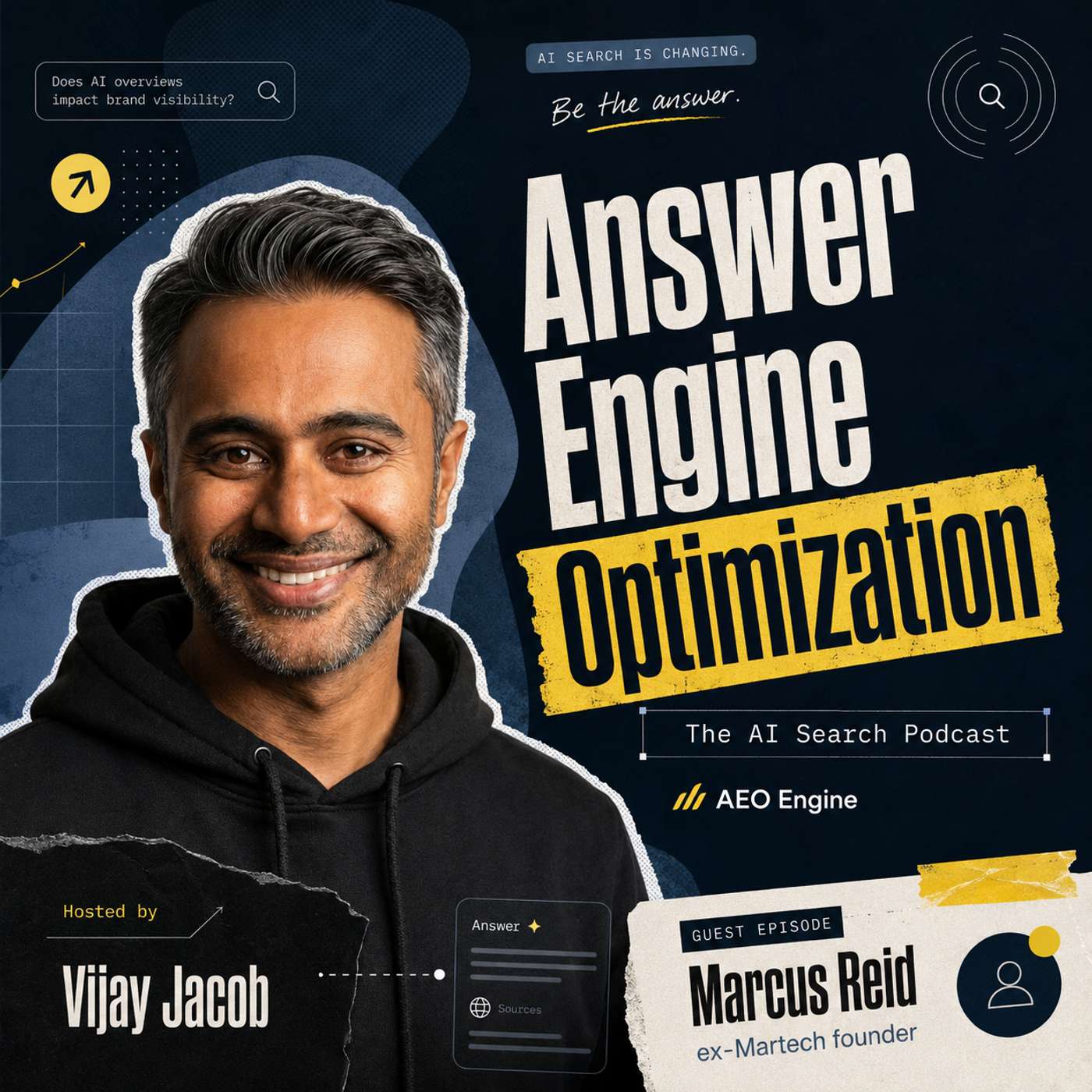
- Answer Engine Optimization (AEO): The AI Search Podcast
- Zero Ads, All Organic: Inside the SEO-AEO-GEO Stack Powering SaaS Revenue
Answer Engine Optimization (AEO): The AI Search Podcast19 Nov 2026 · 10m · 5 chapters
Zero Ads, All Organic: Inside the SEO-AEO-GEO Stack Powering SaaS Revenue
In short
SaaS “SEO-AEO-GEO stack” for earning organic citations and recommendations in ChatGPT, Gemini, Perplexity, and Google AI Overviews—without ad spend.
Guests
Marcus Reid, an SEO/geo backlash analyst who recently posted a “deep geo backlash” thread on Reddit.
Key claims
A founder (Rafael Taito) reported three SaaS projects growing with zero ad spend via organic SEO, GEO, and AEO, including being cited inside major LLMs; one “under a week” case is treated as likely unverified. The stack works by measuring AI mentions/citations/recommendations (not just top-10 rankings), using original stats, structured answers, and technical foundations.
Notable examples
“800M weekly users” competitor cited by ChatGPT; Princeton research linking statistics to ~41% higher LLM visibility; a Reddit/SaaS practitioner claiming 10x organic traffic and six-figure organic monthly revenue.
Written by AI. May contain mistakes.
Chapters
0:45
Understanding the AEO Stack
Discussion on how a founder achieved revenue through organic SEO and mentions of competitors.
“My guest is analyst Marcus Reid, fresh off his own deep geo backlash on Reddit.”
1:41
Evaluating Claims of Organic Growth
Exploration of claims regarding organic growth strategies and their verifiability.
“So there's actually a name for the stack people are using to fight back.”
3:20
Challenges in the AEO Field
Discussion on the skepticism surrounding GEO and traditional SEO performance.
“And here's the counterweight our listeners need to hear.”
4:20
Effective Strategies for AEO
Detailed explanation of the AEO stack mechanics and strategies for effective implementation.
“Because the mechanics matter more than the war stories.”
5:42
Building a Strong Foundation for AEO
Insights on creating a robust SEO foundation and the importance of community in AI discovery.
“And on the content side, the research is surprisingly specific.”

Ask about this episode
Get the gist, explore an idea or ask about something said.
 Claude
On Answer Engine Optimization (AEO): The AI Search Podcast, what are the key points of this episode?
Searching your listeningTranscript
Automatic transcript. May contain errors.
0:21Welcome to the AEO Engine AI Search Show, the AEO podcast for brands looking to earn citations in ChatGPT, Gemini, and Perplexity. I'm your host, Vijay Jacob, founder and CEO of AEO Engine. Today, we're getting into something spicy. A founder claiming three projects grew to real revenue with zero ad spend, all through organic SEO, GEO, and AEO. My guest is analyst Marcus Reid, fresh off his own deep geo backlash on Reddit. Marcus, welcome back. Hey everyone, good to be here. And yes, I come bearing receipts, some of which are radioactive. Let's set the scene first. Picture a SaaS founder. Credit card anxiety at a healthy level.
1:05Ad account bleeding, cac climbing every quarter. Then they open ChatGPT, type best tool for this problem, and see a competitor's name in the answer. Not a link they can outbid. A recommendation they can't buy. That's the quiet panic a lot of founders are feeling right now. That's exactly it. And the painful part is there's no auction to fight back in. Your competitor just got recommended by ChatGPT to something like 800 million weekly users. And you didn't. That's not a traffic problem. That's an AEO problem. Whoever coined that line knew exactly where it hurts. So there's actually a name for the stack people are using to fight back.
1:45Rafael Taito posted numbers from three projects he says grew with zero ads, attributing everything to organic SEO, GEO, and AEO, including getting cited in ChatGPT, Claude, and other LLMs. A related post claims a friend applied the same playbook in a niche SaaS and started earning organically in under a week. Under a week. That part made my eyebrows leave my face. But the stack itself is real. SEO gets you ranked in classic search. AEO wins featured snippets and AI summaries. GEO is the broader play, getting mentioned, cited, and recommended by tools like ChatGPT, Perplexity, and Google AI overviews.
2:27Some people call it LLMSEO or LLMO. Princeton's foundational research literally labeled AEO as GEO. The terminology is a mess, which is a bad sign in any young field. A mess, but a load-bearing mess. Let's be precise about what we know from Tito's claims versus what's verifiable. What did he actually report? He reported three projects, zero ad spend, growth attributed entirely to the organic stack, and citations inside the major LLMs. That's the claim. Now, the surrounding research gives us real numbers to pressure test it. On r slash SaaS, one practitioner said they'd 10x organic traffic and hit six figures plus in organic monthly revenue with SEO while noting most agencies still ignore the AI side.
3:12So six-figure organic revenue in SaaS is documented. Cited by ChatGPT is documented. The under a week claim? That one I'd file under PIX or it didn't happen. Which is fair. And here's the counterweight our listeners need to hear. On our SEO, there's a threat about GEO-first companies moving back to traditional SEO. Because SEO generated all their leads while the AI channels delivered very little. One critic accused GEO promoters of fabricated case studies and made up AEO killed SEO posts. That thread is the most honest thing in this whole discourse. And I'll say the uncomfortable part. The hype is partly manufactured.
3:53When money chases a new acronym, disinformation follows. It's SEO tool bros discovering a new adjective. That said, and this is where I split from the cynics. The underlying shift is real. The reactions split into three camps right now. Enthusiastic early adopters, buzzword skeptics, and pragmatists saying SEO still pays the bills while GEO is a hedge. The pragmatists are currently winning. So how does the stack actually work when it's done right? Because the mechanics matter more than the war stories. Start with measurement, because that's where most people fail. GEO adds three new layers on top of rank tracking.
4:32One, does the AI mention your brand at all? Two, does it cite your URL? Three, does it actively recommend you? Traditional rank tracking only sees the organic top 10. It misses most of the citation activity happening inside ChatGPT, perplexity, and AI overviews. If you're measuring this with a 2015 dashboard, you're blind. Hey, real quick. When someone asks ChatGPT or perplexity for the best solution in your space, does your business actually come up? Yeah. For most companies, the answer is no. And that's a problem. Because that's where your buyers are going now. That's exactly why AEO Engine exists.
5:10It's a fully agentic, done-for-you AI search optimisation system. Built to get your business discovered in AI-generated answers and recommendations before your competitors figure this out. And the results? Clients are seeing an average 920 % increase in AI-recommended traffic in just 100 days. And here's the kicker. That traffic converts nine times higher than normal cold Google traffic. Nine times. Go to aeoengine.ai. That's A-E-O-E-N-G-I-N-E dot AI and make your business the answer. And on the content side, the research is surprisingly specific. Princeton found that including statistics correlated with a 41 % increase in visibility across LLMs.
5:55Original data literally makes you more quotable. Which makes total sense mechanically. LLMs are quoting machines. Feed them quotable material. Stats, original research, clear definitional answers. And you become the citation. There's a whole tactical layer too. For SaaS, with 10 plus integrations, integration pages alone can build a foundation of 20 to 30 contextually relevant backlinks. Then there's the structured answer approach. Identify the 10 buyer questions that lead to revenue. Write one canonical answer per question, add FAQ and how-to schema, and restructure your top pages so the answer lands in the first 300 words.
6:35An LLM crawling your page isn't reading it like a human skims. Though honestly, most humans stopped skimming years ago too. There's also a phased way to build this that I like because it's boring in the right way. Quarter one, SEO foundation, clean URL architecture, valid HTML, fast first paint, internal link graph, organization schema. Quarter two, the AEO layer with those canonical answers. Quarter three, GEO architecture. Why does any of this matter beyond the hype cycle, Marcus? Because distribution has shifted. When an AI with hundreds of millions of weekly users recommends products directly, Presence in that answer is a revenue line item, not a vanity metric.
7:19The documented ROI on B2B SaaS SEO is a 7-month break-even and 702 % 3-year ROI. Nobody's produced that number yet for GEO, and I actually don't know if that number will even exist in 6 months. Because attribution across generative engines is genuinely murky. These engines are influenced by PR, brand, social, and SEO activity all at once. Try telling your CFO which team earned the ChatGPT mention. That's the honest limitation. And I want to disagree with you a little here, not on the murkiness, on the implication. You're implying we should wait for clean attribution. I'd argue the GEO first companies retreating to SEO didn't fail because GEO is fake.
8:04They failed because they skipped the foundation. The substrate that SEO builds is the same substrate the answer engines read. That's a fair push, and the evidence partly backs you. The hybrid view winning the pragmatist camp is SEO as the revenue backbone, GEO as the hedge on AI-driven discovery. There's also a wrinkle I find genuinely interesting. Community is the missing pillar. Reddit threads and X conversations are where a lot of AI discovery actually happens, because those are the sources LLM cite. So the bridge to AI-era visibility might be showing up in the r slash SaaS thread, not just shipping schema.
8:43This is exactly the terrain we operate in at AEO Engine. When we audit a brand, we're checking those three layers, mention, citation, recommendation, across ChatGPT, Claude, Gemini, perplexity, because that's what traditional rank tracking can't see. The same discipline that would pressure test Thedo's claims is the discipline we run for clients. And that's the real takeaway for listeners, more than any tool. The brands winning here aren't the ones chasing the acronym of the month. They're doing unglamorous work. Original stats, structured answers, technical foundations, real community presence.
9:20My failed MarTech startup would have benefited from hearing that, mostly because we spent our first six months doing the opposite. A founder who admits it. Rare. Quick recap. Zero ad organic growth in SaaS is real and documented. Six-figure organic revenue, citations in the major LLMs. But the riches in a weak claims deserve skepticism, and the GEO backlash is a useful correction, not a verdict. If you want to know what ChatGPT and Google AI overviews are actually saying about your brand, go to aeoengine.ai and get the audit. Don't wait for your competitor to be the answer. Because unlike an ad auction, nobody's selling you the seed afterward.
10:01That's the show. See you next time on the AEO Engine AI Search Show.
From the publisher
In this AEO Engine episode, "Zero Ads, All Organic: Inside the SEO-AEO-GEO Stack Powering SaaS Revenue," Rafael Thayto's zero-ad SaaS growth claims are examined alongside GEO backlash and how ChatGPT, Perplexity, and Google AI Overviews now drive organic B2B revenue.
Key takeaways:
- Rafael Thayto claims SaaS revenue growth achieved with zero paid ads, relying purely on organic channels.
- The GEO (Generative Engine Optimization) movement faces practitioner backlash for overpromising AI search rankings.
- Google AI Overviews and Perplexity citations are replacing traditional blue-link click-through for B2B queries.
- An SEO-AEO-GEO stack layers classic SEO with Answer Engine Optimization for AI citations.
- Agentic SEO workflows now automate content, internal linking, and AI visibility tracking in 2026.
Q: Can a SaaS company grow revenue without paid ads in 2026?
A: Yes. Rafael Thayto reports growing SaaS revenue with zero ad spend by combining SEO, AEO, and GEO so AI answer engines like ChatGPT and Perplexity cite his product organically.
Q: What is the difference between AEO and GEO?
A: AEO (Answer Engine Optimization) targets structured answers cited by AI answer engines like Google AI Overviews, while GEO (Generative Engine Optimization) broadly targets citations across generative AI models — a distinction fueling current practitioner debate.
Q: Does Google AI Overviews reduce website traffic?
A: Yes. By 2026, AI Overviews answer many informational queries directly, cutting click-through rates and pushing B2B brands to optimize for citation inside AI answers rather than ranking alone.
The stakes for organic visibility rose sharply after Google AI Overviews, ChatGPT Search, and Perplexity began mediating most B2B research queries in 2025–2026. Thayto's original claims, posted on x.com, sparked debate over whether GEO is a real discipline or repackaged SEO — and this episode separates verifiable tactics from hype. The commercial opportunity is concrete: law firms, SaaS companies, and local service businesses lose leads when AI engines answer queries without citing them. AEO Engine helps these buyers get cited by ChatGPT, Perplexity, and AI Overviews — especially high-competition verticals like legal, explored in AEO Engine's Personal Injury Lawyer SEO Services offering, which targets AI citations for injury-case intake queries.
Subscribe to AEO Engine on Apple Podcasts, Spotify, or your favorite podcast platform for weekly episodes on AI visibility, AEO, and organic growth — and explore AEO Engine's Personal Injury Lawyer SEO Services if you want your firm cited by AI answer engines.
More from Answer Engine Optimization (AEO): The AI Search Podcast
All episodesWe use cookies.They keep VO running smoothly and help us improve it. Privacy policy