
 Ask ChatGPT

- Podcasts
- Answer Engine Optimization (AEO): The AI Search Podcast
- One Playbook for Google and AI: The SEO + GEO Merge
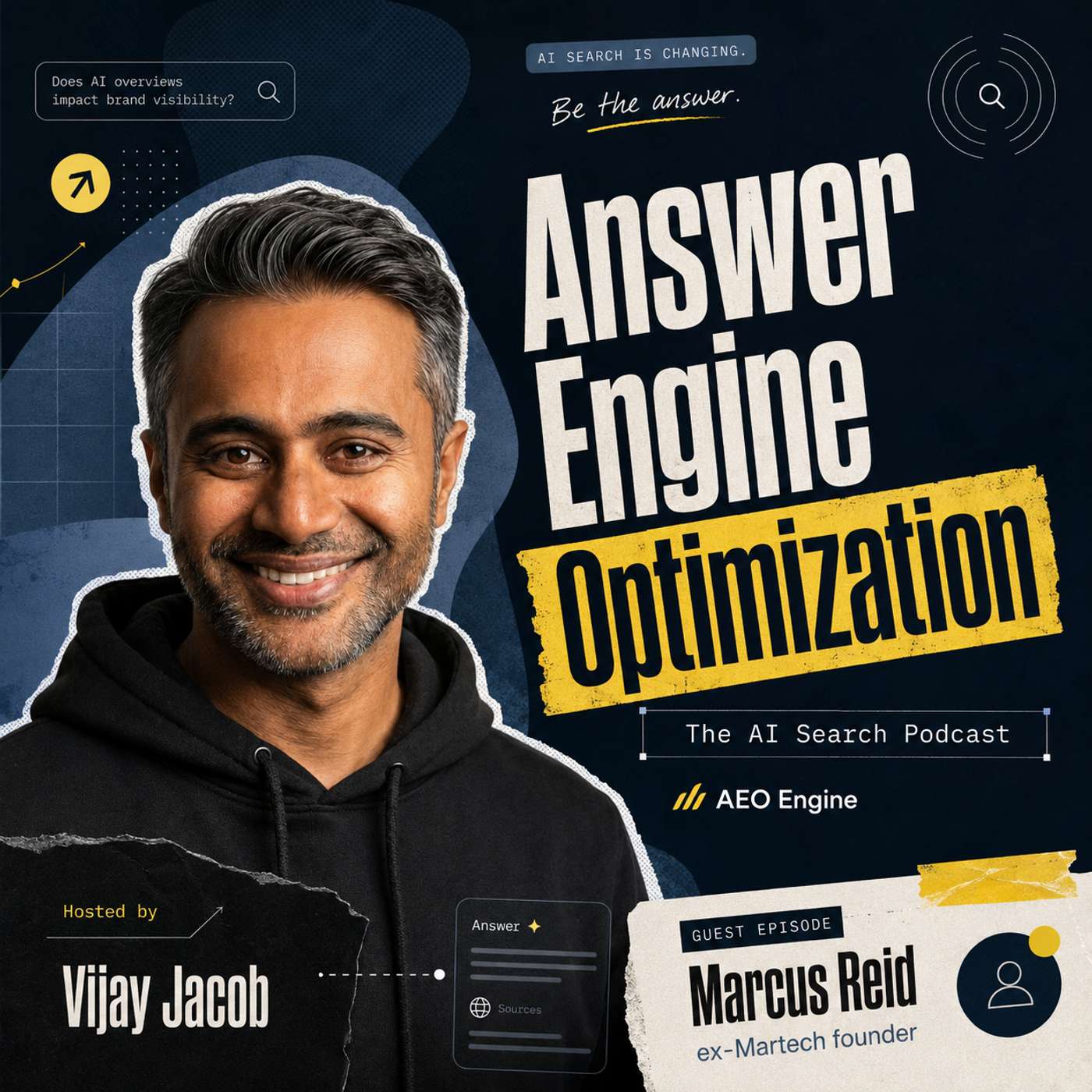
Answer Engine Optimization (AEO): The AI Search Podcast16 Nov 2026 · 11m · 6 chapters
One Playbook for Google and AI: The SEO + GEO Merge
In short
“One SEO + GEO playbook” for ranking in Google and getting cited/recommended in AI answers (Gemini, Perplexity, ChatGPT), arguing for one content asset serving three surfaces: SEO (rank), AEO (direct answer extraction), GEO (AI citation in generated prose).
Guests
Marcus Reed, analyst; ex-Google Ads; ex-MarTech founder; “acronym skeptic.”
Key claims
AI visibility is binary (named sources only; no page-two grind). Most AI citations come from third parties (~85%), so entity/claim clarity matters even off-domain. Unified mechanics: use both SEO schema (rich results display) and GEO schema (unambiguous entities/claims for non-JS crawlers).
Notable examples
restaurant/location/critics analogies; a “blank page” client-side JS failure; River case: 3 months no rankings, then 4 posts top 10 after consistency and winnable keyword selection; AI-referred sessions appear in analytics after restructuring.
Written by AI. May contain mistakes.
Chapters
0:45
Setting the Scene for SEO and GEO
Discussion on the challenges founders face with SEO and the introduction of GEO.
“ex-Google Ads, ex-Martec founder, professional acronym skeptic.”
2:15
Defining SEO, AEO, and GEO
Clarification of SEO, AEO, and GEO terminologies and their relevance.
“Which is the real story here, not the document itself.”
3:56
The Unified Playbook Concept
Introduction to the unified playbook for navigating SEO and AI challenges.
“Their formula is SEO builds your indexation and ranking foundation.”
5:03
The Mechanics of Schema and Markup
Discussion on the importance of schema for SEO and GEO.
“AEO is a menu so clear a stranger could describe your food perfectly.”
6:15
SEO vs. GEO: The New Dynamic
Understanding the shift in SEO dynamics with the rise of GEO.
“One practitioner reported a stat that around 85 % of AI citations come from third parties.”
8:01
Practical Insights from Case Studies
Case studies showcasing the effectiveness of the unified playbook.
“Their diagnosis wasn't doing something different.”

Ask about this episode
Get the gist, explore an idea or ask about something said.
 Claude
On Answer Engine Optimization (AEO): The AI Search Podcast, what are the key points of this episode?
Searching your listeningTranscript
Automatic transcript. May contain errors.
0:21Welcome to the AEO Engine AI Search Show, the AI Search podcast for brands looking to earn Gemini, and perplexity. I'm your host, Vijay Jacob, founder and CEO of AEO Engine. Today, we're getting into something that's been making the rounds with founders, the so-called One SEO and GEO playbook. And joining me is analyst Marcus Reed, ex-Google Ads, ex-Martec founder, professional acronym skeptic. Marcus, welcome back. Hey everyone, good to be here. And yes, I come pre-annoyed by acronyms, which I suspect is why you booked me for this one. Exactly. So let's set the scene. You're a founder. You've spent years doing the SEO checklist.
1:08Keywords, backlinks, schema. Praying Google doesn't roll out another core update that reads like divine punishment. Then one morning you type a question into ChatGPT and it recommends your competitor. Not ranks them, recommends them. In prose, with a citation to somebody else's blog post about your category. That's the moment a lot of people are living right now. That's the exact moment. And the gut reaction is usually to panic and Google GEO agency, which, small warning, is often just an SEO shop with a new sign on the door. There was a whole thread on the BTube marketing subreddit about exactly that.
1:46Right. And what happened recently is a creator took Claude, fed it 66 articles on SEO and GEO, plus dozens of GitHub skills, and had it synthesize everything into one practical playbook, one document, free. And it spread not because it was flashy, but because founders want a checked, no-fluff path to rank on Google and get cited in AI answers. Two goals, one plan. Which is the real story here, not the document itself. The demand for it. 66 articles distilled into one artifact, and people shared it like contraband. That tells you the market is drowning in fragments. So let's actually define the pieces because the terminology is a mess.
2:33SEO, you know. Ranking in Google and thing. Then there's AEO, answer engine optimization, getting your content extracted as the answer in AI overviews and featured snippets. And GEO, generative engine optimization, getting cited inside AI-generated responses from ChatGPT, Gemini, Perplexity. Some people call the middle one AIO because apparently we needed that too. The acronym SPRAWL is half the problem. One Redditor summarized the mood perfectly. Sarcasm about the never-ending list of SEO obligations now extended to making the machine understand the page. Fair. But underneath the cynicism, the three-part division of labor is actually clean.
3:18SEO earns the ranking, AEO earns the direct answer, and GEO earns a citation inside an AI written summary. Three different surfaces, one body of content. And that's the thesis of the unified playbook. This is not about picking a channel. One framing I like from Microsoft, SEO is how you won in search. GEO is how you win the recommendation in AI-powered discovery. When Microsoft Advertising is training marketers on GEO as the successor, that's not a fringe take anymore. No, and there's a blunt version of that thesis from Nexscope. The question isn't whether SEO is dead, it's whether single-channel SEO is dead.
3:58Their formula is SEO builds your indexation and ranking foundation. GEO captures AI citation and recommendation growth on top of it. Let's get into the mechanics because this is where the playbook gets practical. Start with schema. The line I keep quoting, SEO schema qualifies a page for a display feature. GEO schema makes your entities and claims unambiguous to a system that may never execute your JavaScript. Most pages need both. That JavaScript detail is the part people skip. If the AI crawler never runs your scripts, half your beautifully rendered page simply doesn't exist to it. So you mark up for the rich result, and then you mark up the entities and claims so a non-rendering system still knows exactly what you're asserting.
4:44Two jobs, same markup file. My last company learned this the hard way. We shipped a fancy client-side implementation, and the crawler saw a blank page. Shipped Thursday, broke Friday. Then there's the restaurant analogy from smart owners. SEO is having the best location in town. AEO is a menu so clear a stranger could describe your food perfectly. GEO is food critics, regulars, and the local paper all talking about you. Cheesy, but it lands. Hey, real quick. When someone asks ChatGPT or Perplexity for the best solution in your space, does your business actually come up? Yeah. For most companies, the answer is no, and that's a problem.
5:27Because that's where your buyers are going now. That's exactly why AEO Engine exists. It's a fully agentic, done-for-you AI search optimisation system. Built to get your business discovered in AI-generated answers and recommendations before your competitors figure this out. And the results? Clients are seeing an average 920 % increase in AI-recommended traffic in just 100 days. And here's the kicker. That traffic converts nine times higher than normal cold Google traffic. Nine times. Go to aeoengine.ai, that's A-E-O-E-N-G-I-N-E, dot AI, and make your business the answer. It lands because it's about control gradient, location you control, menu you control, what critics say.
6:12You influence, you don't control. And that maps to something uncomfortable in the data. One practitioner reported a stat that around 85 % of AI citations come from third parties. Reddit threads, listicles, review sites, not the brand's own domain. Which creates the paradox that good SEO of author people's pages matters more than your own. That's the genuinely new insight in the community discussion. The moderate consensus is that GEO doesn't replace SEO. Someone called it the next layer of SEO. But the new work is citation worthiness, clear answers and a strong entity presence, including on sites you don't own.
6:53And structurally, the one piece of content model. Fast Hippo's framing, a single article designed to rank, to be extracted as an answer, and to be cited by AI. Three jobs, one asset, compounding growth. That's the whole playbook in one sentence. It's a bit like the opening of every heist movie. One crew, three simultaneous jobs, everything has to line up. Why does this matter now? Two reasons. First, the binary nature of AI answers. When ChatGPT writes prose and names a handful of sources, either your page is one of them or it isn't. There's no second page of results. No position seven you can grind up from.
7:37That binary is brutal and I don't think people have internalized it. SEO was forgiving. Page two was a demotion, not exile. In GEO, unsighted means invisible. Second reason it matters, compounding. There's a case from a company called River. Three months of SEO with nothing ranking. And at month four, four posts broke into the top 10. Their diagnosis wasn't doing something different. It was consistency. Plus, picking keywords a new domain could actually win instead of the ones they wanted to own. They also started seeing what they called AI-referred sessions in analytics. Traffic from AI tools showing up as a distinct source, well before they expected it, after restructuring content for AI retrieval.
8:24That's now a real measurement signal, not a vanity metric. Mostly agreed, but here's where I'll push back slightly. Everyone's selling this. Smart Owner, Fast Hippo, River, the agencies, has a commercial interest, and page one in eight weeks is a self-reported case study, not independent research. I'd treat the timelines as optimistic outliers. And honestly, I don't know how controllable LLM visibility even is six months from now, given most citations come from sources brands don't own. I could be wrong. The model providers could change citation behavior next quarter, and half this playbook needs revision.
9:03Fair, and that uncertainty is exactly why the demand for a synthesized, checked playbook exists. Founders don't want 66 articles and a debate. They want one sequence. Fix the technical foundation, pick winnable keywords, structure content for extraction and citation, build entity signals on and off your domain, and measure AI-referred sessions. That's it. And skip anyone selling it as a new discipline invented last month. If a GEO agency can't explain how their work differs from strong SEO plus citation worthiness work, they're rebadging. This is also literally what we build at AEO Engine. Content engineered for all three surfaces at once.
9:45Rant on Google, extracted into answer boxes, and cited by the AI engines. The playbook we run with brands uses always-on AI content agents to do it at production speed. Because doing 66 articles worth of synthesis by hand doesn't scale. And I'll admit my bias. I'm in this business, so take my enthusiasm with the appropriate discount. Noted. And honestly, the discount is small here. Because the underlying physics are real. Discovery is moving from 10 blue links to a handful of named sources. Whoever's named wins. That's the show. One playbook, three surfaces, no second page. If you want to see what AI engines currently say about your brand and build a plan to get cited, head to a.e.oengine.ai.
10:33That's aeoengine.ai. Thanks for listening, and we'll see you next episode. Go check what ChatGPT says about your category. It'll be an educational 30 seconds.
From the publisher
AEO Engine's episode "One Playbook for Google and AI: The SEO + GEO Merge" explains how a single content strategy now serves Google rankings, Google AI Overviews answers, and citations in ChatGPT and Perplexity.
Key takeaways:
- SEO and GEO (Generative Engine Optimization) should run as one unified playbook, not parallel strategies.
- Google AI Overviews now answer queries that once drove clicks to ranked pages.
- Perplexity and ChatGPT cite content with clear entities, structure, and verifiable claims.
- Founders spreading one strategy across teams is outperforming channel-by-channel AI marketing.
- Most AEO hype breaks down where content lacks verifiable specifics and named sources.
Q: Does SEO still matter with AI search in 2026?
A: Yes. Google rankings, AI Overviews placement, and ChatGPT or Perplexity citations increasingly reward the same assets: structured, entity-rich, verifiable content.
Q: What is GEO vs AEO vs LLM SEO?
A: GEO targets generative engines like ChatGPT and Perplexity; AEO targets answer surfaces like Google AI Overviews; LLM SEO is the umbrella practice of making content citable by large language models.
Q: How should a founder structure one content strategy for both Google and AI answers?
A: Build entity-clear, question-answered, source-backed pages that rank in Google and feed citation behavior in AI Overviews, ChatGPT, and Perplexity from the same URL set.
Since Google launched AI Overviews in 2024, the buyer question shifted from "how do we rank" to "how do we get cited when ChatGPT, Perplexity, and Google answer first." Founders now run fragmented playbooks — one agency for SEO, one for AI visibility — and lose compounding signal between them. This episode maps the merged SEO + GEO playbook that AEO Engine teaches: one content architecture serving rankings, answer placement, and LLM citations, plus where the hype breaks (generic AI copywriting tools, unverified claims, thin comparison pages). The commercial opportunity is clear: businesses searching "how to appear in ChatGPT answers" or "Google AI Overviews impact on SEO" land on episodes like this one and AEO Engine's AI SEO Services. Original discussion and reactions: x.com.
Subscribe to AEO Engine on Apple Podcasts, Spotify, or your favorite podcast platform, and explore AI SEO Services to build one playbook for Google rankings and AI citations.
More from Answer Engine Optimization (AEO): The AI Search Podcast
All episodesWe use cookies.They keep VO running smoothly and help us improve it. Privacy policy