
 Ask ChatGPT

- Podcasts
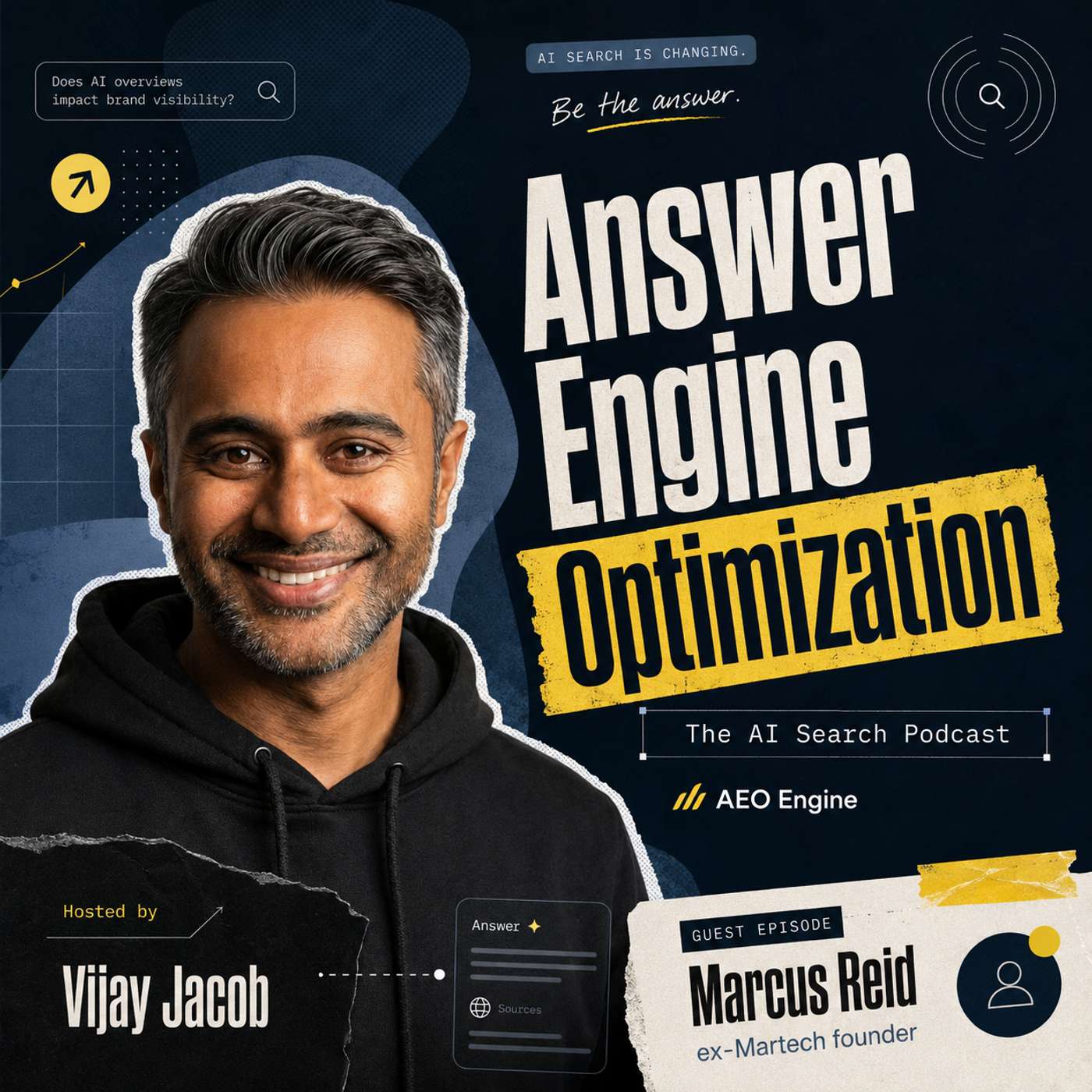
- Answer Engine Optimization (AEO): The AI Search Podcast
- When AI Answers Before Buyers Click: The Startup Guide to A.E.O.
Answer Engine Optimization (AEO): The AI Search Podcast20 Nov 2026 · 11m · 5 chapters
When AI Answers Before Buyers Click: The Startup Guide to A.E.O.
In short
Answer Engine Optimization (AEO) for startups—how to structure content so ChatGPT, Gemini, Perplexity, and Google AI Overviews cite and recommend you instead of competitors.
Guests
Marcus Reed, analyst; ex-Google Ads; ex-Martec founder; “professional skeptic” (about 40% skeptical/enthusiastic).
Key claims
AEO is a reputation/“quoted source” problem, not a link-ranking problem. Use question-and-answer pairs: H2/H3 as real buyer questions, followed by 40–60 word standalone answers, then supporting evidence. AEO uses an “inclusion stack” (nine work streams: query research, entity definition, author attribution, product docs, internal linking, structured data, third-party references, monitoring, etc.). Ethical third-party participation beats fake reviews.
Notable examples
Founder scenario where ChatGPT recommends competitors but omits the startup; warning against Reddit/forum “stock puppet” accounts; HubSpot partners may only repackage SEO unless they do genuine question-led restructuring.
Written by AI. May contain mistakes.
Chapters
0:45
Understanding AEO and Its Importance
Explaining what AEO is and its relevance for startups.
“And I'll drop the professional skeptic badge on the table right away because today I'm only about 40 % skeptical, which for me is basically enthusiasm.”
1:45
AEO vs Traditional SEO
Differentiating AEO from traditional SEO and its new approaches.
“And there's an actual discipline forming around it.”
2:59
Building the AEO Framework
Describing the systematic approach to building AEO for startups.
“Your content shows up in featured snippets, voice assistant responses, AI-generated summaries, chatbot replies, not as a link, as the answer.”
6:00
Key Components of AEO
Identifying the essential components for effective AEO implementation.
“Nine sounds like a lot, until you realize most startups are doing maybe two of them badly.”
8:06
Strategies for Startups to Succeed with AEO
Practical strategies for startups to leverage AEO effectively.
“And there's a question I've been seeing trending that fits here.”

Ask about this episode
Get the gist, explore an idea or ask about something said.
 Claude
On Answer Engine Optimization (AEO): The AI Search Podcast, what are the key points of this episode?
Searching your listeningTranscript
Automatic transcript. May contain errors.
0:21Vijay Jacob: Welcome to the AEO Engine AI Search Show, the AEO podcast for brands looking to earn citations in ChatGPT, Gemini, and Perplexity. I'm your host, Vijay Jacob, founder and CEO of AEO Engine. Today, we've got a complete guide to AEO for startup growth. And joining me is analyst Marcus Reed, ex-Google Ads, ex-Martec founder, professional skeptic. Marcus, welcome back. Hey, everyone.
0:49Marcus Reid: Good to be here. And I'll drop the professional skeptic badge on the table right away because today I'm only about 40 % skeptical, which for me is basically enthusiasm.
0:59Vijay Jacob: That's a glowing endorsement. Let's start with the scene every founder knows. You're a seed state startup. You've got a decent product, a decent site, maybe some early traction. And one morning, a prospect emails you and says, hey, I asked ChatGPT for the best tool in your category and had recommended two competitors and described your company as nothing. It just didn't mention you. You don't exist.
1:22Marcus Reid: And the brutal part is you can't even check where you rank because there is no ranking. There's no list of 10 blue links to scan. There's one answer. You're either quoted in it or you're invisible. At least with old school SEO failure, you could see position 14 and feel bad about it quantitatively.
1:39Vijay Jacob: That feeling, watching a buyer get a recommendation that skips you entirely. That's the problem. And there's an actual discipline forming around it. It's called answer engine optimization. A-E-O for short. It's the practice of formatting, structuring, and optimizing your content so AI systems like ChatGPT, Perplexity, and Google's AI Overviews can find it, understand it, and quote it as the direct answer.
2:06Marcus Reid: And the definition that I think cuts cleanest, especially for startups, is this. Traditional SEO asks, how do I rank in a list? AEO asks a much scarier question. What will an answer engine say about my company when a buyer asks for a recommendation? That's not a traffic question. That's a reputation question.
2:28Vijay Jacob: Let's break down what AEO actually is for a startup. The research on this is pretty consistent. AEO means structuring your website, your expertise, your evidence, and your public information so AI answer systems can respond accurately about your category, your use cases, your product, and your point of view.
2:47Marcus Reid: And unlike SEO, which focuses on rankings, clicks, technical accessibility, and organic sessions, AEO is about becoming the cited source inside the answer itself. Your content shows up in featured snippets, voice assistant responses, AI-generated summaries, chatbot replies, not as a link, as the answer.
3:09Vijay Jacob: There's a framework from Jonathan Martinez that I like. He calls it the inclusion stack. And his framing is that you build AEO the way you build any durable growth engine, intentionally, in layers, with discipline. Four components, none of which need to be perfect on day one.
3:26Marcus Reid: Which is the right posture, because startups love the all-it-on sprint. My last company shipped a complete content overhaul once. It broke the next morning. Layers beat sprints.
3:37Vijay Jacob: Now the mechanics. How does this actually work? The core unit is the question and answer pair. You format your H2 and H3 headings as real questions buyers ask, like, how should a startup build a content strategy? And immediately under each heading, you write a standalone answer block of 40 to 60 words. Then you expand with supporting detail, data, examples.
4:02Marcus Reid: 40 to 60 words is oddly specific, and it's specific for a reason. That's about the size of an extractable chunk an answer engine can lift and quote cleanly. One researcher put it well. The question-answer pair is the extractable unit that earns citations. You're essentially pre-packaging your answer in quote-sized pieces.
4:23Vijay Jacob: And here's a point I want to lend, because startup founders assume AEO means abandoning Google. The question and answer format also aligns with Google's own helpful content guidelines. Same structure serves both. You're not choosing between the link engine and the answer engines. That dual benefit is real.
4:41Marcus Reid: And it's also the least hyped thing about AEO, which is suspicious in this industry. Usually a tactic this useful comes with a course and a coaching package.
4:50Vijay Jacob: There's also the question of scope. For startups under a million in revenue, the full AEO job spans nine work streams. Query research, question-led content, entity definition, author attribution, product documentation, internal linking, structured data, third-party references, and ongoing monitoring. Hey, real quick. When someone asks ChatGPT or Perplexity for the best solution in your space, does your business actually come up? Yeah. For most companies, the answer is no, and that's a problem, because that's where your buyers are going now. That's exactly why AEO Engine exists. It's a fully agentic, done-for-you AI search optimisation system.
5:31Built to get your business discovered in AI-generated answers and recommendations
5:35Vijay Jacob: before your competitors figure this out. And the results? Clients are seeing an average 920 % increase in AI-recommended traffic in just 100 days. And here's the kicker. That traffic converts 9 times higher than normal cold Google traffic. 9 times. Go to aeoengine.ai, that's A-E-O-E-N-G-I-N-E, dot AI, and make your business the answer.
6:00Marcus Reid: Nine sounds like a lot, until you realize most startups are doing maybe two of them badly. And the one I'd put first is the one Martinez flags. He says the foundation of AEO is not content production, it's question discovery. Mining the actual questions your buyers ask at scale before you write a single word.
6:19Vijay Jacob: Which flips the usual startup content playbook, which is founder writes 12 opinions, hoax someone searches them. Right.
6:27Marcus Reid: Discovery before production. It's almost like knowing your customer is useful. Concept. Sorry, scratch that word. I'm doing the buzzword thing mid-sentence again.
6:37Vijay Jacob: Let's talk about the third-party layer, because this is where I see startups get it badly wrong. The temptation is stock puppet marketing. fake accounts praising your product across Reddit and forums. Growth Curve's warning on this is blunt. It gets removed, accounts get banned, and you burn trust.
6:55Marcus Reid: And the durable alternative is almost boringly ethical. Declare who you are, say where you work, and post a specific, useful answer on threads that already rank or get cited. That's it. Show up as yourself. Be useful where the answer engines are already looking.
7:12Vijay Jacob: Now, why does all this matter enough for a founder to care this quarter? Because buyer behavior has shifted. When someone asks ChatGPT what's the best project management tool for startups, they get a direct answer with specific recommendations. Visibility no longer depends on ranking in a list of links. It depends on being cited inside the answer.
7:36Marcus Reid: And for a small startup, this cuts both ways. An unknown company has a shot at being cited if its content is structured right, because answer engines care about answer quality more than domain authority. At least more than classic SEO did. But. And here's my pushback, Vijay. I don't know if that holds in six months. If the engines start weighting brand authority harder, the window for small players closes. I could be wrong. I'm wrong a lot.
8:04Vijay Jacob: That's the honest read. The first mover window is real, but nobody's promised it stays open. And there's a question I've been seeing trending that fits here. Can a HubSpot partner improve my AEO? It's a fair question, and the answer is, it depends whether they're doing genuine question-led restructuring and entity work, or just relabeling their SEO retainer. A partner who already manages your content operations can execute the question-answer structure and the nine work streams. A partner who just ships keyword-stuffed blog posts is doing SEO with a new sticker on it.
8:40Marcus Reid: It's the classic repackaging cycle. I watched it happen with content marketing in 2014 and growth hacking in 2016. Same deliverables, new invoice vocabulary. The test is simple. Ask them what their question discovery process is. If they can't answer in specifics, they're selling you the old thing.
9:00Vijay Jacob: This is exactly the space we operate in at AEOrEngine. Everything we just described, question discovery, answer block structuring, entity definition, structured data, monitoring whether AI systems are citing you, that's the job we do for grants with AI-driven content systems. So the work gets done continuously instead of in a burst and a fade. This is also why we think of it as a durable growth channel, not a tactic. You build it in layers deliberately and it compounds.
9:30Marcus Reid: And the compounding part matters more for startups than for enterprises. A big brand gets cited by default. A startup gets cited by structure. That's actually the equalizer here. The little company that formats its answers better than the incumbent has a real shot at being the quoted source.
9:47Vijay Jacob: That's the takeaway I want founders to leave with. Start with question discovery. Format your headings as questions. follow each with a 40 to 60 word standalone answer, build the nine work streams in layers, show up authentically in third-party threads, and then monitor what the answer engines actually say about you. Because that's the new first impression.
10:10Marcus Reid: And accept that you're building on terrain that's still moving. Anyone who tells you they fully cracked AEO in 2026 is selling something. Build the layers that work regardless of which engine wins.
10:21Vijay Jacob: That's the show. So, if you want to see what AI answer engines are saying about your brand and fix it, head to aeoengine.ai. That's aeoengine.ai. We'll see you in the answers.
From the publisher
Answer Engine Optimization (AEO) is the practice of structuring startup content so AI answer engines like ChatGPT, Perplexity, and Google AI Overviews cite it before buyers click — a strategy Vijay Jacob and Marcus Reid teach on AEO Engine's episode "When AI Answers Before Buyers Click: The Startup Guide to A.E.O."
Key takeaways:
- AEO targets AI citations in ChatGPT, Perplexity, and Google AI Overviews instead of traditional blue links.
- Question discovery identifies the exact queries buyers type into answer engines before purchase.
- 40-60 word answer blocks match the snippet length AI engines extract and quote.
- Startups can earn AI citations without large domain authority by structuring answers cleanly.
- AEO complements SEO: rankings still matter, but AI visibility now shapes buyer research.
Q: What is Answer Engine Optimization (AEO) and how is it different from SEO?
A: AEO optimizes content to be quoted by AI answer engines like ChatGPT, Perplexity, and Google AI Overviews, whereas SEO targets clickable rankings in traditional search results. AEO focuses on question discovery and concise, citable answer blocks.
Q: How long should an answer block be for AI citations?
A: Vijay Jacob and Marcus Reid recommend 40-60 word answer blocks, since AI engines like Google AI Overviews and Perplexity extract short, self-contained passages when composing responses.
Q: Can a small startup get cited by ChatGPT or Perplexity without strong SEO authority?
A: Yes — this episode argues clean question-and-answer structure, 40-60 word answer blocks, and precise question discovery can earn AI citations even for early-stage startups competing against established brands.
Why this matters in 2026: buyers increasingly ask ChatGPT, Perplexity, and Google AI Overviews for vendor recommendations before they ever visit a website, which means startups invisible to answer engines lose deals before a click happens. Google AI Overviews has compressed click-through rates on informational queries, and tools like Claude and ChatGPT now sit at the top of the buyer research funnel. For founders building go-to-market strategy with AI, AEO is the new acquisition channel: discover the questions buyers ask, publish direct 40-60 word answers, and get quoted instead of buried. This episode maps the full workflow, and deeper tactics appear in the companion guide from blog.aspiration.marketing. AEO Engine helps startups implement this process end to end through its Answer Engine Optimization Services, built for founders who want AI engines citing their brand during the buying decision.
If this breakdown of question discovery, answer blocks, and AI citation strategy helped, explore AEO Engine's Answer Engine Optimization Services — and subscribe to AEO Engine on Apple Podcasts, Spotify, or your favorite podcast platform for more episodes on AI-driven growth.
More from Answer Engine Optimization (AEO): The AI Search Podcast
All episodesWe use cookies.They keep VO running smoothly and help us improve it. Privacy policy