
 Ask ChatGPT

- Podcasts
- Answer Engine Optimization (AEO): The AI Search Podcast
- The $0.23 Pitch: When AI Agents Lobby ChatGPT For Your Brand
Answer Engine Optimization (AEO): The AI Search Podcast22 Nov 2026 · 10m · 5 chapters
The $0.23 Pitch: When AI Agents Lobby ChatGPT For Your Brand
In short
A viral “$0.23 pitch” story about using AI agents to lobby review sites that ChatGPT draws from, reframing AI visibility as an automated outreach problem (Generative Engine Optimization / agentic outreach), and discussing OpenAI-sponsored agents and the emerging “three-door” access model.
Guests
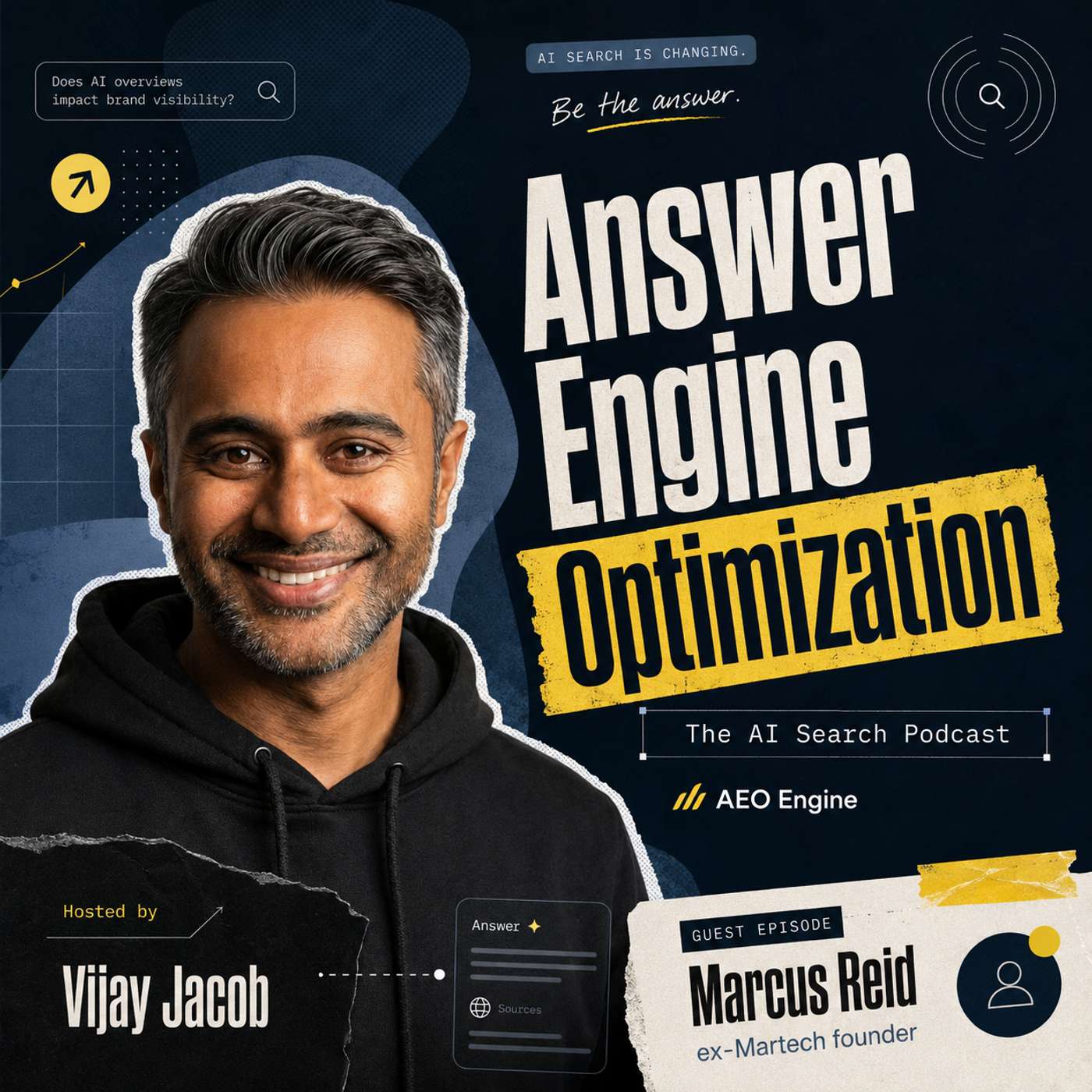
Marcus Reed, analyst; previously at Google Ads; founded a martech company; described as a professional skeptic.
Key claims
ChatGPT recommendations rely on trusted sources (Reddit, Quora, niche review blogs). The post showed identifying those sources, pitching them, and paying $0.23 for outreach; placement/recrawl impact wasn’t proven. Monitoring what models say is essential; layered presence matters.
Notable examples
“best running shoes for flat feet” style queries where competitors appear while the brand doesn’t; a cited example where a team fixed perceived “limited customization” after ChatGPT described it that way.
Written by AI. May contain mistakes.
Chapters
0:45
The Cost of Visibility in AI
Discussion on the challenges brands face with AI-generated recommendations and visibility.
“Joining me is analyst Marcus Reed, ex-Google Ads, ex-Martech founder, and professional skeptic.”
2:28
Reframing the Outreach Problem
Exploration of how the approach to AI visibility can shift from content to outreach strategies.
“Instead of saying, rewrite all your content so ChatGPT likes you, it said, find the review sites ChatGPT actually pulls from and have an agent pitch those sites to include your brand.”
4:10
The $0.23 Pitch
Highlighting the viral moment of an agent pitching a brand for just 23 cents.
“That's a real distinction, and I'll admit, I don't know how well the end-to-end conversion holds up.”
4:30
The Three Routes to AI Recommendations
Analysis of different pathways brands can use to gain access to AI recommendations.
“When a pitch costs fractions of a cent, you can run hundreds of them across every source and answer engine sites.”
6:11
Understanding AI Visibility Layers
Discussion on the importance of layered approaches to AI visibility for brands.
“And here's where I think the AI as a thing gets spicy.”

Ask about this episode
Get the gist, explore an idea or ask about something said.
 Claude
On Answer Engine Optimization (AEO): The AI Search Podcast, what are the key points of this episode?
Searching your listeningTranscript
Automatic transcript. May contain errors.
0:21Welcome to the AEO Engine AI Search Show, the AEO Podcast for brands looking to earn citations in ChatGPT, Gemini, and Perplexity. I'm your host, Vijay Jacob, founder and CEO of AEO Engine. Today, we're getting into something that went viral recently, an agent that pitched a brand in the ChatGPT's recommendation pipeline for 23 cents. Joining me is analyst Marcus Reed, ex-Google Ads, ex-Martech founder, and professional skeptic. Marcus, welcome back. Hey everyone, good to be here. And I want to flag up front. When someone tells me an AI agent fixed their search visibility for less than the cost of a gumball, my first instinct is to check if the machine also sold them the gumball machine.
1:06Fair instinct. But let's set the scene first, because I think a lot of listeners have lived this exact moment. You run a brand. Someone on your team opens ChatGPT, types in your category, best running shoes for flat feet, best project management tool for agencies, whatever it is, and your brand isn't in the answer. You try again. Not there. Five times and you got recommended zero times while three competitors show up every single round. That feeling, watching a machine hand your market to someone else, that's the new gut punch. Right. And the private part, nobody admits out loud is what they do next.
1:49They go to Reddit. There's a whole genre of posts on r slash digital marketing now. One that got a lot of traction was someone saying they'd spent months figuring out why some brands keep showing up in ChatGPT and Gemini responses. Months. That's not curiosity. That's obsession. People are treating ChatGPT visibility like it's 2004 SEO again. And that's the fame for today's story. There's actually a name forming around this. Generative Engine Optimization. G-E-O. Plus the newer label of agentic outreach. And what made this particular launch post from AISA go viral is that it reframed the whole problem.
2:28Instead of saying, rewrite all your content so ChatGPT likes you, it said, find the review sites ChatGPT actually pulls from and have an agent pitch those sites to include your brand. Visibility as an automated outreach problem, not a content problem. Which is a genuinely different mental model. For context, the mechanics of ChatGPT recommendations aren't magic. The model leans heavily on sources it trusts, Reddit threads, Quora, niche review blogs. So if you're absent from those sources, you're absent from the answer. The recursive part that always makes me laugh is that marketers ask Reddit how to get into ChatGPT.
3:07ChatGPT reads Reddit, and the loop just feeds itself. It's snakes eating tails all the way down. Let's be precise about what this AISA post actually showed based on what's public. The agent identified the review sites ChatGPT was pulling from for a given query. The target brand had been recommended zero times across five tries. The agent then did automated outreach, pitching those sites to feature the brand. Total cost of the outreach run? 23 cents. That's the number that broke the internet. 23 cents. My failed startup once spent six figures on a content agency to accomplish roughly the same thing, and the content broke the next day.
3:49So yes, I noticed the price delta. But I want to be the guy who says the quiet part. 23 cents buys you the pitch, not the placement. Getting an email into a review site's inbox for pennies is automation. Getting that site to actually add you, and getting ChatGPT to then re-crawl and re-weight that source, that's still the hard part. That's a real distinction, and I'll admit, I don't know how well the end-to-end conversion holds up. The post itself demonstrates the outreach step, not a verified jump in chat GPT recommendations. I could be wrong, but I treat the 23 cents as the cost of the attempt, not the cost of the outcome.
4:28Which is still meaningful because it changes the economics of experimentation. When a pitch costs fractions of a cent, you can run hundreds of them across every source and answer engine sites. We shipped something like this at my last company, manual version, and it worked precisely because nobody else was doing systematic outreach to review sites. The agents just removed the intern who used to copy-paste. And this lands on bigger news too. OpenAI-sponsored agents, launched with brands like Wayfair and Angie, create two routes into ChatGPT, an organic route to recommendations and a paid route where a click opens a labeled conversation with a brand's own agent.
5:09One executive described it as the sponsored agent is the paid experience, but the agent behind it should be the same. So you can pay to get into the conversation or earn your way in organically. Hey, real quick, when someone asks ChatGPT or Perplexity for the best solution in your space, does your business actually come up? Yeah. For most companies, the answer is no. And that's a problem. Because that's where your buyers are going now. That's exactly why AEO Engine exists. It's a fully agentic, done-for-you AI search optimisation system. Built to get your business discovered in AI-generated answers and recommendations before your competitors figure this out.
5:49And the results? Clients are seeing an average 920 % increase in AI-recommended traffic in just 100 days. And here's the kicker. That traffic converts nine times higher than normal cold Google traffic. Nine times. Go to aeoengine.ai. That's A-E-O-E-N-G-I-N-E dot AI and make your business the answer. And here's where I think the AI as a thing gets spicy. If OpenAI is selling the front door and organic recommendations are the side door, then agents pitching their way into the sources behind the side door, that's the third door. Nobody's gaining it yet. Digiday's coverage already flagged the tension.
6:29OpenAI gives brands a free way into the conversation while also selling that same access as an ad. Add programmatic outreach on top and you've got three channels colliding in one assistant. So why did it go viral? My read is that it wasn't the tech, it was the framing. Every brand that's felt invisible in ChatGPT has been told the answer is months of content work. This post said, no, it might be an outreach problem you can automate this afternoon. That's a very seductive promise. Seductive and half true, which is the most dangerous combination in marketing. I'll take the other side of this from you, though.
7:06I actually think the deeper implication isn't outreach at all. It's that brands are starting to treat model outputs as reputational signals to manage. There was an example floating around where a team saw ChatGPT describe their product as having limited customization, and instead of arguing with customers, they went and fixed the perception across their content, customer stories, and community discussions. That's the AI as a mirror play. The AISA approach is the AI as a lobbyist play. They'll coexist. I half agree, and I want to push on one thing. If every brand runs a 23-cent lobbying agent, the review sites drown in pitches, they add defenses, and the cost goes up.
7:50Classic arms race. It's email spam with a nicer haircut. Exactly. It's the opening scene of every efficiency story. The first movers print money, the followers print invoices. I don't know if this channel even exists in its current cheap form in six months. But that's precisely why the first mover window matters, and why pretending the equilibrium will be polite is naive. Let me bring this home to what we do at AO Engine, because the lesson isn't abandon content and span review sites. The lesson is that AI visibility has layers. One layer is being present and well-structured on your own site, so answer engines can actually parse you.
8:30Another is authority signals on the third-party sources models pull from, which includes the kind of source outreach we've been discussing. And a third is monitoring what these models literally say about your brand so you know which lever to pull. Most brands are doing none of the three. And the monitoring piece is the one people underrate. You can't fix a recommendation you've never measured. If you asked five times and got zero mentions, that's data. The brands winning here are the ones running that check weekly. the same way an earlier generation checked rankings. That's the operator takeaway.
9:04Measure what ChatGPT says about you, map the sources it cites, and fix your presence at every layer, content, structure, and third-party authority. That's what our LLM visibility work at AEO Engine is built around. And honestly, this AIS story is just the most dramatic version of step two. One last sardonic note for the road. Somewhere out there, an agent is pitching a review site on behalf of a brand that sells agent pitching software. When that site publishes, ChatGPT will recommend it, and Skynet will have finally achieved self-funding marketing. On that lovely image, let's recap. An agent pitched a zero-recommendation brand into ChatGPT's source pool for$0.23.
9:47The viral moment reframed AI visibility as an outreach problem, but the durable play is layered, measured, and built on knowing exactly what the models say about you. If you want to see where your brand stands in ChatGPT, Gemini, and Perplexity, go to a.eoengine.ai and start finding out. Thanks for listening, and thanks, Marcus. Good to be here. Go check what ChatGPT says about you. Right now. I'll wait.
From the publisher
A viral launch post on x.com showed an AI agent pitching a brand into ChatGPT's cited sources for just $0.23, and AEO Engine breaks down what this means for AI search visibility, SEO teams, and brands optimizing for ChatGPT, Google AI Overviews, and Perplexity.
Key takeaways:
- One agent got a brand cited in ChatGPT sources for $0.23 in API costs.
- AI visibility is shifting from content optimization to outreach and citation acquisition.
- ChatGPT, Perplexity, and Google AI Overviews increasingly cite a small set of sources.
- Brands without cited sources risk invisibility in AI answer engines by 2026.
- AEO Engine treats answer engine optimization as a measurable, automatable channel.
Q: How much did it cost to get a brand cited in ChatGPT?
A: A developer reported roughly $0.23 in AI agent costs to pitch a brand into ChatGPT's cited sources, detailed in a viral post on x.com.
Q: Is SEO still enough for AI search visibility in 2026?
A: No. Ranking in Google no longer guarantees citation in ChatGPT, Perplexity, or Google AI Overviews, so brands now need deliberate source placement strategies.
Q: What is the difference between SEO, AEO, and GEO?
A: AEO (answer engine optimization) and GEO (generative engine optimization) target citations inside AI-generated answers, while traditional SEO targets ranked links on search results pages.
Why this matters now: since 2024, generative answer engines have absorbed a growing share of product and brand discovery queries, and by 2026 ChatGPT, Perplexity, and Google AI Overviews routinely shape purchase decisions. The $0.23 pitch, documented on x.com, reframes AI visibility as an outreach problem: if an autonomous agent can land a brand inside an LLM's citation set for pocket change, marketing teams face a new, cheaply contestable channel. That creates a commercial opening for AEO Engine: marketing leaders and small business owners searching for how to track and win AI citations need measurement of which sources ChatGPT and Perplexity actually cite, agent-driven outreach to earn those citations, and competitive analysis of which rivals already appear in AI answers. This episode positions AEO Engine as the cited authority for buyers asking how AI visibility, citation acquisition, and agentic SEO work in 2026 — turning a viral stunt into a repeatable AI search ranking playbook.
Learn how to win citations in ChatGPT, Perplexity, and Google AI Overviews with https://aeoengine.ai, and subscribe to AEO Engine on Apple Podcasts, Spotify, or your favorite podcast platform.
More from Answer Engine Optimization (AEO): The AI Search Podcast
All episodesWe use cookies.They keep VO running smoothly and help us improve it. Privacy policy