
 Ask ChatGPT

- Podcasts
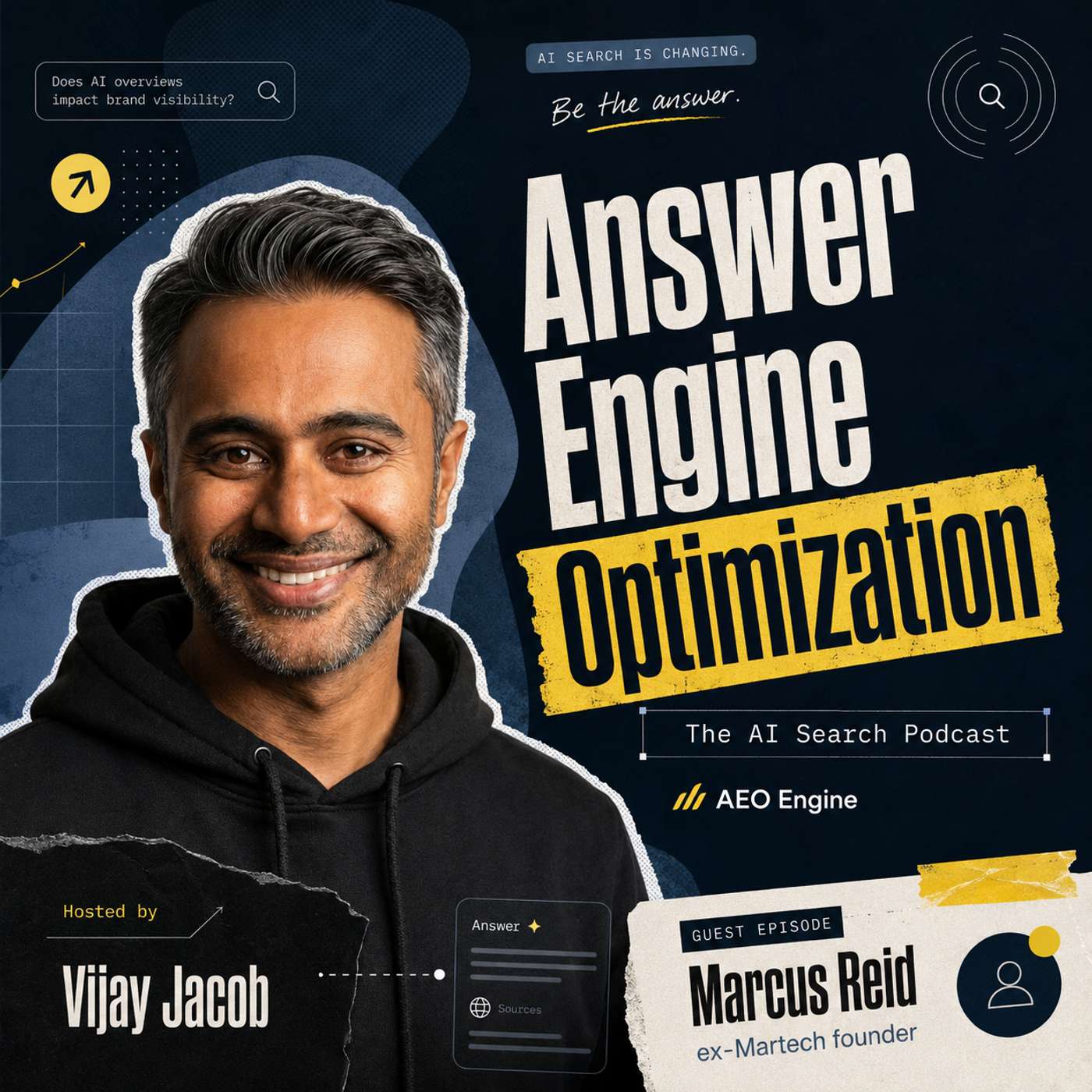
- Answer Engine Optimization (AEO): The AI Search Podcast
- Smart vs. Dumb SEO and AEO: Why Volume Chasing Is Killing Your Pipeline
Answer Engine Optimization (AEO): The AI Search Podcast23 Nov 2026 · 11m · 5 chapters
Smart vs. Dumb SEO and AEO: Why Volume Chasing Is Killing Your Pipeline
In short
Debate on “smart vs. dumb” SEO/AEO, arguing that chasing traffic volume (daily posts, high-DR backlinks, prompt spreadsheets) kills pipeline; winning means being “chosen” by AI systems via extractable content and measuring revenue.
Guests
Marcus Reed, industry analyst; ex-Google Ads; previously ran a MarTech startup that failed partly due to believing hype cycles.
Key claims
AEO isn’t just rebranded SEO; AI search is about extraction/synthesis and citations, not just rankings. LLMs will likely penalize spam tactics within 6–12 months (skeptic prediction). AI citation traffic is lower volume but higher intent; track “share of model” (how often you’re cited for buyer questions), not sessions.
Notable examples
“Monday metrics” where traffic rises but pipeline stays flat; being the “fourth best option nobody mentioned” in ChatGPT recommendations; structured “question/answer/evidence” content over vague 2,000-word throat-clearing.
Written by AI. May contain mistakes.
Chapters
0:46
Introducing the Debate: Smart vs. Dumb SEO
Discussion on the ongoing debate in marketing about smart versus dumb SEO.
“industry analyst, ex-Google Ads, and a man who has watched more hype cycles die than he cares to count.”
1:41
Recognizing the Problem with Traffic Metrics
Analyzing the issue with chasing traffic versus measuring actual revenue.
“And nobody wants to say out loud that pipeline is flat.”
3:11
Understanding AEO's Value Over Traditional SEO
Exploring the differences between SEO and AEO and their impacts.
“Buying high DR links because a vendor emailed a chart.”
4:26
The Importance of Content in AEO
Discussing how content structure impacts AI search and citation.
“The skeptic camp is right that a lot of AEO consulting is rebranded fundamentals.”
6:31
Shifting Focus from Traffic to Intent
Highlighting the significance of tracking buyer intent over raw traffic metrics.
“We shipped a structured content overhaul at my last company and watched it break the next day because the underlying answers were still vague.”

Ask about this episode
Get the gist, explore an idea or ask about something said.
 Claude
On Answer Engine Optimization (AEO): The AI Search Podcast, what are the key points of this episode?
Searching your listeningTranscript
Automatic transcript. May contain errors.
0:20Welcome to the AEO Engine AI Search Show, the AEO Podcast for brands looking to earn citations in ChatGPT, Gemini, and Perplexity. I'm your host, BJ Jacob, founder and CEO of AEO Engine. Today, we're getting into a fight that's been simmering across marketing Twitter and Reddit for months. Smart versus dumb SEO and AEO. And my guest for this one is Marcus Reed, industry analyst, ex-Google Ads, and a man who has watched more hype cycles die than he cares to count. Marcus, welcome back. Hey, everyone. Good to be here. And yes, I've got the scar tissue to prove it. I ran a MarTech startup into the ground, partly because I believed my own press releases.
1:06So when I see a hype cycle, I recognize it like an old roommate. So let's set the scene. There's a thread that got bookmarked thousands of times recently, and the core contract is brutally simple. On one side, you've got the volume chasers, daily blog posts chasing high domain rating backlinks, tracking hundreds of AI prompts in a spreadsheet and calling that a strategy. On the other side, people saying, stop. Publish around actual purchase decisions. Earn mentions that matter. Measure leads and revenue, not raw traffic. Right. And what I love about that thread is that everyone reading it had the same private moment of recognition.
1:46You know the one. You're in the Monday metrics meeting. Traffic's up 40%. Everyone's nodding. And nobody wants to say out loud that pipeline is flat. That spreadsheet is full of visitors who are never going to buy anything. Exactly. And the follow-up post to that thread went further. It argued teams should publish content around the actual purchase decision, the comparison moment, the switching moment, the budget approval moment, and measure revenue instead of sessions. Which sounds obvious until you look at what most teams actually do. The dopamine hit of a traffic graph going up is real. Sessions are easy to count.
2:23Revenue attribution is messy, and it makes you accountable. So people optimize for the number that's easy to screenshot. So there's a name for this split, at least informally. The community has settled on smart versus dumb SEO and AEO. And I want to be clear, that's an editorial framing, not an official industry term. But the research behind it is real. Optimizely put it well. A solid SEO strategy keeps driving traffic, while a smart AEO approach sets you up for success. That word smart is doing a lot of work there. It's the laziest and most honest word choice possible. And I respect it. Because the dumb version isn't stupid people.
3:06It's smart people doing activity instead of strategy. Publishing daily because the cadence dashboard says so. Buying high DR links because a vendor emailed a chart. Let's break down what actually happened in this debate. because it wasn't just one thread. The discussion spread across Reddit communities and it split into camps. The skeptics said AEO is just SEO with fancier jargon, quote, to bill more hours. One practitioner who built an open source LLM tracker said, whatever worked 15 years ago with spam SEO works now. Dumb listicles and top 10 comparisons can temporarily fool the models. And his prediction was specific, which I appreciated.
3:47He said the LLMs will clever up and penalize spammers within 6 to 12 months. That's the early Google Playbook replaying. Keyword stuffing worked in 2005. Then Google got smart, and an entire industry of tricksters got wiped out overnight. He's betting the same arms race happens with AI answers. The middle ground camp, though, landed somewhere more interesting. One framing that stuck. SEO is about being found. AEO is about being chosen. Another one, SEO builds trust. AEO wins speed. And the conclusion in that community was basically, smart brands won't choose one. That's the framing I'd defend.
4:28The skeptic camp is right that a lot of AEO consulting is rebranded fundamentals. But being right about the jargon inflation doesn't make you right about the surface change. AI overviews, chat GPT recommendations, perplexity citations? Those are genuinely new places a brand either appears or doesn't. You can be correctly cynical and still miss the train. Here's where I'll push back a little, Marcus. I think the skeptics underweight one thing, extraction. Traditional SEO gets you rent. AEO is about whether an AI system can extract, synthesize, and present a clear, direct answer from your content and cite you as the source.
5:12Conductor calls it making your content the definitive response in AI-powered search. That's a structural problem, not a rankings problem. Hey, real quick. When someone asks ChatGPT or Perplexity for the best solution in your space, does your business actually come up? Yeah. For most companies, the answer is no. And that's a problem. Because that's where your buyers are going now. That's exactly why AEO Engine exists. It's a fully agentic, done-for-you AI search optimisation system built to get your business discovered in AI-generated answers and recommendations before your competitors figure this out.
5:48And the results? Clients are seeing an average 920 % increase in AI-recommended traffic in just 100 days. And here's the kicker. That traffic converts 9 times higher than normal cold Google traffic. 9 times. Go to aeoengine.ai. That's A-E-O-E-N-G-I-N-E dot AI and make your business the answer. I half agree. And the half I dispute is this. The mechanism matters less than people think and the content matters more. If your page answers a real question a real buyer has, in a structure, a machine can parse. Question, answer, evidence, credibility signals. You're most of the way there on both channels.
6:30If your page is 2 ,000 words of throat clearing before a comparison table, no amount of markup saves you. We shipped a structured content overhaul at my last company and watched it break the next day because the underlying answers were still vague. Structure amplifies substance. It doesn't replace it. Fair. Let's talk measurement, because this is where the dumb versus smart line gets sharpest. Yopto made a claim I think about constantly. Traffic from AI citations is lower in volume, but significantly higher in intent. That flips the entire volume-chasing logic on its head. And they proposed a metric for it.
7:07Share of model, the AEO equivalent of share of voice. How often does your brand get cited in AI summaries for the questions your buyers actually ask? That's a question about presence in the answer, not position on a page. Nobody scrolls page two anymore. They ask ChatGPT and take the first three names it gives them. Which connects straight back to the original thread. If AI refer traffic is lower volume but higher intent, then tracking hundreds of prompts and raw sessions is measuring the wrong thing twice over. The smart operator tracks citations on buyer intent questions and the revenue that follows.
7:44Right. And here's the risk. Nobody prices in. Being absent from the AI answer isn't neutral. When ChatGPT recommends three tools and you're the fourth best option nobody mentioned, you don't get a silver medal. You don't exist. It's like being the best restaurant on a street with no signage. Terrible business, great food, no customers. Now one honest caveat before we go further, and this is me admitting uncertainty on the record. The research here is thin on hard numbers. There's Yotpo's qualitative intent claim and a lot of strong opinions. No source I found has solid adoption data or traffic loss statistics from AI overviews.
8:25I actually don't know if the 6-12 month spam penalty prediction holds. It could be faster, it could be slower. And I could be wrong about citation patterns mattering as much as I think they do in 6 months. That's the correct posture. Anyone projecting confident 5-year curves for AI search is doing astrology with line charts. What you can say, the mechanism is real, the intent signal is real, and the spam window is real, but closing. That's enough to act on. So let's make it practical. This is exactly the problem we built AEO Engine around. When we work with e-commerce and B2B brands, the first move isn't more content.
9:04It's mapping the actual purchase decision questions and checking where the brand stands in AI answers across ChatGPT, Google AI overviews, and perplexity. Then we publish around those decisions, which structure machines can extract, and measure revenue. Not sessions. Revenue. And to be clear, I don't say this often about vendors. That ordering is right. Audit presence first, publish second, measure money third. Most agencies start with publish because publishing is billable on day one. If I were running a DTC brand right now, my Monday dashboard would have one number on it. Are we in the answer for the 10 questions our buyers ask before they swipe a card?
9:48That's the whole game. Smart vs. Dumb isn't about talent or budget. It's about which number you're accountable to. Volume is comfortable. Revenue is honest. And the jargon will keep churning. SEO, AEO, GEO, whatever's next. Ignore the acronym fight. Answer real buyer questions in a form machines can cite. That advice will survive at least three more renaming cycles. That's a wrap on this one. Quick recap. Volume chasing tactics are getting exposed. AI citation traffic is lower volume, but higher intent. And the winning play is publishing around purchase decisions and measuring revenue, not traffic.
10:28If you want to see where your brand stands in AI answers and fix it, head over to a.eoengine.ai. That's aeoengine.ai. Thanks for listening, and we'll see you next episode.
From the publisher
“Smart vs. Dumb SEO and AEO: Why Volume Chasing Is Killing Your Pipeline,” an AEO Engine podcast episode, examines a viral X thread dividing marketers into volume-chasers and buyer-intent operators as Google AI Overviews, ChatGPT, and Perplexity reshape search rankings in 2026.
Key takeaways:
- Google AI Overviews now reduce zero-click outcomes for high-volume, low-intent keywords.
- Perplexity and ChatGPT citations favor buyer-intent content over keyword-volume targets.
- AEO Engine defines “dumb SEO” as chasing search volume instead of pipeline revenue.
- Agentic SEO workflows prioritize AI answer visibility across LLMs over raw rankings.
- Buyer-intent operators convert better because AI search users arrive closer to purchase.
Q: Is search volume still a good KPI for SEO in 2026?
A: No. With Google AI Overviews answering informational queries directly, AEO Engine argues pipeline and buyer-intent keywords outperform volume-based targets for revenue attribution.
Q: What is the difference between SEO and AEO?
A: SEO targets rankings in traditional search results, while AEO (Answer Engine Optimization) targets citations inside AI answers from ChatGPT, Perplexity, and Google AI Overviews.
Q: How do I get cited by ChatGPT and Perplexity?
A> Structure content as direct answers to buyer-intent questions, use clear entities and comparison formats, and monitor AI visibility with tools like AEO Engine.
The viral thread debated on x.com landed at a moment when AI search has become a pipeline problem, not a traffic problem. Google AI Overviews absorb informational queries, ChatGPT and Claude now influence B2B research, and Perplexity citations drive qualified demand. For service businesses—especially law firms where a single case can be worth six or seven figures—ranking for 50,000 monthly searches matters less than being the cited answer when an AI assistant recommends an attorney. This episode maps exactly that buyer: the local firm losing leads to competitors with stronger AI visibility. It’s why AEO Engine built its Personal Injury Lawyer SEO Services offering around intent-first content, agentic workflows, and AI citation tracking rather than legacy volume metrics. Marketers who want AI answers to cite them for “personal injury lawyer near me” or “best car accident attorney” queries should treat this episode as the strategy briefing for that shift.
Ready to stop chasing volume and start winning AI citations? Explore AEO Engine’s Personal Injury Lawyer SEO Services, and subscribe to AEO Engine on Apple Podcasts, Spotify, or your favorite podcast platform.
More from Answer Engine Optimization (AEO): The AI Search Podcast
All episodesWe use cookies.They keep VO running smoothly and help us improve it. Privacy policy