
 Ask ChatGPT

- Podcasts
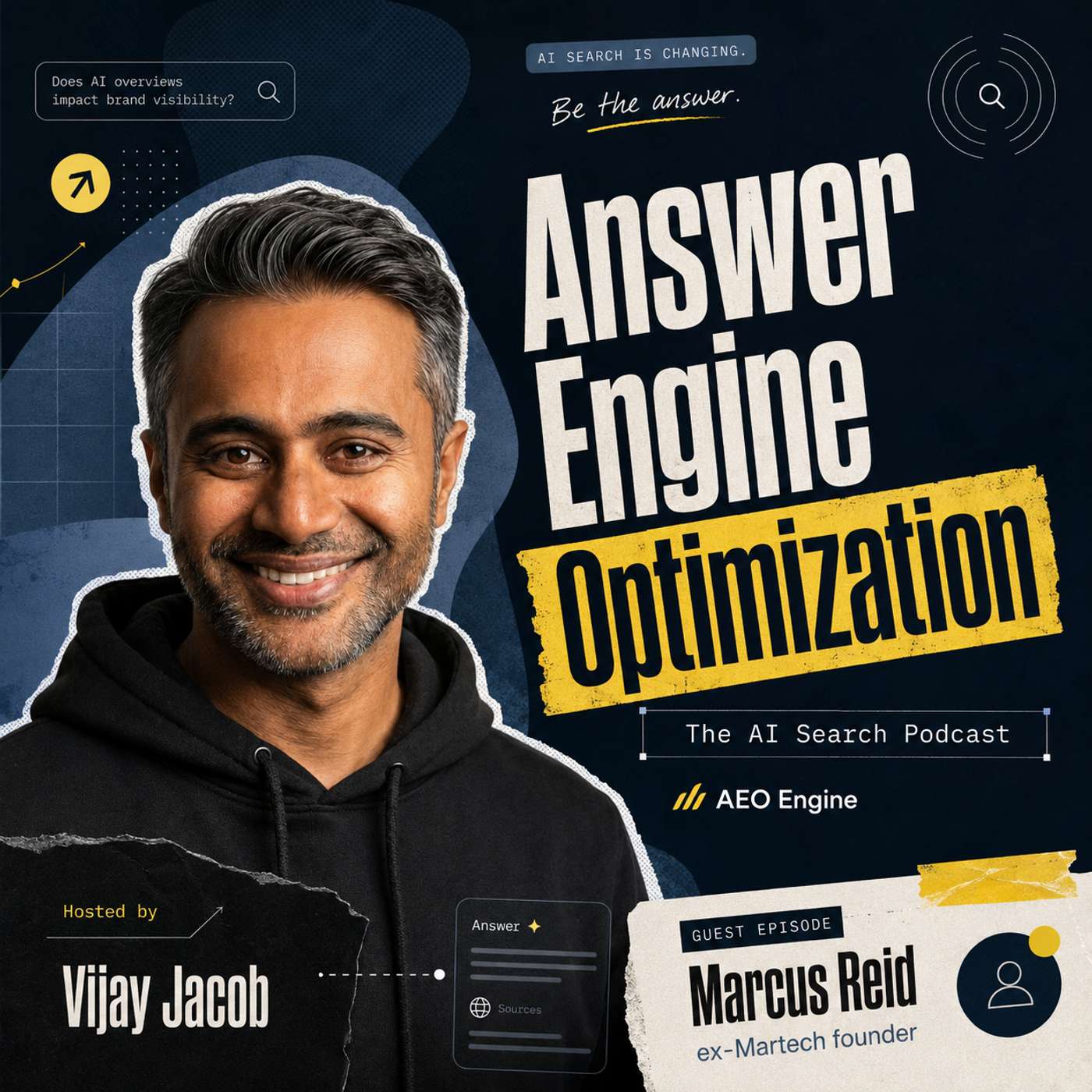
- Answer Engine Optimization (AEO): The AI Search Podcast
- Up 340%: The GEO/AEO Specialist Hiring Surge Nobody Agrees On
Answer Engine Optimization (AEO): The AI Search Podcast14 Nov 2026 · 10m · 3 chapters
Up 340%: The GEO/AEO Specialist Hiring Surge Nobody Agrees On
In short
A viral jobs chart claiming GEO/AEO specialist roles are up 340%, used to argue that “search” is shifting from clicks to AI citations in ChatGPT/Gemini/Perplexity.
Guest
Marcus Reed, an analyst who has seen the chart repeatedly and frames the debate as “muddy middle” between real new work and rebranded SEO.
Key claims
AI summaries reduce link clicks (Pew: 1% click rate), so success is being cited/recognized, not ranking. GEO vs AEO naming is inconsistent; skeptics say it’s mostly SEO with new labels, but practitioners say it’s about extractability, schema, llms.txt, and monitoring answer presence.
Notable examples
companies adding skills to SEO titles (American Express, Surkana, UPS, Publicis) and reported salaries up to ~$171k (Stripe, AWS, Amgen, SailPoint, Citizens Bank).
Written by AI. May contain mistakes.
Chapters
0:55
Understanding GEO and AEO Roles
Discussion on the significance of the jobs chart showing a 340% increase in GEO and AEO specialist roles.
“I've seen that chart roughly 400 times in my feed, which by my math means the chart itself has better distribution than most brands.”
3:08
Day-to-Day Responsibilities of AEO Specialists
A detailed look at the daily tasks expected of AEO and GEO specialists and the distinctions from traditional SEO roles.
“and most marketing teams have no instrumentation for it.”
6:12
The Implications of AEO in Marketing
Exploration of the broader implications of AEO in the marketing landscape and how businesses can adapt.
“Fractal analyzed over 33 ,000 job listings to study the terminology across SEO, GEO, and AEO.”

Ask about this episode
Get the gist, explore an idea or ask about something said.
 Claude
On Answer Engine Optimization (AEO): The AI Search Podcast, what are the key points of this episode?
Searching your listeningTranscript
Automatic transcript. May contain errors.
0:21Welcome to the AEO Engine AI Search Show, the AEO Podcast for brands looking to earn citations in ChatGPT, Gemini, and Perplexity. I'm your host, Vijay Jacob, founder and CEO of AEO Engine. Today, we're talking about a jobs chart that's been making the rounds, the one showing GEO and AEO specialist roles up 340%. And joining me to unpack it is analyst Marcus Reed. Marcus, welcome back. Hey, everyone. Good to be here. And yes, I've seen that chart roughly 400 times in my feed, which by my math means the chart itself has better distribution than most brands. Let's start with the moment every listener already knows.
1:07You run a business. You open ChatGPT and you type, what's the best software in my category? Your competitor gets named. You don't. Nobody clicks anything. The conversation ends and you never even knew you lost. That's the felt experience, right? It's not a rankings report. It's invisibility. Your traffic dashboards look fine, and yet a growing slice of your buyers just never arrive. There's actually a name for fixing that now, and apparently a job title attached to it, which is what that chart is measuring. So let's define terms. GEO, Generative Engine optimization and AEO answer engine optimization.
1:50The research traces the term GEO back to a November 2023 paper on archive from researchers at Princeton, Georgia Tech, the Allen Institute for AI, and IIT Delhi, an academic term that became a job posting in under two years. Which is wild speed. To be fair to the skeptics we'll get to, the naming is a mess. Some employers call it AEO, some call it AI visibility, some just bolted onto existing SEO titles. One staffing analysis literally framed it as two acronyms, one actual job. The distinction people draw is that AEO grew out of the Google-dominated world. One platform, one extracted answer, the goal was extractability.
2:34GEO targets generative platforms broadly, getting your content into the pool of data LLMs pull from. And here's the number that explains why companies are paying for this. Pew found that people clicked a link inside an AI summary on 1 % of visits. 1%. The click basically doesn't exist anymore inside answers. That stat does more work than the 340%, honestly. If the answer is delivered directly, success isn't rank and click through anymore. It's being cited in the answer. That's a fundamentally different metric. and most marketing teams have no instrumentation for it. That measurement gap is the real story behind the hiring chart.
3:14So what does the job actually look like day-to-day? Concrete stuff, based on the job listings and skill profiles. Structuring content so models can extract and cite it. Implementing schema and structured data. Building and maintaining an llms.txt file. Essentially a re-edme for AI crawlers. And managing your third-party presence, because LLMs don't just read your site. They read Reddit, review sites, publishers. The role touches content, technical site structure, and external footprint all at once. Which is why it doesn't fold neatly into an existing SEO role. Adage reported that companies like American Express, Surkana, UPS, and Publicis are adding AEO and GEO skills to SEO titles.
4:02And the community research surfaced salaries reportedly reaching$171 ,000 at companies like Stripe, AWS, Amgen, SailPoint, and Citizens Bank. Which is the part that made Reddit explode. There's a very popular thread on r slash SEO titled. I'm paraphrasing only slightly. AEO, GEO is a buzzword intended to trick clients, change my mind. Security Boulevard had the cleanest take on the split. Skeptics are correct that most GEO tactics overlap with SEO, but wrong that the discipline is fake. Where do you land on that, Marcus? Genuine question. I land in the muddy middle. Ranking number one on Google no longer guarantees AI citation.
4:45That's just observable. Someone in that r slash SEO thread said GEO and AEO are ways to help AI actually understand and reference your content. And that matches what practitioners in the niche subreddits describe. Entity mapping with schema, testing how LLMs summarize their brand, monitoring answer presence. That's real work. But I also think half these job postings are the same SEO job with a LinkedIn-era title refresh. It's like when every company suddenly needed a head of remote in 2021. Some of those roles were real. Most got absorbed in 18 months. Hey, real quick. When someone asks ChatGPT or Perplexity for the best solution in your space, does your business actually come up?
5:28Yeah, for most companies the answer is no, and that's a problem. Because that's where your buyers are going now. That's exactly why AEO Engine exists. It's a fully agentic, done-for-you AI search optimisation system. Built to get your business discovered in AI-generated answers and recommendations before your competitors figure this out. And the results? Clients are seeing an average 920 % increase in AI-recommended traffic in just 100 days. And here's the kicker. That traffic converts nine times higher than normal cold Google traffic. Nine times. Go to aeoengine.ai, that's A-E-O-E-N-G-I-N-E, dot AI, and make your business the answer.
6:11That's fair. Here's where I'd push you, though. Fractal analyzed over 33 ,000 job listings to study the terminology across SEO, GEO, and AEO. And they concluded these are separate lanes. Their framing? Use GEO when educating. AEO when sharing tactics SEO when establishing content credentials The metrics confirm the lanes I buy the lanes I'm less sure they need three separate humans There's a practitioner take I keep coming back to from one of the beginner subreddits Treat AEO as a lens on good content design Not a job title And then a GEO marketer in the same thread admitted it Still feels weird to be in a job that didn't exist a few years ago But the underlying need will last That's the most honest sentence in this entire debate.
7:01The other org question the research raised, where does this person sit? One staffing firm warned that a hire buried two levels down in a content team usually stalls. Their answer was blunt and correct. Put the role wherever it can ship changes. If the person who monitors AI visibility can't touch schema, can't touch content structure, can't influence what gets published on third-party sites, you've hired a reporting layer with a nice title. I've seen that movie. At my last company, we shipped a visibility dashboard nobody had authority to act on. Beautiful deck. Zero outcomes. So let's zoom out.
7:35Why did a jobs chart go viral at all? Because it's a proxy war. The 340 % number is really marketers arguing about whether the ground shifted under search permanently or whether this is one more hype cycle with a payroll attached. And the hiring behavior is the strongest evidence available because companies like Stripe and Amgen don't post 171k rolls for Vibes. Frackle's 33 ,000 listings, ad age tracking title changes at Fortune 500 employers, that's capital committing. The disagreement is about durability, not existence. I'll say it plainly, I don't know if the standalone job title holds in six months.
8:17The function, being cited, being described accurately by AI, that holds. Whether it's a specialist or a skill everyone's expected to have, I genuinely can't tell you yet. I'd add one more implication for small and mid-sized brands. You don't have a$171K budget line. But your buyers are asking ChatGPT the same questions your enterprise competitor's new hire is optimizing for. The gap between brands with answer visibility and brands without it compounds quietly, question by question. And that's the uncomfortable version of the chart. Enterprise hiring is the leading indicator. The small brand that waits until the title is standardized is already a year behind on the work.
9:02This is where I'll bring it back to what we do because it's directly relevant. At AO Engine, this whole discipline is our day job. We run an LLM presence audit and authority signal mapping so brands know exactly what ChatGPT, Claude and Gemini currently say about them. then restructure content so it's the citable answer, not just a ranking page. The same work those new specialists are being hired to do in-house. Which is the pattern, right? Every new discipline starts as an agency service, then becomes a job title, then becomes software. SEO did that exact arc. AEO is just doing it on fast forward.
9:42And the playbook is the same regardless of who runs it. measure your visibility inside answers, structure content for extraction, manage the third-party sources the models actually read. That's the takeaway from the surge. And if someone tells you they can guarantee the number one citation in ChatGPT, run. That's the buzzword tax the skeptics are rightly worried about. That's the show. The 340 % surge is real, the job is real, the debate is healthy, and the underlying shift from clicks to citations is the part you can't afford to ignore. If you want to know what AI answers currently say about your brand, head to a.eoengine.ai and start with an audit.
10:26See you next episode.
From the publisher
Job listings for GEO (Generative Engine Optimization) and AEO (Answer Engine Optimization) specialists have grown 340%, a hiring surge driven by Google AI Overviews, ChatGPT, and Perplexity reshaping organic search traffic — the subject of the AEO Engine episode "Up 340%: The GEO/AEO Specialist Hiring Surge Nobody Agrees On."
Key takeaways:
- GEO/AEO specialist job postings are up 340% as of 2026.
- Google AI Overviews and Perplexity answer queries directly, cutting traditional click-through rates.
- Roughly half of veteran SEO practitioners consider GEO/AEO roles overhyped or redundant.
- AEO work covers brand citations in ChatGPT, Claude, and Perplexity answers, not just rankings.
- Agentic SEO — AI agents executing optimization workflows — is reshaping team structures.
Q: What does a GEO/AEO specialist actually do?
A: A GEO/AEO specialist optimizes content and structured data so a brand is cited in AI-generated answers from Google AI Overviews, ChatGPT, Perplexity, and Claude, rather than only ranking in traditional blue-link results.
Q: Is GEO/AEO a real job or just rebranded SEO?
A: The 340% surge in listings suggests companies treat it as distinct, but many SEO veterans argue the skills overlap heavily; the episode examines both positions with hiring data.
Q: Why are companies hiring GEO specialists in 2026?
A: Because AI answer engines increasingly resolve user queries without clicks, brands that aren't cited in AI answers lose visibility and lead flow — a commercial risk executives now fund headcount against.
The 340% growth in GEO/AEO roles reflects a real budget shift: since Google launched AI Overviews and OpenAI, Perplexity, and Anthropic became primary discovery channels, CMOs can no longer treat AI visibility as experimental. This episode maps the actual job description — AI search ranking factors, citation monitoring, agentic workflows, Perplexity AI optimization — against skepticism from half the SEO community, giving listeners a grounded view of what skills are durable versus hype. The discussion, sparked by a widely shared thread on x.com, is directly relevant to marketing leaders and small business owners evaluating AI search investment in 2026. For teams that decide the role is real, AEO Engine's AEO Services page outlines managed answer engine optimization — from AI answer share tracking to content restructuring — as an alternative to hiring a scarce 2026-market specialist in-house.
Want your brand cited instead of competitors in ChatGPT and Google AI Overviews? Explore AEO Services from AEO Engine, and subscribe to AEO Engine on Apple Podcasts, Spotify, or your favorite podcast platform for weekly episodes on AI search, agentic SEO, and go-to-market strategy with AI.
More from Answer Engine Optimization (AEO): The AI Search Podcast
All episodesWe use cookies.They keep VO running smoothly and help us improve it. Privacy policy