
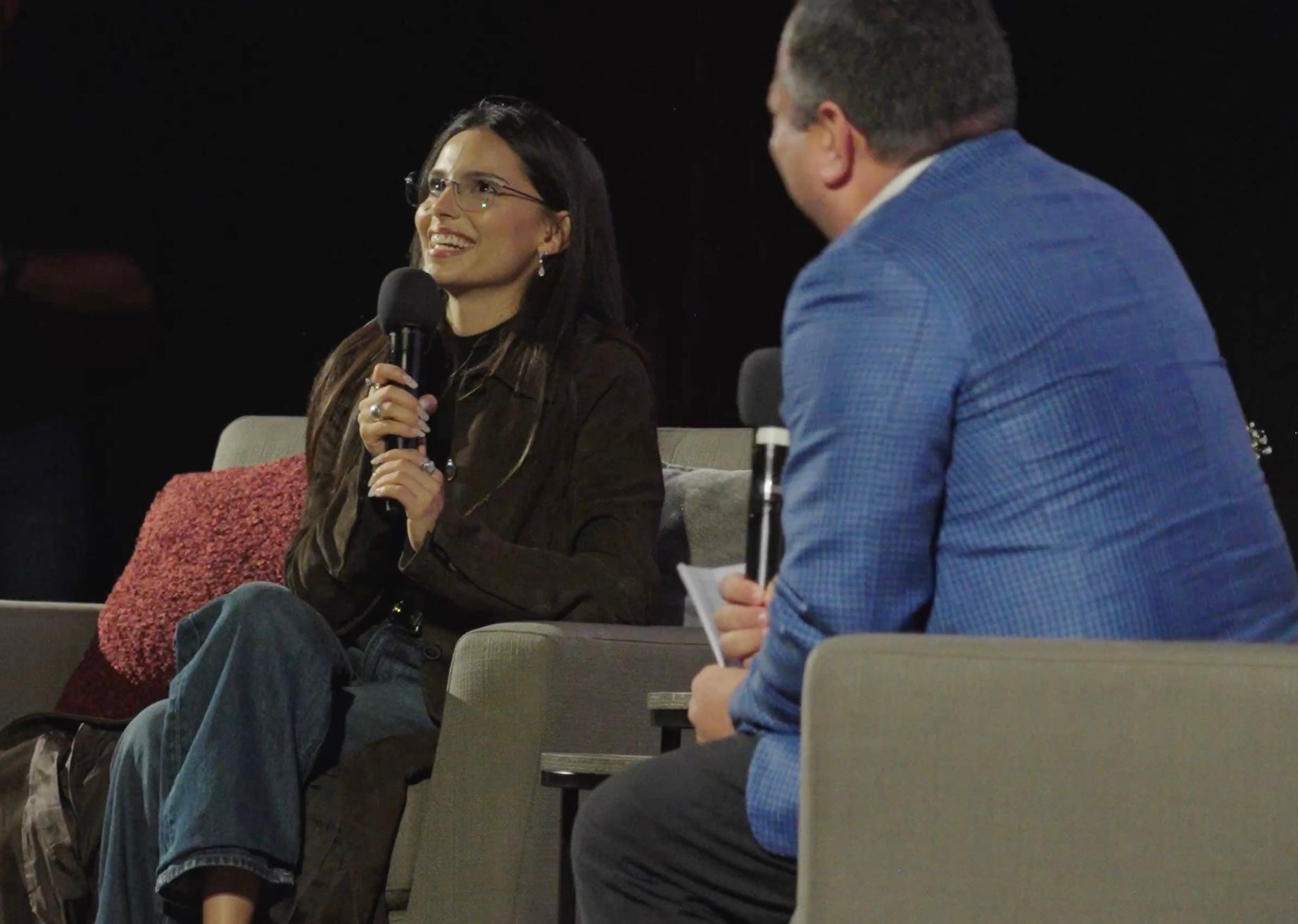
 Ask ChatGPT

- Podcasts
- Awards Chatter
- Inde Navarrette - 'Obsession' [LIVE]
In short
Live film-school masterclass with Indy Navarrete about her leading role as Nikki Freeman in Curry Barker’s indie thriller Obsession, including how she built the performance, the film’s themes, and her career path from TV to film.
Guest backgrounds
Indy Navarrete is an actress born in Tucson, Arizona, raised across multiple states after her parents divorced; her mother is a hairstylist and her father served in the Marines. She moved near Los Angeles as a teen, worked scrappily for headshots/demo reels, and started with commercials, then TV (13 Reasons Why as Estella; Superman & Lois as Sarah in 47 episodes, 2021–2024). During COVID she streamed and played video games.
Key claims
She says Obsession’s story is framed from Bear’s perspective, so Nikki’s actions aren’t an “objective” trope; she aimed to make Nikki terrifying through subtle timing/expression, using director shorthand and vocal/physical “languages.” She credits confidence gained from 13 Reasons Why and learning continuity across many Superman & Lois directors. She describes the transition to film after being cut from Superman & Lois as financially and emotionally difficult.
Notable examples
Her 13 Reasons Why school-shooting episode; her “no, no, no” performance pacing; prep references like Mia Goth (Pearl) and Get Out; Obsession’s first day shooting the bed-makeout scene; using music (Paramore/divorced dad rock; Fleetwood Mac “Landslide”) to reach Nikki’s grief.
Written by AI. May contain mistakes.
Chapters
0:30
Indy Navarrette's Early Life and Background
Indy shares her upbringing, family background, and early influences.
“Whatever ends up happening as far as further recognition for this film, we can rest easy knowing that we have many decades of more great performances to look forward to from this star.”
2:37
The Impact of a Military Upbringing
Indy discusses how moving around shaped her identity and acting.
“Welcome, welcome, and thank you so much for squeezing us in.”
4:23
Indy's Name and Early Interest in Acting
Indy reveals her real name and how she developed an interest in acting.
“Because she was like, do you feel like the many faces that you wore prepared you for the many faces you were going to wear?”
6:20
Moving to LA and Early Acting Aspirations
Discussion on Indy's move to LA and balancing education with acting.
“Meanwhile, I was just having so much fun screaming at people and just like crying and like being this dramatic kid.”
7:42
Navigating the Acting Industry and Early Challenges
Indy talks about the challenges of headshots, auditions, and networking.
“But even things like headshots and practical things that everybody here has got to think about, Now, that's not, a lot of time and different things factor into something, even as simple as that, right?”
9:50
Breakthrough Role in '13 Reasons Why'
Indy shares her experience working on '13 Reasons Why' and its impact.
“Denton's Death Date yeah yeah um so I my first audition was for commercials as I'm sure if anybody here that's an actor has gone out you you've done commercial jobs.”
11:50
Life After '13 Reasons Why' and the Pandemic
Indy reflects on her career during the pandemic and upcoming projects.
“This is Netflix and all of that comes with that.”
14:00
Life Before the Pandemic
Inde shares her experiences during the transition from '13 Reasons Why' to 'Superman and Lois'.
“I don't know if that was right after 13 Reasons Why or you had already started on the next TV project that I want to mention.”
15:11
Coping with COVID Through Video Games
Inde discusses how video games helped her cope with loneliness during the pandemic.
“So it was kind of scary, but also very fascinating at the same time.”
16:51
Student Interaction: Video Game Adaptations
Inde answers a student question about which video game adaptation she'd choose.
“And so I just surrounded myself with video games at that time.”
Show all 38 chapters
18:26
Experience on 'Superman and Lois'
Inde reflects on her role as Sarah in 'Superman and Lois' and the impact of working with various directors.
“throughout this and they are of varying degrees of weightiness and seriousness and slash fun.”
23:15
Learning from Challenges on Set
Inde discusses the lessons learned from working with different directors and the experience of getting injured on set.
“He would just be so frustrated sometimes.”
24:28
Transitioning After 'Superman and Lois'
Inde talks about the challenges faced after leaving her role on 'Superman and Lois' and her pursuit of new opportunities.
“And now I feel like on sets, I'm able to use that to further communication.”
27:05
The Journey to 'Obsession'
Inde shares her feelings about her first leading role in 'Obsession' and the significance of the project for her career.
“And then, you know, that's where streaming came in.”
28:00
Indie Film Journey and Auditioning for Obsession
Learn about Inde Navarrette's experience auditioning for and preparing for her leading role in 'Obsession'.
“but this was my first leading project where I was going to be in day in and day out.”
31:20
Character Development and Perspectives
Explore the in-depth character discussions and how perspectives shape storytelling in 'Obsession'.
“and the difference between love and romance.”
38:00
Breaking Tropes and Societal Reflections
Discover how 'Obsession' subverts traditional tropes and comments on modern societal issues regarding relationships.
“Was there a conversation about why that was important to you or how you guys were thinking about that?”
42:00
Understanding Bear's Wish
Explore the implications of Bear's wish on Nikki and its narrative significance.
“and what would make Bear make this wish in the first place, right?”
43:30
Shooting Challenges and Authenticity
Discuss the shooting schedule and the challenges of portraying character depth in brief scenes.
“And so we're kind of going in the first day of, I know Curry's nervous.”
45:40
Creating a Unique Performance Language
Learn how the actors developed a unique vocabulary to enhance their performances.
“because then I did have privacy with things because it's a very intense movie.”
48:00
Vocal Techniques and Tension in Acting
Delve into the vocal techniques used by the actors to create tension in their performances.
“Therefore, everybody's supposed to be acting normal, but to the audience it's a tense moment.”
50:40
The Role of Music in Character Development
Discover how music influenced the portrayal of Nikki and added emotional depth.
“Yeah, and those are, but that's kind of a cool callback there, I guess.”
53:00
Crafting a Complex Character
Explore how Nikki's imposed desires shaped the performance and character authenticity.
“I've found that music early on in my life kind of slices me open in a way that sometimes is deeply uncomfortable and I don't want to feel.”
56:05
Character Depth and Performance Crafting
Explore how imposed desires shape character authenticity in performance.
“I said that actors are usually taught to focus intensely on what their character wants and why they want it.”
58:03
Physicality and Gore in Filmmaking
Discuss the physical demands of acting and the evolution of a gory scene.
“but probably never more so than in the other car scene that we're talking about.”
1:00:21
Changing Endings and Creative Decisions
Understand the impact of audience feedback on film endings and creative choices.
“And some of them were like the moment when she's reading a book upside down on bed and she cuts his hair and then the duct tape wall.”
1:03:02
Reflections on Life After Filming
Learn about the mindset transition from completing a film to its release.
“It's kind of like a one night sort of a thing, or it can come and go based off of how glittery and golden the relationship is.”
1:08:26
The Life-Changing Night at TIFF
Discover the significance of a film screening at TIFF and its impact on a career.
“I mean, Jujutsu Kaisen, I find to be a very fascinating anime.”
1:10:00
Reflecting on the Life-Changing Night
Inde Navarrette shares her experiences and thoughts on the night of the film's screening at TIFF.
“I believe you were rooming with somebody else from the movie.”
1:11:54
Celebration and Unexpected Success
Navarrette describes the celebration after the screening and the ensuing excitement over the film's success.
“Movies that open wide never get bigger in subsequent weeks, right?”
1:14:14
Understanding Box Office Reactions
Discussion on the film's box office performance and the impact of audience reception.
1:16:01
Navigating Viral Fame
Navarrette talks about handling viral moments and the attention surrounding her role.
“It sounds wonderful and amazing and I love the way that it shows up in my family members' lives where now I can tell my dad, no, no, no, no, don't do that.”
1:17:38
Aspiring to Direct
Navarrette discusses her interest in directing and the storytelling approaches she values.
“We have a question that I want to include from James Bowman from Screenwriting.”
1:20:23
Handling Relationships and Personal Growth
Navarrette reflects on the lessons learned from her role regarding relationships and self-identity.
“And I really want to make films that allow people to use that aspect of their brains.”
1:24:01
The Impact of Relationships on Self-Identity
Explore how relationships influence our sense of self and the fear of rejection.
“If Bear had just asked her out, what would she have said?”
1:25:19
The One Wish Willow Concept
Discuss the hypothetical implications of having a wish and the realities of loss.
“And I would wish for free furniture, because why is a couch$7 ,000?”
1:27:56
Future Opportunities in Acting
Hear about the actor's aspirations and strategic choices in their career.
“obviously a lot of people have very quickly become very invested in you and your work and your future and excited about all of it.”
1:29:29
Character Transformation and Respecting Source Material
Learn about the importance of character transformation and honoring creative work.
“And I really want to not look like myself in some characters.”

Ask about this episode
Get the gist, explore an idea or ask about something said.
 Claude
On Awards Chatter, what are the key points of this episode?
Searching your listeningTranscript
Automatic transcript. May contain errors.
0:01Curry Barker: Fall never arrives all at once. First the air, then the light, and slowly the things you love begin to find each other. A jacket meets a dress, a hoodie slips beneath a blazer, an old cap finds a new scarf. Because you don't simply step into the season, you create it layer by layer until it finally feels like fall. Find fall your way at Ross.
0:30Inde Navarrette: Good evening, everyone. I'm Scott Feinberg, a presidential fellow here at Chapman University and the executive editor of awards coverage at The Hollywood Reporter, and it's my pleasure to welcome you to a very special installment of our film school's masterclass series that is also being recorded as an episode of The Hollywood Reporter's Awards Chatter podcast. Tonight, 500 students and I have the privilege of being joined by someone who, at just 25, is not much older than most of the people in this room, but has already done some truly outstanding work, most notably in a film that we've just screened here, Curry Barker's Obsession, which cost just $750 ,000 to make, had its world premiere at the 2025 Toronto International Film Festival, where it sparked a bidding war, was released by Focus Features in North America in May of 2026, and quickly became not only a massive blockbuster and one of the most profitable films of all time, It's now grossed more than$500 million worldwide, but also a critic starling and serious awards contender in large part because of the performance of our guest in her first leading role in a film.
1:37Inde Navarrette: Her portrayal of Nikki Freeman, the real one and the wished one, scared the hell out of a generation of moviegoers, launched a thousand memes, and has been described by The Hollywood Reporter as a virtuosic performance, by the Los Angeles Times as instantly classic, by The Guardian as a barnstorming breakout, and by The New York Times as an Oscar-worthy turn. Whatever ends up happening as far as further recognition for this film, we can rest easy knowing that we have many decades of more great performances to look forward to from this star. And so without further ado, would you please join me in welcoming Indy Navarrete.
2:36Curry Barker: Hi, guys.
2:43Inde Navarrette: Welcome. Welcome, welcome, and thank you so much for squeezing us in. You're a busy lady.
2:50Curry Barker: Of course. Also, sorry to the audio listeners for the podcast. You're driving and woo!
2:58Inde Navarrette: Well, we're going to kind of, as much as we can in the time we have, cover your whole story. And so, to begin with, can you just share where you were born and raised? And I know that's a complicated answer. And then also what your parents did for a living.
3:12Curry Barker: Yeah, that's a really good question. So, I was born in Tucson, Arizona. And there you go. I lived there for two years until my parents divorced and my mom we went to Tulare County which is in between Fresno and Bakersfield in California 559 and then I bounced around between North Carolina Washington and then from fifth grade onwards Texas Corpus Christi so really kind of just taken in all the states if you will don't know what my accent is and then my mom My mom is a hairstylist. She built her business from the ground up. She's been doing it for, I'm not gonna give her age away, for a while now.
3:53Curry Barker: And my dad has retired. He, you know, did his Marine and yeah, he retired.
3:59Inde Navarrette: So it's kind of interesting. I don't know if you've noticed this, but I've found in interviewing people over the years that quite a few, I guess, military brats, I don't know, army brats, whatever it is, have ended up in the performing arts. I don't know why that might be. maybe it is something to do with the moving around. Do you have any theory of that?
4:19Curry Barker: It's so funny. Somebody asked me that the other day, and I was like, this is kind of becoming a therapy session. Because she was like, do you feel like the many faces that you wore prepared you for the many faces you were going to wear? And I said, what the? I mean, but I think the answer is yes. I mean, it kind of depends on how you see it, and every child is different. I kind of just took it as an opportunity to, like, every area was a different accent. I find myself, whenever I go back to Texas, I do have a Texan accent. Whenever I go back to Tulare, I sound like I'm from Tulare. So I think it kind of just like wearing multiple different faces really emphasizes that.
4:52Curry Barker: So I think it's true.
4:54Inde Navarrette: So just for those, you know, keeping track of stats like this, things like this at home, trivia. You were not born with the name Indy.
5:01Curry Barker: This is true.
5:03Inde Navarrette: What is your actual name and where did Indy come from?
5:06Curry Barker: My social security number is. Yes, right.
5:08Inde Navarrette: Exactly.
5:11Curry Barker: Danielle Fabiola Navarrete is my full name. And Indy came from, I was very independent as a kid. I very wanted to do things myself, which I think for my mom being a hairstylist and trying to pin a baby down to do her hair is not a good thing. So Indy stemmed from that and then other family nicknames, but Indy kind of just really felt very kismet, if you will.
5:36Inde Navarrette: So all the moving around and all of that, I think you've said that might have to some degree contributed to wanting to or getting lost in movies and TV and video games and other things along the way. But when did acting itself first just enter the equation? I heard like for a lot of people, maybe it might have been a summer thing.
5:58Curry Barker: Yeah. So my mom being a single mom, during her years that I was with her, I went to a YMCA camp in Tulare County and there was like theater aspect of it. It was all different ages and the teacher kind of just pulled my mom aside and was like, you know, she kind of has something going on here if you ever want to explore that. Like I think she's doing really good. Meanwhile, I was just having so much fun screaming at people and just like crying and like being this dramatic kid. So that's how I initially just saw it with acting, but also at the same time I found being a very empathetic kid, I found myself understanding roles in movies and emotions at such a young age and it kind of just became addictive to feel those emotions and me really wanting to portray them and not in like a silly funny way definitely in a way of like i feel like at a as a young age i had to understand emotions and using movies in that sort of um really sort of a way so i believe it was after freshman year
7:04Inde Navarrette: of high school from what I read that you that's around when you headed to LA did you head to LA because you wanted to pursue this professionally or did you get to LA and then decide you wanted
7:15Curry Barker: to pursue it professionally what is the politically correct answer we moved because Tulare County was no longer where we were going to live and my mom grew up in San Pedro which is south and so we moved to Redondo. There we go, I'm shouting everybody out. And so we moved to Redondo and I had always wanted to be an actress and so of course having that adjacency to Los Angeles was really really wonderful but my parents are very big on education and so very much so putting that forward and not making acting first but definitely squeezing it in where I could and just kind of seeing where the cards led, if you will.
8:02Inde Navarrette: And so if you could paint a picture of what it was like when you got to town, I mean, I think you've talked about, like, for anyone that thinks, you know, because now it looks like you showed up overnight and it's, here we are. But even things like headshots and practical things that everybody here has got to think about, Now, that's not, a lot of time and different things factor into something, even as simple as that, right?
8:33Curry Barker: Yes. Headshots are really expensive. And if you don't have the opportunity, well, if you're not born with some financial opportunities, that is a bit of a stick in the mud. So I graduated high school early in order to pay for demo reels and headshots and kind of just gas to take myself to and from jobs. So I did that because I believed in myself more than I wanted to create friendships in high school, if I was being honest. But also at the same time, whenever it comes to headshots and demo reels, I kind of went a route where I worked at a coffee shop and one of my coworkers was in a band and the head of the band wanted to make films.
9:25And so obviously you guys have a lot of resources here at Chapman with friends who also want to do the same thing that you do.
9:31Curry Barker: So, you know, kind of reaching out to friends that are photographers that want to use that opportunity, you know, for them to photograph and learn how to photograph and you getting headshots or just kind of really welcoming the community and kind of seeing it as a bartering system, if you will, of, you know, I want to show my acting chops and you want to show your directing chops. can we work on a demo reel so i really got scrappy with certain things which was really fun because my imdb thing that i saw people talking about that was a black and white shot that i did with a friend i used that for headshots i just found it to be um more enticing than the kind of like sort of headshot um i i saw more as like a snap from a movie yeah if you will yeah um how about
10:17Inde Navarrette: early auditions what was the what sorts of things were you getting the opportunity to audition for what sorts of feedback were you getting um leading up to what I guess was I think the first job period was this um Snapchat series is that right?
10:33Curry Barker: Denton's Death Date yeah yeah um so I my first audition was for commercials as I'm sure if anybody here that's an actor has gone out you you've done commercial jobs. But I don't remember the way that I got the Snapchat series, but I just remember being so stoked that I got something in the first place. And kind of just trying to learn on commercials, probably being a super nosy kid, just, well, what does that mean? And they're like, you're a day player. Why are you talking to me? But yeah, just trying to learn everything that I can and starting the Snapchat series was really, really cool because it was the first time I was ever actually physically on a set.
11:15Inde Navarrette: And in front of cameras.
11:16Curry Barker: And in front of cameras and day in, day out, like playing a character that had continuity. It wasn't just an in and out.
11:22Inde Navarrette: The next step on the way to where we are today, I guess, would be a part that you played in 2020 for nine episodes on the fourth season of, of course, 13 Reasons Why. This is Estella, the younger sister of Monty in that show. And I guess that's like a different level of, you know, in terms of just profile, getting growing your own profile and being part of a bigger thing. This is Netflix and all of that comes with that. Right. So what just how big a deal was that? And I think you talked about on that project, just if we were to talk about steps along the way, like there was there's a episode where there's appears to be a school shooting.
12:08Inde Navarrette: and you've said you learned more on that day and are, I think, prouder of the work from that day than any other.
12:14Curry Barker: Yeah, whenever, I feel like my first kind of pinch me moment in this industry was getting the phone call that I was going to be on 13 Reasons Why because that show was so popular while I was in middle school and high school and it was the first kind of project that really, I knew people that I went to school with were going to see it. And also I was going to be a part of a cast where I was a really big fan of those people. So I really had to turn on the mindset of like, okay, this is work. But I was super young whenever I did it. So I learned a lot on that set. And one of them being the scene in particular that you had mentioned of the school shooting was the first kind of opportunity that I had to show a different range rather than just like a cute little teeny bopper girl of fear, tragedy, you know, kind of processing what could be happening and what is very common in America with school shootings.
13:17Curry Barker: And I remember that day having this weird inclination of I'm supposed to be listening to my mom's voicemail. And if anybody here that has parents, which I know you all do, you know the voicemail of your parents and you kind of have it memorized if you will or at least I do and so that played in my head and it just got me really emotional and so I kind of learned where to add in personal ties and when to take them out and that was really cool to learn on 13 Reasons and also the director of that episode really just allowed freedom with me and it kind of started a bit of confidence in me of like, oh, I am capable more than I thought I was.
13:58Inde Navarrette: Now, this little thing happened at some point along the way called a global pandemic. I don't know if that was right after 13 Reasons Why or you had already started on the next TV project that I want to mention. Do you remember like where things were in terms of your life at the time that the world shut down?
14:20Curry Barker: Yeah, I had gone out for Superman and Lois. I had done a short film in between 13 Reasons Why and Superman, and that was called White Tina for USC, and my hair was completely blonde. And so I remember going out for Superman with that hairstyle. And then, you know, COVID hit. I was living with my best friend and I remember me, her and her mama going to the grocery store to try and get dinner like ingredients and it was chaos. So I remember the transition being like that, and we filmed in Vancouver, so we had to go get COVID. Oh, my God, what is it called? Vaccines, dear God. I did not go to college.
15:02Curry Barker: COVID vaccines, and you're obviously going into a different area, so you have to quarantine. And I did not think that my experience on a TV show as a series regular, which is a huge, massive dream of mine at the time, to be mixed in with something like that. So it was kind of scary, but also very fascinating at the same time.
15:22Inde Navarrette: Well, and I guess I don't want to gloss over something else that happened during the period when you couldn't go out and work around others, which was, you know, your home, like all of us, kind of probably with some degree of, like, boredom and loneliness. And you found an outlet that seems to have got a lot of other people's interest, too. Can you?
15:51Curry Barker: I was giggling because I thought you were going to be like, I heard you got a cat during that time. I was like, yeah. No, yeah. Well, video games has always been a really big part of my life. I specifically started with playing, I talked about this, but Shrek Party. And then after that, my family kind of being the military area and having an older brother, him and I really bonded over Call of Duty. so that was really cool to play um I mean then we get into Xbox territory which is like Halo and so um but yeah I really loved uh video games and especially during that time it was something to kind of keep myself normal um so it didn't feel too crazy because I think being 19 18 years old and you're in a completely new country with people that you don't know you don't have your parents It's also during a pandemic, like where do I put all of my energy to?
16:46Curry Barker: And I like to be a very positive person. I've always seen myself as not trying to focus too much on the negative. And so I just surrounded myself with video games at that time. Detroit Become Human was a really cool game. Oh, my God. Yeah, Detroit Become Human. But I guess the aspect, though, of - It's like really good games.
17:08Inde Navarrette: The aspect of streaming, though, I wonder if that - Oh, that in particular. Well, I'm just curious. No, I mean, all of this is applicable, but I do wonder for that, like, is there almost a performance element of that as well?
17:22Curry Barker: Yeah, but I also feel like there's a performance element to, like, every day. But I think the way that I saw streaming was I grew up watching YouTube videos. I feel like I traveled a lot, obviously, having a military family. And so what I would spend my time watching is, like, Markiplier, who recently just...
17:45Curry Barker: who recently just made Iron Lung, right? So it's like really, really cool to see people that I've grown up watching. But in particular, kind of seeing the performance of, it's not necessarily, I never saw it as a performance. I kind of saw it as an enjoyment. I mean, I got, I feel like I acted the same on streaming as I did with my cousins or my brother playing video games. but it was nice to get paid for it. Yeah, why not? It was definitely great to pay bills with that, especially during a time where I felt like it was difficult to pay. But yeah.
18:23Inde Navarrette: Nice. We're going to intersperse student questions throughout this and they are of varying degrees of weightiness and seriousness and slash fun. So our first one is more just kind of a light, fun way to start. Let's go to Sarah Huber of the Writing for Film and TV track.
18:47Hi.
18:48Curry Barker: Hi. My question is if you could be in any video game adaptation, what game would it be and which character would you play? You're evil. You are so pretty and evil. I think what I would do is, honestly, I mentioned The Wolf Among Us. I found that to be a really fascinating game because it's a part of the subgenre of gaming where every decision that you make affects the ending of the game. And I find that concept to be very interesting rather than kind of like a linear game like The Last of Us. So I think that would be really fun to explore. And I think I would play Snow White.
19:28Inde Navarrette: There you go. Thank you. Question one down. So I guess coming out of the pandemic was when you embarked on or really got going on what is the part you've played the longest of any part at this point. And that is Sarah on this TV series adaptation. Well, how do we summarize this? She's the love interest of Clark Kent and Lois Lane's son in Smallville, Kansas on Superman and Lois. this is on the CW from 2021 to 2024. You're in 47 episodes. And what I want to ask about this one in particular, I believe it was written and show run by one person, Todd Helbing. But as is the case with TV, given the volume of stuff that has to be made, there are a lot of people directing the episodes, a lot of different people.
20:24Inde Navarrette: And what for you in those years that you're on the show and and you're in a ton of different episodes. Was there value in working with a lot of different people?
20:33Curry Barker: Oh, definitely. I found that to be my college experience. The beauty of being on a TV show like that is there's different directors almost every single episode. You'll occasionally have one or two come back to reprise their role, if you will. And sometimes they're actors from another show trying their first opportunity at directing. But it was really fascinating because every director is extremely different and especially when actors become directors they direct differently than directors that are straight out the gate directors. So it was really kind of constantly feeling like you're in a whirlwind because you have to fight for continuity with a character that other people don't necessarily fully understand because they're coming into a fully formed world that you and your cast are building that they're doing for one or two episodes.
21:26Curry Barker: And so as a young woman trying to figure out where do I fit in that with trying to fight for the character that I feel like I'm building whilst also paying respect to the people that have wrote that particular character for that episode. So it was really, really interesting because when I first got there, like I said, I was 19 years old, which I'm sure a lot of you guys are. and it's very scary like you feel like you have a good head on your shoulders you feel like you understand your world and then you're thrown into one that is so foreign and already built and you have to adapt while also having like a backbone and not getting your feelings hurt and being adaptable so it's it's a lot and so different directors taught me different things Whereas, for example, one director was really big on me not being big, acting-wise.
22:23Curry Barker: And then another director was really like, I really want your emotions to be loud, and I want you to scream, and I want it to be ugly. Whereas some people are prim and proper, or sassy or not sassy. So kind of finding the character continuity in the middle of that. But I took nuggets of information of what I wanted to do as a director. and I, which we can tell the story, but I don't think it's important. I got hit by a car during season four. I was going there next. And, um, don't bike in Venice. Um, don't do that.
22:53Inde Navarrette: Venice, California, Venice, California.
22:55Curry Barker: Doom. Don't do that. And, uh, I tore my ACL and so I couldn't walk and it was the season finale of season three. And so I couldn't, I was a waitress in the, um, cafe and I had to walk from one point to the other when I technically couldn't and so it's kind of like okay I'm gonna put my game face on and the DP at the time because we had a cam and b cam so on odd episodes we had a different camera setup and camera team and then on even episodes a different one so I'm working with one of them that I've worked with for years and I genuinely my heart goes out to this man he knows I love him but I thought he was one of the grumpiest men that I've ever met in my entire life.
23:37Curry Barker: He would just be so frustrated sometimes. And I didn't understand. And so I was kind of sitting there, and I'm really nervous, right, because you're next to, essentially, a grumpy grandfather. And so I just got the confidence one day to pick his brain about why he was so grumpy on something. Tyler, who played Superman, something had happened within a shot. And I just was like, why did that upset you? And he goes, because that mark wasn't hit. Therefore, the lighting didn't match. therefore that shot can't be used. So oftentimes, sometimes they're not grumpy at you, they're grumpy at the situation, and that really had me gain a bigger respect for, excuse me, hitting my mark, because it's not just my job to act in it, to be captured, it's like really important to respect other people's jobs, because there's a lot of hard work that goes into that, that I didn't understand, that naivety didn't allow me to understand.
24:28Curry Barker: So every single episode taking now that opportunity after I got hit by the car to ask questions and about lenses and lens frames and why did this matter or like Dutch things to show that like as though I know I'm learning you guys probably know more than me but there's angles that can communicate things to the audience in a specific way of emotions that they know that I don't so I was using that opportunity a lot and I did that for a while. And now I feel like on sets, I'm able to use that
25:03Curry Barker: to further communication. And I feel like it really allowed me to grow as an actor because now I have a deeper understanding for the way that films are made that I feel like really aids conversations.
25:14Inde Navarrette: Yeah. I believe after season three, there were budget cuts or something on that show and a number of people, including you, were going to be departing. I think you came back periodically in season four, but the point was suddenly from having a steady job on a show that's being seen by, you know, a decent sized audience and a part and all of that, I believe that was the beginning of actually a fairly dry period. And I wonder if you can just explain, because again, I think oftentimes people see the guests in their, you know, in a great moment and they don't realize that there are these crappy moments for everyone and I just wonder if you can describe like what was going on in your mind in your day-to-day life during that period um I guess after that right after yeah so um it was really a big blessing in
26:07Curry Barker: disguise because I was really really sad when I got the phone call that I wasn't going to be able to come back as a series regular but like I said really trying to see the positive side of things because there's always a positive and it was that I now had a free a free schedule available for films and I've always wanted to transition into films so now I had a schedule that I didn't have before and so just auditioning auditioning auditioning and when there was a lot more no's than yeses it can kind of become oh wow shit what am I gonna do and I didn't know about budgeting I didn't really know anything about credit and so the way that I could spend money beforehand wasn't the way that I could spend money then and so I kind of blew through a lot of the savings that I got from Superman.
26:55Curry Barker: And so at the beginning, whenever I was streaming and, you know, I, I bought all of my PC components and I bought all like the greatest stuff and I built it. And then I was just like, I'm broke. What do I do? And then, you know, that's where streaming came in. And that's when really just time in and time out telling myself, is this something that I really want to do. I can go back to school. I can teach. I can, but I just always had this fire in my belly of just keep going. You really, really love this. And I don't necessarily see myself do anything else. I'll be happy with it. I'll be happy with teaching, but I know that I can, I'm going to try until I can't try anymore.
27:36Curry Barker: And I have a really lovely team that really, really also believed in me, but that's really difficult when you keep going out for things. And it's also significantly harder when your friends get the projects that you wanted and And you go, oh, mother. Because it's just so like, shit, does nobody see what I see in myself? And then obviously I know we're going to get to this, but transitioning then into Obsession, I had a film beforehand, but this was my first leading project where I was going to be in day in and day out. I just was like, you know what? I feel like nobody believed what I could do in other projects because I had shown them a certain type of work before.
28:15Curry Barker: if I could get anything out of Obsession, it will be the best calling card ever of if you want to see me as a girlfriend, a regular girlfriend, a crazy girlfriend, a grieving person, it will be all in this movie. Period.
28:34Inde Navarrette: So at the time that you first heard about Obsession, did the name Curry Barker mean anything to you?
28:42Curry Barker: I love him so did he but unfortunately I think our algorithms were so different um but no no I
28:51Inde Navarrette: hadn't so just for people who who don't know I guess primarily he and your other co-star eventually in Obsession had been working together right uh on YouTube projects and in fact uh one prior film that he had directed but it was only like was it$800 or$8 ,000?
29:10Curry Barker: Oh milk and cereal? Yeah.
29:12Inde Navarrette: $800. That was the one prior film he had done before Obsession. So when you, I guess, hear from one of your representatives or whatever that a script has come in from Curry Barker, who's not a name that necessarily meant anything at that time to you or to most others, the guy's coming off an$800 movie. Was this like, do I even read this? or like yeah how did uh no i never i never thought like that because if anybody had gotten
29:40Curry Barker: my name they also would have thought the same thing so i definitely never like to think of anybody else like that um plus we all start somewhere right no of course um but whenever i got that script i mean i had told my team i really want to do something like i had mentioned that really showed range and difference because sometimes um people can't see what you're capable of until you quite literally show them. And then sometimes people do see things in you that other people haven't before, like my team. And so they knew what I was capable of. And so they sent in Obsession and I read it and I was like, this is going to require a lot of me that I don't know if I'm capable of.
30:23Curry Barker: But even as I was having that thought process, I was like, shut up. You are so capable of this so reading it and then um sending in the tape i felt pretty confident do you remember
30:34Inde Navarrette: what was on what did you tape what did they ask for a specific scene or oh yeah so the there was
30:40Curry Barker: two scenes um to my knowledge curry can more than welcome call me a liar but as from far as my memory the first one was um the car scene it's a lot longer the very beginning not that car scene in the other car scene. Could you imagine that being the audition?
30:57Inde Navarrette: Can you just smash your head through it? Yeah.
31:01Curry Barker: Show me your mom. Anyways. So the first one being the monologue that was cut from the movie, but it's whenever Nikki and Bear are coming back from the bar and you really get to see Nikki's kind of like soul. She's kind of burying it all out. She's been drinking. She's talking about her book and how she wants to be a writer and the difference between love and romance. And the second one was, I can be Nikki, I can be. And so those were the two that I sent in. And then I heard back about a Zoom callback. And I was in such a place in my life emotionally where I didn't feel like I could hit that well of emotions.
31:43Curry Barker: And so I went in knowing that there was already this mental block. And I was like, this is going to suck. But I'm going to try it anyways. I'm going to give it everything that I can. And so I did. And Curry must have seen something in me that I felt like I didn't show, which always is a really big thing, if I can say to anything of you guys. If you have 5%, give 100 % of that 5 % because somebody's going to see something in that. Don't give up on yourself yet. That's all I have to say about that. Because had I done that, I would not be talking to you guys right now. But we did that. Oh, thank you.
32:19Curry Barker: Thank you. But it's true. And I think going into that callback, it was really important to show something. He saw something. And then we had the chemistry read with Michael. And that was wonderful, because there was no chemistry between him and I at all. Love him dearly, though.
32:35Inde Navarrette: Yeah, yeah. And were there multiple chemistry reads, in fact?
32:39Curry Barker: Oh, yeah. I had met one other bear. And what's fascinating is I think that person did a great job. But sometimes just because an actor does a great job doesn't mean that they bring that character to life in the way that they should be brought. So it has nothing to do with talent. It has everything to do with what is good for the role and communicating what Curry wanted to. But Michael definitely, he did great.
33:02Inde Navarrette: And so then, what, you just get a call, hey, congratulations, you've got the part. Like, this is obviously, in hindsight, the call that changed your life. So take us back to that moment. And did it feel like a big deal?
33:15Curry Barker: Oh, yeah. I feel like I blacked out. Yeah, I definitely blacked out because I was like, oh, this is the first time I'm leading something. And, you know, like indie films are always really cool and exciting. And I can't wait to jump into that genre. And then we immediately just started having conversations and calls with the producers and with Curry to talk about how we wanted her to look and what the days and the schedules was going to be like. So I remember that phone call just kind of being, like planning a war if you will because again it's something I've never done before and obviously you guys just watched the movie and it's pretty intense so looking at the call like the schedule and just kind of being like okay how are we going to attack this did you and he also discuss why
34:01Inde Navarrette: this was the story he wanted to tell him now because I mean it feels like it can't be a coincidence that it's coming along at a time when there's many studies and anecdotally and probably we could pull the students in this room and they could speak to this uh better than any study but like everything indicates attitudes of young people at the moment are changing towards dating sex some speculate that the pandemic might have affected things being online anyway but then extra online. Just all kinds of things like this. I mean, incels was not even a term people use until fairly recently. And that's obviously in one way to interpret what this movie's getting into.
34:48Inde Navarrette: So I just, I guess I wonder, did you guys ever discuss like why this, why now?
34:54Curry Barker: That's a really good question. And I think it's an important question.
35:00Curry Barker: I think to answer your question on why was the story told now I think when you look back on movies that were made in the 70s and 80s and 60s and 50s and 90s they're representative of the human experience that is happening at that point and there's obviously writers in the room that are writing about their personal experiences and life experiences or experiences that they've scene and I don't want to speak for curry but I think that sometimes to studiously almost or scientifically almost extrapolate the meaning of something kind of takes away the experience of watching it and I think that when I watch certain films and I feel seen by them whether you feel seen by Nikki or Bear, that's the point.
35:57Curry Barker: And I think that the conversations that are being had because of the movie are extremely important. And I don't think it should be isolating. I don't think it should be an isolating experience. This might sound controversial, but I want the people that resonate with Bear to have an understanding of why they resonate that way. And I want the people who feel like they resonate with Nikki to get an opportunity to be understood on why they resonate that way. Because if this is the society that we're living in, how are we going to ever get to an explanation or a middle ground or an understanding of each other if we don't have those conversations?
36:39Curry Barker: And to see people talking in parking lots on different moments, that's fucking awesome. Are you kidding me? Like to have a thing where you go to school and you're super excited about it and you talk to your friends about it That's community based. That's what's important about it And I think to specifically talk to filmmakers. I don't think that you should be scared about writing personally intimate movies out of fear of how they're gonna be Perceived or even studied. I think you should just make them. That's what Curry did is he made something and he gave it to the world and it's kind of up to them to decide how it is.
37:17And I just don't think that finger-pointing necessarily immediately
37:23Curry Barker: should be what should happen, but I do think that people should understand why they feel the way that they feel.
37:29Inde Navarrette: Well, another part of the conversation around the movie and one that I wonder if you guys directly had or if it was just kind of implicitly understood is that we've been seeing for decades movies in which the girlfriend or the girl or the wife or whatever I guess it's usually the girlfriend is an obsessive maniac I mean the most famous example is probably Fatal Attraction but there are many others and so how much of this you know obviously this takes that and in a way subverts it but was was Was there a conversation about why that was important to you or how you guys were thinking about that? Because, I mean, just a long question, but you have talked about how it's very...
38:21Inde Navarrette: What was, I know, discussed was that this movie is clearly from Bear's perspective, and that's going to affect the way... It's how he's perceiving things. It's not necessarily an objective portrayal. So, anyway, I'm going on. Hopefully, you get what I'm driving at. I don't know. hopefully I'm sniffing what just yeah exactly exactly I just learned that phrase today it's kind of fun throw that into your class um yeah Curry and I had really in-depth conversations
38:48Curry Barker: on what this uh role would mean in general and I think to answer your question on like there's always films with an uh an obsessive girlfriend it kind of goes back to like
39:04Curry Barker: it's a trope and I think that things are much deeper. I'm pretty sure a lot of women in this audience know what it feels like to be slighted or to feel as though like something's wrong and you want to know what's going on and kind of turning this on its head, right? We see very, very clearly that her decisions are not her own and that because a guy wanted a chance with her, he kind of took away her sense of control. And so whenever it came to those particular conversations, I'm sorry to say that we didn't have a lot about those in particular. And it was very freeing because I didn't have somebody every day kind of analyzing me and being like, well, why are you doing it like this?
39:45Curry Barker: Curry just had a fundamental understanding of what he wanted to communicate in the film. And that communication coming through like her movements and her understanding, but he kind of left a bit of the emotional freedom to me to show. And so I wanted to walk that tightrope with Nikki on not making her that character and not making her that trope and I only get a few moments with the audience of what real Nikki is like and I still wanted to communicate where she was and how terrifying this experience is for her it's also really fun to play with unreliable narrators right we kind of see this with the Joker we kind of see this and this with Bear because it's solely told from his perspective where at the very beginning of the film you're kind of like is she flirting with him is she not flirting with him can i just say curry
40:32Inde Navarrette: i was at your talk you did with curry a few days ago in toronto and he said he gave you a lot of the the kind of credit is not even the right word but that acknowledged that you brought a lot of that to the table in terms of discussing like well okay maybe she should call him babe right but does she call everybody all of her friends babe and how does he interpret that maybe you can just i mean because there's there's that aspect of it too which um i i think like yeah what you're going what you're starting to talk about about like you know the the perspective is so crucial to understanding where this is all coming from yeah i think that um me and michael did not have any
41:14Curry Barker: conversations about where i was coming from nikki's perspective or where he was coming about from bear's perspective we also never talked about never talking about it it kind of just ended up happening. And I think that really aided in us kind of just reacting off of each other. And Curry really allowed me to have that freedom with Nikki. And I really wanted to add a sense of normalcy to her. I find that women that I find attractive in life are women like Cate Blanchett that are so bro-y and so like sitting here and so confident in themselves. Like, are you flirting with me? Are you not? Are you just saying that I look cute?
41:47Curry Barker: Why do you think I look cute? Are you sure you look cute? You want to take my clothes off? How you doing? And I think that I really wanted to add that aspect to Nikki because it's very attractive. It's a very attractive quality in a person. And I wanted the audience to understand what was so enticing about her and what would make Bear make this wish in the first place, right? Because it's not the wish itself. I want Nikki Freeman to love me more than anybody else in the fucking world is a really fucked up thing to wish for because you're taking away that person's ability to think for themselves, but I really wanted the audience to understand why he was making that wish in the first place, because I think as men and women and everything in between, we definitely have crushes on people.
42:31Curry Barker: Are you kidding me? And so where does that stem from? And they're intense sometimes, especially whenever you're younger, and I just really wanted to make sure that that was conveyed. Was it conveyed?
42:42Inde Navarrette: Yes, yes.
42:47Inde Navarrette: But I do think, I don't want to gloss over something you alluded to a moment ago, which is how much responsibility and probably pressure you felt in the sense of you have basically just a few minutes in this movie where we see what she was like before she was impacted by his wish. And in that time, you have to both convey, you know, kind of who she is and what she's about, but also why somebody would potentially be that interested in her to do what he does. And just a lot has to happen in a very short amount of time. And yet, as we all know, movies are not usually shot in sequence. and in your case with this movie can you share you report you get to set what is day one what is the what is day one of shooting and the first section of shooting before any of the stuff that we're
43:45Curry Barker: talking about um that's a really good question so the way that this worked because we shot it for $750 ,000 which technically isn't true we shot it for less than that we there was additional money for research reshoots and so whenever we first got in what was so smart for the producers to do specifically our line producer with putting money together is there were only a few locations and so what does that look like it looks like you shoot out locations so we were at bear's house for the first two weeks i want to say of shooting and so everything that took place in bear house bear's house is what we shot first and on the first day i remember going in with all the knowledge of the conversations and prep work that I had with Curry, that I had with Michael, that I had with everybody involved, and we shot when they're making out on Bear's bed, and she goes, what the, what the, and then she shoots backwards.
44:41Curry Barker: That was our first day, and that was a pretty big task, and before going in I had told Curry I'm really sorry but I'm not gonna show you any of the freakouts in rehearsal, and I think I saw him die because you kind of need to show that because it's very important for the character but I felt like if I gave it away too early it wasn't going to be as authentic as I needed it to be because I don't think people see that as intimate but I think scaring yourself is very intimate and scary and I really wanted to keep that safe before it needed to come out in order to play it true. And so we're kind of going in the first day of, I know Curry's nervous.
45:21Curry Barker: I know that I'm kind of like really being a dick by saying like, I'm not going to show you anything. And I mean, he'll even say now that it was like a weight lifted off of his shoulder whenever we did that first freak out. And he was like, oh my God, okay, she can do it. She just needs privacy in these things. And so it was great having that relationship with him because then I did have privacy with things because it's a very intense movie. I like your hat. Sorry, just keep looking at it. But it was a very intimate shoot in the shooting out the house. We had all of the crazy moments happening at the very beginning of the movie.
45:59Curry Barker: This is some really intense shit. Other than the car kill and it gave me, I mean, at that point, we had done everything in the movie that was scary. So I felt like, whenever it comes to the party scene, And I'm like, oh, this is a piece of cake because I've already shown everything to everybody else on set beforehand.
46:18Inde Navarrette: Well, and when, you know, we talk about some of the I guess I'm not I guess crazy is not the not the PC word to say here, but like the more out there stuff that she's when she really, you know, is possessed or or whatever. There's some pretty big swings here that you have to take. I mean, this is where the faces, the head tilt, the voices, a lot of the physicality. This is a very physical performance. And I guess I wonder how you and Curry arrived at the degree to which you both wanted to do that. And I know you're saying, like, even with the kind of moments where she kind of comes to a little bit about what the real person is peeking through.
47:05Inde Navarrette: like okay but then how about these moments where um a lot has to be communicated but like I imagine you know it could have been really mishandled unless you're on the same page so how did you guys figure out exactly how far you wanted to go with those yeah I think um creating
47:27Curry Barker: buzzwords and vocab like creating a language that you can speak with your director that is shorthand and also having references not be imitations. And I think that that was a really important aspect because if you're using words like this is a very tense moment, it's really important to ask why is it tense? Is it tense because it's like in Glorious Bastards and there's a bomb underneath that Quentin showed beforehand. Therefore, everybody's supposed to be acting normal, but to the audience it's a tense moment. Is it tense because it's in our eyes? And so what was really important is we created this like language such as what I like to call pearlescent.
48:16Curry Barker: So Mia Goth, who is a phenomenal actress, yes, is in a movie called Pearl. And I watched that in in preparation for this movie as recommended by curry barker and that was a way for me to communicate again not imitation but reference into vocal ranges with nikki right because there's sometimes where she's just staring and that's tense okay well she's tense with like the why don't you love me and then she screams it right i've never screamed like that before in my life I didn't have a reason to um or like I think we shot that when she screamed stay in one take because I was like it's so jarring when you're not that sort of a person to have your body reach those vocal levels so creating languages like that and also knowing why or knowing what your director wants so I knew that he really wanted me to play with pacing so the infamous Infamous is a bad word, right?
49:22Curry Barker: That means bad. The famous. The no, no, no scene.
49:26Inde Navarrette: Yes, yes.
49:27Curry Barker: That really worked out in my favor with understanding that Curry really likes pacing because of the fact that she goes, no, no, no, no. So right, the pause that I just did between the first no and the second no, dead silent in the theater. Like, what's going to happen? And the point behind that is reaffirming the fear that audiences should have of Nikki, of what is she about to do? What does she mean, right? Like, is she saying no? Like, no, her dad doesn't have cancer. And then you realize that it's... So the way that we effectively did that with the shorthand was, okay, Curry wanting the no to mean different things.
50:03Curry Barker: And what's happening behind the eyes? Is real Nikki popping out? Is she not? Is what's gonna happen? So really in those moments with the prep, trying to create references, again, not imitations, because I think that's freeing as an actor.
50:16Inde Navarrette: Well, and you guys have been great about acknowledging Mia Goth and multiple movies. Hereditary, I think, was another one that Curry and you both wanted to see before doing this, right? Yeah, yeah, yeah. And then with the no, no, no, I don't, I believe it. It's an homage to Get Out, right? Betty Gabriel, the one who's in the sunken place, the lady in the house, and she was so great. And what a performance. Yeah, and those are, but that's kind of a cool callback there, I guess.
50:45Curry Barker: Oh, 100%.
50:46Inde Navarrette: Let's go to Brady Lofrano from Film and TV Producing for another question.
50:54Curry Barker: Hello.
51:00Inde Navarrette: A lot of what makes Nikki terrifying is the tiny changes in expression, movement, and timing. How much of that physical progression did you map out beforehand? And how much did you discover on set with Curry?
51:14Curry Barker: Oh, well, thank you. That's a wonderful question. Um, how much of the progression of the physical and the facials and the vocals did we map out before Curry and what was found on set? Just so I understand the question correctly. Yes. Okay. Um, we mapped out, I want to say the vocals beforehand. And I don't think anything was in any particular reason. I think it was just kind of the way that it ended up happening. Um, but to answer your question, we mapped out vocals like, and so come lie with me. Like we like played with voices beforehand on how can we make it creepy whilst also not being overzealous and oversaturated.
51:55Curry Barker: So really kind of working on that beforehand, which was really fun. And then whenever it came to the physicality of it, that was kind of all on the day. Again, not for any particular reason. I'm pretty sure if we had a bigger budget, we definitely would have had like dance choreography. But that was directed and choreographed by Curry Barker.
52:14Inde Navarrette: Um, so yeah, he would sometimes like kind of show in this, I guess there's, would he kind of show what he was driving at?
52:22Curry Barker: Yeah. Yeah. So what Curry would do is like, if I was in the corner and like the T-Rex, sorry, the T-Rex arms, um, that was his idea. Everything's his, from his brain. So it was like, that would be really weird. What if you just do that? Or whenever I'm kind of sneaking out of the corner in the room, that's kind of his idea. and a lot of those was really just in the moment of curry finding of course he had ideas coming in but just seeing the setting and seeing the lighting and seeing the way that it looked on camera how it would be the creepiest I hope that answered your question yeah thank you okay yeah let's go to uh I want to just ask you about music because I think you've said that music in terms of slipping in you're not i i kind of it's obvious but it should be underscored that
53:17Inde Navarrette: you're basically you're playing multiple characters in here and you are probably because of the order of shooting barely able to you know one day is probably one uh character or the other another just so in order to effectively slip into the mind space of wish nikki versus real nikki or whatever or what role did music play for you in that?
53:43Curry Barker: I've found that music early on in my life kind of slices me open in a way that sometimes is deeply uncomfortable and I don't want to feel. And I've kind of used that to my advantage whenever it comes to roles and characters. And particular with Nicki, I felt like there was this punk aspect to her. And so I kind of brought in that via music. And so I would drive myself to work and I would drive myself home from work and I would listen. I mean, I'm pretty sure it's talked about publicly my love for like Paramore, Creed, Korn, essentially what has been nicknamed divorced dad rock. Yeah, my girls in the next room.
54:30Curry Barker: So I think that that really kind of aided that punk aspect of her. and what I listened to towards the ending of the film was Landslide by Fleetwood Mac because it's kind of you know because I built my heart around you and you know we're all getting older that I felt like really effectively allowed me to tap into the grief that she's feeling at the end because of course the whole movie is from Bear's perspective and the only time that it shifts is at the end and we get to see what Nikki's left with and how devastating that is and also how common that experience is for people to feel that level of grief you know and i wanted to play that again truthfully and effectively and i found that music sliced me open that way and that was
55:18Inde Navarrette: landslide by fleetwood mac wow uh our next question comes from poet kir kiril kiril kiril kiril uh writing for film and television um she's uh uh on a writing track but this is a really interesting to me question about acting as well. So Poet.
55:39Curry Barker: My name is Poet Karelchi. Actors are usually taught to focus intensely on what their character wants and why they want it. But Nikki's central desire isn't actually hers. It's imposed on her by someone else. So my question is, how did that affect the way you crafted the performance? That's a really, yeah, that's a really great Great question. How did my actors say that again? I said that actors are usually taught to focus intensely on what their character wants and why they want it. But Nikki's sensual desire isn't actually hers. It's imposed on her by someone else. So I'm just wondering how that affected the way that you crafted the performance.
56:20Curry Barker: Thank you for asking that question because it gets me to say something that I've wanted and to be saying publicly that I think is really important for actors just in general that I learned on this project is just because it's not her wish doesn't make it any less true for her. And I think that that is what really allowed her to seem so real is that it is real for her. So I didn't want it to seem as though it was false or fake or anything. And so that I feel like really drove home what Curry wanted, which is, again, this wish version of her. but whenever the underlying version of her came out well what does that look like it's not just her not wanting what is happening it's her not understanding what's going on so showing like six stages of grief in six seconds and what does that look like and so um sometimes I think it's really important in an acting aspect to kind of throw away your perception of what's going on in that person's world and trying to see it from theirs because like the way that you want to come across sometimes is not how you're seen and so sometimes it's really nice to see it for what it is if that makes any sense so it was kind of important for me to let go of everything that Nikki was supposed to be and really focus on just what she was and working with somebody like Curry, I mean, it's right there on the page, which was really cool.
57:47Curry Barker: That was a wonderful question. These are wonderful questions. It's almost like you guys are in college.
57:56Inde Navarrette: One of the byproducts of doing a very low-budget movie, I guess, is that you're going to be doing most of your own stunts, right? This is a very physical performance, as we mentioned, but probably never more so than in the other car scene that we're talking about. Can you just talk about what that entailed? Because this movie screened initially, as we'll talk about in a moment, at the Toronto International Film Festival a year ago as part of the Midnight Madness section. And what they saw is something that nobody's seen since because some changes had to be made, right? Yep.
58:33Curry Barker: That scene was significantly more gory. Megan Lawless, who plays Sarah in the movie, had to do gurgling noises and ADR with water to simulate blood and it was a really really really freaky doll I mean um Ali Shehorn who was our makeup and prosthetics artist on that aspect of the film really did a good job at mimicking what that would look like um and so Tiff got to see the version of that that is so just I mean it's good that it looks a little bit fake but there's some times where you go I
59:04Inde Navarrette: don't need to see that and that would have been an NC-17 that was you were gonna you were gonna the get-rated NC-17, which would have prevented it from ever having the financial success that it's had.
59:15Curry Barker: 100%. But it's fascinating now with the love that people have had for Obsession, it's kind of like, well, let's all champion maybe to see that. Yeah, the director's cut or whatever. Director's cut, yeah, but there was, for Tiff, a much gorier aspect of that.
59:29Inde Navarrette: Just in terms of other, speaking of director's cut, like things that have evolved over the course of this movie, because also we should say you shot this movie three years ago. Is that right? We're now about, we're in 2026. Like it took a while to come out, right?
59:46Curry Barker: Okay, I'm looking at my team like, is that true?
59:49Inde Navarrette: 2023, you guys shot it. Oh, no. 2024?
59:53Curry Barker: 2024. 2024, excuse me.
59:55Inde Navarrette: Goes to TIFF in 2025.
59:57Curry Barker: Yeah.
59:58Inde Navarrette: And after that, so among the changes at some point along the way, right? this is not the ending that we've seen tonight was not the original ending no and there were reshoots so can you just share like what in what's changed yeah so in the original film uh
1:00:19Curry Barker: that's a really good question um yeah we shot it in uh september october well i'm sorry october november of 2024 and i remember because i it was a voting day um to vote for this new presidency yay and I wanted to go vote in person and I was covered in blood and I was like can't do that sent in my physical ballot go vote I think that's important and yes but it yeah we shot in that short amount of time and then whenever we did reshoots it was really important because we the curry did pre re-screening tests to test audiences. And what had come back was kind of like this overwhelming notion for Bear to save Nikki and I, Curry, rather than going the route of what the audiences needed, he wanted to go a different route, which was furthering that that was the point, that that was the feeling that you guys were feeling, is that he's not doing that.
1:01:20Curry Barker: And so we added scenes of that nature. And some of them were like the moment when she's reading a book upside down on bed and she cuts his hair and then the duct tape wall. the ending of the movie in the script was she takes the gun and she shoots herself and we did shoot it and I had to learn she I had to learn what bodies do after they've been shot and it's not I digress so I wanted to do another good acting job on that and I learned and we shot it in one take and we shot in that same day the ending that you guys got to see today that was originally not going to happen and so it was kind of on that day.
1:02:04Inde Navarrette: Do you know why they decided to do the ending that we ended up with?
1:02:07Curry Barker: I think options. I also think that sometimes whenever you know you bring on producers and they have like a creative idea in the moment it can be like no I don't want that to be the ending because I like this one and you kind of see in the editing bagel that would
1:02:21Inde Navarrette: actually work out the flip side of this is that there are i guess there's another scene that you shot at least one that did not get used that i think you wanted you were hoping would be used i think it might have even been the one that you mentioned you auditioned with right in the car the other car scene yes so what what was that about dots are we connecting uh yeah so the there
1:02:46Curry Barker: was she went on a really long which i think would be really cool to see in the director's cut because you guys further get to see Nikki's brain more than you already have. And it's kind of a really long monologue on the difference between love and romance, right? So like love is fleeting. I'm like trying to remember the monologue, but it's something along the lines of, um, romance is fleeting. It's kind of like a one night sort of a thing, or it can come and go based off of how glittery and golden the relationship is. But love is the real deal and it's the ins and outs and it's the ugly aspect of life and relationships.
1:03:16Curry Barker: And that's kind of the things that we should be being for and you can kind of tell through that monologue that that's what nikki is looking for in life and that kind of would have further solidified what her morals and values stood on but that did end up on the editing floor and i'm kind of happy about it in a way because i think it really simplifies um that moment between bear nikki before all the chaos ensues right arlo thompson is from the film and tv producing track and he is up just give hind how you doing um so my question is what do you like most and least about working with younger first time or in the case of curry second time filmmakers oh that's a really good question i think to start off with what i like least is um that .
1:04:13Curry Barker: Honestly, nothing. I don't think that there's anything wrong with working with people that are newer. But I would say, I mean, there's something about somebody that's been in the business for a really long time that has the experience to draw from. But again, like I said, there's a positive side to everything. And what's nice about Curry is he wasn't set in his ways. You know, he's just starting out and he had something to prove and something to show. and it was really good to work with him because he's incredibly collaborative and creative. He knew exactly what he wanted, which is really important as an actor.
1:04:53Curry Barker: You need direction. That's why they're called a director. You can't have a set where an actor knows more than the director. You're fucked. So I think that what needs to happen is that sense of direction. But what's cool about Curry is if somebody else had a bigger or I should say a different idea that he liked than him, he didn't have an ego about it he just wanted the end product to be the best it could be and if sometimes another person had a a better idea he went with it but he still had a blueprint that he wanted and he would fight back on things like there was sometimes where he was a stickler with like a comma or the or an and or something and I remember kind of being frustrated because it's five o 'clock in the morning I'm like I really really am tired I want to go home but now watching the end product i was like that changed the whole meaning of the sentence so i think whenever it comes to younger people they're very hungry and they're incredibly intelligent and they're very
1:05:50Inde Navarrette: smart and um they rock thank you yeah of course so we we mentioned that the film was shot in 2024 24 maybe reshoots after, but 2025 it gets seen in Toronto, but not released until mid-2026. So there's a long period there between you doing the work and the world really getting to see it, which leads us to Wenlang Jing from the directing track. And just give one second for the mic and camera to get to you.
1:06:34Inde Navarrette: Hello, Indi. Hi. My question is, what was your life and mindset like between the completion film and the release? Like, what were going to be the plans?
1:06:43Curry Barker: Do you mind repeating that? What's my life and mindset like? Yeah.
1:06:47Inde Navarrette: What was it like between the completion of the film and its release? Like, what were your plans going to be?
1:06:53Curry Barker: Yeah. So what my life was like between the ending of the movie, or the completion of filming, and the release of it, was kind of like a double-edged sword because I felt like I really completed something really special and kind of got a high every day of proving to myself that I could do things that I had never done before and then going home and not doing anything and kind of just being like, what do I do now? Okay, I can stream for four hours, but what do I do after that? And so I would spend my time with watching films, with trying and screenwriting, and really hanging out with my friends. I would go with a group of friends, and we'd hang out all the time.
1:07:45Curry Barker: So my life was pretty boring during that time. But I saw that as an opportunity to kind of hunker down and remember what I learned from Obsession and not let that go. And what I learned on Obsession, a big part of it, was I didn't go to obsession to make friends I really wanted to work and that was a bit hard for me because I was a people pleaser at the time and so I was like shit okay well then after that I felt like okay I didn't go there to make friends I felt like I did something really special where does it go I transitioned that into studying film and watching movies and why do I like them and what I like is anime so like why do I like that yes yes yes but why do I I like that.
1:08:27Curry Barker: I mean, Jujutsu Kaisen, I find to be a very fascinating anime. Yes, to be a very fascinating anime. But why is it so different than Demon Slayer? Why is it so different than other ones? Hold on, hold on, because I want to make a point.
1:08:40Inde Navarrette: Hold on.
1:08:42Curry Barker: With Jujutsu Kaisen, they play with timelines, right? With Demon Slayer, they don't. It's very linear. And what does that mean, and how does that affect with storytelling? I really dove into why is Jujutsu Kaisen so good? and I learned about timeline and about storytelling and how you know a person can have a monologue at the beginning of the episode that man That matters two episodes later or even at the end of that and that person's dead and you don't learn it until then So then attaching that to my screenwriting and trying to learn that way So whenever I had free time definitely hanging out and with friends and everything like that But also taking it to understand my craft because I could only hope that obsession had the response that it did but But I would be damned if I didn't take that opportunity to grow.
1:09:26Curry Barker: I hope that answers your question.
1:09:32Inde Navarrette: So the first indication that you really had a big thing on your hands with Obsession was that Toronto screening at Midnight Madness, September 5th, 2025. Yes. The night that kind of changed your life, right? Right? So just, I wonder if, I mean, even you've talked about just getting into Toronto was a huge deal. You go to Toronto a year ago, and you were back again just last week. It was a very different setup a year ago. I believe you were rooming with somebody else from the movie. All of that, you go to the screening. I don't know what you necessarily expected was going to play like, but can you just, when you think back to that night and how at the end of the night, You just processed it all.
1:10:16Inde Navarrette: Very rarely can somebody point to an exact date like this where their life completely changed. I think we have to ask you about that night.
1:10:25Curry Barker: Yeah, that week was very, like I had mentioned earlier, I felt like, you know, very broke and not having a lot of opportunities and constantly hearing and knowing. and the fact that we got a film into TIFF and it was going to be screened with an audience that we could be there for, and it was something as iconic as Midnight Madness in the first slot by Peter Koplowski, I was like, okay, if this is where my career peaks, this is dope. Like, let's go, let's really take it all in. And so that was kind of my mindset of really trying to take everything in and not miss a beat. So that was really cool.
1:11:08Curry Barker: But yeah, going back this time around and kind of just having people say, you know, this changed the game. It's a bit of a whirlwind. I feel like I'm Dorothy in the tornado and I'm like wearing red shoes. And so it's a bit of a whirlwind, but I'm very honored.
1:11:25Inde Navarrette: But even that night, so the movie plays, people go nuts. It's very obviously Midnight Madness, late at night, movie ends. Take me through leaving that theater to, I mean, I think it was overnight that this bidding war started for the movie um i don't know if your family was with you in toronto like just the logistics of processing this and digest okay this movie just was received this way
1:11:52Curry Barker: yes i understand all that yes yes yes so the way that we celebrated it is the way that we made it with the cast and crew yeah and uh we went to we went to a bar afterwards and we partied I think we were all I mean at a certain point you know there was a band that was playing and we're kind of just all like for the audio listeners I was head banging and it was just really really special because again to make a movie like this to have it feel this special to get into Toronto and then to celebrate with the cast and crew was wonderful and I remember at the end of the night just still being on a high and then the next day learning about bidding wars and also just having people at Toronto come up to you and be like you know people want to buy your film and you go oh my god I don't know what that means um thank you though and so kind of just seeing where that night took us is kind of insane so I think to answer your question on processing it I'm still processing yeah which is only fair I mean
1:12:49Inde Navarrette: so again movie which costs less than a million dollars yeah sells for somewhere between I think 14 and 15 to focus 15 folk that's pretty soon after that goes away until may when it gets released in 2615 theaters in north america on may 15th um the advanced word you know coming out of the gate was clearly pretty good 94 on rotten tomatoes a minus cinema score but the fact that okay, opening weekend,$17 million. That's great. That's great, right? Movies that open wide never get bigger in subsequent weeks, right? Okay, for the next five weekends, it was bigger than the opening weekend. And in the end, we're up to now over$500 million worldwide.
1:13:48Inde Navarrette: So as these as these kind of milestones along the way, I guess I just wonder opening weekend, let's just start there. How are you? What are you doing on opening weekend? And how are you finding out that this thing is is then in the ensuing weeks becoming this insane phenomenon?
1:14:05Curry Barker: I mean, you're kind of crossing your fingers that you make your money back. And I was crossing my fingers that people took away from Nikki what I felt like I was able to give her. and also just saying thank you to everybody that went to go see it in theaters time and time again and then also told more people to go to the theaters the second weekend it was just kind of a crazy experience I mean I didn't I didn't know things like that existed I also from an actor's perspective didn't understand box office numbers I just want to I forgot that
1:14:42Inde Navarrette: we can do this can we just cue there is a chart that i just think it's so crazy okay this doesn't happen okay does everybody follow this that's the weekend by weekend and again i understand people don't this is not why you do what you do but that is pretty insane are we seeing 17 the first week same number of theaters basically the second week
1:15:05Curry Barker: 20 almost 24 the number of theaters went up yeah eventually but not like for the first few weekends
1:15:11Inde Navarrette: it's anyway I don't mean to make this about the numbers but it's pretty insane no but I think the
1:15:16Curry Barker: point that you're trying to make is kind of just like since it's an unprecedented thing yeah and having people go to the theaters for an original story I mean is kind of just insane to think about um so I think that's the point that you're trying to make which yeah it's very insane and we felt very honored and it kind of just left our hands I could joke with curry that when I'm now I'm just starting rumors but I'm like we had a baby and um between me him and Michael yeah and it's obsession and now it's no longer ours it's kind of everybody else's you know what I mean like it's it's for
1:15:49Inde Navarrette: other people well and you've said that I know with regard to obviously you know the memes and the things that have taken on but I wonder if you can just um break that down a little bit because I think we can only imagine what it must be like where you know I think most of us have sent a text or whatever where it's your face you know either smirking or or the no no no or whatever I mean it's got to be so weird to be in the middle of all that and I wonder if you how you can
1:16:21Curry Barker: both enjoy that and also not go nuts yeah I think it's a I think the true answer which I think is important to tell a bunch of young people like I am also figuring this out there's no perfect way and of course attention feels great but I think that it's really important to recognize how it makes you feel and where you get your cup filled and I think that the way that I'm handling it personally is at a certain point I kind of have this thing where like it's none of my business and I hope that doesn't sound rude. It sounds wonderful and amazing and I love the way that it shows up in my family members' lives where now I can tell my dad, no, no, no, no, don't do that.
1:17:10Inde Navarrette: I was wondering, have you set? I don't think anybody in this audience
1:17:15Curry Barker: if they had the memes they would not do,
1:17:17Inde Navarrette: it's the best. I'm glad, I'm glad. But I think it's a two-hander.
1:17:22Curry Barker: One, it feels wonderful and I can kind of kiki ha-ha with it. But I think also at the same time to kind of keep my feet on the ground and head not up in the clouds is really to kind of go, you know what, like, this is really fun, but some of it isn't my business. Sure.
1:17:41Inde Navarrette: Last few things. We have a question that I want to include from James Bowman from Screenwriting. And just give it a sec for your mic and just hold on for the camera as well. And there we go.
1:17:57Hello.
1:17:58Inde Navarrette: I am James Bowman, screenwriting MFA. You've kind of already answered this question, but with all the discourse surrounding Obsession, have there been any reactions to the movie that have particularly stood out to you? For instance, things that made you think, yes, that was what I was going for. Or even things that made you think, oh, well, that wasn't what I was thinking, but I'm so glad that people took this away from this.
1:18:24Curry Barker: I think when people thought I was a cat.
1:18:32Curry Barker: I think you need a more glitter. No, I don't know. I think it was. That's a very niche reference um uh yeah i think when people thought i was a cat but i mean shout out to whoever made that because like it went pretty viral and it was really like funny and like to think about like sandy overtaking nikki was pretty funny um don't know what vendetta sandy had against sarah but i think that one was really funny yeah um okay these these are all kind of all over the map
1:19:11Inde Navarrette: These are the potpourri section of... We have Oscar Fredson of directing.
1:19:27Inde Navarrette: So you've recently expressed interest in directing. What kinds of movies would you be drawn to directing and why?
1:19:37Curry Barker: That's a really good question. What movies would I be drawn to directing and why? I really love kind of what I was touching on with JJK, with messing with timelines. I think that that is really effective and fun storytelling when you can tell something out of order, but it makes sense. And I think it's a very difficult task to strive for, but I think it can be really rewarding. I also think simultaneously kind of treating the audience not as idiots and as detectives because they're extremely smart and they'll pick up on everything. That way you don't have to over explain as much as you think that you do.
1:20:23And I really want to be a director where I can lay out a situation and very similar to
1:20:31Curry Barker: where like everybody's had that experience when you walk into a room and you can kind of tell who's related, who's familiar with each other, who hates each other, and what's going on. That's just human intuition. And I really want to make films that allow people to use that aspect of their brains. And I think filmmakers like that, I really want to, period, end of sentence, meaning like finishing that thought, don't know where I was going with that. But doing films like that would be really
1:21:03Inde Navarrette: important to me yeah also from the directing track jack wiggum what a last name yeah and is are we seeing jack anywhere oh there he is it's very dark hi my name is jack um i was wondering
1:21:21Curry Barker: so as an actor i'm sure that you've received many notes throughout your career from directors and i I was curious, is there a note that is particularly your favorite or had a big impact on the role? ARIELA GARCIA - Ah, beautiful question. I thought you were going to be like, what's the worst note anybody's ever given you? What's the best note? I think that the camera sees everything. And I think that sometimes as an actor, we'll kind of beat ourselves up, especially in a self-tape era where we get to immediately watch ourselves back. and we're our own first form of feedback, which can sometimes be extremely biased because we have this perception of a performance that we want, right, to portray.
1:22:09Curry Barker: But sometimes it's not what we think is there, but other people can see it. And so I think a great note is that the camera can see, can sniff what you're stepping in. And I think to trust yourself that if you feel it, it will be red and just because um it looks different than what your head is does not make it bad those two should not be correlated at all with each other um because it's human emotion and
1:22:38Inde Navarrette: just because it's different doesn't make it wrong max pirangeli from pr advertising and entertainment marketing is up next and we have camera person in place hi andy hello my question is, has your role in obsession changed the way that you view or approach real life relationships?
1:22:57Curry Barker: Oh, that's a really good question. Not necessarily, because I feel like Nikki's story is, I think obsession is an original story, but I don't think that it is a drop in the ocean, if you will, in terms of relationships. I find that especially whenever you're young and you're growing up, you're learning a lot about yourself. And so to kind of take what I learned from Nikki of don't allow people to have control over you. You should be very independent. But also at the same time, if you're in love with somebody, then you're in love with them. And there's nothing wrong with that. And I find that relationships are very beautiful.
1:23:39Curry Barker: Just as I'm growing up, I really want to give myself grace in not understanding everything. Very happy in mind right now. and I think that no matter the clapping I can't wait to tell him that but I think like as you're growing up you're learning yourself just as much as you're learning in relationships and a relationship should not define who you are at all whatsoever and the amount of attention or love that you are getting from somebody else does not define yourself whatsoever and I think it's really important on any side to remember that so just know that you are loved and important and love everything.
1:24:21Curry Barker: Love as much as you possibly can.
1:24:22Inde Navarrette: I love it. Thank you.
1:24:24Curry Barker: Of course.
1:24:29Inde Navarrette: If Bear had just asked her out, what would she have said?
1:24:32Curry Barker: I love that question because I think it allows everything sold from his perspective, right? So inherently, Curry was so confusing sometimes when he would look at me and be like, she likes him. And then like in a different setting, in a different take, she does not like it. And I'm like, what the fuck are you talking about? And so I think personally, had he had the courage to ask her out, I think that her answer probably would have been.
1:25:05Curry Barker: Because I think it's really I think what the point is, is that Bear is not comfortable with rejection. right which is why he is so based out of fear uh that fear of rejection kind of overtakes um overtakes him and whether nikki said yes or whether nikki said no should not have affected the outcome of his decisions i think that um being fear-based sometimes can push you to make decisions that aren't a reflection of who you are but at a certain point your actions are who you are but you won't you won't tell us hell no um he almost almost gave her the one wish willow what would she have wished for oh
1:25:54probably like because she's she's leaving maybe she and ian are a lot closer than you think because
1:25:59Curry Barker: i think that girl would have wished for a billion dollars
1:26:05Inde Navarrette: almost there we're gonna go to Emerald Westlake of creative producing
1:26:11Curry Barker: hi hey um if the one wish willow really existed do you think you would ever consider using it if so at what point of your life would you use it and what would you wish for ooh what like me as indie or like me as nikki indie as me as indie okay that's a very good question um oh my goodness i love this question
1:26:39um i think uh i do think i would use it because i think it's a wonderful thing
1:26:46Curry Barker: to like wish for things and to be honest with you girl i don't think anybody here is 25 but but furniture is expensive. And it's ridiculous. And I would wish for free furniture, because why is a couch$7 ,000? What is happening? And also, Ikea's more expensive. What is going on? I think more furniture, free furniture, is what I would wish for.
1:27:12Inde Navarrette: What do you think becomes of Nikki after the credits? And is that something you would ever be open to exploring if Curry does do a sequel?
1:27:21Curry Barker: Oh, that's a good question. I would totally be open to doing a sequel. Are you kidding me? Who am I to say no? Awesome, awesome. And I think that what is she doing afterwards? I think the non-pretty answer, which I think is more important to give sometimes than kind of just giggling through answers, is she's starting a grief process. I think when things happen that we are completely out of our control, right? Like losing a loved one, losing a parent, losing autonomy, having an experience that wasn't your fault, It's very difficult to understand on anything. She's just starting the grief process.
1:27:55Inde Navarrette: I think what I would like to close on is asking you to just tell us, obviously a lot of people have very quickly become very invested in you and your work and your future and excited about all of it. So I know in the near future, I think we're going to be seeing you on SNL.
1:28:14Curry Barker: Oh, yeah.
1:28:17Inde Navarrette: We are going to be seeing you in several films, including as part of the Marvel Cinematic Universe. Yes, this is true.
1:28:31Inde Navarrette: so bottom line as we speak here in uh september of 2026 this moment in time if we could get a snapshot of what sort of you're excited about those you know obviously i think people would love to hear a little bit about the decision to to get into marvel but just big picture like what's what's the future looking like to you right now oh what's the future looking like oh
1:28:57Curry Barker: So I think the future is looking like really hunkering down because I'm in a very specific opportunity in my career where I can kind of make it last as long as humanly possible or throw it all away. And I think I really want to be specific with the next couple of my decisions to really kind of solidify what I want to do in this industry. And what I want to do is have characters that are people and grounded and really thought through. And I really want to not look like myself in some characters. I attach myself to the Waffle House Index. And essentially, I want with that character to either gain a lot of weight, lose a lot of weight, add eyebrow piercings, maybe shave my head, like do everything humanly possible to look different.
1:29:46Curry Barker: Because I also recognize that with acting comes like the freedom of being a completely different person. and one of those people being Rogue, Anne Marie. Yeah. And I think that simultaneously, as much as I can bring to the character, as paying homage, as paying respect to the incredible writers that are a part of Marvel, you know, with Jake Shire directing, kind of taking what they want to do, adding my own sauce and then kind of going from there, sugar.
1:30:30Inde Navarrette: Well, I want everybody here to join me in saying how much we appreciate you taking the time to be here. Thank you so much, Andy.
1:30:42Curry Barker: Fall never arrives all at once. First the air, then the light, and slowly the things you love begin to find each other. A jacket meets a dress. A hoodie slips beneath a blazer. An old cap finds a new scarf. Because you don't simply step into the season. You create it layer by layer until it finally feels like fall. Find fall your way at Ross.
1:31:11Inde Navarrette: Hi there. I am fully charged and here to tell you Toy Story 5 is now on Disney+. It's been too long, cowboy. Woody, Buzz, and Jessie are back for a brand new adventure with some seriously cool new tech. What? Holy butterscotch! You said it, Jessie. So, save your batteries and watch the global phenomenon at home. And the best part? It's perfect for the whole family. Power up your movie night and watch Disney and Pixar's Toy Story 5, now streaming on Disney Plus. Rated PG.
From the publisher
In front of an audience at Chapman University, the 25-year-old actress, who shot to the top of Hollywood's A-list after her $750,000 indie horror flick grossed more than $500 million worldwide, reflects on her path to the filmmaker Curry Barker and the role of Nikki Freeman; the making of the film, including scenes — among them, an alternate ending — that were shot but cut; and how her life and career have changed since the film's phenomenal success.
Learn more about your ad choices. Visit megaphone.fm/adchoices
More from Awards Chatter
All episodes
We use cookies.They keep VO running smoothly and help us improve it. Privacy policy