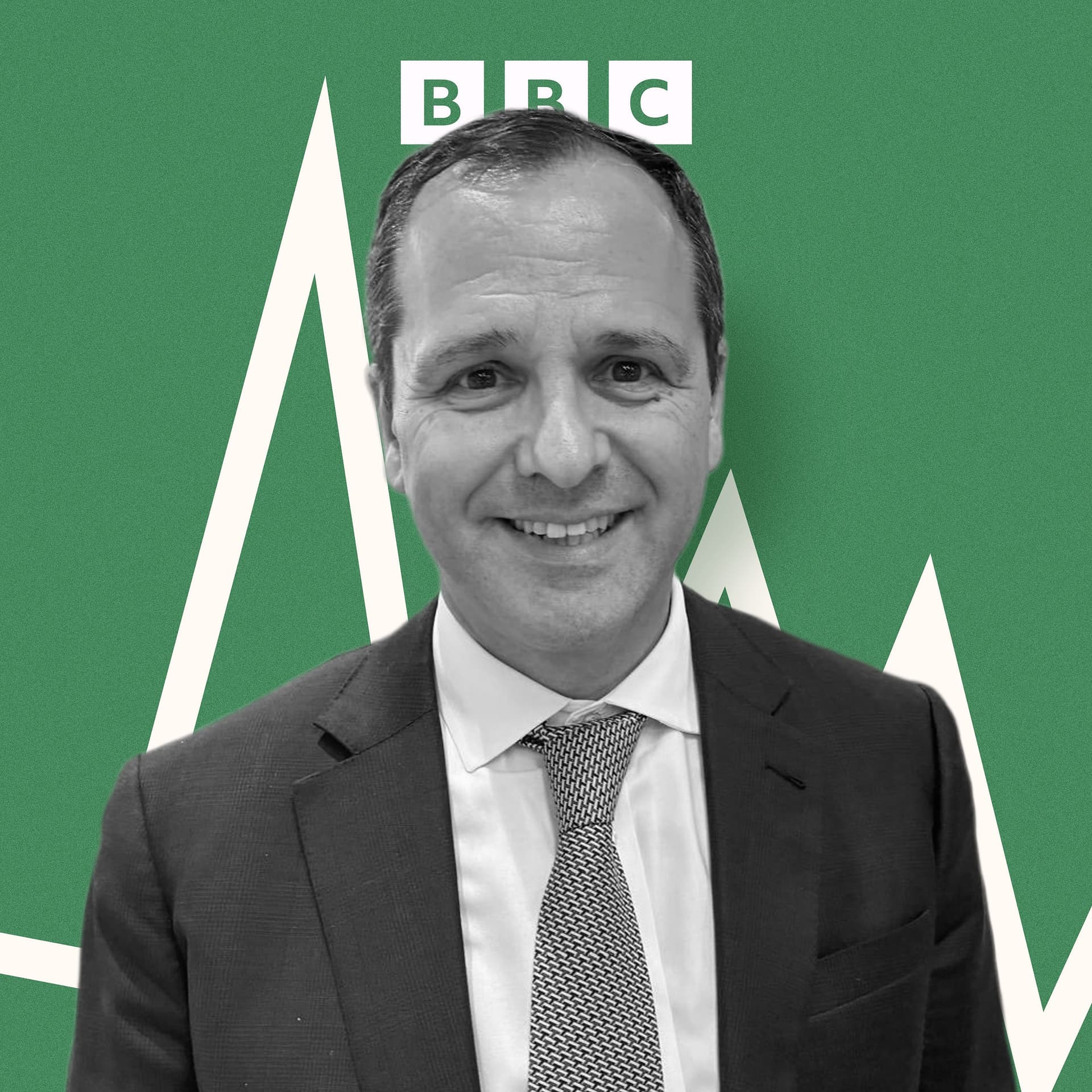
In short
Big Boss Interview - Episode #1: AO CEO John Roberts: Taking the Tough Decisions
Podcast Overview Big Boss Interview is a podcast series featuring interviews with high-profile chief executives and entrepreneurs. The show is hosted by Sean Farrington, Felicity Hannah, and Will Bain, renowned presenters from BBC Radio 4's Today programme and BBC 5 Live's Wake Up To Money. Each episode delves into the challenges and opportunities faced by leaders of major organizations.
Episode Summary In the inaugural episode, John Roberts, CEO and Founder of AO.com, celebrates 25 years of leading one of the UK's largest electrical retailers. In a candid discussion with Sean Farrington, Roberts shares insights on the current economic climate, the impact of recent legislative changes, and the competitive landscape within the retail sector.
Key Discussion Points
- Current Economic Climate
- Recession Outlook: Roberts believes the UK is entering a recession and urges the government to support businesses for growth.
- Optimism Amidst Challenges: He argues that despite economic downturns, opportunities exist for businesses that prioritize customer service and quality.
- Employment Rights Bill
- Concerns About Recruitment: Roberts expresses apprehension about the Employment Rights Bill, suggesting it may deter businesses from hiring due to increased complexities and risks associated with employment.
- Philosophical View on Business: He advocates for a balance between employee rights and the flexibility needed for businesses to take risks on new hires.
- Competition Landscape
- Chinese Firms and Amazon: Roberts sees competition from Chinese retailers and Amazon as beneficial, driving improvement in service quality and pricing.
- Sustainability of UK Businesses: He believes UK businesses can thrive if they focus on excellent service and operational efficiency.
- The Importance of Customer Service
- Customer-Centric Philosophy: Roberts emphasizes the importance of exceptional customer service as a key driver of business success, noting AO's strong ratings on Trustpilot.
- Investment in Logistics: AO has invested significantly in logistics and recycling operations to enhance service quality.
- Youth Employment and Education
- Challenges for Young People: Roberts discusses the difficulties facing school leavers today, especially in the context of AI and technology replacing traditional entry-level jobs.
- Advocacy for Youth Programs: He critiques the lack of investment in youth facilities and programs, highlighting the need for better support for disadvantaged young people.
- State Pension and Taxation
- Pension Increases: Roberts critiques proposed increases to the state pension, suggesting they may detract from investments in youth and essential services.
- Taxation Philosophy: He argues against excessive taxation on the wealthy, advocating for more efficient government spending.
Key Takeaways
- Long-Term Thinking: Emphasizing the need for businesses to think long-term rather than focusing solely on short-term results.
- The Role of Competition: Roberts believes healthy competition is essential for driving innovation and improving service standards.
- Investment in People: He stresses the importance of investing in employee development and creating opportunities for youth.
Concluding Remarks In this episode, John Roberts presents a blend of optimism and realism regarding the challenges and opportunities faced by businesses in the current economic landscape. His insights highlight the importance of adaptability, customer service, and responsible corporate governance in navigating the complexities of modern retail.
Next Episode
- Tune in next week for more insights from leading business figures. A new episode will be available every Friday morning.
- Feedback and questions can be directed to [bigboss@bbc.co.uk](mailto:bigboss@bbc.co.uk).
Subscribe
- Search for Big Boss Interview on BBC Sounds to stay updated with the latest episodes.
Written by AI. May contain mistakes. Listen to the episode to check what was said.
Transcript
Automatic transcript. May contain errors.0:16Hello, what an exciting day today for us. you're listening to the first episode of our new podcast, The Big Boss Interview, brought to you by us, the BBC business team here in Salford. I'm Will Bain, and each week you'll hear myself, Felicity Hanna or Sean Farrington, speaking in-depth to one of the UK's biggest business leaders. And it's our big launch day today, so Sean, our captain, is in charge of it all. No pressure, Sean, to kick it off then. Fortunately, Will, already done. So the pressure of the actual interview off, just the pressure of the reviews from the listeners, from our bosses ourselves about what we're doing.
0:53And it is exciting, isn't it? Because we are able to tell everybody a little bit more about the insights we get from some of those bosses of the biggest businesses. Not necessarily the biggest, most influential businesses. It could be the most influential brands that impact us in so many ways with the careers that we have or the decisions we're making on a weekly basis of what to buy. And for episode one, a great choice, really, a company that I think will touch a whole load of people's lives right across the country. AO.com really came in to kind of shake up the way we buy, well, to start with fridges and freezers, but then any kind of electrical items online, right, as well.
1:31And so you've been speaking to John Roberts, who's the boss there, but not just the boss, the founder of the company as well. And that was a crucial bit, the founder of the business, so that every decision he's made over the last 25 years has led to the company that it is today. He might not own quite as much of it as he once did, but the insights he's able to give about, you know, working with Mike Ashley, the retail titan who now owns a chunk of AO.com, AO World, the wider business as it is at the moment. Limiting the size of the state pension, John Roberts not afraid to hold back on some of his big thoughts.
2:02It's what you do when you go up against these mega Chinese retailers as AO are at the moment. So insights all round, views all round as well. It really was a fascinating chat to have with him. Well, let's get right to it then. And here, our very first Big Boss interview. John Roberts, founder, chief executive of AO Group, AO.com, as people may well know it. John, welcome to the Big Boss interview. Thank you for having me, Sean. And a great place to start off when a company like yours puts out their financial results and we get a glimpse, as we do every few months because you're listed on the stock markets and you have to tell your investors and the world how you're getting on.
2:44We get a glimpse quite regularly about how AO is doing. And fair to say that in recent times it's been a pretty positive story coming out of AO. Why is it looking so good at the moment? I think it's the output of a ton of work from lots of amazing committed people. And we've never had better ratings around customer service. We have the benefit, as you say, Sean, we're listed, but we're a founder-led business. I've actually, yesterday, was celebrating my 25th anniversary in the business. And so we're able to think long term. So we think more like a private business. and so I talk about it internally as we'll cash the check in the second half.
3:28And so if that means we need to make a decision today that I think is right and the board thinks right for our customers and for service and for our people, we'll do that irrespective of what it does to short-term results. But over time, you build momentum around things like brilliant service. We are globally recognized as the number one company on Trustpilot. that didn't happen in three months or six months or nine months. It's the output of hundreds and thousands of decisions over a long period of time. And yet after 25 years, that's where you're seeing and saying record results, profits, sales at levels that you've not seen before.
4:09So there's something, isn't there, about the era at the moment, about how you're doing things about what customers want that mean it's clicking a little bit. Well, so I deeply believe, and I always have believed from the beginning of our business, that if you look after customers brilliantly, they will look after you. But we are in a low frequency category. You don't buy a washing machine every week. It's not grocery. We don't have the breadth of range that somebody like an Amazon would have in terms of their frequency of transactions. And so we have to sometimes wait a long time for those repeat purchases and the loyalty of customers.
4:45we now sell more than we've ever sold we grew up selling washing machines and fridges as you well know but we now sell tvs laptops phones kettles toasters and all sorts of different things that give people now more and more reasons to come back to us and they are doing that and and it is founded in amazing customer service you know having we've served nearly 15 million customers now We've got nearly a million reviews on Trustpilot that rate us 4.9 out of 5. And you've got to remember what we do is really hard. You know, we do two-man home delivery. We install washing machines. We install gas cookers at the point of delivery.
5:30And so that's complex when you're stepping into people's homes. And so, yes, we're brilliant at that, but it's because we invested to bring all our logistics operations in-house, so we control it. We brought all our recycling operations in-house so that we control that, so we can take all your old tech away. We've recently bought Music Magpie into the group. That wasn't about books and CDs, although that's a great part of their business. That was about how we can control recycled tech. But that journey with Steve Oliver and the team at Magpie, you know, ultimately, I guess it took about two years of conversation to be able to do that.
6:13But that's going to be the platform for lots of new things that we'll be able to do over the next 12 months and 24 months and beyond. And so, yes, these are the best results that I think that we've ever put out. But they really are the output of decisions we've been making over a long period of time. But it shows, does it, that businesses can grow, can be profitable in the current environment. And we'll probably get on to various aspects of what that current environment is. But you hear many say this isn't a good environment for businesses to thrive in at the minute. But you seem to be a counter to that if you get other things right.
6:51I disagree that it's not an environment to thrive in. The market is still huge. We are still a very prosperous nation. and so in that is a ton of opportunity and we've lived through a few recessions in the last 25 years and for what it's worth I think we're heading into another one and I see that as yet another opportunity because mediocre businesses tend to really suffer and what I've seen over the years is that people have a flight to quality and a flight to value so it's an absolute flight to price They just want the cheapest that they can get or they want to pay a bit more and they want the best that they can get.
7:33And one of my philosophies in our business has always been that the best service is actually no service, which means it's the most profitable service. And so I do believe you can have both. And what I mean by that is if you go on our website now, Sean, and order something, and the website's so good that you're able to decide which one you want and you use all the reviews to help you choose that, and we've leveraged our scale and our structural advantage to make that the best price in the market, and then all our systems work such that that arrives at your house in the morning, we deliver it and we install it, and you don't actually need to speak to anyone other than the delivery drivers and everything else, you can track your delivery online.
8:19It's all amazing. That's the most profitable service. Every time something goes wrong, I have to pay someone to deal with it. I have to come back. I have to bring it back. I have to do something. And so what we're able to do, and, you know, this does, it's not exclusive to being a founder-led business, but because I've done everything and because I understand everything, you know one of my key jobs in the business is to obsess about all those micro points of detail and it will have jumped out to many in what you were describing there amidst your optimism for your business you didn't the country is heading for recession now there's official measures of what recession is we often talk about talk about the economy shrinking of over two periods of three months in a row what what do you mean by the country's heading for recession well i think as a nation we're very good at talking ourselves into recession is is one point uh but you know fundamentally at the end of the day we have inflation coming through uh and we are now feeling that in the costs across businesses uh business leaders that i speak to right across the piece are looking at how they can take people out one of my phrases that i use a lot is that costs walk into businesses on legs those legs have got a lot more expensive it is much more difficult to recruit people.
9:36It's much less flexible than it has ever been to recruit people. And I think that there's bad actors in anything, okay? But the majority of businesses that I see and talk to, they don't want to have their people over, as it were, and exploit those people. Happy people tend to be more productive and tend to look after customers better. I think you're alluding to the employment rights bill and everything around the workers' rights. Because what unions would have said to us and those backing that bill would say, well, yeah, quite. And those businesses, they'll be able to carry on the way they have been.
10:16But actually having these extra rights in place, day one rights, instead of having to work a certain period of time before something kicks in and other things as well. It protects workers in those businesses that aren't having such a good relationship with their employees. So I'm not sure it does for what it's worth. And I think enforced dogma on these things isn't good for those people. If you look at the amount of offshoring that is going on, if you look at AI, look at the challenges to jobs. We should be talking about job creation, not enforcing things that make business leaders think twice about recruiting people and about giving somebody a chance.
10:59And I'm passionate in our business about grow our own and give people a chance. If the risks associated with giving those people a chance start going up exponentially, then you think twice about it. How does that work for you? Somebody, you know, and you have a philanthropic side as well. Over the years, you've invested in local, the northwest of England around Bolton, local youth schemes and the like. So you have that passion and we've seen that evidenced. But at the same time, you're looking at a balance sheet, you're looking at a business. How do you manage that? At what point do you go, the money needs to talk more than my heart?
11:43Yeah, so again, because we're a founder-led business, I get more latitude, shall we say, on those things. So my answer's probably better not as AO, but more generally in business. I'm a campaigner for making the apprentice levy infinitely more flexible. The amount of businesses that I speak to that because of the rules that are attached and the constraints that are attached to the apprentice levy are unable to deploy their apprentice levy. For kids leaving school now, it has never been harder to get on the employment ladder because AI is so good at lots of those base roles. If you're at the top of the pyramid, you know, and you've been employed for 30 years, then you are theoretically more secure.
12:31And so when you look at that as an employer, should I take the risk on those people or should I make the investment in AI? I'm not saying they're necessarily mutually exclusive, but you are definitely going to lean into the technology rather than lean into the people from day one. If it doesn't work out, the extreme example of this, when we talk about philanthropic stuff, is looked after children. People coming out of kids in care in old-fashioned language, as I always think about them. Those people are challenging. Another great example is what James Timpson's done at Timpson, where I think about 10 % of their staff now are people leaving the prison system.
13:16And James has been a pioneer for that. And he's now in government. And he's now, yeah, so he's the capable one. And so what he did when he was outside government was essentially ask businesses to take a risk on these people that will be more risky to employ because societally this is a good thing to do. And ultimately, these people will be great for your business. And his business is the petri dish, if you like, for the evidence for that. but now if that doesn't work after six months and it doesn't work out with that person if the barriers to exiting that person from the business your willingness at the beginning to take the risk on that person it's going to be lower you know it's not that you suddenly don't care but it's going to be lower and so as we put more grit in the machine it just makes it more difficult.
14:14And the whole thing around self-employment, there's lots of people that want the flexibility. You know, in our business, we give the option to our drivers to be self-employed and to be employed. And it's different roles and different shapes of different things. And overwhelmingly, they want the flexibility. So we give them the flexibility. I would hold us up as a wonderful employer. You know, we care deeply about our people. We invest in our people as much as we possibly can because our people are our difference. And so it'll put less grit into our business, but it'll still put grit into our business and grit is cost.
14:54And that means that it's harder to be competitive. And so if you look in our world at the minute, we've got, you know, topical news, JD has just tried to buy Argos. So this is the big Chinese, isn't JD Sports? No, the biggest retailer in China. Yeah, JD.com. And let's not get into the ownership structure. But the biggest... Just explain almost what you mean by that. Well, so a number of Chinese businesses have involvement of one form or another from the Chinese government. And some of it's opaque, some of it is overt. But they are fundamentally the biggest retailer. They do about£150 billion in China.
15:33and they've just bought MediaMarkt in Germany. They've been looking at buying curries in the UK. I think it was last year or the year before. They've just tried to buy Argos. We've got to compete with that business. All their tech is being developed in China. All their robotics are being developed in China and being deployed in the UK. We have to be an absolutely ruthlessly low-cost, efficient, brilliant service model, and that means we need happy people and it means happy people to give amazing service to our customers, but it also means that we can't carry costs that some of our competitors are not carrying.
16:15It's as simple as that. And to not accept that is fantasy land. And we're a UK success story, I think, as a business. We employ thousands of people. We do great service. We're rooted in the UK. and we should be turbocharged by our UK government, not disadvantaged. And a flip side to that, should we be doing something about the impact that the Chinese companies, often backed by the Chinese state, have on business here in the UK and on customers here in the UK? Should we, the JD.com Argos one's an interesting one, never quite got there last weekend, who knows, we might at some point end up talking about JD.com in a bit of a different way.
17:04What did you make merely of the fact that that deal might have been done? Well, they're incredibly ambitious. For me, you know, we grew up as a disruptor. You know, when we were growing up, we had all the bricks and mortar retailers trying to strangle us at birth and trying to stop the brands dealing with us. And so I'm a great believer in competition. Competition is fundamentally good for customers. You look at Amazon in the UK, it has raised the bar on service. If you look at Ocado, it has raised the bar on service. Would the bricks and the incumbents don't disrupt themselves? And so it needs people to come and agitate.
17:46You need to be kept honest. And I think aggressive competition is good for that. I was doing my State of the Nation as an all-hands, all-staff meeting yesterday and talking to our people about, we're back in a polar bear race. Come on, we've got somebody behind us. We've got to up our game on everything that we're doing. And it's a rallying cry. So I think it's good for our business and we can use that on right. How do we go back to every little thing about how we make things better for customers? I'll give you a wonderful example how you can be a victim of your own success in it. I got an email yesterday from a customer who had a delivery yesterday, and he wrote to me as the chief exec of the business, because when our drivers deliver and we give away these green teddy bears, and it's just a random act of kindness, a spontaneous thing.
18:39It's not something that people have ordered, but he's ordered from us before. And kids and dogs love these teddy bears. And his complaint was when the drivers arrived, they only had one teddy bear left on the van and his dogs get this. I mean, what a snowflake world we live in. His dogs were distressed because they only had one teddy bear. And that was his complaint to me. And as a result, he's going to think about shopping somewhere else. And I wrote back to him last night and said, well, it's a first on me that the dogs are now complaining. But anyway, don't worry, we'll send you another teddy bear today because I just love it.
19:14I love the fact that that means so much to you. Surely when people are watching prices so much, eventually when you're up against Amazon and JD.com will only go so far eventually, won't it? We've got to be the best price. But it comes back to the point of the best service is no service. We've got to be fundamentally be the best. I've been competing with Amazon for the majority of my working life. So I'm completely used to that. And I think they're about as good as it gets globally from an e-commerce and fulfilment and time and everything and consistency. Do you feel like it's a level playing field?
19:52Nothing's a level playing field. With something like Amazon, though? Nothing in life is a level playing field. I won the postcode lottery of birth. I was born in the north-west of England to parents that loved me and got to go to a good school. That is a lottery ticket relative to loads of people across the world. Absolutely nothing is a level playing field. And in business, you're always looking for an edge. you're always obsessing about how can I get an edge with this, how can I get an edge with that. So I will never want anything to be a level playing field. You know, certain things like tax, and you shouldn't be able to buy fuel for half the cost or something like that.
20:35Right. Well, actually, tax is an interesting one, isn't it? Historically with Amazon, people have said over the years that's enabled them to get to this point of power that for so long the tax playing field wasn't fair. And so now they're... I don't know which bit of tax wasn't fair. Was it the corporate tax, corporation tax that they were paying in the UK compared to the sales and what they might have been making out of... They have adhered to UK laws and every company tries to minimise the amount of tax that it pays within the framework of the law. So it's an easy press soundbite. Amazon create thousands and thousands of jobs in the UK.
21:18They pay millions in tax on warehouses that they have. And they don't just create warehouse jobs, by the way. I'm sounding like an advert for Amazon here. But, you know, they create a lot of really high-quality roles, as do we as an organisation. You know, our average pay levels are higher than bricks-and-mortar pay levels, and therefore that generates more tax and better quality jobs for the economy. So it's just different. If you look at Tesco's home delivery business, it's bigger than Ocado, but then Ocado will get criticised for being an econ business. The big supermarkets, if you like, talk about how unfairly they are disadvantaged in the tax environment and how the internet's killing the high street.
22:02I mean, don't make me laugh. Are you telling me that supermarkets didn't kill high street butchers, bakers, greengrocers, et cetera, and then they've got some competition that they don't quite like and all of a sudden the internet is killing the high street. Yeah, every single major supermarket has had a right old go at doing the internet, haven't they? In non-food, they've just not been particularly good at it. I'm interested in mentioning the high street, of course, so much relevance about the talk around retail. And actually, one of the developments at AO in recent years has been the increasing stake of Fraser's Group and Mike Ashley with his huge retail empire.
22:40We don't have time to list all the fashion brands that he's picked up over the years, never mind those original Sports Direct and Fraser's that he has now. What role does AO.com, I think he's at 25 % now, the stake of Fraser's Group. So where does AO fit in that Mike Ashley Fraser's strategy of retail? Well, so we actually fit in, so we don't fit in strategically. so there's nothing that we do strategically together. There's opportunities that we've talked about over the time but we've never made any of them work. But Mike's really smart. So I think that the way Mike views the investment and I haven't actually, Mike gets a lot of bad press around he's all over, he'll be all over me if you like.
23:26I haven't actually spoken to Mike since I think it was July 23. So to dispel that myth and they are just a shareholder in our business. But when they took their stake and they bought their stake in one lump, in one decision, because Mike trusts his instinct and he knows the business and again, we're a founder-led business, so he's backing me. He knows I've got the majority of my wealth tied up in the business. So he's happy to align behind that. But I think it was very firmly a heads I win, tails I don't lose. He has made an incredible return already, notionally on paper, on the investment that he's made.
24:07And as I understand it, he's very happy with that. Strategically, there could have been things that we might have done and we've explored them. What kind of things? Because people actually would be able to picture this because we're talking about brands that we're so aware of. Well, so if we had ambitions to go and be a bricks and mortar retailer, for example, they've got a huge store estate. They own retail parks. And they've got, you know, they as a business understand store-based retail to their very core. And so we don't have those ambitions. We had some of those conversations, but that didn't work out.
24:43Two-man home delivery. So there's lots of things across all, again, as you say, all the different things that Mike's involved in, where we do third-party logistics for other companies because of the quality of our two-man home delivery. and in the end it just sort of wasn't worth either side pursuing that and I wanted to keep us absolutely focused on being brilliant in the electricals market. So there's a number of different things that we've talked about but again it gets portrayed as if it's very aggressive. It's not. Michael Murray who's the chief exec, Michael and I catch up twice a year but if he wants me, he's got my phone number, he'll pick the phone up to me If I want him and I want some advice on something that he can help with, he would help.
25:30Why wouldn't he give advice to help something he's invested in? So it's a very cordial relationship. Is there a sort of, not us against them mentality necessarily, but when you see the might of JD.com and they're clearly looking around at British brands, I mean, might there be a moment where, has there been a moment where they've come to you and said, would you be interested in selling to us? My ambition is to keep running this business the way that we run it. I love it. You know, it was referred to in my 25th birthday yesterday as my sixth child. I've got five official human kids. And, you know, we've got thousands of people across the business that I class as my sixth kid.
26:11I've got deep relationships. We run our business like a family business. And, you know, I don't want to go anywhere. I don't want to change anything. I'm not sure what JD would bring to us as an organization. No, they haven't been in contact. Cheaper products? So I can go and buy cheaper products. But no, they haven't been in contact with us and I certainly won't be picking the phone up the other way around. Just as you mentioned, kids, so there are many aspects of your working life and personal life where you see the future for kids. You talked about the apprentice levy. What are the prospects now for somebody growing up in Bolton when AI is advancing the way it is?
27:01And you've talked about the businesses being nudged more towards the technology investments than the individual investments at the moment. What is happening to children becoming adults going into their or wanting to go into their career at the moment? I think it's never been harder. I've been saying for years that we're teaching kids in school for all the jobs that won't exist. And I think that the divide, the depressing divide, my kids will be fine. If you grow up in a low-income, disadvantaged background family, you're not doomed to failure. But the hill to climb is so much harder. We don't invest in facilities and pathways as a nation for disadvantaged kids.
27:54And fundamentally, it comes down to one thing, because those kids don't vote. Politicians live in a world of votes. They only care about the votes. Everybody knows we need to reform the welfare bill, right? Everybody knows. It is ballooned out of all control. Even the Labour leadership tried to get it reformed. But when it actually comes down to the MPs with a massive majority doing the right thing for the nation, they back out of it. Why do they back out of it? Because I might not get elected again. And so they are absolutely in the currency of votes, and these kids don't vote. And honestly, in all the time I've been doing this, it all comes back to that.
28:40You try and take a Murrayman off a pensioner, uproar. But we've closed thousands of youth clubs. We've got rid of over 5 ,000 youth workers in youth clubs over the last 10 years. It is a national disaster. We spend$100 billion on the big E of education, which is schools. We spend 0.1 billion, 0.1, on the little e, which is youth clubs. and youth workers. And kids spend the majority of their lives, when they're awake, outside the school gates. And if you're from a low-income family, what are we giving for those kids to do if they haven't got the money to go bowling or go to a swimming club or whatever it might be?
Read the full transcript
29:29And so they hang around. And so what do they do? They end up in trouble. Positivity doesn't fill a void. There is a spike in antisocial behaviour crime, would you believe in the two hours after school closes why because there's nothing for them to do and we have no plan as a nation for what we're going to do about that and so that for me is representative of what chance of those kids got and so we can moan about that or we can get practical and we can get real about it to say a traditional education in school just isn't actually for everyone from every background taught in the same way for everyone.
30:13So I think we need brave politicians that are willing to make the investments in the areas that we need. Can I ask you, on that topic, because it's always pertinent, but recently we've heard that the state pension may well be going up by, looks set to go up by 4.7 % next year because of this triple lot, the rules around it, whichever is highest ever, out of how much average earnings have gone up or how much prices have gone up or 2.5%. And average earnings came in at 4.7%. So the state pension is all set to go up by that amount next year. What should happen to the state pension then? Well, so for me it's a self-fulfilling cycle because earnings keep going up because we keep fueling them to go up with all the legislation and the changes that we're making and the inflation that is coming with it.
31:07What actually ends up happening in that scenario is that becomes another reason that we can't afford to invest in kids. And so, you know, government is about choices. And the truth is it's about difficult choices. It is not a popularity contest. Isn't it? I mean, I know we could go down a big political conversation at the moment. If it is, it's not working. so but it really shouldn't be about a popularity contest in you know you're elected on a mandate to do things and you should get on with that mandate to do things and you should be judged on the results of that not flip-flopping around and blowing in the wind and certainly when you've got a major majority you have a major mandate to go and take the tough decisions and and we We just seem to be like a chocolate teapot at every opportunity where, oh, well, we can't upset them and, oh, we can't upset them.
32:11You cannot please all the people all the time, and neither should you try. It's just a reality. What I think people have a problem with is tax and waste. I certainly have. I believe deeply in a responsibility to pay tax. From my point of view, you know, I've been economically fortunate out of our business, but, you know, I've donated everything that I've earned from all sources for the last 11 years to charity. I don't need the income, so let's put it back in. So that's not the voice of a, you know, a brutal, economic, you know, hardline business leader. I believe in deeply in doing the right thing but I think you've got to make the case for what the right thing is and then you've got to make it happen.
33:03What I really object to is the narrative that you can just keep taxing wealthy people and wasting the money. We are driving incredible amounts of wealth out of this nation and for me we should be... Do you see that? I have seen... Where do you see that? So I'm not going to name names, but I know many people that have left the UK, that are economically, you know, it's easy for them to move. It'd be easy for you to move though, wouldn't it? It would be easy for me to move, but I'm a lad from Bolton, you know, my family and friends are in Bolton, and I've got a business here, and so I don't want to move.
33:46But equally, does there come a point where you say maybe? I was talking to someone the other day who's moved to Dubai, and this is not a super wealthy multimillionaire. This is somebody who is an engineer who earns a six-figure salary in the UK, who's moved his family out to Dubai, and he was showing me he'd got his first pay slip. and it was a higher salary and the deductions of tax, zero. National insurance, zero. You know, fuel's free. It's sunny. You know, there's no crime. But there's a reason you're in Bolton. I'm not from Dubai. I take a different view. He's really enjoying it over there.
34:32That's a person that was earning a six-figure salary in the UK, who was paying tax in the UK, And the balance, and everybody's balance is different, right? His balance got tipped that I'm just not having this anymore. I'm just not having it. They are wasting my taxes. It's like when you put income tax up to 50%, the tax take, as in the actual amount of money we raise, goes down. So you just can't keep gearing the tax up. What you've got to do is you've got to run the country efficiently. You've got to take the tough decisions. That didn't actually come up when you were talking about the weight of labour and the labour cost.
35:20You mentioned employment rights and how much the owners are recruiting that. But actually, it didn't seem to be that national insurance increases was particularly a bugbear compared to those. It's all in the bucket. It's all in the bucket of more tax, more waste and more grit in the machine. Another great example is self-driving cars, right? Self-driving cars have galactically lower rates of accidents than human beings. but is anyone trying to rush through any legislation on that see if they pop up on ao.com before the decade is out john roberts we're going to have to leave it there but thank you very much for your time chief executive and founder 25 years at ao great to hear john roberts there sean being quite so candid about all those areas in particular of i guess uk policy that we've talked so much about on wake up to money for example candid on issues that very much directly affect his business day to day.
36:22We will see the Employment Rights Bill go through Parliament and see the impact that some of those extra rights for workers will have on businesses but also on employees themselves as well. But also so candid on some of the bigger issues that he certainly felt we need to be debating a little bit more, the levels of the state pension, the amount of support that should be going for younger people to get into work at the moment, the balance of that. of course these are big decisions as a nation we need to be making ending up with the chancellor in the budget later this year yeah absolutely all conversations that are only going to ramp up between now and the budget in november and as you say some of them conversations that are going to be ongoing for some time fascinating insight there from john robbers just to mark your card then that from next week the podcast will be available to download each and every friday morning you can get in touch with us as well give us your thoughts the type of questions we should be asking big boss at bbc.co.uk.
37:18Thanks for listening to us. Please subscribe to the feed. Search Big Boss Interview on BBC Sounds if you haven't done already. And we'll catch you on next week.
From the publisher
AO Chief Executive and Founder, John Roberts is celebrating 25 years at the helm of of one of the UK's biggest electrical retailers - he speaks to Sean Farrington in the first episode of Big Boss Interview. John says he believes the UK is entering a recession and calls on the Government to do more to allow businesses like his aid growth. Instead he feels the Employment Right Bill - which is currently making its way through Parliament - will make business leaders think twice about recruiting. He also outlines why competition from Chinese firms or Amazon is good for business. Meanwhile, with the budget on the horizon, John warns of the dangers of stealing Murray Mints from pensioners and outlines his lack of sympathy for supermarket chains.
Timecodes: 00:00 Intro 02:20 Start of interview with John Roberts 06:40 The current economic climate 10:00 Impact of the Employment Rights Bill on businesses 15:00 How hard it is to be competitive today and the impact of Chinese business 19:30 Competing with Amazon 22:30 Relationship with Mike Ashley 26:50 Prospects for school leavers today 30:00 Increases to the state pension 32:00 Raising taxes on the wealthy 36:00 Sean and Will discuss the interview