In short
Interview with Arm CEO René Haas about how AI will drive chip demand, robotics, and health breakthroughs, including a claim that AI could cure cancer within his lifetime. He also discusses Arm’s shift from licensing CPU designs to supplying manufactured “AGI CPU” chips, supply constraints (memory, wafers, fabs), and why AI demand may not “run out.”
Guests
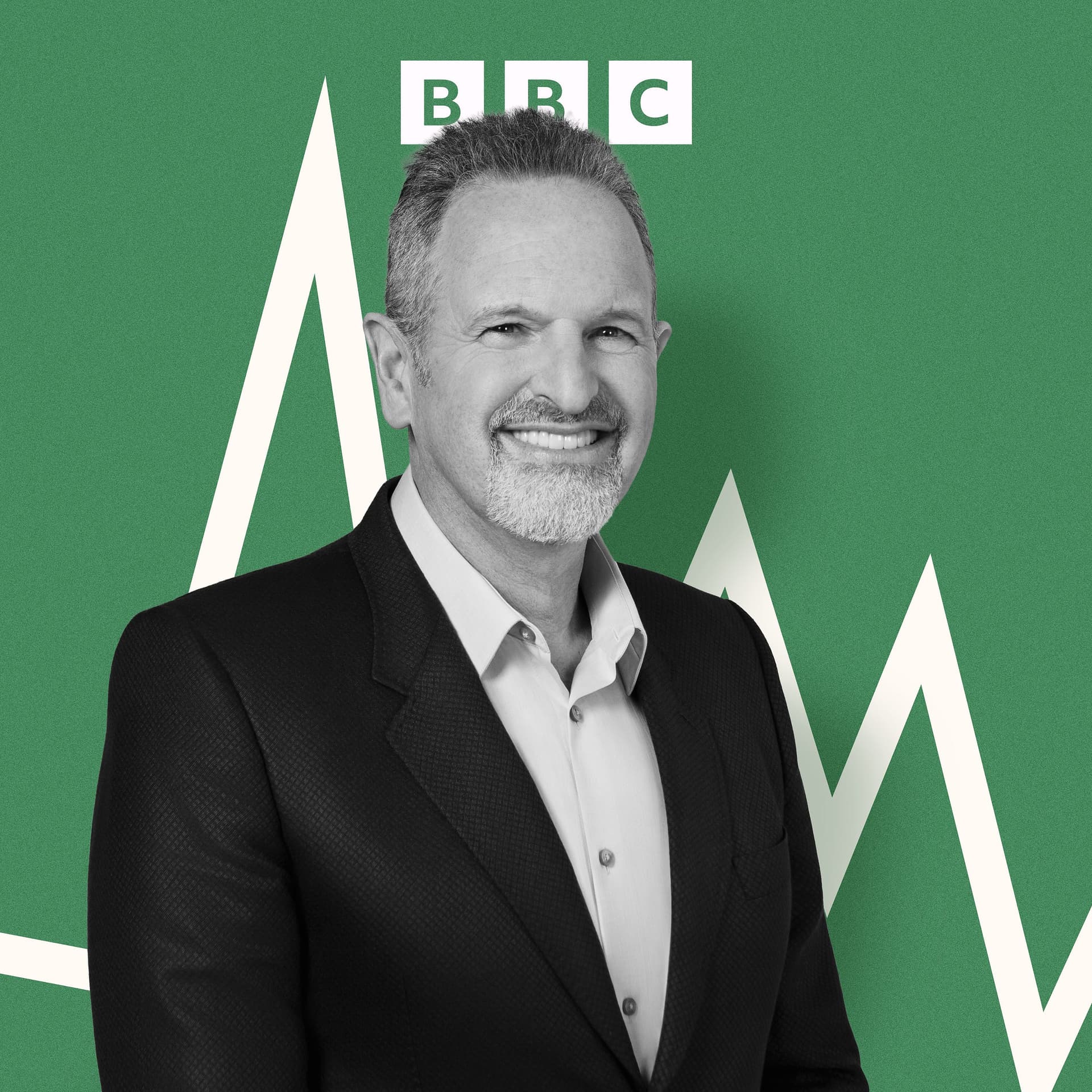
René Haas, CEO of Arm Holdings (semiconductor company designing CPU “brains” licensed to chip makers). Faisal Islam is the interviewer/economics editor for BBC’s Big Boss Interview.
Key claims
AI will be ubiquitous across health, education, and all industries; some jobs will disappear but others will be created. Arm’s power-efficient CPUs (he says “twice as power efficient”) will be central to data centers and edge devices. AI-enabled robots will learn new tasks and be reprogrammed for changing workflows. AI will shorten drug discovery and testing; “in our lifetime” it will help cure cancer.
Notable examples
Arm CPUs inside smartphones, cars, PCs, earbuds, and AI data centers; NVIDIA Jetson robots using NVIDIA GPU plus Arm CPU; Meta’s “ARM-AGI CPU” announced in March with manufacturing via TSMC; SoftBank and other multi-gigawatt data center buildouts; historical anecdote about low-power CPU leakage working even when unplugged.
Written by AI. May contain mistakes. Listen to the episode to check what was said.
Chapters
Tap a time to open that second in VOThe Power of Arm Holdings
0:30 to 3:12
Discussion on Arm Holdings' influence in technology and AI.
“to buy, sell or attain any specific investment or service.”
AI in 10 Years: Ubiquity and Impact
3:12 to 4:20
René Haas shares insights on the future of AI in various industries.
“And what's the thing the public hasn't understood that you can tell us about what's yet to come?”
The Evolution of Robotics
4:20 to 6:05
Exploration of how robotics will change with AI advancements.
“Some jobs will be created that we don't know about.”
AI and Healthcare: Curing Cancer
6:05 to 8:10
Discussion on AI's potential in revolutionizing drug development and curing cancer.
“You see them in factories today, they install a tire in a factory or inside a distribution area, they're the forklifts that move up and down.”
Understanding Arm's Business Model
8:10 to 9:42
Explanation of Arm's business-to-business model and its impact on technology.
“I mean, obviously, you're ubiquitous in the tech industry, but you're not a brand that a consumer would buy at this point.”
The Origins of Arm Holdings
9:42 to 10:40
A look back at the founding and early innovations of Arm Holdings.
“I think we have figured out that not only have we shipped enough chips for every person on Earth, we've shipped more chips than every person who's ever lived on Earth.”
Power Efficiency in Technology
10:40 to 13:44
Discussion on Arm's focus on power efficiency in its chip designs.
“Just describe that and how central is Cambridge in the UK to your story?”
Manufacturing Chips: A New Direction
13:44 to 14:02
René Haas discusses Arm's recent shift to manufacturing chips for specific purposes.
“I'm going to jump forward to this year now.”
Transition to Manufacturing ARM Chips
14:02 to 14:50
Learn about ARM's shift from licensing to chip manufacturing.
“Yeah, so just to put a finer note on that, we're having someone else build it for us.”
ARM's Collaboration and Demand Surge
14:50 to 15:54
Discover the collaboration with Meta and the skyrocketing demand for ARM chips.
“So we worked very closely with Meta a couple years ago, and Meta came to us and said, we would like to have you actually have the chip manufactured, and you be the supplier to us of that product.”
Show all 23 chapters
Competitive Landscape in Chip Market
15:54 to 16:49
Explore the competitive dynamics and the need for efficient CPUs in AI.
“a company so known for sort of not manufacturing the complexities of the manufacturing supply chains.”
Challenges in Supply Chain Manufacturing
16:49 to 18:15
Understand the complexities and challenges in chip manufacturing and supply chains.
“trying to get hold of materials, testing equipment, wafers, everything.”
AI Demand and Semiconductor Growth
18:15 to 20:15
Analyze the unprecedented demand for chips driven by AI advancements.
“what we're seeing in terms of the chip market?”
Long-Term Outlook for AI and Chips
20:15 to 21:36
Discuss the sustainability of AI demand and its implications for the future.
“and so I lived through that dot-com bubble.”
Valuation Shifts in the Tech Industry
21:36 to 23:05
Examine shifts in valuations within the tech sector and the role of semiconductors.
“Trillions of market value have been created in recent years.”
The Role of ARM in AI Growth
23:05 to 24:24
Learn about ARM's position in the evolving landscape of AI and CPU demand.
“ARM, you know, we're very unique because we have two ways that we deliver value to our customers.”
Cost and Accessibility in AI Models
24:24 to 25:59
Explore the balance between cost and performance in future AI models.
“Now, clearly, some have looked at how expensive that has got.”
Future of AI and Data Centers
25:59 to 28:00
Discuss the future of AI and the role of data centers in fulfilling demand.
“and getting the absolute best form of their AI models, it might be that the impetus is towards maybe more value-for-money models, cheaper models, generic models.”
Future of Compute Capacity and Manufacturing
28:00 to 30:06
Exploration of compute capacity needs and manufacturing dynamics.
“Well, the talk now is about multiple gigawatts of data centers, right?”
Geopolitical Considerations in Semiconductor Production
30:06 to 33:06
Discussion on the geopolitical implications of semiconductor manufacturing.
“Back in the day, there was a company called GE Plessy.”
UK's Role in Global Semiconductor Landscape
33:06 to 35:05
Insights into the UK’s position in the semiconductor ecosystem and potential.
“From some corners of Silicon Valley, there is a little bit of sort of doing down of the UK one hears occasionally.”
Balancing Patience and Speed in Semiconductor Development
35:05 to 36:50
Understanding the balance between quick decision-making and the patience required in semiconductors.
“Semiconductor is the ultimate oxymoron of impatience and patience.”
AI's Role in Transforming Work and Future Opportunities
36:50 to 39:42
Exploration of how AI augments work and the future job landscape.
“AI is wonderful at solving bugs, addressing bugs, making it easier to find out what was the cause of the bugs.”
Transcript
Automatic transcript. May contain errors.0:00Rene Haas:This BBC podcast is supported by ads outside the UK.
0:30up at Whole Foods Market.
1:00to buy, sell or attain any specific investment or service.
1:18Welcome to Big Boss Interview. I'm Liana Byrne and this week we have an interview that our economics editor Faisal Islam has done with a British company that designs the brains behind most of the world's electronic devices, making them one of the most influential tech companies there is. Who have you been speaking to, Faisal?
1:36Rene Haas:I've been speaking to René Haas, the CEO of Arm Holdings. Not the most famous company in the world, but perhaps one of the most ubiquitous in terms of the design of the central brain of microchips that control not just billions of devices or even tens of billions but hundreds of billions of devices most famously the iphone but also cars and now increasingly at the heart of the build-out of ai data centers and that is such a boom that they've changed a long-held strategy only to design and get other people to do the manufacturing they're now actually with the help of tsmc um the taiwanese they're manufacturing chips for direct sale to help fuel the astonishing build-out we're seeing of artificial intelligence data centres.
2:32Rene Haas:The consequences of that boom, René Haas tells me, could be a cure for cancer that would not be possible with humans alone. A world within five years, ten years, of ubiquitous self-learning humanoid robots, and the self-learning is made possible by AI. What is the consequence of that for our economies, for our jobs, how sustainable is even what we're seeing right now financially, and who's going to win from the simply staggering amounts of money being raised and spent by the world's biggest tech companies, including Arm Holdings. Let's hear it then. Here is Arm Holdings CEO, René Haas.
3:20Rene Haas:I want to start pretty big right I mean you sit somewhere almost nobody else gets to sit in this period of extraordinary change in technology and in our economy you've worked inside NVIDIA worked in the semiconductor industry for three decades or more and you now run ARM and your technology is in nearly every phone every device on earth so what does the world look like in 10 years time because of AI? And what's the thing the public hasn't understood that you can tell us about what's yet to come? Yeah, thank you for having me. What does the world look like in 10 years? Gosh, it's even hard to say what it's going to look like in five years.
4:00But I think in 10 years, artificial intelligence will be ubiquitous into every market that we know, every vertical we can think of, whether it's health, whether it's education, It will be pervasive everywhere. It will have some pretty dramatic effects, I think, on how we live, play, and work. Some jobs will go away. Some jobs will be created that we don't know about. But at the heart of it will be AI.
4:26Rene Haas:And you have experience, not just, if you like, in the core supply chain of the chips that drive the AI, but also in the applications. Talk to us about the key growth area. You're in every corner of smartphones or automotive or whatever. Robotics, for example, is something that you've been pushing hard. Yeah, maybe I'll link back to your first question with robotics. ARM is the heart of the semiconductor industry and the electronics industry to that end. We are the CPU or the brain that sits inside every electronics device. And the brain is so important, as you can imagine, for every electronics device because that's what essentially runs the chip or the program or the end device.
5:13We're in data centers, we're in automobiles, we're in PCs, we're in smartphones, we're in earbuds. But we are the brain that makes those things go. Robotics, to your first question, I think in 10 years will be a huge change function. We are the brain in today's robotics. One of the leaders today in robotics is NVIDIA. Their Jetson series, all of the things that they do there, the heart of that uses an NVIDIA GPU and an ARM CPU. The work that Qualcomm does in robotics, they use ARM CPU. So we are the brain of all these modern robots. And I do think in 10 years, we will see physical AI robotics in a very large way, whether it's around manufacturing, cleaning services, security, infrastructure, manning building bridges, doing repairs.
6:03Rene Haas:uh we will see actual actual actual i mean people talk about robots and they're not you're due to the sci-fi future of actual absolutely 100 as as workers physical workers fixing stuff cleaning stuff absolutely yeah 100 the if you almost work backwards you'd ask well well why can that not happen yeah because artificial intelligence today one of the things that enables with robots is for the robots to learn that's a very key point because robots prior AI were built for a certain purpose. You see them in factories today, they install a tire in a factory or inside a distribution area, they're the forklifts that move up and down.
6:43With artificial intelligence, these robots can see, learn, and essentially be reprogrammed for new tasks. So in the service industry, the robot that was programmed to make a bed can now make a bed, but can also learn how to arrange the towels in a room or clean the dustbins or whatever you want to go off and do. This is only enabled by AI. AI allows these robots to learn, these humanoids. So what will happen is you'll have these general purpose systems that because of AI will be able to learn and deliver new types of workflows. That is going to happen 100%. We need to get the costs down. We need to be able to get them to be lighter, faster.
7:28But that's just an engineering cost issue that we're going to get our hands around.
7:31Rene Haas:And then just tell us, in terms of the application of AI scientifically, where could we go? What problems that are currently unsolvable could be solved? Yeah, I've always thought that the killer app for AI is health. Now, drugs can take 20 years to be developed. 95 % of those R &D efforts fail. AI is going to not only shorten the amount of time that those drugs can be invented, it's going to shorten the amount of time that you test them. You'll start to replace some human trials with AI. But more importantly, you'll find a cure for cancer that today, you and I, other humans, not in our lifetimes.
8:06I believe in our lifetime, AI will help cure cancer.
8:09Rene Haas:So this is your company that built on science, but it will transform science as well. I mean, obviously, you're ubiquitous in the tech industry, but you're not a brand that a consumer would buy at this point. Just describe what it is, the core of what you have done and where you've come from, and just how many of these devices you're in. Yeah, so ARM is business to business, meaning that we're not a consumer brand. We don't sell to consumers. Our customers are people in the semiconductor value chain or people in the electronics value chain. But the way to think about it is if you're building a chip, and that chip is essentially inside of your vehicle, your data center, your automobile, your consumer appliance, that chip that makes all those things go, we are the company that supplies to those chip makers.
9:00So what does that mean exactly? We build a CPU, as I mentioned earlier, which is the brain, it's the essential element. But what we do is we design that brain and we license it to a company building chips. So it's the blueprint. If you're building homes, we're providing the blueprint to how you build that house. And then it's a very wide business model that essentially Apple, NVIDIA, Qualcomm, Samsung, Tesla, Amazon, Google, Microsoft. It would be very hard to name a company that doesn't use us as opposed to who does use us. So we are, in every major device you can think of, over 350 billion chips have been shipped since the company was invented.
9:42That's an astonishing number. It's an astonishing number. That's dozens for every human. Yeah, and it's probably low. I think we have figured out that not only have we shipped enough chips for every person on Earth, we've shipped more chips than every person who's ever lived on Earth. Add them all up, and we're still larger than that. So it's the most ubiquitous compute platform ever invented.
10:02Rene Haas:And yet, where we are now is the potential start of an exponential curve up in the usage of these sorts of chips. We are at the start of a growth phase unlike anything we've ever experienced, certainly I've ever experienced. And it's really around what drives artificial intelligence, which is, when you think about the logic of it, it makes sense. Because artificial intelligence, number one, requires a lot of chips. It requires a lot of compute. That's what we do. And artificial intelligence can touch everything, every human, every industry, every workflow. So just to go back to the origin for a second, this all begins where we are right now in Cambridge in the 1980s, a team behind the BBC Micro, the Acorn computer, some engineers with not a great deal of money, I understand, in a barn, designing chips that were so frugal that they even worked when the circuit board wasn't plugged in.
10:58Rene Haas:Just describe that and how central is Cambridge in the UK to your story? Oh, gosh. Yes, we're in a beautiful facility right now, I can assure you this is not where it all started. It was a joint venture between a number of companies, but the real driver was VLSI Technology, Apple. It was a spin out of Acorn. And what the company was looking to do was to design a new microprocessor, a new CPU, for use. In fact, the first use case was the first PDA, something called the Apple Newton. And there were two big requirements for that first PDA. this is 1990s now, a long, long time ago, it had to be low power, because you're running off a battery, and it also had to be rather inexpensive, because it had to go inside a plastic package.
11:46Back then they were in very heavy ceramic packages, so we needed it so it didn't generate a lot of heat. So that was design requirement. Make it inexpensive, and don't draw a lot of power. And to your comment, yes, the engineers overachieved, because what they found out was the very first microprocessor, the way these test boards are built is you have a test board, has a bunch of other components, and you plug it into a wall and the processor runs. But what they found out overnight on the very first run was when they unplugged it, so no power is on the board anymore, so technically the CPU should not work, the CPU was still working.
12:21And it was still working because there's tiny little bits of leakage currents that exist on the board. That sipping amount of power was still enough to make the CPU go. So they thought, oh my gosh, we're really onto something. We've got something that's incredibly power efficient, which is kind of the heart and DNA of the company.
12:38Rene Haas:And the critical point that you still retain to this day is the combination of compute power and power efficiency in terms of energy use. That's right. The company then grew quite a bit and the first designs were the GSM phones and then smartphones. And now, as I said, we're really everywhere. and power efficiency is the key to it. But I think one of the most important things that happens with any company when it's conceived are the habits you learn relative to designing products. And we were fortunate, and I'm super fortunate now as the CEO of the company, that that DNA was forged around low power and being very power efficient.
13:18And that really found itself into every single product that we build, which is why now even in data centers, when people think about, oh my gosh, Arm, ARM, aren't you known for smartphone chips? How are you possibly being used in these data centers? Well, these data centers use hundreds of megawatts and gigawatts. Anything you can do to be more power efficient is incredibly critical, and ARM is twice as power efficient as the next leading CPU.
13:44Rene Haas:Okay, right. I'm going to jump forward to this year now. And so famously, you designed the chips. You did the blueprints for them, and others manufactured them. A big moment this year when you start essentially manufacturing chips for a specific purpose. Yeah, so just to put a finer note on that, we're having someone else build it for us. Manufacturing chips is a big lift. But what we were faced with a couple of years ago was many customers were starting to come to us and say, hey, look, you're licensing this blueprint to me, and increasingly you're expanding the blueprint. What does that mean?
14:21We were moving away from single blocks of IP to the entire subsystem. What does that mean? Data centers, for example, used not only one CPU, but hundreds of CPUs. So we had customers that we were starting to deliver hundreds of CPUs in this blueprint, connected together, all just working. What was happening was customers saying, we need more and would like more. Could you complete the job for us and actually have the entire blueprint of the chip and then have it manufactured? And in some cases, these chips, most of what was inside the chip was ARM intellectual property. Maybe in some cases, 90%, 95%.
14:58So we worked very closely with Meta a couple years ago, and Meta came to us and said, we would like to have you actually have the chip manufactured, and you be the supplier to us of that product. That product is the ARM-AGI CPU. We announced it in March. Meta was the lead partner, but since then we've announced many other customers, Cloudflare, SK Telecom, Oracle, multiple customers, and the takeoff has just been amazing.
15:29Rene Haas:Yeah, and you said the demand was double what you could supply already. Yeah, what we said back then was we had a billion dollars of demand. What we said, and that was in March, in May we said that number was$2 billion. And two months later we said that number is north of$2 billion. So the demand has been off the charts for the product. Okay, and that maybe answers my next question, which is this is why you break the habit of a lifetime, a company so known for sort of not manufacturing the complexities of the manufacturing supply chains. But doesn't it mean you're competing with your own customers?
16:07I don't look at it that way. In this case, we were asked to build the product in a market that was largely underserved. And I think the proof point would be, are we seeing demand for the product? We're seeing huge demand for the product. At the same time, there are other ARM-based CPUs that companies can go to. NVIDIA being one, the NVIDIA VeriChip. They announced their intent to sell that product. And last I heard from Jensen, he's got great demand for Vera as well. So right now what we're looking at is a market that needs efficient CPUs, particularly in this world of AI, which we can get into as why are CPUs so important again.
16:44But no, I think it's a market that's well underserved.
16:48Rene Haas:But you're now involved in the sticky business of supply chain manufacturing, trying to get hold of materials, testing equipment, wafers, everything.
17:00Rene Haas:moments when the world's most advanced industry just can't make enough of this stuff. Yeah. My entire career, as we chatted about earlier, was around semiconductors. So all those muscles that I had learned, and we have a lot of great people inside the company who spent decades also as well, we're now having to exercise. But as you can imagine, given where we sit inside the ecosystem, relationships with people who make memory, the Microns, the Samsungs, the Hynex of the world, the TSMCs of the world. These are all people that we know and have strong relationships with. It's not like we showed up and said, hey, we're going to now start to become a customer of yours.
17:38They were like, who are you and what do you do? Well, they know us all very, very well. But yes, to your point, we are in a absolutely supply constrained environment, of which I think we will be in for a bit because the demand for artificial intelligence, as we chatted earlier, it touches everywhere and everything. And as a result, chips are at the center of it and supply is going to be tight.
18:02Rene Haas:And memory chip prices have obviously nearly doubled because of the AI data centers hoovering up all the supply. It's making smartphones more expensive. It's affected demand for smartphones as well. Is this just a bump in the road, what we're seeing in terms of the chip market? Or could there be something more fundamental going on here? If it's a bump, it's a really, really big bump. Yeah. Because the demand for chips and artificial intelligence and memory is at a scale we've not worked on before. Right. And you say, well, why is it different this time? If you look at artificial intelligence and the way it works today, these models with lots and lots of parameters that need to train and then essentially provide all the information from an inference standpoint, there's a lot of things it needs to remember.
18:53When people say trillions of parameters, that's really the amount of information being used to weigh out how answers are derived. So when people say, oh, the model has taken all the information that we have on the internet and then some, all the information on the internet and then some, that's a lot of memory, right? when you think about what's required there. So it's different this time just because of the sheer scale. And when you think about the scale, and then whether you're TSMC or Micron or Samsung or SK Hynix, the capital expenditures for building out new factories is immense. It's tens of billions of dollars.
19:31It takes a long time to build these factories, two, three years. And then when you look at the amount of spending that's taking place with the hyperscalers, hundreds of billions of dollars of CapEx to build these new data centers that essentially will get the compute and the power and the coolers, et cetera, et cetera. These are big, big numbers that are somewhat circular in terms of driving overall demand.
19:54Rene Haas:Right. And sustainable? I mean, is there trillions of demand kind of going in a particular direction? I mean, people are saying that it'll run out of steam. Are you seeing any sense of that at all? You know, the way I look at is we were chatting earlier about when ARM went public in 1999 and I was at a different company at the time and so I lived through that dot-com bubble. And at the dot-com bubble, we went through obviously a huge build out of infrastructure. At that time there was, end quote, a lot of dark fiber that was not being used. Today we don't have that issue, all the GPUs are being used, but one could argue, well gosh, will we go to some level of capital correction your valuation correction.
20:38I think that's not impossible. I think it quite potentially could happen. That doesn't mean that the demand for artificial intelligence goes away. And again, let's go back to that timeframe with the internet build out. We did not have an issue that the internet 20 years later is not a valuable utility. In fact, it's almost too valuable. If you don't have access to a smartphone, try to get into a sporting event or a concert. It's not going to happen. That's the internet at its backbone. So artificial intelligence will be the same. It's going to be table stakes for everything that we do. We may see a short-term bump in the road or some pause or whatever you want to call it.
21:18And then people will freak out and say, you know, end quote, AI is dead, which is complete nonsense because it's only going to get better from here. And it's going to be a greater utility. So I don't worry about it too much. We may see something like that, but the long-term demand prognosis, I don't know how people can argue against it. It's not logical to me.
21:37Rene Haas:Trillions of market value have been created in recent years. I'm intrigued by Arm's position in that ecosystem. Clearly the value has gone to the GPU, graphics processing units, creators, because they help create the models, train the models. and where you sit has traditionally helped more with the use of the models, the inference of the models. Do you think that that's up for grabs? So much of the valuations have gone towards the creation of the models and towards the AI companies, the LLMs, the Anthropic valuation, the OpenAI valuation. Do you think that could be up for grabs as AI evolves in the direction that you set?
Read the full transcript
22:20Well, right now I think the value has kind of gone to anybody who's in the electronics industry, right? If you look at the top 10 market cap companies, NVIDIA, Apple, Google, Alphabet, Amazon, Meta, go back 20 years. It's General Motors. It's Exxon. It's a completely different industry. So now all the top 10 value companies are really in our world. Then when you sub-segment inside the world, you know, semiconductors, memory companies are hugely valuable. NVIDIA is very valuable. AMD is very valuable. Broadcom is very valuable. We are quite valuable. I think it's a recognition that semiconductors are essential.
23:05ARM, you know, we're very unique because we have two ways that we deliver value to our customers. One is our IP business model that I talked about, which is really all about providing this blueprint to everybody in the industry. And then our new business, the AGI CPU business, is hugely valuable because frankly, CPU growth has been outpacing GPU growth over the last year or so. And if you think about, well, why is that? Because I thought GPUs was everything in terms of creating all these tokens. GPUs are hugely important, of course, creating the tokens, but the distribution of the tokens, sending those tokens to different dispatches for users, that's a CPU task.
23:46It's been amplified now that we've gone to agentic AI, which is essentially a robot, a little robot, a mini bot, that is doing the task independent of a human. That work, the scheduling, the dispatching, the organizing, the checking, that's the kind of work only CPUs can do, which is why CPU growth has been exploding. Which, back to your value question, which is why I think people look at ARM and say, oh my gosh, it's a pretty important company because we have the most power-efficient CPU ever invented, and at the same time, the ubiquity of the architecture.
24:24Rene Haas:You talked about the token costs. Now, clearly, some have looked at how expensive that has got. You know, perhaps the first six months of this year, people were letting it run free and racking up bills of hundreds of millions of pounds and dollars and euros. people have sort of stepped back from that a little bit potentially because the costs have maybe proven prohibitive are you saying that your technologies can help bring that cost down again absolutely yeah yeah that's the essential absolutely i think i think this this certainly you this term token maxing and people using more and more artificial intelligence costs need to come down and they will come down at the same time i have a hard time seeing putting the genie back in the bottle when it comes to how people use artificial intelligence.
25:14My analogy is, we were chatting earlier about my earlier career, when I worked at Text Instruments, we didn't have the internet. We had an incredible library full of textbooks and encyclopedias and data books that we go off and reference. Imagine the internet's been invented, and now people are saying, you know what, you can use the internet between two and four, but the rest of the time, please go to the library and collect your information. Companies are looking and saying, well, I'm going to be disadvantaged. If my competitors are using the internet 24-7 and I can only use it for two hours, I'm going to be at a competitive disadvantage.
25:46So I think you're going to start to see a tension relative to the pricing, people looking to get costs down. But I think it'll be hard for companies that use it heavily to put the genie back in the bottle because it is so advantageous.
25:58Rene Haas:But it may be that the frontier AI companies that are investing so much and getting the absolute best form of their AI models, it might be that the impetus is towards maybe more value-for-money models, cheaper models, generic models. We've seen this move between open and closed. How are you positioned if there's a move away from the more expensive frontier models towards something that's a little bit more commoditized? Yeah, it's a great point because I think the story is still to be told. relative to the delta between these frontier models that run the best you can possibly buy versus the open source models, which are perhaps 90 % as good, but much less costly.
26:48Rene Haas:You think they can be 90 % as good? Could be. Yeah, could be. Thankfully for me, I don't care. Because the frontier models are going to run on ARM, and the open source models are going to run on ARM. We're the plumbing that all that's going to run through independent of it. So thankfully, I don't have to pick a winner. in that case. I think it'll be interesting to see how it plays out, but in either way, it's fine for us. But surely in ARM world, do you not benefit if the AI happens more closer to what we wear and what we use as consumers rather than in some data center that's operated in the desert?
27:23I do well in both cases. You're hedged, okay. I do well in both cases because my ARM AGI CPU is in the data center. We are over 50 % market share today in the data center. Amazon builds on us. Microsoft builds on us. Google builds on us. NVIDIA builds on us. And they build on us whether it's open source or closed. So it's fine for me. And then if it ends up on the edge, which it will, and you'll have some hybrid, whether it's to your point on your lapel or in your car or some new device that's not your phone, that's all going to be on arm.
27:56Rene Haas:When I'm told by the frontier AI companies that they are just at the point of exponential growth of capacity of these frontier models that they'll be able to replace all knowledge work by 2030 you're at the core of the supply chain here aren't you it's like do your chips have the capacity to supply given all the constraints we've talked about that level of compute in two or three or four years time i mean there's a bunch of assumptions being made that that it'll just carry on going up, but aren't we hitting the buffers now in terms of how much compute is available to fulfill these sorts of promises?
28:37Well, the talk now is about multiple gigawatts of data centers, right? There was a data center announcement that SoftBank made, for example, a 10 gigawatt build out of a data center in Ohio that we just did as part of SoftBank Group. There's been multiple gigawatts of data centers announced in France, up to five gigawatts. These are giant scales, right? And then people are talking about Elon and Jeff Bezos about terawatt data centers in space. The constraint for making all that happen is going to be back to the earlier chat about wafers and memory. Can you get enough chips? Yeah. We can't remember, can we?
29:13Right now it's quite constrained. It's quite constrained. We're going to build, we need more fabs before we can put a data center in space. I'll tell you that much. And we'll probably only put data centers in space when the biggest impediment to data centers is the cost of the data center.
29:28Rene Haas:Which brings me back to this country. I mean, Arm did fabulously well out of not manufacturing. You are now manufacturing. Government ministers have said, well, we should think about some of the startups that are involved in manufacturing in the UK. Is there potential? You're now using manufacturing of your own chips. is there any potential for this to happen in the uk yeah so again just to clarify our chips are being built by tsmc yeah so we're not doing it ourselves uh no i actually don't think so i don't think it's necessary for the uk to put fabs uh fabs are are very expensive uh they take a lot of specialized workers they take a lot of natural resources and there's a pretty broad ecosystem for those but can the uk do more around startup activity and things around that ecosystem more design companies that are in the semi-space?
30:23Absolutely. Back in the day, there was a company called GE Plessy. That was a semi-gigrant company based in the UK. It was a joint venture from other companies and some smaller companies. It's not much here anymore. So I don't think you don't need to build, physically build the chips per se. But I think having people around that chip ecosystem would be good.
30:43Rene Haas:Is there not an argument, and did this motivate any of your move to create arm chips themselves is there not a geopolitical argument now that yeah okay it's efficient to centralize production of these things in one place or two or three places but actually the world's a stranger place now it's a more fragile place do you not want to control supply chains a little bit more have them closer to you geographically do you buy into that does that not work in the semiconductor industry to some extent yes i think having um geographic diversity is a good thing uh I think, if I think about this part of the world, there's Britain and there's Europe, could this part of the world benefit by having some advanced fabs?
31:27Certainly. Does it need to be in the UK versus being in Europe? I think that's a debate point. I think geographic diversity is a good thing. Right now it's quite centralized. TSMC is the leader and they're in Taiwan. They have a site in Arizona, but right now the leading edge work is largely done in Taiwan. Same thing with Samsung in Korea. They have fabs in Texas, but the leading edge stuff is done in Korea. So I think if we can get the companies to expand their facilities in other parts of the world, that would not be a bad thing either.
31:58Rene Haas:Did the UK miss a trick then? I mean, just, you know, you think about all the IP coming out of your company 35 years ago. I mean, TSMC is only three or four decades old. It was an idea of the state. Could we have done more? People also regret, you know, that Arm is now Japanese-owned, floated on the New York Stock Exchange. Could it have been more of a champion for the United Kingdom if it was still fully UK-owned? Yeah, well, we are HQ'd here, and you are inside our headquarters. I don't know if it's so much about the domicile as it is where are the people. Arm's, half of our people are in the UK.
32:39The facility we're in, I think, is 4 ,000 people plus. The rest of the UK, we have 1 ,000 people. So we have 5 ,000 people inside the UK, by far and away, the largest employer in Cambridge in the electronics industry and then really, I think, across the entire area. No, I don't know that we had missed a trick here, but I think could more be done around a consistent policy of semiconductors and innovation and startup ecosystem? I think there's always opportunity there.
33:06Rene Haas:From some corners of Silicon Valley, there is a little bit of sort of doing down of the UK one hears occasionally. I mean, do you, but yet there's you here, there's DeepMind in London. Do you, I mean, what do you say about the UK tech ecosystem generally? I think Silicon Valley kind of thumbs your nose at almost anybody who's not in Silicon Valley. So it's not just, it's not just about the UK. What's unique about Silicon Valley is just decades of ecosystem between venture capitalists, universities, many companies, a huge startup ecosystem. It's just very hard to replicate that, whether it's in the UK or other parts of the world.
33:41I think there's sometimes scaling. UK is a certain size. And that may be part of the challenge. But it's not a shortage of talent. UK has got a lot of great people.
33:51Rene Haas:And have you tried to apply some of the Silicon Valley mindset into the UK? I don't know if it's a Silicon Valley mindset. It's probably more mindset, my mindset. And that's probably a function of how I was trained and how I learned. since 1999. I've either worked for startups or worked for a founder of a startup, which was NVIDIA. I worked for Jensen for many years, but before that I did startups. And what I learned with startups was really, and also from Jensen, was moving quickly, being decisive, taking risks, not being afraid to fail, pushing the envelope, asking not why, but why not. And I've tried to instill that culturally into Arm as the leader.
34:35I've been here about four and a half years. But I wouldn't say it's a Silicon Valley thing. I think it's just more my values.
34:40Rene Haas:Is there a role for patient sort of state capital, though, when we've seen, you mentioned TSMC, we've seen the success of the Taiwanese kind of visionary move for 40 years. You've got the U.S. government taking a stake in Intel now. You've invested in some startups in the U.K. that the government's also invested in, like Olex. You have to be patient, don't you, though, to see these returns? And you have to sort of be able to cope with a little bit of failure here as well. That's a wonderful point. Semiconductor is the ultimate oxymoron of impatience and patience. And by that, I mean all the things I talked about in terms of making fast decisions, being decisive, not being afraid to fail.
35:22Those are very key. But semiconductors take a long time, Right. Well, the discussions I'm having today, I've met with a number of the engineering leaders. We're about 2028, 2029, 2030 roadmaps, products that are available in 2031. You know, here it is 2026. I just did my earnings call last week. I don't spend my time thinking about very much what the earnings look like, because that's a function of work we did years ago. In semiconductors, just given the nature of how far we look out, we're five years plus. And you have to be patient. You have to be able to have a perspective that the investment that you've been making does take time.
36:02And the first product you build may not be great. The second one, probably not great either. The third one could be a home run. So yes, we're always this trade-off of moving quickly but being patient.
36:14Rene Haas:I'm struck that some of the main deployments, most advanced deployments of AI is happening in the AI industry, in the tech industry. Tell me, how have you used AI within your company almost to make the AI? It becomes a little bit circular, but is it replacing jobs? Is it augmenting? What's the balance? I think it's definitely augmenting. I wouldn't be able to tell you today that proudly my headcount is reduced by 25 % because we have AI bots doing all the work. But we have a lot of engineers using the work just to make them allow their work to be easier and to go faster. One of the things that's a big part of when you design a product or a chip, it's not the design, it's verifying that design and going through all the bugs and testing the bugs, identifying the bugs.
37:01AI is wonderful at solving bugs, addressing bugs, making it easier to find out what was the cause of the bugs. and we have engineers literally, I've had many of them tell me, you know, they'll run a report on a weekend and come in on a Monday. In the past, they would have to do all the Pareto's of exactly what they saw. When they come back, two-thirds of it might have been done and fixed. That just allows them to go faster. So I think probably we have 90 % of engineering using it on a daily basis. I use it all the time myself personally. So, yeah, we use it very heavily in sidearm.
37:37Rene Haas:And what about in your home life? How would you advise people use it with their children? Some concerns as well as some opportunities there? Yeah, you know, for people to say, gosh, you know, AI is going to replace humans and it's going to replace jobs and knowledge work. AI is going to be there, period. We know that. And that's for all things we've talked about. So I would tell anyone who's talking to their kids or, in my case, grandkids, learn it, embrace it, and become comfortable with it. Because ultimately, AI is a utility that's going to allow us to be more productive and effective. So don't be afraid of it.
38:13Rene Haas:And then, well, you say don't be afraid, but it's quite difficult not to hear from the AI leaders that keep on saying, you know, how doom-mongery the future might be and how we all need to protect against it and governments need to be quite hard. Like, you know, you're actually running the core technology that provides the capacity for this exponential power to replace human labor, to do some mildly scary things, we're told by the AI companies. Do you think about that responsibility? Is that your job or are you just going to provide as much compute powers as possible? You know, a little bit, but I would say at the same time, the estimates of jobs going away and being completely replaced by by machines is a bit overstated right i was looking at it was reading an article this morning i can't even tell you why i was reading it but it was about the economy in 1776 when the united states became an independent nation 96 of the revenue and labor was farming right now in the u.s it's about four percent but were people worried about oh the farming jobs are going away and as a result because the farmers have no jobs, there are no jobs, almost kind of nonsensical.
39:18I view AI as a similar type of thing. Will it change how we work and live and play? Of course it will. But at the same time, it's going to create opportunities that we can't imagine today in terms of what that means. So I tend to be an optimist by heart. I would say embrace it, learn it. And I feel in arms role, I feel very lucky to be leading a company that's at the heart of it, because I think we can make the planet a better place.
39:41Rene Haas:Well, he's out there. Thank you very much, René Haas, for joining BBC News. Thank you.
40:11This can capture opportunities in all market environments. Capitalize on around-the-clock access to highly liquid global futures and options markets across all major asset classes. Visit your online broker and get started. See what adding futures can do for you at cmegroup.com forward slash podcast. Derivatives are not suitable for all investors and involve the risk of losing more than the amount originally deposited and any profit you might have made. This is not a recommendation or offer to buy, sell, or attain any specific investment or service. With a subscription to the BBC website and app, you can now get early access to your favorite BBC podcasts.
40:45Listen to shows like You're Dead to Me, In Our Time, Good Bad Billionaire, and more. Plus, there's all the other great benefits you get with a BBC subscription, from live streaming the BBC News Channel and acclaimed documentaries to in-depth analysis and features. Visit bbc.com forward slash subscribe to find out more.
From the publisher
Artificial intelligence will help cure cancer within our lifetimes, according to Rene Haas, chief executive of Arm, the Cambridge-based company whose chip designs sit inside almost every smartphone on Earth. There are more than 350 billion chips using Arm technology have shipped worldwide.
Haas says health is the "killer app" for the technology. Drugs can take 20 years to develop and around 95% of research and development efforts fail. He argues AI will shorten both the time it takes to discover new drugs and the time needed to test them, with some human trials eventually supplemented or replaced by AI modelling. "I believe in our lifetime, AI will help cure cancer," he tells BBC Economics editor Faisal Islam.
But the ambitions Haas describes run into a physical constraint: the world cannot manufacture enough chips to meet demand. He says the industry is in an "absolutely supply-constrained environment" and expects that pressure to continue. Memory chip prices have risen sharply, smartphones are becoming more expensive, and handset demand is under pressure. Asked whether the shortage is simply a temporary bump, he says: "If it's a bump, it's a really, really big bump."
The expansion of AI infrastructure is driving much of that demand. Large AI models require vast amounts of memory and computing power, while technology companies are committing hundreds of billions of dollars to new data centres. Haas says new semiconductor fabrication plants can cost tens of billions of dollars and take two to three years to build, limiting how quickly additional supply can come on stream.
That constraint also shapes his view of some of the more ambitious proposals for AI infrastructure. Elon Musk and Jeff Bezos have both talked about the possibility of putting large-scale data centres in space, but Haas says the immediate problem remains much closer to Earth: "We need more fabs before we can put a data centre in space."
Haas also says a correction in technology company valuations or investment levels is possible. He lived through the dot-com crash and draws a distinction between that period and the current AI boom, arguing that today's computing capacity is being heavily utilised rather than sitting idle. A fall in valuations, he says, would not necessarily mean a collapse in demand for AI, which he believes will become embedded across businesses and everyday technology.
Arm itself is also changing. After decades of licensing chip designs to other companies, it has begun supplying complete data-centre chips of its own. Haas says demand for its new Neoverse product rose from around $1 billion to more than $2 billion within five months, with customers including Meta, Oracle, Cloudflare and SK Telecom.
Presenter: Faisal Islam Producer: Olie D'Albertanson