 Big Take
1 Nov 2026 · 15m

 Add vo to ChatGPT or Claude to ask about everything you hear
vo listened to this episode to put together the overview and transcript, so there may be the odd mistake.
Indonesia’s stock market may be downgraded by MSCI from emerging markets to standalone, raising fears it becomes “uninvestable,” triggering large capital outflows and higher borrowing costs.
Ben Otto, Bloomberg’s Indonesia “chief” (Bloomberg News correspondent covering Indonesia).
Bloomberg reporter focused on Indonesia’s markets and policy; explains MSCI index mechanics and Indonesia’s reform efforts.
MSCI isn’t a regulator or credit agency, but its index classifications drive passive fund flows. A standalone downgrade would likely cause major selling (analysts cite outflows potentially above $8B). MSCI’s concerns include coordinated trading/market manipulation, questionable free-float figures, opaque or undisclosed ownership, and “locally the MSCI trade” using affiliated shareholders to meet inclusion thresholds.
MSCI’s Oct 16 formal process (two-rung downgrade to standalone) after earlier freezes/warnings; Indonesia’s fines (117M) and sanctions against brokers; stock exchange and regulator leadership resignations and reforms.
0:01This is the Bloomberg Tech Minute brought to you by ChachiPT. I'm Carol Masser. Getting hired at SpaceX requires exceptional ability and may include having Elon Musk review a candidate's resume. So writes Bloomberg Businessweek's Lauren Grush. She reports that the company culture is defined by Musk and job candidates must understand that a commitment to SpaceX means adhering to this culture and exhibiting loyalty to Elon Musk. To get hired, candidates must demonstrate their achievements from past jobs, and hands-on experience matters more to recruiters than advanced degrees, with the company looking for people with raw, innate intelligence.
0:39A spokesperson for SpaceX didn't respond to a request for comment on its recruiting and hiring practices, but according to recruiters, advisors, and those who've interviewed for jobs there, it's the space exploration dream that draws people to the company, and Musk invokes that dream regularly to remind workers why they're there. Prospective hires are told that the job will require stamina, including in job ads that candidates, quote, must be willing to work extended hours and weekends as needed. One major perk for all that hard work? Employees' access to equity, either the right to buy shares or payment in the form of restricted stock units that vest over time.
1:16That's the Bloomberg Tech Minute brought to you by ChachiPT. Get started at ChachiPT.com. For big business, AI opened up a world of promise, but that world of promise turned into a world of pain. Cost spiraling, data trapped, security and governance risks multiplying, and ROI out of reach. That's why enterprises turned to Boomi to connect data, apps, and AI, helping them operate securely, efficiently, and at scale. Boomi turns a world of AI pain into a world of AI gain. As Boomi says, we got you. Head to boomi.com. That's B-O-O-M-I dot com.
2:21The Chase Mobile app is available for select mobile devices. Message and data rates may apply. JPMorgan Chase Bank, N.A. Member FDIC. Copyright 2026. JPMorgan Chase and Company.
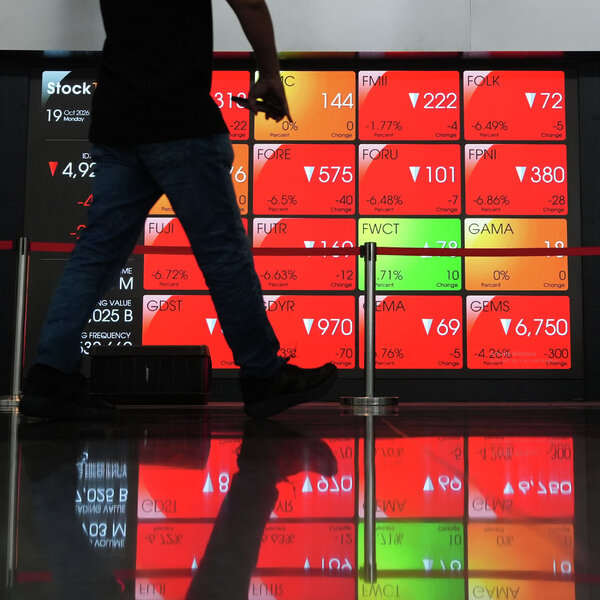
2:36Bloomberg Audio Studios. Podcasts. Radio. News. Indonesia is Southeast Asia's biggest economy. It's a G20 economy that's on track to be a top 10 economy in a number of years. It's the world's biggest exporter of thermal coal. It's the biggest producer of nickel. So it's an emerging market powerhouse in a lot of ways. For years, that powerhouse status has made Indonesia a favorite with emerging market investors. But this year, sentiment has soured. And increasingly, investors are heading for the exit. It has the world's worst-performing stock market, down about 40 % this year. You've seen record outflows of about$5 billion.
3:20Much of the turmoil centers on the MSCI, an influential index provider whose indices shape where global investors put their money. Earlier this month, the MSCI warned it could downgrade Indonesia to a standalone market status. It's a classification that's usually reserved for countries facing international sanctions or sustained economic crisis. It was a huge shock. The stock market fell almost 12 % that day. That was the biggest one-day drop since 1998 during the Asian financial crisis. You know, for global investors, it's quite extraordinary to think about emerging market Indonesia along the same lines of Argentina, Lebanon, Ukraine.
4:05It raises these questions of how do you really invest in Indonesia then? Should you? Or is this the moment that Indonesia becomes uninvestable? This is The Big Take Asia from Bloomberg News. I'm Wan Ha. Today on the show, Ben Otto, Bloomberg's Indonesia beer chief, joins me to explain how Indonesia's stock market is facing a looming downgrade and why repairing the damage may be a case of too little, too late.
4:39I wonder if you can briefly walk us through the different MSCI classifications and where this standalone marketeer that they're threatening to downgrade Indonesia to sits. So MSCI is a U.S. headquartered company listed on the New York Stock Exchange. Essentially, it builds and maintains financial market indexes. It's not a regulator. It's not a credit rating agency. In simple terms, it makes lists of publicly traded companies around the world. It assigns them weights and it groups the country as according to how developed, liquid or accessible their markets are. So you have developed markets. At the top, those would be wealthy, highly liquid markets like the U.S., U.K., Japan.
5:25One rung down is emerging markets, growing economies with accessible but less mature markets, Brazil, India, South Korea, right now Indonesia. One rung down from that is frontier markets, smaller, less liquid markets. MSCI classifies a couple dozen of them, like Vietnam, Morocco. And then at the very bottom, you have standalone. A standalone market is one that MSCI tracks separately. It does track it, but it excludes it from its broad global and regional indexes. No Asia-Pacific market is currently classified as standalone, but that is what Indonesia is facing now. What happens when the MSCI downgrades a country's stock market?
6:12You know, how quickly does money flee? Yeah, just big financial consequences. You've got trillions of dollars in these global investment funds combined and they're benchmarked to MSCI and other indexes. But there's a chain reaction, right? You have a passive fund that's tracking something like the MSCI Emerging Markets Index. And so that has to hold all the countries and stocks in that benchmark, including, as of today, Indonesia. If a country is removed, those passive funds have to sell. Active fund managers, they don't have to, but, you know, they might reduce their exposure because of it. That selling then can weigh on the stock market, as it has in Indonesia.
6:51if confidence deteriorates more broadly, then that pressure can spread to other markets, currency, bond markets. A downgrade also tells investors that MSCI essentially sees serious problems with market accessibility or functioning, and that makes it hard to attract new capital. Earlier this month, MSCI made an announcement that it's considering downgrading Indonesia from emerging market to standalone status. It's a rare double downgrade. It said it was concerned about the investability of the Indonesian stock market. But Ben says those doubts have been building for some time. To understand what happened, it helps to go back to January of this year.
7:38That was when MSCI froze certain changes to Indonesian stocks in its indexes, and it warned that it could downgrade the country to frontier market status. So one rung down. And what were the red flags that they found? The concern was around coordinated trading, so market manipulation, free floats that weren't legitimate free floats, and ownership that wasn't fully disclosed. And in some cases where it was disclosed, it was incomplete information or still very opaque. It was hard to trace back ownership to the genuine owner of the shares. Then it also emerged that some companies or insiders in Indonesia might have been playing what's called locally the MSCI trade, which is where you use affiliated shareholders to make your free float look larger than it really is.
8:35and then coordinated trading to push up the share price. And that can make a stock look big enough or liquid enough to qualify for inclusion into an MSCI index. Once you're included, then the passive funds would be required to buy it, potentially pushing the price up even further, giving the company easier access to capital. Faced with the prospect of moving to frontier market status, Indonesian authorities quickly tried to clean house. Senior leaders of the stock exchange resigned and were replaced. Same thing at the financial regulator. And they were meeting with MSCI every two weeks. So there was the general sense by mid-year that Indonesia was responding seriously.
9:20And markets thought it would avoid that worst outcome, which at that point was a downgrade to frontier status. And the probability of things going south seemed very, very minimal. But curiously, about two months ago, people we were speaking with in the market started saying things like, well, Frontier maybe has a 20%, 30 % probability, which is higher than we've been hearing, but still a fairly low probability. And we're just waiting for November to hear that Indonesia hasn't been downgraded. And then came the bombshell on October 16th that MSCI was launching a formal process to consider downgrading Indonesia, not just a frontier, but two rungs all the way down to standalone.
10:04The announcement rattled the Indonesian government. Actually, on the same day of the MSCI news, it's imposed a fine of 117 million in cases involving three listed companies, along with sanctions against brokers, other market participants. Indonesia said that it would remove high shareholder concentration stocks from the local index. And locally, the thinking that that solved a big part of the problem. But in the days since, we are getting the message that that's not really all that MSCI is looking about. Can Indonesia avert a double downgrade? That's after the break.
10:54This is the Bloomberg Tech Minute brought to you by Chachi PT. I'm Carol Masser. Getting hired at SpaceX requires exceptional ability and may include having Elon Musk review a candidate's resume. So writes Bloomberg Businessweek's Lauren Grush. She reports that the company culture is defined by Musk and job candidates must understand that a commitment to SpaceX means adhering to this culture and exhibiting loyalty to Elon Musk. To get hired, candidates must demonstrate their achievements from past jobs and hands-on experience matters more to recruiters than advanced degrees. with the company looking for people with raw, innate intelligence.
11:32A spokesperson for SpaceX didn't respond to a request for comment on its recruiting and hiring practices. But according to recruiters, advisors, and those who've interviewed for jobs there, it's the space exploration dream that draws people to the company. And Musk invokes that dream regularly to remind workers why they're there. Prospective hires are told that the job will require stamina, including in job ads that candidates, quote, must be willing to work extended hours and weekends as needed. One major perk for all that hard work? Employees' access to equity, either the right to buy shares or payment in the form of restricted stock units that vest over time.
12:09That's the Bloomberg Tech Minute, brought to you by ChachiPT. Get started at ChachiPT.com.
12:23If Indonesia does get downgraded to a standalone market status, it would likely trigger a major exodus of investment from Indonesian equities. Analysts estimate that outflows could reach more than$8 billion. This would drain capital at a time when the government can't afford to lose investor confidence. We've seen record outflows of 5 billion. Those are very, very big numbers. It's also really bad for the rupiah. Already at near a record low, it could raise borrowing costs for the government, for companies. You know, and more broadly speaking, for Boho, it's not great news. One, there's the confidence issue in Indonesia.
13:04But also he has very ambitious goals of lifting economic growth to levels of 8%, levels that haven't been seen since the mid-90s. And that can't be done without foreign capital. So that was already an ambitious goal, but weaker foreign investment, tighter financial conditions, that would make it that much harder. What does the MSCI at this point want to see from Indonesia? There's no absolute roadmap that we've been given or that we've seen. But essentially, MSCI wants to see a market where stocks are investable, not subject to market manipulation. They want to see enforcement. Indonesia is probably on the right track with a lot of its rule changes.
13:51But that is not enough for MSCI. Some of our reporting has shown that two things that MSCI has been concerned with in particular is, One, something of a nuclear deterrent, something more than fines and penalties, comparable to jail time, being barred from markets for manipulation, something that would deter actors from manipulating the market in different ways, something that would send a real message. Our reporting also indicates that they've underscored the importance of surveillance, of actually being able to track what's going on in the market. And if they're really looking at the broader universe of all stocks in Indonesia, that's, you know, give or take a thousand stocks, that's a lot of companies and trading that you need to be looking at.
14:38So how is Indonesia responding to this? What are regulators planning to do now until April to address MSCI's concerns? They have a plan to let investors know when shareholders are affiliated with the company. It's created that list of highly concentrated ownership. It's taken them or will take them out of its benchmark index. It's set out a phase plan to raise the minimum free float. So it's done a lot from the Indonesian side. There's a real feeling that these are real changes. And is there a sense whether this is enough to avoid a downgrade? There's a lot of confusion in the market right now.
15:17We have reporting that shows there was a call of more than 100 market participants speaking with MSCI last week, where they really wanted to know why such a drastic step and whether Indonesia stood any chance of retaining emerging market status. people that were at the meeting told us that msci had said there's a need for reforms to weed out bad actors so even at this late stage after months and months of making changes to indonesia stock market this is still the kind of language coming from msci and that msci representative made very clear that if Indonesia wants to avert this double blow to its status, it essentially needs to convince MSCI and global markets that it can really regulate the stock market.
16:11And I guess, Ben, what stands in the way of Indonesia cleaning house at this point when it comes to the stock market? Indonesia scores very poorly on corruption rankings in general. There have been concerns about the stock market for a long time. Some of the companies involved are run by tycoons, some of Indonesia's wealthiest business people. And so the question has been, to clean up the market, is there a need to take on those powerful entities in any way? And if the answer is yes, then you're going to need political support at the very top for that. And do you have it? MSCI could choose to keep Indonesia at EM status if it sees clear evidence of material improvements.
17:00Or it could move it down only one rung to frontier. But history is not on Indonesia's side. MSCI's published record essentially says that there's no clear example of an emerging market defeating a formal proposal to move directly to standalone status. The signs aren't great, right? Because Indonesia has already been working on this for more than six months. After the sum of all this evidence that MSCI has and looking what Indonesia has done, they brought up the nuclear option of going all the way to standalone. So there's some disconnect there. If the downgrade does happen, how does this impact global investors based in New York or London or even California?
17:42Yeah, people in New York, London, California, they do care. They do watch Indonesia. It's kind of a bellwether for emerging markets. It's always been a riskier market, but it's always been a place where risk takers want to go. And this would essentially signal that it's too risky for even the risk takers to go to. For investors around the world that want to be in emerging markets like Indonesia, it would remove this from their portfolios. And, you know, you wonder if that removes it from their broader consciousness in a way.
19:00We'll see you next time.
19:08you're traveling for business or planning your next adventure, now's a great time to make every purchase go further. Apply today at www.delta.com slash podcast. Offer ends November 4th. Minimum spending requirements and terms apply. The world of business is constantly evolving and Comcast business keeps you totally in step with secure AI-backed networking in more than 100 countries. They're powering over 90 % of the Fortune 500 and millions of small businesses. That's a lot of muscle. And behind it all, thousands of experts answering your call at 2 a.m. like it's 2 p.m. One partner powering how business gets done for companies around the globe.
19:48When you add it all up, no one does business like Comcast Business. Quick question for you. How much of your day is spent typing? Email, Slack, notes, prompts to chat GPT? Whisperflow is a voice-to-text app. Instead of typing, you talk and it types for you in any app on your Mac, Windows, iPhone, or Android. It takes out the ums, fixes the typos, and the result sounds like you wrote it, four times faster than typing. So the email that used to take two minutes now takes 30 seconds. Whisperflow is free. Download it at whisperflow.ai. That's W-I-S-P-R flow dot A-I.
After a rare double downgrade warning from MSCI, Indonesia suffered its worst stock rout in nearly 30 years.
On today’s Big Take Asia podcast, host K. Oanh Ha speaks with Bloomberg Indonesia bureau chief Ben Otto about what dropping Southeast Asia’s largest economy from key global benchmarks would mean for investors and what Jakarta can do to avert the crisis.
Read more: What Happens If Indonesia Is Removed From MSCI’s Global Indexes?
Further listening: Indonesia’s $15 Billion Free Lunch Experiment
Host: K. Oanh Ha; Guest: Ben Otto; Produced by Naomi Ng; Edited by Crispina Robert and Nicole Beemsterboer; Engineering by Greg Tock.
See omnystudio.com/listener for privacy information.
Scan the code with your iPhone camera
Listen in the app.