 Big Take
23 Jun 2025 · 18m

 Add vo to ChatGPT or Claude to ask about everything you hear
vo listened to this episode to put together the overview and transcript, so there may be the odd mistake.
Why oil prices fell despite escalating Middle East conflict (Iran missile strike on a U.S. airbase in Qatar; fears about Strait of Hormuz closure), and what that implies for global markets and U.S. shale.
Javier Blas, Bloomberg Opinion columnist and oil-market reporter for 25 years; Sarah Holder, host (Bloomberg “The Big Take”), plus brief mentions of UBS head Nadia Lovell and strategist Matt Maley (Market Minute segment).
Conventional wisdom says Middle East conflict spikes oil, but this time it didn’t—Brent fell from about $80 to below $70. Reasons: markets have learned not to price disruption that may not occur, and the “post-U.S. shale revolution” era reduces U.S. reliance on Hormuz. Trump can intervene with less recession risk; $75 oil is “just fine.”
2014–2016 OPEC action to hurt shale; 2019 Houthi attacks on Saudi oil fields; Strait of Hormuz carries ~20% of global oil; possible tanker/mine/rocket tactics; triple-digit oil is unlikely but $100+ is possible if Hormuz closes.
0:00Some people treat ChatGPT like some kind of smart search engine, and some use it to get work done. ChatGPT Work is a new way of working in ChatGPT that can take action across your apps and files, stay with a project for hours if needed, and turn a goal into finished work. It's designed to help you move from a chaotic starting point to a reviewable first version. So all the source materials, briefs, and scattered information that you have to grind through to turn into something useful can just become something useful. Put ChatGPT to work on your most ambitious ideas and projects. Get started at ChatGPT.com by selecting Work Mode, available on Plus and Pro plans.
0:42For big business, AI opened up a world of promise, but that world of promise turned into a world of pain. Cost spiraling, data trapped, security and governance risks multiplying, and ROI out of reach. That's why enterprises turn to Boomi to connect data, apps, and AI, helping them operate securely, efficiently, and at scale. Boomi turns a world of AI pain into a world of AI gain. As Boomi says, we got you. Head to boomi.com. That's B-O-O-M-I dot com. This is Robert Smith from Business History. If you're listening to this, there's a good chance you're a small business owner. And like every small business owner, you started with a dream to do what you love and watch it grow.
1:24What you probably didn't dream about? Keeping up with cyber threats. That's where MasterCard can help with access to tools that help identify cyber threats to better protect your business. Building your dream business? Priceless. For cybersecurity in a changing world, there's MasterCard. Learn more at MasterCard.com slash small business.
1:53On Monday, Iran responded to the U.S.'s weekend strike on its nuclear facilities by launching missiles at a U.S. airbase in Qatar. Qatar said it intercepted the Iranian strike. No casualties were reported. And oil prices dropped.
2:10Javier Blas: The biggest story of the reaction of the oil market to the conflict in the Middle East is one of what has not happened. Javier Blas is an opinion colonist for Bloomberg. He's covered oil markets for the last 25 years. And he says after past flare-ups of violence in the Middle East, oil prices have spiked. But not this time. You have asked people what was the biggest political risk for the oil market. There was an open conflict between Israel, Iran, and also involving the United States. and what was going to be the impact of the oil market, the answer was triple-digit oil. There was a debate about it was 100, 150, 200, 250.
2:53Javier Blas: And that has not happened. When the market opened, Brent oil futures were trading at around$80 a barrel. And after Iran struck the U.S. airbase Monday afternoon, oil prices started falling, at one point dipping below$70 a barrel. It is lower than where we started the year. It is lower than where we were when the origins of the conflict in 2023 with the attack by Hamas into Israel happened. And it's about the price of about 20 years ago. And while it tracks that oil prices would go down because markets interpreted the attack from Iran as a de-escalation, which watchers say it was, Javier says oil prices were already less vulnerable to this conflict than one would expect.
3:38because there's a relatively new dominant player in the global oil market, the U.S. I'm Sarah Holder, and this is The Big Take from Bloomberg News. Today on the show, what war in the Middle East means for global oil markets and what it doesn't.
4:04Bloomberg Opinion columnist Javier Blas says the conventional wisdom has long been that conflict in the Middle East equals an increase in the price of oil. It was a given that with one would come the other.
4:17Javier Blas: Because the Middle East is so important for global supply, and particularly the Strait of Hormuz is so important to global supply, the conventional wisdom, and actually the reality has been that every time that we have been involved in conflict in the Middle East, the oil prices have increased. Just because the market was pricing the potential of a disruption and because of the centrality of the region into the global supply, a price increase will happen almost every time that a conflict has happened there. But that hasn't happened this time. Javier says there's two reasons why. First, oil markets have learned not to increase prices because of the fear of a future disruption in supply.
4:57Because often those disruptions haven't materialized.
5:01Javier Blas: The second reason is that this is really the first time that we see Middle East conflict in what I would call the post-US sale revolution era. The US has gone from producing around 7.5 million barrels a day, when you count all the barrels, 20 years ago, to produce almost 21 million barrels a day today. and his dependence on the flow of oil from the Strait of Hormuz have come down significantly. So again, from a psychological point, when you are less reliant on that waterway, perhaps traders feel that they don't need to put as much price risk for a potential disruption. Well, the U.S. shale revolution is so significant to the story, as you're saying.
5:44The U.S. pumps more than a fifth of the world's total oil right now. That's more than Russia. That's more than Saudi Arabia. Can you say more about what happened over those past 20 years?
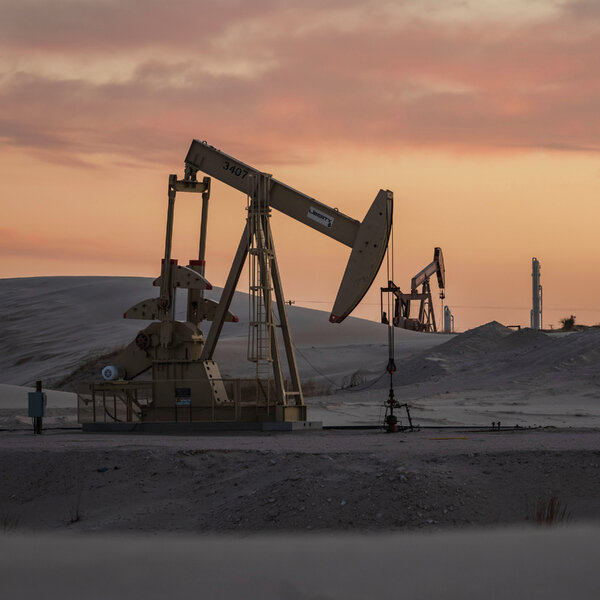
5:54Javier Blas: The shale revolution started about 20 years ago when some American oil engineers and business people tried to crack a new type of rock called shale. They discovered that they could drill vertical wells, then turn the drill bit 90 degrees and go horizontal to tap those very fine shale rock formations. And then the problem is that the oil will not flow until one crack at the rock. And to crack at what they discover is what we call today fracking or hydraulic fracturing, which consists of injecting water, sand and chemicals underground at huge pressure until they create fractures on the rock that allow the oil to flow.
6:40Javier Blas: That really unlock a significant amount of new production in the United States, particularly in Texas and New Mexico. So one of the effects of the shale revolution is that the U.S. is less reliant on Middle Eastern oil. What has the reaction been in the Middle East then to the dominance of U.S. shale? The reaction has been several times to try to kill that revolution, bring prices down. That's what OPEC, led by Saudi Arabia, did in 2014 to 2016, trying to bring prices down to make shale uneconomic. And now I think that what the Saudis have discovered is that shale continues to grow and they are trying to increase production to recover market share that they have been losing against shale.
7:27Javier Blas: And that is also very interesting right now because the crisis has come at a time where shale production was booming and Saudi production was also increasing in an effort to recover market share. How is that sort of impacting strategy and geopolitics when it comes to this conflict? Like, why is this such a game changer for American presidents, for example, thinking about intervening and entering conflicts in the Middle East? Did the fact that the U.S. is less reliant on oil from Iran play into President Trump's decision to strike Iran this weekend? Every time that the U.S. has faced conflict in the Middle East, the White House knew that the consequence of that was going to be an increase in oil prices, and that means more expensive gasoline in America.
8:15Javier Blas: And I spoke to senior advisors on oil for former President George W. Bush and Barack Obama. And they told me that they knew that however they intervened, there was going to be a price. And the price potentially was a recession in America because of high inflation, high interest rates. And that always acted as a break. I think that for the first time, President Trump perhaps is the first American president that doesn't really need to worry as much. Yes, the oil price can be still painful. And I don't think that President Trump enjoys anything close to$75 a barrel. But he can intervene in the U.S.
8:56Javier Blas: without almost be certain that the country is going to go into recession. Well, it's interesting. This morning, Donald Trump posted on True Social, drill, baby, drill, telling the Department of Energy to start drilling more, to keep oil prices down. What did you make of that? What did that mean? So President Trump wants two things at the same time that cannot happen. Either you have$50 oil and not much drilling, or you have$75 oil and a significant amount of drilling. And I think$75 is about right. It is good enough for the shale industry in places like Texas, New Mexico. Oil companies are going to be doing well.
9:35Javier Blas: They're going to be drilling. But the price is not high enough to be a problem for the economy. And certainly not high enough that this summer driving season, people are going to be complaining about high gasoline prices. So you think Trump should be happy with$75 a barrel? Let me put it this way. I think that many other presidents in the White House facing a Middle East crisis will happily take$75 a barrel. I mean, every other time, the president will have been facing$100 oil, which is really painful for the economy. $75 is just fine. Take the win, move on. One of the most amazing things that is happening right now in the market is that if you look at the price of regular gas in the United States today, with all what has already happened in the Middle East, is lower than it was on the last period of heavy driving in America around the Easter holiday.
10:30Javier Blas: $3 a gallon,$3.233 a gallon is a quite reasonable price if you consider the experience that we have in past years. When Russia invaded Ukraine, the price of gasoline in the United States went all the way to$5. I don't see that happening again during this crisis. And I will expect that prices stay around this level for the next few weeks. After the break, what leverage Iran still has over global oil markets and why the Strait of Hormuz isn't the biggest concern.
11:09Some people treat ChatGPT like some kind of smart search engine, and some use it to get work done. ChatGPT work is a new way of working in ChatGPT that can take action across your apps and files, stay with a project for hours if needed, and turn a goal into finished work. It's designed to help you move from a chaotic starting point to a reviewable first version. So all the source materials, briefs, and scattered information that you have to grind through to turn into something useful can just become something useful. Put ChatGPT to work on your most ambitious ideas and projects. Get started at ChatGPT.com by selecting Work Mode.
11:49Available on Plus and Pro plans. This is the Bloomberg Market Minute, brought to you by Comcast Business. The markets faced plenty of challenges this year. Rising energy costs, higher interest rates, pushback to massive artificial intelligence spending. But through it all, stocks keep breaking records. And some analysts think they still can, with a focus on the fundamentals. Nadia Lovell is head of global equity strategy at UBS. Earnings has been good and continues to be good. And while, you know, we might be past the peak in earnings growth, we're not past the peak in earnings level. But others like Miller-Tabak strategist Matt Maley say those challenges could eventually lead to a downturn.
12:29Whenever we see a significant rise in bond yields like we have and a significant rise in oil prices like we have, the stock market always or pretty much always ignores it for a while. And Wall Street may be starting to take notice. A recent Citigroup index shows more analysts cut rather than raise their earnings forecasts for corporate America for the first time in more than five months. That was the Bloomberg Market Minute brought to you by Comcast Business, one partner powering 90 percent of the Fortune 500 and millions of small businesses. When you add it all up, no one does business like Comcast Business.
13:06Running a business means you're always on the move. The Delta Sky Miles Reserve Business American Express card is made for frequent travelers who want premium benefits that works as hard as they do. For a limited time, new Delta Sky Miles Reserve Business card members can earn 200 ,000 bonus miles, the highest miles offered this year. And when you need to recharge or find a quiet place to work, the Delta Sky Club can turn a layover into precious productive time or a restful reset. You can enjoy 15 visits each medallion year to the Delta Sky Club when flying Delta and unlock unlimited Delta Sky Club access after spending$75 ,000 in purchases on your card during a calendar year.
13:47Plus, receive four one-time guest passes each medallion year so you can bring a colleague along. That's 15 Sky Club visits plus four guest passes for an annual value of up to$950. Value estimate based on$50 per visit rate to purchase additional visits or bring a guest to the Delta Sky Club. Apply today at www.delta.com slash podcast. Offer ends 11-426. Minimum spending requirements and terms apply.
14:17So far, the war between Israel and Iran hasn't dramatically increased the price of oil, even after the U.S. bombed Iranian nuclear facilities this weekend. But as the conflict has escalated, so too have fears that Iran might try to up the ante by closing the Strait of Hormuz. So I asked Bloomberg opinion columnist Javier Blas to tell us about this unique waterway that transports so much of the world's oil.
14:46Javier Blas: The Strait of Hormuz is very important for the oil market for one reason. It is the chalk point, the waterway, for which 20 % of the world's oil flows into the international market. All the oil from Iran, most of the oil from Iraq, a significant portion of the Saudi oil, Emirati oil, all of the oil from Kuwait, they need to go through the Strait of Hormuz to reach global oil refineries. If the Strait of Hormuz was to be closed, oil prices will rise significantly because we will lose a significant chunk of supply. And as I said, it's 20 % of the world's oil goes through it. These are huge tankers, so you cannot miss them.
15:29How could Iran shut down the Strait of Hormuz? Does it need UAE's buy-in?
15:36Javier Blas: No, they can't do it alone. If Iran wanted to shut down the Strait for a brief period, they can't do it. They need to turn to violence. So it will involve probably firing missiles against oil tankers, which will prompt every other oil tanker to turn around and avoid the strait. They can mine, use sea mines to mine the waters of the strait. So there are a number of elements that they could deploy to try to close it. But obviously, every other country in the region and significantly the United States and perhaps China will react to that and try to reopen the strait right away. On Sunday, Iranian state TV reported that Parliament has approved a measure to close the strait.
16:18That doesn't mean it's happening. They need more than just parliamentary approval. But can you game it out for us? What would shutting down the strait mean for global trade, even short term?
16:29Javier Blas: Every day that we were to lose 20 percent of the global supply will increase the price of oil significantly. And if we were to be only a few days of the shutdown, there will be panic buying, particularly for countries that depend on Middle Eastern oil for a lot of the supply. I'm thinking about China, India, Japan, South Korea, Taiwan. So those countries will go into the market that will buy oil from whatever other origin, at whatever other price, and the price will go up a lot. Will the prices stop at$100? No, I don't think so. I think that will go significantly higher than$100. We will get our triple-digit oil prices.
17:07Javier Blas: Yeah, absolutely. We will have triple-digit oil prices. But how likely is that? Very, very unlikely. Just so I understand, what are Iran's incentives to close the Strait of Hormuz right now in the middle of this conflict? And what's the main incentive not to close the Strait? The main incentive for Iran to close the Strait of Hormuz will be to weaponize oil, to turn oil into part of the conflict, potentially to force the United States to talk to Israel so Israel stops the bombing. And the United States think twice in the future about bombing Iran. It's just using oil as a weapon and force probably a diplomatic negotiation around the world.
17:52Javier Blas: That is the biggest upside for Iran to close the Strait of Hormuz. So saying you thought you were insulated from oil supply, but you're not. Like, you really need us. Yeah, and generally the United States, even if the United States suffers not a lot, the United States has an interest on a healthy global economic growth. So other allies will suffer, Japan will suffer, Korea will suffer, the European countries will suffer. And typically that's not in the interest of the United States. The biggest downside for Iran is that if you close the Strait of Hormuz, no one can export oil, and that includes Iran.
18:29Javier Blas: And for the Iranian regime, oil is really the cash cow. That's where the money is coming. So, yes, Iran will close the Strait of Hormuz and it will create trouble for everyone else. But they will shoot themselves on the foot because they cannot sell their oil. It will also hurt some of the biggest allies of Iran, like China. And China will not really enjoy that. And I don't think that Iran can afford losing diplomatic support from China right now. My personal view is that Iran will not close the Strait of Hormuz. I don't think that they have, when you put everything on balance, a good incentive to do it.
19:10Javier Blas: Can it happen? I suppose that one should not say never, but I don't see it. So maybe this closing the Strait of Hormuz isn't the biggest concern that we should be thinking about right now. Are there other major risks that war in the Middle East raises for the global oil trade or energy markets overall? I do think that there are other big risks, and perhaps they don't get as much attention, but they are more important. The Saudi oil fields are within range of Iranian missiles. and a proxy of Iran, the Houthis of Yemen, attack on Saudi oil fields in 2019, disrupting supply significantly even for a brief period of time.
19:57Javier Blas: Do I think that that's likely? Again, I don't think so, but that would be far more devastating than anything happening in the Strait of Hormuz. And to me, that is perhaps the worst case scenario that few are talking about. So Javier, we've been talking about some hypotheticals. What might come next? But right now, we're still sort of processing what happened over the weekend. What do the events of this weekend and potential further involvement from the U.S. in this conflict mean for American oil production going forward? What we know is that American oil production was heading down because prices have dropped significantly.
20:35Javier Blas: The U.S. oil benchmark a few weeks ago was changing hands, used around$60 a barrel. At that price point, American oil production goes down. Since then, because of all what has been happening in the Middle East, prices have recovered to around$75 a barrel. And that has allowed shale companies to lock in future prices. And that means that probably American oil production is going to be higher than we were expecting a few weeks ago, both in the second half of 2025 and also into 2026. But shale is not an infinite resource, right? And Trump has been very resistant to invest in green energy sources.
21:18What happens if oil production doesn't keep going at the rate that's expected? What's the long term plan here?
21:27Javier Blas: Shale is a great resource, and America is extremely lucky with its geological endowment. But it doesn't last forever, and you cannot increase production year after year and expect that that's going to continue for a very long time. At some point, American oil production will reach the Senate, and it means that perhaps if the demand remains at the current high level, that will imply that the United States will need to start importing a lot of oil as it did 20 years ago. Perhaps not as much, but potentially it could go back to the old days of 20, 25 years ago.
22:11This is The Big Take from Bloomberg News. I'm Sarah Holder. To get more from The Big Take and unlimited access to all of Bloomberg.com, subscribe today at bloomberg.com slash podcast offer. If you like this episode, make sure to follow and review The Big Take wherever you listen to podcasts. It helps people find the show. Thanks for listening. We'll be back tomorrow.
22:41Wise is the smart way to manage the currencies you need around the globe. When you send money abroad using your bank, you could get hit with hidden fees and exchange rate markups. There's a better way. Try Wise. Wise uses the exchange rate you'd usually find on Google with no unwelcome surprises. Plus, most transfers happen in under 20 seconds, which means your money arrives in less time than you've been listening to me. It's simple and free to sign up when you download the Wise app. Be smart. Get wise. T's and C's apply. If you're a business owner, you need a card that can keep up. With the Delta SkyMiles Reserve Business American Express card, everyday purchases transform into miles you can use towards future travel.
23:22So business as usual can lead to a well-deserved getaway. And for a limited time, card members can earn 200 ,000 bonus miles, the highest miles offered this year. Whether you're traveling for business or planning your next adventure, now's a great time to make every purchase go further. Apply today at www.delta.com slash podcast. Offer ends November 4th. Minimum spending requirements and terms apply. This is Robert Smith from Business History. If you're listening to this, there's a good chance you're a small business owner. And like every small business owner, you started with a dream to do what you love and watch it grow.
23:56What you probably didn't dream about? Keeping up with cyber threats. That's where MasterCard can help. With access to tools that help identify cyber threats to better protect your business. Building your dream business? Priceless. For cybersecurity in a changing world, there's MasterCard. Learn more at MasterCard.com slash small business.
The conventional wisdom used to be that war in the Middle East would send oil prices soaring. Not anymore.
On today’s Big Take podcast, Bloomberg Opinion’s Javier Blas and host Sarah Holder talk about the emergence of the US as the world’s largest oil producer — and how that new power dynamic is playing out in the war in Iran.
See omnystudio.com/listener for privacy information.
Scan the code with your iPhone camera
Listen in the app.