
 Ask ChatGPT

- Podcasts
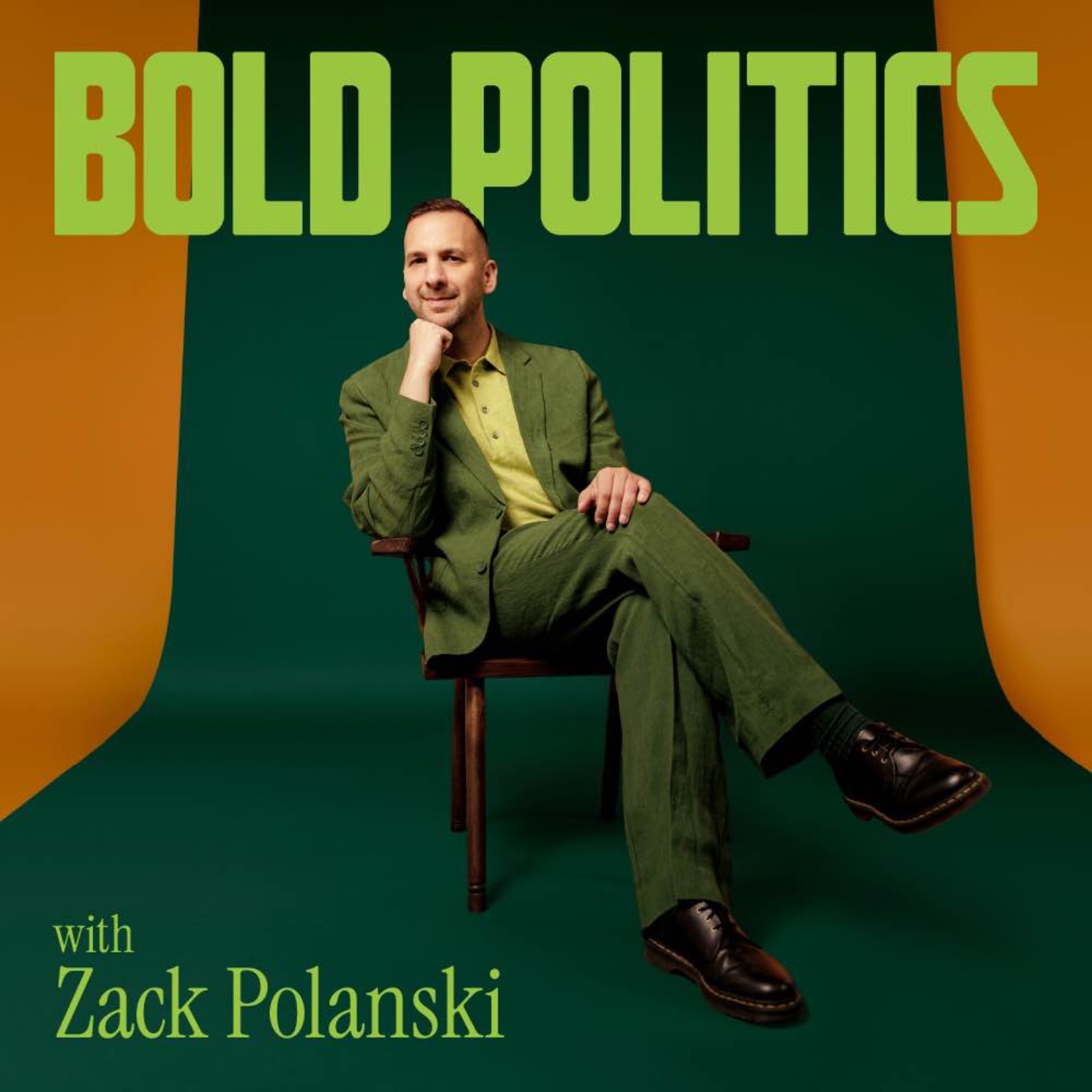
- Bold Politics with Zack Polanski
- How The British Empire Changed The World
Bold Politics with Zack Polanski23 Jun 2026 · 53m · 23 chapters

How The British Empire Changed The World | William Dalrymple
In short
Why Britain’s empire—and the East India Company—reshaped global trade, politics, and modern conflicts; why empire/colonisation and the Nakba are missing from UK school curricula; and how Britain’s legacy still shapes India-Pakistan and Israel-Palestine.
Guest
William Dalrymple, historian and presenter (co-host of the Empire Podcast with Anita Anand). He argues that ignorance of imperial history drives moral confusion in public debate.
Key claims
British empire redirected global trade and ecosystems and enriched Britain via looting (e.g., East India Company money; slave-trade wealth). Statues should not be erased but contextualized with plaques. Britain “cut and ran” in 1947–48, leaving partition catastrophes (India-Pakistan violence; Palestinian expulsion) unresolved. The Balfour Declaration and British mandate actions enabled mass displacement in 1948. British counterinsurgency/torture methods and personnel influenced later Israeli security practices. The East India Company became a corporate power that corrupted UK politics through lobbying and donations.
Notable examples
Clive of India statue debates (Foreign Office; Shrewsbury plaque model); Colston statue in Bristol; Remnants of an Army removed from the Tate; Bengal famine (1740) with monsoon failures; East India Company opium/tea and the Boston Tea Party; 1936 Arab Revolt “watering can” torture; Ord Wingate and night-raid tactics; Nakba towns emptied (Jerusalem, Lydda, Jaffa, Ramle).
Written by AI. May contain mistakes.
Chapters
0:34
The Importance of Teaching Empire
Discussion on why the British Empire isn't adequately taught in schools and its lasting implications.
“Seeking, pushing, optimizing, creating, learning, discovering.”
1:48
The Importance of Teaching Empire
Discussion on why the British Empire isn't adequately taught in schools and its lasting implications.
“William, thank you so much for joining us on Bold Politics.”
6:04
Legacy of the British Empire
Exploration of how the Empire transformed British society and global trade.
“And I think to answer your question, the reason we don't learn it is that when the British Empire ended in the 1940s, 1950s, through to in Africa, the 1970s, it became something which people stopped talking about.”
11:34
Partition and Its Consequences
Analysis of the partition of India and Palestine and the resulting political issues.
“But it's also important in a different way, two other reasons.”
14:03
The Consequences of British Partition Policies
Explore the outcomes of British partition in Palestine and its long-term effects.
“way around this now is some sort of partition.”
17:07
Ignorance of British History on Palestine
Discuss the lack of awareness in Britain about the history and plight of Palestinians.
“And so they get very confused reports only from our media, which, as we all know, has different interests.”
18:07
The Nakba and Its Legacy
Learn about the Nakba and the impact of British actions on Palestinian displacement.
“So we have only a very small Palestinian community here.”
21:44
The Complexities of the Balfour Declaration
Understand the motivations and consequences of the Balfour Declaration on Jewish and Palestinian communities.
“Alpha himself sounds as if, yes, he definitely had many antithemitic traits.”
25:23
The Complexities of the Balfour Declaration
Understand the motivations and consequences of the Balfour Declaration on Jewish and Palestinian communities.
“What if a marginal gain unlocked greater performance?”
26:37
Comparing the Partition of India and Palestine
Examine the parallels between the partitions of India and Palestine post-World War II.
“I don't know if that's going to be easier to talk about.”
Show all 23 chapters
28:00
The Consequences of British Partition
Explore the tragic consequences of British partition in India and Pakistan.
“And so you can compare that, for example, to the French mess in Algeria, where almost a million people die, many of them French citizens.”
29:15
British Withdrawal and Its Impact
Discuss the British withdrawal from Palestine and its disastrous effects.
“exact timeline, I think it was due to take a year and he does it in nine months, but he brings it forward three months rather than extending it.”
31:01
Historical Ignorance and Education
Examine the lack of education regarding British imperial history in schools.
“We bear a lot of the responsibility for the continuing violence today.”
31:49
The East India Company's Rise
Learn about the origins and rise of the East India Company in India.
“The education curriculum is there for that purpose.”
33:04
The East India Company and Its Legacy
Understand the complex legacy of the East India Company and its influence.
“It's a small Georgian house, six windows wide, six windows.”
36:24
Public Opinion and Resistance
Discover the public's resistance to the East India Company and its practices.
“india it's discovered you can grow opium in india to pay for the growing british taste for tea So they become the largest narco operator operating out of India, selling Indian drugs to the Chinese.”
41:21
Media and Awareness of Colonial Issues
Explore how the media and whistleblowers revealed colonial issues to the public.
“its roots and the fortunes made in the East India Company and its rivals.”
42:04
The East India Company's Role in the Bengal Famine
Explore the tragic impact of the East India Company's policies during the Bengal famine of 1740.
“So they're not going to allow, you know, kind of snoopy, even if they existed, snoopy correspondence in to see the Bengal famine of 1740 or whatever it is they want to cover up.”
45:02
Transition from Company to Government Control
Understand the shift from the East India Company's profit-driven motives to British government control.
“First is a company where it's just controlled by a corporation which is for profit.”
46:27
Lessons from Lebanon's Complicated History
Learn about Lebanon's historical challenges and the impact of external interventions.
“Well, Lebanon is a complicated story of itself.”
48:37
Media's Role in Shaping Historical Understanding
Discuss the media's influence on public knowledge of historical events, particularly in the Middle East.
“Until justice comes to that region, you're not going to get peace.”
50:44
The Need for Alternative Historical Narratives
Highlight the demand for alternative perspectives on historical events that are often overlooked by mainstream media.
“I'm horrified by the BBC's coverage of the Middle East.”
53:22
The Need for Alternative Historical Narratives
Highlight the demand for alternative perspectives on historical events that are often overlooked by mainstream media.
“And I think your commitment to the truth and to justice is so important.”

Ask about this episode
Get the gist, explore an idea or ask about something said.
 Claude
On Bold Politics with Zack Polanski, what are the key points of this episode?
Searching your listeningTranscript
Automatic transcript. May contain errors.
0:00Palestine. India. They don't often get talked about in the same conversation, but the clear parallel is the legacy of British Empire. Not just that, but the legacy of corporations, the legacy of oligarchy. And so today, to have a look back, to look at what we can learn from history that might be relevant to this present moment and also our future, I'm delighted to be joined by the wonderful historian and star presenter of a brilliant podcast, William Dalrymple. This episode is sponsored by Crowdfunder. Bring your bold idea to life at crowdfunder.co.uk forward slash bold. Seeking, pushing, optimizing, creating, learning, discovering.
0:49At Aramco, we believe in harnessing the power of data to push the limits of what's possible. That's how we deliver reliable energy to millions across the world. Aramco, an integrated energy and chemicals company. Learn more about us at aramco.com
1:14If you've used Babbel, you would. Babbel's conversation-based technique teaches you useful words and phrases to get you speaking quickly about the things you actually talk about in the real world. With lessons handcrafted by over 200 language experts and voiced by real native speakers, Babbel is like having a private tutor in your pocket. Start speaking with Babbel today. Get up to 55 % off your Babbel subscription right now at babbel.com slash acast. Spelled B-A-B-B-E-L dot com slash acast. Rules and restrictions may apply. William, thank you so much for joining us on Bold Politics. Honoured to be here, Zach.
1:56Thank you. There's a whole lot I want to ask you about. I think the obvious place I want to start, though, actually, is with the education system. When I studied history at school, it was the Tudors, it was the Romans, bit of Second World War. I don't remember talking about empire or colonisation. Maybe schools have got better, but I imagine we're still not there. Why is this not taught in schools? And what is the benefit of when it is taught? It's a very good question. And I think you're right. I've made this point a lot. And teachers correct me that it is possible to do at A-level modules on the British Empire, that they are available, but they're not core curriculum.
2:31And very few people do them. And very few teachers feel equipped to do them. It's still a very much a minority subject for most people. There are schools, particularly in London, with big minority catchments that make a point of doing it, but they are, you know, a tiny proportion of the whole, which means that most British people are entirely ignorant about what is, for better or worse, the most important thing Britain ever did. Britain, through its empire, completely changed the face of the world over about 300 or 400 years. Not only did they change it within a sort of local European context, but they completely upended flows of global trade and ecosystems which had existed for millennia.
3:16The most obvious point being that for most of history, India and China dominated the world economy and that Europe was an add-on. If you look at the classical world, India and China are producing about 70 % of the world's GDP. That's still the case in the 18th century, with India producing, by some estimates, as much as 35-40 % of the world's GDP. So first thing to say is, I suppose, that when we're looking at the world today, we're seeing China already now as the world's number two economy, and India, I think, currently number five, but about to be number three if current trends continue by the end of the decade.
3:58It's going to overtake Japan and Germany, if they haven't overtaken Germany already. And what I think we're seeing is a reversion of the world trading system to what it was in the pre-colonial period. It's taken 80 years since the British left India, whatever it is. 75, 76 years, we're seeing the world in a sense recover from this brief blip when Europe smashed its way around the globe, moving populations around, moving natural resources around, looting some places, bringing wealth to Europe. And if you look at the big country houses in this, you know, people go off for the weekend to the country, they go and see a national house, country house and they have cream teas somewhere.
4:42If it's a big Palladian house of the sort that you might see in a Jane Austen Sunday night drama with women in bonnets and chaps striding through ponds, Colin Firth appearing in sort of gorgeous outfits. If it's on the east coast of the country, quite probably it was built from East India Company money, in other words, the looting of India. If it's on the west coast of the country, somewhere near Liverpool or Bristol, it's more likely to be slave money, the Caribbean. But those two sources of wealth brought capital into Britain and brought also, in the case of the West Indies, cotton into Britain, which was then milled in the Industrial Revolution and which then gave the seed capital for Britain to accelerate massively through the Industrial Revolution and provided the wealth which catapulted England from a kind upper middle position in Europe, and Scotland from the very bottom.
5:36Scotland moves, is even more dramatically than England, from the second bottom place in Europe to the second top in the world between the beginning of the 18th century and the end of the 19th century. So this country is transformed. It transforms Britain, but it also transforms the world. And what gives us great prosperity often detracts from the prosperity of the looted countries or the countries which have been plundered for enslaved peoples or whatever it is. And it remains a strange quirk of our history system that we learn more about the wives of Henry VIII than we do about the entire looting of India or the Caribbean slave trade, which are these two crucial moments in British but also world history.
6:20And so the podcast I do, the Empire podcast with the wonderful Anita Anand, we've made a point of trying to tell the stories that both your education and other podcasts don't tell, this enormous elephant in the room, which is the British Empire. And I think to answer your question, the reason we don't learn it is that when the British Empire ended in the 1940s, 1950s, through to in Africa, the 1970s, it became something which people stopped talking about. For example, the most popular picture at the Tate Gallery was Remnants of an Army, that picture of the doctor from the Afghanistan expedition and limping in on his pony with the rescue force at Kandahar.
7:00Those sort of pictures, which had been enormous crowd pullers in the mid-19th century, got shoved into attics, or in the case of that particular picture, sent off to a regional regimental museum in Taunton and Somerset. Literally the most popular painting in the Tate got expelled. A whole bunch of paintings about Australia and New Zealand got given to Australia and New Zealand, just taken off the walls and dispatched. And the empire disappeared. By the time you get Monty Python in the 1970s or late 60s, the empire is a joke. You get sort of, you know, Ronald of the Raj as a sort of comic figure or carry out on that the Kaiba.
7:35And people would mock their uncles, grandfathers and great grandfathers who'd been there, you know, fighting in India or whatever it was. and I think it's really taken the rise of a generation of post-colonial kids like my co-host Anita like Satnam Sanghera to redirect attention at this massive elephant in the room the most important thing Britain did and we don't learn about it at school fascinating and alongside all of this kind of re-bringing up of history I suppose there's an interesting story about how do we both acknowledge our history look to the future and have nuanced conversations about this And I think one of the examples I think of is the Colston statue in Bristol, which famously was pulled down into the river.
8:16I think there's now a plaque there. And that was kind of the meshing of recognising where history had been, but also not wanting to raise it entirely. Where do you kind of stand in how we should be talking about history? I think it's a huge mistake to remove these statues completely. There are certain places where I don't think they should be. For example, outside our foreign office, we have a picture of Clive of India, who was this sort of psychopathic character who founded the British Empire in India, was wonderful for the British, but obviously was catastrophic for India. So when visiting Indian ambassadors have to come and present their credentials at the foreign office, they have to pass this thing.
8:51It's clearly not the right place. It's not what we want Britain in the 21st century to look like. But I think to remove them completely is missing an opportunity for education. I think these things are important parts of our history. And therefore, exactly what you say, I think the Colston thing is exactly the model I would go for personally, which is to put up a statue. And I went to Shrewsbury in Shropshire last year, and they've done that with their Clive statue. He's up where he always was in the town square, arguably the most important person from Shrewsbury in world history. He hasn't been removed and disappeared, but he's there now with a plaque that gives both sides of the debate and allows people to make their own decision.
9:30And Clive is a good example, really, of someone who, in my view, as someone that studied the history with my particular politics, is a psychopath. Started off as a petty criminal in Shrewsbury and took that violence to India, but was extremely, and there's no question that he changed the fortunes of Britain. A whole channel of wealth, which had previously been enriching India, was diverted into British pockets. First of all, by conquering great chunks of what was then the richest country in the world. The equivalent today would be to conquer the Bay Area and, you know, take on all the territory that's now controlled by Google and Microsoft and Boeing and Hewlett-Packard and that kind of thing.
10:07Bengal in the mid-18th century was probably the richest area in the world producing amazing textiles. There were a million looms in Bengal producing all sorts of fancy stuff like silks and callum curries, but also basic cotton, what they call peace goods, which is basic cotton, which was so cheap and high quality that the British made their fortunes by exporting it around the world. And you get deindustrialization as far away as Mexico because the cloth being produced in India was so good at such quality, at such low cost, that even by the time that the British had shipped it halfway across the world and taken their own cut, it was still cheaper and better than anything that could be made in Mexico.
10:47So you have this period where Britain is enormously enriching itself by exporting this stuff. And how relevant is the story of India and empire to 2026 Britain? Well, it's a long time ago now. Its legacy lies all around us in two different forms, partly in just the sheer wealth of this country. We're still, despite everything, a very wealthy country in the world rankings. And it's there in just the lumps of enormous houses built by returned nabobs, which litter the country, particularly somewhere like Scotland, where it was very poor before and then became suddenly very rich. But also, most of the great country houses built in the 18th century have some link with either the slave trade or the East India Company.
11:32So it is important. But it's also important in a different way, two other reasons. One, in a huge proportion of this country now is descended from immigrants that came with the implosion of empire in 1947. When we left India at the same time, there was this massive immigration. And then again in the 1970s out of East Africa. Some of our most successful communities and some of our most extraordinary communities come from that addition to the national bloodline, if you like, in, first of all, the 50s, then through to the, again, massive immigration in the 70s. So it's important for modern history for that reason, but also because the unraveling of the British Empire left so many of the biggest political problems on the world stage today.
12:18The most probable nuclear fault lines at the moment in the world are either India-Pakistan, which result from the hurried British retreat from India in 1947 and the mess we made of partition and the astonishing enmity that now exists. 1947 continues to this day, in a sense, unresolved because of the way that we rushed partition and the mess we left behind us. Then a year later, the other biggest issue in world politics, Israel-Palestine. And I do think many people realize this in Britain, but at the date of the Balfour Declaration, 1917, Palestine's population was 96 % Muslim and Christian Palestinians, of which only 12 % were Christian, and the rest were all Muslim.
13:09After the Balfour Declaration, you get this horrific development of the Nazis coming to power in Germany. Already, Zionism exists initially because in the 1880s, anti-Jewish pogroms in Russia and Ukraine. In 1930s, you get the road through Kristallnacht towards the Holocaust by the middle of the Second World War. And Jewish refugees have no other place to go than Palestine. But Palestine, the Palestinians do not want people who want ultimately to expel them. So the British create this horrible situation where two peoples who have never had a history of enmity, and in fact, have gone on remarkably well to that situation.
13:50At that point, you have this impossible situation where it seems that the only possibility is partition. And successive British reports, including the Peel report, suggest that the only way around this now is some sort of partition. But rather than see that through, and rather than police it so that there isn't a catastrophe, so that neither people get massacred, the British literally walk out, leaving ultimately the stronger side, which by that stage is the better armed Israeli forces. The Yishov becomes the young IDF. The Haganah and the Palmak have all been trained up. Leaders like Moshe Dayan have been trained by British special forces, and they're better armed, They're better led.
14:33And 85 % of Palestinians end up expelled, many of them on the sand dunes in Gaza, where they remain today. We made a bit of a mess of partition of India and Pakistan. A million people died there. But at least both sides had homelands by the time that that was resolved by the 1950s. Astonishingly, in Palestine, we just left. We handed it over to the United nations walked out, leading to the Palestinians being evicted. And to this day, there is no Palestinian state. We have recognized the Palestinian state on paper, but we've never been further in reality from Palestinian state actually existing.
15:14The Palestinian Authority is almost completely powerless. The Palestinians of Gaza are being bombed every day and are on the edge, possibly, of mass eviction if Netanyahu's government gets its way. While we promoted the idea of a partition of Israel and Palestine. In the end, Israel was born and not Palestine. Palestine remains unresolved, and the Palestinians remain homeless and stateless, and in many cases still refugees. And that, obviously, is the central wound in this horror story of the modern Middle East, which remains this massively separating wound, which every few years revives and in slightly different forms creates new bloodshed and new hatreds.
16:02And our failure, well, not only our failure to solve that problem, but our role in creating it with the Balfour Declaration, where only 6 % of the population were under British rule put in a position that by 1948, they could expel 85 % of the population. Now, that is something, A, we need to sort out and help as far as we can in our diminished position in the 21st century to find justice for the Palestinians and find some way for these two peoples to cohabit, whether in one state or two states. But it's also most shockingly, and coming back to your first question today, something which at no point appears on the British curriculum.
16:46So people confronted with Gaza's terrible situation on the news have no idea how they got there. 99 % of people in Britain simply have no idea why the Palestinians in Gaza are unhappy, why they ended up there, where they're from, who they are. A lot of the British population is either Christian or Muslim or Jewish. And so from whichever angle, we'll get part of the history of that region in their religious studies and so on. But to actually have it explained in a neutral and secular fashion, the history of that country and how the Palestinians came to be dispossessed, is something that most British people simply have no access to in their education.
17:26And so they get very confused reports only from our media, which, as we all know, has different interests. And much of it is controlled by interests which are inimical to the Palestinians and are not at all sympathetic to their position. And I think a lot of the problem with the British response to Palestine, the confusion and the moral confusion of the British response to Palestine is the ignorance. The fact that no one, even in government, really knows this history as they should do, understands who the Palestinians are, what they've been through. And one of the accidents of 1948 is that in the Nakba, most Palestinians ended up either in Gaza in refugee camps or in Lebanon.
18:15Very few came to Britain. So we have only a very small Palestinian community here. We only have a very small Jewish community. They're still larger than the Palestinian community. and so there's been very little domestic political weight or momentum until recently with enlarged Muslim immigration and many Muslims do feel the Palestinian situation more strongly than the rest of us. It's only recently that there's been in a sense a domestic lobby which is interested in the fate of these people whose dispossession is our fault. We re-engineered the conditions under which the Nakba could take place.
18:58First of all, with the Balfour Declaration, but subsequently also, for example, in the 1936 Arab Revolt or Palestinian Revolt, when the Palestinians realized they were heading for expulsion and extinction, they rose up against the British. In that year and the year that followed, a year of terrific bloodshed and some terrible casualties in all the different communities, you ended up with the Palestinians being crushed by violence of such terrible intensity, torture, terrible interrogation techniques involving early versions of waterboarding. They called it the watering can. Heavy violence. A lot of the black and tans who'd fought with extrajudicial methods in Ireland, Ireland got independent, they were shipped off to Palestine.
19:47And led by figures like Duff, When you use the phrase, duff someone up, it's named after him. And so a lot of the techniques used by the IDF and the Shin Bet, the Israeli internal security, are derived from British methods initially tried in Black and Tanzan Island, exported to Palestine, and then incidentally, subsequently exported to places like Malaya and Mau Mau in Kenya, and then re-exported to Northern Ireland. And the techniques, anti-insurgency techniques developed, extrajudicial, many of them involving torture, extreme methods of interrogation. There's a whole history of that related.
20:24And Palestine is the example where it's left this legacy. So you get the Palestinians crushed, their villages bombed. Barmaharis, who later runs the British Royal Air Force bombing of Germany, learns his craft bombing Palestinian villages during the Arab Revolt of 1936. And at the same time that that's happening, other British forces are training up the Haganah and the Palmat figures like Moshi Dayan, who will then go on to lead the IDF. And there are figures such as Ord Wingate, who is a British officer, extraordinary sort of strange, eccentric character who carried an alarm clock around with him, wore garlic around his neck, which he'd take a bite of because he believed it warded off mosquitoes, would address his troops stark naked, combing his pubic hair with a toothbrush.
21:12This sort of strange evangelical weirdo invented the techniques of night raids into Arab villages and what he called the special night squads that the IDF still loses today on Palestinian villages in the West Bank. And Ord Wingate is sometimes known as the father of the IDF. He was a British soldier. So we trained up the forces which eventually expelled the Palestinians while disarming the Palestinians, crushing their villages and expelling and imprisoning their leaders. And for another bit of history that I'm particularly interested in as a Jewish man that I think often isn't told, is that from my understanding of the Balfour Declaration, a lot of it was about removing Jewish people from the United Kingdom who were not welcomed due to anti-Semitism and a place to paraphrase to almost put people.
21:59Yes, it's a complicated story. Alpha himself sounds as if, yes, he definitely had many antithemitic traits. He was very keen on eugenics for a start, which is never a good sign in a politician. But there are a whole load of different players. And you have very strong arguments within the Jewish community of Britain at the time. You have two cousins who are very important figures. Edwin Montague, who was in the cabinet, who believed that it would put Jewish people in this country in a very awkward position and fought strongly against the Barfatek. He was the only figure in the cabinet except for Curzon, who argued against it.
22:38And then his first cousin, who he grew up with in the same house, a guy called Herbert Samuels, who was the first British High Commissioner in Palestine, and who was a very strong Zionist, who'd written a paper in 1916 when Zionism was a fairly unknown creed in Britain that found its way onto the desk of Lloyd George and Balfour. And he was one of the fathers of the Balfour Declaration. So you have a complicated picture with, as today, Jewish people very divided on the issue of Zionism. That's not a new thing. The situation you found yourself in, where you and many Jewish people will go on marches against what's happening in Gaza, while others in the Jewish community will strongly support Israel, which they see as the Jewish homeland.
23:22That situation is not a new one. There's a wonderful book coming out next month. My friend Ben Moser, who's an extraordinary Pulitzer Prize winner in America, has written a book called Anti-Zionism, A Jewish History, which tells exactly these stories. And I think you'd find it very interesting because it very much highlights people that have had the same sort of dilemmas I presume you must have had growing up and discovering what's going on. For sure. And now a quick break with our friends from Crowdfunder. We're stronger when we're together. But the reality is there's been a deliberate shift to make us forget about the things that matter in life.
23:57Kindness, community, looking out for each other. Decades of austerity and growing regional inequality has left so many towns, districts and villages with community projects underfunded. Green spaces neglected. vulnerable people slipping through the cracks and the flip side of that is if we're only looking out for ourselves it's only going to get worse that's why bold politics have partnered with crowdfunder to inspire people across the country to do something amazing for their communities whether you want to create a local litter picking group start a community garden
24:42or turn an unused building into something useful like a food bank. And whether you've got a big idea that needs a lot of money or you just need a little bit, Crowdfunder have raised over£300 million for charities, projects and communities. And there's a crowd of people out there waiting to turn your bold idea into reality. Hey, we'll even give you 50 quid towards your first project if you raise£250 from at least five donors. What could you do for your community? Turn your bold idea into a reality at crowdfunder.co.uk forward slash bold.
25:23What if a marginal gain unlocked greater performance? What if an insight in data could change everything? At Aramco, our focus on detail helps us deliver reliable energy to millions across the world. Because margins aren't marginal, they're where we can truly push the limits of what's possible. Aramco, an integrated energy and chemicals company. Learn more at aramco.com. You've got social dialed in. Search is doing its thing. So why do your marketing results look the same as six months ago? That's because you're fishing in the same pond as everyone else. Podcast listeners are a different audience entirely, more engaged, harder to reach through traditional channels, and ready to act when someone they trust makes a recommendation.
26:13We're Acast, and we put them right in front of you. Browse thousands of the world's leading podcasts, book host reads or run your own ads, and track every conversion in real time. Same skills you already have, brand new results. ACAST. ACAST.com slash advertise.
26:37Can I return momentarily to India and Pakistan? I don't know if that's going to be easier to talk about. What's interesting is that they're strongly related. Although, obviously, they're different parts of the world with very different histories traditionally. The partition of India and Pakistan happens in 1947. Yes. what should have been the partition of Israel and Palestine, which ended up just being Israel, happened in 1948. That's partly what I'm looking for here, is the link of why these two things were roughly happening in similar years, obviously after the war. The short answer is after the war, Britain was bankrupt.
27:07It had borrowed huge amounts of money from America, which it couldn't repay. It was therefore in a very subservient position to America. And that finally plays out in the Suez, 1953, when America blows the whistle and Britain has to pull in because they threatened to collapse the pound, which America was in a position to do at that point. So bankrupt after the war with all these troops that had been fighting for five years against the Japanese and the Nazis, and people wanted to come home. They didn't have the stomach for fighting anti-insurgency campaigns in India or in Palestine. And the British basically cut and run in both cases.
27:40And in both cases, there is a rush to get troops home and a rush to just sort of, you know, wash our hands of what had become a problem. In both cases, they successfully get the British troops out without many British casualties, which was a strong priority at the time. And so you can compare that, for example, to the French mess in Algeria, where almost a million people die, many of them French citizens. The actual British casualties, white British casualties of soldiers and administrators in India in 1947 is in something like the 10s or 20s. And that needn't have been the case. You could have imagined a slightly different ending of empire where the British had not been so quick to get out, where they'd chosen the French in Algeria to fight an insurgency rather than to surrender effectively and give over independence.
28:36And so we could have made a bigger mess of it, like the French did, but even so... A small consolation. It's a big consolation. One to 1.5 million Indians, what would be Indians and Pakistanis, Hindus and Muslims died in the course of partition in some of the most terrible violence and rape and horrors, which is something my son has been studying rather than me. My son Sam Durmple has written a book called Shattered Lands. So you get this British cutting and running in India, Pakistan, and Mountbatten, arguably because he wants to move on to his next job, accelerates partition rather than slowing it down.
29:14And he says that, I can't remember the exact timeline, I think it was due to take a year and he does it in nine months, but he brings it forward three months rather than extending it. As a result, all sorts of safety measures which could have been put in place to ensure the safety of people are not there. And 1.5, 1 to 1.5 million people are killed. Many more raped, many more traumatized, and continuing enmity between India and Pakistan being the result. But Palestine is even worse than that, because no safeguards are put in place to look after, well, either community. But by this stage, the Jewish community is well armed.
29:56There's arms coming in from Czechoslovakia in large numbers. The Palestinian leadership is broken, and the Arab revolt has only just been defeated, and the Palestinian society is shattered. But even so, the British are not there making any attempt to keep the two communities apart, making any attempt to try and solve the issue. They handed over to the United Nations and they leave amid a growing civil war. And the Nakba is well underway. The early part of Nakba, which is places like Jerusalem, Lydda, the Dayocene Massacre, Jaffa, Ramle, these towns are emptied of their Palestinian population systematically, village by village.
30:37town by town. And the British simply are not there to intervene or to protect the people whose welfare and who they were given a mandate to look after these people. The Belfair Declaration states that nothing should be done which will undermine the status of the non-Jewish communities. Of course, 85 % of the non-Jewish communities end up as refugees after this. So it's a very dark period of our history. We bear a lot of the responsibility for the continuing violence today. the fact that the situation is as it is, is our legacy. And we are not taught this at school, so we do not understand it. And that ignorance goes right up to the top levels of government.
31:18And frequently, anyone who does know this history is often appalled when you see politicians on chat shows, answering questions from presenters, clearly, totally ignorant of the history. And you can't just blame them, but it's the fact, you know, they've never learned it at school. They They can tell you about Florence Nightingale in the Crimea. They can probably tell you about Queen Victoria. And they can certainly tell you about the Nazis, but they don't know this stuff. And we need to know it. We just badly need to know it. I mean, this is the reason why we started this podcast, Empire Podcast, but it's, you know, it's a bigger problem than that.
31:53We can't educate the nation. The education curriculum is there for that purpose. And to listeners who kind of maybe are hearing some of this history for the first time themselves, When it comes to India and Pakistan, I mean, it's such a broad question in terms of why we were there in the first place and why we were trying to make these deals and botched it so badly. What would kind of be the potted history? It's an extraordinary history. And it's one that I spent most of the last 25 years writing about. And I'm now moving on to writing the history of the Palestinians. And looking back at that Indian history, it only gets more extraordinary in retrospect.
32:26It's such a strange story. The story is that India was not conquered by the British government. It was conquered by one British company occupying one office block in the city of London, in Leadenhall Street, EC1. It's still there. It's where the Lloyds building is today. If you excavate underneath the Lloyds building, there will be the foundations of the East India Company offices, plural, because it starts off just as something looking like a kind of Tudor half-timbered pub in the 1600s. 1750 when the British are beginning to import their new military technology to India and beginning to conquer chunks of India.
33:06It's a small Georgian house, six windows wide, six windows. And then by the very end, by the mid 19th century, it's become something that looks a bit like Buckingham Palace and spread down the street. But the East India Company is this extraordinary story. And the British give a charter, Queen Elizabeth specifically, gives a charter on the last day of 1599, the same year that Shakespeare's writing Macbeth and Julius Caesar. Those both written the year that the East Indy Company has its first meeting, 1600, 1599, that period. And this British corporation with one office in London goes out and starts a trading venture, which in due course will conquer the richest country in the world.
33:54And for that to be possible, the Mughal Empire has to implode. And in 1739, there's a Persian who comes into Delhi, loots, takes everything, including the Koh-i-Noor diamond, a guy called Nader Shah. And by destroying the center of Mughal power and looting, 890 wagons of gold leave Delhi at the end of this. And there's no money left to pay the Mughal troops or the Mughal governors or the whole thing explodes. It's like taking a mirror and throwing it out of the top floor of a window. So it shatters into a thousand pieces of glass. And where previously India was one unitary state, not just India, but modern India, modern Pakistan, Bangladesh, half of Afghanistan, a slither of Iran was one enormous polity called the Mughal Empire.
34:38Very brutal, but very administratively well-run, extremely rich, the richest country in the world, 40 % of world GDP. Extraordinary, rich, powerful country. that almost overnight dissolves into hundreds of city-states. So Jaipur, Jodhpur, Hyderabad, Tanjil, all these little places. When you go on holiday to India, this is what you end up as a tourist looking at. You go to Jaipur, you see the Amer Palace, or you go to Jodhpur and you see Meranga. But these become little city-states. And this allows these British and French trading companies, two rival forces, to gradually conquer more and more of India, then British defeat the French and conquer the rest of it themselves.
35:21So that by 1799, you have a situation where there are 100 ,000 troops in the British army before they rearm to fight Napoleon. 1799 is just before the big battles, 15 years before Waterloo, six years before Trafalgar. 1799, there are 100 ,000 troops in the British army. the East India Company has 200 ,000 troops in India. A company still run in one office, still only six windows wide, with an annual general meeting, a share price, all the things that a corporation has today. And it's the greatest example in world history of how a corporation can be more powerful than the nation state. And in the 25 years I've been writing about the East India Company, I wrote four books called The Company Quartet, The Anarchy, white moguls return of a king the last mogul in those 25 years while i was writing that we've seen the rise of all these enormous tech bros with their companies whether it's meta or apple or take your pick of x and elon musk and at its peak the east india company not only has conquered india it's discovered you can grow opium in india to pay for the growing british taste for tea So they become the largest narco operator operating out of India, selling Indian drugs to the Chinese.
36:48They buy tea, which they sell in India, in Europe, in Britain, and in America. It's East India Company tea that's dumped into Boston Harbor at the Boston Tea Party. And you have one British corporation, like an enormous octopus with its tentacles, the first multinational corporation. And it is the largest employer in Britain. All people making tar and sails and ships and unloading all these ships which are turning up in rapid succession, day after day, loaded with opium and cotton and tea and spices and all the rest of it. and as well as being powerful enough to take down each individual Indian state.
37:34Remember, they've fragmented, so you can take down first Jhompur, then Jaipur, then Bengal, then Thipu, then Marathas, then the Sikhs. It's not only powerful enough to do that, but it's powerful enough by the 1780s to dominate our parliament. So the East India Company in the early 1600s tries to bribe MPs with cash to extend its monopoly, and it gets caught. And one of the very first governors of the East India Company ends up in the Tower of London. So it's the East India Company, which in a sense invents corporate lobbying. And they realize that there are subtler ways of doing it. And you offer campaign donations.
38:10It's a very familiar story. Absolutely. And they become so successful at this, that by the 1780s, I can't remember the exact figures, it's in my book, The Anarchy, but something like 20 % of British MPs ex-East India Company, because they've just had the cash to buy rotten boroughs, to buy constituencies. But something like 75 % of British MPs have East India Company shares. So the East India Company is in a position to completely, not only militarily take out any of its rivals in India, but also corrupt the body politic at home in Britain. And arguably the biggest legacy of the East India Company, and this is why we should study it, not just because of the mess it creates in India, but because it corrupts our politics and the system whereby large corporate entities can give large donations to political parties.
39:08And an unspoken pro quo that is never published of what you get in return for your large political donation, that is the legacy of the East India Company. I mean, they're not doing it out of the good of their heart. No one gives to a political party expecting nothing in return. And yet it's never stated. It's always left transparent. And then suddenly you find that the person who gave the offering is in the House of Lords or, you know, his company suddenly benefits from some quirk of British policy. Basically, you find that the interests of the corporation mysteriously become the foreign policy of the nation.
39:38One thing I've really, I don't know, and really we should be centering the people who are being invaded in this, but how were British people feeling about this at the time? What was public opinion? This is a really interesting question. This was the thing that surprised me most, I have to say, in my research, is that there is a huge resistance to the East India Company. We kind of, I think people, if they think about it at all, assume that times were different. It was fine to go out and create an empire in the 18th century and that everyone did that and it was okay. What you find is large numbers of ordinary British people booing Clive in the street.
40:13There is a play put on at the Haymarket where Clive is satirized as Lord Vulture, presiding over an enormous Indian famine. And all the main characters in the company have these nicknames, which make them sound like vampires preying on the blood of Indians. And people begin to boo and hiss these people in the streets, so much so that Clive eventually commits suicide. He takes his own life in Berkeley Square. And you find that there's a huge world of liberal opinion who write very passionately against slavery. Ultimately, that's why slavery ends. but also against the looting of other countries and the irresponsibility of the sort of British buccaneers who are going out penniless, coming back 30 years later with enormous fortunes, buying up a beautiful country house, buying up a borough and a seat in parliament and lauding it like oligarchs today over our body politic.
41:12So there's a long history of the way that democracy can be bought by corporations and by individual oligarchs. And that very much has its roots and the fortunes made in the East India Company and its rivals. And how did your average British person know what was going on? Because presumably the press or the journalists at the time were not necessarily reporting, or maybe they were. There's no such thing as foreign correspondents at this point. You have one or two celebrities, a guy called William Howard Russell, who goes and reports the Crimean War for the Times. He's the first war correspondent.
41:43He then goes to what we in this country still call the Indian Mutiny, 1857, which the Indians call the First War of Independence, the largest anti-colonial revolt in history. And a lot of what you learn actually happens from whistleblowers. So the only people that can go to India, the only people who can issue passports for India at this point are the East India Company. So they're not going to allow, you know, kind of snoopy, even if they existed, snoopy correspondence in to see the Bengal famine of 1740 or whatever it is they want to cover up. And it's only when you get whistleblowers within the company writing letters.
42:22So anonymous letters in 1740 are written to the Gentleman's Magazine, to Blackwood's Magazine, to the Spectator. They describe a terrible moment in 1740 when two successive monsoons fail. Now, this happens in India. Monsoons are usually the power that provides the water for the agriculture of India, For two, three months, the sky is dark and water pours down in enormous quantities. But some years they fail, and some years they fail two years in succession. And in those situations, Indian states know what to do. They put money aside for the lean years, like in the biblical story of Joseph advising the Pharaoh to put aside grain for lean years.
43:10and they then create public works so that starving people can earn a crust of money to buy so some of the largest architectural wonders that you see in india such as the the great imam bar and luck now are built as famine relief projects whereby you know 100 000 people are employed to build something that isn't really necessary but it keeps them alive and they're paid every day there's a soup kitchen attached to this and at the end of the day they can go and get their five rupees, whatever it is, and some soup. And they don't die. But the East India Company, which is new to this game and doesn't know the ropes, but also doesn't feel any particular responsibility for the people, allows one million people to die in Bengal in 1740.
43:58And the first year they send out the troops to gather the taxes nonetheless. And there's these descriptions of cannibalism and they hang, in addition to all the rotting corpses all over Bengal, they hang people who won't pay their taxes. So people have to sell their children, sell their land, sell their farmings, but sell their grain. So the following year, there's nothing. And that year, they can't pay anything, even if they threaten to hang them. And that year, the East India Company fails because there's no money coming. Their own greed, they've killed the goose that laid the golden egg. And it's rather like Lehman Brothers being too big to fail.
44:34The East India Company really is too big to fail. And at that point, the British government steps in and you get something called the Regulating Act. And basically, the British state buys a 50 % share in the East India Company and bails it out. And that's the point when what had been a free market company, the East India Company, becomes, for the first stage, under the control of the state. By 1858, the East India Company is abolished and the British move in as a government thing. So you have these two very different phases of control of India. First is a company where it's just controlled by a corporation which is for profit.
45:09I mean, it's a nightmare scenario. It's like, can you remember the movie Avatar where the mining corporation moves to another planet? It's like that in real life. where an entire country of many millions of people are controlled by a for-profit corporation that exists only to enrich its shareholders. And there is massive fatalities, but the result is that the company fails and it becomes a British responsibility. And when the government stepped in, was this a moment again with the British public where people felt like this could be an intervention point where actually things could be for the better?
45:43Obviously, we know that didn't necessarily work out, but it's hard to imagine yourself living in that time. But you'd go, oh, actually, this is a time maybe when the government can sort out this mess. I don't think it does. You get gleeful comments by people like Horace Walpole at the fact that these studio companies failed. I don't think you don't. I haven't seen many idealistic writings. I'd love to say, yes, everyone thinks we can get better. It's utopian. It's wonderful. We can take over and mend it. What you do get is hostility to the nabobs, that people dislike oligarchs then as much as they dislike them now.
46:14That's pretty interesting. And then forwarding, we've obviously spoken about Israel and Palestine, but I just wanted to ask about Lebanon as well, because obviously that's very relevant speaking in 2026. What is there to learn from here in terms of looking at the future as well? Well, Lebanon is a complicated story of itself. It's a very weak state. It was always a state built with very different minority communities. It's where the minority Shia community fled away from the Sunnis. It's where the Christian Maronites fled away from persecution, where the Druze ended up. So you've got these very different communities, and the result has been a state that historically has been too weak to defend itself or really cohere.
46:54And the situation at the moment, though you wouldn't know it with the BBC, is that one fifth of Lebanese are now expelled from their homes. I mean, I'm not a fan of Hezbollah. Hezbollah are part of the problem, but they emerged in the violence of the 1918 invasion of, I know, two invasion of Lebanon by Israel. They didn't exist before then, and they took power at that point. There has to be some way of enforcing peace, but it can't be by giving Israel a fifth of the country, which is what's happening at the moment in which Trump seems to be okay with. As we saw Mick Huckabree saying that he was fine for a greater Israel, controlling great chunks of Syria and Lebanon and indeed Egypt and the maps you see of greater Israel.
47:42And Trump didn't make him apologize or knock him into place or pull him from the job. So there seems to be, you know, quiet American support of this greater Israel idea whereby it's fine for Israel just to absorb a chunk of Syria, a chunk of Lebanon. and one-fifth of the population is homeless at this moment and being bombed. All those villages in South Lebanon are being destroyed. Hezbollah are definitely part of the problem, but the solution is not genocide again, destruction of hospitals, bombing of ambulances and all the other violence we've seen. Responsible leadership needs to be given to restrain Netanyahu to disarm Hezbollah.
48:25I think you need some sort of intervention by the United Nations and our own government in America in an ideal world to disarm Hezbollah, to return Israel to its borders, to enforce Israel to name its borders, which at the moment it hasn't done, not to absorb great chunks of Syria, which it's already doing, and to enforce a peace plan that's going to provide security and peace for all peoples in the region. It's the only possible solution. Until justice comes to that region, you're not going to get peace. It's an obvious and basic fact. A running theme of our conversation has been people's lack of knowledge, sometimes not their own fault.
49:10They're simply not taught, not given the tools to understand the world that lies around them. I said we can know every detail about Berlin, but we just don't know how the Nakba took place, why the Palestinians are unhappy or why Lebanon is being invaded. And when the media aren't giving us this history, how much do you see being a historian as a kind of activist moment because people have different competing versions of history, right? Well, it's really, really interesting. If you think of the telly in this country, or the radio, in the last three years, until this year, have you seen a major series on the history of Israel-Palestine?
49:43BBC put one on, funnily enough, last autumn, after we at the Empire podcast did a 12-part history of Gaza. Now, at that point, when we put that out last year, 12 hours on the history of this problem. The kind of nuanced, in-depth study that should be on every public broadcaster. It should be in PBS, it should be on BBC, it should be on ABC in Australia. Because these are complicated problems that are not taught in school, and people need to understand it. They need to understand the different views, put on people from all the different sides, put on the professors from the different traditions and the different schools of history.
50:16Let's hear it. And we found that when we put it on the Empire podcast, our Gaza series last summer, we had an unbelievable response because people want to know this stuff and they're not getting it from the BBC, not getting it from PBS, not getting it from ABC. And we were getting in a day or two downloads of a third of a million people to listen to these things. So one says you can regard it obviously as an opportunity, but that opportunity should not exist. It should not be something that is as wanted and not provided. I'm horrified by the BBC's coverage of the Middle East. It's been outrageously inadequate from every point of view.
50:57I mean, most obviously the pulling of the documentary on the Gaza Doctors, which eventually went out on Channel 4 and won every BAFTA. but also just the day-to-day way in which the background to the subject has not been made clear the bias often in the reporting particularly on the on the bbc website which i think is particularly culpable you often find much better coverage if you listen to the world service or bits of uh other parts like for a correspondent bbc is a vast organization with different but The website is particularly culpable. And luckily, as we know, people now get a lot of their news from other sources.
51:38So many of us wake up every morning on Instagram with these horrific pictures coming out of Gaza, which we never see on the BBC, which never make it into the mainstream media. And people are more and more distrustful of the mainstream media because, I mean, you know this better than anyone. You've had a campaign against you very clearly aimed at your chances during the last local elections. and I think you'd be the first to agree that the mainstream media is not even-handed or fair in these matters. But luckily, more and more people are getting their news from other sources. Many other sources are available.
52:15For the Middle East, I'd recommend anyone to try Middle Eastern Eye or Al Jazeera rather than the BBC. Middle Eastern Eye is a particularly good source. I find it very reliable. But there's also podcasts if you want to learn history. And obviously, I'm going to promote my own podcast, the Empire podcast, which is 12 hours of the history of Gaza from the time of the Philistines right through to 1948, the Nakba. And then we did another series on the Arab-Israeli wars. If you want to know about Suez, if you want to know about the 1967 war, if you want to know about the 1973 war, if you want to know about the 1982 invasion of Lebanon, and all these things you need to understand, to understand the complete mess there today.
52:58We've got our offering for you, but there's obviously many other places you can go to. Well, I want to finish with something I said to you before we started recording, actually, which is just to thank you for everything you do to your commitment to the truth and commitment to the justice. As a politician, I'm pulled into those discussions whether I want to or not, because that's part of our thing. You are, and you've been very brave. I have to say, I'm a big fan and more power to you, and I hope that you are given a fairer crack of the whip next time around. Well, you've turned my compliment around because what I wanted to say was you don't have to enter that space and you've actually chosen to regularly in all of your work to go into areas where there are, you know, people who want to tell other alternative versions of history.
53:33And I think your commitment to the truth and to justice is so important. I think, you know, there is, there is a feeling that it's a dangerous thing for many people to talk about Palestine. We've seen this week, commentators banned from entry to this country. The same is obviously happening a lot in America. People who comment on or take the Palestinian position on social media are not getting visas and so on. I'm luckily in a position where, A, I have my own podcast, whose boss is Gary Lineker, who's not known for kowtowing to anyone. And I haven't got an academic job which can be pulled from me.
54:12I'm in a very privileged position of being able to say what I like. Plus, I spent many years of my life in that region, in the Middle East, but also in India. And I feel strongly that these are things that people need to know, and they've never been taught. There is a huge appetite to learn this. I do feel it is a kind of duty. My next book will be a history of the people of Palestine, who are these people that Goldemir says does not exist. What is the history of the Palestinian people? And I'm sure that that will get me in just as much trouble as you've got, Jack. Well, I already want to read it, so I imagine it will do very well.
54:44Just finally, you mentioned a couple of times you have a podcast on this show. It's funny you should mention that, Zach. The Empire Podcast. Yes, indeed. And if people want to find out more about you and your work, where's the best place for them to go? There's a whole variety of books, mainly published by Bloomsbury. There's the Company Quartet. If you want to know more about the Ascindia Company, The Anarchy particularly, I'd point people towards on that subject. I have a website and the podcast. The Empire Podcast, as we were saying. Very great. And I don't make my guests compete against each other, but if there was a competition for the amount of dense information in a short period of time, I think you're winning this podcast because that was an amazing amount of information.
55:17Thank you very, very much. Thank you very much. This episode was brought to you by Crowdfunder. What's your bold idea? Start it at crowdfunder.co.uk forward slash bold.
55:35Seeking, pushing, optimizing, creating, learning, discovering. At Aramco, we believe in harnessing the power of data to push the limits of what's possible. That's how we deliver reliable energy to millions across the world. Aramco, an integrated energy and chemicals company. Learn more about us at aramco.com.
56:06ACAST powers the world's best podcasts. Here's a show that we recommend.
56:39Acast helps creators launch, grow, and monetize their podcasts everywhere. Acast.com.
From the publisher
How did Britain use its empire to accumulate enormous wealth? What role did the British play in the dispossession of the Palestinian people? How does a corporation become more powerful than a state?
In this week's episode, Zack Polanski is joined by historian William Dalrymple.
_____
What's your bold idea? Bring it to life with Crowdfunder: https://www.crowdfunder.co.uk/bold?utm_source=boldpolitics&utm_medium=referral&utm_campaign=cf_boldpolitics_spotify
_____
Pre-order the new book, Hope Is Here now.
Email: [email protected]
Bold Politics Live is at Crossed Wires Festival in Sheffield on July 5th.
Pre-order the new book, Hope Is Here now.
Email: [email protected]
Hosted on Acast. See acast.com/privacy for more information.
More from Bold Politics with Zack Polanski
All episodesWe use cookies.They keep VO running smoothly and help us improve it. Privacy policy