In short
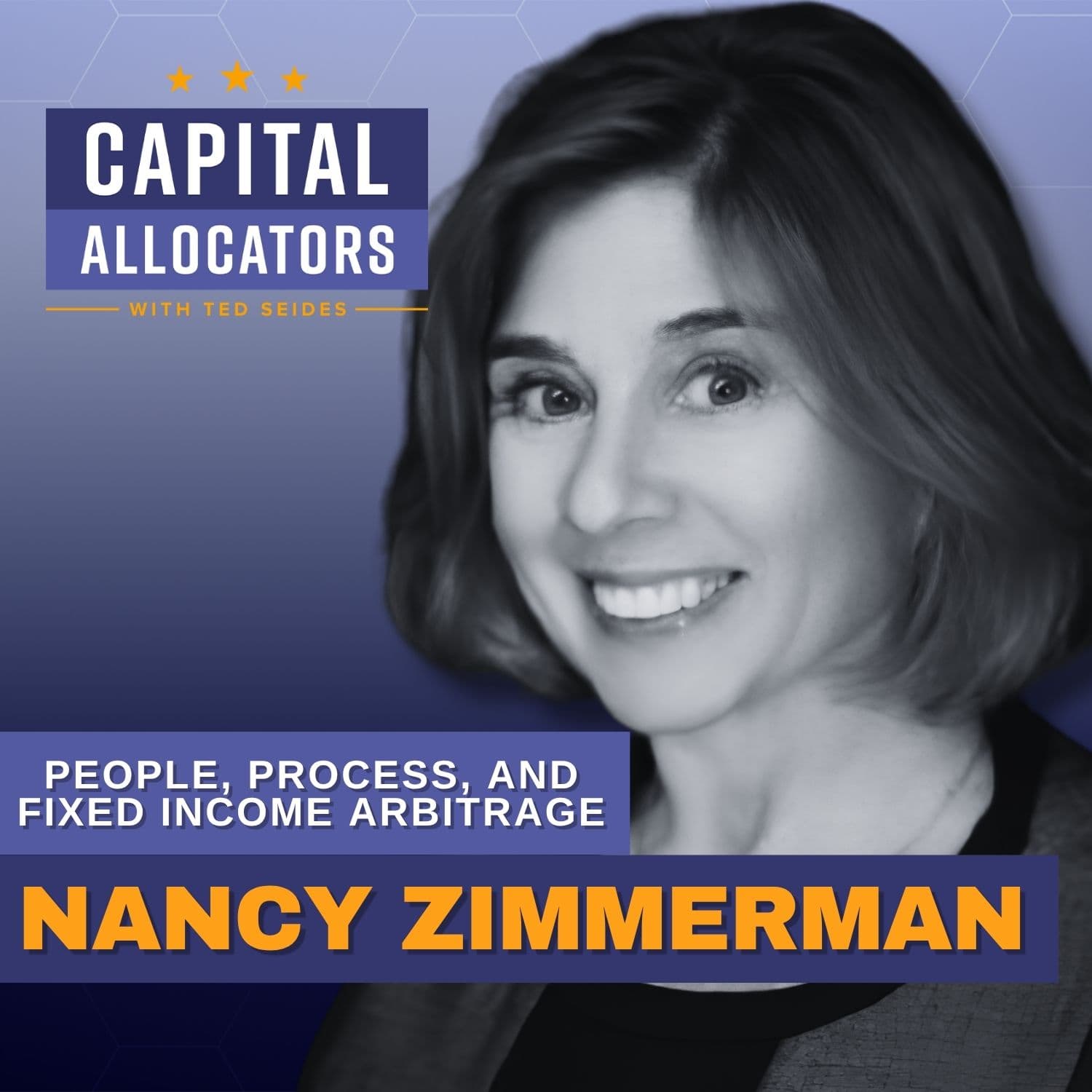
Nancy Zimmerman (Bracebridge Capital) explains fixed-income arbitrage as a persistent source of alpha, how crises change priorities (liquidity, stress testing, drawdown vs capital impairment), and Bracebridge’s bottom-up process for sourcing and sizing mispricings across developed market rates, structured credit, corporates, and emerging markets. She also discusses why inefficiencies persist (investor habitat, segmentation, benchmark/index mechanics, ratings serial correlation, ETF/leveraging effects) and how Bracebridge builds portfolios via correlation-aware diversification and rigorous risk management.
Guest backgrounds
Nancy Zimmerman is co-founder and managing partner of Bracebridge Capital (founded 1994 with Gabe Sunshine; Yale seed via David Swenson). She previously worked at O’Connor & Associates (options arbitrage/market making), Goldman Sachs (pricing platforms and proprietary trading in Treasury curve/option relationships), and has long focused on pricing-to-investing transitions.
Key claims
Arbitrage can be uncorrelated to rates/equities/currency; “pricing” differs from “investing” (catalysts, holding periods, co-variation, capital impairment); good people plus process drive performance.
Notable examples
A healthcare REIT using ring-fenced collateral to borrow while hedging survival via shorts in another capital-structure tranche; corporate/EM inefficiencies from relevering, segmentation, and cross-currency cash-flow discounting; hyperscaler/data-center borrowing creating complex, mispriced obligations.
Guests
Nancy Zimmerman only.
Written by AI. May contain mistakes. Listen to the episode to check what was said.
Chapters
Tap a time to open that second in VOLessons from Crises
0:00 to 1:13
Learn about the importance of liquidity and stress testing during financial crises.
“You want to have liquidity, flexibility to be able to lean into dislocations, especially things where you know them well.”
Nancy’s Early Influences and Career
2:38 to 2:58
Explore Nancy's journey from her childhood influences to her early career in finance.
“Before we get to the interview, we spend a lot of time on this podcast asking other people questions.”
Nancy’s Early Influences and Career
3:03 to 4:15
Explore Nancy's journey from her childhood influences to her early career in finance.
“Most AI tools today are very good at sounding right, But can you actually trace it back to a filing, transcript, or specific passage that drove the answer?”
Nancy’s Early Influences and Career
5:03 to 5:56
Explore Nancy's journey from her childhood influences to her early career in finance.
“I sat down with Randall Stutman, the executive coach behind Admired Leadership, who's advised more than 500 CEOs, including some of the most respected names in asset management.”
Transition to Fixed Income Arbitrage
6:01 to 14:00
Discussion on Nancy's transition to fixed income arbitrage and its strategies.
“Why don't you take me all the way back to the influences growing up that had some impact on what's happened today?”
Understanding Investment versus Pricing
14:00 to 14:45
Learn the distinctions between pricing and investing from Nancy's perspective.
“We knew how to price things, but I hadn't been an investor.”
The Evolution of Investment Thinking
14:45 to 15:40
Explore how Nancy and her team evolved their investment thinking from pricing to strategic allocation.
“One of the things about this business is that there's a new puzzle every day and you're learning things.”
Bracebridge's Value Proposition
15:40 to 17:06
Understand the unique value proposition that Bracebridge offers to investors.
“As we sit here today, how do you describe the value proposition of Bracebridge as a firm?”
Building Expertise in Markets
17:06 to 18:25
Discuss the importance of market expertise in achieving arbitrage opportunities.
“How do you view the inputs of what it takes to deliver some uncorrelated alpha generating return stream?”
Evolution of Bracebridge's Business Model
18:25 to 19:54
Learn about the evolution of Bracebridge's focus areas from inception to present.
“What was the evolution of Bracebridge from where you started to these four areas of corporate, structured credit, emerging markets, and DM rates?”
Show all 21 chapters
Navigating Corporate and Emerging Markets
19:54 to 21:49
Explore how Bracebridge addresses inefficiencies in corporate and emerging markets.
“We have a lot of basis packages that leaves us with a way to immunize corporate credit risk at a single name level.”
Challenges and Opportunities in Fixed Income
21:49 to 23:46
Understand the challenges and opportunities faced in the fixed income space.
“Then we have our oldest business, which is rates, which is fabulous.”
Researching Investment Opportunities
23:46 to 26:43
Delve into the rigorous research processes that inform investment decisions at Bracebridge.
“We do see benchmark driven passive investing, this proliferation of exchange traded funds, which have to create and destroy things in a very mechanical way.”
Constructing a Diversified Portfolio
26:43 to 28:00
Learn about the steps involved in constructing a diversified investment portfolio.
“First, we try to think about what is the opportunity?”
Understanding Portfolio Construction
28:00 to 29:11
Learn how to construct a portfolio by identifying opportunities and correlations.
“Fundamentally, the first thing we want to do is look at things on a bottom-up basis.”
Position Sizing and Crisis Lessons
30:04 to 36:44
Explore effective position sizing strategies and lessons learned from financial crises.
“When we think about position sizing, we got to think about how this thing's correlated to other things and aggregate rather than thinking that something is just one position.”
Talent Identification and Market Dynamics
36:44 to 42:09
Understand the importance of talent and market dynamics in investment strategies.
“You want to incentivize people to be doing what it is that you wanted to do.”
Exploring Market Dynamics and Constraints
42:09 to 44:56
Learn how market constraints and human motivations shape financial decisions.
“This will be a whole podcast of its own.”
Insights from Brown's Investment Committee
44:57 to 48:26
Discover the importance of asset management and the evolution of investment strategies at Brown.
“The first I'd be remiss if I didn't ask you about Brown's Investment Committee, what you learned from that experience.”
Impactful Relationships and Their Lessons
48:27 to 52:01
Understand the significance of relationships and processes in achieving success.
“When we're making good choices, when the choices we're making is because of what everyone else is doing or what we said we would do before, before things change.”
Advice for Aspiring Market Professionals
52:02 to 53:02
Get valuable tips for young professionals looking to enter the financial markets.
“What advice would you give someone who is interested in getting involved in this business?”
Transcript
Automatic transcript. May contain errors.0:00You learn a few things during crises. You want to have liquidity, flexibility to be able to lean into dislocations, especially things where you know them well. You feel like you are positioned to take advantage of it, maybe make it go away. Every crisis teaches and reinforces that you want to stress test. You want to think carefully about what factors could cause a drawdown in your portfolio. You want to think hard about what's the difference between a drawdown and a capital impairment because those are different things. Also thinking about what doesn't work. What are you relying on in terms of institutions, courts, banks, counterparties, these kinds of things.
0:43You learn them in your first crisis and you never forget them. Stuff begins to rhyme for you. The most important thing that we learn is good people who are curious, have thought through things and can maintain their curiosity, their bearings and have a real sense of rigor and purpose are vital to those moments.
1:13I'm Ted Seides and this is Capital Allocators. My guest on today's show is Nancy Zimmerman, the co-founder and managing partner of Bracebridge Capital, a$13 billion alternative asset manager specializing in fixed income arbitrage that she founded over 30 years ago in 1994 alongside Gabe Sunshine with Capital from David Swenson at Yale. Our conversation traces Nancy's evolution from pricing securities to investing and the enduring sources of inefficiency in fixed income markets. We discuss the nature of arbitrage opportunities and their persistence over time, and then turn to hunting for mispricings today across developed market rates, structured credit, corporates, and emerging markets.
2:02Along the way, we cover Bracebridge's process for sourcing ideas, assessing relative value, determining position sizes, constructing a portfolio, and managing risk. We close with building a team, aligning the organization and its clients, investing in today's exciting and unusual environment, and transferring investment knowledge to work on the Investment Committee and Brain Science Research at Nancy's alma mater, Brown University. Nancy is among the sharpest, most curious, funny, and deeply experienced investors in the hedge fund world. Before we get to the interview, we spend a lot of time on this podcast asking other people questions.
2:43This time, we're turning the tables on you. We just launched our latest audience survey. We want to learn more about who's listening, how you listen, and what we can do to make Capital Allocators even better. Links in the show notes. Thanks as always for listening and helping us compound knowledge and relationships. Capital Allocators is brought to you by AlphaSense. Here's something for you. Most AI tools today are very good at sounding right, But can you actually trace it back to a filing, transcript, or specific passage that drove the answer? Or are you just trusting the confidence of the output?
3:21For allocators, that's not a minor concern. A missed filing, incorrect source, or context that gets lost somewhere in a retrieval chain aren't edge cases. They're how decisions go wrong. Alphasense is the AI platform built specifically for this. They own the content, over 500 million curated documents, from broker research and expert transcripts to filings and earnings calls. And they own the retrieval layer on top of it. That means every answer can link back to an exact verifiable source. Because the answer is only as good as what's underneath it. And with Alphasense, you know exactly what that is.
4:04See it for yourself. Try a free trial at alpha-sense.com slash capital. That's alpha-sense.com with a hyphen in the middle slash capital. Capital Allocators is also brought to you by Morningstar. Morningstar helps break down the barriers that stand between investors and their goals. Access public and private market research and data within your tools and AI platforms. Utilize indexes backed by independent research. Navigate complex markets with clear and timely credit ratings. And help free up time with managed investment solutions and retirement services so you can move forward with greater confidence.
4:48Morningstar. Nothing in your way. Visit Morningstar.com slash game on to discover your next move. Capital Allocators is also brought to you by Admired Leadership. Back in April on episode 497, I sat down with Randall Stutman, the executive coach behind Admired Leadership, who's advised more than 500 CEOs, including some of the most respected names in asset management. Randall introduced me to Alex, an AI leadership coach's team built on 40 years of proprietary research into what the best leaders actually do. For investment professionals, that means your entire team gets on-demand coaching grounded in the behaviors that drive results and build the kind of followership that retains your top talent.
5:42We use Alex and our team at Capital Allocators swears by it. Try Alex for yourself at the link in our show notes, tryalex.admiredleadership.com. And I hope you enjoy my conversation with Nancy Zimmerman. Nancy, it's so fun to do this with you. Glad to be here, Ted. Why don't you take me all the way back to the influences growing up that had some impact on what's happened today? I grew up outside Chicago in Skokie, Illinois, and I went to Brown. I was a sophomore at Brown where I was doing some math and some computer science, making some large metal sculptures for Christmas. I got a job at a art gallery.
6:30Sometime before I got home to take that job, it went out of business. I came from family where you had a job. I needed to get a summer job. My sister, who honestly is perpetually out of my back my whole life, introduced me to some guys who had about five years earlier, Dropped out of MIT to start an options arbitrage firm at the Chicago Board of Options Exchange at the SIBO, backed by some grain traders. O 'Connor and Associates, they gave me a summer job running messages, doing things super eye-opening. I found out about options markets. It was a combination of news and math puzzles. I was lucky with my timing.
7:11It's 1983. So it's just learning how you use a personal computer. if you put somebody on the floor of an exchange with a shark. It has quotes. You can figure out how to manipulate them in a tiny little program so that you can arbitrage the difference between that Kansas City value line and the S &P 100. The way that they used to do this before this moment is they would make a piece of paper. They would write down every price they could imagine for one of them and then where they wanted to do the arbitrage on the other. This was replaced by five lines of code. They had a huge pedagogical interest in educating everyone because they sat in crowds where people were always giving away money.
7:53They went through a lot of trouble to make sure that everybody who worked there understood how to price things, put call parity, where the arbitrage free forward was. They were careful to go through in a very detailed way what we know and is like physics. What is an assumption so we can make the Black Shoals work? They would do these things that were time intense. You would have somebody who was the partner in charge of risk arbitrage go through how to do a binomial tree. to figure out how the math worked. A very big focus on the distribution of returns of a trade, what it meant to make prices, how one price related to another, thinking about when we use models to describe prices, volatility, what goes into that, what were our assumptions.
8:48They spent a lot of times making sure that you understood how to price a box, call and a put of one strike versus a call and a put of another. They did a little bit gloss over of why markets move. They were uninterested in macro or any things that weren't bottoms up around pricing options or pricing other derivatives that it drew your attention to this part of the program. I spent a lot of time at Brown after that doing coursework. halfway through Brown, you can decide, I want to know everything there is to know about statistics and probability. It is interesting to see how small things that are serendipitous feed into what happens.
9:35Then I went back to O 'Connor after I said, if you can get back here on June 5th and take this test, you can go to the floor and make prices in Swiss franc options, which is the third market for Swiss franc options, which means there's six people sitting at the Merck who are looking at boards to see if they can arbitrage or make prices that are wide enough to capture some more bid offer and lay the risk off in the other two markets. It was a great experience. I learned to make prices. I was on the floor during the middle of Plaza Accord when they decided, we're just going to put the dollar in a different place.
10:12Those things stick with you to see big currency interventions to understand how all the pieces work together, how currencies and bonds work together. I was a market maker in currency option, probably all the majors. O 'Connor did a tie up with some guys for Chicago, which was a big deal internally. At some point, they started a bond initiative. The bond options at the Board of Trade was a huge crowd. The futures were active. It was a lucrative business for them, and they decided they should be more involved in the over-the-counter business. They hired some people. I went over that. I don't really remember why.
10:52I found out about bonds. I found out there's all these cash flows. At that time, there were only three instruments describing U.S. risk-free interest rates. Now there's 48 in the first three years of the curve. I went and I found out about bonds, basis trade, cheapest to deliver plays, cash for future arbitrage, doing market making. How did you get from that initial seat to eventually starting Bracebridge? There was a crash in 87. This one, stocks used to go down.
11:27And O 'Connor was an equity place, a little bit of a retrenchment into that. And I went to Goldman to try to see if I couldn't help them build a platform that made prices in U.S. treasury options everywhere. It was exciting. I learned a lot of things. I spent a third of my time making prices or managing somebody who made prices, a third of my time doing the kind of things you do to have a vibrant, fabulous business like Goldman has, building models, cultivating clients, working with clients, educating salespeople. And I spent a third of my time, proprietary trading, trying to take advantage of the difference between two completely fungible cash flows in the U.S.
12:10Treasury curve or two options that were on the same part of the yield curve, stripping and reconstituting bonds. That third was what lit me up. I was always interested in figuring out why is this happening? How much worse is it going to get? What's going on here? What are the flows that make this happen? What are the institutional arrangements that make it happen? I wanted to have my whole day be like that last third of the day. I went out into the world to try to find a way to do that. Eventually, a lot of wanderings leave me in an office, sitting with David Swenson and Dean Takahashi. David was the grandfather of the SWAT, talking about how he built that and LIBOR and why aren't these things efficient.
12:54I tell David what I do. There's a lot of alpha in fixed income. There's too many instruments describing the exact same things. You can generate an uncorrelated return by putting them together and make a diversifying set of cash flows. He loves the idea. And I said, isn't somebody else doing this? He said, no. Every time I meet somebody who says they're doing this, they spend a lot of their risk capital and time, guessing which way rates are going. We immediately click because we both have this bedrock idea that this is not a good sport to play at the same time as trying to do what we then called fixed income arbitrage.
13:37It was the start of a beautiful partnership. I had this unbelievable privilege of building a tool that I hope helped the endowment diversify without giving up expected returns. They helped Gabe Sunshine and I become investors, taught us the difference between pricing something and investing in something. On that day when I was sitting there, we weren't investors. We knew how to price things, but I hadn't been an investor. What do you mean by the difference between pricing something and investing in something? How do we decide between the duration of opportunities? How do we think about how things inside the portfolio co-vary?
14:15To think hard about catalysts and holding periods. To think about the difference between capital impairment and a drawdown. All these super important things. It was a special professional opportunity. Yale became a seed investor. We rented a little office here in Boston. How long do you think it took you to go from a small team of two who knew how to price things to understanding the trade-offs that went into building a portfolio? One of the things about this business is that there's a new puzzle every day and you're learning things. It's rich and deep. It is probably not until sometime in 98 or 99 that we are fully baked investors thinking about things in the way that we would think about them now in terms of how to allocate a dollar of arbitrage capital across the opportunity set that we feel comfortable.
15:14but we know everything about in fixed income arbitrage and have a process that is detailed and allows us to compare this to that. Would I rather do something that was a longer duration for a bigger edge? Is it arbitrage? How long will it take? Is there a catalyst? How do we know this? How did it get here? What will make it converge again? It's probably someplace in that time. Somehow that was still a quarter century ago. That was a quarter century ago. As we sit here today, how do you describe the value proposition of Bracebridge as a firm? I think about the investment strategy that we're delivering to people, how it can help them meet their goals when they're building a portfolio.
16:03Our strategy is an alpha generating strategy that should allow you to diversify without giving up expected return. It should be completely uncorrelated to the general level of rates, the shape of the yield curve, equity levels, or to any currency. You can think about your asset liability management. What are my real assets? My liabilities. And this thing where you add a diversification instrument that's uncorrelated, especially to the downside, changes the profile and what your return is. you'll see that you add in 20 or 30 percent absolute return that is legitimately absolute return. You get superior total returns because you get more compounding.
16:48This diminution in vol is relevant for delivering good risk-adjusted returns. We're focused not on the firm that's Bracebridge, but on what we're delivering in terms of an investment vehicle. I'd love to tease through how you do it. This started as a firm of two people as much different today. How do you view the inputs of what it takes to deliver some uncorrelated alpha generating return stream? We're looking for inefficiencies across two things that are similar, substantially similar, or can be made to be similar through cows. Bonds are a great place to do this because they mature or they default.
17:29We try to have people become extremely expert in markets so that they can have the technical rigor from a bottoms up to understand how to price every instrument, how it's contractually constructed, how it trades, what kind of institutional vagaries there are around it. We have people in markets who are expert in those markets, but are coming at it with this different view, trying to understand how to price things correctly. What should you pay for this? We have people in structured products. We have corporates. We have an emerging market group. Then we have our oldest business, a developed market group, which is more people than we had then, more computers, more technology, doing a lot of the same things because there are still inefficiencies in developed market rates.
18:24which is incredible. What was the evolution of Bracebridge from where you started to these four areas of corporate, structured credit, emerging markets, and DM rates? Those are four stories that are all different. Structured product, natural outgrowth of being mortgage geeks. Gabe Sunshine's a huge mortgage geek, trades CMOs at Goldman, trained by a guy who can price an IOPO in Lotus 1-2-3, wind up trading the whole compendium of things that are around resi mortgage and commercial mortgage as soon as people try and put other collateral and vats that make structured product. Corporates, a little bit different path.
19:06It begins in the early 2000s when we have tranched corporate risk. Take the hundred name index, slice them up, first default, second default, third default. At that time, we trade options on them. I don't really know why it was completely necessary, but we can help ourselves. It's not just us. The whole market trades options on them. All that stuff has to be priced in a way that's coherent. The hundred names have to go together. That gives way to single-name CDS. Once they're single-name CDS, we have a bond, we have CDS, into which it's deliverable. There has to be an arbitrage relationship to those things.
19:45That is out of whack during various times. As we roll through the financial crisis, it gets completely insane. We have a lot of basis packages that leaves us with a way to immunize corporate credit risk at a single name level. We can begin to price out a capital stack. The probability that this company either defaults or pays has to be the same for every place in the capital stack. What happened after the GFC? We wind up with this pretty interesting business sometime around the GFC. Spring shoots come up, people start relevering. During that period where people are starting to relever, things come down.
20:33Interest rates are low. Central banks are keeping things low. There's many bonds issued. They're in different currencies. People who don't even have a corporate presence are issuing in countries in their currency. All this stuff leads to a lot of inefficiencies in corporates. Now we can hedge them. In IG or in risky credit, it becomes obvious to us that this is a place to do the same thing that we do the rest of the platform. EM is the gift that keeps giving. There is a general dislike. You don't want to have such a big position. A lot of people want just a little EM. There's an index. It's an emerging market benchmark index.
21:14There's dollar bonds in the index. If there's things that are outside the index, they're inefficient. We can have a pair of a U.S. dollar bond and another currency, same obligor, often defaulted, often cross-defaulted under competent jurisdiction. When you swap all the cash flows back to a single currency, they'll have different discount rates. People issue bonds with calls, with puts, with resets. All that stuff's got to get priced. It's not a place where people naturally think they can get involved without deciding they care about the credit of the country. It's been a reliable place to find alpha.
21:50Then we have our oldest business, which is rates, which is fabulous. If you told me in 1994 that I would still be finding opportunities and develop market rates today, I would have thought you were nuts. We thought, well, basis trade until we can't basis trade. Here we are. I would have expected things to become more efficient over time, but instead we have better tools, a better team with more experience, more diversity of perspectives, better path to this moment. We can aggregate a lot of information across the portfolio. We can do risk management in a more fluid way. Markets are bigger and more complex.
22:30How do you think about the potential for another adjacency coming into your core four markets? At this point, the waterfront's wide enough that most of the time when we see something, It's in the seams. People will develop instruments to help everybody manage their own financial situation. Usually, if you make something special for an investor or a set of investors, if they don't want it anymore, doesn't trade that well after they have to get rid of it. Over the course of time, when you find one of these inefficiencies, why don't the markets price them away? Why do they persist over decades? A lot of inefficiencies come from places where you have a constrained economic agent.
23:20You have investor habitat. You have market segmentation. You have somebody narrowing a mandate as a way to govern a manager. People create these indexes to meter performance. They quickly become strategies themselves. You have the ratings agencies that go into creating the index itself. Ratings are positively serially correlated. We know they're backward looking. That creates some inefficiency. We do see benchmark driven passive investing, this proliferation of exchange traded funds, which have to create and destroy things in a very mechanical way. If you add a little leverage to that, some very unusual things go on.
24:11We have some second order things that can happen. We see hurting and crowding and all the things we've seen since Kindle Burger. Whenever there's newness, new instruments, a change in the level of rates or volatility, market ownership, shifting ownership, a set of solvent guys deciding they just want to have a different amount of borrowing. Those things create opportunities. As you look at the fullness of time of doing this, what are some of the significant changes in being able to find the opportunities today than when you started? We find opportunities a lot of different ways. All of the old ways we used to find opportunities, which did involve computers and data feeds then, and still do now even more.
24:59How do you find two things that are basically the same thing and they have different prices? The way that we found is by having curious people who are expert in a market embedded and looking at everything and trying to price everything that's going on. Sometimes you find things using all those things together. Here's an example that just pops into my mind. There was a REIT that was running out of cash or they had some debt covenants. They couldn't pay any more interest, but they could still borrow money. We found them using modern techniques. It's a REIT. It's a focus on health care in real estate.
25:41They didn't have a plan to refinance a revolver. They had this rule that they couldn't pay any more interest. They were allowed to borrow money. They had unencumbered property. We ring-fenced some property, lent them the money against the property. With full disclosure and everyone knowing, we're able to hedge out whether or not this REIT survived or not by shorting another part of the capital structure. This is a joint venture between our structured products team and our corporates team. It worked out until like you're borrowing at eight and a half. You're lending to the same name at 11 and a quarter and you're secured on your long side.
26:20This one was found using some combination of industrious person with a lot of data and a way to sort through it. Some actual outgoing phone calls and sourcing of the thing. Structuring with lawyers, people who figure out how to ring fence the collateral that you want to encumber. When you surface up something that looks like an opportunity in a universe of lots of different opportunities, what goes into the research and the assessment to determine whether it's a good fit for you to put into a portfolio? First, we try to think about what is the opportunity? Is it arbitrage? Why is this happening?
27:04Is there a catalyst? How will we get out of this? Will it be the maturity or will they default? How much capital can we use up? on our pair? Do we know that from using a model? Do we know that from some first principles because maybe one side's completely unlevered or something like that? How does it compare to what we're getting paid for doing substantially the same thing in another area? That can be in another name in the same market, or it can be across the platform in a different part of the portfolio. would like to make sure that we're getting the highest risk-adjusted returns for doing arbitrage.
27:45We think that is a place where we can craft a portfolio that has good risk-adjusted returns and also take responsibility for doing that through alignment with our investors. When you go from the individual trade to creating a portfolio, how do you build the portfolio? Fundamentally, the first thing we want to do is look at things on a bottom-up basis. What is the opportunity? Then we try to look at how are these things correlated with each other? Do they come from the same force that's creating the inefficiency? Are they in the same sector? Is there some communal force that's making them correlated?
28:23And then could there be in some other world? We build a portfolio on a completely forward-looking basis, trying to get opportunities that we see, to take advantage of inefficiencies, to compete against each other, to have what we hope is the best suggested return across the portfolio on a forward-looking basis. We do a bunch of stress testing to try to make sure that we have been careful about how things will be correlated, especially in the downside case. You want to have some diversification across the thing because you want to make sure that you have buying power to do things on a crazy day when people are selling things.
Read the full transcript
29:02They don't want to be selling them at the price, but they don't have much of a choice. That's an elemental part of it. We're going to take a quick break in the action to tell you about Ridgeline. Ridgeline makes your day unrecognizable. That's how refreshingly different it is from legacy investment management technology. With Ridgeline's front-to-back AI native platform, your typical tech pains disappear. No integration headaches, no data discrepancies, and no upgrade cycles. Instead, you get real-time data flowing through everything from portfolio accounting to reporting to reconciliation, trading, compliance, and more.
29:43In the AI era, asset and wealth management firms moving to Ridgeline gain a decided advantage. That's why customers call it miraculous, game-changing, and an awakening. If that's not how you would describe your investment management tech, request a demo at ridgeline.ai. And now, back to the show. How do you think about position sizing? When we think about position sizing, we got to think about how this thing's correlated to other things and aggregate rather than thinking that something is just one position. You want to have some concentration guidelines around how much your balance sheet is in a certain kind of market or a certain name.
30:31There are arbitrations that come because people decide those are bad and those are good. They're the exact same thing. You still want to think about how many of that flavor of whatever it is you have on your balance sheet because people may just decide they don't like that stuff. You have to think really hard about if you're doing things that are secured, you have a security interest in something, that collateral is going to co-vary with the sector that it's in. You need to think about that as well. Those things wind up constraining what you think is sensible to do. Position sizing is going to fall out from a bottoms-up process.
31:07You're going to have some overarching ideas about concentration. This is something you do get with 34 years. You build up the portfolio based on your best expectations. Every now and then, something goes awry. LTCM back in the day, 2008, COVID. What'd you learn during those crisis periods? You learn a few things during crises. You want to have liquidity, flexibility to be able to lean into dislocations, especially things where you know them well. You feel like you are positioned to take advantage of it, maybe make it go away. Every crisis teaches and reinforces that you want to stress test. You want to think carefully about what factors could cause a drawdown in your portfolio.
31:59You want to think hard about what's the difference between a drawdown and a capital impairment, because those are different things. Also thinking about what doesn't work. What are you relying on in terms of institutions, courts, banks, counterparties? These kinds of things, you learn them in your first crisis and you never forget them. Stuff begins to rhyme for you. The most important thing that we learn is good people who are curious, have thought through things and can maintain their curiosity, their bearings and have a real sense of rigor and purpose are vital to those moments. We are in a moment where a lot of stuff does rhyme with other periods.
32:43A lot of people talk about having deja vu to the dot-com era. That's also true locally in the space that we are applying our craft, which is you've seen a lot of risk capital go somewhere else. We're seeing enormously mispriced things and some pretty ordinary stuff on what looks like a sunny day economically with volatility low, the VIX low, a lot of liquidity to trade things. So you would expect there would be more price discrimination, more people trying to trade the right asset. We see a little bit less of that. That is also similar to dot com. You do learn to think about patterns. Liquidity is good, not just because you have cash.
33:30If you have fairly liquid positions, you can move things around. You're not going to predict where it is that people are going to decide to throw the babies out with the bathwater. In the middle of COVID, we're buying treasuries and escrow at 80 cents on the dollar. Things happen. You want to be able to move your portfolio around so you can take advantage of those things. How have you gone about identifying talent for your team? The Yale model and David's magic was people, people, people. I'm told when they cleaned out his office and they pulled open his drawer, there was a note card that said people, people, people.
34:06That's at the heart of all this stuff. When I first met Gabe Sunshine, when he came to interview at Goldman, he didn't even know anything about finance. He's the most talented person. A lot of it has to do with not just having an enormously high IQ, but the wraparound of diligence, curiosity, humility about what do we know and what do we not know. That comes from this approach of thinking about people. This is a fun part of this thing I've been doing. It gets you out in the world and you meet people. You find interesting people to talk to across diverse backgrounds, education paths, find all kinds of people.
34:48who are lit up by markets. And then like the coherence and clarity of what we're trying to do. We're not trying to make any macro predictions. We're trying to find alpha, capitalize on it, get things to converge. What are some of the characteristics that make someone successful as an investor in this style? The first thing that transcends everything else is curiosity and a desire to know. There's other things that have to come with it. Math, rigor, a taste for reading things, a lot of humility about whether you do in fact know, some desire to self-test yourself, to be able to explain it, to be able to challenge your own ideas, to be able to challenge others' ideas and still have them talk to you the next day.
35:35Those things are the characteristics that make people successful at this. One of the things that makes people successful at something is they like it. Markets are interesting and puzzles are interesting. If you're the kind of person who's really curious, you like puzzles, and you're given a puzzle, and you're more curious about it because you have not yet solved it, you're still waiting for that aha, that's your person. As you've grown the firm over the years, many of the people have been with you for a long time. I would love to hear your perspectives on incentive alignment, how you keep people motivated who are doing the same thing over and over and over again.
36:13When I think about alignment, what matters are as investors, we want to make sure that every single person who's committing capital is aligned with the investor. First easy way, make them investors. We want senior people to get paid more when investors do well. We want to think about getting people to invest in their colleagues, in collaborating, producing what we call public goods, which is models, methods, things that other people can use. You want to incentivize people to be doing what it is that you wanted to do. As you've grown over the years, had a bunch of the same partners and brought more people in, how have you thought about matching the appropriate size of the activity with the opportunity set?
37:06The opportunity set has to be in charge. We don't stock the lake.
37:10Nancy Zimmerman:We just fish here. There are moments in the world where rates are inefficient and you're having a food fight every day for capital. There's moments where central banks are managing every single yield curve. There's nothing to do because the non-economic agent has a spline and buys the cheap bonds in the name of QE. Those worlds are different. It's a fun moment to be in the second one. One of the best things that happened from this partnership with David is this dialogue about the opportunity set. Trying to carefully describe what do we think the opportunity set is? What can we deliver given the opportunities in the market?
37:51Having capital that is sized for the opportunities that we have, which doesn't have much to do with us. We have to be respectful of that. It's a natural outgrowth of the rest of what we do. It was hammered home to us early in our career that it was part of it. How have you gone about maintaining such strong relationships with your investors during periods of time where the opportunity set isn't as good and you don't know when it's going to come back? The secret to maintaining relationships is communicating. My investors are just an absolute pleasure to communicate. I probably learn more than anyone else learns when I talk to them.
38:33I also try to be really candid about what we can deliver and what the opportunity set looks like. We were once closed for like almost a decade. What's the type of environment that's best suited for you to deploy incrementally more capital? When developed market rates are wacky, this IG hyperscaler thing is amazing because these guys are bringing$250 billion of IG bonds, which is the same size as the Treasury. It's probably $350 billion out past 10 years. A lot of bonds. The last two decades or more, there has always been somebody who wanted to buy bonds. First it was Japanese, then the Chinese with the conundrum.
39:14That was complicated, but they did want to buy our bonds. Our own treasury from 2008 until the end of QE, those guys are buying bonds. Now, who's the buyer? Treasury wants to buy some more bonds. They want to move the duration in. They're going to do some buybacks. That's also interesting. We get to this new era of policy experimentation. I feel 43 instruments that describe the same rate process in the first three years. And some of them are calls and puts and not everything's going to be priced right every day. It's good for what we do. What's an example of something you've looked at in the explosion of lending to the tech ecosystem with all the build out of what's happening in AI?
40:03Hyperscalers are issuing in size. There's also data centers. They're tenants. They're taking out obligations, doing guarantees. All of that leaves a rich complex of obligations of a small group of corporates that are mathematically related. These guys just want to borrow money, as much money as they can. They're in an existential situation. Some of them think they're going to win, so they're in a tournament. it. They want to win. It's a winner kick all thing. Some of them think they need to survive. Maybe on Monday they thought they were going to win the whole thing. And on Wednesday they think they want to survive.
40:40It's fluid. Whatever it is, I don't think that they're particularly worried about basis points. Maybe have a 32 % return on investment over 10 years. What they want to borrow is as much money as they can for as long as they can. They're borrowing it in whatever currency they can. Sometimes they're the tenant in a data center and they sign a lease. Sometimes they're just issuing an IG bond. It makes perfect sense that they're not that fussed up about the basis point stuff. As they move rates from four and a quarter to 461 now, that does impact traditional basis point people, like an insurance company that's a bazillion times geared.
41:25It's an ecosystem. This hyperscaler stuff inside a single name is interesting. Cross currencies, it's interesting. Google, right out of the gates, the first thing they did was a 100-year sterling bond. That's interesting. That is not the easiest set of cash flows to price or sometimes to place. It's all happening. On the corporate bond world, a lot of what you're describing are mathematical relationships to find these inefficiencies. Over the last couple of years, there's been a lot of activity, liability management exercises that have more to do with the people in the bonds, how they're playing those games when things run into trouble.
42:08And I'm curious, how do you think about where mathematical relationships can go awry because of the motivations of the people playing the game and the game theory alongside it? This will be a whole podcast of its own. When I think about the evolution of our corporate team, becoming involved in this stuff, there is a change. There's a lot about what people are doing, who's Zooming who. There's an expression in that market, if you're not at the table, you're on the menu, which not that appealing, but might be true. These things don't start out as soap operas. They start out as situations with big capital stacks and legal contracts.
42:51The math is the least of it. What's enforceable? Who else has voting rights? I don't know that it turns out to be personalities as much as it turns out to be constraints. What's important for this business going forward to be either an ongoing concern or to restructure entirely? Rates are where they are. People borrowed a lot of money in 21, 22. They are going to need to refinance it. There's different rates now. And if they don't have a business model that allows them to roll that stuff, you don't have to see stuff. It's this qualitative understanding of what is possible or likely. It's the quantitative understanding of what cash flows are owed, what rights accrue to whom if those cash flows aren't paid.
43:45Where's the security interest and how do you get at it? What kind of group is involved? That stuff's fascinating. I don't think anybody would expect it to be completely efficient. To roll up your sleeves and get involved in this, you ought to get paid a reasonable amount on risk capital. It's been a few years you've been doing this. Would love to hear your thoughts on what the next period of time at Bracebridge looks like. The next three to five years look a lot like the last three to five years with the excitement of what's going on in financial markets, which is truly extraordinary, plus AI, a lot of compute, exciting team of partners who are hitting on all cylinders.
44:25We have the best team we've ever had. We have an extraordinary opportunity set. We have a really important moment to play a role in people's portfolios by providing them with diversification. How about for you? I'm excited to be part of that team, learn from our mistakes, stand on our shoulders, try not to make the same mistake twice. Imagine if you don't even have to make my mistakes. If we could pass some of that on, this is just a great moment in markets. Happy to be part of it. I'd love to ask you about some of the other activities you've been involved with alongside of Bracebridge. The first I'd be remiss if I didn't ask you about Brown's Investment Committee, what you learned from that experience.
45:05It's been an enormous pleasure and privilege to watch Joe Dowling and then Jane build their portfolio and their program, train junior people that use AI. Brown has a great group of stewards focused on asset liability management, how Brown's going to have resources to fulfill its educational mission. That's been great. I remember that one of the first investment committees that I was at, there was somebody who brings up a native conversation about this correlation between stocks and bonds. It's a moment that's different than this moment. I don't remember who's running the endowment at the time.
45:48They're like, we have these bonds and they earned this. They're like, we need more returns than that. You can need whatever you want. That's what bonds yield. Bonds change. Now we think about people have many fewer bonds in their portfolios because they're not reliably anti-correlated. We are in a different world where there's a huge demand to borrow money. If we see a slight downturn in the economy, I don't think anybody is completely convinced that they're going to act in a way that's going to be balanced for their portfolio. Well, it's interesting for me to see people unpack that, think about how is this endowment going to work?
46:25It's given me real insight into how people are smart and doing incredibly interesting things on the regular. They're not as intimately involved in the minutia of pricing an asset, portfolio construction, or investing. my involvement in Brown, what made me come to the table in 2012. First of all, leadership, because Chris Paxton's an extraordinary leader. It is always a pleasure to watch someone lead. You learn every single minute of it. The brain science stuff that I got to do, there were talented people and they were about to do something extraordinary. They're trying to figure out how do I pick between this and that?
47:07How do I pick between doing the gut-brain axis, coming up with a process to figure out what areas are we going to invest in. So I felt like I could learn a lot about brain centers. Super exciting. And also bring discipline to that activity. That's been fun. And they also are committed to training young people. When you train a postdoc, there's a lot of skill wraparound, just like what we do. People need a lot of skills to do arbitrage. People need to be able to communicate with their colleagues. They need to be able to explain to somebody why they're wrong. and have the conversation keep going on.
47:43They need to be able to notice things about what they're doing that need course correcting and go get help. They need to be able to use new tools. They need to be able to know they need new tools and they don't have them yet. There's a lot of things that are similar. It's fun to get out of your own space where you're building out something to meet a narrow and specific purpose, to bring that to a place where somebody's trying to decide, should we do this or that? how many people can we have in the graduate program and still serve them correctly. Diane Litskin, who's an extraordinary leader, seeing Chris Paxton in action, that's been fabulous for me as a leader myself.
48:22It's made my world a lot bigger. You see what pressures people are under to see how people make choices. When we're making good choices, when the choices we're making is because of what everyone else is doing or what we said we would do before, before things change. When all of a sudden we're in this world where we're making choices about securities that are not about the price of those things or the risk adjusted return, they're about us. What are some of the views that you have now in that forum that are different from other people's? That it might be good to just sit and listen.
49:05People are not forward-looking. People like to talk. For a lot of people, that's their way of understanding something. I want to make sure I get a chance to ask you a couple of closing questions. What is the most rewarding thing you do outside of work? We're taking out parenting, most rewarding and challenging thing any of us do, most purposeful thing. My kids are big. I think I've managed to work myself out of a job. Forward-looking. I'm still involved with Brain Science at Brown. I'm still in the Corporation at Brown. It's been quite rewarding. What was your first paid job and what'd you learn from it?
49:39I was a lifeguard at a JCC. I got a gig as a swim teacher out of it. That was sweet. If you meet an older person who decides they want to learn how to swim, if they just relax, they can learn to swim. Which two people have had the biggest impact on your professional life? I wonder if another person asked me I would answer the same way. is one of these funny cognitive psych tests. David Swenson, who we all knew and loved. And Gabe Sunshine, my partner, who I started the business with, who's been an unbelievable thought partner, rigor demander, careful investor, side by side with me for however many years we've been doing this.
50:26Most may not know you're married to well-known economist Andre Schleifer. You've both had incredible runs on independent career paths. I don't think I've ever asked you how you first met and what it's been like. Around the time that there's this crash, I met this young economist who was an assistant professor at the University of Chicago, who had written his dissertation about market efficiency and used index inclusion for stocks as a way to show that markets aren't efficient because nothing's happened to the company. I was fascinated by this person. First of all, he's an enormously supportive person.
51:09Second of all, it's great to have somebody in your life who is a real life of the mind. And it also reminds you when you're doing things at Brown, how important the university is, how important undergrads are at a university. The difference that education makes in all of our lives, the specific things from sitting in the probability class to the soft things of having a roommate that you have to get along with who comes from a different part of the world. Professors that you maybe cross paths with or maybe you cross swords with. This power of the university, having had the privilege to be included in that community, to be with somebody who had a life of the mind, who's trying to get to the bottom of things all the time, write books, move the frontier, has been enormously fabulous for me.
51:58And I'm enormously grateful that this just happened. What advice would you give someone who is interested in getting involved in this business? This is an extraordinary moment to be a young person in markets. You can come and add value right away. You're going to get up the curve faster. You're going to learn things. You're going to at least have context when you ask your questions. Markets are the most interesting thing. This is a really exciting moment to be a young person in market. And I think there's going to be a lot of opportunity. All right, Nance, one more. What life lesson have you learned that you wish you knew a lot earlier in life?
52:35I wasn't as indexed as I am now on how much process matters. I've known since I was a kid that people mattered. You could count on people. They were reliable. They were rigorous, curious. They wanted to know what the right answer was. But I didn't know at the beginning how much process mattered. Process plus people is how you get performance. I wish I knew that when I was 18. Nancy, thanks so much for taking the time to do this. Thanks for having me, Ted. Thanks for listening all the way to the end. If you made it this far, how about one ask for me? Tell one friend about the show. It's the best way to keep growing this incredible community.
53:19Thanks so much. And until the next one, stay curious and keep compounding knowledge, relationships, and capital a little bit at a time.
53:31Nancy Zimmerman:All opinions expressed by TED and podcast guests are solely their own opinions and do not reflect the opinion of capital allocators or their firms. This podcast is for informational purposes only and should not be relied upon as a basis for investment decisions. Clients of capital allocators or podcast guests may maintain positions and securities discussed on this podcast.
From the publisher
Nancy Zimmerman is the co-founder and Managing Partner of Bracebridge Capital, a $13 billion alternative asset manager specializing in fixed income arbitrage that she founded over 30 years ago, in 1994, alongside Gabe Sunshine with capital from David Swensen at Yale.
Our conversation traces Nancy's evolution from pricing securities to investing and the enduring sources of inefficiency in fixed income markets. We discuss the nature of arbitrage opportunities and their persistence over time and then turn to hunting for mispricings today across developed market rates, structured credit, corporates, and emerging markets. Along the way, we cover Bracebridge's process for sourcing ideas, assessing relative value, determining position sizes, constructing a portfolio, and managing risk. We close with building a team, aligning the organization and its clients, investing in today's exciting and unusual environment, and transferring investment knowledge to work on the investment committee and brain science research at Nancy's alma mater, Brown University.
Nancy is among the sharpest, most curious, funny, and deeply experienced investors in the hedge fund world.
Take our audience survey. Tell us more about you, how you listen, and what we can do to make the podcast and platform better.
Try ALEX by Admired Leadership.
Learn More
Follow Ted on X at @tseides or LinkedIn
Subscribe to the mailing list
Access Transcript with Premium Membership
Editing and post-production work for this episode was provided by The Podcast Consultant (https://thepodcastconsultant.com)