Ask ChatGPT
 Cold War Conversations
9 Oct 2026 · 1h · 21 chapters
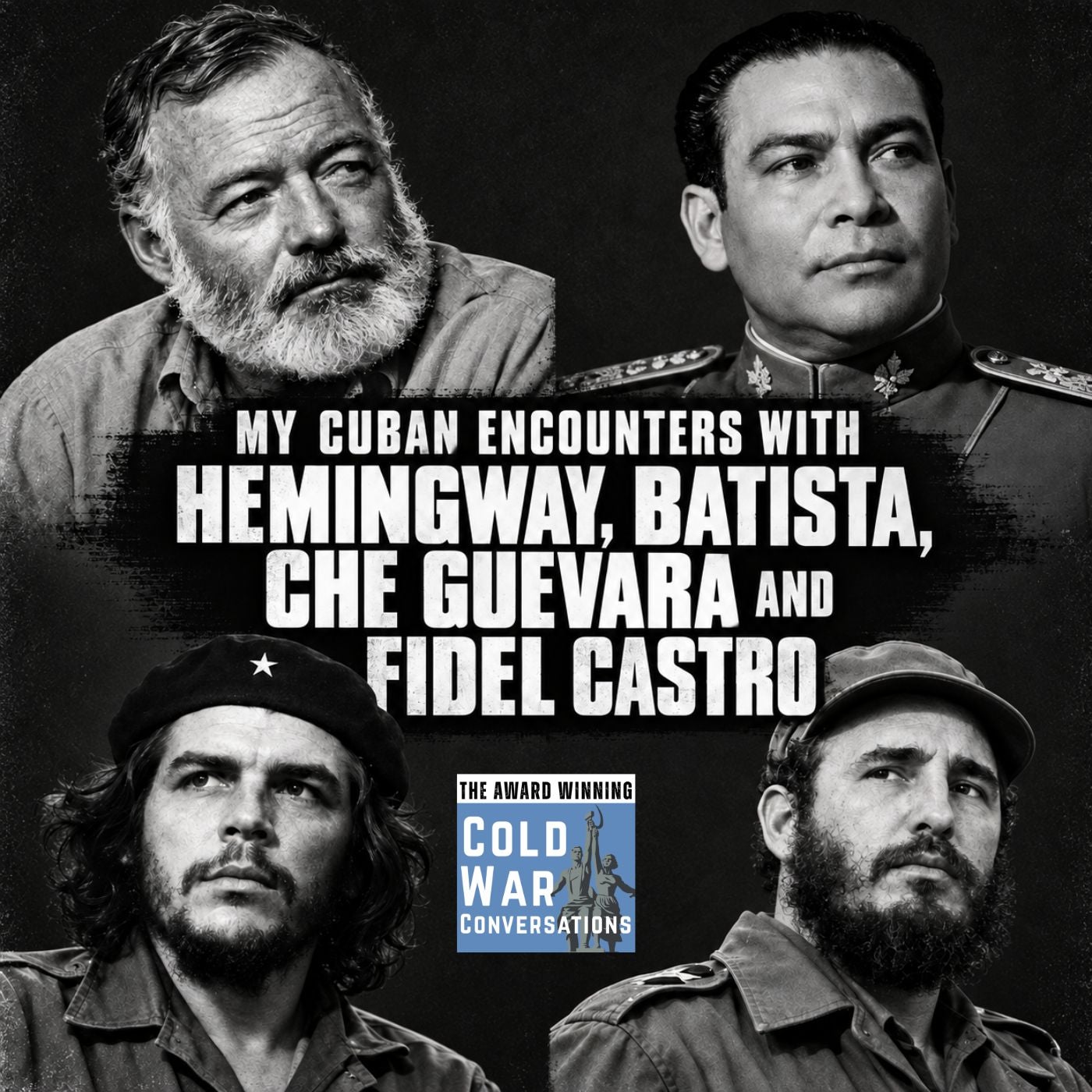
Peter Lamas recounts growing up in pre-revolutionary Havana and how political upheaval forced his family to flee Cuba, with personal encounters involving Ernest Hemingway, Fulgencio Batista, Che Guevara, and Fidel Castro.
Peter Lamas is a Cuban-born (born 1944) artist and author who later immigrated to New York after applying for asylum in the early 1960s. His father was a barber with elite clients in Batista’s government; Peter was a teenager during the revolution and exile.
Hemingway’s visit led to a near-casting opportunity for Peter in The Old Man and the Sea film; Batista’s regime employed his father, changing the family’s status and making them vulnerable after Castro’s takeover; Peter’s mother arranged escape paperwork via connections; Peter describes Castro as narcissistic and personally painful to meet after fleeing.
Hemingway’s cabin cruiser “Pilar” and a telescope view of Havana; Batista’s palace haircut/shave hiring; Che Guevara living across the street and inviting Peter to his home; Castro lunch at the Theresa Hotel in Harlem arranged by Peter’s uncle, Louis Rano (Castro’s Cubana Airlines pilot).
Written by AI. May contain mistakes.
Peter Lamas shares his stunning encounter with Che Guevara.
“The stylist who found the perfect outfit for your big interview.”
Peter Lamas shares his stunning encounter with Che Guevara.
“What happens when a Cuban teenager who has lost his homeland finds himself across the lunch table from Fidel Castro.”
Exploration of Peter Lamas's upbringing in pre-revolutionary Cuba.
Peter reflects on family, class, and his artistic influences in Cuba.
“I was born in Havana, Cuba in 1944, just before the war ended, World War II.”
Peter recounts his interactions with Ernest Hemingway and fishing outings.
“interest in beauty, interest and everything that had to do with art in general.”
An engaging story about a surprise visit to Hemingway's residence.
“And he took care of a cabin cruiser for Hemingway.”
Peter recalls his first impression of Hemingway as a child.
“And as we're getting, as we're passing the house, he stops and I can see this man that looked like Santa Claus to me.”
A deep reflection on the philosophical conversation with Hemingway.
“And so did my mom a little, you know, coffee.”
Peter discovers his family's connection to Hemingway's famous novel.
“And he started showing me Havana and being a, it was sort of like a philosophical experience for him and for me especially, and the way he described what I was looking at through the telescope.”
Learn about a missed opportunity to act in a film alongside Hollywood legends.
“I'm living in Cuba, so still everything is a little bit foreign to me.”
Discover the relationship between the speaker's father and Cuban dictator Batista.
“Now, tell me about your father and his work.”
Experience the traumatic events surrounding a revolutionary attack on Batista's palace.
“So our position changed immediately when he started working for that particular government.”
Explore the effects of Castro's rise to power on the speaker's family and community.
“Your family are still in Havana and there's a house opposite where your little brother goes over to play with the children there.”
Learn about the narrator's close friendship with Che Guevara during the Cuban Revolution.
“I said, do you know where you sent me to?”
Discover the narrator's mother's concerns about the Castro government and their plans for escape.
“Your parents are getting a bit nervous about their position in Cuba.”
Hear about the family's emotional journey as they leave Cuba for Miami under challenging circumstances.
“And she got a hold of my uncle and said, I want to start getting my paperwork ready to pay a tourist visit to Miami.”
Learn how the narrator adapted to life in New York City after fleeing Cuba and the challenges faced.
“And as I looked out the window, weeping, my mother grabs my face and points it to the front of the plane.”
Hear a touching story of kindness that shaped the narrator's early experiences.
“An amazing story, the kindness of strangers.”
An account of an uncomfortable lunch with Fidel Castro and reflections on his character.
“Peter, can you tell me how you happened to have lunch with Fidel Castro?”
Learn about the host's intimate experiences with Che Guevara and Fidel Castro during his time in Cuba.
“I found him to be totally, totally different than Castro.”
Learn about the host's intimate experiences with Che Guevara and Fidel Castro during his time in Cuba.
“You've reached us outside normal business hours.”

Get the gist, explore an idea or ask about something said.
 Claude
On Cold War Conversations, what are the key points of this episode?
Searching your listeningAutomatic transcript. May contain errors.
0:00Welcome to Cold War Conversations, the home of real stories of the Cold War. This episode is brought to you by Nordstrom. For 125 years, Nordstrom has been part of your story. The stylist who found the perfect outfit for your big interview. The first pair of walking shoes for your one-year-old. The tomato soup you shared with your sister at the cafe. These are the moments that make Nordstrom, Nordstrom. Big or small, we're here for all of it. celebrating 125 years with new moments still add. Discover it all in Nordstrom stores and at Nordstrom.com. Finding a doctor is hard enough. Finding the right doctor, even harder.
0:40Someone who takes your insurance, has an available appointment when you need one, and feels like someone you can actually open up to. That's where ZocDoc comes in. Download the ZocDoc app to search and compare doctors by specialty, insurance, and availability. Read real patient reviews, Find the right fit for you and book instantly. Because getting seen by the right doctor matters. ZocDoc. Ready to be seen? Download the ZocDoc app today.
1:06Peter Lamas: And he grabs me by the shoulder as I'm walking towards the door. And this is Che Guevara. And he didn't even introduce himself. He didn't have to. What happens when a Cuban teenager who has lost his homeland finds himself across the lunch table from Fidel Castro. Peter Lamas recalls an extraordinary childhood in pre-revolutionary Havana and a life touched by history. He describes meeting Ernest Hemingway, Cuban dictator Fulgencio Batista, Che Guevara and Fidel Castro. Political upheaval has forced his family to flee Cuba, leaving everything behind. Beginning again in New York with little money and no English, Peter found kindness in unexpected places, before a remarkable invitation brought him face-to-face with Castro, the man he blamed for uprooting his family in an unforgettable and deeply painful encounter.
2:14I'm delighted to welcome Peter Lamas to our Cold War conversation. the stories in this episode are from peter's book jackie kennedy's stylist there'll be links in the episode information for you to purchase the book and support the podcast i am today 82 years old so writing this book really was a quite an interesting experience going back in time
2:41Peter Lamas: I was born in Havana, Cuba in 1944, just before the war ended, World War II. And I grew up in a very interesting international ambiance because you had a lot of tourists from all over the world. I thought Cuba was the monocle of the West. It was very international. It was the largest island in the Caribbean, 90 miles away from the United States. Beautiful waters, beautiful beaches. And my parents were, we were, I don't want to say poor, but we were middle class, a little bit lower than middle class. My father was a barber. My mom would stay at home and she took up accounting eventually in school.
3:25And we lived with my grandmother and my aunt. It was a small family that I come from. I'm an only child. and one of
3:33Peter Lamas: members of my family and my mother's side had some money provided us with enabling me to go to a private school. It was quite interesting to meet a different class of people that I was used to growing up being and these were very affluent individuals so I felt out of place there but no matter what somehow with my interest in art interest in beauty, interest and everything that had to do with art in general. My mother, and I used to sit when I was very young, three, four, five years old, she collected magazines from all over the world and we would look at them together. So I got very interested in what was beyond Cuba in a way that she exposed through these magazines and books.
4:23And sort of this appetite for or travel or meeting people is throughout the book there's an amazing cast of characters um in here you get the opportunity to meet Ernest Hemingway oh my gosh that yes that out of all the chapters I wrote about there are two there that are my favorites starting with Hemingway because uh Gregorio Fuentes was Hemingway's captain in his fishing motorboat. It's not a yacht. It's like a cabin cruiser.
5:03Peter Lamas: And he took care of a cabin cruiser for Hemingway. He was an expert fisherman. He would take him out outside of the waters of Havana for marlin fishing. Hemingway loved marlin fishing. And they would spend sometimes two or three days out there fishing day and night for marlin. And so Gregorio Fuentes, being the captain of Hemingway and worked with Hemingway for over 20 years, I think he really knew him for about 30. And out of the 30, 22 years he spent being the captain of the Pilar. That was the name of the cabin cruiser that Hemingway owned. And he had it in Havana Harbor. They would go fishing.
5:46Now, Gregorio came one day and said to my parents, who we knew him well, He was a friend of my father's older brother, close friend.
5:54Peter Lamas: He says, I want to take you out for lunch, and then I'm going to take you, because my mother was dying to see where Hemingway lived. He lived right outside of Havana, not far from the city, but up in the hills. And he says, I know you've been dying to have a ride. We'll go, I'll take you for a ride around the Fica, and maybe we'll even go in and just show you around. And so my mother said, well, you know, if that's possible, but I don't want to, you know, get Mr. Hemingway, if he's there. upset. He says, no, he's there, but let's go for lunch. So we went for lunch to make the whole story short.
6:26Peter Lamas: We get into the car and go driving up to Hemingway's home. And as we approach the house, the tinca, as he called it, is a big complex with many acres of property, of land encompassing the tinca. And he says, let's go in. Let's go in. And he drove in. He was driving. He goes in and there's a big circular that goes around the front of the house and then it takes to the property inside their gardens and all kinds of different areas for planting and growing crops and things of that nature. It was almost like a farm, not really. And as we're getting, as we're passing the house, he stops and I can see this man that looked like Santa Claus to me.
7:09I was 12 years old. And he comes out with Bermuda shorts and a white shirt that looked like he
7:18Peter Lamas: slept in and rolled up sleeves and come down my friend what are you doing here and he says i just came to he called us family to bring my family just to see where you lived they wanted to go by and check it out and blah blah blah so he said no no no come on out come on right immediately so he forced that forced us out of the car and my daughter introduced my dad and his best friend my dad's older friend, Miguel, and my mom. And then as he was introducing me, he says to me, muchacho, what's your name? He didn't give Gregorio a chance to introduce me. He asked me immediately. And there was a bond that immediately happened.
7:58Peter Lamas: A connection, not a bond, a connection that happened that I couldn't understand, but he liked me. So I went along with him. I was a little bit of a shy, 12-year-old. And I knew I wasn't reading then at 12. I didn't know that the personality that was standing in front of me, I know it was as big as God in the world of literature, but at that age, I wasn't aware. And but I liked him. And he reminded me of Santa Claus. And so he says, come on out. Come on in. And we went in. My mom kind of resisted. He said, no, no, no, no, no. Come on in. Because we said we had lunch. with all that. I says, well, have drinks.
8:37My father loves to drink. And so did my mom a little, you know, coffee. She wouldn't drink liquor. And we met Mary, his wife, and we sat at his dining room table. And as we're sitting down, he asked me, what do you like? What's your interest
8:52Peter Lamas: at 12 years of age? What are you looking forward to? And I told him, I said, I'm an artist. I like to sculpt. I like to paint. I like to enjoy. He says, oh, my God. He says, come here. Let me, I have to show you, I have a number of dear friends that are very famous artists. Obviously, we know who they are without having to go into that explanation. And he says, yes, back in the 20s, I would hang in Paris out with the Passos and the Salvador Dali. And he's throwing these things out there that I didn't know really at 12 years old who they were. But I knew some of them. my new dolly, for instance, and he's showing me different artworks that he had hanging from these gifted artists.
9:33Peter Lamas: And I was I was that to me looks like, you know, an altar of paintings all around from these famous people that he gathered, combined with the animals that he had trophies hanging from the walls that he had hunted in Africa. And to me, I had a 12 year old seeing these animals hanging from the walls and between with the art. I was, it was psychedelic for me. I didn't know how to, what to, how to take it all in. And so then he took me outside to show me his cats because he loved, I told him I love cats. And he had like 20 cats. He collected cats. He loved cats. And we were walking around showing me his favorite cats.
10:15Peter Lamas: And as we walked, I see peacocks through the grounds. And to make it on his shoulder, I said, oh, I got to get up close. She says, no, no, no, don't. They can be they're beautiful to look at, but they can be very mean and cruel. So nevertheless, I didn't listen to him and went up close and one came running towards me to attack me. And I ran back to his arms and he says, I told you that beauty sometimes brings danger. And so I noticed this tower and this is the fun part of it all. I noticed this tower next to the house still there. and on the third floor is where his wife built the tower so he can have on the third floor arriving to be able to ride and without interruption even though he loved riding in his bedroom standing facing a wall as I discovered later on but we went up to the tower I see a telescope looking uh piercing through a window and Havana you can see right through that window the whole city lane out there and I said oh my god as I look out the window I said can I see is this a telescope?
11:19I knew what a telescope was kind of, but I never saw one in person. And so he brought a chair where he sat to write and finally the telescope had me, looked at me at 12 years old, holding me by the waist. I've been touched by Hemingway, man.
11:38And he started showing me Havana and being a, it was sort of like a philosophical experience for him and for me especially, and the way he described what I was looking at through the telescope. And I'll never forget, but Gregorio Fuentes, also my family's friend, I didn't discover it until a few years later when it was mandatory in high school to read the Hemingway's The Old Man and the Sea novel. And as I read the novel, it's based on Gregorio Fuentes'
12:12Peter Lamas: life the man who was dear close friend to my family who i've seen so often and i didn't realize that gregorios had that same experience when he was younger shared it with hemingway and that's what gained hemingway the idea to create the book the old man in the sea and you narrowly missed out on a starring role in the movie that was my shock to i'll never forget that you know, you have certain things in your lifetime that you will always remember, good or bad. And that was, I don't know if I classified as good or bad, but after reading the book, I came home to my mom. I said, you know, I guess it just dawned on me that we went to meet this, we met this man, Gregorio Fuentes, and this is his life.
12:58I did, why didn't you people tell me? I guess they did, but you know, at 12 or 13, you're kind of oblivious to what people communicate sometimes to you. And
13:07Peter Lamas: And so he explained to me, yes, that's Gregorio's life that Hemingway based this novel on. And I must share something with you. He says, I hope you won't be upset, but I have to be honest and truthful with you. Remember how close he became to you and how you and him navigated so well. The first day we met him, he took a liking to you. He came back after that long tour that he shared with you back to the room. And as he came back, he said to everybody, I found Manolini. Now, I heard Hemingway say that, but it never registered what he meant. And I went out to play with the cats and so forth. When he said, I found Manolini, Mary, his wife, said to him, you're talking about the character in the book, Manolini?
13:55He says, yes, I found the boy who I want Manolini to be, to play Manolini, this young man here, Pedrito. and so he turned around to my mom and dad and sat down for a little bit of time
14:07Peter Lamas: explained to him we're going to film the movie next year and I would like your son if that's possible to be in the movie I would insist on him at least for six months taking lessons to learn English and acting and I will be responsible for that and we will put all that together and then when the film begins it could be several months we don't know exactly yet and it will be mostly filmed here but he might have to fly to california or i forget what it was the whole detail was not as explicit to me but the idea was that he wanted me in the film and my mom turned around and after a few minutes of thinking he says i can't put my son through this i think it would be too much pressure for him he's a very sensitive boy and i just don't want to risk the having him become nervous upset and uh i don't know how he's going to react to all this when my mom told me that i said do you know what you did by turning it down i could have had my grandchildren watch the movie today and say that was your dad when he was 12 your granddad when he was that 12 also with my grandchildren so yes i missed out on the opportunity of working with but i did go see the movie being filmed and at that time i didn't know that my father my mother had turned it down so a year later legorio came and picked us up with my dad and his older brother and we went to the where they were shooting right behind moral castle in havana harbor and i got to see hollywood and all the equipments and and yes director's chair with this old man sitting there i didn't know who spencer tracy was at the time but i my father said He's a giant of a star in Hollywood.
15:56And I knew Hollywood. I've heard of it. I'm living in Cuba, so still everything is a little bit foreign to me. But there was Spencer Tracy, which I got to meet, the director, Hemingway. And we spent the whole day. They fed us. They made us comfortable. It took forever to see one scene or two being filmed because in movies, it doesn't happen, you know, one after the other. They cut and take breaks and so on. But I can say I watched part of The Old Man of the Sea being filmed in Havana, met Spencer Tracy, and discovered later on in my life, a few years later in high school, that I would have been in that particular segment of the film playing Manalim, the child.
16:41Incredible. Incredible. Now, tell me about your father and his work.
16:47Peter Lamas: My father was a barber and he had quite interesting contacts, people that were clients of his. And one of them happened to be the barber of Batista. And he was my father's client and became my father's friend. Fulgencio Batista was a Cuban military officer and dictator of Cuba, whose corrupt authoritarian rule was overthrown by Fidel Castro's 1959 revolution. they developed a quite an interesting friendship here he was older than my father he was like my father's mentor to some degree in his profession and he learned a lot from this man even though this man got his haircuts from my father he also taught him his own way of doing things and his secrets and so forth and my father learned a lot from him when it came to the profession of being a barber.
17:41Peter Lamas: My father was a true professional when it came to maintaining someone's appearance. And he recommended Batista to my father saying, I am retiring, but I have my replacement and I, please, I highly recommend him. And the people working with Batista, his secretaries and so forth, they asked them to have my father come meet them and they met my father. If you remember, if you look at these videos from way back, everybody dressed beautifully with suits and ties. Nobody was too casual. So he showed up with a beautiful, you know, suit and tie. And they liked him a lot. They put him through the test.
18:17Peter Lamas: They had one of the people in the palace where Batista operated from, the presidential palace, give him a haircut and a shave. And the man was very satisfied. So they hired him. It was not that complicated. That being said, my father started working not only on Batista almost on a daily basis, but also very important people around Batista and eventually these so-called colonels in general in the army and in the police force. So my dad started really connecting well with very influential individuals in government. And little by little, his clientele group, they provided excellent tip and rewards and and gifts and so on.
19:00So our position changed immediately when he started working for that particular government. And you came along to his workplace.
19:10Peter Lamas: He invited me a number of times to go and visit him. I had during vacation time when I was in school. And I was very close to my dad, so he asked permission and they said, I was very well behaved. There was a special room for barbering in the palace, very elegant beautifully done wood paneling and had everything that you can think of to need to groom a person and it was quite ample room so it was uh air-conditioned at the time and i love spending time with him watching him quietly there were magazines that i would read and keep him company and i people got to know me a little bit here and there and uh yes i got to meet batista at one point he when he walked in and he introduced himself and he says oh well behaves He told my dad, what a well-behaved son you have.
19:59Well, it's a pleasure. I shook his hand, sat down, and continued doing my thing with a magazine. And so I can say two or three times I did meet Batista in my experience. Not that I'm crazy about admitting that, but with his reputation.
20:16Peter Lamas: I remember one time my father going through a severe experience in 1957. I still remember March of 1957 when the palace was attacked in Havana by these so-called university students trying to overthrow and assassinate Batista while he was in the palace. And Castro was already gaining a lot of momentum in Cuba when he was in the Sierra Maestra mountains trying to overthrow Batista. And so I remember that incident. I wasn't there, but my dad came home and shared with us, after we saw it in the news on TV, what went down. And it was quite a traumatic experience for him because they shut down the palace and they all had to take refuge.
21:04And as he was allowed now to leave the palace, they asked him to leave through the back, not through the front, where all the horrific incident happened. But he came around as he was passing by and he sees the bodies of these young students all massacred and bleeding and dying in front of him. And it was quite a turmoil for him to experience this uprising revolution that started in March of 57. And from there on, it just grew until Castro took over in 59. Cold War history deserves to be remembered. and by listening to the next few adverts, you help us to do exactly that. Thank you. This episode is brought to you by Nordstrom.
21:50For 125 years, Nordstrom has been part of your story. The stylist who found the perfect outfit for your big interview. The first pair of walking shoes for your one-year-old. The tomato soup you shared with your sister at the cafe. These are the moments that make Nordstrom, Nordstrom. Big or small, we're here for all of it. celebrating 125 years with new moments still add. Discover it all in Nordstrom stores and at Nordstrom.com. At ZocDoc, we know you care about your health. You wouldn't do that early morning cardio if you didn't. So the fact that your annual physical is overdue just shows how hard it can be to get seen by a doctor.
22:28Sorry, that doctor's not a network. Press one for more options. You've reached us outside normal business hours. The next availability is in three months. ZocDoc makes finding the right doctor easy. Download the app and search by specialty, insurance and availability. Read real patient reviews, then book instantly. ZocDoc, ready to be seen? So January 1959, Castro seizes power. Your family are still in Havana and there's a house opposite where your little brother goes over to play with the children there. Can you just explain a little bit more as to whose house this is? it began that my father did well with working for the president and gaining enormous benefits from the clientele that he had that was very wealthy.
23:21My father wanted to be a jewelry designer as his second career, let's call it that. And he got tremendous support from some of the people in Batista's government to open up a small, fine jewelry store establishment right near the Tropicana Cabaret in Havana, which was the most glamorous of all. If you were a celebrity going to Havana, you would go to the Tropicana. It was the must because all the major stars from the United States would perform there. And my dad had an establishment there selling jewelry.
24:01Peter Lamas: He did quite well, so we were able to buy a condominium in this part of Havana. In fact, the person who recommended the condominium we bought was a senator client of my dad, who said, it's a beautiful building literally across the street from where I live. You should go check it out. My father did, loved it. We bought it. And later on, my aunt and uncle bought the floor above. So the family stayed together, not realizing that that senator who recommended my dad to take a look at the building lived across the street, abandoned his home, fleeing Cuba, when Castro in 1959 took over. He came into the city during the New Year's Eve celebrations of 59, and everybody that had a relatively important position in government of Batista took their belongings, their money, their whatever, and flew out of Cuba.
25:01And then the next day or two, as Castro was coming in, they were flying out. And that house was a major senator, important senator, with Batista's government,
25:12Peter Lamas: and he left it empty. Now, who's to know that after Castro came in a month or two later, we see soldiers standing guard outside of the home, literally across. I mean, I can take a stone and hit the house. That's how it pulls literally across the street from us, opposite. And I see all these soldiers. And my grandmother one day in that particular time period said to me, your cousin, not my brother, I'm an only child, but my younger cousin who was five years old, he says, he's playing with a neighbor's children that just moved in across the street. I said, who are they? There's soldiers out there constantly guarding.
25:52Peter Lamas: He says, I don't know. He must be in some kind of government position. I said, yeah, but that doesn't, there's about five soldiers out there. It looks like an important person. He says, I don't know. Just go pick him up. So as I left my home, crossed the street, and the guard said to me, I'll never forget one of the guards, stop right there. Where are you going? I said, I live here. My cousin is inside George, Toronto, and he's playing with the children inside. He says, stay right there. So he goes in, comes out. He says, he does this to me with his hands. Come on over. Come with me. And so I walked inside and he takes me to the end of the house where the big terrace patio is located.
26:35And the children are playing. There's about four or five children there. I still don't know who this couple is, who has children and blah, blah. So as I'm playing with the kids and then it was time for me to take my cousin back because it's almost dinner time. I'm walking back by myself in the hallway to the front entrance and I look in one of the rooms and I see this figure that my jaw threw out to the ground and it was a pretty obvious expression
27:05Peter Lamas: someone should have taken a photo of my expression because when I saw this figure and then this figure got off the desk where he was sitting and walks towards me and he says who is he your brother I said no no no that's my cousin George he says please he's welcome to come every day he gets along so well with the children my house is your house come as often as possible and he grabs me by the shoulder as i'm walking towards the door and this is shegevada and he didn't even introduce himself he didn't have to but he grabs me i've been touched by a number of major figures in history uh starting with Hemingway and now Che Guevara grabbing me by the shoulder, walking me to the front of the door.
27:51Peter Lamas: And as I walked down and across the street, I got home and I said to my grandma, I can't use the curse words that I use. I was surprised I used it with her, but she's family. I said, do you know where you sent me to? You know who's living there? She says, no, I don't know. It's a lovely couple with kids. I said, no, it's not a lovely couple with kids. It's more than that. And so I explained to her my experience. And from then on, I started, I said to my grandma, every time George goes across the street, I'm taking him and I'm picking him up. And I did. I did exactly that. I would walk in and eventually the guards got to know me, his wife got to know me well, and I would play with the children and he would come and join us and play.
28:34So I got to get to know him intimately in a way that nobody probably has ever in his family environment. And he would talk to me like any other person that would talk to me, not because he was shegabar. He went down to the level of the children, playing with them, playing with me. He knew I was about 16 at the time, and I looked
28:56Peter Lamas: even younger. So I gravitated to him, and he gravitated to me without realizing it. And we developed, we created a friendship. It was not an overwhelming friendship, but it was a friendship. I'm in his home. And sometimes he said, no, you're staying over for dinner. Make sure that go over there and tell your grandma that you and George are staying over. And so I would call her by the phone. I said, I'm not going over. I would dial the phone. I said, I'm staying over. So eventually my mom got concerned because here's where it all started changing. As that year went on from 59 to 60, it was a short time.
29:33If you realize when Castro took power and when we left in 1960. It was a matter of a year and not even. And so my mom said, I'm not comfortable. You go staying and participating so closely with Che Guevara and his family. I just don't feel, I'm not comfortable with this. And she says, please be careful. And also she was concerned because my father was Batista's barber. Nobody up to then ever said anything about that. And here I am with the enemy who could put my father in prison because of the association of having my dad become Batista's barber and all his cronies. And so mom just felt it's getting there.
30:23It's much too close, the ambiance that you're creating with our family and his family. But ambiance to me, my uncle Louis, which is my mother's sister's husband, was number one captain in Cubana Airlines. and when Castro took over, he wanted the best pilots from Cabana Airlines for him to use to fly all over the world. And my uncle became his number one choice. And at one point when I was in Che Guevara's home, somehow, I don't remember how it happened, but he says, oh, no, no, we're aware that even your uncle is Castro's pilot. And in my mind, I said, wow, how did you know that?
31:07Peter Lamas: I think they let me in and allowed me to become so close to the family because of the connection that if Castro chose my uncle, Lois, to fly him with his, trusting his life in his hands, he could trust our family as well. There was a connection there somehow that brought us all together to some degree. And so that was the story of me meeting Che Guevara. Your parents are getting a bit nervous about their position in Cuba. And so they speak to your uncle to see how they could escape. Can you just describe that period for you? My mother's very intuitive. I call her a psychic. And she said to me and my dad, I don't trust this government that just took over.
32:02Peter Lamas: I feel this is going to lead to socialism, eventually to communism, eventually to a dictatorship that we just got out of. And I don't want to repeat the same experience. I would like to leave the country only because I feel that my son, as she's talking to my dad in front of me, I want him to have an opportunity for a life that is meaningful and not be so stressed under the circumstances of what I'm seeing. And so my dad says, oh, what are you talking about? Everybody loves him. And I think he's going to be good for the country. And she says, don't be so naive. Pedro, my father's name, Pedro. I'm Pedrito, same name.
32:44and uh he says he says to him don't be so naive i am really being that serious i want to leave and if you don't leave i will take my son with me but we're leaving and i looked at her and i said
32:58Peter Lamas: to dad i said dad don't let this happen i love cuba my friends are there my life that's all i've known i've never traveled out of cuba so i know i knew there are other places out there that are very unique and beautiful and special, but I didn't know anything about except for Havana. And I didn't even leave Havana that much to go into the interior of Cuba. So that was my world. And my friends were all there and my schooling, so on and so forth. And I said to her, no, I'm not going. I'm staying with dad. She said, no, you're coming with me. And we're all going together. And that is it. And she got a hold of my uncle and said, I want to start getting my paperwork ready to pay a tourist visit to Miami.
33:44We're going to go there and we'll come up with an excuse to why we're going to Miami. And so my uncle filled her in on what's going on with the government in those days. You can't just leave Cuba now that easily. You have to have a good excuse and you're not allowed to take much. whatever's in your luggage it better be for the event that you're saying you're going to and don't have more than that like mementos and photographs and so on because then they're going to get suspicious and put and stop you from leaving and at that time they were doing that they were trying to keep the so-called citizens with fleeing Cuba because of the uncertainty with this new Castro government.
34:30So my uncle had a lot of connections. Now that he is flying on behalf of personal pilot of Castro, that elevated him in a certain position in that particular government that allowed him, because of who he is, to get permission for my mom and dad and myself to go to Miami for a wedding. And that was the excuse. We were going for a wedding. and coming right back. And my grandmother's there, my aunt's there. It's kind of like the whole family is leaving, just the three of us to go to the wedding. And they allowed that to happen. But, you know, me going through that experience before leaving was very emotionally traumatic.
35:16And I was quite upset and depressed and so on. And as I got onto that plane, and it wasn't easy getting onto that plane because I made one mistake. Hemingway had given me a fish to remember him by that he carved I still have it by the way and I wanted to take that fish with me and I put it in my pocket not in the luggage but in the luggage I put an envelope with some dirt from my garden in Cuba and I folded it and put it in there won't you know that they examined our luggage before getting on the plane and the immigration and they discovered this Emily says, what is this dirt in this envelope doing?
35:57Thank God for my uncle who was walking in with us. He says, oh, no, he loves to garden, and I don't know what's doing. He tried to make up an excuse that I'm a crazy teenager. Don't worry about that. And so because they started analyzing, wait a minute, he's taking a little bit of Cuba with them, if you really think about it. And so but we were able to get on, got on the plane. And as I looked out the window, weeping, my mother grabs my face and points it to the front of the plane. And my uncle is, by the way, captain of that airplane that he's taking us to Miami on. And she says, look over, your future is in front of you.
36:35And that's how it all ended when we left Kiba. And when you arrive in the U.S., you have got a relative who can give you some money. but you are relatively starting from nothing again in the U.S. We couldn't take hardly any money with us. When we arrived, we applied for asylum. In those days, you could do that. And we got our paperwork, our social security number, so forth. We had to stay for about three days achieving all this with the help of Cubans that were already there, helping the newcomers coming to the U.S. escape to Cuba. And while we were there, my father called my godfather, who lived in New York.
37:25He was a leading chef for the St. George Hotel in Brooklyn Heights. And my father said, we want to come to New York. My wife doesn't want to stay in Miami because she felt leaving Cuba, going to Miami, I was never going to pick up English the way I should. She says, there's too many Cubans here. Now they have signs we speak English in Miami. instead of the opposite. And so she got my father to call my godfather. He helped us send us money for a train ride, the three of us, going from Miami to New York to Pennsylvania Station.
38:02Peter Lamas: He took us in for about a week, and then eventually my dad got a job as a barber out in the Upper West Side of New York. My mom, who's an accountant, got a job in an accountant firm, and you don't need much English to do that. He was basically a bookkeeper, not even an accountant. And I just had to figure out what to do with my life because at the time, I think I was 17. We arrived in New York, and to me, New York was a whole different universe. We arrived in early September, and already I could see it was all buildings, you know, with nothing, no... flowers, no trees, hardly to see and speak up.
38:47And it was very, very dark and gray,
38:51Peter Lamas: because it was always cloudy and rainy for some reason in September when we arrived. And I was so depressed by the ambiance, by the surroundings. And we got to find an apartment in a brownstone up in the attic where the, in those days when it was erected, and it was in the late 1800s, people had servants. So we were living in the quarters of the servants, not very pretty, not very comfortable with old furniture that God knows how long it's been there, but it was very affordable. And we stayed there for quite a while until my father and mother were able to, you know, put together some money to find a better apartment to live in.
39:31And we stayed in Brooklyn Heights for quite a while, but that first experience was very depressing. And And when they went to work, I didn't know what to do because I wasn't going to school. I was supposed to, but I graduated high school. So here I am wondering, what am I going to do next? I wanted to go to the University of Havana when I was in Cuba, but never got a chance to do so. So I had to become, I became a messenger. New York is very easy, north and south, east and west. And you have streets and avenues. So I'm intelligent enough to figure all that out as a messenger. and that was my introduction to moving into new york city and expanding my life and creating my life from there there's a lovely story in the book of you meeting this elderly man on the brooklyn heights promenade can you tell me about saul and diane yes he was the one that stood out
40:23Peter Lamas: for me the most but i met a number you know when you get older and you are so-called retired you're in your 80s, even though I'm 82 right now, I don't see myself or think that way. But in those days, they would go to the promenade, which is the most beautiful view of New York City you can imagine, in Brooklyn Heights, facing downtown Manhattan. And they would sit in the park benches and feed the pigeons and read their paper or book and just stare at this beautiful skyline of New York. and a few of them, starting with Saul, started noticing that I had a Spanish-English dictionary that I was reading.
41:02Peter Lamas: And so they asked me in English, you know, are you learning to speak English? And I figured it out. You know, I would say, wait a minute, let me look. And they would laugh and be patient with me. And little by little, they took an interest in helping me. They would bring a pad and pencil and help me. And they taught me English. I learned English sitting in the trenches of the part with these older people who gave me the time of day and the love and the interest and patience to work with me to learn the English language. I will never, ever forget, or I am so grateful for these loving people that I met.
41:39Peter Lamas: And I got to know them eventually, as you said, later on. Then they had health challenges. In one case, I helped a man who was going through an attack and I had his address because he invited me to lunch one day and I kept his address and I ran over and I called his daughter to come with me because he was sitting in the parking lot wasn't far away and she was so thankful because she was able to get a wheelchair and bring him back home and then they took him to a hospital I didn't know if I saved his life or not but I know I did good by him and we continued that friendship for quite a while that was my My first experience in America.
42:15An amazing story, the kindness of strangers. Yes. It's time for a short break. These adverts help preserve more extraordinary Cold War stories. Thanks for listening and supporting our work. Starting or growing your own business can be intimidating and lonely at times. Your to-do list may feel endless with new tasks, and lists can easily begin to overrun your life. So finding the right tool that not only helps you out, but simplifies everything as a built-in business partner can be a game changer. For millions of businesses, that tool is Shopify. Shopify is the commerce platform behind millions of businesses around the world and 10 % of all e-commerce in the U.S., from household names like Gymshark, Rare Beauty, and Heinz, to brands just getting started.
43:03Shopify has hundreds of ready-to-use templates that can help you build a beautiful online store that matches your brand's style. And you can tackle all the important tasks in one place, from inventory to payments to analytics and more. No need to save multiple websites or try to figure out what platform is hosting the tool that you need. And if people haven't heard about your brand, you can get the word out like you have a marketing team behind you. With easy-to-run email and social media campaigns to reach customers wherever they're scrolling or strolling. Start your business today with the industry's best business partner, Shopify.
43:37and start hearing. Sign up for your$1 per month trial today at shopify.com slash realm. Go to shopify.com slash realm. That's shopify.com slash realm. This episode is brought to you by Nordstrom. For 125 years, Nordstrom has been part of your story. The stylist who found the perfect outfit for your big interview. The first pair of walking shoes for your one-year-old. the tomato soup you shared with your sister at the cafe. These are the moments that make Nordstrom, Nordstrom. Big or small, we're here for all of it. Celebrating 125 years with new moments still add. Discover it all in Nordstrom stores and at nordstrom.com.
44:24Peter, can you tell me how you happened to have lunch with Fidel Castro? We had just left Cuba, Ian, and right after arriving in New York City, where we decided to reside in Brooklyn Heights, we got a surprise visit from my uncle, Louis Rano, who
44:45Peter Lamas: is the number one Cubana Airlines pilot, Captain Cubana, Louis Rano. When Castro took power, he got the people at Cubana Airlines to recommend their best pilots because he was planning to do a lot of international traveling. And obviously, my uncle Louis was at the top of the list, and he recruited him. He trusted him. He was very impressed with his record. So he became Castro's personal airline pilot for Cubana Airlines. and one of the very first trips he took was to the United Nations in September. Anyway, we get a knock at the door and there was Uncle Louis standing there and he told us, obviously, he flew Castro to the United Nations.
45:33Peter Lamas: He was going to be here for a few days and he liked me a lot. He says, Peter, while I'm here, I want to see a few Broadway shows and I got two tickets for Camelot, which was the big hit on Broadway at the time. And this is my, the U.S. is a whole new adventure for me. I didn't know what to expect. I've never been to the U.S. before. And here I'm going to Broadway, which I've heard about. And so that was, I forget the day of the week it was, but he came to pick me up the following day to go to the theater. And it was a matinee show. So he said to me, let me pick you up around 1030, 11 o 'clock and we'll take off the mandate doesn't start until three but you know we're going to have lunch and so forth before and take a view of the city he knew the city he's been there before a number of times so uh he picked me up and he says on our way into the city manhattan he says i have to make a quick stop a quick stop by um the theresa hotel in harlem now i don't know where harlem is I've heard of Harlem.
46:41I think I've heard a lot of them. But he explained to me that he's going there because he has to pick up the itinerary for the, not the following day, but the day after, because they're leaving. And he explained to us already, I knew that he was there for the UN, Castro was getting the speech. So I said to him, wait a minute, where are you picking this up? He says, at the hotel where Castro's staying. And I said, I, you know, I've been through a lot, It still has my family, all of us together. When I hear that name Castro, it sends shivers up my spine. And it also makes me very angry, upset because of us having to leave my homeland, which I love so much, and my friends and our lives.
47:20So we went by subway and we got to 123th Street in Harlem and walk on 123th Street. It's a very famous street right next to the Apollo, famous Apollo Theater. is the Teresa Hotel. And so it was almost like a tour for me, wandering through Harlem, seeing the Apollo, and then walking into this rundown hotel, the only way I can describe it. And I said, what is he doing here? Why isn't he where all the other dignitaries stay near the UN in different hotels? And he says, well, we'll find out, because, you know, I'll be honest with you, I don't know that answer. We walk upstairs and I wasn't expecting to see Castro, obviously.
48:09So he just went to pick up this manila envelope with all the information he needed. And as we walked in, they said, oh, el comandante, meaning the commander wants to see you upstairs. And we walk upstairs because the elevators were not working up. We walk up two flights of stairs. He took over almost the entire hotel with his entourage, and he wanted to for security reasons. That's why he probably also chose that hotel for a number of reasons, which I'll share with you in a minute. So we walk up to the second floor where we were told that he would be, and as we enter this very large room, it looked like a conference room.
48:55There was a lot of people there, and I could see him immediately. He stood out. and my uncle Louis told whoever was at the door, I'm here, the commander wants to see me and he escorted him to Castro and Castro already knew him, obviously. He flew on the plane with him and became very, tried to become very intimate with him from that friendly point of view. And so he started to my uncle Louis and he looked at me, he says, who's he? And he says, that's my nephew. He didn't say we just arrived, we escaped Cuba. None of that, he didn't want to go into that. And he told me that, by the way, before entering the hotel.
49:29do not divulge anything so we walked in and he says does he speak Spanish he says yes of course you can talk to him in Spanish I guess he figured oh he's living here he must be he spoke English only whatever but so I followed his orders and directions of not saying anything admitting anything and I spoke to him briefly he introduced himself and nice to meet you welcome to our humble gathering here and blah, blah, blah. So they're talking, and then he turns around and he says, I'd like to invite both of you for lunch. Have you had lunch? Where are you going? He says, well, I have a matinee. We're going to see Camelot on Broadway.
50:10He says, oh, let me tell you, I would love to go to Broadway, but they haven't invited me. All these dignitaries get free invitations to go see Broadway plays with limo service and all that, and I've been ignored. He started kind of protesting about how they're treating him. And I discovered later from my uncle, he says, that's a lot of BS. But nevertheless, he was kind of, you know, making up trying to make a point of how he is not welcomed in the U.S. So we go to lunch and my uncle says, well, we don't have too much time. It's at three o 'clock. But yes, it's now like 1145. So it wasn't that late.
50:49And we sat down at a area on the same second floor, but to the right side. It's sort of like a little private dining room near the kitchen.
50:59Peter Lamas: And he started talking to my uncle and to me in Spanish, obviously, what he was doing there, how he felt about the way the U.S. is treating Cuba and him personally with the revolutionary movement. And I deep inside, I can't repeat on air what I felt and what I was thinking because it's quite repulsive, to say the least. and I shouldn't want to go there. But I was very upset, almost to the point of crying, that I couldn't believe I found myself in the presence of a man that I so greatly disliked, who had really changed all of my life and my family's life to the point that it was very hard for us coming here with no money, leaving everything behind.
51:49And there he is complaining about how the world is treating him and how he feels, you know, insulted, neglected, and all of the things that he was sharing with us. And I was that much away, even though I'm turning 18, but I'm intelligent enough to be able to communicate with him my feelings with anger, but without going overboard. But I said, no, out of the respect and consideration for my uncle, I'm just going to be silent. And I barely ate the food because I was choking on the food that he was giving us to eat and keeping him company. And that lasted a good hour, almost hour and a half, where my uncle said, we really need to leave now, Comandante, because it's getting, you know, we don't want to run into traffic and it's hard getting around the city.
52:43And he let us go. But I just recall that incident to this day to be so uncomfortable, so painful and insulting at the same time. I don't like to carry hate in me. I don't believe in that. But you go through a very traumatic experience in your life, especially at a young age. And you don't know, you're not mature enough to, what's the word, analyze your emotions that easily. Even when you, as an adult, it becomes challenging. But as a young person, you're not really equipped to do that as well. And I left that hotel in tears. And my uncle tried to calm me down. And he says, look, I'm sorry I shouldn't have brought you here, but I had no choice.
53:28And he says, so he said to him, but you realize the food we ate, he has a chef.
53:35Peter Lamas: He was sharing with me, trying to distract me. The chef has to go out. one of the reasons he picked Harlem, because he wants his chef to go out, not around Harlem, but outside and shop for all the different foods with his two assistants to carry back to the hotel because he's afraid of being poisoned by the CIA. So he takes every precaution to avoid the chance of the CIA having an easy time picking him out. And the CIA has been trying since he came into power and as we're walking through the streets i i couldn't get out of my mind the experience i had sitting with a man eating lunch face to face having to shake his hand which i at first i wanted to reduce but again consideration for my uncle louis i said no just swallow your pride and do what you have to do but uh it was a very challenging time and in hearing his conversation, I'm a good listener.
54:38I take pride in saying this because I do. Even my wife said to me, you know, most men filter their wife's comments. And she says, you're one of the rare animals that really pay attention when I'm telling you something and you don't ignore me or filter the comments, the statements that I'm trying to bring across to you.
55:01Peter Lamas: And I did pay attention to what he was saying carefully because I wanted to make sure that everything I felt had validity in the way this man is communicating to us. And I saw that behind the appearance and behind the so-called I'm doing good for the country, there was a big ego, an enormous ego, and a narcissistic ego behind this personality. And that was the first time, I don't think, in that 1960, narcissism was recognized as well as it is today. But I didn't give it a name, but I realized it's all about him. and that really left a a bad taste in my mouth because you have hurt so many people and you are so clueless to the damage you've caused thinking that you can liberate Cuba from a dictator when you are coming in and you're no better than the man we he just got rid of I met Che Guevara many times before leaving Cuba and he was different even though they were in the same two peas in a pod as the saying goes I liked him there was something genuine and authentic about that man there is also a dark side to him that I've read about but when I was there at the time conversing with him, getting to know him I lived literally across the street from him And for the reasons I shared with you earlier, I got to go into his home and really got to know him well.
56:46I found him to be totally, totally different than Castro. Castro was a narcissist and he worried on his sleeve and you could tell. And so that's been my experience basically with Castro. When you were at that lunch with him, did he try and engage you in conversation? He was curious about me. He's not stupid, not whatsoever, because my Spanish was perfect. Never spoke to me in English. If he wanted to trick me, he should have spoken English because he knows how to speak English. So he never went to that degree. But, yeah, he was curious, but I'm not that important to him. So I don't think he was wanting to know what is all about, Alfie, with you, as the saying goes.
57:39And I was careful because I was protecting my Uncle Louis. I didn't want to, in any way possible, make it challenging, dangerous for him. Yeah, no, completely uncertain. After all, he had been the person who'd managed to get you out. Get me out to begin with, yes. He took a lot of risks. That must, yeah, a lot of risks. A lot of risks.
58:03Peter Lamas: Did Castro know anything more? I think he knows everything. That man, nothing escaped him, but I wasn't that important. And he had other agendas while he was there in New York at the UN. And he liked my Uncle Louis. He generally liked my Uncle Louis. And so he invited us for lunch. And that is one experience I'll never forget, being that close, intimate with this so-called international figure. Him and both Che Guevara. don't miss next week's episode where Peter becomes the stylist to none other than Jacqueline Kennedy and she reveals to him her thoughts around her husband's assassination in Dallas in 1963 the stories in this episode are from Peter's book Jackie Kennedy's stylist there'll be links in the episode information for you to purchase the book and support the podcast want to learn more about this episode don't miss the extras such as curated videos photos and other content just look for the link in the episode information special thanks to the generous efforts of our financial supporters who keep the show on the air if you'd like to join this select band go to coldwarconversations.com slash donate the cold war conversation continues in our facebook discussion group just search for Cold War Conversations on Facebook.
59:33Thanks very much for listening and see you next week.
1:00:01Press 1 for more options. You've reached us outside normal business hours. The next availability is in three months. But ZocDoc makes finding the right doctor easy. Download the app and search by specialty, insurance, and availability. Read real patient reviews, then book instantly. ZocDoc, ready to be seen? Kelly Clarkson here with Wayfair. I know holiday magic starts at home, and Wayfair makes it easy. They have everything from Christmas trees and mantle decor to outdoor lighting and inflatables that I'll use year after year. Head to Wayfair.com today. Wayfair, every style, every home.
What happens when a Cuban teenager who has lost his homeland finds himself sitting across the lunch table from Fidel Castro?
Peter Lamas recalls an extraordinary childhood in pre-revolutionary Havana and a life touched by history. He describes meeting Ernest Hemingway, Cuban dictator Fulgencio Batista, Che Guevara and Fidel Castro.
Political upheaval forced his family to flee Cuba, leaving everything behind. Beginning again in New York with little money and no English, Peter found kindness in unexpected places—before a remarkable invitation brought him face-to-face with Castro, the man he blamed for uprooting his family, in an unforgettable and deeply painful encounter.
Buy the book and support the podcast here https://amzn.to/4xKDoGE
Curated episode extras https://coldwarconversations.com/episode477
Help me preserve Cold War history via a simple monthly donation,.
You’ll become part of our community, get ad-free episodes, receive a sought-after CWC coaster as a thank-you, and bask in thewarm glow of knowing you are helping to preserve Cold War history.
Just go to https://coldwarconversations.com/donate/
If a monthly contribution is not your cup of tea, we also welcome one-off tips via the same link.
Find the ideal gift for the Cold War enthusiast in your
life! Just go to https://coldwarconversations.com/store/
CONTINUE THE COLD WAR
CONVERSATION
o BlueSky https://bsky.app/profile/coldwarpod.bsky.social
o Threads https://www.threads.net/@coldwarconversations
o Twitter/X https://twitter.com/ColdWarPod
o Facebook https://www.facebook.com/groups/coldwarpod/
o Instagram https://www.instagram.com/coldwarconversations/
o Youtube https://youtube.com/@ColdWarConversations
Learn more about your ad choices. Visit podcastchoices.com/adchoices