Ask ChatGPT


 Decouple
23 Oct 2026 · 1h 15m · 22 chapters
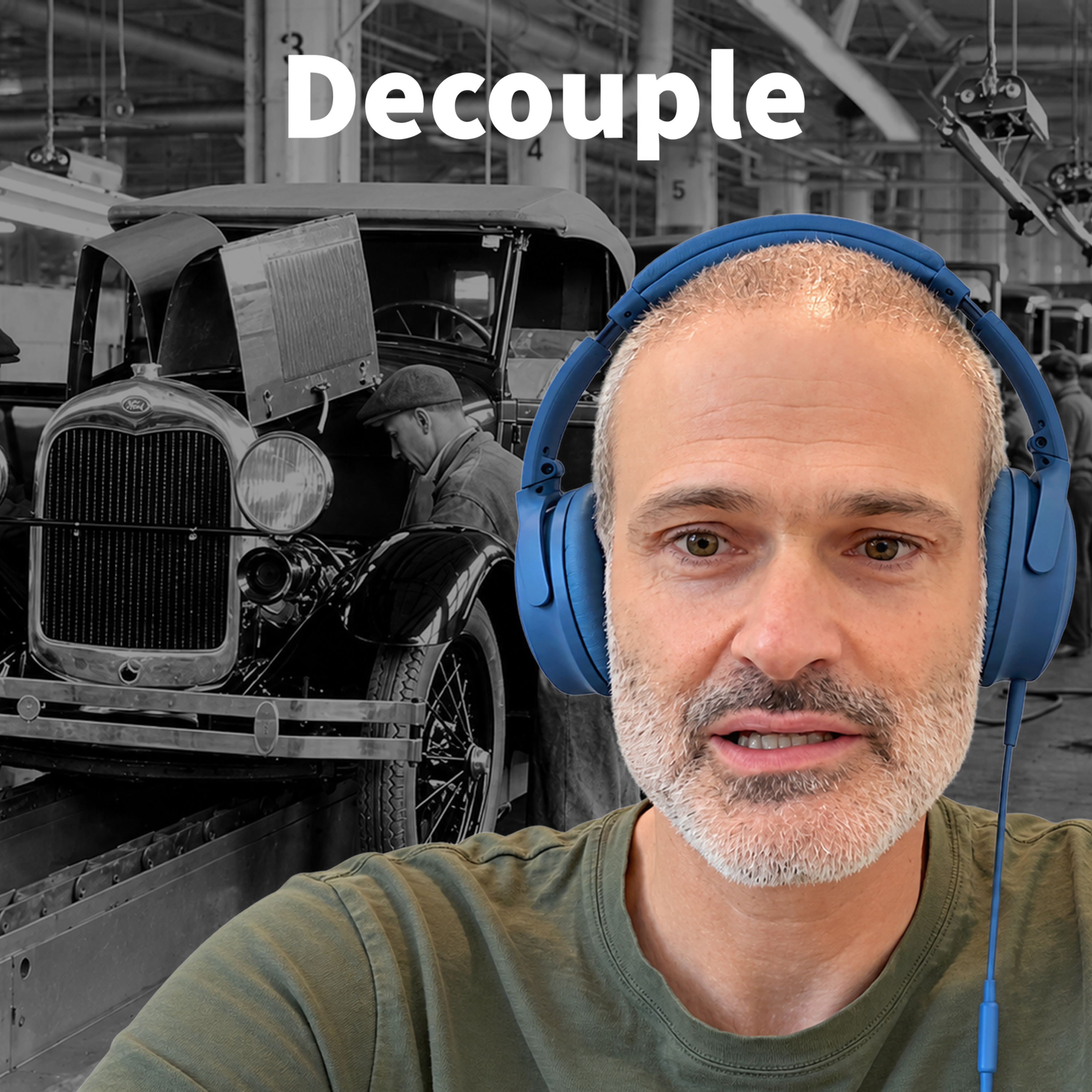
How Henry Ford’s mass-production system—built by sequencing work like Chicago stockyards and applying it comprehensively to Model T production—became a global industrial template, then a strategic weapon. The episode links U.S. productivity, labor organization, and open technology transfer to Soviet and Nazi industrialization, culminating in World War II “war of the factories” dynamics.
Stefan Link is an associate professor of history at Dartmouth, specializing in global political economy and capitalism. His award-winning book Forging Global Fortism argues American mass production shaped both Soviet and Nazi industrialization.
Pre-Ford cars were workshop craft goods for the rich; Ford targeted mass customers (especially Midwestern farmers) and used assembly lines to make complex products with unskilled labor. The “$5 a day” wage and an 8-hour day reduced turnover and stabilized immigrant labor. Ford’s “producer” ideology and ghostwritten books (via Samuel Crowther) appealed to European anti-liberal right thinkers, while Soviet engineers read them for production know-how. Ford transferred technology openly (patents without enforcement; tours; no royalties) because he treated innovation as a public good and because U.S. national-security policy hadn’t yet focused on tech transfer.
Ford’s Highland Park/Model T sequencing “nailed down” by 1913; River Rouge as a blueprint; 1929 Ford-Soviet tech agreement with Soviet engineers on-site for years; German engineers recruited for Volkswagen; Soviets learned more effectively by sending their own engineers to Detroit than hiring Western experts.
Written by AI. May contain mistakes.
Learn how Ford's assembly line transformed automobile production.
“The idea came to us in a kind of more or less loose fashion from the stockyards in Chicago.”
Explore the background of industrial policy and its global context.
“But I think maybe I'm becoming more of a prime mover maximalist.”
Examine the disparities in motorized vehicle production in the 1920s.
“I did a lot of research at the Ford Motor Company archives in Dearborn, which is really a wonderful place.”
Understand how automobile manufacturing changed from craft to mass production.
“this survey that was done, I believe, in 1927, looking at the numbers of motorized vehicles in a variety of countries around the world.”
Discover Ford's vision to make automobiles accessible to the masses.
“So not the kind of Midwest that we associate now with the automobile industry.”
Learn about the sequencing operations and assembly line methods introduced by Ford.
“And then they start experimenting with these sequencing operations, assembly line operations, which were really nothing new, if you want, in terms of industrial organization.”
Learn how Ford's assembly line redefined production and labor.
“He says as much, he says, The idea came to us in a kind of more or less loose fashion from the stockyards in Chicago.”
Explore the harsh realities of assembly line work and Ford's innovative pay strategy.
“And if you want, the secret sauce of the assembly line process is that it makes a lack of skill almost into a productive resource.”
Understand Ford's unique approach to capitalism and its global impact.
“And the company may help you gain citizenship, kind of maybe a path to upward mobility.”
Explore Henry Ford's unique capitalist philosophy and its implications on production.
“Everybody's looking at America and going like, what is happening here?”
Learn how to support the Decouple podcast and its mission.
“If Decouple provides you with energy literacy on demand, please consider supporting it.”
Discuss how Ford's ideology attracted both Nazi and Soviet interest.
“So, you know, it feels like the, not just the paradigm, but the kind of religious mantra of modern capitalism is the role of the corporation is to maximize returns for shareholders.”
Explore how Ford’s open source approach to innovation shaped technological advancements.
“So the open source stance of Ford is, and this is not nearly as well known or understood as it really should be, is part of this producer populist philosophy.”
Understand the historical context of American technology transfers to the Soviets and their implications.
“There's a whole literature out there in institutionalism, which insists that, in fact, very kind of solid intellectual property rights are indispensable for innovation.”
Analyze the financial outcomes of Ford's technology transfers with the Soviets and their economic effects.
“You know, Ford was famously a peace activist trying to stop World War I in its tracks rather unsuccessfully.”
Examine the role of technology transfers in the World War II context and their impact on production.
“why he thinks, you know, he has these kooky ideas, a car made out of soy.”
Delve into the differences between Soviet and German approaches to technology and production during WWII.
“I think this is important to understand generally about the process of technology transfer.”
Explore the contrasting approaches of Germany and the Soviet Union in wartime production.
“There's a lot of foot-dragging resistance.”
Discuss the complexities of technology transfer in China's industrialization efforts.
“And, you know, I'm struck by modern day China.”
Learn about the implications of historical tech transfer for U.S. manufacturing policy today.
“It depends on the technological ecosystem.”
Learn about the importance of consistent industrial policy for technological revolutions.
“The infrastructure rollout, you know, it's clear there is an understanding that, yes, if this is supposed to work, you need charging stations.”
Discover Stefan Link's exploration of the global impact of the Great Depression on industrialization.
“And so, you know, what the actionable lessons are, I don't know, I'm a historian, not a policymaker, luckily.”

Get the gist, explore an idea or ask about something said.
 Claude
On Decouple, what are the key points of this episode?
Searching your listeningAutomatic transcript. May contain errors.
0:00The idea came to us in a kind of more or less loose fashion from the stockyards in Chicago. Sequencing breaks up all sorts of spatial and operational problems. What the revolution was, was that Ford and his engineers started applying this exhaustively and comprehensively to the entire production process of the automobile. So to a particular good that was more complex than the carcasses of hogs or, say, the operation of canning or, say, the mass production of textiles, this kind of stuff that had been mass-produced before, that was really the revolution. And it took them a long time, really up until 1913, to really nail this down for the Model T production at Highland Park.
0:43A warm welcome back to Decouple. Today I'm joined by Stéphane Link. Dr. Link is an associate professor of history at Dartmouth and a historian of global political economy and capitalism. His award-winning book, Forging Global Fortism, tells the remarkable story of how American mass production became a model for both Soviet and Nazi industrialization and ultimately a weapon in the contest for 20th century industrial power. Stefan, it's a pleasure to have you on the podcast. I'm a little ashamed I didn't come across your work earlier because it's a 10 out of 10 in terms of the interest we have on this show.
1:15Great. Wonderful to be here. So, Stefan, before we dive in too much further, what really jumped out at me reading your book, and again, I have to credit one of my listeners for bringing it to my attention, was I think a lot about productivity revolutions. You know, I've gravitated through, I think, being an energy maximalist, you know, really coming to terms with the extraordinary abundance that's resulted from humanity's successive exploitation of increasingly energy-dense energy sources, the miracle of, you know, fossil fuels. But I think maybe I'm becoming more of a prime mover maximalist. One of my guests talked about Alexander the Great and his great conquests of Asia coming across the oil seepages in Kirkuk.
2:02But of course, he didn't have diesel engines to put them in and mechanized armor to go and smite his enemies with. So it was a kind of a curiosity or Greek fire. But maybe after reading your book, I'm becoming a manufacturing maximalist. because it strikes me in reading your book that you're documenting probably one of the greatest productivity revolutions that humanity has ever seen, and that is in the form of Ford's assembly line manufacturing. So before we dive into all that, give us a little bit more about yourself, your background, why you came to find this topic as interesting or more interesting than I do.
2:41Sure. So as you said, I'm a college professor. I teach at Dartmouth in New Hampshire, and what I teach is economic history. So my undergrads come to classes that I teach. I teach one global economic history survey since 1800. That's usually a very popular class. I teach a class on the global 1930s, so the global Great Depression. So my work is mostly, you know, 20th century history of international political economy. And it is within this broader topic that, you know, I came to the book. Really, you know, when I started writing the book, it took quite a long time to write. But when I started writing the book, I got interested in industrial policy essentially before it became all the rage.
3:38And I wanted to understand how this worked in a kind of global context, in a technology transfer context. How do we get to a place that the automobile industry, which was, you know, obviously the original internal combustion engine technology was not innovated in the United States, but the mass production of these things was innovated in the United States. And the United States was so far ahead in the 1920s. And how do we get to a world where this technological revolution spreads worldwide? And I came to discover that it has to do a lot, actually, with that particular time in the interwar years, the 1920s and 30s.
4:30And that war in particular, actually, made a big difference in spreading this technology abroad. So that's what the book is about. And it took me into very interesting and very different places. I did a lot of research at the Ford Motor Company archives in Dearborn, which is really a wonderful place. I also did research in Russian archives, in Russian regional archives in Nizhny Novgorod, which is, you know, Nizhny Novgorod, formerly Gorky, was Gorky under the Soviet Union, which is the home of the big automobile factory that the Soviets, you know, built essentially on the model of Ford's River Rouge.
5:14I dug into Volkswagen files. I dug into, you know, it required tracking down files from General Motors that are not easily accessible about what they did in the 1930s in Germany. So it was a great research journey. And from that emerged, you know, a kind of remarkable story that then as I was writing it, you know, and actually since it's been published, I'm discovering more and more has remarkable resonances for our time today in terms of the politics of technology transfer, the geopolitics of technology transfer. I guess. You mentioned this kind of enormous disparity that existed in the 1920s.
5:58I think the the fact to name sort of one set of numbers or stats that jumped out at me from your book was this survey that was done, I believe, in 1927, looking at the numbers of motorized vehicles in a variety of countries around the world. The Soviet Union, I think 18 ,000. Poland, something around that number. Argentina was doing fairly well, I think 80 to 100 ,000. So you're hearing these kinds of numbers in the tens of thousands. And then you swing your attention over to the U S and it's 22 million. And I had to check, is that a, did Stefan get this wrong by an order of magnitude? Cause this just sounds completely bonkers.
6:31I think the population of the U S was something like 150 million at that point. So, um, I think that was, you know, all sort of registered motorized vehicles. But when you think about, you know, what a vehicle does, particularly compared to replacing horses, you know, for instance, in drafts, agriculture, or just human mobility, it's bonkers. You think about a modern combine harvester, and that's not what's being banged out in the 20s, but you're doing the work of 1 ,000-plus individual human beings with one farmer and one machine. So in terms of that earlier statement I had about this being perhaps the greatest productivity revolution and my progression through energy maximalism to prime mover maximalism to manufacturing maximalism, correct, the ice engine, the auto cycle or diesel cycle engine, these are German inventions.
7:14but what you talk about is that these are pretty boutique these are sort of luxury vehicles until Ford gets around to mass manufacturing them so I'm wondering if you can build off of that diatribe slightly by giving a sense of just what what manufacturing looked like before Ford what what was this revolution that introduced what exactly did he do on the shop floor to make something as complex as an automobile you know that if we if we hit 300 ,000 kilometers on our cars, which supposedly they're capable of, that's eight times around the world. You know, those are now consumer products that we all sort of have.
7:46So what did the shop floor look like pre and post Ford? When Americans started building automobiles, this was in the 1890s, this was workshop work, craft work, and, you know, small workshops that were run by skilled mechanics, combined various operations, upholstery, metalwork, engine building, located New York, upstate, places like Rochester, Buffalo, but even down in Pennsylvania. So not the kind of Midwest that we associate now with the automobile industry. And this being craftwork, the kind of automobiles that were put out were also expensive. They were not designed or anybody meant them to be a kind of mass consumer good.
8:32They were essentially, you know, a kind of new kind of gadget for the rich. You don't need a horse anymore. You can drive yourself. And in a little twist that I'm sure many of your listeners are familiar with, a lot of these were actually early electric vehicles, right? The East Coast built electric vehicles based on fairly new battery technology, taking advantage of the electricity revolution that was going on at the same time. And so these workshops, you imagine them, you know, were small. You would have maybe two or three automobiles being built at the same time, very inefficient. I mean, these were nice models, right, but expensive.
9:12And so only a few people could afford them. And what the Midwestern designers and mechanics figured out, and this is where this interesting culture of innovation of the Midwest comes in, they were dissatisfied with the idea that this great new technology, which would replace the horse, you know, the fruits of that would only redound essentially to the better off, a typical kind of, you know, sort of populist middle-class stance. And this is really where Ford comes out of. And so Ford wasn't the only one. He succeeded the most resoundingly. But the idea was, we're going to build this for the masses.
9:55And that means it needs to be, there needs to be more of them. We need to be able to build more in, you know, more quickly. it needs to be cheaper, it needs to be more efficient. And also, this is very interesting historically, the Midwestern mechanics said, we don't want these electric vehicles, we're going to use the ice engines, because the kind of electric vehicles had a little bit of, you know the way that they were they were perceived was as more like the upper class thing so the the internal combustion engine was uh was the one that was uh built built for the masses and you know where did ford uh get this who did he think uh should uh you know was going to buy and use these new more inexpensive vehicles so who were the first mass customers of the model tea.
10:53It was the farmers, of course. It was not the rich urbanites from the East. It was the farmers, the Midwestern farmers, who were, if you want, the other constituency of this kind of dense Midwestern agro-industrial landscape. This was very interesting, actually, at the time that had emerged by the late 19th century, in which there were these middling cities throughout the Midwest, surrounded by very productive commercial farms. In the first decade of the 20th century, farmers had a fairly good time. It was a period of rising prices. So there was growth and expansion and they could afford more.
11:33And here again, if you want the political sensibility of this entire region and of this era was populist. This late 19th century populism, you know, very different from our kind of 21st century variety. society and it was a kind of producer populism in which it didn't matter if you were a farmer or a mechanic one could easily you know start out as a farmer and then become a mechanic more or less self-taught this was indeed exactly Ford's story he came from the farm became a self-taught mechanic and you know built the first mass production auto incorporation was exactly Ford's background you were a producer you could be a farmer or a mechanic the people that you profoundly disliked were the big railroads because they would gouge you on freight rates.
12:23It was the financiers out east. It was the stockholders who often would have this pesky habit of imposing their own ideas onto, they didn't know the workshop, but they would have their own ideas about what should be produced and how mechanics can stand that. This is sort of Ford's milieu, if you want the intellectual and political horizon. And this is where the idea of the mass-produced automobile for the masses comes from. And this was indeed so successful that the Ford Motor Company started producing behind demand really pretty much immediately after its founding in 1903, which pushed the production process in a direction as Ford and his engineers, what they tried to solve was the problem of how do we make more of this more quickly, more efficiently?
13:24And then they start experimenting with these sequencing operations, assembly line operations, which were really nothing new, if you want, in terms of industrial organization. You know, the canneries had used kind of assembly line methods. You know, the stockyards in Chicago used a kind of system called the disassembly line. You can imagine the carcasses of hogs or the cows, you know, moving from one station to the other. And Ford actually says as much, you know, in his kind of reminiscence is ghostwritten. but fairly well-reflective, actually, of some of the thought processes and the history. He says as much, he says, The idea came to us in a kind of more or less loose fashion from the stockyards in Chicago.
14:14And it's actually a very common-sense idea, right? Sequencing breaks up all sorts of spatial and operational problems. if you've moved house and called over friends and arranged them in a line and everybody hands a box to the person next to them from the house to the truck, that's a type of sequencing operation. It's very common sense. You don't have to be a kind of genius to come up with that. What the revolution was was that Ford and his engineers started applying this exhaustively and comprehensively to the entire production process of the automobile. So to a good, a particular good that was more complex than, well, you know, the carcasses of hogs or, say, the operation of canning or, say, the mass production of textiles, this kind of stuff that had been mass produced before, that was really the revolution.
15:11And it took them a long time, you know, really up until 1913, So almost a decade to really nail this down for the then Model T production at Highland Park. The entire process is extremely fascinating and is well documented. If you go to the Ford archives in the 1950s, researchers sat down with all the veterans from Ford's early days and interviewed them about this, how this happened. They described this very vividly as a trial and error process. You can still tell that they're extremely proud of what they did back then. And by the way, all of these reminiscences, if any of your listeners are interested, are online, accessible online.
15:53If you go to the website of the Henry Ford, fascinating, fascinating reading. And this solved the productivity problem. To solve the productivity problem through sequencing, first of all, you know, Ford says somewhere, we began, like everyone else, building automobiles like you would build a house. You have the product stationary and you bring the materials to it and construct it up. The sequencing paradigm, the product moves and the workers are stationary, right? It inverts the logic. And this has all sorts of consequences. Spatially, you know, this transforms the way factories are laid out. It's, you know, they used to have several floors, even Ford's initial Highland Park factory had several floors.
16:39River Rouge is one gigantic ground floor. You can imagine why. You know, this comes out of sequencing. Sequencing also has the consequence that obviously you break down the operations into this minus, every step of the way is a minuscule operation. That means you specialize, you specialize machinery. And that kind of induces a leap in machine tool building. So these fairly modest, effective but modest, multipurpose machine tools, a lathe, a drilling machine that used to populate the workshops of, say, the carriage makers or the bicycle makers, were now replaced, and Ford leads the way here, by these immensely productive and very expensive, powerful, special-purpose machine tools.
17:28The big example is, you know, a kind of a multiple drilling operation for the engine block that did this in 90 seconds. That was something that Ford rolled out in 1913. And it also has the consequence that every step of the way, you know, these are sometimes, sometimes you use these big machines, but a lot is a fairly simple process done by hand. And this is where the mobilization of unskilled labor comes in. So you needed a lot of workers to produce all of these automobiles. And if you want, the secret sauce of the assembly line process is that it makes a lack of skill almost into a productive resource.
18:13So, you know, where did Ford find the workers for the Highland Park factory and River Rouge? These were the immigrants of the time. The 1900s, the first decade of the 20th century was, you know, the first big wave of U.S. in migration, especially from Europe, Eastern Europe, Southern Europe. These were often people, you know, fresh off the farm, as they like to say, who had never seen a factory from the inside. They had absolutely zero experience with metalworking, completely unskilled. And this was another problem that essentially you tackle with these assembly line methods. You put unskilled workers and all of a sudden, completely unskilled workers can build a highly articulate good like the automobile.
18:59That is the revolution. So it's the kind of comprehensive application of, you know, a kind of common sense operational innovation to the most complex good that this had been tried with prior to that, the automobile. And the economies of scale and economies of learning turn out to be absolutely spectacular, absolutely immense. And this is what, you know, by the 1920s, even before then, but by the 1920s, definitely, you know, strikes the attention of observers worldwide saying, what's going on in the United States? We need a piece of that. So, you know, there's the wonder at, you know, the hydrocarbon, there's a wonder at the prime mover, there's a wonder at the assembly line.
19:43But to give this story, you know, it's human edge, you mentioned these unskilled laborers. We're going to be talking later into the 30s about the really gruesome characteristics of some of those unskilled laborers. For example, when Ford's assembly line was brought into sort of Nazi systems of production. But before we get there, just if you can describe what these working conditions were like. I've watched Modern Times recently. My son loves slapstick comedy and Charlie Chaplin. But these were really brutal working conditions from what I understand and may have had something to do with why Ford decided to pay people a little more money than the competitors were.
20:20Help me understand that more, the$5 day. Yeah, yeah, absolutely. Yeah, so, I mean, as you point out, these assembly line jobs famously are really terrible. They're exhausting in a way that, you know, it's not hard physical labor, but it's, you know, you damage your nerves pretty quickly. They're, of course, mind-numbing. that any kind of creativity is essentially taken out of the work process. And so if you imagine Detroit in the 1910s, a city that was booming because the automobile industry was booming, so it attracted a lot of these immigrant workers into jobs that were terrible to do. So a lot of them at the time, the term that, I guess, the hiring personnel at these automobile companies would use, they were floaters, right?
21:09They would stay, you would maybe take a week to train them, and then they would stay for like three months and then kind of give up and move on because the job just was soul crushing. So what do you do about that? And this is where the$5 a day comes in. I think it has really two roots. It clearly has the origin that the Ford Motor Company was battling turnover and you need stability. it's uh you need stability you want stability in the workforce so yes obviously one big way to make it more attractive for workers to stay is to simply pay them more and this is an absolutely unprecedented uh you know daily wage really raised eyebrows at the time but it also you know why is it so unprecedentedly high it also comes out of uh interestingly so this became clear to me in my research to a larger extent that we are maybe, you know, that we're maybe accrediting this with from this kind of producer orientation that Ford and his leading engineers really had the sense, oh, wow, you know, we've made so much money out of this revolution, and we should really reinvest it into the production process.
22:26And that means also rewarding the workers. So, at the very minimum that they stay on the job. They stay on the job. So there was a kind of, if you want paternalists, sure, but there was a kind of recognition that these unskilled workers, while they do not participate in the work process from the perspective of the skilled workers running the Ford Motor Company to the same extent as they did, it was the skilled workers they felt like, this is our baby and we run it, but they contribute. They're absolutely crucial. So we want to reward them accordingly. And along with this was, you know, this was kind of expanded into a little bit of the famous infamous sociological department into a kind of paternalist institution that also wanted to make sure that the workers who worked at the Ford Motor Company, you know, didn't drink, didn't lodge, didn't share their homes with lodgers, you know, got married, had stable home lives, this kind of stuff.
23:27but also what mattered for immigrants, you know, learned English and, you know, maybe pursued a path to citizenship. So this was kind of stuff that the sociological department would help with. And this was, you know, not unattractive to at least a good segment of the workforce. So the bargain became, and this is typical of the kind of mass production wage bargain, The bargain became, you know, high effort, a high effort workday, but Ford at the same time, you know, shortened it to eight hours. So a kind of workday length that, you know, was unheard of, was very good by the standards of, say, the textile industry at the time or the steel industry, where you would toil 10, 12 hour days for, you know, poverty wages, essentially.
24:18So the bargain was a short workday, intense effort. And yeah, Ford never entirely admitted how soul-crushing these jobs were, but they really are. But you get paid a lot. And the company may help you gain citizenship, kind of maybe a path to upward mobility. So that was the bargain. So the other side of this labor story is, you know, not everyone is in the soul crushing repetitive task. There's some totally brilliant process engineers that are figuring out how to tweak this, how to improve things, how to get a chassis down from taking X hours to X minutes. And those people become very important in terms of being one of the vital resources that spreads this technology of assembly line mass production around the world.
25:06So just quickly shine a light onto that other part of the workforce there. Aristocracy is maybe the wrong way to put it because they're not lazy rentiers. They're figuring out how to make highly productive systems more productive. No, that's absolutely right. So the other, you know, you mentioned modern times. So the unskilled workforce is famous in the mass production process. But what's clear, what became really clear to me in my research, what's as essential is the so-called skilled core of, yes, process engineers, highly skilled to, in Ford's case, have learned all their chops essentially on the shop floor.
25:42You know, these are not college trained engineers. These are not white collars. They're all, if you want, they're apprentices of the former, you know, skill aristocracy of the old chops. And they build this firm. They're very proud of it. And they think for them, this is, you know, developing skilled work further. And they're about, in any mass production factory at the time, you know, between maybe 10 up to 20 % of the workforce. And they organize the layouts. They, you know, subcontract to the machine tool suppliers. They, you know, do process innovations, etc., etc. And they make this thing run.
26:20And they, if you want, they embody this spirit, especially at the Ford Motor Company, of this mass production revolution and say, yes, this comes out of this populist lineage. This comes out of this agro-industrial revolution in the Midwest. This is how we carry this torch further. This is how they think about it. But when other countries start trying to copy this, they also really hone in onto this skilled core because they realize when the Nazis or the Soviets, which is what I talk about in the book, come to Detroit and hire engineers, these are the people that they hire. They say, like, we're going to bring them to our home soil and have them help us set up these systems over there.
27:11So you mentioned again, there's anxieties in Europe at this period. Let's jump in, I guess, to the 1920s, post-World War I, where the US is now the world's premier financier. It's displaced, I guess, New York has displaced London. It's really protected its markets. It's still got high tariff walls. And it is just producing at absolutely bonkers levels. You mentioned the 22 million motor vehicles in the U.S. versus, you know, the tens of thousands in a variety of European countries. And so there's this, I guess, huge anxiety in Europe that the economic world order, the world is globalized. It is at the time is being really upended.
27:51So obviously there's a fascination with Ford and Ford is feeding that fascination by ghostwriting some books, which are hugely popular as Europeans, I guess Japanese. Everybody's looking at America and going like, what is happening here? So tell me a little bit about Ford's writing and his philosophy. He's a capitalist, but he's not a shareholder capitalist. What kind of capitalist is he? What's he espousing and why does everyone find something they kind of like in it? Yeah, I mean, this is a really interesting story. And it took me a long time to understand this, because, you know, we think about Henry Ford as almost, you know, the quintessential American capitalist.
28:27And I think often he's kind of very, in a kind of facile manner, folded in with these Robert Barron types, or, you know, compared to Carnegie or Jay Gould or J.P. Morgan. And that really does him, well, injustice, I guess I was going to say, but it kind of misses the particular texture of what he was trying to build. You know, you say he was a capitalist. He would have rejected that label if only for, you know, he was virulently anti-socialist. That's not the point. But he would have rejected that label because in the, if you want, vocabulary, political vocabulary of 19th century populism, the capitalist was precisely the rentier, the coupon clipper, the financier, the unproductive rent seeker.
29:15That was what the capitalist was. So they wouldn't have referred to themselves as capitalists. They were producers, right? Producers. And in a very interesting way, the Ford Motor Company is essentially the kind of thing that these mechanics build if you give them the liberty to do that. And the reason they were able to do it is because what Ford hit on, this car for farmers essentially, was so successful in the initial period that Ford was able to continually reinvest into expansion without ever having to tap capital markets. and therefore retain complete operational control over the Ford Motor Company by design.
29:56This was definitely, definitely part of policy. You know, it also explains some of Ford's well-known, infamous, more kooky pursuits, you know, his virulent anti-Semitism, his, you know, very vocal opposition to Wall Street, also his complete incomprehension of, say, labor organization and the unions that became strong, obviously, then with the backing of the federal state in the 1930s, because for him, the unions were also essentially enemies of production. And anyway, so there is a whole kind of neo-populist mass production philosophy that Ford, if you want, elaborates indeed, you know, that manifests itself in River Rouge and in the Ford Motor Company.
30:51And Ford himself, obviously not a writer, he's a mechanic. But there is this ghost writer, Samuel Crowther, at the time, who is a little bit of, you know, is an interesting figure, also very, very emblematic of the 1920s, you know, the Roaring Twenties. This was the big decade also of business journalism, really, when that came into its own. So journalists covering how businesses worked, what the lives of business people were like, how they built their fortunes became a real genre. So Samuel Crowther was one of these writers. And yeah, she had portrayed people that Ford would not like. So the financiers, Raskob, a big General Motors guy from the competition.
31:34But Crowther and Ford was a kind of felicitous meeting of minds. So he got access to Ford and he had this uncanny knack ability to put into words, into very effective prose, essentially this Ford philosophy of mass production, this populist philosophy of mass production. And that was the origin of these three books that Ford, Samuel Crowther wrote for Ford based on conversations with Ford in the 1920s, the big one, my life and work. You know, hardly an autobiography. It talks in very evocative fashion. One can still read it with profit today in the first half of the book, simply of how the photomortar company got going.
32:16Very interesting. But then it has all this philosophizing about how society and economy should work. And that had, you know, a very characteristic, again, sort of producer, producer first kind of philosophy. And this, interestingly, was very attractive to kind of right-wing critics of liberalism in Europe. So, you know, the Ford-Nazi connection is often talked about how, you know, Hitler at various turns, you know, said chapeau to Ford. Here's an American we could work with, et cetera, et cetera. And this was partially based on the early anti-Semitic publications that Ford supported. But it was also based on precisely this kind of anti-liberal producer ideology, which was exciting to a certain part of post-liberal right-wingers in the 1920s in Europe.
33:16But these books, and this is the remarkable thing, were also gobbled up by Soviet engineers and Soviet officials who, of course, had absolutely no truck with Ford's social philosophy. They thought it was risible. They knew their own social philosophy was based on Marx and Lenin, right? But they read this with a fascination. You know, they were fascinated by essentially what this literature could tell you about how to organize modern production, which is what the Soviet Union wanted to achieve at the time. In the process, the big goal was to catch up and overtake the West. So this is how you end up with My Life and Work, and actually its successor volumes, becoming these unlikely bestsellers really across the world for different reasons.
34:10The Soviet story is really interesting because there are three different editions of the successor volume to My Life and Work circulating in the 1920s Soviet Union in Russian translation, kind of publishing houses. The 1920s in the Soviet Union were more motley and less kind of totalitarian than it would become under Stalinism, more intellectually still open. So you had publishing houses kind of falling over themselves, saying, we want to publish this first and endowed with our kind of preface that sets things straight, etc., etc. So it really made an intellectual dent there, too. And in a sense, this kind of intellectually provides the foundation for the hardcore technology transfers that then all took place in the 1930s when engineers from all over the world started showing up at River Rouge saying, you know, can you help us build this at home?
35:07Independent analysis only works if it's independently funded. If Decouple provides you with energy literacy on demand, please consider supporting it. Become a paid subscriber on Substack or make a tax-deductible donation on our website, decouple.media. Join the community. Keep the lights on. Preferably nuclear. Now, back to the show. So, you know, it feels like the, not just the paradigm, but the kind of religious mantra of modern capitalism is the role of the corporation is to maximize returns for shareholders. And there's certainly a rationale there in terms of, you know, if we just allow authoritarian charismatic entrepreneurs to reinvest profits, they may not do that in ways, you know, profits are information.
35:55And those could be potentially invested in other parts of the economy that are not just banging out, you know, the millionth Model T, which hasn't changed much in 14 years. So, but in terms of the appeal to Nazi and Soviet ideologues, I think that, is that at the core of it, that it's not just about maximizing shareholder returns, but producing, A, just, you know, producing in the context of, you know, Germany being held back by the Versailles Treaty or, you know, a Marxist revolution having occurred and actually a very agrarian society, but promising, you know, kind of bounty. production's at the service of something else.
36:31It's, you know, rear armament or, you know, rebuilding national pride in Germany. It's, you know, creating, I guess, socialist utopia. And Ford is sort of saying, yeah, this is not all about the shareholder. Is that a big part of sort of what lies at its ideological appeal fundamentally? I mean, if you talk about how this was attractive to, you know, the Nazis are only the most prominent, but there is this whole kind of ecosystem, especially after World War I in Europe, of a kind of post-liberal right who really eat this up precisely for the reason that you're saying. They are looking for a kind of economic model that focuses on production in which, you know, rent seeking and profitability is not the main criteria, but really output.
37:19And if you want some sort of organic community, be it the people or the corporation. Now, how do we organize a corporation as a community? This is the kind of stuff that they find fascinating. One really has to say in the Soviet case, they don't buy into that at all. That part is to them essentially capitalist apologia. So there's a real difference in the reading. They go to Ford to seek the instruction of how do we mass produce? How do we set up what has become essentially the lead sector of economic growth in this period. And as the Soviets recognize very early on, not only is it the lead sector in economic growth with backward linkages, spillover effects, innovation, et cetera, et cetera, it is also a dual use technology.
38:07If you want to outfit a modern land army, which the Soviets, from the very get-go, say we need to do because another war is coming, the capitalist West will sooner or later attack the Soviet Union. We need to know how to build tanks, build airplanes, essentially on assembly lines. So there's a very kind of hard-nosed, beyond sort of all the ideological flirtations and philosophizing, there's a very hard-nosed reason why this became incredibly attractive. So the tech transfer part of the story is really astounding. And actually that's, that's sort of, um, my first intro to it years before finding your book was, um, I've got a friend, uh, who's a wealthy guy who collects a lot of different things, but he did have a Jeep in his, uh, garage.
38:54It's a gas Jeep. It has a hammer and sickle insignia on the, uh, on the, on the steering wheel. Yeah. Yeah. And that really sparked curiosity. And I learned about the Gorky automobile plants, um, which again is, uh, I guess like a River Rouge copy paste into the Soviet Union into a totally different political economy. But yeah, I just found it fascinating. Obviously, the US and the Soviet Union were not the bitter Cold War rivals they'd be sort of 20, 30 years later. But when you think about the advantage the US had in 1927, when it had those 22 million motorized vehicles up against tens of thousands in other countries, if the world war had broken out at that time, it would have been the Spaniards versus the Incas or the Aztecs, right?
39:35In terms of that drastic difference in capacity. So what I guess you have and what your book documents so well is this period in which a variety of actors, your book doesn't dwell on the Japanese too much, but the Germans, the Soviets are coming over and learning from Ford. And he's sharing everything. He's sharing patents. He's, you know, here, open an office in my building and you're going to have free access to walk the floors here. Like, it's just a little bit unimaginable, certainly in a very present moment, not sort of 10, 15 years ago in terms of the kind of tech transfer that Apple was involved in, say, in the early 2010s.
40:17But, you know, things have radically changed, you know, whiplashed in the last few years. But yeah, help explain that moment and describe this incredibly open technology transfer that occurred and why. It sort of boggles the modern mind. Yeah, yeah, it absolutely does. So there are two things, as you say, that are remarkable here. So the fact of the matter is that in the 1930s, the Soviet case is particularly striking. The Soviets signed this tech transfer agreement with the Ford Motor Company in 1929. And then essentially they set up shop at River Rouge in Dearborn, you know, an engineering bureau where at any given moment there are at least two dozen Soviet engineers on site, essentially looking over the shoulders of the operations people at River Rouge the entire time.
41:06and they stay there for seven years and uh you know the entire time transfer all the innovations you know first the entire kind of setup what's the blueprint but of course process product innovation doesn't stop and so uh the remarkable thing about this tech transfer is that it's not only a snapshot of say you know 1929 or 1930 just as ford had rolled out the model a but uh the entire innovation process through uh through you know it was the depression so not that much was going on in the early years, but really by 1935, 36, this machine is rolling again. And the Soviets have the benefit of all of that.
41:44And there are two things that are remarkable about this. One is, how does this make any sense, right, from a kind of corporate standpoint? Why is Ford so open, you know, from its own standpoint? And the other thing that's remarkable about this is, how is this not a national security issue for, you know, for Washington? And both of these have kind of remarkable explanation. So the open source stance of Ford is, and this is not nearly as well known or understood as it really should be, is part of this producer populist philosophy. And it's remarkable the extent to which Ford and his leading engineers, Charles Sorensen in particular, who really championed the Soviets saying, yes, yes, come here, you know, they really subscribe to that to them and this it's interesting to understand you know if you go back to the late 19th century which is when all these people were young and um and sort of started out um they benefited precisely from this very open uh engineering and scientific uh information exchange coming over from europe right you know how do you what's a what's a what's an internal combustion engine how do you build it this stuff was essentially openly accessible and also this this idea that, well, technological innovation is, if you want, a kind of public good, right?
43:07It should not be subject to monopolization by, again, rent seekers or any individual. So innovation is a public good that needs to be shared and should not be monopolized even by inventors or innovators. So Ford, you know, came out very strongly in the early, in the 1900s and the 1910s against the patent system. And the remarkable reality of the Ford Motor Company in this period was that, you know, they were pragmatic about the patent system, that they did obviously take out patents on their process innovations and product innovations simply to, you know, prevent other, if you want, free riders from copying it and then taking out a patent themselves, right?
43:56And saying, actually, I have the patent on this, not you. So they took out patents. They were smart enough to do that, but essentially then did not enforce it. Instead, you know, offer these tours to engineers says, okay, come here, look at what we're doing. If you can do it better, you know, I dare you, I dare you to do it better, but go ahead and try. And this is the way they felt with the Soviets. Essentially, it's a kind of open source stance to technological innovation, which really flies in the face of much of how we think about it. There's a whole literature out there in institutionalism, which insists that, in fact, very kind of solid intellectual property rights are indispensable for innovation.
44:43Well, Ford and his people disagreed, And, you know, one can also debate the point, you know, the kind of line between reward for innovation and rent seeking in terms of, you know, monopoly on innovation. That line is very thin. And so I think foreign people understood that. So that explains that. The other aspect of this, the national security aspect. Well, the remarkable truth is that the United States was not yet, you know, Washington, the Commerce Department, the Department of Defense, they were not yet concerned about technology transfers to potential strategic enemies. This was really something.
45:26So national security, you know, the very term is actually innovation of the 1940s. All of this is a World War II, post-World War II phenomenon, very much propelled and obviously by the Cold War. So the machinery at the time just didn't exist. This would not be something that would cross policy circles in the way, obviously, it has since 1945. There is a real shift there in the 1940s. Yeah, and we, you know, let's not forget the Soviets were allies in World War II, right? At the time, I mean, at the time of these technology transfers, so the United States only diplomatically recognized the Soviet Union in 1933.
46:04So, you know, in the 1920s, under the Republican administrations, the Soviet Union, there was no diplomatic recognition. But actually, there was a lot of commercial, you know, were a lot of commercial interactions between the Soviets and the United States. So it's not like this is a friendly relationship, but it was not one that would rise to these kinds of national security concerns that we're familiar with today. Were these tech transfers big money earners for the Ford Motor Company? Or again, was this sort of like this is the patrimony of humanity? You know, Ford was famously a peace activist trying to stop World War I in its tracks rather unsuccessfully.
46:44But yeah, did he make a lot of money off this? did the Soviets honor their agreements? How did it pan out? It's still, I'm looking at this and the details are in the book, but on the whole, it seems like the Soviets really took advantage of this to an extent that you feel like was the Ford Motor Company a little blue-eyed here. So again, the open source stance, usually when there is a tech transfer, what you want from the party that you give technological information to is kind of royalties, simply for all the tacit knowledge that you're transferring. And so the Ford Motor Company, remarkably, and this was kind of unique even in this context of tech transfers, says we're not charging you royalties.
47:33We're just charging you for, you know, if you buy a machine, obviously you have to pay for it. And all we want you to do, if you want in return, is import around 90 ,000 Model As, you know, so we can get some export proceeds from that. In the event, the Soviets do not honor that part of the agreement. I think they import about half of that over, you know, a period of seven years or so. So it was not a boondoggle. It was not, you know, it wasn't the thing that, say, tied at the Ford Motor Company over the depression. You can't really say that. This is interesting, you know, just in parentheses.
48:12This is different for some of the smaller machine tool builders in the Midwest. You know, the Soviet Union was industrializing leaps and bounds precisely in the period of the Great Depression, you know, when the Great Depression was devastating, you know, U.S. industry. So often for some of these smaller machine tool builders, in fact, Soviet purchases were the lifeline that got them through the Great Depression. But I don't think you can say that, you know, for the Ford Motor Company. What the Ford Motor Company did to ride out the Depression was essentially,
48:46you know, go through the immense windfall that had still been left over from the Model T, you know, such a big war chest that allowed them to ride out the lean years. And then really in the 1930s still do what they wanted. You know, not, again, beholden to any kind of interference from, as they would say, the bean counters who say, do we really have money for this? You know, is it strategically a good idea? Which explains, you know, when Ford starts building its own steel, why he thinks, you know, he has these kooky ideas, a car made out of soy. He goes into rubber production in Brazil. You know, all this kind of stuff.
49:23If you had a board of directors, they would say, no way. But that was the reality of this. Yeah, I mean, another thing that struck me was on this topic of tech transfer, not so much with the Soviets, who I think sent their own people over, trained them and brought them back and somehow Stalin didn't shoot them for having been too exposed to Western decadence. Oh, he did. The Nazis, okay. That fits the character quite well. Right, right. Maybe you let them get some stuff built first. But with regard to the Nazis, I mean, they recruited a lot of top talent at Ford and just, you know, kind of took it away back to Germany.
50:04And a lot of them ended up staying, I guess, for the duration of the war. But that's another hemorrhaging of, again, this very elite class workforce that Ford, you wouldn't think of a modern company, you know, being so happy with that sort of phenomenon occurring. I guess I'm curious a little bit about this being all tested in terms of Fortis production being imported by Germany and the Soviet Union and then put to this test, this competitive test by World War II, which is sometimes referred to as the War of the Factories. I forget which American general said this, but the war was won as much by the truck as the tank.
50:41When you look at mechanization between the various forces, I was looking at those numbers before this interview. It still blew my mind. The Nazis had 600 ,000 horses used in Operation Barbarossa and their Eastern Front operations. Yes, they had, you know, blitzkrieg capabilities at the, you know, the tip of the spear, but, you know, they were still moving a lot of logistics across huge, huge, vast distances by horse. So it was by no means a kind of complete mechanization, but certainly this intervention, this tech transfer was really vital. But in terms of the two systems, you know, the Nazis and the Soviets and that test of World War II, the War of the Factories, how did that pan out?
51:23What can we learned from that in terms of, you know, who best implemented the Ford package or is that even the way to look at it? I mean, the thing about tech transfer is always that, you know, it's never a one-to-one process. I think this is important to understand generally about the process of technology transfer. It's a very delicate proposition because the technological process, if we're talking here, say about the mass production of automobiles, needs to be inserted in a kind of technological ecosystem that, in the Soviet case, for example, is just radically different and really not set up all kinds of intangibles.
52:03Is it education? Is it standards? Is it just a kind of technological culture or different stuff that you don't think about that make implementing tech transfer somewhere else really difficult? So it's not a surprise that actually in these two cases, the Nazis and the Soviets, you end up with significant differences as much as with a similarity. So obviously the Germans have an easier time really transferring this just based on their own very deep engineering culture. The fact that a lot of the engineers, you know, not a lot of, but Ford had in leading positions, essentially migrants from Germany who had left Germany sometimes in the 1910s, some of them in the 1920s.
52:55You know, if you're an up and coming engineer in the ailing Weimar Republic, you're like, I'm going to America. This is where it's happening. And you can, you know, sort of make a career there. And then in the 1930s, the German labor front shows up at your doorstep and says, we're going to give you very good conditions if you can come back and help us set up volkswagen with your uh you know with your with with your with your expertise um the soviets have a much harder time and so it's interesting what emerges in terms how the tech transfer works so the soviets find that inviting american engineers you know on the construction sites of the first five-year plan is not as effective as sending soviet engineers to detroit and have them you know try and meticulously study and learn and then come back to the Soviet Union and help build up what's going on there.
53:49Simply because, you know, I think the cultural differences, and I don't mean in terms of, you know, language barriers are obviously there too, but simply in terms of the technological culture are so vastly different. They're so big that this is actually fairly ineffective, even though the Soviets spend a lot of money and pay very high salaries to some very high profile American and Western European engineers in the early 1930s. But that actually has limited impact. It's the other way around. They send their own engineers who, you know, do an amazing job, you know, sort of just learning and then transferring this.
54:27And they have a better sense of how you transfer this into this very different technological culture and technological level of the Soviet Union. And, you know, you mentioned Stalin. A lot of them actually are in peril by the time of the Great Purge, 1937. In the book, there's an example of Stepan de Bietz, who is a fascinating figure, early kind of Bolshevik, at the head of this tech transfer bureau at the Ford Motor Company in the early years, who sets up Gorky and runs it. He actually loses his life in the Great Terror. But then there are some lower level engineers who, and I think they are really important, who survive, you know, kind of shop floor engineers.
55:16And they then start running war production. You can follow this in the particular example, as I do in the book at Gauze, Gorkowski Automobilny Zawod, the Gorky Automobile Factory, which of course gets transformed into a forge of tanks and self-propelled artillery during World War II. In Germany, you have a very different landscape. The German engineering landscape is often these Mittelstand, these small and medium-sized firms, right? And the Nazis try and make them into, well, a kind of wartime machine. and they are often actually reluctant, remarkably reluctant to kind of import wholesale these American methods because they have their own idea and what emerges in World War II is a kind of often fight between the ministerial higher-ups and the Ministry of Munitions headed by Albert Speer who has a huge headache trying to whip these small and medium-sized firms to kind of rationalize them into war production.
56:29There's a lot of foot-dragging resistance. A lot of them also, they realize the war isn't actually going to go Germany's way. I mean, this is really, to anyone with eyes to see, this is clear by early 1942, when the assault on the Soviet Union is essentially halted. And so they start essentially covering their assets and thinking maybe about the post-war future. So they don't really cooperate. And the interesting thing is, or they cooperate willy-nilly. The interesting thing is that that has no parallel in the Soviet Union because there is no civil society, no entrepreneurial stratum left. You know, the top-down political control has been established in the 1930s almost comprehensively.
57:15So what I found is that the real difference there is, and it is decisive for the war, is that the Soviet Union is able simply to, it's not because of the planned character of the economy, as the Soviets themselves would have phrased it, it's because of the command character. They are able to mobilize all the resources for the purposes of the war effort completely brutally, in the sense that there is no civilian economy left. In the Soviet Union, if you did not have some kind of role in the overall war machine, be it in food production, factory production or so, you were very likely to starve. And in Germany, there is still, you know, a kind of this leftover of these private firms where the state has to, you know, deal with them increasingly coercively, but they don't get their way.
58:02So that explains a little bit why overall this mass production revolution seems to work in the Soviet Union's favor. And there's one interesting stat here or kind of factoid that explains this really well. which is that if you look at the type of simply arms, be it combat aircraft, for example, or tanks, if you look at what the Soviet Union does, they have a very limited range of kind of weaponry that is very well mass-producible. and the German war planners, you know, when they capture, say, you know, a downed Soviet plane or so, they look at this and they marvel at this and they say like, wow, this is almost crude, but perfect for mass production.
58:49Well, we constantly have to fight with these individual suppliers about specifications and they don't fall into line. And that means we have too many models. The process is inefficient, et cetera, et cetera. You know, Speer actually acknowledges
59:05He says, the Soviets really have this over us. So because of the command character and essentially the absence of a civilian economy in the Soviet Union, in a kind of brutal form, they perfect this mass production revolution for wartime. I should add that this is, as economic historians agree on this, is a crucial factor. If you want to explain why the Red Army is actually overperformed in World War II and beat back the Nazis, American help was helpful. It's easily exaggerated. The Soviets had much of the fighting, and they did hold their own. Lead Lease was very helpful with crucial goods, especially fuel, etc.
59:50But how mass production was implemented is part of the puzzle. But one also has to say that, you know, the German war machine, I'm referring here to the work of Adam Tews for, you know, listeners might be familiar with this. But for those of you who are interested, a book from 20 years ago, a really remarkable book on the Nazi war economy, on the entire Nazi economy. And this is very solidly argued. Ultimately, for its megalomaniac goals, the Nazi economy did simply not have the resources. It essentially was short on labor, coal, fuel, oil, especially in the environment of obviously being cut off from world markets despite all the efforts of mobilization, etc., etc.
1:00:38So that also helps explain the outcome here. Let's kind of take the analysis that you formed around World War II and this tech transfer. And, you know, I'm struck by modern day China. We did an episode with Kyle Chan looking at this phenomenon of what we called involution capitalism, where there's a similar sort of producerist philosophy, I think, at place where the shareholder does not have primacy, where reinvestment is huge in terms of maybe probably still R &D, but certainly in production. and just the enormous sort of scales. We hear about the BYD factory that's got a footprint larger than the city of San Francisco.
1:01:19It sounds a lot like what Ford would smile at. How do you think if Ford were here today and he took a trip through China, what do you think his response would be to that current reality? Have they read My Life and Work over in China? You know, that's a really great question. They did read it in the 1920s, remarkably. So, you know, this kind of first generation of Chinese nationalists, Sonia Tsen in particular, you know, has some references to my life and work. It wasn't exactly formative, but this was really a global reception. That's a good question. Would Ford like it? I think he would probably be attracted to, yes, simply the kind of engineering prowess and ingenuity that takes place in the production process on shop floor.
1:02:08the you know from from from the kind of forward perspective r &d comes from the shop floor right it's not uh the kind of separate unit that says oh we're developing a kind of new clever product with uh you know uh consumer which you know will have great consumer demand and now it's your it's your job to produce it uh a much more kind of organic and so i think he would marvel at that But I think what he would be very uncomfortable with is obviously the big presence of state institutions, be they the local governments or the directive of the central government. In that sense, Ford had no place for – he hated the New Deal states, the kind of muscular federal government and interventionist government.
1:02:56Ford absolutely hated it. Again, he felt like these are people who know nothing about production and yet they tried to meddle with the process. right um but in terms of tech transfer i think what really became clear to me writing this book is just how well complex really a technology transfer is it's i think as complex as the process of innovation itself and so you know you don't just transplant a kind of system uh from you know point a to to point b and then uh run with it as the chinese figured out But, you know, after about 20 years of making themselves into the workshop of the world and essentially inviting all these multinational corporations into joint ventures, the automobile industry is a great example of this.
1:03:46As they figured out is this does not actually result in really great technological transfer spillovers at all. You know, multinational corporations have very little incentive to say, do research and development. in China. You know, what they like is the automobile industry is, again, is a great case in point if you think about Volkswagen or so. What they like is, you know, uses as a production hub for the last generation platform. Well, innovation takes place, you know, at home. Obviously, that's not what the Chinese side wants. The big question in catch-up industrialization and tech transfer is at the very core of catch-up industrialization.
1:04:31everywhere, necessarily so. Big question is, can these tech transfers be transformed into indigenous innovation capacity? That is sort of the big, big puzzle. And for the longest time in the Chinese automobile industry, as I understand it, this actually wasn't possible. You know, still 10 years ago, you would read a lot of pieces saying, you know, say what you will about industrial policy and the automobile industry didn't work in China. Still, Volkswagen, Toyota, as all the outside firms are dominating the market. Now we sing a different tune because of the leapfrogging in the EV. This is very interesting, where the story apparently is that these EV builders are often founded by engineers who were kind of disgruntled with the lack of really development progress in these joint ventures.
1:05:31And then, you know, find their niche in the supplier ecosystem and then start innovating from there and do a kind of tech transfer, you know, orientation that does not work with one dominant outside firm, but actually kind of samples from many firms. And always, you know, I think this is absolutely key, tries at least, is very hard to retain strategic control over innovation, in-house innovation. And then, you know, and then apparently this is where industrial policy comes in. And then the state catches on. Then they say, oh, there is actually indigenous innovation here. Now we're going to support it.
1:06:15So it's this kind of give and take between the state and the market. So I think, I mean, the lessons are twofold, I think, from the story that, you know, I'm telling in the book. First of all, you know, technology transfer is very delicate and it's not easy. It depends on the political economy. It depends on the technological ecosystem. You know, it's excesses and direction on the ecosystem that the transfer is to. But it also, you know, if you just look at the automobile industry, it's very clear that without kind of state support, it's very unlikely to, you know, really take off. And that doesn't mean that the state does it, right?
1:07:02It's not like industrial policy can simply produce this. It's this interaction between what goes on on the shop floor and, if you want, the kind of incentive structure or ecosystem that is given by development-oriented states that tends to produce these results. And I think in that sense, this is really a kind of story that very much connects to some of the big themes of today. So one of the big themes today in the Western world is certainly the rise of Asia, I guess to some degree, you know, Mexico, and there's a few other outliers as the manufacturing hubs of the world and a real decline and a real unease, particularly as we leave the end of history and there's more great power competition and more of a realization that, hey, you need to be able to build things if you want to fight a war.
1:07:56manufacturing is in a pretty terrible state in the US and Canada and Europe. What do you think can be learned there in terms of efforts to re-industrialize or, you know, bring manufacturing home from this history of tech transfer that you've been studying so closely throughout this book and with what you've shared with us on China? The big lesson is, and this is a hard sell, especially in the United States, I think, that we need to be more, you know, more open to and more innovative to, yes, a kind of public industrial policy. You know, this is, you know, think about it like this, the entire, the remarkable innovation leap that took place in the United States after 1945 is entirely unthinkable without the national security state and this huge state-backed innovation ecosystem that connected private firms with the federal government, with research universities.
1:08:58And to sort of rediscover this spirit, I think, would be absolutely essential. And then the other, you know, what's always also a hard sell in the United States is the idea that, yes, you can actually learn from these East Asia cases. Americans, I don't think, are very open to saying, oh, maybe someone else has figured something out here that might be worth adopting, you know, always oscillates between kind of fear and rejection. You know, if you take the example of the EVs, you know, whether or not you like that direction that it is going, it is clear that this is a technological transformation of the first order, right?
1:09:43And without this kind of framing policy, so in China, you know, how did this really get off the ground? Not only did these firms get subsidies, but they were also held, at least by, you know, the local governments to innovation benchmarks, right? There needs to be a process of accountability. The infrastructure rollout, you know, it's clear there is an understanding that, yes, if this is supposed to work, you need charging stations. You need the kind of infrastructure framing policy. It's not only a cash for clunkers program. Here, until recently, it was axed by the Trump administration. You could get a little bit of a tax break if you got an EV.
1:10:25It's simply not good enough. There needs to be, or if you wanted to go the Chinese route, if you wanted to really affect this technological revolution, you would have to have a kind of consumer-facing subsidy program on a much larger scale. But that would obviously presuppose the will to say, this is the direction that we're going. And it's very clear that, you know, kind of the, if you want, political will formation in the United States is lacking. So, you know, this goes somewhat beyond the book, but if you look at the East Asian cases, one of the remarkable things there is for these kind of, for industrial catch-up to happen, for indigenous innovation capacity to emerge, for these technological revolutions to emerge, you need policy consistency.
1:11:12which is unfortunately why it makes sense that often authoritarian states are somewhat better at this. If you look at Korea, the Korean process is obviously famous. This is a very authoritarian, very brutal regime in the 1970s, politically really very unattractive. But it provides this kind of framing policy consistency, you know, a kind of catch-up goal that remains in place even then in the successor regimes in the 1980s. The same for the Chinese Communist Party. Whatever the crises have been, there is policy consistency, you know, the kind of, and it's a trial and error process. It needs to tolerate failures, right?
1:11:59It can do so if there is this policy consistency for better or worse. You know, we love our democracy, obviously, and we should keep it. But the kind of policy formation, you know, if every four years there is a complete reversal in industrial policy, orientation, ecosystem, it's pretty much useless. And so, you know, what the actionable lessons are, I don't know, I'm a historian, not a policymaker, luckily. but thoughts along those lines is always when I look at the story. Yeah. Yeah. Stephen, what are you working on today and how can people find you in your work? Oh, yeah. I am working on a global history of the Great Depression, you know, or much less a kind of, the point is not to say like, oh, this is the globe, but trying to understand this as a crisis, it really comes out of the book.
1:12:51You know, I talked about the industrial transformation in the 30s in the book, and now I'm interested in You know, the world at large, which was divided, you know, by the time the world fell into depression in the late 1920s, really manufacturing was still very localized. The American Midwest, you know, the American manufacturing built in Western Europe. Everyone else was doing raw materials and essentially exporting them in return for manufacturers. And then the depression happened. This model collapsed. and you see the emergence of industrialization efforts everywhere in the periphery. And I really think this is a major change in the structure and orientation of the world economy in the wake of which we still live with today.
1:13:34And as we just talked about, successful ketchup industrialization is incredibly hard to pull off. And most often it fails, but sometimes it succeeds. And the interesting thing is, starting after World War II, everybody tries. you know, this becomes a new recipe, if you want, a kind of competitive development. And so I'm kind of tracing, trying to trace the origins of the story in the 1930s. That's what I'm interested in currently. All right. All right. Well, we will put links to your book, obviously. People should pick up a copy, Global Fortism. And if there's anything else that you have to share, we'll make sure that's in the show notes.
1:14:14Thank you so much, Stefan, for coming on the podcast today. Thank you for having me. It's been an absolute pleasure, you, Chris. Today's episode was made possible through a generous donation from the Xerxes Foundation and from listeners like you making pledges on our sub stack. If you'd like to join the tribe, please do head over to our sub stack, smash that pledge button, or if you would like a tax deductible receipt, you can hit the donate button and make a contribution to our fiscal sponsor. We genuinely appreciate your support. It is only through your generosity that we're able to continue to offer energy literacy on demand.
By 1927, the United States had more than 22 million motor vehicles on its roads, compared with just 18,000 in the Soviet Union. This staggering disparity reflected one of the greatest productivity revolutions in human history: the mass production of machines capable of multiplying human labour hundreds or even thousands of times over. I'm joined by Dartmouth historian Stefan Link, author of Forging Global Fordism, to explore how Henry Ford and his engineers transformed automobile manufacturing from a skilled craft into an industrial system capable of producing millions of affordable vehicles. We examine the technological foundations of the assembly line, the transformation of unskilled labour into an extraordinarily productive industrial workforce, and the distinctive Midwestern culture that gave birth to this revolution.But Fordism was more than a manufacturing technique. Ford championed a radical producerist philosophy that elevated industrial production above shareholder returns, attracting admirers across the political spectrum, from social democrats to Nazis and Soviet communists. Remarkably, Ford opened his factories to Soviet engineers and helped transfer America's extraordinary industrial capabilities to its future geopolitical rivals. We trace how this technology transfer transformed Soviet and German industry, shaped the outcome of the Second World War, and offers lessons for understanding China's industrial rise, Western deindustrialization, and the struggle to rebuild productive capacity in an age of financialized capitalism.Listen to Decouple on:• Spotify: https://open.spotify.com/show/6PNr3ml8nEQotWWavE9kQz• Apple Podcasts: https://podcasts.apple.com/us/podcast/decouple/id1516526694?uo=4• Overcast: https://overcast.fm/itunes1516526694/decouple• Pocket Casts: https://pca.st/ehbfrn44• RSS: https://anchor.fm/s/23775178/podcast/rssWebsite: https://www.decouple.media