Ask ChatGPT

 Decouple
25 Sep 2026 · 1h 14m · 23 chapters
The Canada–U.S. trade war and Canada’s strategic vulnerabilities, arguing the conflict is more than tariffs and could escalate via “ratchets” across U.S. administrations.
Jesse Huebsch (process engineering background; worked with sulfuric acid plants; policy-focused; active member of Canadians for Nuclear Energy).
Biden largely didn’t roll back Trump-era barriers; if America-first factions persist, trade tensions may staircase upward each cycle. Canada can’t “decouple” (about 70% of exports go to the U.S.), but should reduce dependency like an insurance premium.
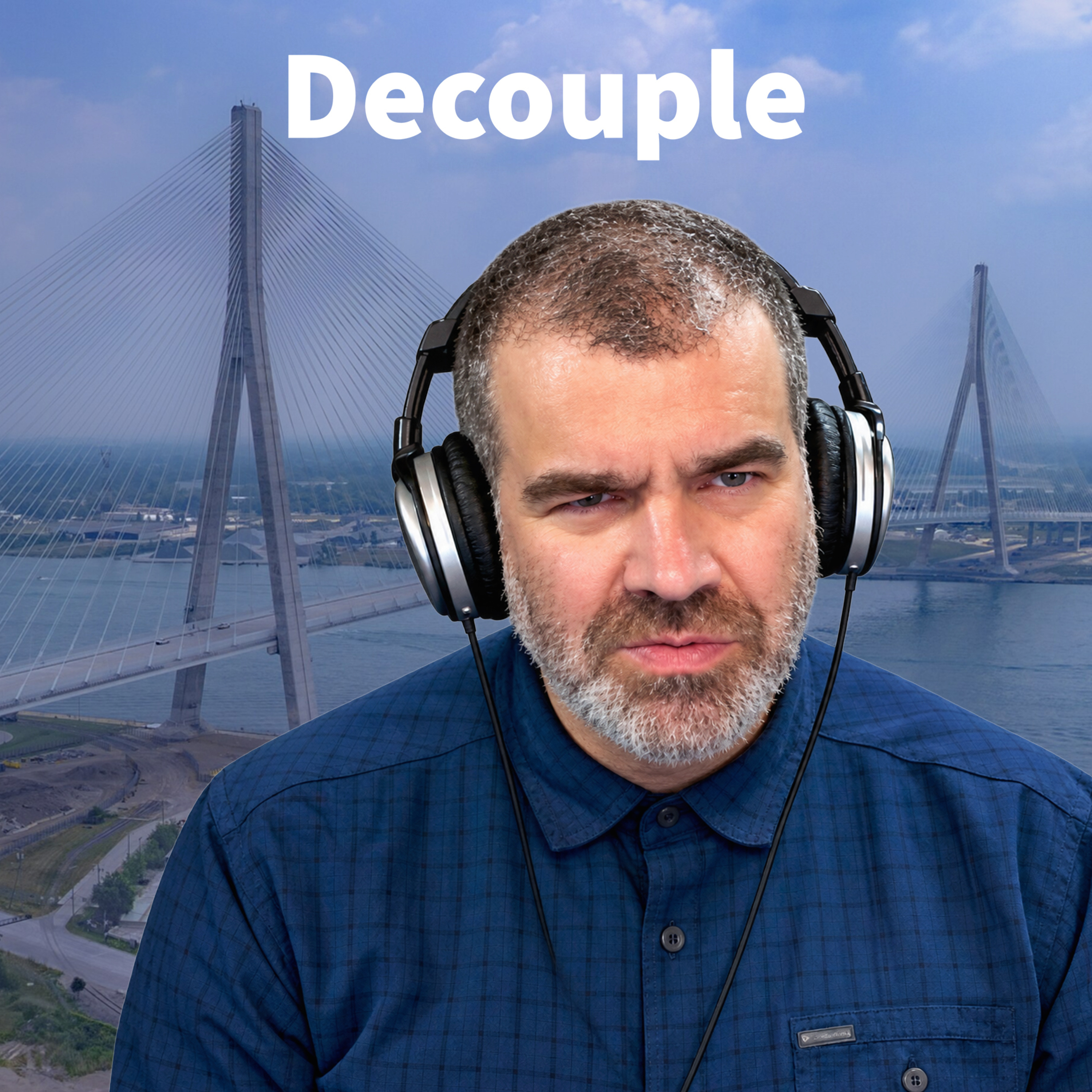
U.S. threats include cutting off trade with Canada/Europe, bans on Canadian alcohol, and possible exclusion of Canadian products from federal procurement; tariffs on steel, aluminum, autos, plus quasi-legal measures. Strategic leverage examples: Line 5 oil pipeline (cutting it would rapidly disrupt Ontario refineries and raise costs); the Gordie Howe Bridge customs-plaza delay used as leverage to extract concessions. Trade deficit argument: goods deficits with the U.S. are partly offset by services surpluses and investment/capital flows; Canada’s deficit is driven by selling oil that the U.S. refines into higher-value products.
Written by AI. May contain mistakes.
Discussion on the historical context of the U.S.-Canada trade relationship and recent escalations.
“Today, I'm joined by returning guest, Jesse Hoopsch.”
Exploration of recent trade threats and the implications for Canadian products and industries.
“well, but more broadly, just standing a little aside from the fray and paying attention to what's going on.”
Discussion on how infrastructure impacts trade and the historical context of Canada-U.S. economic ties.
“and it kind of looks like things are not heading in a improving direction anytime soon.”
Analysis of Canada's energy dependency on the U.S. and the risks involved during trade tensions.
“I mean, I guess the key bit to look at there is we're a very, you know, spread thin, so very large distances east-west.”
Speculation on whether current tensions are temporary or indicative of a larger trend in trade relations.
“And that lifeblood is largely coming into Ontario, which is the manufacturing center alongside Quebec.”
Learn about the vulnerabilities in trade relationships, particularly focusing on hydrocarbons and their implications for Canada and the U.S.
“That would be a, you know, many tens of billions of dollars investment.”
Explore the historical evolution of trade relations between Canada and the U.S., focusing on tariffs and economic philosophies.
“you know, our trade relations have shifted over the years.”
Discussion on the implications of shifts in automotive production and imports.
“so that any net reduction in our automotive production is made up by overseas imports or essentially anyone but American.”
Exploration of the Auto Pact and its impact on Canadian and U.S. automotive industries.
“Yeah, so the, I mean, broadly the Auto Pact was an agreement that there'd be as many cars produced in Canada as sold in Canada.”
Analysis of trade dynamics at the Ambassador Bridge and recent changes.
“but because the industries were so established and cross-linked, there wasn't a natural consolidation on one side of the border or the other.”
Examination of Trump's trade policies and their implications for Canada.
“Because to me, I mean, in terms of the more granular stuff that's said, and again, most of this is diplomacy via Twitter or X or Truth Social.”
Discussion on the USMCA and the effectiveness of tariffs on Canadian goods.
“in particular with the edgelord inside voting base or you know the key support faction So throwing red meat to the base, basically.”
Analysis of U.S. tariffs on aluminum and their impact on domestic production.
“have been dodged by, um, not applying to goods covered under the USMCA.”
Exploration of how tariffs affect the U.S. auto industry and its competitiveness.
“And primary aluminum capacity in the U.S.”
Discussion on the importance of EV supply chains for national security.
“has, especially for final assembly, an industry that has significant spare capacity, you know, the automotive industry has not been the strongest in some time.”
Explore the critical components of supply chains and their impact on national security.
“critical components that would suddenly be unavailable due to a broader failure of one of the parts makers or something like that.”
Learn about the contentious Gordie Howe Bridge project and its implications for trade.
“Let's talk about, and maybe try and list them, if you can, triage them for me in order of importance, just thematically.”
Understanding the potential fallout from the shutdown of critical trade routes.
“if it gives them a short-term advantage.”
Discuss potential economic strategies Canada might consider in response to trade tensions.
“Leading into the bit broader question of where are the other vulnerabilities?”
Explore the intricacies of Canada-U.S. trade relations amid military supply concerns.
“And then think of those in terms of the timeline when they would need to be ready as the, you know, when's the next time it would likely to be used?”
Discuss the economic consequences of tariffs and the potential for inflation crises.
“But what do you think forces a resolution here?”
Exploring the implications of the Canada-US trade war on nuclear energy projects.
“It would be potentially very ugly and potentially a genie that pulled out of the bottle could not be put back in or at least not without another depression between now and then.”
Discussing critical vulnerabilities associated with different nuclear technologies amid geopolitical tensions.
“What are your thoughts, given the trade war, given the Gordie Howe bridge example on what we should do?”

Get the gist, explore an idea or ask about something said.
 Claude
On Decouple, what are the key points of this episode?
Searching your listeningAutomatic transcript. May contain errors.
0:00Jesse Huebsch: I think we can look back at our recent history after Trump term one, where the Biden administration didn't really bring up new threats. They also didn't roll back much of the other trade barriers that had been imposed by the first Trump administration. From that standpoint, I think we can say that if the America First faction is still predominant in the Republican Party, we end out potentially with a ratchet each cycle of administrations, where one faction is inclined to ratchet up the difficulty to trade, and then the other faction are uninclined to ramp those kinds of tensions back down. We end out with a bit of a staircase, and that's probably the optimistic scenario.
0:58Chris Keefer: A warm welcome back to Decouple. Today, I'm joined by returning guest, Jesse Hoopsch. I always try and pronounce it fancy. There's a lot of vowels there, Jesse. But welcome back. It's great to have you again. Thank you. It's good to be here. Now, Decouple doesn't really care that much about sort of credentialism. Occasionally, I have big names on the podcast, but I've always sort of made it a point of pride to find people that I find particularly interesting, people with a fair degree of freedom of expression who are also content experts and in many cases sort of semi-savants. And I put you in that category.
1:36Chris Keefer: Well, I'm not trying to infer anything about your social skills, which I think are, if not adequate, very good. But we've had you on previously, Jesse, for a great episode on process heat. Incidentally, that's Seaver Wang's favorite episode. He's listened to many times, apparently. And we also had you on for a chat about modularity. You have a background in process engineering, working with sulfuric acid plants. But I've just noted you to have a wide range of interests, to be very interested in policy questions. You're, of course, an active member of Canadians for Nuclear Energy. Anything else to say about yourself?
2:11Chris Keefer: established some credentials for the topic of today, which is the Canada-U.S. trade war?
2:16Jesse Huebsch: I mean, I think I would take it as from, you know, having business in both sides of the border as well, but more broadly, just standing a little aside from the fray and paying attention to what's going on. So I'd take this as a, you know, conversation among interested parties as opposed to the academics or leaders directly in the space. So from that, with a little bit of remove, hopefully we can have some interesting insights
2:46Chris Keefer: on the topic at hand. Fantastic, fantastic. And what a topic. It is really funny. I think there's been a bee buzzing in some ears. I had a dedicated listener, George Street, shout out. He is a Republican politician from West Virginia on a number of energy committees who spends a lot of time in Canada at conferences. And he actually called me up two days ago and he said, hey, why don't you have an episode on the Canada-U.S. trade war? And I said, funny, you should mention it. That's all I've been thinking about for the last week and a half as I get ready for this episode. So yes, we are in the midst of a trade war.
3:22Chris Keefer: Things have escalated pretty sharply over the last couple of weeks. What are some sort of standouts for you in terms of headlines, just to provide that context to people that are not watching this closely?
3:34Jesse Huebsch: I mean, if we start going into the real closest and most recent stuff, we start getting threats around cutting off trade with Europe and Canada entirely if we should dare to talk to each other about having our own trade agreements. We've got some complete bans on Canadian alcohol going into the U.S., the potential for complete exclusion of any Canadian products in any U.S. federal procurements whatsoever. However, this is above and beyond the large tariffs on steel, aluminum, autos, and whatever other odds and ends they can find any legal mechanism or quasi-legal or even not legal at all, but just with a slow court system that won't act on it until it's been in place for a while.
4:24Jesse Huebsch: So I think we can say at this point it really is an actual trade war and not just a spat or a mild dispute. and it kind of looks like things are not heading in a improving direction anytime soon.
4:38Chris Keefer: So we're going to get into a number of those topics in a lot more detail. And we're also going to sort of theorize, you know, how to get out of this conflict. Before we do, I guess a couple of things. I mean, we are a couple of Canucks, a couple of Canadians bringing our perspectives. We have a very international audience here, probably 40 % U.S., 20 % Canadian, and the rest scattered around the world, mostly in the Anglosphere. but we have like five listeners in the Hashemite Kingdom of Jordan. I review my stats every once in a while and I'm surprised by who's tuning in. Some listeners in Guam, et cetera.
5:08Chris Keefer: But, you know, like I bring certain biases to this for sure. Interestingly, I could, if I wanted to, have the initials UEL after my name as I'm descended from United Empire Loyalists. So those were, you know, My father's line were American citizens who sided with the crown and fled to the Niagara Peninsula and set up shop there. We're involved in the War of 1812. Family lore has it, and I think this is probably an exaggeration, that we were part of the expeditionary force in the War of 1812 that retaliated for the Americans burning down York, the precursor of Toronto, by actually burning down the White House, the Capitol building, the Department of War, the Department of the Treasury.
5:56Chris Keefer: There was a lot of arson back and forth. I mean, Canada and the U.S., we've had great relations, I think, through the vast majority of our existence, but there were some testy waters early on. And I think, you know, Trump has talked about, you know, and we have lots of Twitter images of, you know, Greenland, Canada, the whole thing in the beautiful red, white and blue. And I think there is a question to some of our international listeners, why does Canada even exist? It does look like this arbitrary straight line, especially in the western part of the country in the 49th parallel, right across this map of North America.
6:31Chris Keefer: And I think there's some pretty interesting reasons for that. I mean, obviously we have the Great Lakes, which form a natural sort of geographic barrier. But again, we had a number of conflicts over the years that helped settle out the present boundaries that we have. I think a big topic of today is going to be, though, the fact that North-South economic integration is almost the most efficient thing in North America and our geography. We have a 6 ,500-kilometer southern land border with the U.S., and 90 % of our population lives within 250 kilometers of it. And so our efforts at nation building have really been about trying to impose an East-West logic to some degree on this reality of these two nations that exist.
7:16Chris Keefer: And when we talk about nation building projects, there's nothing that compares to the CPR railroad famously built in a ridiculously short number of years, I think around a decade, linking from coast to coast, getting all the way across that incredible barrier of the Rocky Mountains and bringing British Columbia into Confederation. So I'm not going going to do a massive history lesson here, but I did just want to touch a little bit on, you know, this idea of sort of why we are two countries and why we remain two countries. And I think why there's an interest certainly with you and I in remaining a distinct country.
7:50Chris Keefer: So I'll pass the mic back to you for Jesse after a bit of a diatribe there. But maybe we could talk though a little bit about, you know, things like the CPR, things like this, this theme of East West economic integration and the sort of history of building up that infrastructure. As we enter into a new stage now of discussing this desire to have some strategic autonomy, to not have all our eggs in the U.S. basket. And when we talk now about nation-building projects, I think a lot of it is around that question of maybe sacrificing a little bit of economic efficiency so that we're not critically dependent.
8:25Chris Keefer: Anyway, I'll pass the mic back to you after that long diatribe, Jesse.
8:28Jesse Huebsch: I mean, I guess the key bit to look at there is we're a very, you know, spread thin, so very large distances east-west. In particular, we have a giant gap of low population density between Ontario and Manitoba, where we start getting back into the more populated agricultural regions of the prairies. So we have a well over a thousand kilometer gap where there's very little population density, development, very little demand centers. So it's always been historically, by straight economics, more cost effective to route infrastructure below the Great Lakes, along with being able to access the markets along that route, rather than going across the top of Superior, where not only do you have the gap between where the population and the demand is, but you have the very tough country of the Canadian Shield, which adds a lot to infrastructure costs.
9:37Jesse Huebsch: So forcing the CPR through Canada was a big first step and we have a limited amount of particular gas pipeline that we have paid the extra cost to route through the North of Superior all-Canadian route. On the flip side, we have other routes like the oil mainline and line five that goes through the states south of Superior, accesses a number of other markets there, and then a portion of it is brought back into Ontario near Sarnia. And Jesse, when you say Superior, we're just talking for the international listeners, we're talking about this massive cluster of Great Lakes.
10:21Chris Keefer: And again, going north, you're into this Canadian shield. It's this vast granitic area full of lakes and swamps, hard to build over and, as you said, unpopulated.
10:30Jesse Huebsch: And this gets into some of the kind of critical integrations and vulnerabilities that we have. When we have an administration that is prone to being the hyperactive teenager in the cockpit of a commercial airliner without supervision, every lever that exists will get pulled regardless of the short and long-term consequences. So with this kind of infrastructure, we're leaving some levers on the table that could impose some very immediate short-term pain for us in the sense that while we are more than self-sufficient in oil production, we are regionally dependent on transportation infrastructure to get it there that's not fully in our control.
11:23Jesse Huebsch: And that creates some strategic vulnerabilities when we no longer have the entire confidence that all of the rules are being followed in a good faith fashion, even if we have disagreements when we're negotiating those rules.
11:42Chris Keefer: There's been some hyperbole, to put it mildly, really coming from both sides during this trade war, particularly in terms of some of the Canadian threats. Famously, Doug Ford talking about cutting off electricity supplies to the US. And I think that's so illustrative. The folly of that kind of a move is so illustrative when we realize that oil, which, you know, as much as it's denigrated in the last sort of 10 years of energy transition discourse is the lifeblood of our economy. And that lifeblood is largely coming into Ontario, which is the manufacturing center alongside Quebec. But we'll focus on Ontario here.
12:18Chris Keefer: It's coming into Ontario again via a route through the U.S., Line 5, and then refined in Sarnia. But that's where we get a lot of our diesel and gasoline, which again is the lifeblood of our economy. And so when there's talk about we should shut off, enter an energy war with the U.S., we wouldn't come out of that very well if they turned off the valves of Line 5 on us.
12:39Jesse Huebsch: Any victory in that kind of war would be Pyrrhic for whoever was the victor. You know, areas we just don't want to go, but we also have to be cognizant of some of the responses and actions may not be entirely rational or take the broader picture considerations. So that's where the question comes up of what strategic vulnerabilities do we have that we should just be not leaving on the table, you know, not leaving Chernikov's gun on the wall, as it were, to be used in Act 3.
13:19Chris Keefer: So I think, you know, one of the really crystallizing moments that you mentioned for me, because, you know, we're going to talk in this podcast a lot about, again, these dependencies that we have, how to minimize them, reduce them. There's no decoupling from the United States. 70 % of our exports go to the U.S. There'll be some attempts to diversify that. It may end up more like 60 if we're able to, you know, fortify our rail networks and port infrastructure and move more things to Asia and Europe. But, you know, we're in bed with the United States for the long haul. And that doesn't have to be a bad thing.
13:49Chris Keefer: But we are talking not about decoupling, despite the name of this podcast, but reducing those dependencies. And, you know, I think there's some discussion about because that imposes major costs and major economic inefficiencies. If we were to say, you know, we're at a critical vulnerability because we ship the majority of our hydrocarbons, liquid hydrocarbons anyway, to our industrial heartland in Ontario through a link in the United States that could have the valve turned off and build an oil pipeline over the Great Lakes as we did with our gas pipeline. That would be a, you know, many tens of billions of dollars investment.
14:28Chris Keefer: And so it raises this question of, you know, is this just a blip? Is this just a Trump phenomenon? Is this temporary? Is it, or is it intermittent? And I think that was, I think a good framing in our pre-episode talk that we felt was important. So let's just discuss thematically that question of, you know, is this just an aberration and we can just, you know, try and keep quiet for a couple of years? Or is there really a rupture, as our prime minister famously said at Davos?
14:56Jesse Huebsch: I mean, I think we can look back at our recent history after Trump term one and the Biden administration where the Biden administration didn't really bring up new threats. They also didn't roll back much of the tariff type or other trade barriers that had been imposed by the first Trump administration. From that standpoint, I think we can say that if the MAGA type, America first type faction is still predominant in the Republican Party, we end out potentially with a ratchet each cycle of administrations. administrations where one faction is inclined to ratchet up the difficulty to trade and then the other faction has never naturally been free traders and are uninclined to ramp those kinds of tensions back down.
16:01Jesse Huebsch: We end out with a bit of a staircase and that's probably the optimistic scenario, is that's what we're looking at going forward. Obviously, the bad scenario would be that the democratic mechanisms in the U.S. collapse and they don't have effective democratic government anymore where the MAGA-type factions are more or less permanently ensconced. I don't think that's terribly likely, but we need to leave that as a little bit of a possibility in our minds when we're considering any of these things that that could happen. On the flip side, we have to think about who's left in the Republican Party when the damage of the current term comes home to roost sometime after this presupposed Democratic victory in 2028.
17:04Jesse Huebsch: We're likely to have some very difficult times economically coming into the next election cycle. So the odds of the Democrats staying in power for more than eight years, let alone even getting to that second term, have to be looked at with some concern. and then with the question of, well, who is likely to be in power or what faction is likely to be in power in such a Republican term? That's where we came up with that sort of intermittent trade, going from trade nastiness to just slight protectionism and the intermittent ratchet. So from that consideration, we also need to be thinking a little bit strategically of if we're going to make investments in the infrastructure that we need to do that, breaking of critical dependencies gives us a bit of a timing target.
18:08Jesse Huebsch: So the next cycle would be to have stuff completed in 2032 or very early 2033 to be ready for the next potential administration or maybe some of the longer... to implement stuff. We get another four years to contemplate, but that really gets us into working backwards from the, where do we want to end out to be in a more secure environment? What do we need to do to get there? Which of these potentially expensive projects are worth the price as an insurance premium, even if the straight economics don't pencil in, like the potential Energy East or Northern Shield pipeline that we've been talking about that would go from Alberta through the Canadian Shield to Ontario and then potentially onwards to Quebec and the Maritimes.
19:09Chris Keefer: Independent analysis only works if it's independently funded. If Decouple provides you with energy literacy on demand, please consider supporting it. Become a paid subscriber on Substack or make a tax-deductible donation on our website, cccouple.media. Join the community. Keep the lights on. Preferably nuclear. Now, back to the show. I mean, just to get a sense of, you know, the vast kind of tug and pull of history here, you know, our trade relations have shifted over the years. Famously, Canada had very strong tariffs under John A. MacDonald around the time or shortly after Confederation with, you know, Potentially the worry of military annexation fading, but economic annexation being a big possibility.
19:53Chris Keefer: And this, again, was an imposition of that East-West economic integration logic over efficiency. But high tariffs on U.S. imports, which led to a manufacturing boom in central Canada. There was a lot of spillover effects that I won't jump into there in terms of being the origin of some Western alienation that we have here in Canada. But suffice it to say, certainly recently, we've moved more and more into, you know, a liberalism or even a neoliberalism, the North American free trade area. And this idea that, you know, let's harness comparative advantage and, you know, build things and make things where it's most economically efficient to do so.
20:31Chris Keefer: And, you know, ultimately, all boats are going to rise as a result. Clearly, we've shifted from that into, certainly on the U.S. side, more of an economic nationalist or mercantilistic approach where, you know, there's big concerns with things like trade deficits. Talk a little bit about the Canada-U.S. trade deficit and whether or not you feel that's a legitimate source of frustration.
20:53Jesse Huebsch: I mean, I think it's fundamentally a misunderstanding of what trade balances actually represent. So obviously there are some potential issues if as a country you run a sustained trade deficit overall to the rest of the world. But with each individual other jurisdiction, you should not necessarily expect to have a consistent balance of trade. I have a massive trade deficit with Costco. They have never paid me directly a penny, but I've spent thousands of dollars there. Should I be worried about shutting them down, or am I getting goods that I value at least as much as the value of the currency that I'm giving them?
21:51Jesse Huebsch: and then overall as long as I have a trade surplus with my employer somewhere else in the rest of the world or the rest of the economy some of those trade flows somehow managed to find their way from Costco indirectly through mentoring channels to my employer so that the money exists for me to get it back that way. Now with that, so there are some very large structural trade imbalances in the world, largely centered around China being a net exporter and the United States being a net importer overall. That being said, of all of the trading relationships the U.S. has, for the size, it's actually quite balanced with Canada, where the bit that puts us over the edge in the trade deficit is essentially us giving them, you know, selling them oil that they largely process into higher value products and then sell either internally or export those products.
22:57Jesse Huebsch: So from that standpoint, you know, the bit of trade deficit that they have with us is largely to get raw material inputs that supports their broader industry. The other aspect, of course, is that they're generally only looking at the goods balance, where they tend to have quite a large trade surplus in services. So that includes stuff like IT, any revenue that Google or Microsoft or any of those make, as well as various professional and other services. But broadly speaking, in terms of the scale of it, the overall balance is that there's minimal imbalances. Those tend to shift a little bit over time as specific factors come up.
23:48Jesse Huebsch: The other part that they tend to forget is, by definition, to have a capital surplus, you have to have a trade deficit. The United States is particularly good at pulling in investment from other countries into their country, which adds to their capital goods install base and to their productivity. But because of how currency flows work, by definition, to have a sustained capital surplus, you have to have a trade deficit. Otherwise, the relative value of your currency would have to shift to make up for the inability of other countries to get the dollars that they want to be able to invest with.
24:36Chris Keefer: I mean, I think a lot of the preoccupation comes out of China Shock 1.0 and the deindustrialization of the Rust Belt, for instance. And so a trade dispute with Mexico makes a little bit more sense as this is sort of a classic, very export-oriented manufacturing economy, lower wage labor, and indeed some of the alterations, I believe, to NAFTA under the USMCA require a certain amount of the labor put into an auto has to be paid more than$16 US an hour. I think that's fantastic, and that's very understandable. And certainly there is a certain amount of friction during this sort of renegotiation of trade within the North American bloc with Mexico.
25:17Chris Keefer: I think Mexico is responding particularly to border issues, reinforcing the border, taking action on cartels, doing some work around ensuring they're not a backdoor for Chinese inputs to get tariff-free into the US. But Canada is really in the spotlight here, which to me is a little bit surprising because I don't think Canada is the country that is de-industrializing the rust belt with low-cost manufacturing labor. And as you said, in terms of the trade deficit scenario, there is a trade surplus in services and I believe in goods when you subtract the oil, which as you mentioned is a raw input that they do value add with.
25:54Chris Keefer: So it is a little bit of a bizarre situation we're in. Absolutely.
25:59Jesse Huebsch: I mean, I think there's, the other way to look at it is for, especially for industries like those in the Midwest, because there's been enough time, there's a lot of integration between them where the joint industrial base of Canada and the US has a larger market between them. And when they have that larger market, they can get larger scales, more readily access to inputs and being more globally competitive. That's the other part of this that makes it really challenging to entirely understand on a purely rational basis of why this is coming up. For example, the integrated North American auto market, if you shave out the demand side from Canada as well, and not just the fabrication side, you end up with a significantly reduced automotive industry that loses a fair bit of scale and ends up being less competitive, less able to compete in export markets versus the, you know, um, upsurge in Chinese EVs and other products.
27:12Jesse Huebsch: Um, I think there's been a, call it almost a, uh, main player character syndrome thinking of, Hey, if we can pull in all the automotive production jobs, um, then Canada will just buy our cars. We'll get those jobs. We won't lose any scale because we still have the same total market. and that will help us in the swing state voting base. The part that that's missing is that, you know, Canada gets a say in that as well. We really should be telling them that, okay, you can tariff our industry and you may succeed in collapsing it, but we'll make sure then that we adjust our own tariffs so that any net reduction in our automotive production is made up by overseas imports or essentially anyone but American.
28:10Jesse Huebsch: And I think that's the broad public mood now is very much in a anyone but American, even, you know, grocery store produce, would I rather currently buy Peruvian blueberries or American blueberries? Well, Yeah.
28:31Chris Keefer: That is, I think, so important when we're talking about a rising China, now a China shock 2.0, where if we were to contain, let alone compete with China, where they're winning is really scale. When you look at the size of BYD's automotive factory and it sits on a footprint larger than the city of San Francisco, when we're talking about fracturing our potential to build at scale. And the history of the Canadian auto pack, maybe that's worth going into here because I think that's illustrative of taking things in the opposite direction towards economic efficiency, towards scale. And really what you're describing is a return to how things were pre-auto pack.
29:07Chris Keefer: So maybe this is a good chance to talk about this because this is maybe sort of Canadian-U.S. cooperative industrial policy at its best.
29:15Jesse Huebsch: Yeah, so the, I mean, broadly the Auto Pact was an agreement that there'd be as many cars produced in Canada as sold in Canada. But to make the industry more efficient overall, it didn't have to be the same cars. So you can have a plant that specializes in F-150s and 90 % of the product would go south of the border. And then we would import nine different models from south of the border so that we can have the full product slate in Canada while building roughly the same amount as would be sold here. And that was very effective in integrating the combined auto industries. So there's essentially no such thing as a completely Canadian or completely American car.
30:10Jesse Huebsch: There's parts and subcomponents from both countries in every car or truck assembled in both countries. and that allows, especially on the supply chain side, significant economies of scale in those kinds of facilities to be able to achieve a much better cost point and efficiency and product variety. Then, you know, eventually we got into the free trade agreement and the NAFTA, where we no longer had that specific balance requirement, but because the industries were so established and cross-linked, there wasn't a natural consolidation on one side of the border or the other. For example, previously, the Ambassador Bridge had the highest amount of trade flow of any single connection point in the world.
31:05Jesse Huebsch: I think it was about a billion dollars a day, if I remember the stats right. You can do a quick fact check for the notes there.
31:12Chris Keefer: And that's the bridge between Michigan and Ontario for those.
31:16Jesse Huebsch: Yeah, for Detroit and Windsor in particular. Now that probably won't be the single biggest because a new bridge got built there that's going to be splitting those flows. But we can get into that a little bit later on.
31:32Chris Keefer: I am eager to go there. But perhaps before we do, it's really hard to grasp and understand exactly what Trump's intent in. There's a certain amount of meme warfare, for sure, in terms of the Governor Carney or Governor Trudeau remarks or the 51st states, Twitter memes or the American flag painted across Canada and Greenland and I think maybe Mexico as well and Venezuela. I'm not sure. But what do you read as the intent? Because to me, I mean, in terms of the more granular stuff that's said, and again, most of this is diplomacy via Twitter or X or Truth Social. But it's this idea that auto jobs shouldn't be in Canada.
32:17Chris Keefer: We should bring those home. There was a threat, I believe, last week on Bombardier, which is a Canadian aerospace manufacturer. They used to do commercial aviation jets. They were tariffed pretty hard on their C-series jet and ended up offloading it to Airbus, but now focused on just on, I think, private business style jets. Trump's saying, you know, if you want access to our markets, build them here. We already do. That's already happened. There's a large Bombardier factor, forget in which state, somewhere in the South. Yeah, it sort of feels like there's this desire to turn Canada into a little bit of a kind of resource hinterland for the American center to move kind of all high value manufacturing south of the border in a kind of zero sum game.
32:59Chris Keefer: Whereas the old assumption was, you know, comparative advantage. Let's do things where they make sense. Let's upscale and efficiency and kind of mutually prosper. Is that anything like your read?
33:10Jesse Huebsch: The challenge here is trying to assign a singular reason to anything that happens in this administration. Because his preferred leadership style is to have multiple competing factions that fight with each other for preeminence. Each of those factions has their own reasons. and they can be mutually contradictory reasons and they can bubble up to the surface at times. All of the reasons can be somewhat true. So there is certainly a reaction to the China shock. We want to get what was called friend-shoring under the Biden administration and then that's been amped up to, well, let's not do just friend-shoring but bring everything absolutely home.
34:02Jesse Huebsch: Um, there's a bit of the, we want a resource colony. We want, you know, these are critical resources. We don't have all of them. We need access to them. There's a bit of, um, the Mercury Tower projection on the map makes Canada and Greenland look very big. And he wants to be, um, you know, historically remembered as the, uh, president who added the most area to the country and live in the history books. These are all true aspects to that. There's a bit of envying the freedom of action of Xi and Putin and other dictators and disliking democratically elected leaders who don't have the same freedom of action to offer obsequence and bribes.
34:56Jesse Huebsch: beyond that it's hard to say which is the preeminent rationale behind it you know all of them can be true along with a lot of aspects for domestic consumption in particular with the edgelord inside voting base or you know the key support faction So throwing red meat to the base, basically. I think there's also a lot of just not recognizing how those kinds of memes will read to someone who's being threatened with annexation. You know, hints at, well, we're not going to do it military for now. We're going to wait to see if other things worked. and then seeing the snatch and grab and plundering in Venezuela.
35:52Jesse Huebsch: So it's hard to say, put it firmly in the category of it's just a joke when we see examples where it wasn't a joke and now there's a bunch of dead people.
36:09Chris Keefer: Yeah, I mean, there's been kidnapping and blackmail in Venezuela, but let's talk a little bit more about what's happened so far with Canada. Um, the USMCA, um, it seems like the, the acronym gets shifted around depending on which country he's talking about. It is. The CUSMA. I'm sure the Mexicans start with Mexico as well. They do. Um, but we've have had, uh, what sound like large tariffs imposed, uh, but most of those have been dodged by, um, not applying to goods covered under the USMCA. Um, I'm not sure if steel and aluminum, uh, fit in there or not. I think they certainly don't now. But let's talk about the relative efficacy of US tariffs on Canadian goods.
36:49Chris Keefer: And I think two counterexamples in terms of that strategic objective of trying to create a bit of a resource hinterland and draw high value manufacturing and value add into the US. Tariffs on autos or that affect autos and tariffs on aluminum and steel work very differently in the US in terms of whether their own goals or whether they have some potential for success, even with that risk we talked about of sacrificing scale because of Canadian retaliation. So let's work through those two examples because I think that's very interesting. So maybe with aluminum, does U.S. tariffs on aluminum lead to a booming primary aluminum industry in the U.S.?
37:26Chris Keefer: I hope my tone of voice isn't making this sound too rhetorical.
37:30Jesse Huebsch: As an aluminum smelter boss, there is only one person with that title in the United States, of course. But as a, or let's say, prospective aluminum smelter boss, are you willing to make an investment that is going to take 20 years to pay off when the tariff environment changes every week? And you are, you know, aluminum being essentially liquefied electricity, so your input is electricity costs, and in that market you are competing against open ai anthropic google etc to buy every scrap of electricity you can get their hands on and they have an implicit marginal value to power of about a thousand dollars a megawatt hour and you need to be able to get it in the tens we can very quickly rule out that there is any possibility that any significant primary aluminum capacity gets added in the United States in the next 20 years.
38:40Chris Keefer: And primary aluminum capacity in the U.S. right now is, do you have a sense of what percent?
38:45Jesse Huebsch: It's in, I think, the low double digits at best percent. And that is likely to be a facility that's only going to be staying open by being mandated to stay open because otherwise they could probably resell their electricity rights for far more
39:05Chris Keefer: than the value of their aluminum product. Right. And for greater context, Canada has, I think, some of the lowest electricity costs in the world for aluminum production due to the massive hydroelectric infrastructure in Quebec where a lot of this aluminum smelting is centered. So there's a huge Canadian comparative advantage there. We can make the stuff dirt cheap.
39:24Jesse Huebsch: Much of the hydroelectricity was built specifically for making the aluminum and was built by the aluminum companies at the time. And I expect that there is some very good agreements on very long-term price rates for those smelters that could not be replicated now even if someone wanted to.
39:49Chris Keefer: So the impact in the U.S. on buyers of aluminum is that, I mean, it's very small. I think it's 16 % of primary aluminum in the U.S. is domestic. But suffice it to say, with steel as well, the aluminum or steel producer can now increase their prices close to what the tariff goods are going to cost. So everything costs more. And as you're saying, they're unlikely to make the massive investments required, not just in the smelter, but in the electricity supply, the transmission, all the enabling infrastructure with a tariff environment that's rapidly shifting. And, you know, there may be a ratchet, but, you know, things have been intermittent.
40:28Chris Keefer: And so some folks are, I guess, happy and getting rich out of this. But in general, costs are going up. This is inflationary. Let's shift to autos though, because again, if I'm on Team America and I am trying to reshore Canadian manufacturing and auto jobs, this is something where tariffs or even uncertain intermittent tariffs on Canadian autos has a big impact. Walk us through that.
40:49Jesse Huebsch: In that context, because the U.S. has, especially for final assembly, an industry that has significant spare capacity, you know, the automotive industry has not been the strongest in some time. So from that standpoint, anything you can do to shut down some competitors leaves a bit more potential volume on the table for the facilities that already exist. so in that case they're looking at it in the context of it's not major new investment that's needed to be attracted they just need to have some of their competitors go under and then stay under and then that volume is theoretically ripe for the plucking now there are some very significant risks that creates with that integrated parts supply chain as well that it's not like ford has their own parts supply and Toyota has its own parts supply.
41:50Jesse Huebsch: It's all cross-integrated. And with some very significant shifts in that industry, you could end out with some very critical components that would suddenly be unavailable due to a broader failure of one of the parts makers or something like that. So it's not a clean victory, but it looks a lot better on paper that way. Now, the other little bit of an aspect that I think is part of the thinking of at least one of those factions is that a full-stack EV supply chain is absolutely essential from a national security standpoint, not for the EVs themselves, but because EVs represent all of the components in a robust drone supply chain.
42:46Jesse Huebsch: Drones being the radical shift that we're seeing between Ukraine and Iran in how especially medium intensity wars are conducted. But the main parts that go into making drones is batteries, it's power electronics, um injection molded parts um a little bit of um you know chips but not necessarily super high-end ones you need some fairly basic processing and image recognition stuff like that and then in going into those is the critical minerals and processed raw materials that get turned to you know cathode active materials get turned into cells they get turned into modules pair it with a flight controller a motor and some injection molded blades for a quadrocopter and you have a drone now the production of those looks a lot like a tier one's parts supplier in terms of complexity and a lot of the processes that go into it a seat in a car looks a lot like a drone you know it doesn't actually look like it when you go into it, but it has a bunch of sub-components linked together by a wiring harness on a structural framework with some bits of electronics, and you can easily incorporate some battery packs and some fans and a camera.
44:18Jesse Huebsch: But it's a similar size, a similar number of components, similar types, or at least from a supply chain standpoint, types of components. So from that standpoint, having a robust automotive industry and particularly an ev industry means that you have all the bits that you need to rapidly shift over to drone production even more so if you have the full stack on the batteries and some of the electronic components as well so by trying to press for that collapse, even if we were to be allowed certain other industries, it would take away some very, you know, critical for sovereignty and security industrial supply chain.
45:05Chris Keefer: Let's talk about, and maybe try and list them, if you can, triage them for me in order of importance, just thematically. What are the great sort of vulnerabilities that Canada has, dependencies? And I do want to talk about the Gordie Howe Bridge. So if you want to work that in as well.
45:22Jesse Huebsch: Let's start with that one because I think the example there goes a long way to describing where our concern is. So the Gordie Howe Bridge was another bridge being built not directly alongside but between the same regions of Detroit and Windsor, the hubs of the automotive industry, to improve the access between southwestern Ontario and Michigan. It was also going to de-bottleneck and potentially steal traffic from the Ambassador Bridge, which is owned by a Trump ally that collects tolls on it. But it had been contentious for some of those reasons to get built, but Michigan had long recognized the need.
46:10Jesse Huebsch: Canada offered to pay for the whole thing, including the construction on the American side using U.S. materials and then recoup that loan over the long term from toll revenue and then went so far as that once that was recouped, the revenues after that would be evenly split between Ontario and Michigan. So a more than fair deal where the side that was taking on the financial risk was not seeing any more long term upside than the side that was taking on no financial risk. Then at the 11th hour, the Trump administration used certain administrative procedures related to getting the customs plaza set up to threaten to indefinitely postpone any opening of the bridge, which would leave all of the financial cost and the interest incurred, incurring on Canada with no revenue to offset it or the broader impact to the broader industries and wanted to change the deals so that they'd start being able to pull revenue into a slush fund under their control immediately before the loans would be paid off.
47:32Jesse Huebsch: I mean, that's probably more depth than anyone really needs to go into. But the key point of that is there was already an existing agreement that was already more than win-win, but because they had a lever administratively, this is the equivalent of, you know, getting your electrical inspection after your renovations and then the city deciding, oh no, we want you to put in an extra lane of parking, otherwise we won't approve your electrical permit. You know, completely unrelated and And something that would, in normal times, be unheard of using as that kind of leverage. But they used this leverage because it exists to try to extract concessions because we had more at risk.
48:28Jesse Huebsch: So what this leads to in particular is we see that they're willing to use levers even even if they have long-term negative consequences for them, if it gives them a short-term advantage. So what we were calling in our pre-check critical vulnerabilities are anything where the impact is very disproportionate in the short term as opposed to just general broader economic trading and efficiency. where that leads to is the example that we discussed already was line five so that's where largely canadian exported oil well trans shipped oil is brought across through the midwest and into ontario so it's mostly alberta oil with a little bit of midwest and rocky mountain state
49:26Chris Keefer: oil brought in for whatever the blending requirements are.
49:31Jesse Huebsch: But that's one where if they were to shut that off, it would cause an immediate crisis in Ontario, but have a very limited amount of lost sales revenue of oil for the regions that it transits through. So that's a critical vulnerability where there's a strong bit of leverage
49:52Chris Keefer: within control that would have a disproportionate impact. It seems really hard to imagine, but what would you foresee that looking like if you were to paint a picture of line five being cut off? And I don't mean to fear monger here, it seems so preposterous that you shouldn't even have to imagine it. But when you hear about the Gordie Howe bridge incident, nothing seems to be completely off the table. The lever's there, it could be pulled. So just to give us a bit more of a vivid sense of what that might look like in Ontario, for instance.
50:17Jesse Huebsch: So that, I mean, that would immediately mean the vast majority of pipeline imported oil would not be available. We could make up a certain portion of that via rail, potentially a crash reversal of the pipeline that goes from there through to Quebec, where there is some port infrastructure, where we start needing to import, you know, overseas oil through Quebec to backfill in, as well as heavily filling up the already very full rail lines, which would likely limit other exports or our ability to bring goods across the country from one side to the other, or Asian imports into Ontario would raise the cost of grain imports.
51:05Jesse Huebsch: It's unlikely to mean that we have an actual fuel shortage, but it would raise costs quite substantially and would potentially lead to the shutdown of one or more of the refineries that we do have, as they would have a much higher cost basis and then be competing on against refined products from entities that don't have that disadvantage. So, you know, it would be not fatal, but extremely ugly. And, you know, in a single round prisoner's dilemma sense, it'd be worth paying a fairly substantial cost to avoid that. And that's exactly the rationale that was used on the Gordie Howe Bridge. Leading into the bit broader question of where are the other vulnerabilities?
51:57Jesse Huebsch: I mean, we, not as vulnerable, but we import most of the natural gas in the eastern half of Canada from the US because the production regions there are much closer than Alberta and British Columbia, where it's mostly produced in Canada. But at least there, there exists an underutilized pipeline that could be pushed in capacity. I believe there's some parts of it that there's inactive portions that could be reactivated. So it's a lot less critical. In the lower mainland, we have a deficit of refining capacity. So the Vancouver area could be somewhat starved of various refined petroleum products.
52:40Jesse Huebsch: On the flip side, we export a large share of the crude oil into those refineries. So there's some immediate counter leverage that would make that a lot less attractive to use as a lever. Similarly, we have a large deficit of refined products in Alberta, but that deficit is almost entirely the diluent used that thins out the bitumen enough so that it can be put in a pipeline so if they stop shipping us diluent well the obvious answer is well sorry guys we can't ship you the bitumen that you get at a steel and can make your value added products and then we start getting into the you know obviously the auto industry has critical vulnerabilities because, you know, every component in the car is necessary.
53:33Jesse Huebsch: You block anyone and you can't build that car at all. Of course, that's a bit more of a, you know, mutually assured destruction method there as we have matching components that go into essentially every American vehicle that if they were blocked would be couldn't build at all. and then the next tier you get to is probably more on the financial services and it side so stuff like the swift system you know threat of american sanctions on canadian banks for us dollar transactions and the you know potential for them to impose individual sanctions on individuals or financial institutions to cut off certain it access telecoms to europe or asia and those sorts of things so that's where you know those are ones where we don't necessarily need to do those all ourselves we're not trying for autarchy but do we need to be making mutual arrangements with other middle powers that are not likely to get hegemonic inclinations where they try to use that leverage.
54:48Jesse Huebsch: Like, say, France has as much to lose as Canada does if they stop being perceived as being, you know, a reliable and fair-dealing partner because they don't have that extra bit of leverage just to sheer scale that, you know, our neighbors to the south or China has.
55:08Chris Keefer: I mean, so I guess it begs the question, sort of in terms of corrective action, we can build a pipeline around the Canadian shield, the northern side of the Great Lakes. Is that, if you were a czar of this trade war response, is that something you would seriously consider or is it?
55:24Jesse Huebsch: I mean, you'd have to do the very careful, you know, financial and scenarios analysis. It's one that will never pencil out on sheer economics. A private entity will never build it for those reasons. But you have to evaluate it in an insurance policy sense, especially the type of insurance policy where by building it, it's likely to never actually be needed because it removes the upside from the factions that would force its use. if you know a pipe already exists then it's really boring to cut off access this way all it does is cut off a certain amount of american exports of oil even if it's the minority of the flow in which case it's just shooting yourself in the foot to you know trigger that eventuality so there's a lot of contingency in there and i hope our government is going into those into great depth, especially of the, well, what would the consequences be of any of those kinds of things being triggered when they're comparing it to the costs?
56:38Jesse Huebsch: And then think of those in terms of the timeline when they would need to be ready as the, you know, when's the next time it would likely to be used? Obviously, it's not going to be ready during this term, but could we have such a thing ready for 2033 or 2037? and those would be the kinds of considerations that we'd really need to be putting in. I mean, another area we should probably talk about is the very high-profile F-35 versus the Gripen. So they're both fighters that have enough U.S. components that the U.S. could block their sail. But that's the thermonuclear option. If they block the sail to a NATO country of either of them, it would be like a neutron bomb going off in the U.S.
57:31Jesse Huebsch: defense export industry. You know, there'd be a lot of potential pain there. The big difference is the F-35 has a U.S. controlled parts supply system. So everyone who buys them other than Israel agrees to get parts from this U.S. controlled system rather than setting up their own stockpiles of parts. Similarly, the software is managed by the U.S., including for each flight, you know, generating the mission profile, which includes stuff like the location of air defenses, target locations, all that kind of stuff that's necessary to get the full capabilities out of the F-35. So both of those are, you know, levers that if they were pulled would render the fleet either greatly degraded or inoperable in the space of days to weeks.
58:31Jesse Huebsch: Whereas for something like the Gripen, where it's a U.S. engine, but it's not a U.S. controlled parts system. And if we were to buy that, we would get our own copy of the software so that we would be doing any updates, any mission planning and stuff like that would be directly under our control. We could stockpile enough engine parts for a number of years of operation, even if we were cut off from easy access for more of those parts. And that's kind of the, you know, not completely decoupled versus critical vulnerability distinction that I think we're getting at. And really strongly in points in favor of at least having a large chunk of our fleet being not critically dependent.
59:19Chris Keefer: I'm just trying to think, because again, we're a couple of Canucks here. We're bringing our own biases. I think we both feel fairly strongly on this issue. If you had to identify areas of legitimate concern in terms of the Canada-U.S. trade relationship, previous frictions before the Trump administration have been things like our supply management on our dairy or dairy quotas, softwood lumber disputes where most Canadian trees are on crown land and I guess the stumpage fees are low and that generates a certain amount of money. certain amount of friction. Again, I guess Chinese precursor parts are working their way in, tariff-free into the U.S.
59:57Chris Keefer: Are there major concessions available to Canada to try and tone down this trade war?
1:00:02Jesse Huebsch: That's the fundamental problem, is to the extent that they have been somewhat legitimate concerns, those have been generally when we had a better relationship. stuff that was worked on mutually outside of major renegotiations. So if the rules of origin labeling was not entirely clear, there'd be regulatory refinements. Maybe it wouldn't be as fast as everyone liked, but it happens in the background. And then there's a number of areas where the U.S. never really liked that we had some exceptions to the trade, the supply management being an example, but they also had their own matching exceptions to that, like sugar and tobacco on the agricultural side, that they, in the same agreement, kept out with the same kind of structure of a limited quota, low tariff amount, and then a massive tariff quantity beyond that.
1:01:06Jesse Huebsch: Both sides never have actually had the amount of imports to activate those high levels, but they've been, you know, matching, you know, not the same sector exactly, but matching sensitive sectors. And we had previously mutually agreed that, okay, this bit's off, this bit's off from your side, our side. So from that standpoint, you know, you can have disagreements on whether it was good for consumers to have those excluded, but there was a fair method of that exclusion by both sides picking their favorites and carving them out so from that it's really hard to point at anything that was really you know legit beyond that um the you know overall tariff rate on u.s products coming into canada was something in the order of on average, like 1 % or a fraction of 1 % have to look up the exact number, but it was, you know, so trivial as to be meaningless, especially outside these few set aside areas.
1:02:20Chris Keefer: So Jesse, how does this end? Like, how do you foresee this winding down? It sounds like we've been ratcheting up retaliatory tariffs. There's a lot more room to go in terms of, you know, causing each other pain. But what do you think forces a resolution here?
1:02:33Jesse Huebsch: I guess it depends really on the timescale that we're talking. I mean, if we're, you know, the bad case would be that we're waiting another two and a half years for a new administration that will, you know, likely at least take away the stuff that's not being used for the actual intended purpose and wind back the stuff that we haven't actually signed away yet. Anything that we do sign away now is gone forever. We will not get an iota of relief that way back from a future democratic administration. We shouldn't expect that to ratchet back. How it might end sooner than that would be, well, inflation is coming back with a vengeance.
1:03:24Jesse Huebsch: Tariffs are extremely inflationary, especially for the amount of revenue raised, like in our steel example, where you're only raising the revenue on the import share of steel, which by definition is meant to decline with the addition of the tariffs. The inflationary pressure covers across all the value of the steel as the existing producers can capture that windfall rents. So from that standpoint, if the inflation becomes enough of a crisis that something must be done and unwinding tariffs, especially with Canada, is just a couple of executive orders and a bruised ego where unwinding the inflation due to the Straits of Hormuz might be beyond, you know, the Avengers, let alone mere mortals.
1:04:28Jesse Huebsch: There could be the possibility that we get to a point where something must be unwound. Otherwise, there'll be figurative blood in the streets, that's the easiest button to unwind.
1:04:41Chris Keefer: We're hearing right now as the bond yields reach above 5%, a lot of alarms south of the border. Inflation's a major driver of those rising bond yields. So it does seem like, despite again, the US being 13 times bigger than us by GDP, having this vulnerability in terms of the amount of exports we send south of the border, This is a fragile hegemon, financially speaking.
1:05:10Jesse Huebsch: Yeah, I mean, there's that critical dependency back, not on any single entity, but on the rest of the world. So the U.S. bond market, because they are reliant on that capital account surplus to make up for their trade deficit, as well as their budget deficits, they do have a glass jaw that way. And the other fun factor there is most of the other countries are largely part of the reasons they maintain foreign reserves and foreign reserves for U.S. are mostly in the form of treasuries is to have the working cash and cash like instruments to manage that trade, the trade flows and trade relationship and stuff like that.
1:05:59Jesse Huebsch: To the extent that the rest of the world ends up with reduced trade flows with the U.S., above and before even any policy considerations, they would naturally tend to reduce their holdings of treasuries to have a balanced amount of various foreign reserves relative to their trade patterns. if less people are buying treasuries especially since treasuries are mostly fairly short term most treasuries sold are not for new debt but to replace treasuries that are coming due if there's less people that want to buy them they will not bid as much money per treasury so they essentially that the yield is in the inverse of the cost that's bid for them so effectively that means the yield starting is going up and that starts getting reflected back then in the interest rates being paid on u.s government debt state debts local debts as well as most financial instruments mortgages loans commercial financing for industrial applications and stuff like that.
1:07:13Jesse Huebsch: Now, the U.S. has been running a trade deficit that's almost as big as the entire GDP of Canada every year, which is far beyond what's actually, you know, sustainable on a debt-to-GDP ratio aspect. If the bond market starts feeling that there's risk of future yield increases, or not even risk of not being paid back, but that the value of the dollars that they'd be paid back in could decline, then they're going to be asked to compensate for that by higher yields. So the risk is that by being in such a tight financial constraint is if they start getting into a bond yield snowball, it can spiral out of control.
1:08:06Jesse Huebsch: um the mutually assured destruction bit of that is very uh you know all of the central banks around the world could make an active decision instead of this kind of like passive natural readjustment to maybe not sell any treasuries but just not renew them one for one as they reach maturity and start really putting some significant pressure on bond yields. I mean, their private entities also control a huge amount of these kinds of reserves. But for most banking regimes, they have a requirement on how much reserves they need to hold against their loan book. and it's not quite as clean as, you know, every dollar of reserves is just a dollar.
1:09:04Jesse Huebsch: There's all kinds of financial instruments that can be held and then they're modified based on their financial riskiness on how much they count. So like maybe your utility bond only counts for 80 % of the face value of it because there's some residual risk. All these governments could start saying, oh, we're seeing some weird stuff happening in the US treasuries are no longer valued at 100 % of their face value. They're 90 % or 80%, which would also lead all of those private holders to reducing their relative holdings because they become relatively less valuable to them as compared to other bonds or financial instruments from other countries.
1:09:57Chris Keefer: That sounds like a recipe for global economic calamity.
1:10:02Jesse Huebsch: It would be potentially very ugly and potentially a genie that pulled out of the bottle could not be put back in or at least not without another depression between now and then. Which is why it's a mutually assured destruction kind of approach. But at a certain point, that's not off the table either.
1:10:25Chris Keefer: Jesse, this is a podcast which is hyper-focused on nuclear energy, and I noticed that we have barely touched on it at all. And we have an opportunity here because when talking about so-called nation-building infrastructure and projects, we are talking about capital expenditures and the tens or even hundreds of billions. And one of the hundreds of billions of dollars expenditures being discussed right now, certainly in Ontario, is a nuclear expansion. We have one SMR under construction, possibly a full four. But this talk has really turned towards large modular reactors. And really, we're faced with two technologies, the Kandu technology, our national reactor technology, and the Westinghouse AP1000.
1:11:06Chris Keefer: What are your thoughts, given the trade war, given the Gordie Howe bridge example on what we should do? And I'm really not trying to ask this as a rhetorical question because I think folks familiar with me will know my answer. So feel free to answer any way that you like. Six months ago, I may have added a somewhat different answer.
1:11:23Jesse Huebsch: But to me, the Gordie Howe bridge was really my joker moment on what kind of actions this admin or a future MAGA faction admin might have. So the Westinghouse likes to advertise the AP1000 as being 100 % Canadian owned, or at least it does on Canadian podcasts. Pretty sure it doesn't do that on American podcasts. But it's becoming very clear that the U.S. government regards Westinghouse as an instrument of American foreign policy. You can see headlines about, you know, Korean investment in it all being promoted by the administration. what this and especially since the technology is domiciled in the u.s this leads to the potential for export restrictions being applicable to it and the risk of it being either partway through a project or through the you know proprietary fuel or other technical support of it being gordy howt We have a new verb here.
1:12:29Jesse Huebsch: We do. This starts really putting those kinds of critical vulnerabilities questions on the table, especially now we have one where it's not one option has like next to no economic value versus the other one having a large economic value but had critical vulnerability. They both do the same thing in that they produce electricity. I think they would probably be expected to be close enough in cost that there would be a real competitive bid there. It's really starting to put that long-term vulnerability question on the, well, we have to manage the critical vulnerabilities we have now, and maybe they're not worth essentially writing off the previous investments to close them.
1:13:17Jesse Huebsch: But let's just end this with a rhetorical question. Should we be creating any new critical vulnerabilities?
1:13:25Chris Keefer: I think that's a good place to leave it, Jesse. Thank you so much. This has been a lot of fun, great exploration. I'm very impressed with your literacy and a wide variety of topics, and today is no exception. Looking forward to having you back, Jesse.
1:13:39Jesse Huebsch: Thanks again for coming on to a couple. Looking forward to the next time.
1:14:11you
The Canada-US trade war is escalating, threatening to unravel decades of economic integration between two of the world's closest allies. Chris Keefer is joined by returning guest Jesse Hoops to examine how we got here, what Washington hopes to achieve, and how Canada can respond to an increasingly unpredictable neighbour. From tariffs on aluminum and autos to the potential collapse of Canadian manufacturing, they explore the consequences of economic warfare between countries whose industries and supply chains have become deeply intertwined. Can Canada defend its economic sovereignty without inflicting even greater damage on itself, and what might ultimately force an end to the conflict?The conversation explores Canada's critical vulnerabilities, including the Gordie Howe Bridge, Line 5, American-controlled financial infrastructure and the F-35 fighter program. Chris and Jesse examine whether Canada needs to sacrifice some economic efficiency to secure greater strategic autonomy, including through new pipelines, domestic industrial capacity and a more independent nuclear supply chain. With billions of dollars in new nuclear construction on the horizon, what does the trade war mean for Canada's choice between CANDU and the American-designed AP1000? And if the current rupture in Canada-US relations becomes a recurring feature of American politics, how much should Canada be prepared to spend to ensure it cannot be held hostage by its largest trading partner?Listen to Decouple on:• Spotify: https://open.spotify.com/show/6PNr3ml8nEQotWWavE9kQz• Apple Podcasts: https://podcasts.apple.com/us/podcast/decouple/id1516526694?uo=4• Overcast: https://overcast.fm/itunes1516526694/decouple• Pocket Casts: https://pca.st/ehbfrn44• RSS: https://anchor.fm/s/23775178/podcast/rssWebsite: https://www.decouple.media