Ask ChatGPT

 Design Matters with Debbie Millman
30 Dec 2025 · 57m · 24 chapters
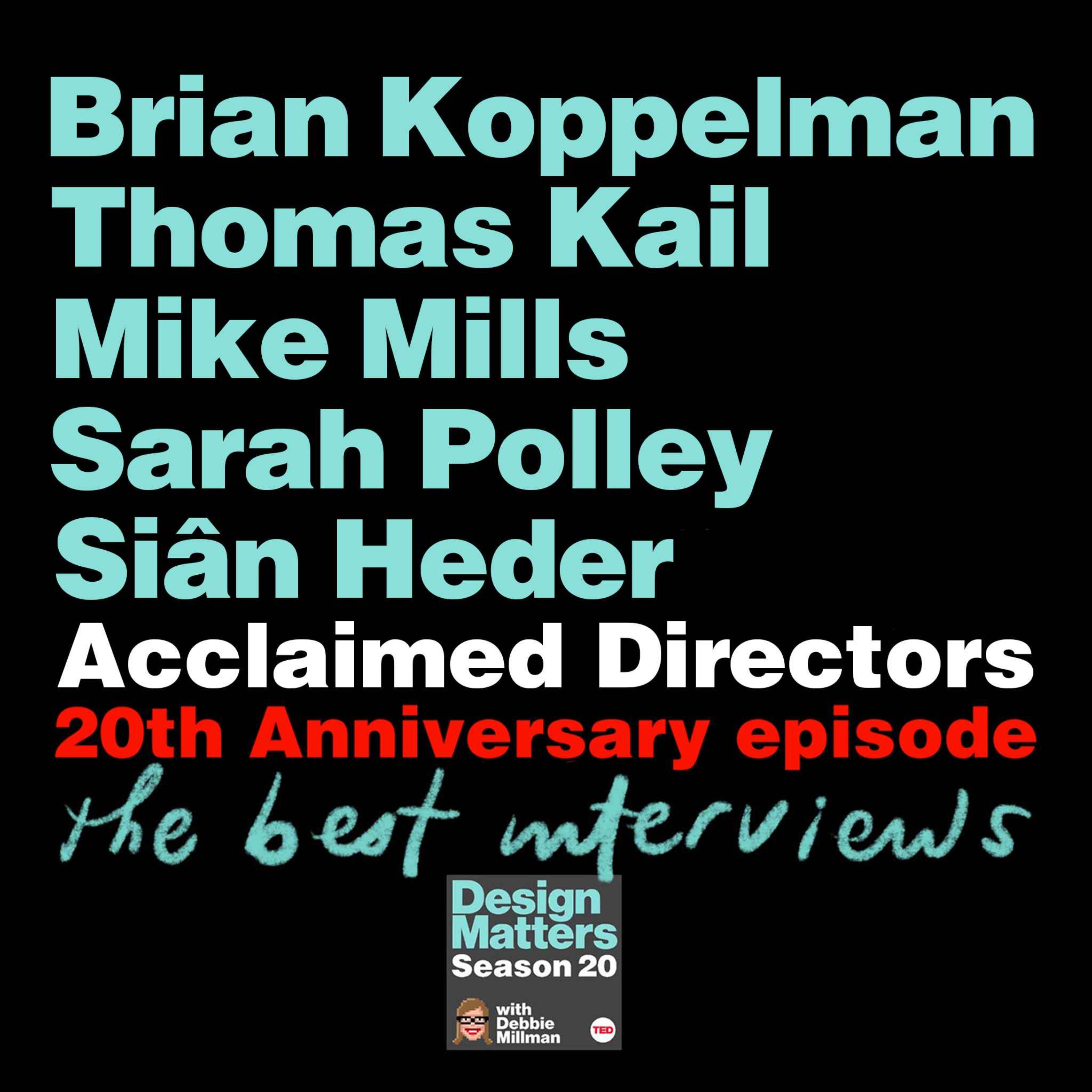
Description: For the 20th anniversary of Design Matters, Debbie Millman revisits conversations with acclaimed directors Brian Koppelman, Thomas Kail, Mike Mills, Sarah Polley, and Siân Heder, exploring the director's role in creative collaboration.
Written by AI. May contain mistakes.
Discussion on the impact of directors in various mediums and collaboration.
“We were saying the same lyrics at the same time.”
Brian Koppelman shares his journey and the films that shaped his career.
“I didn't do this work for very long, 11 years after that, until we wrote our first movie.”
Insights into Koppelman's writing process and partnership with David Levine.
“poker club in manhattan on 24th street uh i called him in the middle of the night and i said dude we're going to make a poker movie.”
Exploration of Koppelman's fascination with poker and risk-taking in filmmaking.
“We never get there, but some closer version of that.”
Discover the initial struggles and experiences in the theater industry.
“He was someone who made our job more difficult.”
Learn about the valuable lessons gained from working as Audra's assistant.
“And I was – I thought, well, this is it.”
Explore the founding of Backhouse Productions and their early shows.
“You were introduced to Alan Hubby, the owner of the Drama Bookshop on 40th Street.”
Understand the importance of collaboration and networking in the arts.
“And that was, you know, there's a line in Hamilton, you know, which is taken from a quote attributed to Burr.”
Hear the story of the first meeting with Lin and the connection made.
“You and Lynn met in the spring of 2002, though you had been given the script and score of the musical In the Heights two years before.”
Discuss the challenges of providing honest feedback to peers.
“Well, that was a five-hour conversation that became the rest of your life.”
Examine the impact of hip-hop on storytelling within theater.
“When you finally met at the Drama Bookshops Theater, you sat and talked for this five-hour sort of mega conversation.”
Learn about the influences and perspectives that shape Mike's work.
“that's going to be alive in a certain way.”
Discuss the portrayal of depression and its significance in storytelling.
“me looking at things that have happened that have sort of more of a historical tooth to it, that have something about someone who's less represented in our narrative, someone who had more of a struggle.”
Discover how depression influences creativity and art-making.
“So this thing which I found in the Eames, this thing which I find in some conceptual art, and like Hans-Peter Feldman, this thing which I found in Ozu is this like stark simplicity and sati.”
Understand how loneliness shapes the narratives within films and art.
“And I'm attracted to so much art, which does that for me.”
Learn about the personal experiences that inform the making of films.
“And so whenever you make anything, any drawing, any book, any movie, you go into that river a bit, you know what I mean?”
Explore the complexities of family narratives and storytelling.
“but he's saying it to all these strangers in the darkroom, and he's really in touch with them.”
Investigate how personal truths adapt within family narratives.
“And the way we do this unconsciously, it just got its kind of talons into me.”
Reflect on how misunderstandings shape our perceptions of family.
“And then the most astonishing thing happened.”
Discuss the emotional impact of discovering family secrets.
“How did the realization about who fathered you biologically impact how you felt about your mother and your father?”
Explore the complexities of family relationships and personal guilt.
“I mean, I think at first I felt tremendously guilty for finding it out.”
Learn about the significance of representation in media through storytelling.
“and I'm so glad she had some fun while she was here.”
Discover the process of developing authentic and nuanced characters.
“And the first time she did it, I will never forget that.”
Understand the challenges and responsibilities of depicting deaf culture.
“This is about making this character really complex and understanding why she made the choices she made and giving her many dimensions and aspects.”

Get the gist, explore an idea or ask about something said.
 Claude
On Design Matters with Debbie Millman, what are the key points of this episode?
Searching your listeningAutomatic transcript. May contain errors.
0:00Everything in that movie came from the real world down to the dog. I think I became less dogmatic about truth and more interested in what people need emotionally to survive.
0:36celebration of the 20th anniversary of design matters. We'll hear from some of the directors that Debbie has interviewed over the years. We were saying the same things. We were saying the same lyrics at the same time. What's the next thing that I want to do? Boy, this seems hard to do. How do I do it? I felt a huge responsibility to get it right.
1:03theater movies television different mediums yet they all require a director directors are the people at the center of an intense collaboration of writers actors designers and technicians in recent years i've had the opportunity to speak with some of the great directors working today and I'd like to play some excerpts from a few of those interviews. Brian Koppelman has produced albums and written and directed movies and television shows. When I spoke with him in 2017, he was the showrunner for the TV show Billions, which he also co-created. I read that you were really impacted by how the Coen brothers and Spike Lee captured a new kind of language, what you referred to as both spoken and visual.
1:49and then years later when you saw Pulp Fiction, opening night was to you the way people talk about seeing the Beatles on Ed Sullivan. That's completely true. So talk about that moment. Well, that was college. Another one of those moments. Yeah, I was in college. Well, so Spike Lee, his movie She's Gotta Have It and the Coen Brothers Raising Arizona came out within a few months of one another and I remember going to see She's Gotta Have It. I'd never heard of Spike because it was his first movie. That movie destroyed me. Yeah, I couldn't handle it. First of all, it was the funniest thing I'd ever seen in my life.
2:21And then also, it mattered so much. The visual style and the sense of humor of it and what it was about killed me. I went back three nights in a row. I brought, each night I brought more friends to see the film. And I memorized it. And then soon thereafter, I went to see Raising Arizona and did the same thing. And that kind of planted a seed, right? I didn't do this work for very long, 11 years after that, until we wrote our first movie. But that's when I realized there's this language in both a visual and a verbal language. And people can use language in film in this very specific way. But yes, in 94, when I saw Pulp Fiction, the world exploded for me.
2:59The first movie you wrote is a film called Rounders, which you wrote with your writing partner, David Levine. And you first met David back on Long Island when you were 14. You've been best friends ever since. And I read that when you were first doing press for Rounders, you got so bored with the same questions you were being asked over and over about how you met. You started to make up exaggerated stories. Yeah, I don't even remember them, but we did. We made up a lot of stories. To like find the origin story, the actual true origin story. No, we met. We didn't meet on Long Island. We met on like a bus tour of the American West.
3:31That's actually how we met. At JFK? Did you really meet at JFK? Yeah, that's really where we met. At the airport? Yeah. And was it one of those moments like boom or best friends? No, we became best friends like the first day or second day that we met. Yeah, we did. We bonded right away somehow. He was 14. I had just turned 16. And we were the only kids who read on that thing. We both had books. And I really, in a really goofy way, I walked around with like a valise full of cassette tapes. So I was like real nerdy and geeky. I did that later in life with CD cases. Yeah. I mean, so I walked around.
4:02Basically, I wanted an iPad. I really wanted like an iPhone or iPod then. They didn't have it, so I had to have my own. So I would walk around with like 60 or 80 cassette tapes all the time. And somehow Dave was like, oh, yeah, that's the dude I want to be friends with. You've stated that the key to a good collaboration is to be grateful for what the other person brings to the collaboration. How do you write with David? How do you write with a partner? Well, it's shifted over the years. And the way we basically work now is we outline together. So we will go through the whole story together. And then we write the scenes separately.
4:36So we break the whole thing down into scenes together in a room. Here's the way the story is going to lay out. And then he'll take half of it. I'll take half of it. We go away and then we have a master document and we'll submit those scenes as we write them to the master document. And then one of us will go through it first and do a polish and then the other one will go through it and we just switch off. But how do you come up with the original idea? How did you come up with an idea? Let's do a gambling movie where one guy's got out of the business and a friend comes out of jail. And, you know, like how does that happen?
5:06Well, that one happened because I had never in my life had I smoked a cigarette and I'd hated cigarettes. And I caught myself in my office late at night eating like a cheeseburger and smoking. And I was miserable. And I realized what I was miserable about was Amy and I had had our first child. And I wanted to be the kind of person who would say to his kids, go chase your dreams, be anything you want. And I saw that I wasn't doing that and that I'd be a hypocrite. So I went to Dave was tending bar across town from where I was. And I went and I said, look, man, I have to figure out how to do this.
5:42I really want to write a screenplay. And he'd been writing and tending bar. And he said, well, we'll write a screenplay together and then you'll learn how to do it. And we'll we'll really do it. We started talking about what themes would interest us. And we had this idea of a kind of friendship between two people. and we had a couple of scenes uh like there's a scene in rounders when one guy is hiding out in a gym and the other guy goes and finds him in the middle of the night we had that scene really early on but we didn't know what they were going to be exactly and then one night i walked into a poker club and as soon as i walked in and heard the people talking and looked around it was an illegal poker club in manhattan on 24th street uh i called him in the middle of the night and i said dude we're going to make a poker movie.
6:27And he said, yeah, I get it. And then he came the next night to the club. And then we knew where these guys were going to live. You've written or directed or produced a number of poker-oriented or casino-oriented films, Runner Runner, Rounders, Ocean's 13. You also created the TV show Tilt, which was a series set against the backdrop of a fictional world championship of poker tournament. You were also cast in a bit part as a card player in Tony Gilroy's amazing film, Michael Clayton. Hey, that's no bit part. A part. Thank you. A part. Thank you very much. What is it you like so much about gambling?
7:05It's not gambling. It's poker that's fascinating to me. Gambling, although I've written about all sorts of gambling and know about it, what I'm really fascinated by, the thing that really continues to be almost an obsession to me, is professional poker players. It's such an incredibly difficult thing to be, to believe that you can outsmart everybody else at the table, that you have the guts to make the call at the moment when you have a very slim edge, that you can read when the other person's lying or when they're telling the truth. They're like modern-day gunslingers to me, and they always have been.
7:37And it's another life. If I had another shot, it's another thing that I would do. I'm just not quite a good enough card player. But the world of poker has never stopped being something that I love. How do you manage your tells? Right? You're not going to tell us? No, it's hard. No, it's hard. So you're also very involved in meditation. Yeah. That is a big part of your life. Yes. Do you find that meditation and this sort of inner calibration necessary for playing poker well have something in common? Well, awareness. So one of the ways in which people manage tells, I guess, is that instead of making it about you, you make it about the other players.
8:18So you're living in a posture of curiosity and fascination, right? What's going on with them? What's happening over here? So instead of being obsessed with my own state, right, I'm looking and noticing. So certainly that stuff ties in in some way. Meditation wasn't in no way driven by a desire to be, like, better at playing cards. Just better at life, right? Yeah. I practice Transcendental Meditation, which is, you know, silent mantra meditation. And it is a way to gain some calmness and some stillness and a bit of peace. And has the practical effect of, for me, reducing physical manifestations of anxiety by a really big amount.
9:02The same amount that those symptoms would be reduced by taking Lexapro or something. There's a lot of intense emotionality in your movies and in your TV shows. In a podcast with Seth Godin, you talk about how movie executives take comfort in decisions on which they can't get fired. Yeah. But most of your films have some element of risk taking, chance making, gambling. And I don't mean gambling. I mean it rhetorically, sort of life gambling. Your screenplays aren't cliches. There isn't always a predictably happy ending. And I'm thinking of Solitary Man, for example. And yet you've managed to have a career in this industry for decades now.
9:44How do you manage this sort of risk-adverse, try-not-to-take-gambles tenets of the movie business? I tried to set up my life in a way that I could take risks. So that Amy and I thought a lot about the way in which we wanted to live. So that when there were years where I made a lot of money in Hollywood by being a screenwriter, I didn't spend it all, which allowed me to go take the risks of making a movie like Solitary Man. So there have certainly been years when it's been close to the line where, you know, we're living out of savings and we're looking at each other and not sure because I'm making— She's a novelist.
10:25She's a novelist and we're making an independent—Dave and I are making an independent film. but when I made the decision with Amy that this was the life I was going to chase we were really aware because I wasn't I was 30 and I had a career and we were really aware that we were taking a chance together that this could work we were aware of the choice we were making which was to live as writers and filmmakers and I always wanted the ability to turn down Hollywood jobs that I didn't want to take. Even when I talk about like knowing I had to be a writer or not wanting to take those jobs, for me, those weren't sort of effete notions.
11:09The fuller thought was that I realized I was a blocked person, a blocked writer. And that thing of me sitting, smoking and eating a cheeseburger late at night in this office is that I realized I would become toxic, that something would die in me. And that if I allowed that to happen, that toxicity would spread to those that I loved. That was really the thought, because when something dies, it becomes toxic and it spreads. And I didn't want to become toxic. And so I've always had an awareness that if I'm not leading from a place of curiosity and fascination, I become sad and angry and miserable.
11:49And then I could be that way to the people that I love. And that instead, if I'm leading from those places and I feel like even if that means I make a movie like Solitary Man that while incredibly well reviewed and I get letters about it all the time, wasn't a big commercial hit, but that gave me so much more joy than doing some rewrite on some big movie because I was making something that I cared deeply about making so that I had this sense every day of making progress and moving forward and becoming closer to a perfected form of myself. We never get there, but some closer version of that. So I don't even think about risk.
12:29I don't process risk in the way you're talking about. I really think of all this stuff as what's the next thing that I want to do? Boy, this seems hard to do. How do I do it? Brian Koppelman in 2017. Thomas Kale is a multi-award winning director of plays and television shows, and he's also a producer. In 2016, he won a Tony Award for his direction of the musical Hamilton. I also spoke with him in 2017. When you were about to stage the production of Ree Peter, you found out you had to share the performance space with a freshman who had composed a musical called Seven Minutes in Heaven. And you thought, who is this guy who is taking our lights, a freshman in a dorm?
13:16He wrote a musical. How cute. Tommy, who was that freshman? Well, the world calls him Mr. Lin-Manuel Miranda, but I call him Mr. Lin-Manuel Miranda. It was the freshman Lin who I never met. He was just this, like, phantom in the shadows. You thought it was an annoyance. It was. I didn't think it was. It was. because we had a light plot and we had seven lights and then five of them would disappear to this dorm for this. I mean, first of all, it's a terrible title, The Seven Minutes in Heaven. We still talk about it. But there was this precocious freshman who was writing things and they were taking from us and we were seniors.
13:53And, you know, I watched Grease. Like, you don't mess with seniors. And so he was just in the way. He was someone who made our job more difficult. And he then spent the next 15 years doing that in my life. Well, all that being said, you actually never met during the one year you overlapped at Wesleyan. I did not meet him. After you graduated, you got a$100 a week job as the assistant stage manager at the American Stage Company in Teaneck, New Jersey. And I read that you lived in a windowless basement apartment nearby. But you couldn't have been happier. The first three apartments I lived in were...
14:31I read that you actually didn't want your mother to see the first three apartments. There is no way my mom was going to see those apartments. Yeah, I just, I came to this late, so I felt I was behind. And when I got that job through the good graces of a friend of mine who got me an interview for this job that was basically free labor, and they gave me$84 a week after taxes. And I drove the van and swept the stage and wrote the program and, you know, was backstage doing run crew and had little walk-on parts. And I just did whatever needed to be done. And that was my grad school. And I was – I thought, well, this is it.
15:12In 2001, you went to work for the amazing Tony Grammy Emmy Award winning performer Audra McDonald. What did you do for her? Whatever needed to be done. Whatever. You were her assistant, right? Yeah, I was her personal assistant. And Audra was an incredible boss, you know, because she really just wanted me to get the work done and do my thing. Like, if I could do eight hours of work in three hours, then great. You know, she really, it was almost like having, you know, not only a window into a world I now started to think about constantly, but if she was in rehearsal for a concert, she'd say, yeah, come hang in the back.
15:48You know, just make sure to get the stuff done. And she was someone who just gave me a glimpse of what was possible, how to act, how to work at the highest level and be decent and kind and thoughtful and forceful and powerful and how you have to navigate and negotiate. And I sort of learned how to produce on a very small level because if she was doing a gig where she wasn't paid, I was kind of the point person. So I would have to coordinate and navigate and figure out what she needed and make sure that she could do her job. And so I was doing that simultaneously with this little company that I had.
16:21And she was like, yeah, do your thing, and I need you here. And so I did that for three and a half years. So that little company, that was when you and some of your Wesleyan friends formed a theater company, Backhouse Productions. Correct. You were introduced to Alan Hubby, the owner of the Drama Bookshop on 40th Street. And Alan was looking for a startup company to produce plays in a 50-seat performance space in his basement. And you signed on for the challenge. What kinds of shows were you putting on at that point? I did four plays that I wrote at the American Theater of Actors on 54th Street, which is sort of like a rite of passage.
16:56It's like above a police station. And I think my budget was$1 ,300. And, I mean, that was the dream. I mean, I was on 54th Street. And the drama bookshop is on 40th Street between 7th and 8th. It's still there. It's an absolute cultural institution that for some reason said, hey, go downstairs, paint that room black, and just make stuff. And that's sort of how we paid our rent. and Alan's generosity made us feel, this was my friend John Mailer, Neil Stewart, and Anthony Veneziale, it was the four of us, we thought, wow, we have 52 weeks to program. We can't fill all of that. So all of those producing genes of yours have to be cultivated because, oh, good, Debbie, you wrote something?
17:35Great. Go get two of your friends. I'll set up the chairs for this one. Okay, then John, you write the next one. Neil, you direct it. I'll be in this. So we just had to keep that thing moving and we had to keep it full. And so I learned not only how much bigger the world was than my little group of friends, but that there were people that were going to make things that I would never be able to make. And I welcomed that. And that was, you know, there's a line in Hamilton, you know, which is taken from a quote attributed to Burr. if I'd read more Stern and less Voltaire, I would have known the world was wide enough for both Hamilton and me.
18:05And when Lynn and I both read the book before we'd really started talking about it, we both circled that. And I think a lot of that was cultivated down in that basement. Like I needed those other people to make those things. Otherwise they would not exist. So this binary idea that it's you or it's me was completely exploded back then. It never occurred to me that someone else's success meant I couldn't achieve or there wasn't space for me. I think there's a way to create space. And I learned a lot of that in this tiny basement, in some sort of paradox. You and Lynn met in the spring of 2002, though you had been given the script and score of the musical In the Heights two years before.
18:45Now, I read that you were immediately taken by the play, yet you waited for two years to meet. We had to graduate. Why? Why? You were waiting for him to graduate. for him to graduate, yeah. So you kind of were watching him? Were you just waiting for him to? Well, you know, in 2000, like, I mean, first of all, talk about when you're not aware of time. You know, he's 22 years old. And I thought, yes, we'll wait two years till he graduates. There's no consciousness that Lynn is living his life for those two years or might not want to meet up with us. There's not a football coach waiting to get him into the professional leagues.
19:18No, this was not the major leagues. And when I went to go visit Lynn with my friends in May of that year, it never occurred to me that he wouldn't say yes. I just thought, well, we'll go and we're going to say, we have a little theater on 40th street with 50 chairs. Why would you not want to go there? And he kind of looked and he was like, all right, and I'll talk to you. But, you know, Lynn was even then focused and deep thinking and had a real idea of what he wanted to do, which was make theater and tell stories. And we sat in the basement in June and just had a conversation that has lasted for, you know.
20:02Well, that was a five-hour conversation that became the rest of your life. But you're not telling us about one really interesting little story that happened before when you first, first, first met. Now, you went to see his senior thesis, which you didn't like nearly as much as in the Heights. And when you met him, you shook his hand and said, enjoy this. You know what? I was a young man. But you tease each other now, right? You say that all the time. All the time. Enjoy this. Absolutely. Yeah, enjoy this, bro. Yeah, I really co-opted that phrase and ruined it for us. Yeah, I was at this time in my life where I thought I couldn't lie.
20:41Like my artistic integrity was so important to maintain for myself that I couldn't go and tell him that it was wonderful if it wasn't. I just said, enjoy this, because frankly, what more was there to say about Unborrowed Time, his senior thesis? Yes. Not to be revived soon. No? Not by me. Now, you said that In the Heights had the ability to capture the music of today, today. That if you go back in history, popular music and theater music were the same thing. And was this the first time that you heard hip-hop used to develop a story in this type of theatrical environment? It was probably the first time I'd heard it.
21:18That doesn't mean it didn't exist. It's just that, you know, in my myopia, I only had so many things that I was absorbing. Because I first heard this in 2000. Yeah, I mean, the first hip-hop radio station didn't come out until 1993. Babito and Stretch Armstrong. Leslie and Grad. head. I remember being on the subway in one of those very un-air-conditioned New York subway stations. Like there's certain ones like Herald Square when you're like, oh my gosh, come on, somebody. And Lynn had written a song about how hot it was in a subway station. And it was just like, he's writing about my life. And it sounds like the kind of music that if someone said, hey, here's the new Tribe album, or the Fugees made this, or here's De La, or, you know, like, then I'd be like, oh, they have a song about this.
22:04And this was a guy writing in the context of story, a larger story, a musical, a song that felt like it was speaking to me in that way that I think we're always looking for something that feels like it's for us. And here it was, you know, quite literally. And I just thought, I don't know who this kid is, but my friends, John and Neil, who had seen the show, I said, you were right. When does he graduate? Let's go find him in May. And I will spill my soda and say, enjoy this and try to not ruin it immediately. When you finally met at the Drama Bookshops Theater, you sat and talked for this five-hour sort of mega conversation.
22:38And I read that you stated that you'd felt like you'd been looking for him your whole life and didn't know. What was that like? Were you scared by that in any way? Did it feel so, like, overwhelmingly powerful that you didn't want to blow it? I knew that I couldn't blow it because we were saying the same things. We were saying the same lyrics at the same time. It was just, where have you been? That's what it felt like more than anything. And I just didn't want to stop talking to him. And so, you know, I feel the same way 15 years later as I did then. And that five hours felt like 10 seconds. I mean, it was not real time and space.
23:16It was just like this Ratatouille moment. It was like, whew, and there I was. Thomas Kale in 2017. 2017 was a bumper year for interviewing directors. Not only Brian Koppelman and Thomas Kael, but Mike Mills also joined me on the podcast. Mike Mills' films include Thumbsucker and 20th Century Women. Let's talk about some of your feature films. You said that you feel you have the best shot at making a good movie if you work from a world that you've closely observed, things that you truly love, and things that truly confuse you. Why the confusion part? That's the most important part in a way because you need to have an alive question and something that you have to desperately heal or understand a bit more, right?
24:11I'm not going to say understand, period. As if that's possible. The questions that are just gnawing at you and kind of tearing you apart on some level, that's great film material. That's going to keep you charged all the way through. that's going to be alive in a certain way. It's going to have a certain electricity. So it's not just for me. I love Allen Ginsberg's Kaddish. I love Howl because it has that quality to it. There's a desperate, he has to write that to be sane. Other things, like Maggie Nelson's Argonauts, that book, I feel like it's someone trying to understand their world on a fairly intense level, right?
24:56And for me, being, you know, okay, being a first world, heterosexual white guy who grew up in a fairly comfortable scene, my perspective, the things the world has shown me is not that interesting or is not that valuable, even to me. I'm not attracted to people like me when I'm seeking a book or a movie or something like that. My parents have very weird, interesting historical stories. So what are you attracted to then? Well, I just feel like historically, in terms of contributing to a narrative that helps make the world more open, helps make the world more heterogeneous, all that. Me just coming up with fiction based on my worldview is not just the most interesting thing.
25:56Me looking at other people, me looking at things that have happened that have sort of more of a historical tooth to it, that have something about someone who's less represented in our narrative, someone who had more of a struggle. And when the struggle for both my parents, there's a personal and political, there's a very minute, granular, intimate interior quality to it that relates also to American history and bigger history. That's really exciting. And that I got to see it firsthand, right? So it's like I can report on it, hopefully with some specificity. That is what is interesting. If I'm just in a passive way, kind of going from my basic unconscious, that I don't find super interesting.
26:43Does that make sense? Absolutely. Yeah. Your first feature film, Thumbsucker, came out in 2005. It starred Vincent D 'Onofrio, Tilda Swinton, and Vince Vaughn, and it's based on Walter Kern's novel about an adolescent boy's mutiny against his family. You wrote a script, you raised$4 million to make it, and I read that you aspired to the simplicity of Yasuhiro Azu, the Japanese filmmaker who placed his camera at only two levels, sitting height and standing height. So you started with gigantic ambitions. Well, that's very simple, actually. If you're starting as a filmmaker, that's a great model because it's like it takes out a million questions.
27:25You only use the same lens. And like lenses and what they do to faces and what they do to the emotions of a scene, that's such a complicated thing that as a 51-year-old, And I feel like I'm just really understanding how a 75 changes the scene compared to a 35, you know. And a 35 is kind of basically what your eye sees. And I kind of learned that unconsciously through Jim Jarmusch. Because Jim Jarmusch is a huge Ozu fan and has that sort of observational plop-down camera quality. And again, this is like very emotionally soothing to me. There's no virtuosic envelopment to it. You're kind of seeing it's a little bit like it's like a documentary photograph.
28:03They look sort of stable about it. Yeah. So this thing which I found in the Eames, this thing which I find in some conceptual art, and like Hans-Peter Feldman, this thing which I found in Ozu is this like stark simplicity and sati. Like I love sati because I have room to think around the notes and to be myself. And there's an openness and you can kind of see the music or something. But there's also a sort of sadness to his music, I think. Sure, sure. Yeah. That's a part of it that I love. Yeah, yeah, yeah. I mean, everything I'm attracted to has some depressive streak in it. I was actually going to ask you about that.
28:38How much does depression figure into your work? The movie you did after Thumbsucker was about Japanese depression. You know, depression is something that's in my family that you can't talk about, that you feel, that you inherit, that you take on as a child. but you can't, it's illegal to say, right? So you spend the rest of your life trying to say it or to have a space where you can feel it and it's okay and to not either be shamed for having the feeling or dragged down by the feeling. So someplace that can hold the feeling without drowning in it or drowning from the shame, right? So some of which of my art, and Thumbsucker in particular, is about a place to have your shame, have your vulnerability, and survive, right?
29:22And I'm attracted to so much art, which does that for me. Do you still feel like you experience a lot of shame? Oh, sure. I mean, less and less. Years and years and years and years and years and years of therapy. You know, I kind of expunged that and just being an adult and being married and having a kid and all that. But it's the background. Your wife, artist, writer, filmmaker Miranda July, said this. making things is what you do to comfort yourself if you feel an inborn loneliness that won't go away and i think that's one of the best definitions of making things or the best motivation that i've ever read about making things um do you agree oh yeah that's we both share that dynamic the mirroring that we wanted or from the family to the big family just didn't work out.
30:17And so you, as kids, you found these other ways to kind of slightly control it, apparently control it, seem to think that you can control it, but not really. And also just keep yourself busy and have some relationship with yourself that you can kind of see and feel and hold on to, you know. Do you feel that beginners and also I think 20th century women reflect that inborn loneliness? There's a sort of sense of loneliness, I think, throughout both movies of trying to be understood, trying to be part of something bigger than oneself in some way. was that and i think all the for different reasons all those characters are trying to be themselves and it's sort of literally illegal or become illegal in their heads i think there you know there's certain artists i'm sure everyone knows this is seen it's like you meet so-and-so they're the chipperest person and they're like oh i just wrote a new song when i hear it sure it's like leonard cohen and all their songs are like leonard cohen but they're like a happy person, but their creativity is a place where their depression, or depression can be like a trapping reductive word, where their unknown mystery of that which is not happiness resides, right?
31:36Yeah. And so whenever you make anything, any drawing, any book, any movie, you go into that river a bit, you know what I mean? And it's not always a negative. It's not always a downward succumbing situation. It's, I think, also a solace in a lot of ways. Or naming it to get out of it or whatever. It could be so many different things. So I feel like I'm one of those people. I'm doing a project right now for the National, the band The National. And I kind of feel like I don't know them really, but it's like somehow I feel like it's true for them. Like their creativity, their joint creativity is a space where that mystery is held.
32:20That sounds so new agey. But I believe it. No, I think I understand it. I mean, maybe there's this innate inborn loneliness that is using creativity in an effort to connect somehow. For sure. Sure. Beginners is loosely based on your own relationship with your father. And the movie starred Ewan McGregor as a graphic designer, whose 75-year-old father, played by Christopher Plummer, has just come out. And he wants to experience the gay life he denied himself when he was married. And when you were scripting Beginners, you wrote the words, this has already happened to everybody all the time on an index card.
33:02How come? So that story is totally based on my life, and it's sort of a creative nonfiction or something. And my dad dying, my second parent dying, and it's quite intense and sad and like a huge milestone. And my dad's coming out and having five gay years, but not having as much as he wanted and dying hungry. You know, like dying, like wanting to eat more of the beach, you know? Yeah. And so you can kind of get like precious about all that, right? Or even like your parents dying. You can feel like it's an individual thing or you can feel just precious. And I wanted to sort of invoke the blues in a way, right?
33:41Like these are things that happen to all of us all the time everywhere. And just to remember that, right? To keep that front and center in my head. Yes, everything in that movie came from the real world down to the dog. But I wanted to sort of put it into a fire and release it to the world, right? That's what making a film about it is kind of doing. And also I had Fellini in my head a lot for both those movies because he's so good at understanding that his stories come from a very personal space, but he's saying it to all these strangers in the darkroom, and he's really in touch with them. And he treats it like a lyrical myth, right?
34:25And he understands the connection between the two things. Mike Mills in 2017. Sarah Polly was a child actor and then an adult actor before she started directing. Her movies include Away From Her and the Oscar-winning Women Talking. One of the things I spoke to her about in 2023 was a documentary she directed. Views of shared reality are reflected, again, in your remarkable 2012 documentary Stories We Tell, where you challenge the idea that any one narrative can accurately portray and reflect reality. And this came with your sort of shocking news that your family wasn't quite what you thought it was.
35:14And I was wondering if you can talk a little bit about the plot of the film, of this documentary. Sure. So I found out when I was 27 years old that the man who raised me, my dad, who I've been talking about, was not my biological father, and that my mom had had an affair with a man named Harry Galkin in Montreal in 1978, and they had conceived me. And I was raised as part of my family with my siblings, not knowing this. There had always been rumors that I was the child of some actor in some play, maybe, but it was really, it was kind of a joke. It never was really serious. I mean, what was interesting was that after this happened, and there was this revelation, and my dad found out, my siblings found out, I would start to hear people tell the story to others.
36:00And the stories that we were telling bore very little relation to each other, even down to the details of how I found out my biological father was my biological father. Like, everything had been shifted or changed or details were missing or added. In many ways, I felt, in order to help fit into the context of the narrative that that particular person in our family had about our family. So I became really interested in the idea of capturing all of the competing and conflicting and sometimes complementary narratives about the same event in a family. And this idea of a story told not by one voice, but by a chorus of voices.
36:42So I was just interested in looking at all the different ways we fictionalize and shift and change the details of our narratives, not willfully and not intentionally, but out of some sense that there is a narrative we are somewhat attached to, there's a story, there's a meaning we're attached to that everything must kind of slot into. And the way we do this unconsciously, it just got its kind of talons into me. And I got so excited about the idea of capturing my dad's version, capturing Harry's version, capturing all of my siblings' version, and having them tell the story in these conflicting ways.
37:18What did making that movie help you understand about the nature of truth and memory, whether it be others' versions or your own? I mean, it's a good question. I think I became less dogmatic about truth and more interested in what people need emotionally to survive. People were telling the stories that had meaning to them, And sometimes they weren't right, but it didn't make it not okay from my point of view for them to live alongside that story that they were telling. It was a lot of, I think, staying out of the way. I think one of the things that I loved about the process was I had to sit with each of my family members and really listen.
38:05And, you know, when you're making a documentary, a really great tip I got from another documentary filmmaker was, you know, when someone finishes answering a question, don't jump in with your next question because it's entirely possible they'll want to fill that space. And in that space, what they might give you is far more potent and unintentional than what their constructed answer might be. And how often do we do that with our family if they tell a version of events we don't agree with, right? We jump in, we correct, we argue, or we say, actually, I remember it this way, but to actually have to listen and to hear people go to the end of a story and leave those silences and let it be their version and not impose my own, you learn a tremendous amount that you've missed about how people think and feel and who they really are.
38:55And I think there's so much about our families where they have remained strangers to us in a way that so many others wouldn't because we're imposing layers and layers of years and years of small interactions that build into one kind of monolithic narrative that we then ride like a bull, you know, like around that relationship. And so to sort of have this very delicate space of listening and finding out where you've just been entirely wrong is really interesting. I actually had a really interesting experience with a family member recently, which, you know, for me, like, shone a light on this whole experience where I talked to a family member recently about something that was happening to me that was kind of exciting.
39:41and then I was sort of inviting them to come stay at my cottage and they were sort of giving me responses that I'm used to over the years of uh-huh uh-huh and in my mind I knew exactly what was going on in this person's head what was going on this person's head was you know why do I have to hear about this great thing that's happening to you like I don't care and you know yeah yeah sure I'd love to come to the cottage this person was never going to come to the cottage and they were sort of humoring me and I could just feel the cynicism and the judgment dripping it's someone I actually have a very good relationship with, but I know that there's parts of me that irritate them and these were present in the conversation.
40:14And then the most astonishing thing happened. They hung up the phone, but they didn't hang up. And I was just about to hang up and I realized they hadn't hung up. And I suddenly heard them call out to someone else in their household and say, I just talked to Sarah. And I thought, oh God, like I'm going to hear all the criticism that I've always known is there, but they've never said out loud. Like this is an openly critical person. And what they did was they conveyed to this person how excited they were for me about this thing that had happened to me and how excited they were to come that summer to my cottage.
40:46And it was so palpable, the joy in their voice and the pride and the excitement about seeing me. And I realized that I had for my entire life been reading a narrative into this person's tone of voice and gesture that did not exist. And it was so horrifying. I'm not somebody who's constantly like reading and negative things to the people. I know, but this was just something I knew from probably 800 ,000 misunderstandings built up over decades. I had created a narrative that wasn't true. And the only way I would have ever known that would be to have been able to hear this thing I wasn't supposed to hear after, you know, a phone call they hadn't hung up on properly.
41:31And so for me, that's actually sort of in many ways what Stories We Tell is about, but it was an amazing moment for me to realize I'm still doing it. I'm still mapping and projecting stories about relationships onto people that aren't real. And we all do that every day in ways we don't get to have, you know, the big reveal that we were wrong. Yeah. How did the realization about who fathered you biologically impact how you felt about your mother and your father? Hmm. I mean, I think at first I felt tremendously guilty for finding it out. And it actually took a close friend of mine after months of just feeling terribly guilty for finding this out to say, do you understand that by finding out this information, you didn't cause anything to happen?
42:22Like, you didn't actually make this happen? You're not responsible for your mother's affair? This isn't something that you did or that you're responsible for that is in any way bad? And I didn't know that. I thought by finding the information out that I had somehow hurt my father. I didn't tell my dad for a long time. I actually didn't tell him until a journalist threatened to print the story who had heard it from somebody else. And so that was actually the impetus for telling my dad in the first place. I think with my mom, I mean, oh my God, my mom was one of that generation of women who was expected to do all of the housework, all of the cooking and cleaning, all of the childcare and provide half of the income to the family.
43:05So she worked crazy hours in a profession that was incredibly dismissive and horrible to women. She had absolutely no support at home. We didn't have help in anything. So she's sort of running around vacuuming and cleaning and dusting and trying to get meals on the table and doing all the grocery shopping because my dad also didn't drive. She's waiting hand on foot on kids and a husband. And I just think any joy that that woman got in her life, I feel no judgment for. So she went away and did a play for a couple of months in Montreal and got to kind of feel herself and have joy and not have to be responsible for everybody in the world for five seconds, I find that really, really hard to judge.
43:53I'm a big fan of monogamy in my own life. I live a very different life than my mother did with a lot more freedom and agency and support and like an equal partner and everything. So I just think it's like I can't find it in my heart to judge her on any kind of moral grounds that she had a beautiful affair and kept that for herself. I think that many people would have just snapped and not been able to care for their kids with that kind of pressure. And if this was what helped her get through, good for her. And she lived a short life. My oldest brother always says that. She always says, you know, she only lived till she was 53 and I'm so glad she had some fun while she was here.
44:36Sarah Polly in 2023. Sean Hader has directed two feature films, including Coda, which earned her an Oscar for Best Adapted Screenplay. The movie was also named Best Picture in 2022. In 2023, I spoke with her about both the movie and a television show she wrote for. I have to just talk briefly about your time on Orange is the New Black. Like, you wrote for the show from 2013 to 2016 and wrote my all-time favorite episode titled Lesbian Request Denied, which was the third episode of season one. And episode one and episode two were great. They sort of set the stage for what the whole show was going to be about in so many ways.
45:26But I remember seeing episode three and thinking, OK, this show is really going to make a difference. It's so layered in so many ways, that episode. And the actresses, Laverne Cox and Uzo Aduba, feature prominently in this episode. And I think many people, including myself, were introduced to them for the first time at that moment. They were both nominated for Emmys for their roles. Laverne Cox was the first transgender actor to be nominated for an acting award at the Emmys. What was it like writing for these characters? What gave you the sense that, for example, in order to really see Uzo Adubo's character, she needed to pee on the ground in front of Taylor Schilling's character?
46:18One of the great moments in television time. Oh, my God. I have to tell you about that moment. I want to get to this larger point, but that was so funny because we built a pee rig for Uzo. And the first time she did it, I will never forget that. She sort of like crouched down and I remember shooting it. And the pee rig like kind of just exploded in the gushiest way ever. And the whole set like fell over dying laughing and Uzo just died laughing too. It was like a massive horse pee, like coming out of this little woman. That episode was amazing. And that show was amazing. I think, first of all, we didn't really know what we were working on.
47:05Netflix wasn't even a thing. You know, I remember getting that job and being like, what? Netflix? Is this like a, is this like an internet show? Like, what is this thing? It was streaming was not a thing. You know, they didn't have, they had us in House of Cards. We didn't know what it was. Obviously, I knew Jenji's work. I was a big admirer of her and fan of her and she is wonderful. And one of the things Jenji did, which was so beautiful, which now I try to embody as a showrunner, was just giving so much ownership of the show to her writers. Like, I think we all felt so invested and so creatively involved and like to feel that kind of ownership when it is not your show that you've created, but you feel like you've been given the freedom to, hey, go create this character.
47:55Especially with Laverne's character, Sophia, there wasn't any trans representation on TV at that time. Transparent had not come out. Like there was nothing to go and look at as an example of this. I felt a huge responsibility to get it right because I thought, oh my God, this is going to be this trans character on TV and I'm not trans. I don't have that experience. Like for me to write this, I need to majorly research this character. And so I did. I talked to so many trans women and, you know, went to the trans support group in LA and, you know, and just really interviewed so many people and talked to them.
48:38And then it was so important to me, both with that character and with Suzanne, who was initially Crazy Eyes, you know, and there was kind of this, this kind of one note element to the ideas of both of those characters. It's like, okay, there's kind of the, oh, it's a trans character in prison. So it's a former man in a woman's prison. There's so much scandal that can happen around that. And I was really invested in like, I need this to be a central character that we're following and to understand her as a complex human on every level. and I remember having this conversation with the leader of like the trans support group in LA and she said does this character have to be in prison and I was like well she does have to be in prison because they're all in prison it's a show about prison and she said oh it's just such a you know whenever trans people are represented they're represented you know as criminals or and she said so I don't love that she's in prison so can she be innocent she should be innocent of her crime and I remember entertaining that idea and thinking no and in fact like understanding her and why she made the choices she made and this idea that she has to be pure to somehow counter trans representation that had existed that she has to be like this angel who's all good and I'm like, this isn't what this is.
50:11This is about making this character really complex and understanding why she made the choices she made and giving her many dimensions and aspects. And so that was just a really interesting journey. And I remember being very fearful, putting that episode out in the world and thinking that I hoped that people could feel the work and the intention behind it. But and then it was so beautiful to watch what happened with Laverne and with Uzo, you know, but especially watching Laverne. And I remember like a year later seeing her on the cover of Time magazine. Yeah. And going, oh, my God, like how beautiful.
50:49Like, I remember watching her audition tape and being like, oh, my God, look at her. Like, this is who Sophia is. so I don't know it's really beautiful when as a storyteller you get to feel like a cog in the wheels of change you know that you set the pebble rolling somehow at the top of the hill and it picked up more pebbles and it became an avalanche and then there was kind of this massive sea change and it's not because of what you did but you are a part of that and it's that is so fulfilling and I definitely had that I think in relation to that episode and certainly with Coda of feeling like, oh, there's a cultural shift happening, and my story got to be a part of that cultural shift.
51:33So Coda won last year's Best Film Oscar. I was so happy when that happened. You also won the Oscar for Best Adapted Screenplay. And when you were first approached to direct Coda, you hadn't seen the original 2014 French film La Femille Billière, the story Coda is based on. What made you interested in this particular story? You know, I think it's always striking when you're presented with something and you think, oh, I can't think of a film with a deaf family at the center of it. And the fact that that doesn't exist in the world felt like a driving force to put it in the world. You know, when I did watch La Femile Belier, the character of the coda at the center was a very interesting, a CODA as a child of deaf adults.
52:24And it's very interesting to me that most deaf people have hearing children and most deaf people are born to hearing parents. And so there's kind of this cultural divide that happens where a lot of times CODAs, you know, who are growing up with deaf parents in a way grow up more embedded in deaf culture than a lot of deaf people did as kids because they had hearing parents that maybe didn't sign or live within the deaf community. So that idea of someone who was kind of part of these two worlds, and also part of neither and living in this limbo, you know, where they culturally kind of felt connected to a community that they actually aren't a part of, which is the deaf community.
53:10And I had a beautiful thing that a CODA friend said to me the other day when she was trying to talk about being a hearing person growing up in a deaf family. And she said, I lived in the oppressor's body. so even though I was their child and I was this I also represented the world that had been oppressive and horrible and exclusionary and holding those things and holding that duality was like a really complicated thing to grow up with so that was very intriguing to me in that character and exploring what that was and having a teenage girl at the center where her feelings were not marginalized, her feelings were actually the stakes of the movie, was exciting to me.
53:59And so all of those things, and then really the deep dive that I got to do with the deaf community, and it's changed my life. You know, it's changed my life, not just as an artist, but it really has changed my life, period. There is this idea of who should be writing what, which I think is very real, and those conversations need to be happening. and I was fully aware that I was a hearing person coming to this deaf story about a culture that was not mine but what that meant is I had to come in as this very pure listener and know what I didn't know and really put a team around me of deaf collaborators both in front of and behind the camera but these moments that are almost embarrassing when you have them you know where like my production and designer and I set up the living room of this family.
54:49And I remember Anne walking onto set and going, no deaf family would ever set up their living room this way. You know, deaf spaces are circular. Everybody needs to see everybody else. Like the living room's not like centered on the TV in the same way. It's centered on like having a conversation with each other. The couch would be facing where they could see the door. They would want to know who was coming in and out. So there were all these moments where you kind of went, oh shit, like I'm such a dumb ass. Why did I, what was I thinking with the furniture? But I had that push and pull. I had the people there as a team to kind of go, hey, no.
55:27And it was a really powerful, amazing experience to make that film, not just in the writing of it, but in the way we sort of re-imagined what a set could be the way we shot it, put it together, you know, even the year long press tour. I think it was a very transformative experience for everyone involved in the film, especially me. Sean Hader in 2023. You can hear the full interviews and hundreds of other interviews with a huge variety of creative people on our website, designmattersmedia.com or wherever you get your podcasts. We'll be back next week with one final special episode called from the many years I've been doing Design Matters.
56:12Yes, this is the 20th year we've been podcasting Design Matters, and I'd like to thank you for listening. And remember, we can talk about making a difference, we can make a difference, or we can do both. I'm Debbie Melman, and I look forward to talking with you again soon. Design Matters is produced by the TED Audio Collective by Curtis Fox Productions. The interviews are usually recorded at the Masters in Branding Program at the School of Visual Arts in New York City, the first and longest running branding program in the world. The Editor-in-Chief of Design Matters Media is Emily Weiland.
For the 20th anniversary of Design Matters, Debbie Millman revisits conversations with acclaimed directors Brian Koppelman, Thomas Kail, Mike Mills, Sarah Polley, and Siân Heder. These excerpts explore the director’s role as the central collaborator, guiding creative teams and shaping a project from vision to execution. Together, they reflect on the choices, pressures, and responsibilities of bringing a story to life.
Hosted on Acast. See acast.com/privacy for more information.