Ask ChatGPT

 Design Matters with Debbie Millman
18 Aug 2025 · 40m
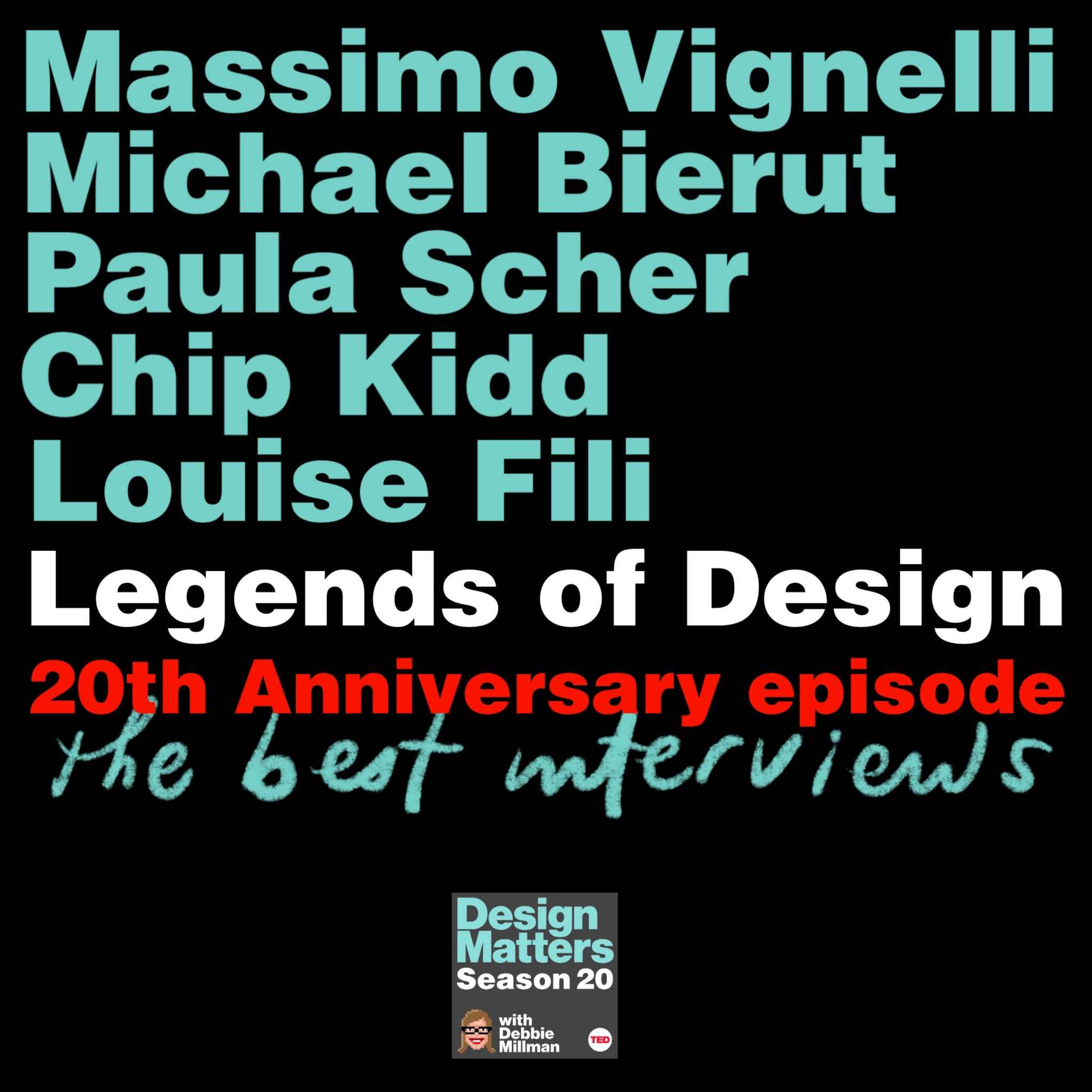
Design Matters with Debbie Millman is a pioneer podcast, exploring the lives and careers of some of the most creative individuals in the world. Celebrating its 20th anniversary, this episode honors the legacy of design through conversations with iconic designers.
Written by AI. May contain mistakes.

Get the gist, explore an idea or ask about something said.
 Claude
On Design Matters with Debbie Millman, what are the key points of this episode?
Searching your listeningAutomatic transcript. May contain errors.
0:00It's not only harmony, but it's provocative at the same time. I mean, my goal is to teach somebody how to see. I mean, it's bringing something to you, and then you have to bring something to it.
0:15From the TED Audio Collective, this is Design Matters with Debbie Millman.
0:22On Design Matters, Debbie talks with some of the most creative people in the world about what they do, how they got to be who they are, and what they're thinking about and working on. On this episode, in celebration of the 20th anniversary of Design Matters, we're going deep into the archives to hear from some of the greats about the power and responsibility of design. It participates in the world of communication. That's just the nature of the beast.
0:53When I started Design Matters 20 years ago, I mostly interviewed designers. I was, and I still am, a designer, and I wanted to have deep, informed conversations with some of the leading lights of my profession. In the early days, the podcast sounded quite a bit different. I think we had a little bit of a technical difficulty at that moment. There was bad telephone audio of me and my guests. I think it's an interesting coincidence. But in 2009, I was able to take it up a notch. I had a little podcast studio built in my offices at the School of Visual Arts in New York City, where I run the world's first master's program in branding.
1:36I hired a producer who is still my producer, a wonderful man named Curtis Fox. I also slowly began interviewing people beyond the world of design. Artists, writers, filmmakers, musicians, creative people, all people living uniquely creative lives. But I never stopped interviewing designers. Over the years, I've had the honor and the pleasure of interviewing some of the most celebrated designers in the world. On this week's show, I want to play some excerpts from a few of my favorites. These excerpts touch on the power of design to change people's lives and the responsibilities designers have in exercising that power.
2:19First up, design legend Massimo Vignelli. Massimo Vignelli was a modernist who designed packaging, housewares, furniture, and more. One of his most famous creations was the 1972 New York City subway map, now considered a masterpiece of information design. This excerpt comes from our interview in 2010. I want to talk about vulgarity. Well, I think one of my major tasks in life was to fight as much as possible vulgarity, not to wipe it out, but at least to reduce it. Do you think that that's possible? Do you feel like you've been successful? I think, of course, not a single-man operation, but I think that in the last 40 years, 50 years, a lot has been done to improve the situation.
3:17I remember when I came to New York, it was a very ugly, dirty kind of city. Today it's beautiful. It's clean. It's a beautiful building. There was no architecture at that time, almost modern architecture. Now it's full of modern architecture. All the big architects are doing things here. It's full of very good designers. There are thousands of good graphic designers around. There was nobody at that time, which was very good for me.
3:45I was lucky. But, you know, it would be for me very difficult to emerge today, you know, because there is so much good design around. Do you feel that the quality of clients has fundamentally changed in the 50 years you've been practicing? Yeah. You know, it's very funny that really what happened. In the old times, I can say that. The old times. In the old times, there were very few good clients. And most of the people were not aware. Today, there are a lot of young people in the companies that they think they know everything. The reality is that they don't. But they're very adamant and they're very commercial.
4:29They're not open. They're not intelligent. They're not cultured enough, basically. They might be intelligent, but they're not cultured enough. And therefore, the communication becomes very difficult because they articulate their wants rather than their needs. And there is a big difference, particularly marketing people, you know, which are the culprit of everything which is wrong. Yes. And, you know, marketing people, they're trained by better education in marketing to satisfy wants instead of needs. And that is the key thing. I want to go back to talking a little bit about your feeling that marketing managers' involvement with design is not always a positive thing.
5:15And you said in your book that we see design that has no meaning, stripes and swash of color splashed across pages for no reason whatsoever. Well, they're either meaningless or incredibly vulgar or criminal when done on purpose. Unfortunately, there are designers and marketing people who intentionally look down on the consumer with the notion that vulgarity has a definite appeal to the masses, and therefore they supply the market with a continuous flow of crude and vulgar design. I consider this criminal since producing visual pollution that is degrading our environment is just like all other types of pollution.
6:03I love to hear you reading it. It sounds even better. Sure, I believe very strongly about that, and I really think it's a crime. It's a word that I use intentionally because I think killing culture is no less of a crime than killing people because it kills their mind. And their spirit. And their spirit. But of course, if we would have to put in prison people that do this kind of crime, that would be too small as a prison. A design prison. They have to look at bad design all day as their punishment. No, but it's true. Marketing people look down to people. Instead, I mean, a good designer or a good responsible client looks up to people.
6:55He understands his function of contributing, taking people out from those low levels and getting them to a better level, just like when you give a good book to a person so they will not have the time to read a bad book, in a sense. and that is the operation one has to believe of course in this redeeming factor of education a redeeming factor of not spreading vulgarity because that lowers the level the more you spread the more the level goes down and instead our operation as designers and architects is to raise that situation so that the world might get a little better placed and increase is the good values.
7:45Make a better food instead of a junky food. It's part of this same idea. Making good music instead of a bad music is part of the same concept. There's making good design instead of bad design instead of commercial design. There's commercial music, there's commercial design, there's commercial fashion, there's commercial everything. Commercial things are done by people that want to exploit other people and couldn't care less about quality. We are interested in quality. This is what is nice. Mobility is our life. Isn't that great? It's beautiful. It's absolutely beautiful. Why do you think that vulgarity is so much easier for people to absorb than culture?
8:23Because it doesn't require culture, exactly. It's easier because it doesn't require education. It doesn't require refinement, brain refinement. So therefore, it's so much easier to like things if you don't know. The moment you begin to know, knowledge brings you sifting abilities. So you begin to sift the good from the bad. The more you know, the more sophisticated you become, the more refined your taste becomes, and so on and so forth. So that is the task, is to sift the trash out. Now, you've said that you believe that design should be forceful and that you do not like limpy design. So how do you define limpy design?
9:06How do you define forceful design? How do you define limpy design? I define forceful design, a design that is emotionally charged, that it has intensity on whatever it does, you know, so that it's not only harmony, but it's provocative at the same time, where the balance between the elements is exciting. the black and the white space, I mean, the printed and the emptiness, you know, are in the proper contrast where the color works in that respect. And all that works with a good sense of appropriateness. So it's great for that situation, you know. I don't like limpy design, you know, the kind of, as I used to say, the kind of nuns like to do, you know.
9:57I wish that our listeners could see the little hand motions you're making right now to define limpy. And, you know, those angel, pure, weak kind of design, basically, you know, pale colors, meaningless stripes and meaningless things. So what is meaningless? Is it decorative? Is it there for the sake of being there? Yeah. Anything which is not pertinent to a situation. But again, it depends on the object and the situation. I have nothing against decoration. Decoration could be very good, you know, but there are ways and ways of achieving. We achieve decoration by subtraction because subtraction is our methodology of working.
10:49Other people achieve decoration by addition. They keep adding. They do something. They do a plate, and then they put the flowers on top. Why do you put the flowers on top? Why don't you design a beautiful plate just by looking at the plate? You say, how handsome that plate is. We have done a plate, for instance, and then we took off the glaze from the edge and revealed the material. And it looks terrific. And so it is a decorative element. There was no need structurally. There is no need for anything else. why we did it, because it adds something by subtracting. That was Massimo Vignelli from 2010.
11:30Massimo Vignelli passed away a few years later, in 2014, at the age of 83. His book that I quoted from, the Vignelli Canon, is still in print. It can also be downloaded for free from a number of different places on the internet. Next up is Michael Beirut, who since 1990 has been a partner at the design firm Pentagram. He's one of the most celebrated and influential designers working today. I've interviewed Michael many times over the years, and this conversation took place in 2016. You worked for Massimo Vignelli for 10 years before starting your now 25-year stint at Pentagram. Stephen Heller asked you what was one of the most important things you learned there, And you stated probably the most interesting thing I learned is that a lot of the things about design that tend to get designers really interested aren't that important.
12:31So can you elaborate what kind of things are you referring to as things that we think are maybe interesting or important and aren't either? I think as a designer, when you're educated, you sort of start at the bottom. Or at least I started at the bottom. I started with just mastering a craft, a craft that involves distinguishing between very similar looking typefaces, resolving the white space in a layout, kind of carefully selecting colors that kind of will work well in different situations, taking the curve of a shape and just making it exactly so. All these things that have to do with shapes and colors and typefaces and stuff like that.
13:07For some time, I sort of thought that that was really the highest form of activity that a graphic designer could engage in. And indeed, when I worked for Mossimo, he demanded attention to that kind of detail. But what made his work successful, I think, had less to do with all that stuff, which simply enabled that success. I mean, he really was just a great editor and a great storyteller visually and just kind of could come up with like the overall idea of how something should be presented. Like, you know, if you're designing a book, let's say, my tendency as a young designer would have been just to fret over coming up with some novel way of handling the page numbers, you know.
13:49You know, it's been done, putting them at the bottom of the page. That's been done. Maybe I'll put them at the center or on the edge of the page or the top of the page or something just to kind of like, you know, blaze new trails in page number location. Massimo understood that if someone's going through a book, they just want to read the words and look at the pictures. And how can you sequence those pictures? How can you vary their scale? How can you make the layout seem both surprising and inevitable? And those are all decisions that are about taste and intuition. Their execution requires a really keen sense of craftsmanship, but the craftsmanship alone is almost meaningless.
14:23And so I think a lot of the things that Mossimo was associated with in his lifetime, like, you know, the famous diktat that only five typefaces would be used, I came to sort of agree with but for another reason. I think that he really thought that those five typefaces were the best typefaces, that Helvetica, Garamond No. 3, Century, Futura, and whatever the grab bag other one was. So those were like the revered kind of like hall of fame of typefaces. And I would hear about these typefaces like, say, Saban, right? Saban, that's a beautiful face. Saban's a beautiful typeface or Perpetua, right? Absolutely.
15:00But I mean, when I look at those compared with Garamond No. 3, I would think, well, like who out there really can tell the difference between Saban and Garamond No. 3 and Saban and Perpetua and Perpetua and – Digo. Yeah, the next Venetian Roman typeface, right? And so why not just pick Garamond No. 3, call it a day and move on to the big issues, which isn't like distinguishing between these two nearly identical typefaces, but rather what do the words say? What do the pictures look like? How can I put them in order that actually makes sense? Yeah, exactly. One less decision you have to make so you can concentrate on the big ones.
15:32Exactly right. I literally remember thinking my mom couldn't tell the difference, so why are we all killing ourselves over this? Now, these days, I love distinguishing between those typefaces. I just love it. You sort of come out on the other side in a way. For a long time, I thought, okay, I'm going to kind of focus on the bigger, progressively bigger issues. And then after you sort of feel you have a handle on them, then all of a sudden the difference between Garamond and Sivan starts to look interesting again mysteriously enough. What is it about graphic design that you find so utterly, endlessly fascinating?
16:08I thought about this like, you know, for a long time. And only very recently have I come to realize that I – that in a way I fundamentally disagree with my old boss Massimo Vignelli. Massimo used to say his book called Design is One, and he used to think that all design disciplines were as one. If you can design one thing, you can design anything from a spoon to a city. I think graphic design is special, and the reason I think graphic design is special is because it participates in the world of communication. The way we exist as civilized people, as citizens living together, depends on our ability to communicate ideas and needs and demands and resistance and all these things to each other.
16:54And we do it through words. And so I can speak to you right now as I am, or I can write something and hand it to you. I can write something and mail it to you or email it to you or transmit it to you in some other way. or you or I could figure out some way to communicate with people en masse, people we've never met. And the more pressure is put on that communication, the more that it requires the intervention of someone who does this thing called graphic design. Someone just wanted to say, I want people to see this forklift truck and know it came from my company, Clark. Then someone, God bless him, said, hey, I got an idea.
17:27Or maybe he didn't even say I got an idea. Maybe he said, you know, just to amuse himself, he said, oh, you know, it would be cute and did that thing with the L and the A, right? not having any idea that it would change my life seeing that logo, basically. Do they know this, by the way? Have you ever gone there? The designer has never raised his hand or her hand and stepped forward and said, you know, it was me. It could be a podcast series in and of itself. Wouldn't that be amazing? The mystery of the creator. But I think the other design disciplines play a role in culture, certainly. But they're not really right there kind of escorting ideas from place to place.
18:02you know, so intimately as I think graphic design does. Michael Beirut from an interview that took place in 2016. In 2018, I spoke with another design legend, Paula Sher, in front of a live audience in Atlanta, Georgia. Paula is also a designer and a partner at Pentagram. She has a vast body of work, including the identities for artistic institutions, including the Museum of Modern Art, the Metropolitan Opera, and the Public Theater. Over the years, she's also worked with some of the world's largest corporations. I asked her about that, and this was her response. There are groups of people who are designers who think that design has to be in the service of some nobler purpose and not for corporate America.
18:53I don't agree with that because I think most people what they confront all day long is corporate America. And I think that a designer's responsibility is to elevate the expectation of what something should be. And for example, I'm very proud of my work for Shake Shack because it elevated a whole area of fast food and it forces McDonald's to do a better job. And I think that that's the role of the designer. And that if you're not doing that and you have disdain for it, somebody worse will do it. And that's what we'll all live with. So I just disagree with that opinion totally. One thing that I've quoted you on many, many times to clients, to colleagues, is the notion that people don't hire really expensive or accomplished brand designers because of how accomplished they are.
19:51It's because they know how to navigate through the politics. And you can do that brilliantly. You often, when starting a new project, you turn briefs and the client expectations around 180 degrees. You challenge specific ways of thinking, specific ways of doing things. Do you think it's because of your level of accomplishment that you're able to do that, that clients will accept that from you because of what you've already done in the past? Or have you always done that? I think I got that in the music business. I mean, I think that goes back. I've done that a long time. I got better at it. And I really don't feel cynical about it.
20:34I mean, my goal is to teach somebody how to see, you know, that people come, you know, if I go to the dentist, I don't want to tell the dentist how to fix my tooth. I mean, I think that would be sort of presumptuous and that I'm just the client's dentist. I mean, my job is to help them make themselves understandable and recognizable to audiences. And I know how to do that. And if they've hired me, I can help them and they can participate and we can work very well together. If they can do it better than me, then they should hire somebody else. in addition to your prolific work as a designer you're also a painter and you have gallery exhibits and commissions as hank said all over the world and you've said that time and social structure are the main differences between your practices as a designer and as a painter it's financial structure actually oh financial structure yeah um so what about the time part time and social structure or financial structure?
21:41Well, the time is it doesn't take very long to design something. And the way I make my paintings, they're very laborious and they take a very long time. And design is done quickly running around with other assistance and help and is highly social. And I paint by myself in a room. So they're very opposite things. The major difference, and designers have a hard time with this, that they'll say my work is art, meaning my work is fine art. And they use it as a value judgment. And I don't see it that way. I think that the difference between fine art and design is financial. If you're a fine artist, you go wherever you go and you make whatever you're going to make.
22:21You determine what you're going to make. And if you're lucky, you stick it in a gallery someplace or you just look at it by yourself. And if you're a designer, you more or less engage with a client and that there is a criteria for it. There's a size for it. There's a materiality that's an expectation. There are a series of set parameters. And design and fine art are not the same act and they're not approached the same way. But they don't require different value judgments. There are terrific pieces of graphic design and there are crappy pieces of fine art and vice versa. And it isn't, it's a measure of nothing.
23:01It's just different structure of how you're making and performing and acting as a person who makes things. Paula Sher. Chip Kidd is one of the most famous book jacket designers in the world. But Chip has also written many books of his own, including the brand new book, The Avengers in the Veracity Trap. He's another designer I've interviewed many times over the years. And here's an excerpt from our conversation in 2013. You declare, whether you realize it or not, most of the decisions you make every day are by design. So can you elaborate a little bit on what that means? It's pretty pretentious, isn't it?
23:45No, it's not pretentious at all. It's just a bold statement. I'd love to just get a sense of how you came up with it. I don't think I started thinking about who was making what or how things got made until I was in college. And I think as a kid, you're trying to negotiate so many other things socially and growing up and all of that, that you probably don't think about who designed that exit sign or your clothes. Or I do remember way back, something like third or fourth grade, where the teacher said, you know, try doing this for a week, like lay out your clothes for the next day, the night before.
24:24And it had never occurred to me to do that. And at first I thought, well, that's stupid. I mean, I just decide like two minutes before I'm going to put them on. But that sort of forced me to think about it. And then tomorrow morning, you don't have to stress about it. You can just put it on and go. I think that's what I mean. All these things are by design. They're by planning. And I think if they're not, that's when you run into trouble. You then ask a nearly unanswerable question. And I'd like to read the question and then the full answer, mostly because I think it's a wonderful answer, but as well, it sort of reflects the tone that you take throughout the book and the way that you've written this in a very relatable, very earthy way.
25:09So I'm going to read about a paragraph. You ask the question, what is graphic design? And you provide both a dull but correct answer and then a far more interesting answer, and I'm going to read them both. The dull but correct answer is that graphic design is purposeful planning that uses any combination of forms, pictures, words, and meanings to achieve one's goal. Now the far more interesting answer is that graphic design is problem solving and sometimes making something really cool in the process. There are all kinds of problems to solve. Good, bad, complicated, easy, annoying, fascinating, dull, life-threatening, mundane.
25:51There are problems that determine the fate of mankind only to you and no one else, and problems that determine the fate of mankind. And some of them are truly unsolvable. But of course, that doesn't stop people from trying, and it shouldn't. But the main thing to learn about graphic design problem solving is that the best solution can usually be found in the best definition of the problem itself. I know that shouldn't sound contradictory and weird, but it's true. Well done. Really fun. But I have to ask you, so this is, you have to help me understand this because I never actually heard it related in this way.
26:31Really? A really unique and original answer. How is the best solution usually found in the best definition of the problem itself? You know, Penn State, day one, introduction to graphic design, they were pounding this into us. But so give me an example. What is the best solution that you can come up with that is actually found in the best definition of the problem itself? Well, OK, so I cite the speed bump and the history of it, which was in the mid-1950s. And people were driving too fast in a suburban area and he wanted to slow them down. And the problem is people are driving too fast in an area where you have a lot of pedestrians.
27:17So why is that a problem? Well, it's because people could get hit. So you just simply want the cars to slow down. What's going to make them slow down? Well, we'll put up a sign. Well, what if they ignore the sign? All right. Well, what's going to make them slow down that they can't ignore, even if they want to? A lump in the road. Again, then I have to backtrack and say, you know, this is a brilliant design solution. It's not necessarily a graphic design solution. The graphic design solution is slow bump ahead. But if you don't pay attention to that, then boom, there you go. That was one example that one of my favorite teachers in college used to talk about, a guy named Bill Kinzer, who died quite some time ago.
28:01But I've never forgotten that. You have some remarkable statements about graphic design in a way that I haven't read before and I want to share a few. You state, graphic design needs your willing participation, even if it's subconscious. Graphic design is message sending into the brain. It is a cerebral experience, not a physical one. Architecture wants you to walk through it. Industrial design takes your hands or other body parts to appreciate it. Fashion makes you put it on. But graphic design is purely a head trip from your eyes to your mind. How does that happen? How does that happen that it becomes a head trip, that it becomes entirely subjective and entirely something that you need to create a construct around?
28:52Because it requires your participation. But it requires your participation, like you just quoted, in a different way than other kinds of design that we're used to. And frankly, part of that could be deciding not to participate, to ignore a sign or to ignore a piece of graphic design that perhaps isn't effective enough to get our attention. To me, it's very special in that way. It's connection, really. It's connection. People ask if a tree falls in the forest and nobody hears it, then… Does it make any noise? Right. Right. And it's sort of the same with graphic design. If you create a graphic design but nobody views it or sees it or understands it, then is it graphic design?
29:35It's still graphic design, but then it's probably bad graphic design. No, it's like what Chris says about comics. And people keep saying that comics are such a cinematic art form. And he says, absolutely not. That's baloney. You sit and you watch a movie. You have no control over the pacing. I mean, you have control over the interpretation. but it's really being laid all out there for you. And comics, you can control the pacing. You can decide what somebody sounds like. You can linger over a page or a panel for as long as you want or just zip right through it. I mean, it's bringing something to you and then you have to bring something to it.
30:16And I feel that, well, first of all, comics are a form of graphic design. Posters and ads and what have you work the same way or are trying to work the same way. Chip Kidd. Like Chip Kidd, Louise Feely is a legendary book designer and designed many of the world's most recognized covers at Random House for many years. But after establishing her own design studio, she started working with restaurants and designing logos and all sorts of packaging. This interview took place in 2012. There are very few designers that have been so successful in numerous different categories. where there's been a very intentional decision to go from doing one thing to another.
31:02So you were doing book jackets, and then you made a very specific decision to then go into restaurant design and then food packaging. How were you able to break away from being considered the sort of typecasted interpreter of sensitive foreign fiction to now being able to be the person that people might go to for sensitive foreign packaging. It's not as easy as it sounds. No. And people always tend to know you by the work you did 15 years before. So it's taken me until fairly recently to shed my... Sensitive foreign fiction persona. Yes. To shed my sensitive foreign fiction persona. But, I mean, how do you say one day, I think I want to go into this now and then be able to do it with real authority and then ultimately with real success.
31:52I mean, there are very few people that have done it. Paula Sher has done it. Karen Goldberg has done it, where they've literally gone from doing one kind of work to then doing quite another body of work. Well, in each case, I think I've eased into it because when I started my studio, I knew that I had to do something other than books. Those were the only clients I had when I started my studio because I had always been freelancing for other publishers. So I started my studio based on this clientele that I had, but I knew I had to go beyond that. And I wanted to as well. So that's when I started going after restaurants.
32:26And it takes some time. It's a whole other world. Whereas in publishing, you're dealing with people who are used to dealing with designers, and you know that in most cases, you'll get paid for that. In restaurants, you know, very often the first conversation I had to have with some of these people was trying to explain to them why they had to pay both me and the printer. Wow. Yes. Now, you say you were going after restaurants. Yes. Your first bestseller was The Lover. What was the first restaurant success that you had? Oh, I don't know if you'll remember this one. It was Prefix. Of course. Ah.
33:04Yes. It was a very colorful client I had there. But the good thing about Prefix is that he was very restless. So he would get bored with the restaurant and rename it, and I'd do a new logo and graphics program for it. So I got a lot of mileage out of that particular space because he changed it three times. So how do you go about determining an identity for a restaurant? How do you make that happen? Well, usually I sit down with the owner if it's possible to have a conversation with them. Many of them, again, they're not used to dealing with designers, but they're not always very articulate. So I'll sit down with them and try to get a sense of what the concept is.
33:45If there is an architect, I like to talk to them and look at drawings or materials or anything that I can get a clue from. But very often, none of them can be bothered, and I'm kind of left on my own. And I have to kind of play 20 questions with them just to try to figure out, okay, well, what makes you different from everyone else. And it's always a challenge. There are very few times when I had really something to work with. However, once I started working with architects like Larry Bogdano, who I collaborated with many times, who was a wonderful, wonderful restaurant designer, it was much, much more satisfying because we could really share our ideas.
34:26And I had things that I could give him and he had things that he could give back to me. And, you know, it used to remind me a lot of when I was doing book covers and there was another art director down the hall who was designing the interiors for these books. And we would never be able to work together. Like she usually had to design her interiors way before I was doing the cover. So when you look at the book, you look at the cover and you open up, but the inside has nothing to do with the outside. And And that's how I used to feel about doing restaurants. They would very often walk me through a gutted space and say, and this is going to be here, and this is going to be here, and these are going to be the colors.
35:04And then by the time it was finished, it had no resemblance to what they had described to me. But that's just the nature of the beast. Now, I happened to visit a couple of the restaurants that you designed in the last couple of weeks in preparation for our interview. And yesterday I went to Marcier, and I went recently to Artisanal. And one of the things that I noticed about being in the restaurants was how integrated the style of the logo was to the overall decor. And that's not something you see in every restaurant. It felt very integrated, for lack of a better word. Thank you. And I was wondering if that's something that was intentional on your part, if it was something that you ended up doing directly with the restaurateur.
35:50And how hard or not hard is that to be able to accomplish? It's very hard. It's very hard, especially, as I said, when you're trying to get direction and you're trying to get details from people and the details don't exist yet. But for something like artisanal, I was lucky because they already had the space. Adam Tahani had designed that years and years before in many previous incarnations. It was his first restaurant design and it was La Coupe. and he designed the light fixtures to echo the light fixtures in the real La Coupole in Paris. And they stayed there after La Coupole closed and a couple of other restaurants that were not French moved into that space.
36:31So finally when Artisanelle came in, it was appropriate to have them back again. But yeah, it's very important to me to, you know, in whatever nuanced way I can, refer to the interior so that it feels correct when you're sitting there looking at the logo in this space, you feel like you're in the right place and you're not looking at someone else's logo. Well, it's interesting because you've stated in Elegantissima, and I also have had a conversation with you about this before, where you've stated that you create logos, not brands. But when I was visiting these restaurants again, I was actually taking umbrage to that comment.
37:06And I thought, no, this is very much a branded environment, even though it might not have been created as a brand with specific brand tenants. There was a certain beauty and of consistency in all of the environments that I was going to in preparation. But I do want to talk to you about the famous comment that you made. And when asked, what is the difference between a logo and a brand, you answered about$500 ,000. And I was hoping you weren't in the room when I said that at the Dialine conference last year. I was. But I'm curious as to, well, I want to know why you feel that way, Because I do feel that the process might be bloated when certain people create certain brands.
37:56But is there really a difference? Is there a philosophical, rhetorical difference between a logo and a brand that's separate from the conversation about money? No, it's really about the money, I think. And the fact that I don't like working with big companies and I don't like brand speak. And I'm sorry to be saying this in your branding program. Well, we try not to have a lot of brands speak. We want to be much more authentic about the experience. But that's a separate conversation. Good. But in fact, the only time I ever used the word brand, I tried to never use it. The only time I ever use it is when my clients are trying to do something destructive with my logo.
38:30And I tell them, no, you can't do that because it will dilute the brand. So it does have power. Yes. Yes. Although it feels very hypocritical for me to say that. But, yeah, it's just that I prefer working for smaller businesses where I can work more intimately with my clients. And it's very satisfying for me to watch them succeed and hope that it had something to do with the logo, even if in a very small way. Louise Feely. You can hear the full interviews and dozens of other interviews with a large variety of designers on our website, designmattersmedia.com, or wherever you get your podcasts. Over the next several weeks, we're going to be creating more special episodes culled from the two decades I've been podcasting Design Matters.
39:17Yes, this is the 20th year of the show. And it would be an understatement to say it is one of the great gifts of my life to be in conversation with so many of the world's most creative people. Mostly, I'd like to thank you for listening. There wouldn't be this show otherwise. And remember, we can talk about making a difference, we could make a difference, or we can do both. I'm Debbie Millman, and I look forward to talking with you again soon. Design Matters is produced by the TED Audio Collective by Curtis Fox Productions. The interviews are usually recorded at the Masters in Branding program at the School of Visual Arts in New York City, the first and longest-running branding program in the world.
40:00The editor-in-chief of Design Matters Media is Emily Weiland. Mm, mm, mm. Oh, oh, oh. Mm, mm.
To celebrate 20 years of Design Matters, Debbie Millman revisits some of her most memorable conversations with design legends Massimo Vignelli, Michael Bierut, Paula Scher, Chip Kidd, and Louise Fili—icons whose voices and vision have shaped the field.
Hosted on Acast. See acast.com/privacy for more information.