Ask ChatGPT

 Design Matters with Debbie Millman
25 Aug 2025 · 40m
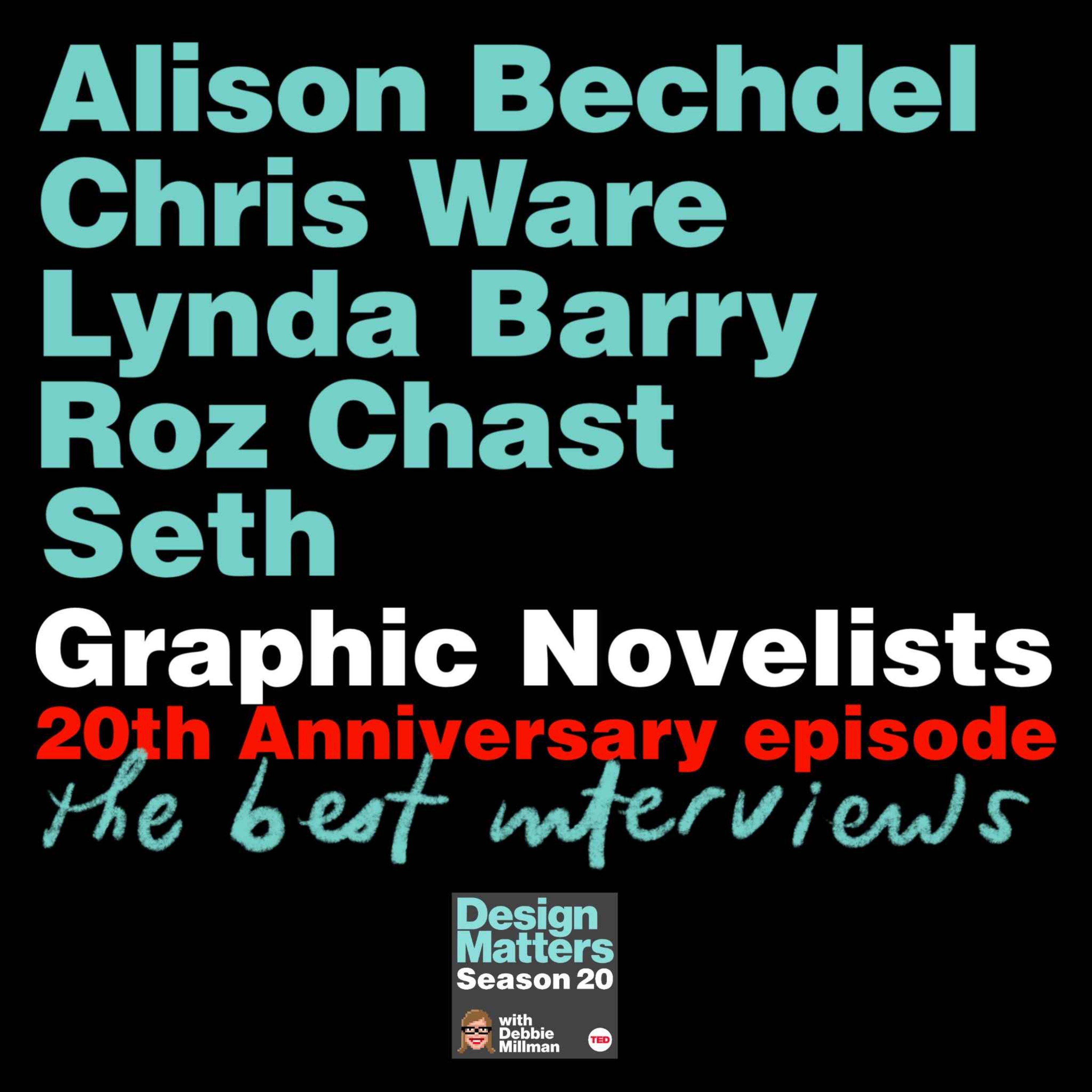
Description: Design Matters is one of the first independent podcasts, established over 15 years ago, focusing on the journeys of creative individuals and how they design their lives.
In this special episode, Debbie Millman revisits conversations with celebrated graphic novelists Chris Ware, Alison Bechdel, Roz Chast, Seth, and Lynda Barry, highlighting their artistry and the impact of their works on comics and beyond.
Written by AI. May contain mistakes.

Get the gist, explore an idea or ask about something said.
 Claude
On Design Matters with Debbie Millman, what are the key points of this episode?
Searching your listeningAutomatic transcript. May contain errors.
0:00That was pretty well it. I mean, I went to art school because I didn't know what to do after school. It was almost like I was seeking forms of expression that no one was going to really notice. You know, there's jokes in it, but it's also the telling of a story.
0:18From the TED Audio Collective, this is Design Matters with Debbie Millman.
0:24On Design Matters, Debbie talks with some of the most creative people in the world about what they do, how they got to be who they are, and what they're thinking about and working on. On this episode, in celebration of the 20th anniversary of Design Matters, we're going graphic, as in graphic novelists that Debbie has interviewed over the years. It is sort of true. I mean, if you say graphic novel, it sounds like a filthy book. Didn't want to have characters that looked like me. I would laugh my ass off.
0:55Hi, listeners. It's your host, Debbie Millman. Thank you for listening to this episode. To hear more episodes like this one, you can follow Design Matters on Amazon Music, or just ask Alexa. Play Design Matters on Amazon Music. Now, on to my conversation. 20 years ago, when I started this podcast, graphic novels were already well on their way to mass cultural acceptance. There was Art Spiegelman's Mouse and Alan Moore's Watchmen from the 1980s, to name just two works that received a lot of well-deserved attention and accolades. By the 1990s, colleges and universities were including graphic novels as scholarly subjects of study, and by the 2000s, graphic novels were mainstream.
1:46In the past 20 years, I've interviewed some of the luminaries of the form, and I'm going to play some brief excerpts from some of those conversations. Chris Ware is an award-winning, legendary illustrator whose work often appears on the cover of The New Yorker. He's also a graphic novelist and one of the best to have ever worked in the medium. I spoke with Chris Ware in 2012, right after the release of his book, Building Stories. Chris, when people ask you what you do for a living, what do you say? I usually just say I'm a cartoonist because it seems to explain the most. and it's the least pretentious word.
2:27I think it's kind of a disarming word. If I say I'm a graphic novelist, then it seems to be a little, I mean, even though that might, in today's world, that might be a little more descriptive of what myself and Charles Burns and Art Spiegelman do. But generally I like the word cartoonist because it sounds more like what I do actually is. But also sometimes people say, oh, that sounds fun, you know, even though it's really not that fun. Now, I understand that you actually have a problem with the phrase graphic novel. And you said that it sounds as if it's referring to a book with an X-rated or at least overly explicit content.
3:04And that when you hear the term graphic novel, it makes you think of Lady Chatterley's lover. Right. And that's not my joke. That's Dan Klaus's joke. So I think Marjant Satrapi started repeating that and giving me credit for it. But that's originally Dan's joke. But it is sort of true. I mean, you say graphic novel, it sounds like a filthy book. So I mean, which is not necessarily inaccurate when it comes to the stuff that I do and some of my contemporaries and peers do. but it's a word for better or for worse that's come to mean comics that are for better or for worse serious or aimed at adults or for illiterate audience so I've come to accept it thusly.
3:39I mean the word comic book itself really is if you take it apart into its constituent words and try to figure out what it means it doesn't give any indication of what an actual comic book is so it just refers to cheap books that are supposed to be funny. I have some old minstrel songsters from I think about 1840 or 50 that have advertisements on the back for comic books, and that is referring to a song pamphlet of joke lyrics. So I don't know how the word eventually came to mean collections of comic strips, but it did. When did you first realize that you wanted to be a cartoonist? When I was a kid, certainly.
4:16I remember when I was around 11 years old, I submitted some pages to this Charlton comic book that I, for some reason, thought was soliciting submissions, but I'm pretty sure that wasn't the case. I just already early on was deluding myself. But I can distinctly recall thinking, if I could only have my own comic book, then I would be happy. Wow. And did they ever respond to your submission? No, they didn't, which makes perfect sense. I was 11 or 12. I used to go visit the World Herald with my mom when she would go in on the weekends to work on a story or something and pass by the guys in the art department.
4:52There was this really nice guy named Mike Drummy, and he'd be in there working on an illustration that was due the next week or something. Just watching these guys work and how deftly they work, and they seemed to be kind of in control of their world in a way that appealed to me. And it seemed like a fun job, and I like the smell of the printing presses and the sound, because all the printing presses were on the first floor, and the whole building kind of rumbled when they were running. So I understand, getting back to, for one more moment, that you said that a comic strip is good for telling jokes and for looking down on characters.
5:29But in Charles Schultz's work, you always felt through his characters and that his work had no beginning, no ending, just a feeling. And as I was going through all of your books and especially reading building stories, I felt very much the same sense that there was no beginning and no ending, really just a supreme level of feelings. Well, it's very nice of you. Thank you. Well, I actually don't remember saying that about Charles Schultz, but I guess it sounds, I mean, when you're only dealing with four panels, it's a very kind of a small chunk or slice of reality. And of course, he was dealing with jokes.
6:06But there is something, I mean, it's something about comics that it's very, it's convenient for telling jokes because you as the reader are safely placed above this little world of people saying things to each other and or being mean to each other. and I think starting in the 1960s, cartoonists started to figure out ways of telling other things with comics and creating other emotions. For a long time, maybe it's almost still the case, it's the only art form that anybody would come to expecting a very specific emotional reaction. You don't watch a television show expecting to be angry, you know, or go to a movie expecting to feel sad.
6:44But I think, you know, comics can produce and communicate the same myriad of emotions that any other art form can. Chris Ware. Alison Bechdel was originally known for her long-running comic strip, Dykes to Watch Out For. She later went on to write her graphic memoir, Fun Home, which also became a Tony Award-winning Broadway musical. Several years later, she published another graphic memoir called Are You My Mother? I spoke with her in 2016. You've stated that drawing people has always been your passion, and as a child, you rarely bothered creating backgrounds for your figures because you were too eager to move on to your next subject.
7:27And you drew hundreds of soldiers and cowboys and Indians and baseball players and executioners and boxers. This is your list. chefs, explorers, policemen, firemen, musicians, scientists, lumberjacks, farmers, spies, mountain climbers, lifeguards, astronauts, accountants, disc jockey, coal miners, businessmen, and bartenders, among numerous other central casting types. But they were all male. Why? Well, as a kid, I didn't really even notice it. I was just, I mean, I grew up in the 60s when it was a man's world. So the guys were doing the stuff that interested me. I didn't – representations of women were just absurd.
8:09They were like housewives or secretaries, which didn't interest me. And then as I got older and had more of a political awareness or became more of a feminist, it occurred to me that to be a woman meant to be something other. It meant that you were not human. You were something other than human. And I would think of like the Mickey Mouse versus Minnie Mouse. You know, Mickey was just like the regular generic human mouse and Minnie was Mickey with all these appurtenances and details added to her. So you say Minnie was Mickey in drag? Yeah. That's better put. Yes. You said that. You know, it wasn't like I was drawing men.
8:48I was just drawing people, the people who were doing the things that interested me. But then later I feel like there was some element of gender dysphoria at work, that there was some way that I've always – I mean, I don't identify as transgender at all, but there was a way that I just felt more male, like more masculine. Like I just am a masculine woman, I guess. And as a young feminist, that felt like very bad. You should eradicate that in yourself if you could. But I've come more to just accept it. Dykes to Watch Out For first cropped up in the margin of a letter you were writing to a friend and you titled the drawing, Marianne Dissatisfied with the Breakfast Brew.
9:26And you've stated that for some reason you were moved to further label it, Dykes to Watch Out For, plate number 27, as if it were just one in a series of illustrations of what you refer to as mildly demonic lesbians. I believe this was your first published cartoon, and it ran in the 1983 Lesbian Pride issue of a feminist newspaper. So how did it get to the newspaper? How did that happen? I worked at that newspaper. I was a volunteer at this feminist monthly called Woman News. And I showed up just because I wanted to meet people and do something interesting and a newspaper sounded fun. And then I got involved with the production end of the paper and we were a collective.
10:09So we just all put this paper out together. No one got paid. And I was doing these cartoons for fun and showing them to my friends. And someone said, you know, you should show these to the collective and see if they want to put them in the paper. And they did. So I started doing one a month for this newspaper. In the indelible Alison Bechdel, one of your books, you write, The concept of a series, although initially a joke, begged for a continuation. I found myself drawing more and more plates in my sketchbooks over the next several months. The captions grew increasingly complex and the drawings more finished and deliberate.
10:45Eventually, I had a small sheaf of dykes to watch out for that I would whip out and display to acquaintances at the slightest provocation. It was at this time you began doing a cartoon for every issue of the magazine and then or the newspaper and then began sending them out. So you tried to do your own syndication. And what was that like? There was this gay and lesbian subculture happening in the 80s that I was so excited by. This whole like sort of parallel world where gay people were making their own art and newspapers and had their own bookstores and bars. And I loved that world and I wanted to document.
11:26I wanted to like not just be part of it but to show it. So I started doing that with these comics. I just wanted to see images of people like me, which I didn't see anywhere in the culture at that point. There was no L word. There was no Ellen. There was very little reflected back. And your comic was really one of the first things. Yeah, in terms of visual stuff. Yeah. I mean, there was like lesbian photography, which I very hungrily sought out just to see these images. I mean, it was like, it's funny, too, because now there's just so many images of every imaginable kind. It's hard to imagine that kind of image desert we had.
12:01Do you remember the book by Jeb, the photographs? Yeah, yeah. Oh, that was very formative for me. Jeb's remarkable book, Portraits of Lesbians. I felt like that was my lost family album, you know. And eventually in my life I met many of the subjects of those pictures. Yeah, it was like meeting your long lost aunt or something. That's incredible. When you first started to syndicate your comics, you began to hand sew postcards. And you were making them on the copy machine at your office job. and you were constantly terrified that one would get stuck in the machine and you'd be found out at this menial job that you had.
12:37And I read that you were always braced for marginality and just expected no one was going to be interested in your bizarre subcultural experiences. Given the success that you've now had, has it gotten any easier for you or are you still constantly doubting your own work and worth? Oh, yes. That hasn't changed. The reason that A, becoming a cartoonist and B, becoming a lesbian cartoonist, someone who wrote about like lesbian feminism of all things, it was almost like I was seeking forms of expression that no one was going to really notice or judge. Specifically my parents. I mean, my father was dead by that point, but psychically, I think I was trying to express myself in a way that my parents couldn't see.
13:24Even later when I would show my mother my work, especially when I was writing Fonho, writing this memoir about my family, she couldn't understand the comics format. And I kind of liked that. Like I didn't want her to really see what I was doing. But that's really because of the relationship you had with your mother, not necessarily the relationship you had with the world. But I think they're similar. I think they're similar. You know, both of my parents loved fine art. They loved literature. They were always reading poetry. And I came, you know, I had to rebel against that. So I found this art form that was anti-elitist and populist.
14:01It was more like journalism. And it was a way of being an artist without claiming to be an artist. Alison Bechdel. Roz Chast is most famous for her hilarious single panel cartoons in The New Yorker. She's also written a number of graphic books. I spoke to her shortly after the publication of her graphic memoir about the decline of her aging parents back in 2016. The book is called Can't We Talk About Something More Pleasant? How different is it to sustain our cartoon narrative over the journey of a book versus an individual panel of a cartoon? Well, an individual cartoon, there's a lot of editing.
14:46You know, that's about boiling the joke down to a sort of essential thing and cutting out what is detracting from the joke. But with a memoir, it's different. You know, there's jokes in it, but it's also the telling of a story. So not every second is joke, joke, joke. It would be exhausting and sort of pointless. In your book, and I'm going to say the title again for anybody that didn't get it the previous times, Kent, we talk about something more pleasant. You describe how in 1990, your husband, your three-year-old son, and you, pregnant with your soon-to-be-born daughter, moved out of the city to the suburbs of Connecticut, where there was more space and greenery and good public schools.
15:26and you state, if doing right by our kids meant abandoning my then 78-year-old parents, so be it. The longer we were there, the more impossible schlepping into Brooklyn seemed. If they wanted to see us so damn much, let them make the trip. And there's a little drawing of you and your increasingly elderly parents with tiny little suitcases standing in the big snow of Connecticut, and you didn't return to Brooklyn again for 13 years. 13 years Brooklyn free. What was that like for you? I guess there was a lot of denial.
16:06Yikes. Yeah, kind of weird, I guess. Do you go back now? I go into Brooklyn for this or that, but not to see my parents because they're not there anymore. Yeah, well, my kids were both very little. And I was busy with work and I was busy with raising two little kids. And the years just kind of passed. And my parents would come up and visit. You know, when I look back, I think, boy, well, okay. But they might have wanted to come to you because it was a bigger house and there was more room and the kids were more comfortable. Yeah, there was that. There were definitely, you know, reasons. Oh, well.
16:44So can't we talk about something more pleasant was not only a number one New York Times bestseller. It was also a National Book Award finalist. And in an interview on the National Book website, you were asked if writing the book was cathartic. And you state, for me, it was a way of remembering, not really catharsis. To me, catharsis is you kind of get rid of it. And I wanted to remember it. I wanted to remember my parents, remember what they sounded like and what the experience was like. And in the book, you state you weren't great as a caretaker and they weren't great at being taken care of. But yet, as reluctant as you were, Roz, you really did take care of them.
17:30I mean, you did a remarkable job of taking care of them. Do you feel that no matter what you would have done, it would not have been enough? Our relationship, especially my relationship with my mother, was complicated enough that the problems probably went far beyond my ability or inability to take care of them from the time they were, you know, 85 on or 80 on. That I would have had to have had a completely different relationship with them from the time I was little, probably. So, yeah. You finally decide that they have to leave Brooklyn. You need to put them in what you referred to as the place.
18:12Yeah. Can you describe the place for our listeners? Things were happening. There was like a sort of decline and things were getting sort of scary. They were falling a lot. They were very ill. Yeah, they were falling. My father had seen all dementia. It was getting kind of bad. I was actually afraid that my father was going to leave the stove on. They were going to like burn up the apartment house or whatever. I mean, I just thought like something really, really bad is going to happen. They were not hardly even leaving the apartment at that point because my mother was very, very weak. And they finally admitted that it was time.
18:47And so anyway, this place was not far from me, about a 10, 15 minute drive, if that. It's an assisted living place. It was very pretty. It was very nice. But it's an institution. It's a place. I just wish there were a better way of dealing with this since it's not abstract. It's not like, oh, well, my parents, you know, they had this weird condition that, like, I'm not going to suffer from. No, they just got really old. And, you know, we're all going to get to that point where it becomes very difficult to manage. And I think about it. I think about it more and more. Has it changed how you feel about aging?
19:27Oh, yeah. Oh, definitely. And are you more worried about it now? Yeah, I'm more worried about it, but I think that I'm just more aware of it. I'm more aware of old people I see on the street or on the subway. It's funny. I came down here by the train, and I don't know whether it was just I was holding this really enormous, heavy bag. But this young man offered me a seat. And part of me was like, oh, what a nice young man. But then another part of me was like, do I look that bad? Do I look that old to you? Do I look like I'm like 90 or something? You know, and I declined, you know, as politely as I possibly could.
20:07It's like, oh, thank you, thank you, thank you. And, you know, made like a little bit of an old lady thank you face. But it was definitely odd. Roz Chast. Seth is the pen name of the Canadian cartoonist who created the series Palookaville, as well as many graphic novels. I spoke with him in 2019, and I did what I often do with my guests. I asked him about his education. You attended the Ontario College of Art. You've said, I entered school a hick, small-town boy who wanted to draw superhero comics. Absolutely. Did you have any other art school aspirations, or that was it? You knew? That was pretty well it.
20:52I mean, I went to art school because I didn't know what to do after school. I knew that I wasn't ready to just go to New York City and show up at Marvel Comics and show them a portfolio. My artwork, in retrospect, wasn't very suitable to that kind of thing. In fact, when I went to art school, I'm jumping the gun here, but I remember we had an assignment once to draw a party scene in one of my illustration classes or something. And I put my drawing up on the board, which I thought was a very realistic drawing. And somebody in the class during the critique said, that's a really smart idea to have done it as a cartoon.
21:24And I thought to myself, it's a cartoon? And then I looked at it and I realized, yeah, I'm drawing in a complete cartoon style that I thought of as realism. And it wasn't even really that close to, like, the superhero comic style because it was much cartoonier. So more old school. Yeah. It was probably more relatable to, like, you know, New Yorker cartoons, although without the finish or polish. You dropped out of college in your third year. You stated that you were more interested in taking drugs and screwing up. And you go on to detail how your schoolwork declined terribly whenever you did it, and you no longer had any idea what you were going to do art-wise.
22:03This really surprised me, given how disciplined you are today. When did that work ethic change? Well, it changed when I decided to come back from that. It's interesting that, like, when I was in art school, I think I went through a very short period of disillusionment. So I wanted to be a cartoonist. I quickly saw by the second year of art school that there was really nothing in art school that was going to teach me that. And I also felt out of touch with the other kinds of art they were teaching. I think I was a little too young to fully understand the sophistication of some of the stuff they were trying to teach me.
22:34I remember in design class, for example, I literally just couldn't understand what they were teaching. I felt they might as well have been teaching magic. What were they teaching you at that point that you didn't understand? Well, they were trying to show you what a good design was and what a bad design was. As simple as that. That's not simple. Yeah, exactly. And I was looking at them and I was like, I just don't have any criteria to make a judgment call. They'd say, this is the good one. And I'd be like, I don't know why. But I was connected to what was going on outside of school. It was at this point, it was just drugs and going to nightclubs.
23:04But the thing was, OK, so I got out of art school. I quit. I dropped out in third year. Then I didn't think about art for about a year. And here I am. I haven't drawn anything in a year. I don't have any interest in drawing. Clearly, this was just a pipe dream. You got to do the work if it's going to happen. And I wasn't doing it. I'm not going to be a cartoonist. I thought I'd always planned this for the last, you know, since I was 10 years old or whatever, and always believed it 100%. And I thought it's not going to happen. And then around that time, I discovered underground comics and alternative comics.
23:36And that kind of turned the door of what I was thinking. And I started to produce a portfolio of that kind of work. That actually began the process of me heading back into being an actual artist. So the underground cartoonist opened you up to the notion that comics could be art. Yeah, it was a big revelation. It's funny. I think the thing was I felt like I had no other skills as an artist. I didn't really – I wasn't very sophisticated in my thinking at this point. So it wasn't like I thought, well, maybe I'll be a sculptor. It was like comics or nothing. And the comics had kind of fizzled for me.
24:08But when I discovered first the work of Robert Crumb and then second the work of the Hernandez brothers, Those two works, first Crumb showing me that comics could pretty well be anything you want, and then the Hernettis brothers being just a couple years older than me, I was like, this is speaking directly to me and my generation. It was all about punk rockers in there. It was influenced by the cartoonists I grew up with, like Jack Kirby and Steve Ditko, and yet there was this totally contemporary hip vibe to it. Suddenly, I was excited. When did you discover Art Spiegelman? It would probably be, I bet you I discovered just about everybody in the next year.
24:46I started reading Raw pretty quickly, and at that point, Mouse was being serialized in Raw. I even wrote Art a letter, I think, within a year. I still have the reply. What did you write him, and what did he write back? Well, I wrote him probably a stupid letter that I don't know what does in the letter, thank God. Maybe he hasn't. Yeah, maybe. I'm sure Art got a lot of letters. But I think I basically told him that I probably piled on the high praise, probably said, you know, It was like reading Albert Camus or something, you know, something high. But the truth was I just told him how affecting it was to me and I was a young cartoonist who wanted to do comics.
25:19And he wrote back basically, you know, a very kind, polite letter, the kind of letter I've written a few times now, which is just sort of straight encouragement. It doesn't matter. You know, when people are that young, and I didn't send them any work, thank God. But even when people send you their work, even if it's terrible, that is no way to judge whether they're going to be good or not. Absolutely. A lot of people who do terrible work when they're 21 are geniuses at 35. So just encourage them. Seth. MacArthur fellow Linda Barry is best known for her long-running comic strip that ran in alternative weeklies.
25:54She's also written a number of graphic books, including The Good Times Are Killing Me and Cruddy, an illustrated novel. I spoke with her in 2019, and we went way back in her life. Now, you've said that comics were the reason you learned to read. Yeah. And that when you were very young, you picked the five comic strips you decided you were going to read for the rest of your life. Yeah, when I was going to be able to read because I had just been introduced to this idea of the rest of my life. And I remember the first thing I did was when I was thinking about it, we were passing a fence. And I looked at this fence and I thought, I'm going to remember that fence for the rest of my life.
26:30And I have. I have ever since. I must have been about four. But I remember picking out those comics. And then also, you know, I grew up in a difficult family and we happened to have little scissors around the house, teeny like tiny cuticle scissors. And I used and I didn't have a lot of toys. So I used to cut out the little characters from the comics, the little black and white characters. And those were my toys. And they were my mom was kind of had a lot of disturbances and would take stuff away from you. So what I loved about them is they were – you could hide them. They were really easy to hide.
27:05You could hide little paper things. And the thing that I used to do that would crack me up – my mom worked in a hospital. She was a janitor. I ended up at a janitor at the same hospital. But she'd always bring home magazines, right? So in like Family Circle magazine or Women's Day, there'd be pictures of food that you could cook. I also loved to look at pictures of food. And I'd put little slits in them and then I'd have like Snuffy Smith or Charlie Brown coming out of those slits. I'd have like the lasagna. You're making collages. And I would laugh my ass off. I thought it was the funniest thing in the world was to be able to sink them into spaghetti.
27:40But yeah, so those were my toys. I became really attached to comics, not in the nerd way that people do where you really know everything about the author and you know everything about – not that way. It was the actual characters themselves. You've written about how you grew up in a troubled household. You just referenced it. And you stated that you didn't have books in the house, but you had the daily paper. And you remember picking out Family Circus before you could really read. And there was something about life on the other side of that circle that looked pretty good. That really still looks good to me.
28:14And for kids like you, there was a map and a compass hidden in Family Circus. The parents in that comic strip really loved their children. and their home was stable. Family Circus was your wished-for family. Yeah. But, you know, I think that what's amazing about comics in general, but also the world, you know, right now it's really important to try to find out what's amazing about the world, right? I think it's amazing that human beings may be born into a family where it's just not the right place or there isn't a lot of love or it's a lot of difficulty, but you're also born into this world that is jam-packed with characters.
28:53I mean, characters that are just waiting for you. And I think it's astonishing that no one teaches little kids how to become attached to the characters they need. Nobody teaches us how to do that, just like no one taught us how to turn a piece of cloth into a blankie that will allow us to sleep that night. We have a natural ability to love characters, to be able to use them. They're transitional objects. Yeah. But the idea that we're born into this world that they're full. One of the things I love to ask my students is I say, well, you guys know who Scrooge is? And they go, yeah. And I say, so Scrooge was here before you were born?
29:30Scrooge is going to be here after you die. Where is Scrooge? And they go, what do you mean? I go, well, where is he? I said, I know he's with Spider-Man and Medusa and Odysseus and, you know, Brenda a star, but where are they? And they look at me and I say, well, let's put it this way. What would it take to get rid of them? And suddenly you realize that there is this world that is mighty and has a lot of strength. And to be born into this world where I didn't have that stuff in my family, but I was born into a family of characters. And Family Circus was that for me. And you know, at a certain point, I realized it was an uncool strip.
30:17And it didn't matter to me at all. I loved being able to look through that little circle and see this happy life. And then one day, I got to meet Jeff Keene. And you know that thing that you always hear that when you see beautiful art, you burst into tears? Like I used to try, like I'd go to galleries or I'd be in museums and I'd just try to just like bust out one tear at least, you know, because it's beautiful or proof of beauty. You know what I'm talking about? But when I met Jeff Keen, Bill Keen used to draw the strip. Jeff now does it. I just, I did. I burst into tears and it wasn't beautiful at all.
30:58It was like snot and shaking and me coming toward him and him backing away because like what's going on here? It was at a National Cartoonist Society event and the joke of the whole conference got to be to just have him – move him within my line of sight because I couldn't stop crying. I still – even now when I'm talking about it, I tear up. And I think it's because when I touched his hand, when we shook hands, I was on the other side of that circle. How the hell can that happen? And then I realized it happened because I drew a picture. It's crazy. It's so much better than I thought it would be.
31:38Life is so much better than I thought it would be. Linda Barry. Adrian Tomina is an illustrator and cartoonist. He first became known for his comic book series, Optic Nerve. Earlier this year, I spoke with him about his early days and about some of the later graphic novels he's published. Your next book, a collection of short graphic stories, Killing and Dying, was published in 2015. It became an instant New York Times bestseller. It was named one of New York Magazine's top 10 graphic novels of the year, one of NPR's best books of the year. It won the Story Prizes Spotlight Award and Eisner Award.
32:20And Zadie Smith praised the collection, stating that you have more ideas in 20 panels than novelists have in a lifetime. Like, I would just say, that's it. I'm done. My life is complete. Well, Zadie Smith didn't say they were good ideas. She said that there was a quantity. That's a very Adrian Tomina response, I have to say. Mr. Glass Half Empty. Yeah. So you stated that in the process of writing Killing and Dying, you tried to eradicate the idea of an audience and attempted to trick yourself into thinking you were a teenager again, drawing comics in your bedroom purely for the enjoyment of making them.
33:05How had your process evolved to a place where you felt like you needed to do that? Were you feeling jaded? Were you feeling like, okay, yeah, if you can talk a little bit about how that happened. Sure. I mean, when I first started making comics, at least the ones that were published, it was totally a private hobby. I had no sense that anyone would see them. So, like, the first Optic Nerve was not designed to be a published comic. It was me taking my sketchbook to the copy shop and making copies of the pages in it that I thought were the least bad. And by the time I started working on killing and dying, making comics had become a full-time job for me.
33:48And there was an audience and there were critics. And a lot of those readers had strong opinions about my work, about what was good and what was bad about it, and especially what I should do differently. At that time, I was receiving a lot of feedback about how to do things better, according to that specific person. Yeah, I was feeling a level of self-consciousness that was starting to feel inhibiting or even maybe corrosive or detrimental to me. I would have these experiences where I would sit down to work and instead of thinking, how can I make this drawing look the best possible way or how can I write it the way I want it to write?
34:33I would be thinking about, you know, what's the comics journal going to say about this or the people who write me letters? What are their criticisms going to be? And I really like that person and they said they wished I worked in this way. So I kind of want to please them and all these kinds of thoughts that were just driving me crazy. In Killing and Dying, you challenged yourself to create characters and stories that were really outside of your direct experience. Each story had its own distinct tone, narrative. One of the things that I think we begin to see more of in your work at this point was ambiguity.
35:12I'm thinking of the mom with cancer in one of the pieces. I think that's my favorite aspect of your work, actually. You're very deliberate about what to leave out. Talk about what made you decide to do that and how you think that helps to create a specific kind of tone and feeling in your work. When I started working on what would become the book Killing and Dying, I felt like the only way forward was to sort of kind of clear the decks and not just pick up where I left off, but just kind of start fresh. So one of those steps was to not write something so – that couldn't be so quickly confused with autobiography.
35:58I didn't want to have characters that looked like me. I didn't want to have characters who were wrestling with the same concerns that I'd been focused on for the last number of years. You know, I just I'd done enough like young Asian American guy in Berkeley stories. And I felt like I wanted to do things that were more fictional. And I also wanted to approach how I created each story differently. And another big thing for me that that I've talked about in the past was just getting rid of all my art supplies. Like I'd gotten completely obsessed with this right way of doing things and using the right tools and having the right materials, which was inhibiting and expensive and kind of starting to yield the exact same results over and over.
36:46And so one of the mandates that I set for myself with this next set of stories was to like write about people that aren't me basically and use different materials, create the stories differently, even if it feels uncomfortable. and like the story you're talking about which is called Killing and Dying that was kind of a breakthrough for me because I was actually at the time I probably wasn't in my right mind at all I was in our first daughter was a baby it was just a very hectic time in our house but I said okay this is a crazy idea but I'm gonna walk up the block to the pharmacy to Rite Aid and whatever art supplies I can buy there off the shelf, I'm going to use that to make this next story.
37:35And then I came back with a pack of like printer paper and a mechanical pencil and a felt tip marker. And I was like, you know, that's it. Let's see if I can do this. It was just so simple. And the fact that the materials were cheap also made a big difference. Like prior to that, I was using these big expensive sheets of five ply Bristol board from Strathmore, You were hand cutting them, I bet. I was hand cutting them. I was buying large sheets. And it felt like this disastrous tragedy if I messed up. And so to have like just a sheet of thin paper that I could just crumple up and throw away felt like a big relief.
38:15And what I found was that it completely took away all the obsession I had about the materials. And I was able to funnel all that obsession into the content, into the story itself. And for the first time, I think, since I was maybe a teenager, I had the feeling that I was creating the work at an appropriate pace as opposed to like slowly pushing a rock up a mountain. I was sort of like, I could draw a panel and then draw the next one. And it felt like a little, I was closing the gap a little bit between the way time feels as we experience it and what it takes to reproduce it on paper. Because in the past, the disparity had been so huge that it felt very stilted to me in a way.
39:02Adrienne Tomina You can hear the full interviews of all of the guests featured here today and dozens, maybe hundreds of other interviews with a huge variety of artists, designers, musicians, performers, and so on on our website, designmattersmedia.com and wherever you get your podcasts. Over the next several weeks, we're going to be hearing more special episodes culled from the two decades I've been podcasting Design Matters. Yes, this is the 20th year of the show, and it would be an understatement to say that it is one of the great gifts of my life to be in conversation with so many of the world's most creative people.
39:47Mostly, I'd like to thank you for listening. There wouldn't be this show otherwise. And remember, we can talk about making a difference, we can make a difference, or we can do both. I'm Debbie Millman, and I look forward to talking with you again soon. Design Matters is produced by the TED Audio Collective by Curtis Fox Productions. The interviews are usually recorded at the Masters in Branding Program at the School of Visual Arts in New York City, the first and longest running branding program in the world. The Editor-in-Chief of Design Matters Media is Emily Weiland.
In honor of 20 years of Design Matters, Debbie Millman revisits standout moments from her conversations with some of the most celebrated voices in graphic storytelling—Chris Ware, Alison Bechdel, Roz Chast, Seth, and Lynda Barry. This special retrospective highlights the artistry, humor, and humanity of five groundbreaking creators whose work has transformed the world of comics and beyond.
Hosted on Acast. See acast.com/privacy for more information.