Ask ChatGPT

 Design Matters with Debbie Millman
29 Sep 2025 · 54m
Host: Debbie Millman
Design Matters is one of the world’s first podcasts, exploring creativity and design through conversations with incredibly creative individuals over 15 years.
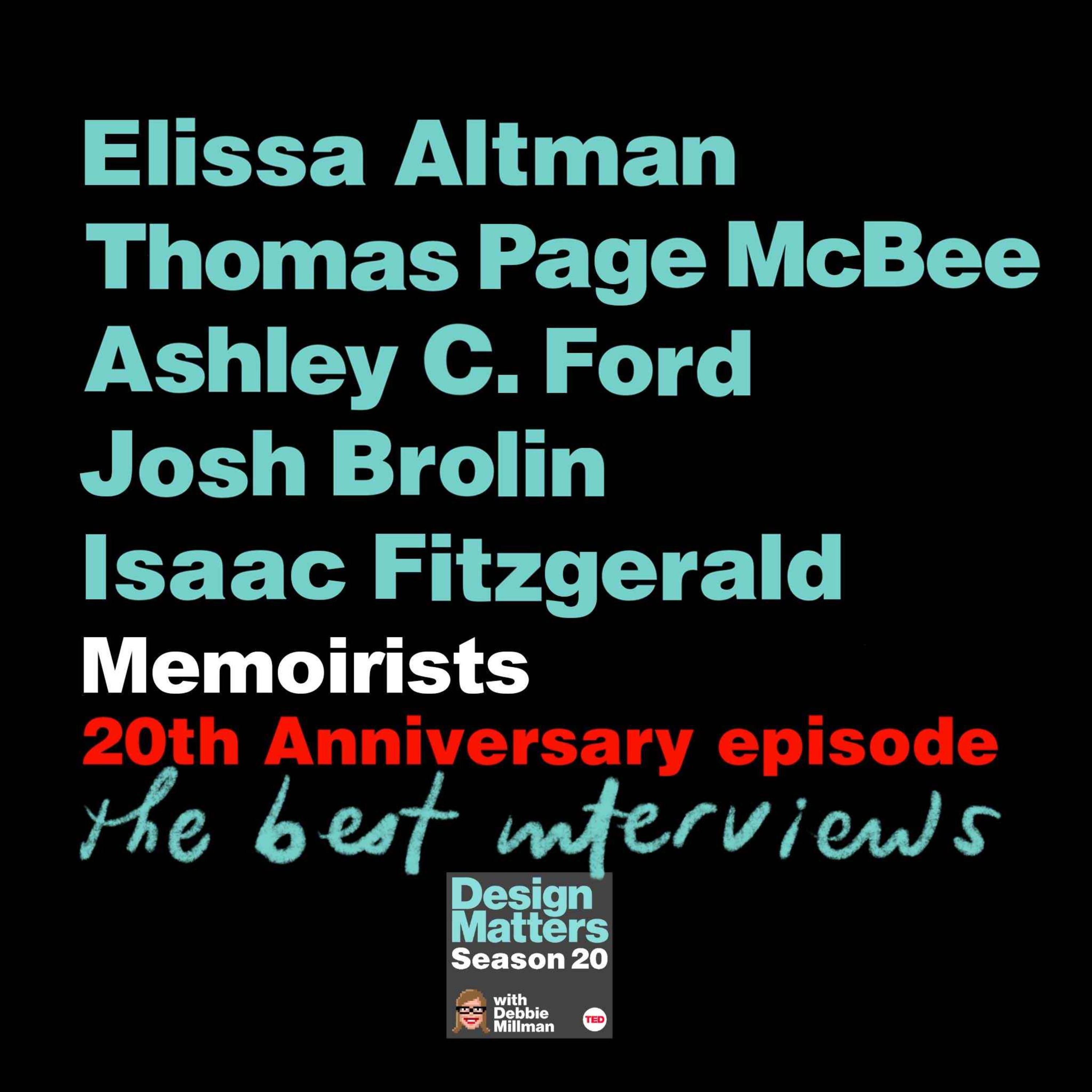
In celebration of 20 years of Design Matters, Debbie Millman shares memorable conversations with memoirists Elissa Altman, Thomas Page McBee, Ashley C. Ford, Josh Brolin, and Isaac Fitzgerald, highlighting their storytelling power and resilience.
Written by AI. May contain mistakes.

Get the gist, explore an idea or ask about something said.
 Claude
On Design Matters with Debbie Millman, what are the key points of this episode?
Searching your listeningAutomatic transcript. May contain errors.
0:00Hello there. This is Debbie Millman and I'm so excited to share something wonderful with you. This month, I am featured on Apple Podcasts as one of their creators we love. This is a big-time honor for me, and I'm so thrilled in the ways that Apple has acknowledged the 20 years I've been podcasting Design Matters. A big thank you to all of my friends at Apple Podcasts for their generosity and support for the last two decades. My world was turned upside down. And at the same time, there was actually a sense of relief. Gender, I think, is kind of almost spiritual. There's something mystical about it.
0:40And that feeling made me want to not let him go.
0:48From the TED Audio Collective, this is Design Matters with Debbie Millman.
0:55On Design Matters, Debbie talks with some of the most creative people in the world about what they do, how they got to be who they are, and what they're thinking about and working on. On this episode, in celebration of the 20th anniversary of Design Matters, we'll hear from some of the many memoirists that Debbie has interviewed over the years. Alcohol was a great friend for a while. In that moment, I don't fully comprehend what I'm hearing.
1:27Ordinarily, when I plot out my interviews, I have an arc I like to follow. I don't start with my guests' most recent work. I start with their upbringing, their education, and then I get to their career, its twists and turns, highs and lows. and then once the stage has been set, I ask them about their most recent work, their book or their play or their exhibition or their music or their movie. But when my guest is a memoirist, well, that plan goes out the door. I can't hold off until the end of the interview to talk about their most recent work because their most recent work is about their life and their upbringing in their education and their career and their ups and downs.
2:14I still do a lot of research about the person beyond their memoir so that I feel fully immersed in their life, and I do learn things that don't always come up in their book. But inevitably, I cut to the chase, and one way of doing that is to quote from the memoir or have them read it themselves. On this week's episode in celebration of 20 years of design matters, I'm going to play excerpts from interviews with a few of my favorite memoirists I've interviewed over the years. First, Alyssa Altman. Alyssa writes a lot about food, and she also writes a lot about her life. Often she writes about her life seen through the lens of food.
2:55I interviewed her in 2019, shortly after the publication of her book Motherland, a memoir of love, loathing, and logging. Given the reach and the stature of your food writing today, Those who don't know you well might be surprised to know that while your father was a foodie, your mother believed in Swanson's frozen dinners, the Gorton's fishermen, and green giant canned vegetables. Is that true? That's absolutely true, right. Can you tell us what she did when your fourth grade class celebrated Texas Day and you volunteered to make the Texas State dish? Wow, that's digging deep. Yes, she sent my father out to our local associated grocery store to buy cans of Hormel chili and to dump the Hormel chili into a big pot.
3:49And we presented that as the homemade chili because it was Texas Day. And doesn't every queen's neighborhood celebrate Texas Day? I didn't even know there was a Texas state dish. I learned a lot while I was doing my research on you, Alyssa. Tell us about, because your dad was a foodie, tell us about the secret lunches your father would take you to in Manhattan when your mom was at the hairdresser. As every good mom in my neighborhood did on Saturdays, she would leave me in the care of my father and go out to the salon. And this was like a multi-hour affair of coloring and touch-ups and teasing and drying and blowing and so on.
4:31And my father would get me dressed, and I was very young at this point, probably still in single digits, and we would drive the seven miles into Manhattan to restaurants like Grunwee. I didn't know where I was going at that point. There were white tablecloths and many, many, many levels of silverware that I had no idea what to do with. And he introduced me to food in a manner that was really secretive. and sort of on the sly. And it was a father-daughter date without question. And we were very, very close. And that just really sealed that closeness and solidified that closeness. And at the end of the meal, it was usually a two-hour meal.
5:19He would get me back into the car, drive me back to Forest Hills. And before we got out of the car, he would open up the glove compartment and take out a tiny lint brush and roll off my clothes so that when I went back up to the apartment, my mother, who would have no idea what had just happened, wouldn't see me covered in crumbs. There would be no evidence of what had just transpired. There would be no evidence of my father's wrongdoing. Did you ever feel guilty that she didn't know about these lunches? You know, it didn't occur to me that there was something particularly illicit. And it was funny when I was writing my first book, Poor Man's Feast, and that was a theme throughout the book.
6:05And I talked to her about it. She had no idea that it had happened until I told her. And she was surprised but not enraged at all. Her favorite thing to say is she has no idea where my love of food comes from. And then, you know, the big joke is that she taught me everything she knows, which, of course, is not the case. Well, we'll go into deep detail about this. You've written about how you look like your dad, talk like your dad, you're built like your dad, and even respond to the world around you like your dad, and that you even sound like your dad. Your parents divorced when you were still quite young.
6:48How hard was the divorce for you? It was, I think, probably as difficult as it is for any kid. I mean, I was 15 when they divorced. But this was still the 70s. This was 1978. Yeah. And it was very difficult navigating the world in terms of where was I going to be? Where was I going to be living? My mother was, you know, a social butterfly in ways that, you know, could sort of make your hair go straight up. My dad fell into a very deep depression and I could see that. And I was much closer to him than I was to her. So my world was turned upside down. At the same time, there was actually a sense of relief.
7:38the rage and the rancor that had sort of been the bedrock and the foundation of the home was gone. Had you started any writing at that point in your life? I don't remember a time when I wasn't writing. Writing and music for me were the two things that kept me afloat. I was given a notebook very, very early on. I am almost embarrassed to tell you how young I was when I was given a notebook. and that was where I turned. I didn't have siblings. I lived in a world primarily of adults in the 1960s and 70s. It was a crazy time and a crazy place. It was like our own little Peyton place. And that was where, you know, that was where I worked everything out.
8:27You know, as soon as I was actually able to start writing, physically start writing, I did. You've written this about a first-time cooking experience. The very first time one cooks for others is rather like losing one's virginity. You can definitely get hurt if you're not paying attention, but you know that somewhere during the course of the evening, you're bound to have at least some fun, even if it's only wine-related. What was your first cooking and entertaining experience? My first entertaining experience, I was really young. I mean, I think I was probably a teenager. My parents were sort of at each other all the time, and I would produce these trays of Delhi-like salami mandalas.
9:21And my father's 50th birthday in 1973, I would have been 10 years old, and it coincided with a really horrible ice storm. The ice storm of the movie and the book. The ongly ice storm. And the delivery guy couldn't make it up the driveway to the apartment building that we were living in. Everything was covered in a sheet of ice. And I sort of rifled through the refrigerator and pulled out all the packages of various deli meats that I could find. And I put together these trays for my father's 50th birthday. So that was really the first time. And I did it with a great deal of authority. I have no idea where it came from.
10:05This was not something that either parent was ever given to doing. And yeah, and it didn't save them. It didn't save them. I mean, I fed everybody. Damn eyestorm. Right, damn eyestorm. Right, right, right. But I know that you, I was asking the question, actually hoping for a very specific story about your invitation to four lucky college friends to dine at your then new off-campus apartment. Oh, gosh. Yeah, yeah, yeah, yeah. That's the story I was thinking about. Yeah, yeah. That's something that I've really sort of shoved into the recesses of my brain.
10:49I think that there was probably a couple of sticks of butter involved. The smoke alarm went off. I think I had to beat at the smoke alarm with the wooden spoon. I think the cats were hovering by the window trying to suck in whatever oxygen they could suck in. Yeah, I've never been good under pressure, which made it really easy for me to decide not to be a chef. Well, what prompted you to ever try again in terms of cooking for people? I love feeding people. I just, I love feeding people. I love having people around my table. And I think certainly that it has a lot to do with the fact that I did not grow up with a lot of joy around my dinner table.
11:37It actually was more like torture. It was more like torture. You know, nobody talked to anybody else. We had a little television set, black and white television set, that actually sat on the dining room table as if it were a guest or a member of the family. This was in the 70s, and this was during the days of the Waltons, and eight is enough. And, you know, I wanted my mother to be Betty Buckley. Don't we all? I still want my mother to be Betty Buckley. I just want Betty Buckley. You just want Betty Buckley. He asked why. But that's what I wanted. I wanted that kind of world and that kind of environment.
12:13And I was sure that if I could feed people, that I would somehow be able to create that. Alyssa Altman from 2019. Thomas Page McBee's first book was his memoir, Man Alive. His second book was Amateur, about learning how to box and what boxing tells us about masculinity's connection to violence. I spoke to him in 2020. You were born female, but you've written that you always saw yourself as a boy. And I knew that you didn't have any singular epiphany and have instead described your transition as an unfolding coming into myself, which I think is really beautiful. Thanks. Can you elaborate on that a little bit?
13:00What do you mean by that? Oh, boy. What a question. I mean, I think that's what my first book, Man Alive, was trying to sort of address. I think that there's a way that we all have had transitions. We've all had major transitions, whether it's moving across the country and starting over or getting married or for other people like having a kid. And I just feel like there are major things that change, not just your life, the trajectory of your life, but, you know, your entire sense of self. And so I don't think it's that different, actually. Like, I think being trans, obviously, there's something about fundamental about my identity that was dissonant to my environment and my experience of myself and so on.
13:42Although even that I'm like, is that that hard to understand, really? Like, I think we all have ways that we experience ourselves as different than the way other people see us, you know? And so I think with gender, it's just such a primary mediating part of who you are that when that difference is not in alignment, it's so dramatic because it's like every part of your life that that dissonance is felt. So that's the sense of unfolding. But again, I think that's so human. I mean, isn't that literally everyone's story? Like for me, it's about gender. But I think it's also about how do I bring myself into sort of alignment as a person in general?
14:16Maybe unfolding is wrong. Maybe it's almost like an expansion or something. Yeah, I sort of feel in many ways that it's standing up for who you are and claiming your identity. I don't know. Like, it's not like I had another choice. You know, it's not like there's a separate identity I could have had that I, you know. But you didn't have to stand up for who you are. No, but I probably would have died. Yeah. You know, and I think there's something. And there are a lot of people that do. And there are a lot of people that do. And I think they do not because it's so hard to be who you are, but because we live in a culture that, you know, doesn't allow for that kind of like, again, I think it's expansion.
14:56And I think with any identity thing, it's like you claim something and it's still a rough fit. You're like, yeah, I'm a man. Okay. But for me, the more interesting thing for me wasn't realizing that this was where I needed to go. But it was like then once I was on this path, how do I actually make being a man be something I'm okay with being? Because gender I think is kind of almost spiritual. There's something mystical about it, in my experience anyway. And I think for a lot of people, I think it gets flattened in culture. And I think it gets obviously politicized and weaponized. But throughout history, trans people specifically have had very spiritual roles in culture because I think we are pointing out something that is ineffable and kind of beautiful.
15:39But to actually be within it and to be within a gender in a way that actually feels authentic, given all the constructions about gender, it's really hard. And I don't think that's specific to being trans. I think it's really hard to be any gender identity, really. I think it's hard to be authentic. Yes. It's weird. Just being who you are without concerns about judgment and shame. I mean, it's daunting. It's daunting. And also it's a process because you can't really be who you are without the feedback of everything around you. So it's more like, how do I navigate all that feedback in a way that, what's my system?
16:15So I can keep coming back to myself. I think that's the work of being human. Absolutely. You described your childhood as, and this is a quote, chocolate milk, science fairs, camping, and the rituals that kept dad's hot breath distinct from the rest of it. Thomas, your father sexually abused you for many years. It began when you were four years old. You've described him as domineering, manipulative, double-crossing, and compulsive, writing, what he did didn't hurt. It disconnected. It made two of me like there were two of him. It made me a stranger to myself. How did you manage through this without losing yourself altogether?
17:01I don't know. I think the repair of integration in general has been kind of a theme of my life. And it's not just been with abuse. It's been through even now, my past and how do I keep my past with me, my past self with me, even in this body and in this life. And I think maybe the way I found to do it is by not abandoning myself further. Like the obvious solution, at least to me, you know, is dissociation is pushing away is trying to stay split to stay sane. And I think, first of all, I was lucky in that once the abuse was was voiced, like I, I was given resources and therapy. And, you know, there was an acknowledgement that's even happened.
17:47And I know from a lot of people who've had this experience that doesn't happen. Yes. So, So that was really important that my mom believed me, that I had a therapist, all that. But it wasn't also so easy. I mean, it was complicated. And there was a lot about how it all was handled that was messy. And I think having writing, you know, I mean, I think having like a way to tell my own story, even when I wasn't feeling like it was being told completely accurately by everyone else around me, I had a way. And I think a lot of my commitment to telling my own story really got me through literally decades, I think.
18:23There really is something about the saving potential of creativity. Yeah, I agree. So I think that's it. You know, you've written that because the sexual abuse that you experienced was discovered when you were 10, you came to understand that even as a kid, their childhood was purposefully destroyed. And I'm wondering, when did you realize that the entirety of your life wasn't? I think I'm still realizing you know I think I'm still realizing that that period anyway wasn't I was just back in Pittsburgh for I work with West Virginia University with some reporting stuff that they do out there and I was down to to do some consulting and reporting and I always pass through Pittsburgh and I always avoid my hometown because my mom died and there's no one I know there and I I actually went back very pointedly to to do some of that work of like really trying to reconcile that like there were positive things that happened.
19:19There were many, many positive things that happened to me as a child that were separate from this and that were life enriching, you know? But sometimes when you, for me anyway, part of the hard part of trauma is how, for me, it's like I just, I've erased so much and I have to keep digging it back up. And that's really painful, obviously, but the value of it is exactly what you're describing because then you can, I can remember the good stuff. And so I think, you know, writing Man Alive was one way. I had a sense that once I transitioned, I had a sense I would feel farther away from myself as a young person and just in general from this period, from this whole time, you know, because I would be moving through the world differently.
19:58And I didn't want to I wanted to stay tethered in some way to my past and to myself and to look at it more closely. So I think that book in so many ways tries to bring a lot of different disparate pieces of, you know, good and bad of my life into alignment. it. When you were 14, the first girl you ever loved was straight. And I'm wondering if you can read a bit about how you described it from your book, Man Alive. Sure. This was a narrative I could get behind. We were 14 and moony, Springsteen-esque. When she first said it, maybe she meant I wasn't too gangly or smelly. Or maybe she meant that I was romantic, that I'd wooed her with a bravery that emerged, blessedly and out of nowhere, with puberty.
20:44Who was this person that, holding up a makeshift canopy of plastic bags, kissed the popular pretty girl near the bus stop with cocksure abandon? Only later, as we got to high school, and the boys grew broader, did it occur to me that not being a dude might be a liability. Is it weird being with me? I asked her. Every memory I have of those years is tainted, a hormonal, sun-bleached gauziness. Picture a dewy summer day, and we're lying on our backs in the park near school. She's the rare adolescent whose good looks never soured into awkwardness, just straight swan from day one. She got up on her elbows to look at me, and I couldn't believe how dumb I was for asking the question.
21:23She paused long enough for my heart to palpitate. She'd had a couple of boyfriends at her old school, and I pictured them as popular, handsome, and decidedly boobless. No matter how you cut it, I was an outlier, and all the swagger in the world wouldn't change that. No, she said, tying up her ponytail. like she never considered it. You're like any other guy. Thomas Page McBee, reading from his memoir, Man Alive, in 2020. Ashley Ford is a writer and the author of the New York Times bestselling memoir, Somebody's Daughter. I spoke with her in 2021. Your memoir follows the arc of your early life, so I really want to just dig right in.
22:05Great. When you were four years old, you went to live with your grandmother and great-grandmother on a little farm in Columbia, Missouri. And you've said that this was the first place you felt like your imagination had no bounds. What kinds of things were you doing back then? Oh, so many things. I had a steady routine for the first time in my life, which I found very soothing. I pretty much knew what was going to happen any day of the week. I knew I had to go to school. I knew that after school I had to go to an aftercare. I knew that my grandma would pick me up from aftercare and that we would go home.
22:50I knew on the weekends we would go to the mall and we would see a movie. I knew that there would always be dinner and breakfast at a certain time. It was just very soothing for me to have everything happen when it was, quote unquote, supposed to happen. On top of that, you know, it being just me and my grandma, there was obviously a lot of attention for me. My grandma would read books to me and just sit with me and talk with me. My grandma taught me how to sew by hand. She would give me little scraps of fabric and I would learn how to thread my needle and sew clothes for my little dolls and things like that.
23:36Just being able to go outside, especially on the weekends, whenever I wanted and just be around. And the adults were in the house and I was just out there doing whatever. And that felt so powerful. I felt powerful when I was on my own. My imagination, my brain, what I could see when I closed my eyes, what I could make myself see made me feel like a powerful person. And I loved feeling that power. I loved feeling in control of myself. I loved having thoughts and stories that were just mine, that I didn't have to share with anybody. It made me feel, I think, like a person. Like, that's when I started being like, oh, I'm a person.
24:27I'm a human all by myself. You know, four years old is around the time we start to actually remember things. It was probably quite good for you that you had that experience. Oh, yeah. To be able to rely on. Even the subsequent events of your life. I know you told your mother used to entertain your grandmother with your stories. Do you remember any of the stories you told her? Oh, man. They were usually stories from the books I read that I would then turn around and make them about me. So she also taught you to read, right? She did. She taught me to read. And she very quickly found out that I had a very, what we call a weird memory in that my grandma thought I could read before I actually could because I could just memorize the words of the story.
25:18And so she would turn the page and I would start saying, you know, what was happening on the page almost exactly like with the words. And she was like, can she read? And it was like, no, I couldn't read. I just remembered everything. For a long time, I had memorized quite a few of the first passages from the book of Genesis in the Bible. And my grandma would introduce me to her friends and then be like, watch this. Tell her about the Bible. And I would just stand there like a recording and start saying passages verbatim from the Bible. And these old ladies would be like, oh, my God. You know, they would be so happy, so excited that I could do that.
26:05And so it made me want to do it more. And that's just something that, you know, continued throughout my life. I love memorizing things. Was this when you thought that Billy Ray Cyrus was Jesus? Yeah, for sure. I had this massive crush on Billy Ray Cyrus because Achy Breaky Heart had just come out. And it was everywhere. And he was on the TV. Like, you could see him perform at award shows. My grandma is also a huge fan of celebrity culture and Hollywood and television films. She really did. Like, she really did. And so we watched all the award shows every year. We watched all of them, the Oscars, the Grammys, everything.
26:48She wanted to watch all of it. And Billy Ray Cyrus was performing Achy Breaky Heart, and he had that mullet. And I was like, that's a man. Yeah, that's probably what Jesus was like. And I totally thought that was true, that Jesus would have looked like Billy Ray Cyrus. I want to go back in time just a little bit, given that at this point you're only four or five. You were actually even younger, around a year old, if that, when your father went to prison. And I read that as you were growing up, you watched a lot of Westerns with your grandmother and then would dream of your dad who would appear in your dreams riding a horse and wearing a cowboy hat.
27:33What's your memory of first actually meeting him? My memory of first actually meeting him happened when I was around seven or eight. my uncle Clarence, my dad's brother, reached out to my mom and said, hey, I would really love to take the kids to see their dad. And my mom was very much like, yes, yes, absolutely. Because my mom never wanted to keep us away from our dad. My mom just didn't have the resources, the time, or even really like the planning ability to be able to get us there. So she was happy for them to take us. And I don't remember a whole lot about the car trip or getting there. I just remember that gate opening, that gate where they put you in and they close it behind you and then they wait to open the one in front of you in the visitation room.
28:36I remember that gate opening and I remember seeing my dad and I remember going over to him and hugging him. And I remember that like at that time, I was already in a place where I'd been kind of warned about being friendly or in any way physical with men by my mother. and I had all this fear about being friendly and affectionate or physical with men. And I didn't have any of that with my dad. He put his arms around me and I expected to feel really weird about it. And I didn't. I didn't feel weird at all. I just felt loved and I felt warm. And that feeling made me want to not let him go. Like just being there and having this moment that felt so unfamiliar but so good just made me want to never, ever, ever let him go.
29:41The way he looked at me made me want to never leave because I didn't know what it was like at that point to be looked at like that. I didn't know what it was like to walk into a room and have someone light up because you walked into the room. And I wanted that bad, but I didn't even know it was available to me, I don't think, until I saw it with my dad. Your father wrote you letters regularly from prison and he told you how beautiful you were and how much he loved you. What did you think of those letters? I thought that for a long time, I would say until I was about 12 or 13 years old, I felt like those letters were because my dad saw the real me.
30:39he saw the real me and the real me actually was lovable and the real me actually was beautiful and the real me didn't make people angry just by existing and the real me you know was all of these good best things and I just wished he was there because if he was there there would be adult around who could say, actually, Ashley is like this. Actually, Ashley is beautiful. Actually, Ashley is smart and wonderful and funny. I wanted somebody to stick up for me with other adults. I just wanted somebody who would be on my side is what I really wanted. And those letters made me truly believe that there was somebody out there on my side.
31:29And I thought if I kept believing and wanting it bad enough, you know, he would just show up. Ashley Ford from my interview with her in 2021. Josh Brolin is a famous actor, a very famous actor, and he's also a writer, quite a good writer. His memoir is titled From Under the Truck. I spoke with him about it on Zoom in 2024. Early on in the book, you state that you have made your life harder than it needed to be. For sure. I learned from the best. Yeah. Well, let's talk a little bit about your upbringing. You grew up on a 230-acre ranch in California. You were primarily raised by your mother, who in many ways is the centerpiece of this book.
32:19And you describe her in the book in this way, and I'm going to quote you. She was armored with a character so unique and memorable that to die would be an insult to her mythology. She'd be leaving behind an easy breeze, a cloudless sky, no music on the radio. She was the zap in every electrical current we had felt. She was the alcohol in a mixed drink. She was the wildness in a sunset just after a horrible storm had passed. there's a really vivid vivid description i'm wondering if you would describe her as happy no but i too don't think that's the goal there's something that i mentioned in my book and not to insult my father and all at all but i think that there was this idea this status quo idea of you know, waking up in the morning and saying, good morning, are you happy?
33:18And I'm like, why is that the goal all the time? You know, so I think that my mother and what I got from my mother is maybe a little too much. You embrace whatever's going on, you know, life is a potpourri and sometimes you're angry and sometimes you're sad and sometimes you can't explain it. And sometimes you're, you're ashamed for no particular reason that maybe you can pull from your past. And, you know, it's this kind of therapeutic idea that if you just go to the right therapy, you can exercise that thing that will finally set you free. And what I've learned in doing a lot of therapy and just curious from a very, very early age, 13 years old, I was paying for my own therapy.
34:04Really? Yeah. There was a guy who used to go to sleep on me. That was therapeutic. You know, literally. But that's what I mean by making it tough. I wanted to experience everything. I wanted to know. I was curious, you know, coming from and I don't say this in a from a victimized place. I was coming from the chaos that I came from. I became insatiably curious about why do people do what they do? Why are they reacting like they're reacting? But I found later on in life that it's my relationship with it that makes the difference. Tony Hopkins had said something to me once. He said, sober. He said, how great is it that we're like this?
34:49And I was like, what does that mean? Like what? He said, we're just angry. We're edgy. I go, why is that a good thing? Is that a good thing? You know, and he's been sober 40 something years and one of the greatest human beings I know. And he said, yeah, because alcoholics given this thing that this engine that seems to live in us that never quite idles properly left to its own devices can be the most hurtful, destructive thing imaginable, but directed in, in the right way, given the right tools can be the most productive, enlivening thing imaginable. So that was a moment in my life where I was like, oh, it's my relationship with it as opposed to having to change and be somebody else and get rid of something that is innate in me.
35:42You became sober at 29, two years after your mother died. What provoked you to try and stop living with the anger in such a destructive way? I think there was another level of drinking and using, I think, I went to to try and get closer to my mother. You know, it was almost like I was writing a true crime novel, you know, and I was at the epicenter of it. The night my mother died, she had pulled a 22 on her boyfriend that she, that was saying, I'm out of here. And he was trying to leave. And she said, you're not going anywhere. And then she was chasing him in the car and she ended up turning a corner that I know very well because we still have that ranch and then hit the tree at 70 miles an hour or whatever.
36:37And everything was heightened. So I think I just heightened what was already stratospheric. And it scared me. And I didn't choose. There was an intervention with some friends. I always liked sober people because they were more honest and I could count on them. And people said, I think it's time. And I tried it. And I stayed sober for a while, but I didn't stay sober forever. I never wanted to stay sober because I felt like sober was invisible. What does that mean? It means that I didn't feel like I had a personality on my own. I felt what drinking did for me, and it absolutely did do it for me for a while.
37:20It gave me a personality. It gave me a voice. you know i didn't have the fear filter the massive fear filter that everything had to be pushed through i'm scared i got i'm sober i go talk to a girl she's not interested in me i'm polite i'm this i'm drunk i put out my hand a girl grabs it and we're together for the next three months or three years i don't know why that works that way i don't like that it works that way i don't know if it has to do with confidence or false confidence or whatever it is, but it seems that when I drank, it all went more smoothly until it didn't, until it bit me in the ass.
38:01And it always eventually bit me in the ass. And now sober, I think, you know, to cut to years and decades later, there is a form of sobriety that I feel that I've found that deals with the fear as well as and much less self-destructively or destructively than alcohol did. But alcohol was a great friend for a while. Well, you said that your childhood, and this is a quote from the book, your childhood was on a leash of the whims of your mother, and your world revolved around country, western, outlaw, 18-wheeler culture. Great line. And this included drugs, a lot of drinking, performing in a punk band, surfing with a group named the Cleo Rats, several rents.
38:48this stint in juvenile detention and prison. Now, you said that if you weren't in prison at the time that you were, you'd have been dead. Why is that? Well, it's the CITO. C-I-T-O. Oh, sorry. No, no, no, that's okay. It's because I'll have a couple of guys call me for sure. Why would I be dead? Because a lot of us died, a ton of us, not a few, 36. So there were a lot of guys that I grew up with because there was the heroin epidemic, there was punk rock, there was just normal self-destructive. Everything that we're talking about that was heightened and more vivid living from my mother was also a culture that I was in the nucleus of in Santa Barbara.
39:39And you can't even tell that story because it's freaking Montecito. So you mentioned Montecito and self-destruction and people go, oh, Silver Spoon self-destruction. I get it. You know what I mean? And back then it wasn't like that. It was a very, I've never seen anything before or since. It was all kind of instigated by this Sid Vicious mentality, sex pistols mentality. And it doesn't exist anymore. I'm in Santa Barbara again. It's lovely here. I'm more geriatric. and I've found the flow. But we moved back to Santa Barbara fairly recently and I contracted a mild case of Bell's palsy. I was so scared of moving back.
40:24I'm like, I was telling my wife, you don't understand. You're not supposed to understand. But if we move there, our little girls are going to end up in prison. Do you understand? This place is paradise in disguise. There is an underbelly. And it's not. It was, but it's not. There was something about that time and place and that group of kids and how parents were in the 80s that all lent itself to a lot of destroying a lot of really brilliant people who I miss dearly. joshie talk about your brother in your memoir and i want to read a line that was one of the most moving and really sad your mother hired a woman named ramona to help her and you describe her in the book as your mother for seven years but she left to raise her own children and you include the date.
41:23You remember the date, September 4th, 1981. You were 13 years old, and you describe your brother in the following way. Jess was nine, and that was the last I saw him, for it was at that moment when he drove his personality inside the garage of his brain and closed the door. Did he ever come out? No. Yes. he came out in his own way in a way that he could control in a way that made him comfortable just like i did i think how he dealt with his surroundings was very different because he's a different person i think and younger and younger but i think he got uh he he the irritation toward my brother was more than what I got.
42:17I got the normal, severe, albeit severe, impatience, but my brother didn't have fight in him. He had violence in him, but he didn't have fight. He didn't have wherewithal. I just think he was more sensitive. He was more affected. You know, I protected him as much as I could. And then I kind of went off and did my own thing once that Cito Rat deal started to happen. But I think my dad describes it now. He said, you were very protective. You were always kind of shaming us for the bad parents that we were toward Jess. You know, I talked to my brother all the time now. So he's doing very well. I mean, I called him about writing that stuff.
43:02And I said, are you okay with this? I wanted to check. Are you okay? You know, and there's some things that I read to my brother. He's like, yeah, I don't think that's how it went, which is always going to be the case because of his perception and my perception of it. But I think we're a pretty open family now. And we kind of look at it through the lens of absurdity. And I think pleased that we survived it. There's a lot of humor in my family. There's a lot of compensatory humor in my family. So we exist on that plane most of the time. Josh Borland in 2024. Isaac Fitzgerald is the author of the New York Times bestselling Dirtbag, Massachusetts, A Confessional.
43:52The book came out in 2022, and I spoke with him when the paperback was issued in 2024. You've written how everyone else in the state called it Rathol, Massachusetts, or A-Hole, Massachusetts. Athol also happened to have the highest teenage pregnancy rate per capita. How did you and your mother moving to the country impact your relationship with both of them? I mean, she really thought she was doing the right thing by you, I assume. No, that's right. This is the thing that you see as an adult. You see how your parents were actually trying to make decisions to improve your life. But as you're experiencing them when you're young, you don't understand that.
44:40And the shock of the change, and especially if you feel like you've gone from a happy place to a sad place, can feel overwhelming. This is something I think about a lot. When you're a kid, your world is your home. Also, maybe school, secondary. That's it. Those are the spaces that you occupy, and those are the places that are most important to you. If an adult comes home and they're angry, that anger fills your whole world. Now, when you're an adult, maybe your boss was a jerk. Maybe you got cut off on the way home. Maybe X, Y, or Z, the bills aren't being paid. There's a million reasons why you're feeling anxiety, why you're feeling stressed out, why you're feeling mad or angry.
45:30you don't even realize that you're filling this small child's whole world with that anger a few years can pass and you're having a rough patch a few years pass and you're like oh that was tough but hey things are getting better now because when you're older a few years is not that long of amount of time when you're eight and your mother or father or both have hit a four-year rough patch, that's half your life. That's all that you know. So I understand now that my mom was trying to do her best. I had been mugged at gunpoint. Somebody had been shot on our front steps. Our neighborhood was rough.
46:17The living situation we were in was rough. She was doing her best to get me out of there with the low amount of means that she had. and this was the option to move out there. Her parents were from that area. There was a farm. There's a house. We can go there. I can see that now. But when I was a kid, all I knew was that there was this place that I liked. I loved the people. I loved the community. Now it was me and my mom and my mom was getting very sad. Of course, because she's wrestling with this decision, which to her eight years ago is a pretty recent decision, actually. But to me, I'm like, why is she so sad about something that happened so long ago?
47:06Was she sad that your dad was now living back in South Boston while she was trying to raise you in a house next to your grandparents in a place that she thought would be more bucolic? Yeah. No, I mean, listen, I think her sadness was very complex. Yeah. And I think there's mental health stuff there, which I struggle with as well. But if I was to take a shot in the dark, I think she dreamed of a bigger life. And is there misbehavior on my father's part? Absolutely. Her parents, again, also coming from rough backgrounds. So their stuff, you know, there's no fault to be laid at anybody's feet. But they were definitely tough on her.
47:52She wanted to live a bigger life. And here she was, back where she grew up, in that same area where she always thought she was going to get away from. And she's raising a kid next to these parents who are rather judgmental. There are other complex reasons why she was sad, but I think at that moment in her life, the question for her was, how did I end up back here? Yeah. Yeah. It seems as if at this point in your life, your parents really lost themselves. They lost their center. Your father began to have affairs. He drank too much. He was physically abusive to you. This is going to be rough to say out loud.
48:37Your mother confessed she had considered aborting you and shared that information with you in a car ride, told you that you might have been better off dead. You were eight years old when she told you this. That's right. I don't even understand how that could possibly be something you ever recover from. Yeah. I mean, the most human answer I have is I don't know if I have yet. Yeah. But I think I'm working on it. I think that's the work of living. Yeah. But no, I want to sit there for a second. It's okay. I will say in that moment, I don't fully comprehend what I'm hearing. Did you even know what an abortion was?
49:22I did, I think, because of Catholicism. Like, I understood what she was saying. And I understood that she was sad. and so I knew when she said maybe it would have been for the best. I know that she's sharing in that moment that like we're all in a tough spot and I think she's questioning her decision. I got that. But when you're young, I don't think you totally have an idea of what death is yet. Like I understood, but you know, like I don't think, I don't think I fully grasped what she was saying. I mean, it wounded me. I want to be clear about that. It did wound me, but I don't think I realized how hard I was being wounded in that moment.
50:11What I really remember from that moment is how unhappy she was in recognizing that. Not fully understanding what was being said, but truly fully understanding that my mother was unhappy. And then I think there's a second realization, which is she shouldn't be saying this to me. I knew that. I didn't fully comprehend what it was, but I knew that she shouldn't be saying it to me because there should have been another adult. There was somebody else, a friend, a parent who was maybe more sympathetic, a partner who was maybe there, who she should have been able to share that with. But that's when I realized how alone she and I truly were.
51:03So many years of my life have been spent being angry at that moment. I think now I can recognize how sad that moment must have been for her. and how truly alone somebody has to feel to say that to an eight-year-old. Because she's not, it wasn't coming from a vicious place. She didn't mean to wound me. I think she wanted very much not to be. But I think she felt so isolated and so alone in that moment. And I internalized that in a real way. It's been something I still struggle with. absolutely self-esteem, but also, I don't know if we want to chalk this up to being Irish, optimistic, that same chipper kid that was running around the homeless shelter, but there was a part of me that made my life feel special.
52:06It made me realize that there was a risk taken to bring me into this world, and that two people might have been making mistakes left, right, and center and constantly, but there had been another option for them too. And it almost made me feel like there's this saying, and I'm not trying to be glib or trite, but just like everything after that felt like icing. My life was mine to do what I wanted to do with it. That's how I came to think about that moment, Not in that moment when I was eight, but not long after, probably around 12, when I start taking more and more risks, I started to realize, hey, I might be in extra innings already.
52:49There's a weird freeingness to that feeling. And yeah, it's tough. Obviously, you shouldn't say that to an eight-year-old. It was a defining moment in my life. But I'd be lying if I said it was all hardship on my end. It was very sad, very wounding. But in a way, it was also freeing. Isaac Fitzgerald in 2024. You can hear all the full interviews and dozens, maybe hundreds of other interviews with a huge variety of artists and other creative people on our website, designmattersmedia.com or wherever you love your podcasts. Over the next few weeks, we're going to continue with more special episodes called from the many years I've been doing Design Matters.
53:34Yes, this is the 20th year we've been podcasting Design Matters. And as always, I'd like to thank you for listening. And remember, we can talk about making a difference, we can make a difference, or we can do both. I'm Debbie Millman, and I look forward to talking with you again soon. Design Matters is produced by the TED Audio Collective by Curtis Fox Productions. The interviews are usually recorded at the Masters in Branding program at the School of Visual Arts in New York City, the first and longest running branding program in the world. The editor-in-chief of Design Matters Media is Emily Weiland.
In honor of 20 years of Design Matters, Debbie Millman revisits memorable conversations with memoirists Elissa Altman, Thomas Page McBee, Ashley C. Ford, Josh Brolin, and Isaac Fitzgerald. This anniversary collection reflects on the candor, resilience, and storytelling power of five voices who have turned personal experience into unforgettable art.
Hosted on Acast. See acast.com/privacy for more information.