Ask ChatGPT

 Design Matters with Debbie Millman
27 Oct 2025 · 51m
Host: Debbie Millman
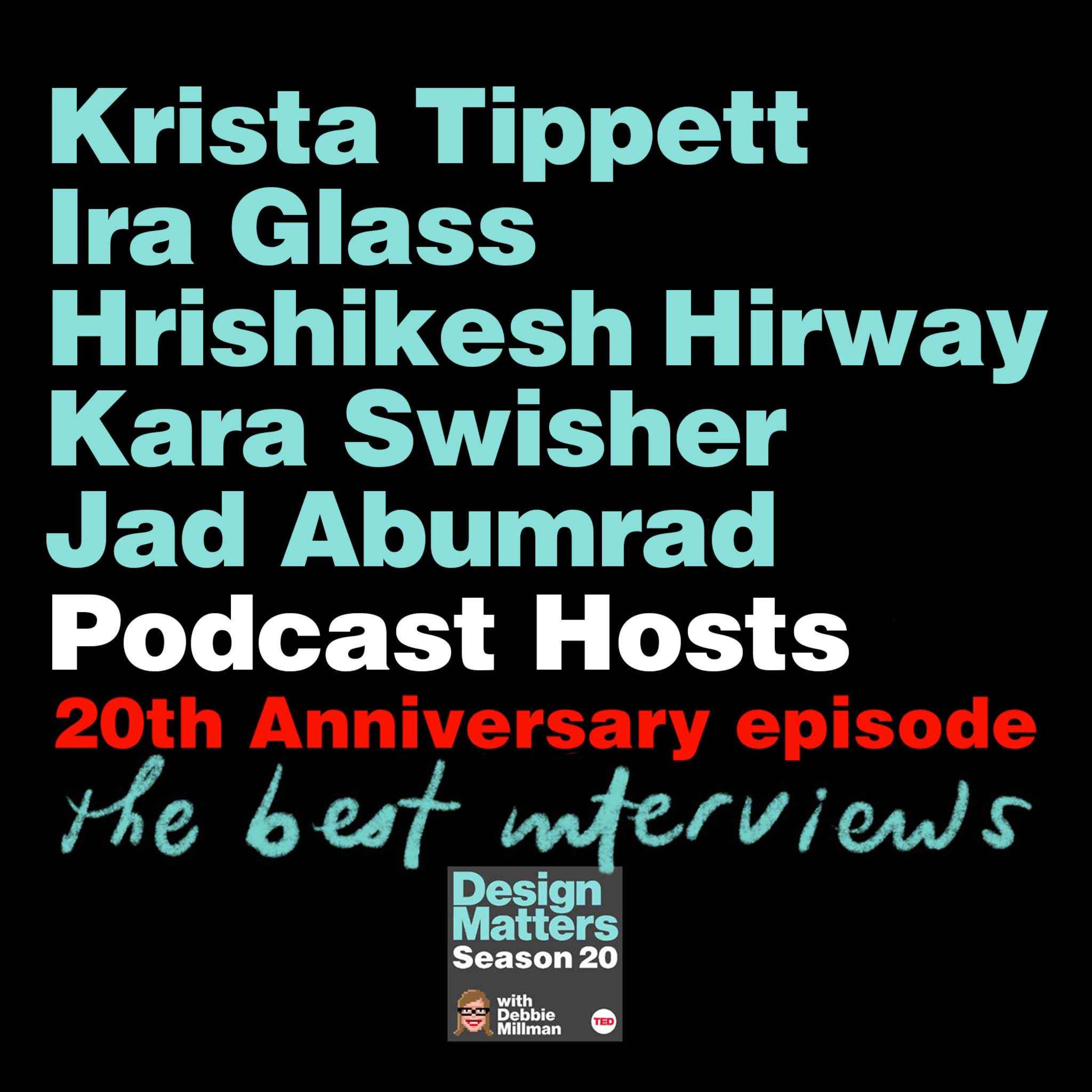
Krista Tippett, Ira Glass, Hrishikesh Hirway, Kara Swisher, Jad Abumrad
This episode celebrates two decades of Design Matters by featuring favorite moments from past interviews with notable podcast hosts. It explores how they found their voices, shaped their formats, and learned the art of listening, shedding light on the craft and conviction behind successful podcasts.
Written by AI. May contain mistakes.

Get the gist, explore an idea or ask about something said.
 Claude
On Design Matters with Debbie Millman, what are the key points of this episode?
Searching your listeningAutomatic transcript. May contain errors.
0:00Like, I looked so young for so long. I was reporting in Lincoln Park High School and I would get stopped for a hall pass. I had no idea what I was going to do and I end up in Minnesota. They said, why are you leaving? And I said, I don't want to talk to you anymore.
0:19From the TED Audio Collective, this is Design Matters with Debbie Millman.
0:26On Design Matters, Debbie talks with some of the most creative people in the world about what they do, how they got to be who they are and what they're thinking about and working on. And I think there was some part of me that was just so determined to just prove to myself that I was right. On this episode, in celebration of the 20th anniversary of Design Matters, we'll hear Debbie interview the interviewers, excerpts from her conversations with fellow podcasters and radio hosts. And along the way, I went from being a musician to being something between a musician and a storyteller and a journalist.
1:02For the past 20 years, I've been talking to people about their lives. I conduct research to find out as much as I can about my guests, and then my job is to craft questions, ask as many of them as time and good sense allows, and pay close attention to the answers. Easier said than done, though. It took me a long time to feel like I really knew what I was doing. It's been one of my great pleasures to interview a number of my fellow podcast hosts in recent years, people I've admired and learned from for a long time. They do what they do with pleasure, intelligence, and skill. I know it's not always easy for them to be on the other side of the mic, but as we say in the business, they are often good talkers, great talkers even, especially about their own learning curves.
1:56In this episode, I'm going to play you some excerpts from interviews I've loved with some of my favorite fellow hosts. In 2016, I interviewed Krista Tippett, the longtime host of the Peabody award-winning program On Being. She's also the author of several books, including Becoming Wise, an inquiry into the mystery and art of living. You write about how you threw yourself into the chances that were coming your way. You learned German, you backpacked around Europe, you spent a semester in a communist East German city on the Baltic Sea. And at that point, you said you stopped thinking about God and threw yourself into saving the world respectably by way of journalism and politics.
2:47Krista, did you believe that thinking about God at that time was not a significant way to help the world? Yeah, I didn't ever have any big rejection moment, or I didn't become atheist. But I was pretty uninterested in religion and in God. And I just didn't, it didn't feel relevant to me. As I settled into Brown, and then went to Europe, I just wasn't sure how it could be very important, and therefore very interesting. After college, you went to Berlin as a New York Times stringer, and you went there with no guarantee of a paycheck or a byline. That's astounding to me. What gave you the courage to do that?
3:32I was 22. When I was 22, I was thinking about how I was going to live the rest of my life without becoming a bag lady. So I think that's enormously courageous. Oh, yeah, I guess it is. I don't think of myself that way. I think I actually need to give my younger self a little bit more credit. I mean, not only did you go someplace where there was no guarantee of a paycheck or a byline, but you were also going to a country that was in enormous turmoil. You mean Berlin, divided Berlin? Mm-hmm. Yeah. Well, I'd been in Bonn and I'd been in East Germany. So I was going back closer to the part of Germany that I first knew.
4:12And Berlin, divided Berlin, yes, was the fault line of the Cold War. But as a place, you know, by the 80s, West Berlin was surrounded by East Germany. It was surrounded by the great communist sea. And it was a very contained, idiosyncratic, kind of a small town. so I was able to go there as a New York Times stringer and immediately kind of know everybody I could want to know and you know be getting invited to diplomatic cocktail parties and be taken seriously because it just it wasn't a big universe and you know I was ready to fail and to like go home with my tail between my legs but it it worked out.
4:58It seems that after you left Berlin and you lived in Spain, you lived in England, Scotland, and then the notions of spirituality and God came back to you. You then decided to pursue a master's in divinity from Yale. Now, you've written that you didn't study theology in order to be ordained. So what motivated you to choose this particular course of study? So I had those about 10 years ending up in divided Berlin, which was such a political place. and I was in the end working for an ambassador who was a nuclear arms expert. So I was like surrounded with, you know, policy thinkers and really serious stuff.
5:39Yeah. And I was really idealistic. I thought we were actually there to save the world. And there was a very unsettling kind of disjunction between the power that these people had, who I was working with, and the kind of immature, unimpressive private lives they had. And also the fact that they weren't actually there to save the world for the most part. I mean, there were some exceptions, but they were, you know, the moving the missiles around was a real ego trip. Yeah, they were there to own the world. Yeah, yes. So it was exhilarating on some level to be part of that. But on another level, it was really unsettling, kind of morally unsettling.
6:22And then at the same time, I was living in divided Berlin, which was just really this great big social experiment where you take one people and divide them into two completely different worldviews. And I was also seeing this paradox at that human level of where people on the western side of the wall had everything in contrast to the people in the east, but they could be really shallow and have impoverished inner lives. And then I was very drawn to the people I came to know and love in East Berlin who really had nothing to work with, you know, kind of materially or really importantly in terms of their choices they had to make, but who created these lives of great beauty and dignity.
7:05And so I started thinking about that work of creating a life of dignity and beauty. And it was through that kind of an anguished inquiry that I started to ask what I now would call spiritual questions. But it took me a long time before I called them spiritual questions. And so when I went to divinity school, it was kind of at the end of that process where I was thinking, okay, actually maybe religion is the place that has always asked these delving questions in the human sphere. Maybe this is relevant and maybe it's important. But I didn't quite trust that. I wanted to study it. Like I wanted to apply my mind.
7:46And so that was the decision to go to divinity school. So I really wanted a theological education. But I didn't completely rule out the idea that I'd get there and want to be ordained. But that's not why I did it. And it was pretty clear to me as soon as I got there that that's not why I was there. What were you imagining you were going to do with your degree? Well, I don't know. And I certainly never, never. It's not like I had this idea in mind. If you told me about this back then, I probably would have been, you know, I would have thought that was great. But I didn't know. It was a bit of a leap in the dark.
8:20I mean, I was doing this with my former husband, who was becoming ordained in the Episcopal Church. You know, I kind of had a companion in this. A comrade. Yeah, a comrade. And then our daughter was born while we were at Divinity School. I mean, I think of that time also as this becoming a parent, which is very formative. You graduated from Yale in 1994 and stated that you saw a black hole where intelligent coverage of religion should be. And at that time, you conducted what you've referred to as a far-flung oral history project for the Benedictines of St. John's Abbey in Collegeville, Minnesota.
9:02And it was really then that you began to imagine radio conversations about the spiritual and intellectual content of faith that could open imaginations and enrich public life. And in a report you wrote about the experience, you stated that the first-person approach to religious speech is essentially about humanizing doctrine. And Krista, is this something that influenced how you wanted to talk about spirituality? I mean, is it really possible to humanize doctrine? Well, it was kind of a discovery that I made. And you have to remember, and, you know, depending on how old people are, they won't remember.
9:42But in the 1980s, 1990s, it was this moment of a few very strident religious voices. Yes, the evangelists came to. Yeah, Jerry Falwell, Pat Robertson. And it was a conclusion of their willingness to be out there, you know, speaking for God and speaking for all Christians and also journalists' willingness to let them do that because it was very entertaining and they delivered soundbites, right? So you had this toxic effect of religion on American politics and society. And this is just an aside, but I think that the phenomenon that we now see of people under 30 who aren't, you know, the nuns, as they say, who are not affiliated with a tradition.
10:27And I don't think we should be at all surprised that people who were born and who grew up in the 1980s and 90s and seeing religion have that public effect are allergic to it. Yeah. I mean, it seems like that's religion without spirituality. Exactly. Yeah. And without an integrity of, you know, who you are inside and what you say you believe and how you live and how you treat others. And so that's what I'm watching. I'm watching that as somebody who's just studied theology and found theology thrilling and relevant and nuanced. And then, I mean, you asked what I thought I was going to do. I had no idea what I was going to do.
11:01And I end up in Minnesota, you know, with a young child. But there was this amazing place, you know, Benedictines, monastics are kind of amazing in the whole history of humanity in ways we don't think about very often. So there's this amazing Benedictine monastery in the middle of Minnesota. And they saw me as somebody who had a journalistic background and a theological education. they've invited me to do this oral history project. So I go on this kind of adventure, interview about 55 people across about a year or two. And some of these people were big names of Christianity in the 20th century.
11:38And some of them were just, you know, extraordinary people who'd come through that place. But every single one of those conversations was intelligent, thought-provoking and fun nice combination and if there's one word that you never use to describe the public religion at that time it would be it would not be fun like intelligent and fun were two two adjectives i hadn't expected and so in the course of that i started thinking you know this is so exciting and it's so interesting and i'm learning so much and people would like to hear this kind of religious voice. And so originally that was a thought.
12:20And then, you know, over a period of time, it became an idea that maybe I could do that. And then it became an idea that maybe I could do it on public radio. And I didn't really have a vision so much of like, you know, I'm going to create a weekly national show. I just got fired up that this was something that should be tried. Krista Tippett in 2016. Ira Glass hardly needs an introduction. The host of This American Life has been at it for a long time now. Lots of longs in this episode. His show was on the radio long before podcasts were even invented. I spoke with him in front of a live audience at the On Air Fest in Brooklyn in 2020.
13:05I discovered a 1991 article in the Chicago Tribune titled, Take It Off with the following description. After deciding to shed his long hair look, a brave dude tries a variety of cuts on the way up. I'd like to show you this image from the paper and ask if it is indeed you, the brave dude. Yes. I can confirm that that is me. Share the backstory with us, if you can, just for a few minutes. It was a really long time ago, and for a while I had a ponytail, which at the time seemed cool. So that went up there? It didn't look like that. It was longer than that. Very Steven Seagal. It wasn't quite Steven Seagal.
13:59It was a little messier. It's not a very dramatic story, but at some point I decided I just wanted to change how I looked because I wanted to change my life at that point. There's some old saying that when a woman cuts her hair, she changes her life. Really? I heard it in a movie anyway. And I didn't know the saying at the time, but it was true. And then somehow somebody knew somebody who was like, oh, we could take pictures of that for the newspaper. Something that had never happened to me before. I had never been photographed for a newspaper. At the time, I was a freelance reporter for NPR. And I thought, okay, that'll be a new experience.
14:45Okay, I'll try that. And that's how it ended up in the paper. It's not very dramatic, I'm afraid. I think the one right above you is rather dapper. that short hair like that it did look like that for a while when I was working at NPR in Washington like through my 20s I started at NPR when I was 19 and did kind of all the low level jobs on all things considered in morning edition but I looked very very young and I was younger than most of the staff and so in my early 20s I just thought like I need to figure out a tactic to seem like an adult and so I wore a tie every day and it sort of worked. Like I looked so young for so long.
15:28I remember when I was in my early 30s, I was reporting in Lincoln Park High School and I would get stopped for a hall pass. Like, I'd have to be, no, I'm an adult. You've said that you don't like interviewing famous people, that mostly because they arrive at an interview with a mask that might be hard to penetrate. When that happens, do you have any surefire way to get them to lower the mask? I mean, honestly, I've interviewed so few famous people that I haven't really had to think my way through that problem. I know you interview lots of famous people. I mean, I think that in general, finding an anecdote or a way in that people haven't talked about before, for example, an article from 1991 that a person hasn't thought about in a long time.
16:23Totally. I respect the technique. And, you know, and then it just, I don't know. I think the people who are so good at that, you know, Terry Gross, there's a print reporter in Los Angeles who used to write a lot for the LA Times, but also for Entertainment Weekly and stuff named Margie Rock. And she and I used to talk about this because she would interview like Nicole Kidman and people like that. And I'd just be like, what do you do? And she would tell a lot of stories about herself, like that would relate to things inside them. and were just enormously empathetic as a person. And they would just get lost in a conversation with her, as lost as somebody can get who's in that kind of position.
16:57And she would get all sorts of things from them that were very personal and very real. I think in general, like, I mean, I've said this a million times, but an interview is a party that you are throwing. And if you are a three-dimensional person, it gives the other person the opportunity to be a three-dimensional person back. And so that's just an enormously powerful force. I remember when I was interviewed by Mark Maron for the WTF podcast, he is so emotionally present and so bare that you just feel like you have to rise to the occasion as the interviewee. Your sister, Randy, has described you as a nosy introvert.
17:39Yes, noisy, noisy, noisy. Noisy. Yeah, but nosy is also true. Nosy is very much. See, I thought nosy was actually really cool, because that would make sense, given your curiosity. But I misread it. It's noisy. Noisy. But nosy is just as true, for sure. Very nosy introvert. Yes. Yeah, noisy introvert is this category that Randy came up with to describe herself, where she can be very social, but actually she prefers to be alone. and then when she said it I realized like oh I have it's like a I know so many people like that especially I think uh writers um so many writers I think have the personality type of like they can manage in a social setting and they're okay for a couple of hours but really where they'd rather be is alone um and and that's a lot of my personality too when my fiancee Roxanne and I first got together, she's very quiet and can be very shy, and I'm not.
18:41And I would want to try to get more out of her, really understand her emotionality and that inner dialogue. And I remember talking to my therapist about it and saying, you know, she's such a good writer, and she talks so much about her emotions as she, while she's writing, and she very sort of abruptly said, that's why she's a writer. So it really helped me understand the different ways that people prefer to communicate. Yes. Yeah. I'm very aware of those tendencies in myself. You sound that like that is something that is concerning to you. Um, what a therapist like response. Um, couldn't help myself
19:33yeah no I understand the ways in which in public I'm able to do things that can be harder for me in a personal relationship for sure you wanted to be both an astronaut and a magician when you were a kid yes but both your parents grew up really poor and they wanted you to be a doctor Yes. I wouldn't say poor, but they were people without a lot of spare money for sure. I believe you were quite a talented amateur magician and became well known in your neighborhood for being able to make a very credible Snoopy out of balloons. Yes. I gigged as a kid magician when I was a teenager and did children's parties and did magic tricks.
20:20I have to say, in terms of just sheer craft, I'm not very good. Oh, really? Because I was kind of hoping that maybe... Oh, I can totally do balloons still. Would you? Yeah, totally. Thank you. There's a variety of colors. Oh, wait, but these are... No, those are the kind for balloons, for animals. Do you want me to hold the microphone? Hold on, I'll put it down. How good is this? Okay, let's just acknowledge that this is a classic radio moment. These are not the right kind of... What you need are ones that are long and thin. Aren't those long and thin? No, these are actually sort of stubby. You need like a 245 or a 260, which means two inches long, two inches wide and 45 inches long.
21:01My point is made. But I have my bag. If somebody could grab my bag from back there. We did not plan this. Like, I do carry around usually a couple of balloons because sometimes you're in a situation, a reporting situation, or just you're with a friend's kid. And it's appropriate to pull out an animal balloon. I could make a coin disappear while we wait for the bag. Really? I hear things happening back there. So can you still make a Snoopy? That's my bag. I could make a Snoopy, yeah. Sure, for sure I could. Yeah. Thank you. Okay. Oh, my. This has been a weird afternoon. I take that as a compliment.
21:47Oh, wow. Okay, Snoopy, not a poodle, but a Snoopy. Yeah. Okay. hold on please can someone tape this videotape
22:01do you want to mic the sound of this
22:07it's funny like I don't buy these balloons very often I can feel that this one's kind of old so it actually might pop so just a warning
22:26Now doing the body and the back legs. This is actually the part that sort of every animal you make out of balloons. I learned this from a book called Roger's Rubber Ark. Okay. Can you see it's Snoopy? Oh, Snoopy. Ira Glass, and Snoopy, live at the On Air Fest in 2020. Rishikesh Herway is the host of the podcast Song Exploder. The format he created of going deep with musicians into their creative process and decision-making has been much imitated, but never surpassed. I spoke with him in 2020, and we got into how a lull in his musical career led to the creation of his podcast. In 2013, I was kind of feeling like, I was like, well, nothing really ever broke for me.
23:20And so that year, I started a new music project. I started a new band, basically. And I started, um, I started working on making a podcast and I also started working on like a TV show idea. Um, and all of that stuff felt like in some ways, like a distraction from, from the 1am radio and the distraction from like what was supposed to be my real, my quote unquote real career. But with the, with the podcast, especially I thought, well, maybe this was, could be a way that I could have a day job that was of my own making and also under my own control that would allow me to pursue music and not have to worry about it as a financial, as my means of survival.
24:06Because I think that's like where a lot of tension was for me. How did you come up with the Song Exploder concept? Well, I had been listening to a bunch of podcasts around that time and really liking them. I'd listen to them on tour. And I was also a big fan of, there's a magazine called Tape Op that I really love that's called the Creative Recording Magazine, where they would interview a lot of the kinds of artists that I liked listening to about the ways in which they'd record. and there were all kinds of strange and weird ways that people would work to try and get the sound that they wanted, you know, outside of like a huge commercial kind of situation.
24:50It was people who were like me, who were recording at home, who didn't have training, but who had made these records that I really loved. And so getting to read those interviews was really inspiring for me. But at the same time, it was also print. And I wanted to go further. I wanted to hear the thing that they were talking about. And I thought, well, a podcast could be a place where you could kind of combine these things. You could get to explain these ideas and then you could also hear these things. And better yet, you could not just hear the song, you could potentially hear just the stem of the song, which is just the isolated layer of that one instrument or that one track, which was something I was very familiar with from having made my own music all of these years.
25:31You know, the moments where you solo just the one track to hear what's really going on in it. So that was sort of where it came from. Is it true that Questlove's liner notes were one of the original inspirations for the show? Yeah. Yeah. I mean, many years before that, I remember he had written in the liner notes for the album, Things Fall Apart. He talked about this drum sound that was specifically when I had been listening to the record, I had really fallen in love with. because there was a, there was a moment where he did what I had been wanting to do, which was make his drums sound like not quite like real drums.
26:08Like there's a moment in the record where it sounds like it switches from a live drum kit to like an old, you know, like a drum sample. And it sounds so cool. And then I'm reading the liner notes and he talked about that. He said, I finally got that sound that I'd been looking for. And, um, and I wanted to know what it was, But that was it. That was all that he wrote, you know, that he had finally achieved it. But I needed to know what the answer was so I could do it myself. So I was thinking about that, too. Rather than assume the risk of doing all of this on your own, you went to a number of established organizations like Spotify and you proposed that they hire you to make the show for them in-house.
26:48And they rejected you. They turned you down. And you went ahead and did it on your own. What gave you the confidence to go ahead and just do it on your own? I don't know. Oh, you know, I was thinking about something that you wrote about one time about the difference between confidence and courage. Oh, yeah. And I don't know that which one it was, if it was if it was courage, despite a lack of confidence or if it was, in fact, confidence. I just knew that it was something that I really wanted, that I would really benefit from if it existed in the world. It had like this no brainer kind of feeling to me.
27:28you know it was really frustrating to me that i couldn't convince people to see this thing and the the worth of this thing the way that i saw it and i think there was some part of me that was just so determined to to just prove to myself that i was right that i thought well i should just do it and i said i said i would give myself a year has spotify since come back um with their tail between their legs so to speak no they have not it's only a matter of time they're doing they're doing fine How did you raise money to produce the show yourself? It didn't actually take any money at first. That was the nice thing because I was just doing it all entirely on my own with what I already had.
28:08So the real factor was just convincing people to say yes to letting me interview them and handing over their stems and letting me kind of make the story out of those components. song exploder debuted january 1st 2014 and featured jimmy tamborello of the synth pop band the postal service looking back on that show now how do you feel about that first episode i mean i i wish i could redo it i think i could i could probably make a better episode now than i did then but it was the first time i'd ever interviewed anybody and it was my first time trying to make a podcast so you know i have to give myself a little bit of forgiveness for the first stab at something.
28:51Oh, yeah. I mean, I look back at my first 100 episodes. I'm horrified. Initially, you didn't want to be in the show at all. And Jimmy Tamburello did both the intro and the outro for the show. That changed when the podcast was picked up by the Maximum Fun Podcast Network. And the founder, Jesse Thorne, felt you should have more of a front-facing role. Why didn't you want that initially? I didn't really see the point. The thing that I was trying to make was about this artist and their song. So I didn't understand what I needed to even be doing in there. It could be this perfect, clean little package from the one voice of the creator of that music.
29:40You still edit out a lot of your questions from the podcast episodes. Why? I love you being in it. I love hearing your voice. You have such a good voice. Well, I still feel the same way about that, you know, that I want it to feel like it's not about me or my point of view. I want someone to be able to just sort of put it on and say, OK, I'm going to listen to this thing and I'm going to hear from this creator. Like, I still think of my presence in the show as being purely functional. The thing that Jesse said was, he said, I think it'll be helpful for people to know that there is an author behind the show.
30:16I think you're the soul behind the show. And I guess that's true, but I also feel like you don't see a designer's name. It's not like a painting where their signature is at the bottom on lots of the most beautiful things that have ever been designed. Without some research, you'd never know who designed it. That's changing a bit, though. I know that James Victoria signs his designs now. Stefan Sagmeister often does. As Paul Rand, I think, did occasionally. In any case. Would you ever? Not my design work, no. Only illustrations or artwork. And why not? Aren't you the soul behind that design? No.
31:03And all the corporate design work that I've done, I worked with a team of people. and very little branding actually comes from a single mind. And so there's always somebody that's doing the market research and somebody that's doing the implementation and so on and so forth. Even working on Tropicana, there was somebody that was airbrushing the droplets on the orange. So if you were going to, and there were like 79 droplets or something, everyone was numbered and corresponded to, you know, talk about Photoshop. That was a big file. So I wouldn't feel comfortable ever saying that I designed that on my own because it was just a real group effort.
31:48But with illustration or with artwork, definitely, you know, when I'm the sole creator, then I do feel comfortable. Yeah. I think that's part of it is that, like, I'm not the sole creator of that show. You know, it doesn't exist without the raw material of that artist's work and their ideas. And so I'm presenting their music and their ideas and shaping it in a way that I think will hopefully serve the song and the story. But I think in the same way that you're describing the teamwork on branding, it doesn't feel right to say like, oh, and this is my creation. Well, we could argue about this offline.
32:30Notice how he turned the tables on me and started asking me the questions. Very crafty. That was Rishi Keish Herway in 2020. The tech journalist Kara Swisher hosts a number of podcasts, including On with Kara Swisher and Pivot, both from Vox Media. I spoke with her in front of a live audience as part of a Design Matters live tour in 2023. I was also joined on stage by my wife, the writer Roxanne Gay. When your dad was 34 years old, he died from complications of a brain aneurysm. Yes. He was fresh out of the Navy. He had three kids. He and your mom had purchased their first house. He had landed a job as the head of anesthesia at Brooklyn Jewish Hospital.
33:19You were five years old. Indeed. And have said that his sudden death has informed everything you've done since. Yes. And I'm wondering in what way? Well, in every way. I think when your parent dies at a young age, there's a great book, I think it's by Irving Yalom or something, called The Lost That Is Forever. It's one of, I love this book. I just, a friend of mine's lost her daughter who has this young child and I sent this to them or advised them to get it. And when your parent dies at a young age, it's as if half your friends have died, right? Because that is your touch point at that age. And at that time, when it happens, it's devastating, but you get through it.
34:02You do. You just do. And so a lot of things don't matter as much as because you realize, one, you get a sense of mortality at a very early age. And two is you can survive a lot of stuff, you know. And a lot of people have gone through worse things, but it certainly was tough. And it was accompanied by the fact that my mom married someone who wasn't very nice. My father was incredibly kind. So I felt like, I mean, I was essentially living Cinderella or something. Like it was like that. And so it makes you think every time I think about death a lot, not in the way I'm going to die tomorrow. It's that I'm always like, should I do this?
34:37I'll be dead in 50 years. Yes. And so it tends to give me a positive spin on everyone. I don't have as much, I just don't have that kind of time. And neither does anybody else. But I have a very good sense of that. The other thing is when I had my first child, who is now 21, when, you know, I have right now also a four-year-old, someone about to turn four, daughter, and a son who's about to turn two. And when my oldest, who's now 21, turned five, I realized the devastation because we were incredibly, I'm incredibly close to my little, my two-year-old. Like, knows me well, walks home, hi, mama, and hugs me.
35:18And it just informed everything. So I think it made me bolder and highly functional, I would say. Highly functional. And my brothers are highly functional. So it's not great, but that's not a great way to learn that. You know, you've noted that when you survive something that awful, very little is going to bother you over the course of the rest of your life. And it seems like that has held true this many years later. And so why do you think that holds true for so long? and do you ever foresee that changing where things might start to rock your world again? Well, only around my kids, I think. That's the only time I get panicked about something happening to them and traveling.
36:00That's the only thing I think. I think I had kids because I didn't want to become one of those people that nothing bothers, right? And I think probably a lot of my earlier relationships, I was like, yeah, we break up. Oh, well, so what? You know what I mean? You get like that. Yeah, it'll be fine. Everything will be fine. I'll be fine. And I think having kids does give you a sense of vulnerability that you can't avoid. Not everybody has kids. Like I get it. There's different ways to do that. But for me, that's really that that's the one thing that gives me a sense of terror sometimes, you know, or scaredness.
36:35I'm not scared for myself. I'm scared for them, especially because I knew, you know, it does give me insight into what happened to me too at the same time. So I guess that would be, it doesn't leave me though. Every time, you know me, I leave things like when I don't like, if I don't like getting enough money or if someone just bothers me. We were talking about someone we know jointly. And when I left this particular thing, they said, why are you leaving? And I said, I don't want to talk to you anymore. And they sort of were like, what? And I go, I just don't want to see you anymore also. And or encounter you or I just I gotta go and so it was and it was because of that feeling of like life's too short it's not a it's more than life's too short it's like I have this many minutes on the planet I don't know what it is but you're taking up far too many of them and you need to move along out of my sight I have to say yes please clap when I hear something like that But it feels a bit mythic because I am not, even though on the page, yes, I'm absolutely that bitch.
37:38But in my day-to-day life, I don't have that thing that allows me to just say, I don't want to ever speak to you again. How do you develop that? It's easy. Just start doing it. Because I do a lot of, yeah, no, no, I don't think so. I was going to do a series of books, and it still might. We just thought of a podcast with you together. It's going to be amazing. It's going to be epic. It's so unlike what you think it would be. It's not badass, ladies. It's something much worse. But I am going to do a book, and it's called No is a Complete Sentence. And the second book in the series is called Yes, I'll Take That, because I don't think women say it.
38:25It's a book for women and other people who need it, essentially. And the third is, maybe I'll call you back.
38:34I don't know. I never regret saying things. I don't. People are like, did you regret that? I'm like, no. No, I like that. That was fun. Wow. Yeah. Someone's going to shoot me someday. One time I was in, because I'm kind of mean to some of the tech bros and they have a lot of money. I was in New York and I was crossing the street and a car made a 180 in front, a big black car, like one of those big Ubers, this whatever, and stopped in front of me. And I literally thought the time has come for Peter Thiel to kill me or Elon Musk slash Mark this, that they have sent in the Israeli secret people that are going to now take me.
39:13I'll be caught up into little pieces and spread around the ocean and stuff. And I thought, I thought, oh God, one too many insults of these, these children, adult toddlers. And I just did it again. And it was a fan. It was a fireman from Queens. And he's like, did I, he wanted a selfie. And he goes, did I scare you? And I'm like, yes. Now you have to abduct me and cut me into tiny bits. Kara Swisher in 2023. Jada Boomrad is the creator and former host of Radiolab, the legendary long-running radio show and podcast. As with Kara Swisher, I interviewed Jad as part of our Design Matters live tour in 2023.
40:01I had a real, like, crisis of, like, what am I going to do? What am I doing with my life? And my then-girlfriend, now-wife, Carla Murthy, just one day, I remember we were standing on a platform to the G-Train or something, and she was like, you like to make music, you like to write, you should go do radio because that's kind of both but neither and so i started volunteering at a radio station uh wbai radio in um downtown manhattan and um right wbai person um wbai back in the day this is pre my time was like mtv it was fantastic it was amazing i got there a little bit late i remember walking in on my first day and uh the newsroom was sort of deserted because there had been some sort of leftist rebellion in the radio station, which there was like every Tuesday at WBAI.
40:53And so there was one guy, and he clearly had to put the news on, and he was strapped, and I walked in, and he was like, you, take this tape recorder and a mic, and just go cover this thing happening at City Hall. And I remember running to City Hall being like, what does that mean? How do I cover something? I remember getting there and just like, why are you angry? You know, just like not even knowing what questions to ask. And but then like I came back and at that point, WBAI was still editing on tape, like actual tape with razor blades. I just remember like putting the thing onto the actual tape, cutting it with the razor blades, recording my own voice, stitching that between the bits that I liked from the interviews.
41:40and then I had a news report on the air at three o 'clock that day. And was it because you learned the skills in your room with the four track? Or how did you learn how to cut tape and splice it together? I mean, I was working on the computer at that point, like most of humanity. But they were still on these reel-to-reel tape recorders, which actually is like, it's the most amazing way to work with tape because it's so tactile and you can kind of like, you can hold moments in a way and rock them back and forth between the playhead and find it's a very very cool way to sort of engage with the process and I just got hooked like instantly I was like oh this is what I should be doing thank goodness for Carla yeah well I mean Carla's made all the good decisions in my life um yeah so I and from that point on I just I volunteered This was a weird moment in, it's actually not weird.
42:37I mean, it's just one of the many moments in New York history where the city was like, there were crazy. I mean, there was endless police shootings at that point. Amadou Diallo, Malcolm Ferguson. I'm suddenly like running through the Bronx covering these things. I don't know how to do any of it, but you just sort of fake it. 9-11 happened right around there. the entire city transformed and we were just we were walking on the pile basically covering what was happening and I just got like a crash course in journalism and along the way I went from being a musician to being something between a musician and a storyteller and a journalist which I still sort of think of as a composer but it all happened in that that short time.
43:21You then began freelancing at WNYC, and in 2002, the program director offered you a late-night Sunday slot on the AM band as a DJ of documentaries. I know. I know. I know. No, I read that you had to make connections between documentaries that included things like a BBC story from Zimbabwe or a sound art piece about dogs. and you'd somehow have to make a connection between them. How were you able to do that? That specific example, I have no idea. You know, it was a, I mean, the whole idea of it at that point was, WNYC at that point was a classical music station and then 9-11 happened and suddenly all of New York was asking questions about the world.
44:17Like we all had this sense that our lives as New Yorkers were suddenly globalized in a way. And so along with that, the program director was like, let's air documentaries from around the world to give us sort of a much wider lens. And so I begged everybody for their documentaries. I called the BBC. I called Radio Netherlands. I called Australian Broadcasting Corporation. They sent me boxes of stuff, like old stuff. And I would just, I don't know, I would just make a, you know, like everyone, when I was under the spell of This American Life. And so I would kind of do the themes, you know, the act one, act two, act three kind of thing.
44:52And I would just, you know, like, I remember my first episode was called Firsts. And it was somebody undergoing electroshock therapy, somebody talking about their period, like a Radio Rookies piece. And then it was some other piece. And I was just like, these are all firsts in some weird way. So like, just like choosing random themes to try and hold all of this content. But that you can really, the way you've described it, you could see the seeds of Radiolab right there. Yeah. I mean, it was, if I listened to those first few episodes, and I'm really glad this was right before that moment on the internet where everything is around forever, this is right before that.
45:36So these episodes are gone and they should be gone. Yeah. I kind of wish my original ones were too, but they're still there. Oh, it's horrible. It's such a curse that everything sticks around the way it does these days. But that, like, if you listen to those old episodes, what you will hear is the sound of Radiolab, like, from the very beginning. It sounds absolutely like the show. But it's kind of half-assed, you know? Like, some of the stories are, like, the connections are a little bit loose. I mean that in a loving way. I don't mean that in a bad, critical way. Things weren't exactly fact-checked.
46:09It was just all very sort of, like, throw it against the wall. very experimental at times because I wasn't a journalist at that point I was still learning I was still figuring out what it means to report something it was only really I'd say three or four years after that that I I would say I figured out like this is how you do the job I was still trying out different voices in the mic on the mic in a way in that way that when you don't know how to talk in front of a mic all the other voices that you've heard in your life come out, you know, I'd sound like Ira a lot. I'd sound like Walter Cronkite and various things.
46:42I mean, I was just like trying. We need to stop you right there. So I found, I found a comment about somebody writing about Radiolab. And I thought you'd be happy to hear how the voice you created for Radiolab was described by a fan. Hmm. They've completely rejected the voice of God format, as well as the voice of casual God format, and even the voice of friendly NPR God format, and replaced it with a truly conversational tone. Very often hosts will interrupt each other and say something like, wait, what? What does that even mean? And that's so true. And I love that this person sort of was so descriptive about what you weren't.
47:34And I can only imagine that those years of struggling and tinkering and experimenting gave you the opportunity to learn sort of semi-publicly how to do what you ended up doing. Yeah. I mean, honestly, I'm so thankful. Like the first three years of Radiolab were basically spent Sunday nights on the AM frequency and no one was listening. I mean, I mean that quite. Did they also cut back the band? Yes. And so I mean that like literally, like they would cut the power of the transmitter right as I came on the air. So you, you couldn't even listen. It's like one block radius. You had to be hugging the transmitter with your body to actually get my show.
48:20And I hated that. I thought it was horrible. I thought I was being taken advantage of but actually now i'm really grateful because i feel like we all need that period of benign neglect to figure out who we are you know um i i get so sad for people who just like they just walk right into a podcasting 12 part series that gets promoted i'm like just give it a minute like you're sad like well kind of like you kind of want people to have like that play playgrounds where they can kind of you know i mean i do think it's important to be able to learn as you make. Yeah. Because I think then what you make ends up being better.
48:59Yeah, absolutely. And the thing about the gods that you just said, I had to sort of stumble my way into that. It's really weird what happens when you talk in front of a mic is that you suddenly feel the pressure to know things you don't actually know, you know, because the mic brings with it all of the people who might hear you and judge you. And so it takes a long time to actually get to a place where you can talk as you actually talk. And I went through a lot of early awkward periods where I tried to talk like that thing that NPR reporters do. They talk like this, like very staccato, very centurion voice of certainty.
49:35And I never knew what I was doing. And when I met Robert, who then co-hosted the show with me for 17 years, between us, We developed a way of examining ideas and playing with ideas that was very fumbly and very, it's just playful is the only way I could describe it. And where you didn't have to know things. You could kind of, you know, be as stupid as you actually are. And that was the invitation is that you're open. You don't really know. Let's go find out together. Almost sounds kind of quaint to say all that now. But at the time, it felt like a real discovery. Jad Abumrad in 2023. You can hear these full episodes, as well as hundreds of other interviews with podcasters, artists, and other creative people on our website, designmattersmedia.com, or wherever you love your podcasts.
50:31We'll be back next week with another special episode called from the many years I've been doing Design Matters. Yes, this is the 20th year we've been podcasting Design Matters, and I'd like to thank you for listening. And remember, we can talk about making a difference, we can make a difference, or we can do both. I'm Debbie Millman, and I look forward to talking with you again soon. Design Matters is produced by the TED Audio Collective by Curtis Fox Productions. The interviews are usually recorded at the Masters in Branding program at the School of Visual Arts in New York City, the first and longest-running branding program in the world.
51:09The editor-in-chief of Design Matters Media is Emily Weiland. you
To celebrate two decades of Design Matters, Debbie Millman gathers favorite moments from past interviews with podcast hosts Krista Tippett, Ira Glass, Hrishikesh Hirway, Kara Swisher, and Jad Abumrad. These excerpts trace how each host found their voice, shaped a format, and learned to listen, revealing the craft and conviction behind the shows that shaped podcasting.
Hosted on Acast. See acast.com/privacy for more information.