Ask ChatGPT


 Design Matters with Debbie Millman
1 Dec 2025 · 45m
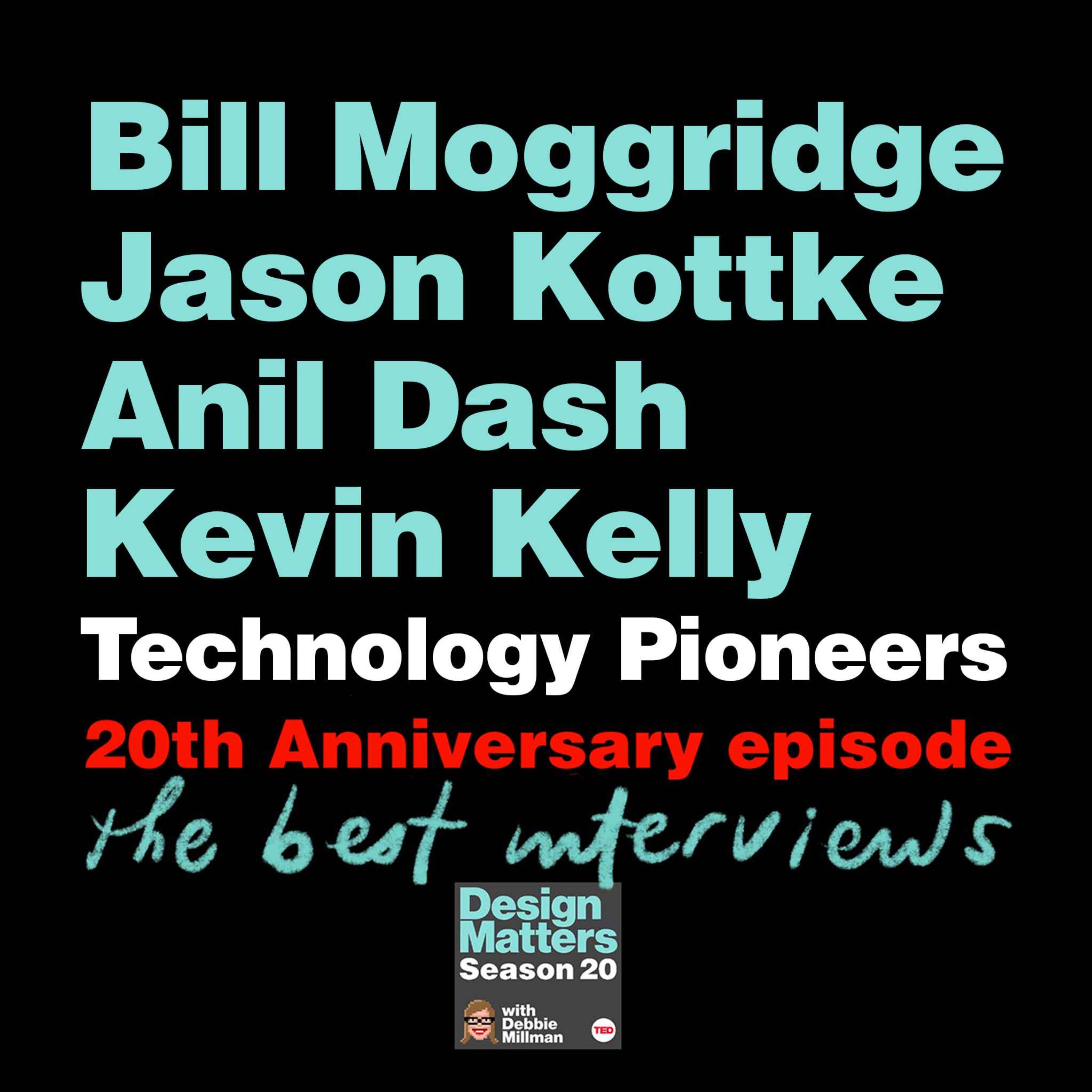
Description: Debbie Millman celebrates the 20th anniversary of Design Matters by revisiting interviews with technology pioneers. The episode discusses the evolution of technology, its impact on our lives, and how early thinkers envisioned the future.
Written by AI. May contain mistakes.

Get the gist, explore an idea or ask about something said.
 Claude
On Design Matters with Debbie Millman, what are the key points of this episode?
Searching your listeningAutomatic transcript. May contain errors.
0:00Very surprising how good the mouse is, still is. In AI, we're going to see increasing numbers of specialized AIs to do different things.
0:13From the TED Audio Collective, this is Design Matters with Debbie Millman.
0:20On Design Matters, Debbie talks with some of the most creative people in the world about what they do, how they got to be who they are, and what they're thinking about and working on. On this episode, in celebration of the 20th anniversary of Design Matters, we'll hear from some of the tech pioneers Debbie has interviewed over the years. Our computer science program is still contained ethics. You know, that's, like, fascinating at any point. I began this podcast 20 years ago. 25 years ago, there was no such thing as a podcast. the technology simply wasn't there yet or at least no one had yet thought to connect audio to an RSS feed the world we're living in today is built on technologies that are changing so fast that it can be hard to keep up fortunately over the years I've had a chance to talk and make some sense of it all with a number of tech pioneers people who have extended our use with and understanding of technologies in new and innovative ways.
1:25On this episode, I'm going to play excerpts from interviews with some of those mavericks. In many ways, the show today will feel a bit like a time capsule, given how much things have changed since I've had some of these conversations. But it's also amazing to hear how much they still got right about the future that we're now living in. Bill Moggridge helped invent the laptop, and he co-founded IDEO, the design consultancy that centered the idea of user-centered design. I interviewed Bill in 2010. Would it be true to say then that your fascination with what people want from everyday things is true?
2:07Yeah, I think that's right. I mean, if there's a simple, easy principle that binds everything together, it's probably about starting with the people. And so the relationship people have to whatever you're designing is the most important factor. And I'm interested in why people like things and what gives them rewards that are long term, what gives them pleasures, what gives them – what's exciting. It's about the effect that everything that you might design has on anybody, somebody. It's interesting that as so many things change around us, you know, the evolution of technologies and social relationships and so on seem to change so fast.
2:48But that principle, start with people, is you can rely on it. I was talking to somebody earlier today about interviewing you, and I was talking about all of your great accomplishments and, of course, talked about you being involved with the first laptop. and he was really interested in whether or not you thought that the laptop was going to continue to exist given the advent of first the iPod and now the iPad and all of the Kindle-type products. Do you think that the laptop is still going to be around in 10 years? 10 years, no question. All the laptop is an input and output structure. and so the output is a display and that display is fairly much the equivalent of an iPad only bigger and better so it could easily be replaced by another form of information display a projected one for example and then the input very surprising how good the mouse is still is in fact if you go back to the original research done on the mouse the people who did that research were very surprised as well but until we find something a lot better than the mouse the mouse tool remains pretty good.
4:02The trackpad is pretty good. The stylus is pretty good. So things that will allow us to input as well as a keyboard or better, perhaps it'll be voice recognition or handwriting recognition, sketching, mousing, all those input devices, they will probably still be resident in laptops. I mean, I think they'll also be resident in workstations, which you can't move around with you because the opportunity to make those bigger and more easy to work with is growing. But the compromise between the little thing in your hand, like a phone, smartphone, or the in-between size like the iPad and that workstation, laptop's still a very good in-between place to be.
4:46Several years ago, you wrote a book called Designing Interactions, published by MIT Press. It's rather extraordinary. It was named one of the 10 best innovation and design books that year by Business Week magazine, 2006. And in the book, you talk at length about the creation of the laptop. How did you get involved in that endeavor in the first place? How did you get initiated into this project? Well, I was just starting my second office. I started my first design office in London in 69. and in 78 I researched places in the US and found out about Silicon Valley and was very excited about that because Silicon Valley was moving from just chips to products as well.
5:35So it's a great opportunity for a designer. I'd already worked on computers and telephones a lot in Europe in 10 different countries so I had a fairly nice portfolio and one of the people who also worked at PARC, John Ellenby, was decided that he wanted to make a new company that would create a computer that was small enough to carry in half your briefcase. And so I got to know him as he was about to embark on this endeavor. And he asked me to form his design and engineering department for the physical design. So you graduated in 1965. You then went to the United States to work a little bit. you came back to London and then did some additional coursework in typography and communications.
6:23Why? Well, my first job was in Erie, Pennsylvania, working for a company called American Sterilizer, which was designing hospital equipment. In fact, I met my wife in Europe and she came over and joined me in Erie as soon as I had enough money saved up and we got married. It seemed a little unfortunate to be working for a company called American Sterilizer, but we I do have a couple of kids. And one of the things they asked me to do at that company was to design the corporate identity. And I did such a terrible job. I thought I had to go back and study something about graphic design typography.
7:01And so we went back to Europe and I started working in an advanced studies department, which is like a little postgraduate program. My wife was then studying furniture design. So we were both at the same school in North London. in order to make ends meet, I started working for myself. And clients started to grow. And I found, well, I said I founded the company when I had my first full-time employee. Now, while you were working on the laptop, did you have any sense of how significant a contribution to technology and culture it was ultimately going to be? Well, I think, you know, there are very few opportunities that a designer has in a career to do something which is truly precedent setting.
7:47And it was clear to me that because it was so new and so different from anything that had come before, and was really getting produced, it might make a big difference. I don't think, you know, you don't predict that it's going to spread in the way it's spread. You just have no idea about that. But it was clear that it was very important in the sense of being very innovative. You write in Designing Interactions that designing the laptop was about shrinking the computer so that you could take it with you, first as a luggable suitcase, then in your briefcase, and eventually your pocket. The transition from desktop machines to laptops was about designing the physical interface to be small enough to carry easily without changing the interactions on the display significantly because of the smaller size.
8:37Did you ever feel while you were doing this that you weren't going to be successful? Well, in terms of the sort of challenges that we were meeting for the physical design, they were small things, if you look at them as individual items. You know, for example, we wanted to know what the right weight would be as a maximum for the specification. So I made everybody in the company, well, there were only seven people in the company, and walk around with their briefcases containing what they normally had anyway. And I gave them one pound weights and said, carry as many of these one pound weights as you can, as well as your normal stuff.
9:15And then tell me when it gets unbearable. And we came out with a pretty good number, which was eight pounds. And so then we tried to design the thing to weigh eight pounds. Same thing was true of the impact, you know, how far could you drop it on the floor without it breaking. That was Bill Moggridge in 2010. He passed away in 2012, but his legacy as a designer and a thinker is still clearly very much with us. Jason Kotke is a designer who has become one of the most influential bloggers of all time. He'd started blogging way back in 1998, when the word blog hadn't even been invented yet. I spoke with him in 2013.
10:00So your site is one of the longest continually running blogs on the web, having been in operation for what you state as approximately 14.756 years, and you've published over 21 ,000 entries. What made you decide to start it in the first place? I was working as a web designer in 1998, and in my spare time I was also doing this site called Oscillate, kind of an episodic website where, you know, every few weeks I would produce something that would stand alone, you know, sort of on its own as an episode. And around that time, people started doing these things called weblogs, and people had been doing diaries and things like that.
10:45And I decided that I wanted to try my hand at it and sort of produced what became Kotki.org as an episode of Oscillate. So it started as an episode, and then it just kind of lived on, and I eventually moved it from Oscillate to Kotki.org. Do you consider yourself to be an editor, a curator, a writer, a designer, a developer, a blogger? How do you describe what you do? I think I'm most comfortable with blogger. I tend to stay away from the curating sort of terminology and whole thing. How come? Curating strikes me as a term that's a little bit highfalutin, if you catch my drift there. And, you know, what I do is not...
11:30Highfalutin. Highfalutin at all, I don't think. You know, it's like 13 minutes of Russian car crashes, you know, isn't highbrow material. But that's only one small part of what you offer your readers. I mean, some of it, I don't know that it would necessarily be highfalutin to curators. But I think that there's certainly quite a lot of seriousness to what you write about. And certainly your writing seems to be something that people take very seriously. Yeah, that's true. The thing I like about blogging or blogger as a term is that I think a lot of people for a long time were very dismissive of people who had blogs and who wrote blogs and, you know, still are to a certain extent.
12:12And, you know, I like embracing that term and being, yeah, I'm a blogger. This is my blog and this is what I do. And, you know, even though it's a horrible, ugly sort of word that doesn't roll off the tongue. Yeah, I think Heather Armstrong says that it sounds like a venereal disease. Yeah, but, you know, just sort of like, yeah, exactly. Now, I read an interview wherein someone asked you how it felt to be internet old. And you responded, sometimes it feels as though I've overstayed my welcome at a party. Like, really overstayed. Like, the hosts come out of their bedroom the next morning, and there I am at the kitchen table eating breakfast and asking when they'll be home for dinner.
12:54overstayed and yet you're still staying. I guess part of it is just that I've done it so long that it's just part of who I am. And so that's one piece of it. I also know how to, you know, I've got the 10, you know, Malcolm Gladwell sort of idea of the 10 ,000 hours of deliberate practice. Like I've got that in. And so I, you know, it's like a second nature sort of thing to me. I can just do it. It's not something I have to think about doing. So when you do things that you don't to have to think about doing. There's not a lot of stress involved. So it's a very easy thing to want to keep doing. But sometimes, you know, there's obviously like I get burnt out sometimes and I don't want to do it anymore.
13:34And sometimes I really enjoy it and I'm really like into it. And there's a little bit extra that I put into it when I'm really enjoying it. Where are you right now in that continuum? I think right now I'm, you know, there've been a couple of recent events. Hurricane Sandy was one. and the shootings in Connecticut was another. And, you know, those two events have really got me thinking, like, okay, what, you know, I've got this big platform. You know, I have hundreds of thousands of people reading. And, you know, what do I want that to be doing? I think in the past I haven't thought too much about that.
14:12I've just sort of been a filter. You know, I read a bunch of stuff, and whatever I find particularly interesting, I write about it, and then I put it out there. and it's not saying anything. It's not getting people into action or anything like that. But, you know, you have these events where it's like thousands and millions of people are affected and, you know, you have issues like climate change and gun control. And it's like, okay, what, you know, maybe I should be doing something else with this readership that I have. Maybe I should be telling them to do something or maybe I should be, you know, encouraging them to, you know, to think about these more weighty issues and sort of leave the, you and whatever behind.
14:52Well, very interesting reaction from what happened after Sandy and now what's happened after the shooting in Connecticut. After Sandy, you sort of stopped writing for a while. It seemed that you found real disdain in the notion of entertaining anybody at that point or being light or frivolous, whimsical. And so you stopped writing for a couple of days, if not longer. Whereas now, there's actually been quite a lot of activity online about how much you're writing about gun control in a very positive way. And probably in these last couple of months, I feel more Jason in the space of Kotki.org as opposed to just being someone that is providing information or inspiration.
15:36There's more of a point of view. Is that something that you feel is intentional and deliberate or more coming from your reaction to these events? Yeah, I think a lot of it is just reaction. It's not me saying, like, I'm injecting more of my personality into the site. It's coming from a place of not thinking about it, being emotional about it, being reactive to things that are happening that are, you know, terrible and scary and affecting my family. and it's like being like a protective father. You know, I have a five-year-old and a three-year-old and I don't want us to fuck up the planet for them.
16:13I don't want them living in a country with 300 million guns and people carrying concealed weapons everywhere. I mean, it's like, I don't want that stuff. And, you know, I'm not quite to that point of like, maybe I can do something about it. I'm at that point where it's like, I'm confused and scared and worked up about it. and what am I going to do about it? I'm going to blog about it or I'm not going to blog about it because I just can't handle it right now. Or, you know, maybe six months from now, I'll know what to do. But right now, I'm just sort of like being reactive. Let's talk a little bit about how you go about choosing what to put on the site.
16:48So you've written that you've recently realized that one of the topics you cover on your site is people are awesome and look at all the amazing things we can do that we've never done before. And this includes things such as people performing physical feats of novelty and amazement on bikes, on skates, on skis, on skateboards, kids from the projects making the cover of Fortune magazine, scientists building a tiny sun in California, inventing 3D printers for human tissue, or quietly but completely changing how people think about space and time, and so on and so on. So how do you decide what to write about?
17:25How many things do you have to read before you decide this is Kotki worthy? I mean, some days are easier than others. Some days I run across like six things right away in the morning and, you know, I write about them. And then, you know, that day's work is kind of done. Some days I just don't find stuff and I just don't, you know, nothing is quite right, I guess. Do you try to do six a day? It's funny because of all these years of reading, I've never actually counted how many posts you do a day. Yeah, I mean, I think six is sort of the magic number right now. It used to be more. I've kind of scaled back and, you know, tried to spend a little more time in being choosy rather than doing 12 things a day that aren't as good, maybe.
18:07one thing i try to focus on a lot is picking stuff that's going to be more or less timeless rather than here's what's going on right now in the news and i think if you if you go back in the archives you you know a lot of the stuff it's like oh that's that's interesting you know that's still interesting it's not like oh this is irrelevant because it was about you know like of course you know facebook bought instagram for a billion dollars like eight months ago it's like nobody cares about that, you know, six years from now. But, you know, the thing where the, you mentioned the physicist in California that built the thing to basically create a tiny sun, you know, and it's all these hugely sort of powerful machine.
18:50Jason Kotke in 2013. Kotke.org is still one of my favorite daily reads, and it's a great source of must-read information, entertainment, and inspiration. Anil Dash is a software engineer and entrepreneur who was also an activist and writer. I spoke with him in 2017. You now describe yourself as being in the technology industry, but you stated in a really remarkable interview with Krista Tippett that technology always means things invented after you were born. And so there was a time when the technology industry was the wheel, and there was a time when the technology industry was fire, and it's every iteration along the way has been the first people to do agriculture were the technologists of their time.
19:45And Anil, I've never thought of tech in this way. What do you imagine humanity will look back on in the tech we're using today and think is prehistoric. The things I already see, I have a five-year-old son, I see the things he catches in movies. A lot of my friends, my peers that have kids have seen this too. Why is that phone connected to the wall? That comes up a lot. And I had to explain to him, not only did I have phones connected to the wall, they didn't have any apps. And he's like, well, what did you do with it? And I was like, I ask myself that sometimes too. or even that I had a computer that was not connected to anything, not let on the internet.
20:27It wasn't connected to anything. It was just a computer. That's like being in an empty box and try to imagine what you're going to do to play with it. Those are basic concepts, the idea of disconnected experiences. And in particular, one of those interesting things I think is not talked about a lot in the transition from party lines to home wall phones to mobile phones is a phone went from being connected to a place to connected to a home to connected to a person. And so I look at, you know, when I was in high school, there was a girl I ended up dating because I was friends with her brother and she would answer the phone.
21:02And I talked to her briefly before asking, you know, is your brother there? How would you even reach somebody unintentionally on a phone today? Those kinds of shifts of person-to-person connectivity and devices being about a person and the idea that a device is useless unless it's connected, which we're seeing the extreme now with everybody trying to make the internet fridge and the smart thermometer and whatever else that they invent. I think as humans, we feel that connection is meaning. And because we anthropomorphize all the devices and the objects that we use, we try to project upon them that connection is meaning for them too.
21:37I think Dan Formosa said that we're not in love with the devices. We're in love with the feeling that we get when we're using the devices and connecting with each other. I balk at the critique of especially young people where they say, you know, you're not paying attention to the real world. You're just looking at that phone. And it's like, you know, the real world is full of strangers. This phone is full of people I love. In as much as you've been blogging consistently, you've had many different jobs and positions in the tech business. You left the Village Voice to become the first employee of Ben and Mina Trot Six Apart.
22:11Ben and Mina are the creators of Movable Type, Vox, and TypePad. You stayed there for six years and left as the vice president of evangelism. What does that mean exactly? It's a little bit of a fake title. It's a title they give you when you've been around a long time and you're almost a founder but not quite a founder. They don't know what to do with you and they don't want to promote you. And what it eventually ended up being is a sort of an outlawed marketing role. You go to events and you talk about the products and you talk about the company and you get people excited. And we were hiring a ton of people.
22:44So you get the new hires excited about what they're doing during the company. You're sort of the storyteller. But it's a, you know, it's a marketing role without the blocking and tackling actual functional things of doing marketing. After Six Apart, you created or worked with the following companies, Expert Labs, ThinkUp, MakerBase, Activate, and you're currently the CEO of Fog Creek Software. What do you think of your career path? It was not predictable and I would not necessarily advocate it to anybody, but I have loved doing all of it. And I think it's an interesting – because, you know, in that mix of things you listed, there's like nonprofits that like I had to write a grant proposal of the MacArthur Foundation to create expert labs.
23:26And I had no idea what that meant, you know, all the way to the other end of – ThinkUp was a fairly conventional startup with, you know, outside investors. and we really tried to make a go of it. And I'm very proud of the product, but we sort of had picked the wrong time to bet on building a tool around social media the way we did. And so that didn't work. But we got this really great breadth. And the through line for me was always this how to find meaning in all this technology and all the social media and social networking that we were creating. In some degrees, in retrospect, I've seen a lot of it as atoning for the choices that all of us made wrong when we created the world of social media and social networks.
24:04because the company sticks apart. We were just talking about, we created some of the first blogging software. So we made the tools that we used to publish and create Gawker and Huffington Post and just countless sites like that that are still around today, for the most part, Gawker aside. They succeeded, but we also set these norms around how a social network would function. And at that time, it was a very small cohort to sit down with the MySpace folks and the Facebook people when those teams were 10 people, and say, how should we do comments on the internet? and how should we do sign in and what should your identity be?
24:36Things that we take for granted do we use every day. And we since then made every mistake that now is classic, right? Whether it's how do you accidentally reveal people's information, how do you expose people to abuse, how do you enable harassment communities to form, how do you create all these antisocial behaviors, how do you allow false information to spread? Every single one of those is traceable to design decisions in the creation of social media and social networking tools. and these were these could have they would never have been prevented but they could have been greatly diminished or not been so empowered how we made different choices in the technologies created and once we started to see some of us started to see that these are these errors it was really hard to put sort of the cat back in the bag and more i think to my chagrin a lot of people decided that they didn't care because there was so much money to be made that there were going to be these negative effects and that maybe they would fix it later.
25:36You talk a lot now on your personal blog, which you have been continuously writing since 1999, about your advocacy for making the tech world more humane and ethical. How inhumane and unethical do you think it is? You know, it's very, this depends. This varies a lot. Some of the people I know in tech are some of the most thoughtful and genuine and generous people I've ever met. There is incredible heart there. I think, one, the vast majority of people are not aware of the negative side effects of what they create because they just can't see it. I've ranted a lot about the fact that our computer science programs seldom contain ethics curriculum.
26:20And there are implications from that where you just aren't taught how to think about the social impacts of what you do. And yet there are so many ethics classes for lawyers and doctors. Yeah, every other professional discipline. That do no harm, right? That's right. There were these aspirations. There were the people that didn't know about the negative impact they could have. And then the recent thing is the sort of the reveal of the Bond villains, the genuine bad actors. You know, the Peter Thiel's of the world who will carry on a years-long, decades-long vendetta behind the scenes using immeasurable resources to carry out the pettiest grievances with the worst secondary effects.
26:56That was the thing I had not conceived of. I was far too naive to think that there were actual bad guys that were actually making bad plans to hurt innocent people for no reason. And he cleverly picked a target that also had, there's a lot of valid criticisms of Gawker. There are a lot of, you know, real reasons to say I don't like some of their ethical choices, But there was no concern for the collateral damage. And we're seeing the follow on effects of that now and will be for years. What's frightening is how close Peter Thiel is now to the president of the United States. You stated that as a journalist, you see a real consonance between the moral challenge that tech has and the moral challenge that journalism has.
27:41You talked quite a lot about this with Krista. What do you see as the consonants? A lot of things. I mean, I'm not a journalist, but I, you know, when I was at the Village Voice and other places, got to work closely with journalists. And I have a lot of criticisms of journalism. Everybody does, especially journalists. But there is a proud ethical tradition and a constantly negotiated set of expectations and guidelines around how to behave, which I think there's a fair argument to be made that you spend too much time sort of navel-gazing and debating over that stuff. But that's such a contrast to tech where it's sort of the literally move fast to break things, right?
28:19It's as close to an ethical framework as we have in the tech industry today. Right. Yet the impacts are very, very similar in terms of the consonants between tech and journalism. Both are defining, one, the framing of how we see culture. They're outlining the space and saying this is what's in the boundaries of acceptable conversation and what is appropriate to focus on. they're both making very strong decisions about what to emphasize right and one of the biggest things we see in culture right now are there are falsehoods sure there are lies through emphasis and this is a thing that journalism and tech are probably equally guilty of you know and in the broader world of journalism we see this on tv news local tv news of the like if it bleeds it leads and as a result there is almost nobody in america who thinks we're at the lowest period for crime, violent crime in the history of the country, yet that's pretty much true.
29:13If not, we're very, very close to it. And so there's a distortion through emphasis. And tech exacerbates that and in fact has a tendency towards that because of what are the easiest patterns for creating code, for ranking things and designing things is basically a rich get richer algorithm. And so it's very easy to say this is the most popular app in the app store and the most popular song in the music store and the most popular search result for this thing. And what happens is you build these self-reinforcing networks that not just repeat the patterns of exclusion and inequity in the physical world, but amplify them and exacerbate them.
29:51Anil Dash in 2017. Kevin Kelly is one of the founders of Wired Magazine. For most of his career, he's been thinking and writing about technology. One of my favorite books of his is The Inevitable, Understanding the Twelve Technological Forces That Will Shape Our Future. I spoke with him in 2023. You just said something that I discovered in researching your work that really, really intrigued me, and it was the idea of technological inevitability. And in reading your books and many articles, I came across this about the way in which technology has evolved. And you state, when looking at the order of technologies on different continents in prehistory, when there wasn't really much influence between the continents, they actually follow roughly the same sequence.
30:45You'll have the domestication of dogs before pottery. You'll have the mention of sewing after pottery. There is a natural sequence which suggests that there is a certain inevitability to technologies. Once you have the previous ones, the next ones are going to happen. And I would say once you invent electricity and copper wires and switches, you're going to invent the telephone. And once you have the telephone, you're going to invent the Internet. So the Internet was inevitable. The internet was inevitable, but the character of the internet was not inevitable. This goes back to our former conversations.
31:24We still have a choice about who owns the internet, who runs it. Is it national, international? Is it run by one country or not? Is it open or closed? Those are all things that we have a choice about, and they make a huge difference. But the fact that the internet arrived, it's going to arrive on probably any planet where they discover electricity and wiring. They're going to have an internet. But the character of the internet is going to be different than ours because of those social dimensions that we get to choose about. And, you know, I fast forward this into saying AI, AI is coming. Making minds is something that evolution wanted to do many, many times.
32:07It reinvented minds in many different lines of development that were all separate from each other. So minds and artificial minds are inevitable, but the character of those, the quality that we really choose about how it's run, who has access to it, how much does it cost, is it open or closed? these are all things that we do have decisions and choices about, and they make a big difference to us. Would you say that in addition to the internet being inevitable, it is a mutation of technology? So I wrote a book called What Technology Wants, and the short answer about what it wants is that it wants the same things that evolution wants, meaning I use the word want not consciously, but like the way that a plant wants light, it leans to the white.
33:03So these are - What technology seeks. These are urges, tendencies. So the tendency of technologies are the same tendencies we see in evolution, because it is, in fact, an extension of evolution. It's evolution accelerated. And so when we look at it that way, where it's going is towards increasing possibilities, increasing forms. So I say that the evolution of technology follows the same thing, the evolution of life, and it's kind of aimed in the same directions, which are towards greater complexity, greater specialization, greater mutualism. and so technology will become more complex and technology also becomes more specialized.
33:50And so my prediction would be that in AI, we're going to see increasing numbers of specialized AIs to do different things, whether it's images or language or music or equations or math proofs, that there'll be increasing specialized versions of them, just like we have specialized cameras, and that there will be more mutualism, meaning that a lot of technology comes to depend on other technologies or may only be used by other technologies, meaning that there will be things that we'll invent that we won't even, that humans won't even use. They'll be invented for other technologies to use. That's kind of mutualism where they are embedded in the system itself.
34:33And so my view is that those are the inevitable things, and they're not at the species level. So I would say in evolution, any planet in the galaxy that had a gravity like Earth's and an atmosphere like Earth, that evolution will have quadrupeds. That's inevitable because that's just a physically elegant solution. Four legs, very, very stable. But a zebra is not inevitable. That species is completely stochastic. It's completely random. So species are never predictable or inevitable, but the larger blueprint is. So the internet is, but a website is not inevitable. Telephones were inevitable, but the iPhone in particular is not necessarily inevitable.
35:31And so we can say certain AIs are going to be inevitable, but ChatGBT4 is not necessarily inevitable. So the notion that most inventions and innovations are co-invented in multiple times simultaneously and independently is one of the properties of something that you call the technium. And I was wondering if you could define technium for our listeners. Yeah, yeah. So we talked earlier at the very beginning about technologies, Poro, that we have a microphone and we've got a camera and we've got cars and even materials, you know, Teflon, Kevlar. We understand these to be technologies, although it's broader because, in fact, technologies would include things like a calendar and timekeeping.
36:23These are technologies, too. But we think of these as independent little things and kind of like in our own lives, our life is a witness to a parade of new technologies as are invented. But in fact, the reality is much more complicated because these new things that are being invented rely on other technologies to make them or even to input them. Like they're eating them, they're consuming them. And so we have really something that's much more like a rainforest of different technologies that are interdependent, codependent on each other. You can't do farming today without computers and satellites and telephones and logistics.
37:09And you can't do those logistics unless you have food for the workers. And so there is a complete ecosystem of these technologies that are codependent on each other. And the important idea about this ecosystem, which I call the technium, is that the technium itself, the forest itself, has certain biases, certain tendencies that the individual components don't have. That the tendencies are not found in the individual components. It's a little bit like a beehive, which I was a beekeeper. And so the bees live only six weeks. But the hive can have a memory of years. So there are attributes of the hive that you can't find in individual bees, no matter how hard you look.
38:00That's because systems have behaviors themselves. All systems have certain antics and biases and tendencies. And so I'm saying we have a system of technologies called a technium that's not just like culture. It's not as an urge. It's actually active. It's an agent. It's doing things. And it has certain tendencies and urges and recurring patterns that are not found in the individual technologies that make up. And all the technologies together make up this technium. And so the question I ask is, what are some of those behaviors of the technium at large? And that's what I get the question, what does technology want?
38:46You've said that the technium is an extension of the same self-organizing system responsible for the evolution of life on this planet. How so? I would say in my definition of things that are created by minds, which is what technology is, that that would include the dams that beaver make, the deaths that birds make, the homes that termites make, because they are being created from their neurons. Their neurons are measuring the honeycomb. Their brains are assembling the nest. this way of looking at technology is something that behaves in the same way as evolution does. So you could map the genealogy of different inventions and showing how they mutate.
39:40There's a little mutation which is picked up and it becomes more common. And that is then the origin of the next one. There's like offspring and children. So it's behaving almost identical to biological evolution with one big caveat, which is that unlike biology, it's very, very, very rare for anything to go extinct in the technium. But otherwise, the behavior of this as it progresses through time is very, very similar to biology. and we see bits of the tectium, or in the sense of things being made from the mind, already occurring in the animal kingdom. And so, for me, we can view technology as origins as not human-made.
40:29Actually, the origins are actually at the Big Bang, at the same origins of the beginning of our universe and life, of these self-organizing systems. And so the mathematics of the energy component of technology follows the same kind of laws that evolution does. So whatever we can measure about evolution, we can apply to the technium and see that it's also very similar. So if you think about birds making nests or beavers creating their dams, you know, there isn't a manual that they get when they are creating them. It's very much instinctual. So they have an ability to be instinctively creative. Right.
41:12There actually is a little bit more leeway. There is, while a lot of it is intuitive, instinctive, but we know from like bird song and stuff, they actually can learn and change. So there's, it's not 100 % reflexive. There are elements of individual creativity, even in those acts. And so it makes me wonder, and I'm just sort of formulating this as we speak, so it might not be quite as eloquent as I want it to be. But if we as humans have an ability to be creative, and that's something that many people think that all humans are born with, the whole notion of folks like Rick Rubin or Elizabeth Gilbert talking about creativity coming through us, the best creativity coming through us, not by us.
42:10I'm wondering if there's some correlation there with this innate instinctiveness in creating the best possible art or invention. Yeah, I think there is. And I think one of the things AI has shown us is that creativity, rather than being a high order, rarefied quality, is actually very primitive. It's actually elemental. It's so elemental that we can actually make machines do it. rather than it being something that's layered on top of consciousness and awareness, it actually precedes all those. And that it's actually so elemental and fundamental that we're capable of programming it into machines so that machines can be creative, certainly with that lowercase creativity of doing something novel.
43:06Maybe not through the breakthroughs yet, but certainly it's a lowercase. And I think animals have shown that they are capable of having a lower case creativity in certain cases. So that, to me, says that, yes, this elemental foundational level of creativity is something that's very fundamental to all living systems. And that's what sort of living systems that try to learn and adapt. You could say that that's one variety of creativity. And I think what we're seeing is that that is something that's portable. That's something that we can move. And it's not just the province of the humans don't own it.
43:48That was the great Kevin Kelly from 2023. You can hear the full interviews and hundreds of other interviews with some of the most creative people on the planet on our website, designmattersmedia.com or wherever you get your podcasts. We'll be back next week with another special episode called from the many years I've been podcasting Design Matters. Yes, this is the 20th year we have been recording this show, and I'd like to thank you for listening. And remember, we can talk about making a difference, we can make a difference, or we can do both. I'm Debbie Millman, and I look forward to talking with you again soon.
44:32Design Matters is produced by the TED Audio Collective by Curtis Fox Productions. The interviews are usually recorded at the Masters in Branding Program at the School of Visual Arts in New York City, the first and longest-running branding program in the world. The Editor-in-Chief of Design Matters Media is Emily Weiland.
For the 20th anniversary of Design Matters, Debbie Millman revisits past interviews with technology pioneers Bill Moggridge, Jason Kottke, Anil Dash, and Kevin Kelly. These excerpts reflect on how technology emerged, how it shapes the way we live, and how these early thinkers imagined the future unfolding.
Hosted on Acast. See acast.com/privacy for more information.