Ask ChatGPT

 Design Matters with Debbie Millman
8 Dec 2025 · 49m
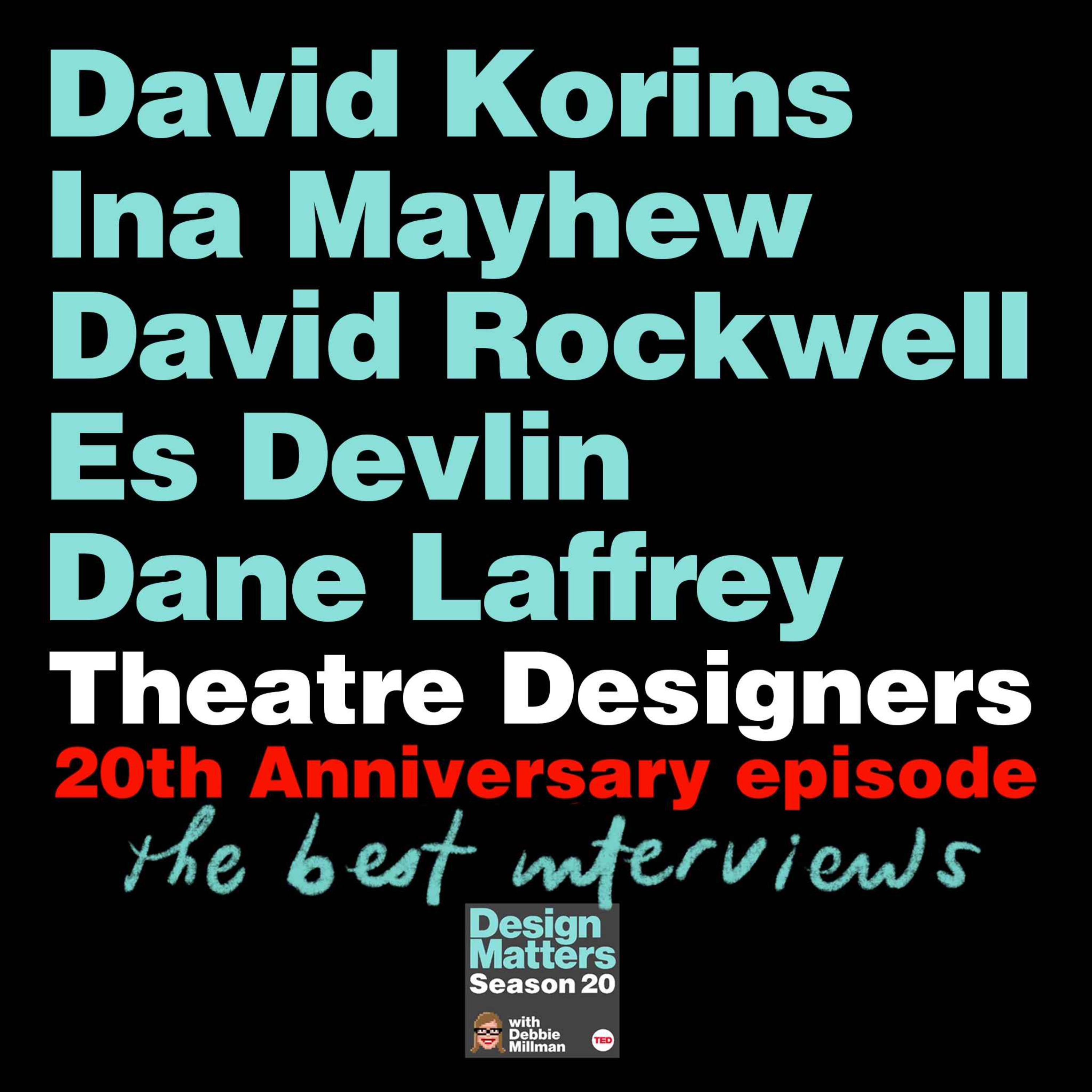
Description: A pioneering podcast that delves into the lives and creative processes of some of the world's most innovative and artistic individuals. Celebrating its 20th anniversary, the latest episode revisits conversations with prominent theater designers.
David Korins, Ina Mayhew, David Rockwell, Es Devlin, Dane Laffrey
The episode features excerpts from past interviews with celebrated theater designers, exploring how design shapes emotion and storytelling in performances.
Written by AI. May contain mistakes.

Get the gist, explore an idea or ask about something said.
 Claude
On Design Matters with Debbie Millman, what are the key points of this episode?
Searching your listeningAutomatic transcript. May contain errors.
0:00David Korins: Theatre is one of the few art forms where things change in front of your eyes.
0:05David Rockwell: We had to really take the audience with them.
0:08Es Devlin: It's very beautiful to be part of an audible gasp.
0:14Ina Mayhew: From the TET Audio Collective, this is Design Matters with Debbie Millman.
0:21Ina Mayhew: On Design Matters, Debbie talks with some of the most creative people in the world about what they do, how they got to be who they are, and what they're thinking about and working on. On this episode, in celebration of the 20th anniversary of Design Matters, we'll hear from some of the eminent theatrical and production designers Debbie has interviewed over the years. The cool thing about theater, we really get to mess with those proportions.
0:45Dane Laffrey: I said, what? You're doing a film? You have to hire me.
0:49Debbie Millman: I live in New York City, and one of the reasons I live here is the theater. I love the theater, and I go to as many shows as I can. I always have, and I always will. Of course, I'm astonished by the dazzling playwriting and great performances. But as a designer, I'm also intrigued by the beautiful design and find it central to every theatrical experience. I feel the same way about films and concerts and their production design. Over the years, I've had the great pleasure of interviewing a number of stellar Earth theatrical designers. On this episode, I'm going to play some excerpts of some of my favorites.
1:32Debbie Millman: In 2018, I interviewed David Korens, who has designed everything from restaurant interiors to performance stages for Lady Gaga, Mariah Carey, and Bruno Mars. In 2018, I spoke with him about his set design for the Broadway show Hamilton. You passionately wanted to be involved with Hamilton and pitch director Thomas Kale that you would be the James Madison to his Jefferson. And we can understand why now. But back then, before it was even off-Broadway, when it was the 10 people in a room, what made you want to be involved so badly?
2:12Ina Mayhew: There's probably a lot of ways to answer that question. But the short one is, they're my friends. And by they, I mean Lynn, Tommy, Andy, Alex. So you knew them before? I did. How did you meet? So, you know, Tommy and I actually met during the Edge Theatre Company days. We met on the steps of the New York Theatre Workshop on East 4th Street. He came and supported some Edge Theatre Company shows. I came and supported his downtown theatre company. We sort of knew of each other. and so as the show started to coagulate and come together i sort of thought like okay tommy seriously like when it comes time call me and then i got a phone call from the public theater and they said we think we're going to do hamilton and tommy wants to interview you interview interview i think we were in tech for a show that we were working on and i sort of thought what is this going to be and i got the music and i got the script and I listened to it obsessively.
3:10Ina Mayhew: And I think at the time my oldest daughter was maybe four or six. I don't know. The days, the years. And I played the opening number for her. I became kind of obsessed with the show. I really liked it. And I played the opening number.
3:25Debbie Millman: I'm not going to give up my shot?
3:26Ina Mayhew: No, the opening number was like the Alexander Hamilton number. And I remember her at six, let's say, saying, put a pencil to my temple, connected it to my brain. And I thought, she was super into it. And I did a lot of work in preparation for that interview for Tommy, including lots of research, some sketches, and I thought about the show a lot. And I never really try and do that because I always feel like directors are halfway fishing for ideas, but I didn't care. I went in there trying to get the job, and I did say to him, I think that like Lynn rose to like you know pretty big stardom within the heights and I think that people think on some level like you've hooked your wagon to his star and like let me be your Madison to your Jefferson like let me be your right hand man I can do this like Andy and I had just done a revival of Annie like I was like we're young scrappy and hungry like who else are you going to hire?
4:25Ina Mayhew: Like, I will not throw away my shot. Literally, I was like quoting the show. Right. And I did try to like at least plant a seed in his mind. Like, boy, will you regret it if you don't do this?
4:36Debbie Millman: And did you bring along any of your what is now legendary models with you? I know that
4:41Ina Mayhew: I brought no model, but I did. I did propose the turntables in the first meeting. You know, we've talked about that a lot, but.
4:48Debbie Millman: Tell me just because I'm afraid that there might be some listeners that aren't familiar with what a turntable on a stage actually is. It's not an actual record player for those that might be wondering.
4:59Ina Mayhew: That's right. Although Lynn was so excited when we proposed that we have two turntables in the floor. He's like, two turntables and a microphone. That's so exciting. No, turntables are a big, huge machine that rotates the stage in a circle. And we have in Hamilton, a turntable. And then on the outside of it, we have a donut, which has a big hole in it. So it's essentially a three foot section that can rotate left or right. And the turntable can rotate counterclockwise, clockwise or clockwise. And we can, we can adjust the speed, the tempo, the starting, the acceleration, the deceleration, and all that perfectly timed to the music.
5:32Ina Mayhew: And I didn't say to him, I think it should have a turntable in it. But what I said to him was, I cannot shake this cyclical motion of the show. There's something about this, um, Aaron Burr, Hamilton cyclical relationship. And Hamilton was swept off the Island of Nevis by a hurricane. and he gets into this storm. And I thought there's something about this cinematic sweeping story that takes place over 30 years. It could be really beautiful. And I think there's this thing where there's a lot of people watching and there's a lot of people listening. And there's like this room where it happens thing, where like you are either in it and you're complicit or you're not.
6:12Ina Mayhew: And I thought that the turntable would be a really good way to tell that story. And Tommy was like, yeah, no, that's not going to happen.
6:18Debbie Millman: He was not that interested. Yeah.
6:20Ina Mayhew: But I guess he was interested enough to go down the road with me. And they said, if you can give me 10 moments in the show where we could use a turntable, we'll think about it. And I sat down and I drew for them 10 moments. And they said, yeah, actually, that sounds really compelling and interesting. We'll think about that. We should we should try it. Like, let's storyboard further. And then they then we did it.
6:45Debbie Millman: True or false? On Hamilton, it's been reported that you parsed through 33 different colors of brick to find the right shade. Yes.
6:54Ina Mayhew: So that's an example, as we talked about how we got to the end result of Hamilton, where when you design, you make hugely obvious choices like the turntable where people say, oh, God, no performers are walking, but yet they're still moving. That's an obvious David Koren steps on stage moment. But then there's 33 variations of Brick where no one gives any thought to that at all. But Brick comes in so many different shades, as do people. Too red, too terracotta, too brown, too beige. What's it going to be? And how are we going to carve out 25 ,000 plus words and 51 songs with very little physical scenery and be able to see these actors in front of this wall and have no backing wall with no wallpaper or no, you know, interior texture?
7:44Ina Mayhew: So it also led to a lot of discoveries with the costume design because the parchment clothing that most of the ensemble wears throughout the show was in direct response to the brick and what it was going to be and how we're going to be able to see people and carve them out with their shapes and etch them out in front of the wall.
8:03Debbie Millman: In addition to the physical elements of the set, you also take a strong psychological approach to your designs and how they convey theme and other subconscious elements to the audience. And for the 2010 production of the Pee Wee Herman show, you crafted each step to be 10 inches tall so that when Paul Rubens' Pee Wee was going up and down, he would be able to, quote, clump up and down like he was a small child.
8:33Ina Mayhew: Yeah, I actually think we went with higher than 10 inches. I think we went with 12 on the Pee-wee steps because the normal rise to run is 8 inches is the rise. And it's a thing I've been thinking a lot about, architectural standards. I think a lot about how table heights are the right height and seats are the right height and light switches and toilet bowls and all those things, curbs, so that we don't fall down and go boom. I think about it a lot. And then I think the cool thing about theater, we really get to mess with those proportions all the time. So in opera, you might make a six inch high step so that they can glide down without breaking voice.
9:12Ina Mayhew: Yeah, that was an easy one with Pee Wee.
9:14Debbie Millman: On Hamilton, during intermission, eight feet of wall is added to the set to convey the impression of the nation being built. I did not notice that when I was at the show. But I would have wanted to. No one notices it, by the way. So why add these layers even when most audience members won't consciously realize they're there?
9:35Ina Mayhew: We add the eight feet because the country has progressed. the kind of big theatrical gesture of the show is that we see the scaffolding being built that the builders would use to build the foundation of the country and the foundation being this kind of unmade brick wall and we tommy and i just talked about there's such a huge moment in the show we're building towards independence there's this war we finally win the war it's this cathartic massive revelation and then we go home and we have to start to govern and what does it mean to kind of sew this nation together. And we thought there's a whole lot of progress as it happened.
10:14Ina Mayhew: You know, we're a big industrious country, you know, really getting its stride. And we needed to show that somehow. So if we're doing this brick wall that's in the middle of being built, we should add layers to it because it would sort of not ring true. So we add that we changed the whole profile and no one sees it because they're busy buying merch or going to the restroom or talking to their friend or taking selfies. and when they come back it has changed and we also change out a lot of the props they go from building and utilitarian and warlike uh objects like guns and muskets and things and we change them to maps and books and china and no one sees it i mean they really no one sees it so much so that when we were in tech rehearsal and we had spent i don't know three weeks on the set tommy and i said we should bring the actors downstage and have them look and let them see the walls fly in.
11:05Ina Mayhew: And we did. And they were all like, huh, I had no idea. I just spent the last 300 hours here and I had no idea. But maybe they felt it. That was David Koren's in 2018.
11:18Debbie Millman: Ina Mayhew is a production designer who has worked extensively with the directors Spike Lee and Tyler Perry. I spoke with her about her career in 2020. You were also doing quite a bit of freelance work at the time, a number of different projects. I believe you started working with Spike Lee. You started working on the TV program Showtime at the Apollo, but I believe you were doing hair and makeup. Is that correct? Yes. So you really are a jack of all trades.
11:48Dane Laffrey: Well, in my time in Rockland County, a dear friend of mine, his name is Teddy Jenkins. He did fashion hair and makeup. Anyway, I would help him a little bit. He was an African-American makeup artist. So there were very few of them at the time. So somehow he got into the world of Spike Lee and he brought me with him. And the funny thing is, is that I was hair and makeup on that music video. I know. You didn't know who I was. I think I probably tried to talk to him. He wasn't exactly approachable. So I just kind of just hung out and watched.
12:27Debbie Millman: And you've since worked on several projects with him, including some commercials and his films Girl 6, Get on the Bus and Clockers. What's the biggest thing you've learned from Spike Lee?
12:38Dane Laffrey: He completely said, you know, I trust you. You're the designer. Do it. There wasn't a lot of back and forth or collaboration at all. He really felt that that was my job and I knew what I was doing and he trusted it.
12:57Debbie Millman: Another defining moment occurred when you bumped into your former classmate, Charles Lane in Macy's, of all places, given that you also worked there. He was about to start shooting his first feature, a black and white, nearly silent film named Sidewalk Stories about a young African American man raising a small child after her father is murdered. How you convinced him to hire you is, I think, one of the greatest pieces of research I've ever found. So can you explain that? Can you share that with our audience? I think that this will be very inspiring to anybody that is needing some motivation to make something happen in their lives.
13:39Dane Laffrey: I think persistence was an understatement. When I ran into him, we were talking and I said, what? You're doing a film? you have to hire me I have to be on it and he was like okay well wait let me see okay what's your phone number and I think I must have called him I probably did call him every day until I said no I want to be on this film I have to be on this film you have to hire me and then I would tell him I said this is what I've done and you have to bring me on I'm you have to I'm going to come on your movie I don't care what you have to say I'm going to be on that film and I think he finally I wore him down and although there was a designer on it already he brought me on I definitely talked him into hiring me I was not going to take no for an answer?
14:40Dane Laffrey: Absolutely not.
14:42Debbie Millman: You worked with Charles quite a bit after that. The film went on to win the Audience Award at the Cannes Film Festival, won a lot of awards. You then were a visual consultant on his next film called True Identity, which was a big budget film. And then you designed an American Playhouse TV film titled The Upper Room. And I think that's really when you began your career, your big career as a production designer.
15:11Dane Laffrey: Yes. Well, you know, what's great about knowing Charles and being his friend, I felt comfortable and confident. You know, sometimes, you know, you're not sure, at least I had his ear when I wasn't sure about something. I was like, what do you think of this? Or how about this location? Or even on sidewalk stories. So there There was a nice comfort level. So it allowed me to figure things out a little bit, not be afraid to make a mistake. You know, there's a little bit of fear. Is he going to like this? Is he not going to like this? So I liked that I had that support. It was a really great way to start.
15:48Dane Laffrey: You know, because I didn't go to film school, because I was a theater designer, it was always a bit of convincing, you know, and really having to show what I've done and what I can do through other types of design. So I was always prepared for a fairly elaborate presentation. Did you feel like you had to overcompensate for something? I think a little bit. I think because I didn't go in the formal direction of film school, that I went in a theater way, way and I didn't have probably what they thought these producers thought would be the experience you would have to be a production designer. I didn't work up the ranks like a lot of people do.
16:34Dane Laffrey: Like they started as an art department PA and they become an art director. I just went in and just started designing. I didn't go up the ranks at all except for when I was a visualist consultant and then art director, rock director on Sidewalk Stories. So, yeah, I do feel that I kind of paid my dues by being an assistant for so many years that I didn't need to go up the ranks. I was on Clockers, an art director, for the same reason I was a visual consultant on Charles because Spike Lee wanted me there. He wanted a representative in the art department that was a person of color and all of that in his kind of eyes and ears.
17:14Dane Laffrey: So I feel that I had just really wonderful support and confidence from these directors, and I learned everything I could in watching all the other things that you have to manage as a designer.
17:32Debbie Millman: How do you assert your vision and your authority with a director, given that so many directors are control freaks?
17:40Dane Laffrey: Well, I guess I do my homework very, very thoroughly. So once I read a screenplay, let's say, and I have an idea, I back it up and I will fully research it so that I have an actual answer for all the questions or like why you want to do this or where do you want to go or what my concept overall is. like for Girl 6 with him in particular, where they lived and what part of town they lived in and all of that, you know, why do they live in the village or why does she live in the village? Oh, because she's an actor and I think that that was affordable. You know, so you go through and then I want it to look like this and this is the color palette.
18:22Dane Laffrey: So I was very prepared and made sure that I could convince them of going in this direction.
18:30Debbie Millman: Ina Mayhew in 2020. David Rockwell is an architect and a designer. He's designed hotels and restaurants and created sets for major Broadway productions, including Into the Woods, Hairspray, and the brand new production of Chess. When I spoke with him in 2022, I wanted to know how he expanded his practice from architecture into set design. So I want to talk about the similarities and differences between designing a restaurant, a hotel, and a Broadway show. And I want to start just by talking a little bit about some of the theater work that you've done. When you created the sets, I believe that your first show was the Rocky Horror Picture Show.
19:14Debbie Millman: It was. In 2000. Now, there are different dates online that I found. One said 1989, but most of the others said 2000. So I'm going to go with 2000. And when you did that show, I understand that you had been meeting with directors for years prior, but just sketching solutions. What were you doing with the sketches and why did it take you so long to sort of decide that you wanted to do a show if you had been doing the sketches all along?
19:39David Korins: Well, I had a successful architecture studio, and I was spending more time at theater with friends of mine than at theater looking at scenery. And I'd studied that as well. I'd studied scenic design post-graduating, kind of ongoing basis. So I spoke to two people, Hal Prince, the phenomenal Hal Prince, who was encouraging and said, just start to sketch out what your ideas might be. And I knew it wasn't going to be a quick journey because I was going from a skill set where I had kind of proven myself over time into a different skill set. I would meet with any director I could, and there were a lot of them who were interested in meeting, sketching and talking.
20:28David Korins: And what started to emerge out of that was my recognition that the real opportunity that was most interesting to me in theater was transitions. I mean, theater is one of the few art forms where things change in front of your eyes. And so the set design and the lighting designer together are kind of the cinematographer, the experience crafting where your eye goes. And I loved transitions all the way going back to the Rube Goldberg constructions and things that had interested me. So it felt like very vital territory. And I would go to the theater twice a week, you know, really my whole life in New York.
21:07David Korins: So it took a while to, there were a couple of false starts. I was offered a show that I started working on and that show didn't happen. And when I met with Jordan Roth, who I knew from restaurant and hotel work, and he introduced me to Chris Ashley, who's really an extraordinary director. He directed Come From Away, which is just closing. And they mentioned the Rocky Horror Show. Having lived in Mexico during those pop culture years, I wasn't familiar with it. So I went home and I rented the movie. Yeah, it's such a great movie. And I went back to Chris and I said, you know, I'm not sure what the key is to making this work on stage.
21:50David Korins: And he said it's about self-creation. It's the audience really creating this in their mind. And it seemed like the perfect first show. And we had a couple of false starts at different theaters. And then we went to see The Circle in the Square, which is the most non-traditional Broadway theater there is. It has no fly loft. It has very little wing space. So it required invention just to get from one place to another. And it was just the most wonderful experience ever. It was a really loving, wonderful, great experience.
22:27Debbie Millman: You've written that architecture and theater are both defined by the people that inhabit and animate them. Without an audience enlivening its streets, its museums, its restaurants, a city is only an empty frame. And I think this has been reflected in the way the pandemic has affected public space. Everything for quite a long time was feeling very lonely. When did you get involved in making the kits for the New York City restaurants to be able to extend their spaces into the outdoors so that they wouldn't lose their businesses? I was editing.
23:07David Korins: Actually, I was at Nobu downtown March 12th, which was a day before restaurants shut down, I believe. And it was a day that they were trying to go to 50 percent capacity in restaurants and see if that would work. And then, of course, everything shut down. And I was in the process of editing drama for Feiden, and I would look out at the city and realize we were living in a period where we got to see what a city would like if it was all hardware. There was none of the life of the city, and it was brutal. It was such awakening of how cities are inert without people, and it sounds obvious in retrospect, but my office immediately went to remote and Zoom.
23:49David Korins: And as we were brainstorming, I started to reach out to people I had worked with around the country in different industries to sort of brainstorm about what might be some initial thought starters that would be helpful. Of course, restaurants had many challenges. There was no customers who were willing to be outside and you couldn't be outside. And to have that start to change, there'd have to be a safe way to get the restaurants to want to be back in business. So four seats on the sidewalk wasn't going to justify enough business to get them back open. So I started to speak to a number of friends all around the country.
24:31David Korins: Melba Wilson was one of them who's a longtime friend. And we started to think about what are little ways that could start to move things in a better direction. And outdoor dining was being talked about. and was being talked about in a way that it might work in Europe, but it won't work in New York. And, you know, there's so much red tape and inertia. So someone in city planning suggested the way to be helpful would be to try and develop a strategy and a prototype. So we came up with a 40-page deck together with Melba Wilson and Andrew Riggi, who was the head of the Hospitality Alliance, speaking again to restaurateurs around the country about a very simple system that would continue to allow the streets to function, but would be an immediate way to get at a big enough scale restaurants back in business outside in a safe way.
25:30David Korins: That document made it to the city. And then we decided to make all of that open source. So everything we had drawn was made open source. And then I realized what we really needed to do was help underserved restaurants, because it was immediately evident that, you know, there was going to be those who could afford it and those who couldn't. We looked at manufacturing techniques of ways it could be made less expensively, and we actually engaged with a lot of labor from the theater world that had no work at the time. Think about those pools of labor. And we set up a non-for-profit 501c3 and worked with the hospitality lines in the city.
26:10David Korins: Our outdoor installations were all non-for-profit for originally six restaurants, at least one in each borough, and then community installations, the first one in Chinatown, where 12 restaurants shared it. And it led to doing that all over the country.
26:29Debbie Millman: David Rockwell in 2022. Es Devlin is a theater designer from the UK who has become one of the world's leading concert set designers. I spoke with her in 2024. One of my favorite pieces that you've created is the work that you did for the 1998 production of Harold Pinter's play Betrayal. Harold Pinter said that you didn't pay any attention, any regard to the stage direction and you designed the fuck out of it. Which I think is like the best compliment you could get from somebody like Harold Pinter. You use projector images of children between the scenes and conveyor belts. And you said you were inspired by Rachel Whiteread's monumental 1993 sculpture, House.
27:21Debbie Millman: Talk about how you approached that play and sort of the courage that it took to do something that really flew in the face of everything that had come before it in regards to not just betrayal, but just stage design.
27:35Es Devlin: The thing is, it was all founded on utter instinct and ignorance, honestly. I think it was a convergence of me literally skipping. I skipped when I came out of the meeting with Trevor Nile and realised I was going to do this project. For me, it was such a dream having just graduated and done this prize project that really pretty much a couple of projects later was for me the epitome of what I wanted to do at that time was to work at the great National Theatre of Great Britain. So I was excited beyond belief. And I had a sense, and this is very odd when I look back at it now, it's very strange.
28:16But weirdly, the thing that I thought was most appropriate when I read the play was to perform it at somebody's sculpture, literally.
28:25Es Devlin: And it's interesting that that was my thought. I just thought, where does this play need to happen? And it was very much in the press at the time because Rachel Whiteread, a phenomenal artist, it was a moment in the 90s where Britain was sort of emerging from 20 years of conservative, that dry politics. and there was an emergence of artists they were called the YBAs the young British artists and we felt a real sense of hope I must say we felt really that the Tate Modern was being planned it was to open in 2000 there was a real sense that our country was finally changing real sense of positivity and we all got behind the sculpture that she made it was so beautiful it was a monument in the East End, she filled a house with concrete and then she took the house away.
29:18Es Devlin: This was a condemned house that was about to be knocked down anyway. She took the house away and it was this exquisite sculpture of the volume of time and space inside a building. And it was everything that I, what we've been talking about on this podcast, about houses having life and voice. and it was plangent it was you know sad as well as potent and to me the the piece that harold had written betrayal was a series of rooms speaking it was rooms to me i think it's quite a particular
29:55Debbie Millman: take on it but to me it was rooms remembering rooms remembering time and humans passing through
30:01Es Devlin: rooms. And I said to Trevor, why don't we do the play at this installation? And of course we couldn't because it was outdoors and it was about to be knocked down anyway, or maybe it already had been knocked down. So I wrote to Rachel and it was an odd thing to do seeing as I was just beginning my practice, one would have thought I might've wanted to make my own mark, but I actually didn't. I just sort of wanted this thing to happen. I said to Rachel, can we make a wall that remembers all of the locations in this play in the style of what you do. And she said, oh, absolutely, you have my blessing.
30:36Es Devlin: Put it in the programme. So we made a ball of plaster and I went and researched around London and found, and I didn't go to it, but I looked at pictures, found exact photo-real references of where we thought the play probably happened. And then I made impressions of them onto this concrete wall. And then we also had the wall remember by projecting onto it. We filmed, we made a film actually. And remember this was in the 90s. It was very unusual to put projection in a theatre. You know, they weren't departments for that. You had to sort of get an advertising agency to come and, it was very expensive to pay for someone to come and make a film to put on your theatre piece.
31:22Es Devlin: Projectors were big and noisy. You know, it was all complicated. it. And we filmed Trevor Nunn's children and the actor's children. So we made a whole kind of family movie out of it. And then we had the furniture passing through. And actually the floor of the piece, because in my mind, again, because I was just, my instinct was to just associate. And because the National Theatre is made out of shuttered concrete, the National Theatre bears the imprint of the making of the National Theatre. It's got that shuttered ply impression on the concrete. So to me, it was already halfway there. So I was conflating the architecture of the building with a piece of concrete that could remember places.
32:05Es Devlin: And to me, it just seemed like obvious that this is how it had to be done. But obviously, it was probably the last thing that poor play needed. But it sort of survived, I think.
32:16Debbie Millman: Well, I love the fact that after the play, Harold Pinter introduced you to someone on opening night and said, have you met Es Devlin? She wrote the play. It's the best possible compliment I think you could give. I think it was definitely
32:29Es Devlin: a backhanded one, more of a slap, but anyway, I'll take it.
32:36Debbie Millman: In The New Yorker, writer Andrew O 'Haganin wrote that each of your designs is an attack on the notion that a set is merely scenery. and when you first started in this industry as set design was not supposed to be its own character give the story away or turn everything into metaphors that could take the audience out of the play you don't do that but your sets are very much of the play and in the play how are you able to avoid taking the audience out of the play I think it's a really that question is it
33:13Es Devlin: goes to the essence of the mystery, I guess, or the technique or the practice of what we're trying to do. And yeah, the way I was taught was definitely don't shout too loud, do less. But equally, I was also taught that the answers will be in a process. So if you read the text, if you research, and if you start with nothing and see what you really need. And I guess, adding a layer, not just responding to the text and what it needs, but also being cognizant of what the space needs. I walk into a room and treat each space as a patient. You know, when I, my family laugh at me because when I come home, I immediately go around the room and move just a few things that really annoy me or the lights have to be a certain way.
33:59Es Devlin: So I think spaces, you know, look for correction or, you know, help medicine. So I think you can respond to the space as well as the play and how the play meets the space or the music or the artwork, whatever it is you're putting into a space. And I think you respond to a moment. You know, it's not just the moment when the piece was written or the songs written or the artwork was written. It's the moment that you are communicating with a group of people. And I think the more and more, actually, I realize how precious, you know, I sort of fell into theater. But now after 30 years, I realize having done many other things how unique rare and precious it is for a group of people to gather together and as my friend lindsey turner the director says still the ego for the greater good you know that's so unusual that we and she puts it like this very brilliantly um she said we all agree uh the actors agree that they'll pretend the audience aren't there the audience will agree to pretend that they're not there.
35:05Es Devlin: Everyone agrees to do it at 7.30. We're all still eager for the greater good. And when you are sitting watching a play, or any performance really, the opportunity for things to go wrong at every single second is so multifaceted. The opportunities for humiliation for all concerned and the fact that we all keep the balloon in the air, we all keep blowing the balloon up together is a very beautiful human thing. I really more and more value that presence, even to be honest, even if I go to a theatre, it's not very good. Sometimes I just, I went to see a play straight after lockdown. I was just so excited to be in a theatre.
35:46Es Devlin: The play wasn't very good, but the audience was so beautiful. So I'm loving this audience, but it doesn't really matter about the play. They were so quiet. They were so connected to one another. that they were all, sometimes an audience is doing something which is just tolerating. Sometimes you can hear the sound and the beauty of an audience tolerating a second rate bit of work from a first class artist. They know the artist is brilliant. They put faith in them. They believe in them. They've all turned out for them. They know that this night just isn't quite working. But there's a beautiful sound of audiences being patient.
36:23Es Devlin: And it's so rare.
36:24Debbie Millman: As you've since gone on to design more than 50 theatrical productions that does not include hundreds of other projects in opera, dance, film, and as I mentioned in the intro, ceremonies like the Olympics and the Super Bowl. You've collaborated with Jay-Z and Beyonce, U2, Billie Eilish, Adele, Miley Cyrus, Shakira, The Weeknd, Lenny Kravitz, Dua Lipa, Lady Gaga. What is it like going from a small black box theater to creating sets for audiences of what can sometimes be 100 ,000 people?
37:02Es Devlin: well the logistics of a touring concert are brutal because the main thing that has to happen is people have to be able to put it in a truck in a really tight amount of time and get it out of a truck in a really tight amount of time and get it up and get it safe and it has to do a job of broadcasting the music and often an image of the performer so there's quite a lot of constraint to that aspect of my practice. That said, when you are among a crowd of, you know, up to 100 ,000 people or going off, I mean, we just did the Bad Bunny concert open in Salt Lake City recently and is now touring America.
37:43Es Devlin: That audience, I must say, I hadn't experienced that particular audience before. Every audience is a different species in itself. And this audience was so joyous, so joyous. you know it was luminous to be there and yet you know the concentration you get when everybody is focused on a text in a small theater you know like the hunt we have on at the moment actually in New York um at St Anne's Warehouse I think that only seats about 250 or 300 people or something very small and the concentration that you can't you know no one's breathing barely and then actually there are some plot points in that that are somewhat shocking I mean not in a terrible way, but they surprise you.
38:21Es Devlin: And the audience, you can hear them go, all together. You know, it's very beautiful to be part of an audible gasp.
38:29Debbie Millman: As Devlin in 2024. In 2025, Dane Laffrey won the Tony Award for Best Scenic Design for the musical Maybe Happy Ending. I spoke with him just a few weeks before he won that Tony. Let's talk about the play, Dane.
38:47David Rockwell: Let's do it.
38:48Debbie Millman: The show is about two retired helper robots called Helperbots. They're named Oliver and Claire. But the set is not really sci-fi oriented. In fact, it feels what I'm going to be calling a bit post-mid-century modern nostalgic with a very of the moment visual gestalt. Don't know if that's in any way what you intended, but that's the sense that I got. Can you talk a little bit about how you approach designing this very unusual, very innovative set?
39:28David Rockwell: There's a few things, and you've hit on a bunch of the important parts. It's a story that we need to weigh into because it's something we don't immediately know, It is an imagined near future. I think the circumstances involving sentient AI beings navigating the world is increasingly close to us and something that feels increasingly believable. But nonetheless, there was a gap to bridge. So I think we knew that in presenting this world, we wanted to lean away from the need to, like, mythologize a kind of, like, sci-fi universe and instead really focus closely on the characters and their lives and as such present them inside spaces.
40:25David Rockwell: And their two sort of apartments are a really important part of the story, mostly in that they're not supposed to leave them. They've basically been placed there until such a time as they can't turn on anymore. those places felt like something we could hold on to that weren't didn't feel like they had the sort of like burnished quality of of of a sci-fi architecture that instead they felt you know a little um having fallen into disrepair you know that it had a kind of like roughness about it that i think is really relatable conjuring that aspect of the world was it was it is an important thing the other thing that for those who see it will know that it moves a lot and at a tremendous pace.
41:12David Rockwell: And that's baked into the writing. And I think when I read it, I was like, oh my, to really do this justice. And because it is so much about two beings deciding to like boldly leave the space that they're not supposed to leave and go on an adventure. And it felt like we had to really take the audience with them, that this is about an experience opening up and expanding and really taking these beings beyond what they thought was possible. And so we wanted to try and give the audience a similar experience. So we needed to build a machine that would do that, that would really be able to convey this idea and convey these wonderful helper bots on an amazing journey and take the audience with them.
42:05David Rockwell: And so I believe really strongly that in theater design, where you are frequently needing to present multiple places in one evening, that all of those places have the same kind of visual value that they are no there's not well these are the main sets and then these are these other little sets that are a bit of a throwaway and you know and there's a sort of like you know there's a tradition in musical theater of the kind of like well-made scenes that are written to be done in one and in in front of a curtain so that the set can be changed behind it you go back to the big set i sort of like reject that idea in contemporary theater making i think that if you're going to do 75 locations, those 75 locations have to have a set of equal value.
42:56David Rockwell: So we needed a set of tools that would allow us to do that, which is a huge ask. It's an enormous problem. So another important aspect of it that is also, again, just like written in is the idea that we go inside these people's minds. We are let into their memory bank to see really critical pieces of information. It's how we learn about them. It's information that they share with each other. And that is something that we knew we had to do. There are entire characters that only exist in this format. So a video element, an element that was going to be digital on some level, felt like it was going to be a part of this world and that we would need to address that and find a way to completely integrate it into the rest of the design so that it felt indistinguishable from the physical elements.
43:57David Rockwell: And that's something we worked really, really hard to do. So those were the sort of like ingredients sitting in the pot before we even put the pot on the stove that we knew we sort of had to address, come to terms with.
44:10Debbie Millman: Maybe Happy Ending has perhaps the most technological visual beauty I've seen in a Broadway show, but it's a real counterpoint to the deep humanity embedded in this story about robots. And the design in many ways seems to erase the boundaries between technology and humanity. There are dream sequences, time sequences, erasure sequences, atmospheric sequences that are just breathtaking. Where did these ideas come from and how were you able to bring them to life?
44:54David Rockwell: Well, first, thank you. That's an incredibly lovely assessment of this work. Again, I think basically everything you describe is asked for in the story. And I love the way that you're talking about the sort of tension between the coolness of the technological world, the sort of the literal and figurative kind of neon edge on it all, mixed with the most sort of surprisingly human story, which I think is the sort of like, it's the magic of the show is that you come in thinking you're going to see a story about robots and you're really holding the mirror up. instead. And I think that's a wonderful story that love.
45:38David Rockwell: Exactly. Exactly. And so that tension, I love, and it feels really important. And I think it's important that these helper bots feel it, you know, they lack agency in the world. And it's something that they learn to have. And they make decisions for themselves, which is not something that they are, quote, programmed to do. And so them navigating a world that really moves around them. That is an idea that I think is woven through the design in an important way. And some of the other things, again, being inside their memories was something that we had to do. And it was so wonderful because it allowed us to create a visual vocabulary in the video.
46:34David Rockwell: And I'm, you know, with this immensely talented George Reeve, who is the video designer on the show and my co-Tony nominee, is that we use those memories as flashbacks to show the audience how the helper bots see the world and the way that they process things and the way that they kind of myopically focus on the human being in front of them. And the background is not a thing that they process. And so when we use video, if you look closely at it, it's treated in exactly the same way. It's not a photorealistic backdrop. It's not in the place of scenery. It is a deliberately digital thing that is precisely the same way that they process the world.
47:22David Rockwell: And now we're giving the audience that opportunity.
47:25Debbie Millman: Dane Laffrey. I spoke with him in early 2025. Maybe Happy Ending is still on Broadway as of December 2025. So you still have a chance to see this beautiful, brilliant musical and Dane Laffrey's Tony Award winning set. You can hear the full interviews and hundreds of other interviews with some of the world's most creative people on our website, designmattersmedia.com or wherever you get your podcasts. We'll be back next week with another episode called From the Many Years I've Been Doing Design Matters. Yes, this is the 20th year we've been podcasting Design Matters, and I'd like to thank you for listening.
48:08Debbie Millman: And remember, we can talk about making a difference. we could make a difference, or we can do both. I'm Debbie Millman, and I look forward to talking with you again soon. Design Matters is produced by the TED Audio Collective by Curtis Fox Productions.
48:24Ina Mayhew: The interviews are usually recorded at the Masters in Branding Program at the School of Visual Arts in New York City, the first and longest-running branding program in the world. The Editor-in-Chief of Design Matters Media is Emily Weiland.
For the 20th anniversary of Design Matters, Debbie Millman revisits conversations with theatre designers David Korins, Ina Mayhew, David Rockwell, Es Devlin, and Dane Laffrey. From Broadway landmarks to innovative film and live performance design, these excerpts reveal how sets and spaces shape emotion, deepen story, and draw audiences into the moment.
Learn more about our flagship conference happening this April at attend.ted.com/podcast
Hosted on Acast. See acast.com/privacy for more information.