 Ask ChatGPT


Design Matters with Debbie Millman is one of the first independent podcasts, exploring the lives of creative individuals and how they shape their artistic journeys.
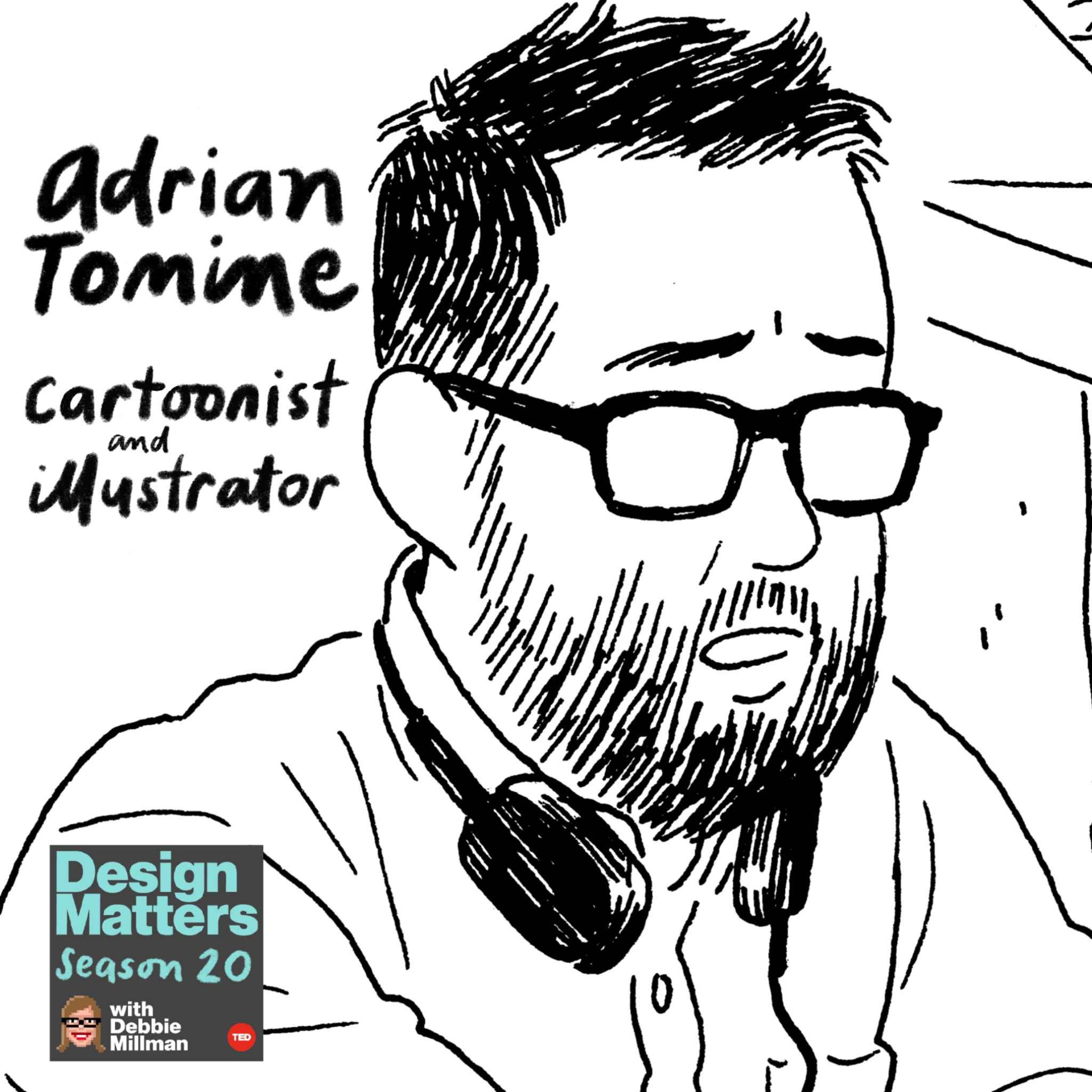
In this episode, bestselling author and graphic novelist Adrian Tomine discusses his extensive career, including his works "Killing and Dying," "Shortcomings," and his latest book "Q&A."
Written by AI. May contain mistakes.

Get the gist, explore an idea or ask about something said.
 Claude
On Design Matters with Debbie Millman, what are the key points of this episode?
Searching your listeningAutomatic transcript. May contain errors.
0:00I would have these experiences where I would sit down to work and instead of thinking how can I make this drawing look the best possible way or how can I write it the way I would be thinking about what's the comics I would be thinking. From the TED Audio Collective, this is Design Matters with Debbie Millman. On Design Matters, Debbie talks with some of the most creative people in the world about what they do, how they got to be who they are, and what they're thinking about and working on. On this episode, graphic novelist Adrian Tomina talks about his relationship with his audience. The endings of my stories in general have been somewhat polarizing.
0:54There have been a lot of famous New Yorker covers, but one of my favorites depicts a young man and a young woman reading the same book on the subway. Their eyes meet, and you can feel that they feel that they're made for each other. But they're on different trains, headed in opposite directions, separated by fate and the MTA. Miss Connections was Adrian Tomina's first of many New Yorker covers. But really, all of his illustrations have a way of imprinting themselves in our brains. His unfussy panels with clean lines and muted pastels often have a poignant, memorable narrative embedded in them.
1:36That's probably because Adrian Tomina is both a narrative artist and a comic artist. His 2018 book Killing and Dying became a New York Times bestseller, making him one of the few comic artists working today to gain a mainstream audience. That audience has questions, and Adrian Tomina enjoys answering them. His most recent book, Q &A, is a compilation of questions he's gotten from readers and fans, and his candid, witty answers are all throughout the book. Adrian Tomina, welcome to Design Matters. Hi, Debbie. Thanks for having me. Oh, absolutely. My absolute pleasure. Adrian, I understand you prefer using the Muji Low Center Gravity mechanical pencil in your work.
2:27And as someone that also loves mechanical pencils, although they're not quite as fancy, what is it about that particular pencil that you like so much? Well, I should actually clarify that there are two mechanical pencils that have been important to me. The first one you talked about is the emoji, which there's a picture of on the cover of my last book. And I use that for all my drawing, like the initial step of my artwork is drawing with pencil on paper. And I've used that pencil for a long time. And I also have this other pencil, which no longer is made. I've gone on eBay searches for it to replace it because it's going to die eventually.
3:09This is like my rough draft pencil that I kind of write my comics and stories with. I take it with me on trips and everything. I've had this so long that I bought it at a stationery store in Berkeley when I lived there. And I moved to New York in 2003. So that was before then. And I have written every comic of mine with this pencil going back to my graphic novel shortcomings. Wow. Have you found a replacement on eBay or no? They're out there. They're out there. A lot of them are previously used, which kind of grosses me out. I don't love the idea of buying a pencil that might have teeth marks on it or something.
3:53But yeah, it's strange how there's an aesthetic component and also just a tactile component where I feel like I would be inhibited in my work if suddenly the tools that I was using felt different. Adrienne, you were born in Sacramento, California. Yeah. But despite being third-generation Americans, both of your parents spent part of their childhoods incarcerated in Japanese-American internment camps during World War II. Why were they incarcerated? Well, first of all, they were born there. They were born into the camps. Their parents were rounded up as were all American citizens of Japanese ancestry during World War II.
4:38Yeah, my two grandmothers were pregnant at the time. So my mom and dad were born in camps and spent the first about two years of their lives there. In 1942, Dorothea Lange photographed your grandmother right before she and your grandfather were incarcerated for four years. Right. How did you find the photograph? And how did you know it was your grandmother? there? Well, it's a pretty well-known photo that's been published a lot over the years. And, you know, I'm sure my mom has a memory of the first time she saw it or when it clicked for her or when she recognized her mom. But it was a long time ago.
5:19And that photo has just kind of always been a part of my life as far back as I can remember, along with my dad also had one of the original posters that's actually pictured in that Dorothea Lange photo in the background. There were these posters that were put up all over giving information about this impending incarceration. And my dad had one of those framed in our house too. So both those images are just kind of a part of my lifelong memory. The Dorothea Lange photo is just, I'm just so grateful to have it because it's such a great photo. It's such a great photo of my grandmother. And a few years ago for a fundraiser, I did an illustration based on that photo.
6:03And yeah, it's just a very intimate experience that the idea of drawing someone, even from a photo, I find a real unusual sense of connection, partially because I work so carefully and slowly. So it's a lot of time spent with the subject. And it becomes almost meditative for me. And as I say in the book, I know that this is an experience that a lot of people find in cemeteries or memorials or places of worship especially. But for me, it really happens through the creative process. And it's something that I recommend for people, even if the results maybe are not exactly what you're hoping for, which is often the case for me.
6:46But the process itself, I find it's a big word to use, but it does feel sort of transcendent in some ways. I understand the print has been acquired by the Library of Congress, where it will exist alongside Dorothea Lange's original photograph. Have you seen them side by side? No, I haven't. I haven't. I'd love to do that. But that was an incredible honor. It meant a lot to me. And I know it meant a lot to my mom, too, to know that her mother went through that experience in a way so that my mom could have her life and that her son could be in this rarefied position to draw pictures every day for a living.
7:29It does feel a bit transcendent, I have to say. Yeah. Both of your parents were professors, but they divorced when you were two years old and you and your mom moved frequently after that. You moved from California to Oregon, then Germany, Belgium. Do you have a lot of memories of living in these various places? I do. And I think a lot of what you're describing was really essential to the life I have now. You know, a lot of times, sometimes I'll, like, I will give talks to schools and parents will come up to me afterwards and say, like, how can we encourage our kid to have sort of the life that you've had?
8:09And I've said, well, I could give you a recipe, but I'm not sure you'd like it. You know, you have to go back and go back in time and get divorced when your kid's two years old and move around. And, you know, and then they think I'm joking. But, you know, I really do give full credit to that experience. And so, yes, I do have a lot of memories. I don't have any memories predating my parents' divorce. But yeah, really the experience of going between different households and having step-parents and step-siblings and moving to new towns, a lot of that stuff was very, to be honest, very difficult for me as a kid.
8:49But I can't think of any other circumstances that would have led someone like me to sit in a room and draw and write to the extent that I did. You know, I know there's a lot of debate about, you know, what's talent and what's hard work and everything. And for me, I really do feel like I wasn't born with any greater innate abilities, but that I had an unusual life that led me to put in a lot of hours so that by the time I was a teenager, I had learned a lot just through trial and error. You've said that you were doing versions of comics before you could even write words correctly. Yeah. What inspired your first drawings like that?
9:32And after that, I want to know if you still have many. Well, I do. I'm actually paying. I live in an apartment in Brooklyn, so there's no storage space. So I'm actually paying money every month to store this artwork in a facility down the street. You know, I have an older brother. He's eight years older than me. And because of him, I have no memories of a time when there weren't comics. He'd already filled the house with comic books, superhero comics, but also there were these paperback reprints of the Peanuts comic strip. I still have those versions. Those were like the first books that I sat down and read.
10:16And so I think, you know, the earliest versions of these sort of primitive comics that I was making as a little kid were me trying to replicate those things, but without having the language ability. So I knew that words needed to be in the balloons and the drawings needed to be in panels. So I sort of did the best I could with my abilities at that time. You've stated that by the time you were 10 years old, you realized you had become a comic book collector and not a comic book fan. And so I want to know what's the difference and what provoked that realization? I guess, first of all, I should say that I did eventually become a comic book fan again, but just a different kind of comic book and with approaching it differently.
11:05But at that point, when I was 10, I had really only been exposed to the kind of comics that I could buy from the drugstore or the 7-Eleven in my case. And so those were mostly superhero comics, Marvel and DC things from late 70s, early 80s. Yeah, I guess I got really obsessed with the collector mentality. And it's something that I've continued to struggle with throughout my life. But I really got caught up in being a completist. And, you know, it sort of plays in perfectly to someone who might already be prone to kind of OCD tendencies. And so as a little kid, I was not familiar with caring about conditions of comics or anything.
11:48But then I got a little older and I started learning about there's these perfectly sized bags that you can put the comics in and then there's these boxes that you have to buy to line the comics up in. And so I got really obsessed with all the minutia of being a collector. So around that time, 10 or 11, I thankfully had a little bit of a moment of self-realization of maybe enough weeks in a row where I'd come back from the comic store, carefully looked at all the things that I'd spent money on, and sort of joylessly slid them into their mylar sleeves and filed them alphabetically, and then waited for the next week to go through the same ritual.
12:25Why joylessly? I would imagine that you'd be ecstatic. Well, no, no, there's a there's a lot of for me, there was a lot of collecting. I you know, I actually, it's interesting. I have a lot of friends who are collectors, and they do derive genuine joy from it. Like I've experienced it with them. I've gone to rare book shows or antique toy shows or comic conventions and seen like, genuine joy that they get from obtaining something. And a lot of that for me was going through the motions, knowing that other people might be impressed if I had acquired a certain rare thing. So I wanted to show it to them, but I wasn't getting any intrinsic joy from it myself or at least a lesser version of it.
13:13But this particular moment in time that we're talking about was that I don't want to speak for anyone else because everyone else has a different experience. But for me, I think I was outgrowing some of the comic books that I had been almost religiously collecting since I was a little kid. It was almost like I jumped on board this train when I was six. And then five years later, I'm like, why am I still reading this? The content didn't appeal to me in the same way that it used to, but I felt like I couldn't stop the obsessive collecting of it. I can relate. What provoked you to start making your own comics?
13:51You created your first comic, Optic Nerve, in 1991. You were just 16 years old. Talk about sort of the conditions that led up to that. And did you start knowing it was going to be called Optic Nerve? Talk about what led you to Optic Nerve. Yeah, well, that was the first comic that anyone's seen. There were a lot of many, many, many comics that I made prior to that, starting with, you know, Peanuts ripoffs and then my own version of superheroes. I did a lot of amateur superhero comics. And at the time, I was very obsessed with Marvel and the Marvel Universe and the idea of building this whole interconnected world.
14:34So I'd have these great ambitions for doing my own version of it. And I would like draw a cover of a comic or a splash page or a few pages. And then I'd be like, oh, my God, I've got like 10 ,000 more pages of this to go. So forget it. And so I have a lot of like false starts in that regard. And they're hilarious, too. Like when I go back and look at it, they're so bizarrely psychological as are as our most superhero comics. But the stuff that eventually kind of made its way out into the public and is still in print. I have sort of mixed feelings about it, but the stuff that was put out under the title Optic Nerve.
15:11Yeah, it started when I was about a sophomore in high school, and that was the result of sort of a seismic change in my comic reading habits. Like I said, when I was 10, I sort of lost interest in the things that I'd been reading since I was a little kid. And then I sort of wandered through a wasteland of not knowing what my relation to comic books was for a year. And then I discovered at the time what were called alternative or underground comics, starting with Love and Rockets by Jaime and Gilbert Hernandez. And that just opened up a whole other world to me. And that led me to a whole range of their contemporaries and their predecessors.
15:54And that was really the impetus to doing the kind of work that was published in those early issues of Optic Nerve. Your first print run of OpticNerve was, I believe, 25 copies, which you made at the local Xerox shop. How did you distribute them and did you charge for them? Yeah, they were a dollar a piece. And the initial round of distribution consisted of giving a copy to my parents and my brother, handing it to them, and putting the other copies in a drawer somewhere. and it slowly evolved from that. I think the next step was putting them on consignment at a couple of local comic shops in Sacramento, like five copies at a time.
16:42And they would let me put it at some bottom shelf in the back of the store. And every week I'd go in and they weren't keeping track. And I would tell them, well, it looks like one sold. And so they'd give me like 50 cents or something like that. But that was the start of it. But several prominent cartoonists, Chester Brown, for example, started recommending your work in their own comics. How did that happen? Did they go to the bottom shelf, see your work? Was there like a bit of word of mouth that was beginning to trickle out? Yeah, I mean, there's, I think from a distance, it would look like I've lived this very serendipitous life, which I have, but it does seem like a lot of things just happened to me.
17:22But the truth is, as especially as a little kid, I was very ambitious, and I was very career minded, which is sort of embarrassing to admit, but I wanted more than anything to be a professional cartoonist. And so I wasn't just like a pure artist who was just putting my heart on the page and whatever happened beyond that happened. I was, you know, a little kid who was into self-promotion, as horrible as that sounds. I think that's wonderful. I think it's really, in many ways, I think it's evidence of good parenting that you have that kind of confidence at that age. I guess so. That's a nice way to put it.
17:59I'm sure if I met the 12-year-old version of myself now, I wouldn't be able to stand him. Who among us? Yeah, yeah. So those recommendations from more established cartoonists, those came about as a result of me putting copies of my comic in an envelope and writing a letter and mailing it to those cartoonists. Oh, okay. It was kind of unspoken, but that was exactly what I was praying would happen, was that they would like it and that they would recommend it. And even more secretly, that then we would become friends. And in a lot of cases, all of those came true somehow. So my bizarre 12-year-old ambitions came true in a lot of ways.
18:41But yeah, it wasn't like these guys just stumbled upon my work and were so impressed with it that they had to tell their readers about it. I was really grubbing for some recognition. You said this in an interview in The New Yorker. When I first started drawing the earliest incarnation of optic nerve, I hadn't even been on a date. I hadn't had a romantic relationship of any kind. So in a way, I was almost writing science fiction. It was my pathetic version of trying to imagine what the future might be like.
19:16That's true. How did your work change when you did start dating? Um, oh, well, that's a good question. Um, yeah, I mean, I learned firsthand a lot of things that I'd gotten wrong. I can even remember my first girlfriend looking at the comics that I was doing and saying, like, why would you draw that? Or why would it be like that? Or that was a big inspiration to me to instead of writing from a point of conjecture, but to actually be in a relationship. And for the first time, I think, you know, get to know someone, their psychology, their personality, their backstory with that kind of depth. And I think that was powerful for me as an artist who was trying to write about real life and human relationships.
20:05I read that Mother Jones magazine called you an indie heartthrob. What year was that? Oh, it was many, many decades ago. Yes. I love that many, actually. But I kind of love that. You knew that, right? No. Oh, you didn't know that? Oh, the quote. Yeah, I remember that. Even then, it was, I think, a source of much humor in my life amongst my friends. Optic Nerve also ran in Pulse magazine, which was Tower Records magazine from 1992 through 1994. Then you decided to go to UC Berkeley, where you majored in English. At this point, what did you think you wanted to do professionally? Well, I actually started out as an art major.
20:54Even before that, I wanted to go to art school. My dream was to move across the country, preferably to New York, and go to some art school. I didn't even know what the names of art schools were, but I just liked the idea of being in New York at an art school. And it was just not financially feasible for my parents. They were like, you know, apply to some in-state schools. Yeah, and I applied to two schools only. I did not get into CSU San Francisco, but I did get into UC Berkeley by some miracle. I don't know. I always feel like somehow they're going to hear some interview like this and go back and check their records and revoke my diploma because there was an administrative glitch and I really didn't get in.
21:43I think you'll be waiting a long time for that to even be on their radar. Yeah, yeah. I think that you probably will get an honorary doctorate from him. And that was one of those things that no one, no one expected. And so when that happened, my parents, who actually are both Berkeley graduates themselves, they said, oh, you got to, you got to do that. You'll still get to live in, in the area that you want to live in, but you got to go to Berkeley. So I did that. I started out as an art major. And within the first week of school, I realized, like, I don't think I want to be an art major. Why? Why is that?
22:21Well, I think things have changed a lot since then, but this was in 1993. And at least what I saw of the art program at the time, there wasn't a lot of interest in the kind of work that I wanted to do. design and illustration oriented, you know, very comic oriented, you know, at least in my experience, it was a very contemporary fine art based program. And so I could feel myself for the sake of grades or approbation from the teachers or from the peers doing work that I really did not believe in. And that was not really of interest to me. And then when I did try and do things that kind of came from a more genuine place, it was not received well.
23:13And so – Wait, why? Why wasn't it received well? You know, like I said, there's been such a seismic shift in – especially in North America in terms of how comics are regarded. And in 1993, we were still in the very, very early stages of that. And so I think at best, there was the idea that maybe I was doing comics in sort of a Roy Lichtenstein ironic way, not that, oh, I want to make these comics and I want to reproduce them as booklets and I want to sell them. That did not really fit in with what the goals of the classes were at that time. I mean, I guess I ultimately did, but there was a feeling that I didn't have the sense of conviction to stand my ground and say, no, no, I'm not doing this.
23:58ironically, I love comics and that's what I want to be a cartoonist. I started trying to do projects more in line with what my classmates were doing. It was also kind of demoralizing in a lot of ways because I'd already been publishing my comics for several years at that point. And so I was really worried about, I mean, this sounds very strange, but I was worried about college getting in the way of my comics career, so-called career. And I really very quickly felt that it was, and that after going to school all day and trying to fit into that world, I didn't feel inspired to come home and pick up where I left off on some page of comics that I'd been working on.
24:47And simultaneously, I was enrolled in an English, basic English literature class, and I was finding myself really energized and kind of excited by that class. And I really love the experience of being forced to read books that I didn't want to read or that I was afraid of or I had some sort of preconceived notion about or I thought were too hard for me and being forced to read those and being sort of led through a sense of understanding them. And so I quickly switched majors from art to English. I have a degree in English as well. Oh, is that right? And I find it to have been sort of the beginning of my curiosity about everything.
25:33And I'm so grateful that I read those books that I read because they've really influenced my thinking from my life since. Yeah. The program I was in was – they called it Lit Crit. You know, you'd read books and analyze them and discuss them and everything. So it wasn't a creative writing program. But that kind of analytical way of responding to art, of not just getting caught up in the plot of it, but by thinking of it as something that was crafted by a human being and was the sum of artistic choices and circumstances and all that. That had a really strong impact on me as a cartoonist. That sort of like critical reading of work is something that I've continued to apply to things that I intake, but also things that I put out into the world.
26:19I believe it was when you were in college that you began working with Drawn and Quarterly, which is a very prestigious Canadian publisher. How did that happen? I mean, you were in college majoring in English. When and how did that happen? Yeah, that happened in my sophomore year of college. So I think I was 19. And again, that's one of these things in my biography that people could read and think like, wow, this publisher in Canada found Adrian's work and sought him out. And they probably envisioned the publisher like flying to Berkeley and knocking on my door and handing you a suitcase of money.
27:00Yes, that was it. Exactly. And once again, it's not the case at all. And it's about that disgusting little ambitious, career-minded person that I was at the time. It was the result of me pestering them. I had been sending them copies of my self-published work for years. and I slowly wore them down. It was like several years of no response. And then I got a note that was on a ripped, it was on the back of a Xerox of someone else's comics that was ripped in half. And the publisher, he became one of my closest friends. I came to really love working with him and spending time with him, Chris Oliveros.
27:46But he dashed off this really sloppy handwritten note that was basically pure criticism. It was just like, here's stuff that didn't work for me, and here's things that you could do better. And again, it's that kind of almost unhealthily high self-esteem. Like, I was overjoyed. Like, instead of feeling despondent or rejected in any way, I took it as a great sign of encouragement that he even acknowledged my work. I mean, I still have the note. I have it in a folder here. And I took his criticisms to heart. And I continued to send work to him. And I think I did that for about four years. And I think he finally just got so fed up with me pestering him, he gave in and offered me a publishing deal.
28:35Wow. D &Q's publication of Optic Nerve has led to numerous book collections, and I want to talk a little bit more about that shortly. But I also want to talk about your relationship with The New Yorker. Your first cover for them was released on November 8, 2004. You were 30 years old. It was the cover that I referenced in our introduction, Misconnections. All these years later, it is considered a classic. Can you describe how you began to contribute to The New Yorker? Because it's such a great old school story that I think our listeners would just love to hear about. Yeah, I mean, I preface the story by saying that almost every aspect of the story is out of date and impossible.
29:21And so no one should take this as prescriptive advice about how to get work. They might get arrested if they tried this. That's right. Yeah. So I – well, first of all, I should say that I did not grow up with The New Yorker, that it wasn't part of my family's household. We were a very West Coast family. And I think I said somewhere in my book that we were more of a Sunset Magazine and Nietzsche Bay Times family than a New Yorker family. So as I was kind of learning more about the history of cartooning, that was sort of my in to The New Yorker. I sort of fell in love with Charles Adams and Peter Arno and Helen Hawkinson and all those artists.
30:00And it was through that I was like, oh, a lot of these things were originally published in The New Yorker. And so that's how I kind of got to know the magazine. And then I became a reader of the present day version of it. That was sort of how I got even the idea of trying to work for the magazine. How old was I around that time? maybe 20, something like that. But I was still living in California and I came out to New York just on a vacation to visit a friend. And I decided I wanted to try and submit some work to the New Yorker. So I looked them up in the phone book, which my friend, like everyone else, had sitting right on their counter.
30:37Was it the yellow pages or the white pages? No, this was the white pages because, yeah, how else were you going to... That's the one I'm talking about with that. Yeah. How else would you know how to call someone on your phone if you didn't have the phone book there. So I looked up the New Yorker and it actually had their street address listed. And I didn't know what kind of what it meant to put together a portfolio. I just knew that I didn't want to actually drop off a real leather portfolio because it was too expensive. So I'd brought along some tear sheets, some pages from other magazines that I'd done some illustration for.
31:06And I went to a stationery store and I just bought like a white school folder and I put those tear sheets in it. And with a Sharpie pen, I wrote my name and my fax number, because that's how a lot of illustrators communicated at the time was through a fax machine, which I felt very professional the day that I actually bought a fax machine. And then I looked at that address, and I walked to that building, which was, I think, two or three locations ago of The New Yorker. I would love if someone from that time could clarify this for me, but in my memory, there was no security. Like I walked into the building, looked at the directory and saw that the New Yorker is on this floor and I just got in the elevator and went up, walked in and asked the receptionist if I could drop off a portfolio.
31:56And he didn't say, yes, that would be great. But he said, you can. And I think that was the first moment where I realized, like, I was sort of in over my head. Like, I didn't know what I was doing. And this was a very dignified historical office that I was in. And I was some kid dropping off a school folder. Well, it worked. Yeah, I threw it on the counter. And I felt very embarrassed. And I left. And I didn't tell anyone that I'd done that because – and I kind of have stuck with that. Like a lot of things that I still do now, I don't tell anyone about until it actually happens because I hate the idea of people asking like, well, did you hear from the New Yorker?
32:37Any news from the New Yorker? No, no, no. And I just kind of tried to put it out of my mind. And then I went back to California. And I'd say maybe a month later, I got a phone call. And again, another antiquated thing, it was a message on my answering machine that I came home and pressed a button on the answering machine and it was Chris Curry from The New Yorker asking me if I wanted to do an illustration. And the first illustration I did was for a band called Luscious Jackson and it was a terrible final illustration. No, it wasn't. Yeah, it is. I've continued to publish it in various places just because of its significance to me that it was my first thing in The New Yorker, but I hate it.
33:26And I've said many times that if Luscious Jackson still exists, that I apologize for tainting their appearance in The New Yorker with my strange drawing. But yeah, it was incredible to me that Chris somehow came upon those samples that I left there and was proactive and took a chance and reached out to me and let me get away with a drawing of a band with very bizarrely small hands. And she kept giving me work. And that was really the start of my relationship there. And it was several years later before I did a cover. And that was due entirely to the arts editor, Francoise Mouly, who's, you know, just had a huge impact on my life in a variety of ways.
34:18But she reached out to me and said that she wanted me to try to do a cover and here's the process of doing it. And I dropped the ball. I just I didn't follow up on it. And what? That point I did not know. I did not. Yeah, you did not follow up. I choked. I felt like I didn't know how to do it. And it was too big of a deal. And I didn't want to have the experience of trying and getting rejected. and it took her really dragging me kicking and screaming and saying, Adrian, come on, you can do this. It doesn't have to be a perfect idea. Just talk to me or send me the roughest of sketches and we'll work through it.
35:03And that's how that first cover came to be. Like it really was her saying no to a bunch of ideas, but zeroing in on a few that might have some potential and talking me through stages of those drawings. And there's details in that final cover that really came about through those discussions with Francoise, not me just saying, here's the finished product. And she gave me a hard deadline. And she said, like, come on, you got to do this. You know, we got approval on it. Here's the slot that we can run it in. So quit stalling and get it done. And so I owe a lot to her for that to this day. The idea for that cover, did you witness that?
35:45Did you see somebody looking at somebody else with the same book from across the tracks in a trade station? So it was all created in your imagination. Yeah, yeah. I mean, there are some illustrations that I've done that are more directly based on things that I've observed or experienced. And that one was more fictional. You know, I don't think that, I don't know if that cover would have existed if I was a lifelong New Yorker. That's really the work to me of someone who has just moved to New York for love and was kind of just feeling very romantic about the city and about this new relationship that I'd entered into.
36:27You know, so I think that sort of outsider perspective of someone who hadn't grown up riding on the subway affected it. And And someone who's lived here their whole life is like, yeah, you make eye contact with strangers on a train, and sometimes you see people on another train. Big deal. But for me, it really sparked a lot of ideas, and that's really where that one came from. There's a lot of versions of that that could have come about to express the same basic idea. But I believe that maybe that that was – at the time, they had like an annual books issue or a fiction issue or something. But I think the idea of books was built into my initial assignment.
37:10And so that's why I use that as the main prop in that image. Optic Nerve issues nine through 11 were later published in your first graphic novel, Shortcomings, from 2007. It's about a 29-year-old Japanese-American named Ben Tanaka, whose girlfriend Miko accuses him of being more attracted to white women than Asian-American women. And the book is heartbreaking in many ways, has a very ambiguous ending, but it's also very funny. How would you describe Ben? Quite a few people out there have written about how unlikable your main character, Ben Tanaka, is. So I'm wondering if you can describe him, but also let us know if you would agree with some of those opinions.
37:59Well, yeah, at the time when the book was published, and especially when it got reviewed in the New York Times, I would waste a lot of time by going on Google and typing in the character's name, Ben Tanaka, plus just some horrible insult like asshole or prick or something like that. And then watching the results roll up. And there was a lot. And I was not very open about this at the time, but I think enough time has passed that I can kind of see the humor in it. But when I was creating the book and when I first published it, I had the feeling that I was – it's not by any means autobiographical, but it did feel very personal.
38:44And I felt really proud of myself for kind of opening up parts of my psychology that I hadn't allowed into my work previously. And I thought like, you know, look how bold I am to sort of expose some of these thoughts or whatever or to write these kinds of characters that I hadn't written in the past and this kind of dialogue. And I really thought that that was going to be rewarded by the world. I sort of imagined. I think especially at the time there was sort of this trend of sort of like extreme confession and openness in art. However, when I started the book tour, I had a very lengthy promotional tour for the book.
39:29And when I started it, I would talk about the book as being thinly veiled autobiography. And by the end of the tour, based on responses that I'd been getting at bookstores and online and reviews, I was talking about how it was a completely fictional book and how it was a critique of a certain type of mentality that I, as a person, could never subscribe to. And I kind of sold myself out in a way by trying to protect myself in a way. How difficult is it to create unlikable characters? Oh, for me, it's very easy, apparently. I would say that's the number one note that I get, especially as I do more work outside of comics.
40:16With my comics work, I have a really incredibly indulgent working relationship where I have very little editorial input. But now that I'm doing a lot of other work, especially in screenwriting, that issue of likability does come up quite a bit, I have to admit. You know, I think people who know me now, I would hope they find me to be a pretty polite and, you know, I try to be an affable person. But as a reader and a viewer, I feel an attraction to characters that other people deem unlikable. Why is that? I don't know. I don't know what it is. But like of all the people I know, I'm like the biggest Curb Your Enthusiasm fan.
41:02I think I have maybe sometimes a different experience of watching it than other people do. I don't find Larry annoying. I love him. I personally love him. Yeah, I do too. I do too. I don't know why that is. But I wish, in a way, I wish it wasn't the case. I wish my natural tendency was to write characters and stories that were just beloved across the board. And people were like, I love that character and I love the story. And that would make many aspects of my life much easier. But yeah, I think it might be a bit of a reflection of my own personality, but I think it's definitely intertwined with my interests as an audience member.
41:52Your next book, a collection of short graphic stories, Killing and Dying, was published in 2015. It became an instant New York Times bestseller. It was named one of New York Magazine's top 10 graphic novels of the year, one of NPR's best books of the year. It won the Story Prizes Spotlight Award and Eisner Award. And Zadie Smith praised the collection, stating that you have more ideas in 20 panels than novelists have in a lifetime. Like, I would just say, that's it. I'm done. My life is complete. Well, Zadie Smith didn't say they were good ideas. She said that there was a quantity. That's a very Adrian Tomina response, I have to say.
42:37Mr. Glass Half Empty. So you stated that in the process of writing Killing and Dying, you tried to eradicate the idea of an audience and attempted to trick yourself into thinking you were a teenager again, drawing comics in your bedroom purely for the enjoyment of making them. How had your process evolved to a place where you felt like you needed to do that? Were you feeling jaded? Were you feeling like, okay, yeah, if you can talk a little bit about how that happened? Sure. I mean, when I first started making comics, at least the ones that were published, it was totally a private hobby. I had no sense that anyone would see them.
43:21So like the first Optic Nerve was not designed to be a published comic. It was me taking my sketchbook to the copy shop and making copies of the pages in it that I thought were the least bad. And by the time I started working on Killing and Dying, making comics had become a full-time job for me. And there was an audience and there were critics. And a lot of those readers had strong opinions about my work, about what was good and what was bad about it, and especially what I should do differently. At that time, I was receiving a lot of feedback about how to do things better, according to that specific person.
44:04Yeah, I was feeling a level of self-consciousness that was starting to feel inhibiting or even maybe corrosive or detrimental to me. I would have these experiences where I would sit down to work and instead of thinking, how can I make this drawing look the best possible way or how can I write it the way I want it to write? I would be thinking about, you know, what's the comics journal going to say about this or the people who write me letters? What are their criticisms going to be? And I really like that person and they said they wished I worked in this way. So I kind of want to please them and all these kinds of thoughts that were just driving me crazy.
44:43In Killing and Dying, you challenged yourself to create characters and stories that were really outside of your direct experience. Each story had its own distinct tone, narrative. One of the things that I think we begin to see more of in your work at this point was ambiguity. I'm thinking of the mom with cancer in one of the pieces. I think that's my favorite aspect of your work, actually. You're very deliberate about what to leave out. Talk about what made you decide to do that and how you think that helps to create a specific kind of tone and feeling in your work. When I started working on what would become the book Killing and Dying, I felt like the only way forward was to sort of kind of clear the decks and not just pick up where I left off, but just kind of start fresh.
45:41So one of those steps was to not write something so – that couldn't be so quickly confused with autobiography. I didn't want to have characters that looked like me. I didn't want to have characters who were wrestling with the same concerns that I'd been focused on for the last number of years. You know, I just I'd done enough like young Asian American guy in Berkeley stories. And I felt like I wanted to do things that were more fictional. And I also wanted to approach how I created each story differently. And another big thing for me that that I've talked about in the past was just getting rid of all my art supplies.
46:24Like I'd gotten completely obsessed with this right way of doing things and using the right tools and having the right materials, which was inhibiting and expensive and kind of starting to yield the exact same results over and over. And so one of the mandates that I set for myself with this next set of stories was to like write about people that aren't me, basically, and use different materials, create the stories differently, even if it feels uncomfortable. and like the story you're talking about which is called Killing and Dying that was kind of a breakthrough for me because I was actually at the time I probably wasn't in my right mind at all I was in our first daughter was a baby it was just a very hectic time in our house but I said okay this is a crazy idea but I'm gonna walk up the block to the pharmacy to Rite Aid and whatever art supplies I can buy there off the shelf.
47:26I'm going to use that to make this next story. And then I came back with a pack of like printer paper and a mechanical pencil and a felt tip marker. And I was like, you know, that's it. Let's see if I can do this. It was just so simple. And the fact that the materials were cheap also made a big difference. Like prior to that, I was using these big expensive sheets of five ply Bristol board from Strathmore, You were hand cutting them, I bet. I was hand cutting them. I was buying large sheets. And it felt like this disastrous tragedy if I messed up. And so to have like just a sheet of thin paper that I could just crumple up and throw away felt like a big relief.
48:08And what I found was that it completely took away all the obsession I had about the materials. And I was able to funnel all that obsession into the content, into the story itself. And for the first time, I think, since I was maybe a teenager, I had the feeling that I was creating the work at an appropriate pace as opposed to like slowly pushing a rock up a mountain. I was sort of like, I could draw a panel and then draw the next one. And it felt like a little, I was closing the gap a little bit between the way time feels as we experience it and what it takes to reproduce it on paper. Because in the past, the disparity had been so huge that it felt very stilted to me in a way.
48:54Your next book, The Loneliness of the Long Distance Cartoonist, was published in 2020. And you begin the book back in Fresno and take us on your journey of being a bullied kid in 1982 to being the father of two girls in Brooklyn in 2018. How has having children changed your approach to the making of your work, the making of comics? I think aside from meeting my wife, I don't think there's anything that's had a bigger impact on me as an artist than having kids. I think it's more kind of inspiring to hear all the positive stuff that I have to say about it, which is I think I did an interview with a newspaper where I said that I'd felt like creatively that I'd sort of painted myself into a corner, especially in terms of subject matter.
49:45And I had no idea how to get out of it. And then having kids revealed some sort of trap door in that corner that led to all this other material. And that sort of led to the book Killing and Dying. I've also talked about how I've spent my life kind of being an introvert and a loner and kind of antisocial and that having kids, it doesn't necessitate it, but I felt obligated to sort of step up a little bit and I'm going to be on the playground. So I got to talk to these other parents. And, you know, when they're younger, there's play dates and you can't just send your kid. You got to go over and sit and have coffee with those parents while the kids play and all these things that I think for normal people are just like, yeah, it's fun.
50:29I get to spend time with other parents. But for me, it was like this like Herculean, like, oh, my God, I can't believe I have to do this. How am I going to get through this? And that, I think, had a direct impact on my work because it made me open to a wider range of people and just took the focus off me in a lot of ways. Also, to be honest, having kids kind of lights a fire under you about making money, too. You know, it's kind of a little crass to say, but, you know, prior to that, like, I used to actually be disdainful of people. who made a lot of money. Why? Like, I don't know. But as like a bratty teenager, you know, I kind of thought of myself as, you know.
51:19Pure than him. I'm the outsider. And I just, yeah, I just want to, I remember just saying, like, I just want to, if I can make enough money to pay rent in this little studio apartment and have my groceries, that's the greatest luxury I could ever have. And then having kids kind of changed all that dramatically. There were two quotes that I found online in my research that I wanted to share, only because I think they're so beautiful. And I love your candor and sort of vulnerability in sharing these things. You've said that your youngest daughter went on an early morning tirade about she had to get dressed and go to school every day.
51:59Well, you got to stay home, draw and eat soup in front of the television. And then another quote, and this one I love even more, the same daughter is later quoted telling her grade school class, my mom is a doctor who helps people with their feelings and my dad sits at home and draws pictures of himself. Yeah, I mean, it's funny that I was working on The Loneliness of the Long Distance Cartoonist for a couple years during my younger daughter's pretty young childhood. And I think her earliest memories, just every day me working on drawings of myself. As much as I've talked about all that having kids has brought to me as an artist and changed my life in so many ways.
52:44When I was writing Q &A, I was getting a lot of questions from people about this sort of intersection between being an artist and being a parent. And I felt this real obligation to open up what I'd said about that in the past and not paint such a purely rosy picture. And to be clear that for me, having kids also made things a lot harder as an artist, and it made it harder for me to have extended periods of work time. And it made me make decisions based on financial things that maybe I wouldn't have made otherwise. I wanted to be clear about that because I find it a little annoying, to be honest, when you see things from public figures, especially like celebrities, when they just talk about what a gift their kids were to them as artists and everything like that.
53:40Which I'm not saying is not true, but I think it often gets left out that – and we also had a lot of money to pay for childcare or that I had a meltdown because I really was not as productive as I once was and it was frustrating for me. And especially as someone who's been kind of a selfish artist, to suddenly have that be upended and have to spend a day at Chuck E. Cheese or something like that is pretty hard. You mentioned your latest book. It's called Q &A, and it is exactly that. It's a book of questions and answers. You've been getting mail about your comics since you put your contact address in the first issue of Optic Nerve, and you've gotten a lot of feedback on your work ever since.
54:25How did you choose the questions you included in Q &A, given you've got so many? The main criteria was, are there recurring questions? Are there things that keep coming up? And there's definitely like a top tier of things that kept coming up. And so those are a lot of what comprised the book. How do you get to work for The New Yorker? How do you get published? What art supplies do you use? Can you help me work on a movie? I had to definitely start with the most popular questions and then sort of find a balance between those and some of the more eccentric ones. I was very surprised by how thoughtful and polite most of the questions were because in the early days of publishing where I would print a P.O.
55:10box address and people would send me letters, it was wild. I mean, it was like all over the place in terms of pranks and bizarre personal pleas and threats and all kinds of very disparate responses. And so I was equal parts relieved and disappointed that when we opened up the line of communication for this book, that it was a very grown up and mature outpouring of questions. Since our interview today is in a Q &A format and your book is in a Q &A format, I thought I might ask you just a few of your favorite questions in the book before we end our interview. First one is, have you ever had a real job?
56:06I'm glad you asked it because, yeah, that is asked of me a lot just within my household. But it's never asked with just pure curiosity. There's always this sort of undercurrent. Almost like an accusation, it sounds like. Yeah, yeah, yeah. Because my kids have spent their whole life watching my wife work very hard to put herself through graduate school and begin a career and have to be out of the house a lot working. and like my daughter may says it's like she leaves and i'm in my pajamas and she comes home and i'm sitting at a desk drawing pictures of myself and um but the answer and yeah i'm happy to get it on record is yes that i have had regular jobs now of course if my wife was here she would barge in and say tell them how old you were when you had these jobs because um i'll ask that question Yeah, the last one was when I was in college.
57:03But through high school and college, I did have a number of jobs and they included a lot of restaurant work. It was dishwasher, prep cook, waiter. And then I worked for a print shop as like a customer service person and then also as a delivery driver. I taught a summer school class. I totally understand why people would be both curious and sort of annoyed by me, because to be able to work from home every day is something that, well, I'm not allowed to take it for granted because of my family, but I wouldn't anyway. It's something that I feel very fortunate for. This is my favorite question in the book.
57:49I was wondering how often you explicitly think through how and why an ending works versus going off on a more intuitive feeling. Oh, yeah, that's a good question. It's hard to answer because, well, I guess, you know, the endings of my stories in general have been somewhat polarizing. You know, some people say, oh, that's great. And some people say, like, I really hate that aspect of your work, especially when they're a little more inconclusive. um i'm working somewhat intuitively i'm working with a lot of trial and error like there are definitely longer versions of stories drafts than what was published and i will say like oh this is too blunt and let me pull back a little bit on some of this uh exposition or something most of all, it's just reflective of my taste as an audience member, as a reader.
58:45I'm sort of trying to replicate or chase the experience that I've had of watching certain movies or reading certain books or comics. In particular, this sense of not knowing exactly, of not feeling completely satisfied. I've come to really love a lot of works of art that my initial reaction was, this is a ripoff or this is full of shit. I was almost hostile towards it initially. And thought like, this guy is pulling my leg. Any examples you can share with us of where that's evolved? Sure. Like when I saw Mulholland Drive, the David Lynch movie, I very smugly thought, eh, it doesn't mean anything.
59:27It's just a bunch of kind of stylish stuff thrown together for fun. And it's just, you know, I don't know. I was a fan of David Lynch prior to that, but I had a very negative reaction to Mulholland Drive when I first saw it. And even the people that I saw it with, I remember them thinking that one of them said like, well, just think about it. And I was like, he's he's lost it. And it was very smug of me. And I remember just the most insane feeling of cringe washing over me even that night, like as I was brushing my teeth and images started to connect and things started to come together. And I was like, oh, my God, what an asshole I am.
1:00:08You know, now I have a completely different feeling towards that movie. Yeah. And so not that I want to put someone through that sort of cringey experience per se, but I find that sort of participatory experience, that experience of kind of having a certain feeling as soon as you finish reading something or watching something and then having that evolve and change as you think about it is something that I don't know if I've achieved, but it's something that I for sure. aspire to. Well, my last question for you is the last question that is in your book. You actually have two answers on different pages.
1:00:44So now that you've done this book, is that it? Are you cutting us all off? Yeah. That was a very poignant question to me. I think it was kind of meant to be sort of funny, but it was poignant to me because it did reflect this shift that I feel has happened, which is that comics publishing has changed to move from pamphlets or comic books that came out regularly towards these big graphic novels. I mean, of course, I'm happy that this has happened and I love these giant masterpieces that my peers have put out into the world. But I do, in a way, feel like as a reader, and I think other people might have this experience, that I felt like I had more of a relationship with these artists when they were putting out a comic book three times a year.
1:01:33They were printing letters and responding to them. For me, that was somewhat of a contentious experience because I would get a lot of negative mail and people were kind of criticizing me. And it used to drive me crazy. And then when things evolved and I started just putting out graphic novels, that whole line of communication kind of dropped off. That was kind of the impetus for this book Q &A. So when I got that question, And it really tied in with what I had been feeling, which is that that direct communication had stopped. And the joke was that I said, yeah, that's it. I'm washing my hands with you guys.
1:02:13No, I'm actually going to read the answer because it's not a spoiler for the book. There's just so many incredible questions and responses. But you said the first answer was, I'm afraid so. I think we can all agree that I've said more than enough. And that now is as good a time as any to end this slightly awkward, obligatory interaction. Thanks and farewell. Then we turn the page and you write, just kidding. I may not always be able to respond directly, but I will continue to read every single card and message for as long as I am physically and mentally able, even beyond that, probably. Yeah, I think that's absolutely the real answer.
1:02:51But for what it's worth, I do still walk over and check that PO box on a regular basis and I open everything that I get and I look at people's messages and I do respond when I can. But aside from that, I also take people's input to heart. And I really, I think I was sort of oblivious to it at the time, but I really was affected by the feedback. And I was not working in a vacuum by any means. And I had a certain level of ego that had to be broken down. And thank goodness my readers were there to do that for me. especially when I was starting out if if I got one piece of criticism I would reflexively dismiss it as like oh that kook and then I would go to my p.o.
1:03:34box and I'd get like five letters that were making the same criticism I would go home and really really think about it and I think um where I've arrived at now is definitely the product of that process and that conversation. Adrian Tomina thank you so much for making so much work that matters and thank you for joining me today on Design Matters. Thank you. Adrian Tomina's latest book is titled Q &A. You can read more about him at his website, adrian-tomina.com. Tomina is spelled T-O-M-I-N-E. This is the 20th year we've been podcasting Design Matters. I want to thank you for listening all these years.
1:04:17And remember, we can talk about making a difference, we can make a difference, or we can do both. I'm Debbie Millman, and I look forward to talking with you again soon.
For over thirty years, bestselling author, screenwriter, and New Yorker cover artist Adrian Tomine’s work has set the standard for contemporary storytelling. He has published several books of comics and illustrations, including “Killing and Dying,” “Shortcomings,” and his new book “Q & A.”
Hosted on Acast. See acast.com/privacy for more information.