 Ask ChatGPT


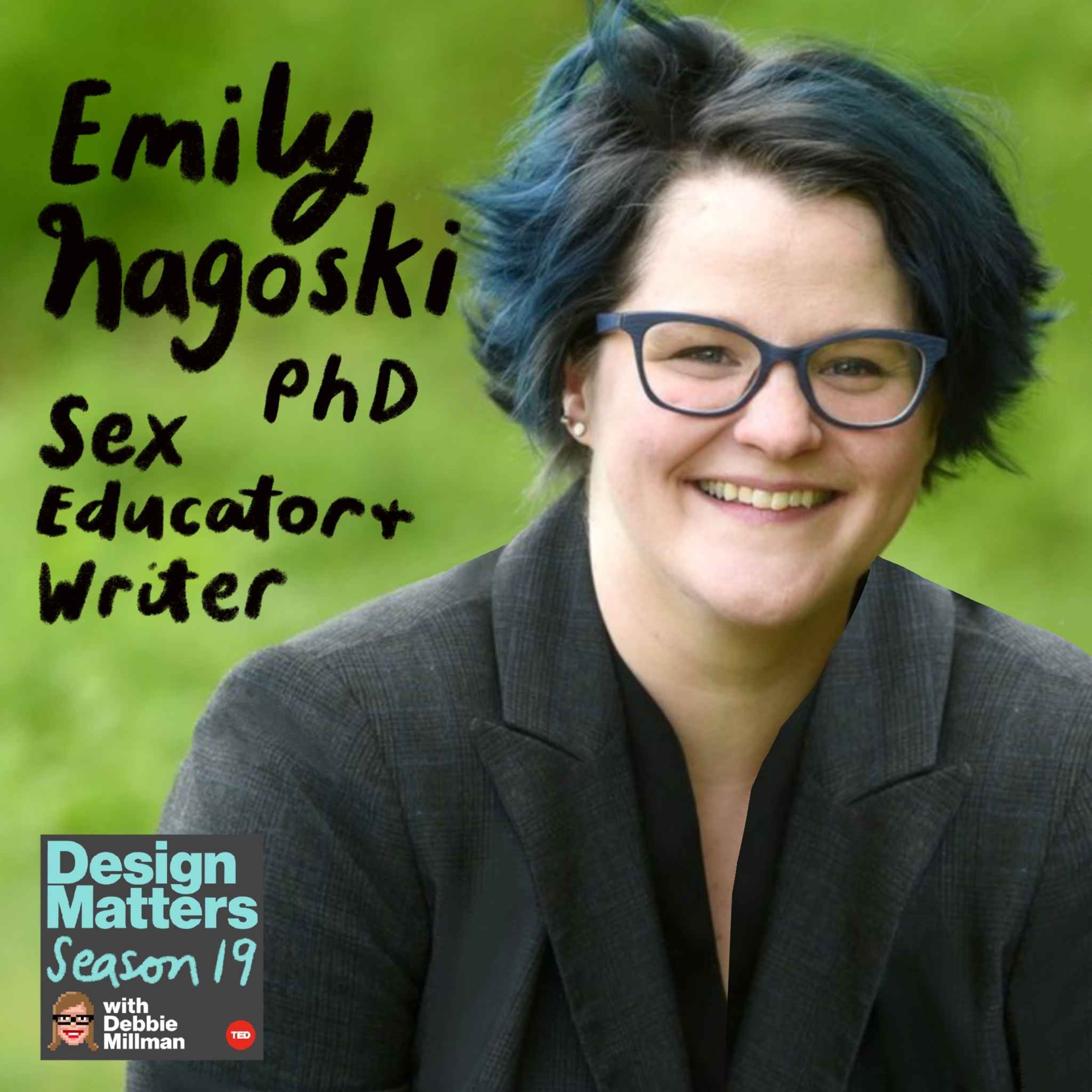
In this episode, Debbie Millman interviews Emily Nagoski, a New York Times bestselling author and educator renowned for her work on the science of sexual connection, intimacy, and arousal. They discuss Emily's career and her new book, Come Together, which explores the science and art of creating lasting sexual connections.
Written by AI. May contain mistakes.

Get the gist, explore an idea or ask about something said.
 Claude
On Design Matters with Debbie Millman, what are the key points of this episode?
Searching your listeningAutomatic transcript. May contain errors.
0:00This episode of Design Matters originally dropped in April of 2024. for. Here's the story. At the beginning of a relationship, it's hot and heavy, sparks a-flyin. But once you lose the spark, you have lost really the only thing worth having. And your choices are either to accept that sex is no longer for you or to fight, to like spice things up to keep the spark alive. But couples who sustain a strong sexual connection over the long term do not talk about spark.
0:32From the TED Audio Collective, this is Design Matters with Debbie Millman.
0:40For 19 years, Debbie Millman has been talking with designers and other creative people about what they do, how they got to be who they are, and what they're thinking about and working on. On this episode, Emily Nagoski talks about the differences between desire and pleasure when it comes to sex. And then comes the gut punch question of, so what kind of sex is worth wanting?
1:07Does this sound familiar? You're too fat and too thin. Your breasts are too big and too small. Your body is wrong. If you're not trying to change it, you're lazy. If you're satisfied with yourself as you are, you're settling. And if you dare to actively like yourself, You're a conceited bitch. In short, you are doing it wrong. Do it differently. No, that's wrong too. Try something else. Forever. This. Now, listeners, you might think that that's from the recent movie Barbie, but it's actually a quote from Emily Nagoski's 2015 New York Times bestselling book, Come As You Are, the surprising new science that will transform your sex life.
1:54The book enabled people to have a deeper understanding of why and how we have sex and how to feel less critical of and dissatisfied with our bodies. Now she's back with a brand new book titled Come Together, The Science and Art of Creating Lasting Sexual Connections. And we are going to talk all about that today. Emily Nagoski, welcome to Design Matters. Hello. It is thrilling to talk to you. Oh, thank you. Thank you. Emily, tell us about NaGoggles. So NaGoggles is a puppet of me. I'm a 40-something white-haired lady with shortish blue hair and glasses, and so is my puppet. And when I was doing promotion for my podcast, the Come As You Are podcast, the production folks were like, would you be on TikTok?
2:45And I was like, no. And they were like, but TikTok? And I was like, I don't know. And my husband, who's a genius, said, how about a puppet of Emily? And they went, yes! And they made me a puppet of me. And I answer sex questions as the puppet, which brings a level of whimsy and like gentle humor that helps to prevent people from feeling freaked out because we're talking about sex. And did you have any hand in designing your puppet? No, they literally just like made a puppet, but apparently it was made by the same people who made the sexual molestation puppet from Kimmy Schmidt. So like professional, like it is every day.
3:30The puppet has roots. Wow. It's amazing. Emily, you come from a family of artists. Your father is a photographer. Your mother is a professional singer and pianist. Your sister is a choral conductor, and your brother is an ethnomusicologist. And you've said that you were a black sheep with your science nerdiness. Were you ever tempted to become an artist or a musician? My plan in high school and early into college was to be some sort of literature or something or other, maybe an English teacher, maybe an English professor. but honestly I decided to major in psychology because it was the thing I already had the most credits in.
4:16Okay good planning there. I was just being pragmatic I was like I could finish my degree in three years if I choose this major. I want to go back a little bit more to your childhood and we're going to get real deep real fast and I hope that's okay and I think from reading you you're going to be okay with that. You've said that you were born and raised in a profoundly dysfunctional and neglectful family of origin, where you had to... He was going right there. I know. I'm sorry. I did say it in advance, though, and I usually don't. Just a giant black hole of the first 18 years of my life. Yeah. I'm sorry.
4:54No, it's fine. So you were raised in a dysfunctional and neglectful family of origin, where you had to hide away from all the other people in order to stay safe. Why is that? What was happening? Oh, so like the key ingredient there is the alcoholic narcissistic father, who was violent toward my mother and siblings. Less so to Amelia and me being the youngest and girls, but it creates an atmosphere. And often the rules in an alcoholic family are like, you do not talk about what's happening in the family, not even to the people who are there, having it happen to them with you. Also, it would turn out not until 2021 did I know this, but you know, in 1977 through 1995, I was living in this home while also being autistic.
5:50Yes. My sister and I were both diagnosed on the spectrum in 2021 in our mid 40s, which like changes our understanding of what was going on my experience was that i could very comfortably and easily escape my toxic home life and let me like shout out to my mother who like made it happen wow it's like five minutes and i'm already crying that's cool But, like, my mom is a survivor. Her therapist called her an optimistic depressive or a depressed optimist. Like, she worked hard to make that family exist and to get us through. So, terrible environment. Mom working as hard as she could to make it decent.
6:43And also, just like no parent is going to be capable of providing an adequate environment for the particular children that we were. But I had this resource of being able to dwell in books. I would, over the summer, go to the library and literally just get a stack of books, lie on the couch and read 12 hours a day. There was a worn spot in the fabric on the arm of the couch from where my heels rested because I just laid there all day reading. I also like worked for the family business in my dad's photography business, but I could read and escape and be good at school and occasionally go to dance classes.
7:26And that was that was me being successful, even though I had like no friends. It didn't matter because I was good at school and I loved reading. It's so interesting how many people I've met that attribute reading to essentially saving their childhood. Oh, God, yes. And maybe even their lives. And I was reading profoundly inappropriate, like age-inappropriate stuff. Like I read The Collected Works of Nabokov when I was 13. Hmm, okay. How did Lolita impact you? I am totally sure I did not understand it. It's interesting. I learned in your most recent book how close physical abuse and neglect live in one's psyche.
8:14Yeah. And that was a real revelation. How were you neglected? So in a home where the father is violent, drunk, narcissistic, and angry all the time, and I have a half-sibling who was seven years older than Amelia and I are, who was, I'm going to call it a little light sexual molestation when we were young. Yeah. No such thing. So there's that. Our brother is just barely two years older than we are and was a terrible mess because he was not good at school. He's like very – he got diagnosed with ADHD in the late 80s, early 90s, which is very early for people to be getting diagnosed with ADD. like that's because he was clearly a genius and like failing at school so our half sibling got a lot of attention because they were behaving violently ian got a lot of attention because he was failing at school and emilia and i were fine we could take care of ourselves we were silent and friendless and deeply depressed at the age of 10 but we were doing fine at school and like We would cook our own meals and be in charge.
9:41Certainly, it would never occur to us to ask for emotional help. And on one occasion, when I was 12, my teacher called my mom to be like, things are really bad for Emily at school. I was very, no friends. Because obviously, I was a profound weirdo. And my mom tried. It was one of those, we're driving in the car to dance classes, so it's a captive audience. So mom tries the parent move of having a serious conversation when you can't escape. It's really slick of her. And like, I just could not be opened. Like we did not, we knew not to ask for help. Even though help was being offered, I wouldn't have known how to accept help.
10:24You also stated that you really weren't paid much attention to unless you were performing and producing. And I'm wondering if you think that that's sort of what turned you into an overachiever. Yeah. So every quarter we got our report card. And if we got over a 3.0, props to my parents for having reasonable academic expectations. 3.2 was really where they wanted it to be. If it was a 3.2, we were doing fine. And if we got a 3.2 or higher, that was report card day. We got to choose what we had for dinner. That was the only time we had takeout pizza. We were also, let me add, like food stamps poor, like no health insurance poor.
11:07Like the one winter when they hung up plastic sheeting in all the doorways and all of us lived in the room with the fireplace because they couldn't afford to heat the house. Like poor, free lunch poor. So the only time we got takeout pizza was when we ordered it because we got to choose what to eat. We were literally rewarded with food when we had good grades. Growing up, your family didn't talk at all about sex and you never got the sex talk. No. Instead, there were medical textbooks and encyclopedias in the house and you learned about sex by reading them. Was your understanding of sex at that time clinical and were you curious about any other aspect of sex or sexuality at that time?
11:51Yes, I was curious about sex always. Anyways, so you might you probably heard the story of like driving home from the library and I must have seen the word vagina in a book because I asked my mom on the drive like what's a vagina and I don't know what she said but I remember she had this flash of like embarrassment and shock and didn't know what to do or say. So when I got home, I looked it up in the medical encyclopedia and I was like, oh, that's what it is. And my mom's reaction taught me how to feel about it. Again, it's just a very like ordinary mid-level sex negative American upbringing. It is most a lot of people, a shocking number of people get explicit messages that they should feel ashamed of those parts of their bodies.
12:32And I didn't get that. I just got, I don't know. Right. Which is like incredibly benign, relatively speaking. But I was reading a lot of romance novels at the library. I would either read them in the library or I would steal them because I felt embarrassed checking them out at the time. One of the first things I did when I got to college, I went to University of Delaware. Go Blue Hens. One of the first things I did was ride my bike to the library, find the sex section, sit down and read the height report. Wow. How did you even know about the height report? I didn't. I went to the sex section and looked for the biggest book.
13:11That's wonderful. I love that. You majored in psychology at the University of Delaware with minors in cognitive science and philosophy. And at that point, you thought you might be a clinical neuropsychologist working with people with traumatic brain injuries or who had suffered strokes. What changed? I loved the brain stuff. You can tell I still love the brain stuff as a social thing in my work all the time. But at the same time that I was earning that degree, I was also volunteering as a peer sex educator. My first year as a peer sex educator, then a sexual violence prevention educator, and then I added on top of that a sexual violence crisis responder.
13:56And that work made me like who I am as a human being in a way that the intellectual stuff just never could. Like I could see the impact I was having on people right there in the moment. And the intellectual stuff couldn't win against that feeling of being like, I am making a difference right now in doing this work. So that's the path I chose. My trainer as a sex educator, Annie Lomax, had a degree in counseling psychology. And I thought, I want to do what she does, I'm going to go get a degree in counseling psychology. Turns out that is not the degree that was for me necessarily. Halfway through it, I realized I do not have the magical something or other it takes to sit in a room with people and just be like, yeah, hmm, interesting.
14:39Tell me more about that. How did that make you feel? I just don't have it. One of the things Amelia and I noticed later on is that I got a degree in counseling. She got a degree in choral conducting, a master's degree in choral conducting. So we both got master's degrees in how to feel feelings and listen. I found this quote of yours, and I think it describes your education perfectly because you also went on and got a PhD. So you've deconstructed your entire education in the following way, quote, I have an undergrad degree in cognitive psychology because, of course, my first interest was in human cognition, not emotion or psychophysiology.
15:20A master's in counseling because it took three years in a graduate program to teach me to listen and feel feelings. And a PhD in health behavior because it took three years in a grad program to teach me to understand how people make choices about their bodies. So, Emily, my question is this. How did this all lead you to become a sex educator? That was the origin. I was an undergraduate peer sex educator. And then I went to Indiana University. The reason I went to Indiana University, my boyfriend broke up with me as I was applying to grad schools. And I had only applied to two schools. And I only got into one of those schools.
16:01And it was Indiana University. I did not know at the time that that's where the Kinsey Institute was. But when I found out, I was like, oh, that's great. I can go like continue my training as a sex educator there. And I lucked the fuck into a job at the Kinsey Institute running Ask Kinsey Now, which is the Q &A service that I ran in particular for the undergraduates at Indiana University. So one of my first jobs when I got to Indiana was people would email the Kinsey Institute questions. I would go up to the Kinsey Institute Library, which is a globally recognized resource and institution, look up the answers and email them back.
16:43And did you love it? I loved it. I loved everything about it. Every question was an opportunity for me to learn something and apply the skills that I had started developing in 1995 in terms of like how to do the education piece of it. And I also somehow managed to get a clinical internship at the Kinsey Institute under Cindy Graham and John Bancroft. The rest of my life, I will be attempting to deserve the opportunities I got at Kinsey. The title of your thesis was An Agent-Based Model of Disease Diffusion in the Context of Heterogeneous Sexual Motivation. What does that mean exactly? You know, I always wanted to write a dissertation with an incomprehensible title, and I'm here to show you that dreams do come true.
17:35So an agent-based model is a computer model where you set up a game, essentially, with thousands of agents, these creatures, and you give them personalities and you give them rules to follow. In this case, it was I gave them sexual personalities using the dual control model, which posits that every brain has a sexual accelerator and a sexual brake. People vary in the sensitivity of that accelerator and that brake. And so I would create a population that had some distribution of really sensitive accelerators or really sensitive brakes or really not sensitive either. And I would run it thousands of times dropping a disease into the system to see how the disease diffused through the population.
18:20So an agent-based model of disease diffusion in the context of heterogeneous sexual motivation. Does that make sense? It does. It does. I learned in your most recent book that illness can impact intimacy in a very positive manner. It can. I'm not going to say that like what a blessing it is to have an illness because it can whatever. No, of course not. But also having a disability or an illness can necessitate the creation of a context that requires you to think differently about sexuality because the standard narrative doesn't work for you explicitly. Like I'm here to say like just the giveaway is it never worked for you and it doesn't work for anyone.
19:07But once you have the disability or the illness, you know explicitly, oh, this set of rules is never going to work for me. I need to create a set of rules that are going to work, given the body that I have. What is it about sex that has intrigued you so much over the course of your life and career? I do not know. It is an innate—like I said, I was reading romance novels when I was 10. I was reading The Hyatt Report when I was 18. I just was natural—like, nobody told me to go to the library and start reading sex science. I just spontaneously started doing it. It's fascinating. In my doctoral program, I was trying to figure out what on earth I was going to do with my life.
19:50So I read a branding book. You're a personal brand. And I had to think through, what am I here for? Why do I exist? What is this? And I realized that the thing that revs my engine is teaching specifically how to teach people to live with confidence and joy inside their bodies. It was reading a branding book that I figured out my purpose in life. And I know not everybody has a clear sense of why they are here. But I do, which I consider a privilege and a gift. Do you happen to remember the name of that book? I don't. It was not a good book, actually. But even not good books can be really helpful.
20:33This might be too personal a question, and if it is, please just ignore it. Have you always liked sex? I am absolutely a weirdo in terms of my sexual response because I conform with the culturally constructed aspirational ideal. What does that mean? What does that mean? What does that mean? I have experienced spontaneous desire, like I have craved sex out of the blue. I have become aroused easily. I have had orgasms from vaginal penetration. So a lot of the things that I spend debunking in Come As You Are are things that I realized were myths when I read the science. And I was like, oh, so my experience, which matched the cultural narrative, is not actually the typical norm.
21:19I am the weirdo. So yeah, it has always been comparatively easy for me until I got married and wrote a book about sex. Well, we are definitely going to get to that. I want to spend just a couple of minutes talking about Come As You Are. You wrote this in Come As You Are. The day you were born, the world had a choice about what to teach you about your body. It could have taught you to live with confidence and joy inside your body. It could have taught you that your body and your sexuality are beautiful gifts. But instead, the world taught you to feel critical of and dissatisfied with your sexuality and your body.
21:55You were taught to value and expect something from your sexuality that does not match what your sexuality actually is. You were told a story about what would happen in your sexual life, and that story was false. You were lied to. I am pissed on your behalf at the world for that lie. And I'm working to create a world that doesn't lie to women about their bodies anymore. Here's my question, Emily. How and why were these lies perpetuated in the first place? So once upon a time in what we now call the Western world, let's narrow it historically down to the British Isles. Men owned the property and women and their children were part of the property that they owned.
22:40So the men would go out and fight wars to protect the property and to gain more property. and women stayed home to raise the children who would inherit the property. Because a woman's body was the property of her father and then her husband, she could not own property herself if she was married. It became the property of her husband. And because her value was an ability to reproduce children who would care for the property and inherit the property so that he knew he was not sending his property to be inherited by somebody else's child, her virginity mattered a lot. And the world saw a small fold of skin over the mouth of the vagina and decided that it was a marker of purity so that there could be some proof, some evidence that this person had never had their vagina penetrated before and therefore was not spoiled goods, essentially.
23:34Over the next centuries. For one thing, we have learned that people who have given birth can still have intact hymens. So it is absolutely not a marker of whether or not anything has ever been in a vagina. Two, the people who were property started to get a voice and started to be able to own their own property and eventually in the 1970s get credit cards in their own names. And eventually in 1992, finally in every state in the United States, it was illegal to sexually assault your wife. So it's the patriarchy. That's what I'm saying. It's capitalist, misogynist, cis-heteropatriarchy is the source and origin of a lot of the lies.
24:22There's also like a big chunk of purity, culture, Christianity on top of it. The first plagues of Europe in the common era were all sexually transmitted. It was gonorrhea and syphilis. And it was really easy for the religious leaders who were required to be celibate to come to the conclusion that God was punishing people who had sex. And so there's the other piece of it that's like, oh, God punishes the people who have sex. In particular, God punishes the women who have sex because their bodies don't don't even belong to them in the first place. So the myths originate in the idea that a woman's body is the property of the men who own her and God punishes us for having sex.
25:05It wasn't until about 1800 that the idea of women being less sexual than men emerged. Before that, the idea was that women were insatiable and had to be controlled in their sexuality. And then women began talking about their own sexual experiences. And we're like, no, we don't want the sex you are making us have. It's a pretty dark story. It's a very dark story. And I think it's important that we really understand where the threads of our current time are coming from. We're first created. And I haven't even added on like the slavery in America part and what race plays as the way we interpret women's bodies in particular.
25:50It's dark and bad. You wrote in Come As You Are that society, people are raising women to be sexually dysfunctional. Oh, yeah. How so? So sex is dangerous, dirty, and disgusting, and you should save it for someone you love. You should be absolutely pure, not even have sexual thoughts, totally chaste until the night of your wedding when you should be a sex pot, able to give 84 different kinds of blowjobs and have 74 different kinds of orgasms. Given the nature of our sexual functioning is that there's a sexual accelerator that notices all the sex-related information and sends a turn-on signal, and there's also a sexual break that notices all the good reasons not to be turned on, all the potential threats, we are being taught that sex is sex-related and sex is also a potential threat.
26:44That means your process of becoming aroused, which is this dual process of turning on the ons and turning off the offs, when you become sexually aroused, you are also activating all the ways you've been taught sex is dangerous and unsafe and dirty and disgusting and shameful. And if you try to drive a car with your foot on the accelerator and the brake at the same time, you might get where you want to go, but it will use a lot more gas and it will burn your engine. So that's the dysfunction, is we are being taught that everything that is sex-related is also a potential threat. The book really catapulted your research and your work into the zeitgeist in a really profound way.
27:31Your book became a New York Times bestseller. You've given several TED Talks that are extremely popular. But something else happened to you during the time you were writing and promoting and touring come as you are. you and your husband stopped having sex. Yeah. Like for months at a time. Why? First, while I was writing it, when I finished the book, it got a little better. Then I went on book tour and it got a lot worse. So what would happen is I would try to follow my own advice and come as you are, which is to make the most of responsive desire. You set up a time, you put your body in I really like this.
28:14I really like this person. What a good idea this was. And instead, I would put my body in the bed, let my skin touch my partner's skin, and I would cry and fall asleep. So even when I tried, like I just couldn't get there, wherever there was, it was not a place I could go. And I was like, well, I need better information than I gave in my own book. So I did what any good sex nerd would do. I went to Google Scholar and I looked at the research on couples who successfully sustain a sexual connection over the long term. And what I found there was so contradictory of the mainstream cultural discourse about sex and long-term relationships that I wrote a book about it.
28:54And also, I found out what I needed to know in order to fix my own situation, which ultimately was the emotional floor plan, which I don't know if you want me to go all the way into the emotional floor plan right now. Oh, we're going to go there. So yeah, give me a couple more questions and then we'll go there for sure. Okay. I was wondering if your sudden turnoff switch was ignited in the same way that people working in an ice cream store stopped liking ice cream. No, I wanted to want sex. It wasn't like, oh, please, no sex for me. It was like I would really like because we had I started writing Come As You Are in 2012.
29:36We only got married in 2012. Like we were newlyweds when things got harder. One of the things that did happen is because I was beating myself up about it, inevitably, because like, you know, I'm a quote unquote expert. I should be able to fix my own problems very easily. And it was not typical of my experience of sexuality that it would be like, what's the matter? Does beating yourself up for something, does that activate the accelerator, do we think? Or does beating yourself up for something hit the brakes and make it even harder to want or like the sex that's available to you in your relationship?
30:11made it so much harder. So that happened. It ended up being the stress. I was so exhausted and anxious and working extremely hard in a very focused way. Like sex is my special interest, my autistic special interest, and I can disappear into writing for 10 hours at a time. Rich would bring me food and I would sort of finish the day with the taste of food in my mouth and an empty plate next to me and not remember having received it. Like, I can focus hard. And switching out of that focus to something else, when I was so drained, like I had just poured all of my energy into this day of writing, I had nothing left.
30:59And I did not know how to balance my energy output between my work and having energy left to be a person with this other person. How did Rich handle all of this? Oh, he's just ideally. He's a spectacular, wonderful. The occasion when I cried and fell asleep, the first time I told that story, people were like, he must have been so angry. And I was like, no, he was really sad for me. He put a blanket over me and brought me tea for when I woke up. He was incredibly patient and kind and understanding. It was actually one of the struggles we had to overcome that each of us was so competent at managing our own lives.
31:44We'd both been single for years and could live our lives autonomously. And especially when I was on the road, he was at home dealing with everything at home and I was on the road dealing with my work. And when I got home, it was so easy and comfortable and we're both so competent that we could just stay in our own lanes. We made excellent roommates, and it required a deliberate shift to decide to rely on each other. And as you were investigating what was happening, did the two of you seek help? Did you go to a therapist together, or were you navigating it sort of independently or on your own? The only professional intervention we did was we went to a Hold Me Tight workshop, which is Sue Johnson's Emotionally Focused Therapy.
32:32It was a very hilarious experience. But it was, you know, it was two miles from our house. We could go home during the lunch breaks. We both did not enjoy the experience, but in the same way that that book that I did not enjoy helped me, this weekend workshop that we did not enjoy was revelatory and profound and a turning point. They gave us this like very simple deck of cards with like conversation prompts or things you want to say to your partner. And there was this one moment when we were just sorting through the cards, like what's a thing I want to say? And he handed me a card that said, I want to be on the same team.
33:12Sorry. It's okay. You start with the childhood neglect and then you come to the moment when like this dude I married turns out to be like my ideal partner. This is what you get. I would say I'm really lucky, but I have had so many years of therapy. I earned him. Yeah. So when he handed me this card that was like, I want us to be on the same team, I felt like I knew what to do with that. Like I understood what that meant. That meant we are going to rely on each other. I'm going to ask for his help, and then I'm going to do the really hard part and accept it. What made you decide to write a book about the experience?
33:53I was talking to my agent about like the things I was learning and how like it's so it just it makes the the things I'm learning make the mainstream conversation about sex and long term relationships irrelevant. I can't believe there's not a book about this. And Lindsay was like, Emily, Emily. That's when I decided to write a book about it. Did you worry at all that revealing your own issues or sharing your own issues would undercut your expertise as a sex educator? Absolutely. A hundred percent. And it's only because Lindsay Edgecombe, my literary agent, who has been from the very beginning, I lucked out and got like the perfect agent right out of the gate.
34:34When I told her and I was like, I worry that saying this in public would people would be like, how can she be an expert when she struggled herself was like, no, it is such a relief to know that even somebody who knows so much can still struggle in this way. And let's face it, I struggled in the face of not that many barriers. Like, we are child-free by choice. We do not have that barrier in our lives. We are two adults in our 30s at the time. Like, there was no reason, there was quote-unquote no reason why we should be struggling in that way. So if it was difficult even for us, even for me, in particular, therapists and sex educators and people who are in training to be therapists and sex educators have like pulled me aside and thanked me.
35:23And it was such a relief that I was willing to say out loud that like just because I do this doesn't mean I'm a sex monster. One thing I was surprised at learning from you in doing my research for our interview was that sex is not a drive. Right. Can you talk a little bit more about that? Yeah. So the language of biologists, drives are motivational systems where your body notices there's a problem. So hunger is a drive. There's low energy. Thirst is a drive. The balance of water and sodium and other things is off. Sleep is a drive. And so like a little alert goes off, beep, beep, something goes wrong.
36:04It pushes you out into the world to go fix the problem. And the consequence, if you do not manage to fix the problem, is you literally die. You die of hunger. You die of thirst. You die. You can die of sleep deprivation. You can die of loneliness. Connection is a drive. Love is a drive. Sex is not one of those. Nothing bad happens to people's bodies if they don't have access to sex. There is no tissue damage. As Frank Beach said in the 50s, there's no tissue damage associated with lack of sex. Instead, sex is an incentive motivation system. And I do not live in a fantasy world. I know that we're not going to transition to all saying incentive motivation system instead of drive.
36:48Sex drive, yeah. But let's understand that like nothing bad happens to a person if they don't get sex. Instead, sex as an incentive motivation system means instead of being pushed by an uncomfortable internal feeling to fix a problem, you are pulled by a pleasurable feeling to move towards some like, ooh, what's that? Some object that is attractive to you. Ooh, ooh, what's that? Curiosity is another incentive motivation system. It is just as organic and innate to our bodies. It is just as, like, natural. It's just nothing bad happens to you if you don't get it. And we all intuitively understand that, like, there are times in your life when you are less curious or less interested in trying new things.
37:35Like, when you're real stressed out, you just want to watch 30 Rock again for the 98th time, right? Because it's your comfort watch or whatever it is for you. Rich was talking about 30 Rock yesterday, and so that is my example today. So that's all. It's natural. It's just not a drive. So you've talked a bit about the dual control mechanism that exists in our brains that govern sexual response. And you talked about the two parts, the sexual excitation system or the accelerator, and the other part is the brake. And you write how some people have really sensitive accelerators and some people have really sensitive brakes and then vice versa.
38:20Some people have really not sensitive accelerators and have not sensitive brakes. And the way a person's sexuality functions will differ depending on the sensitivity of their brakes and their accelerators. And what blew my mind was that these are like personality traits. It seems to be more or less innate and inborn. So does that mean they're kind of genetic? There does seem to be some genetic component, but there's only a tiny little bit of research, and it's not heritable the way something even as fungible as intelligence is heritable. So there is some genetic component to it. Are they changeable, these traits?
39:13We don't know. Yeah, so interesting. I think that should be your next book. But there's not really, like, why change it? Yeah, I guess it's true. Because people can just vary and everyone is normal. Most of us, so it's a standard normal distribution, normal in the technical, statistical sense of, like, most of us are heaped up in the middle of sensitivity. And it's only for, like, a small proportion of people at the extreme ends on either side. And the two components, the brakes and accelerator, do not co-vary. So you can have a really sensitive accelerator and an average brake, a really sensitive accelerator and a really sensitive brake, a really sensitive accelerator and a really not sensitive brake.
39:55They don't vary together. So for most people, the challenge, if they face difficulties around their sexual functioning, it's not because of a really sensitive brake or a really sensitive accelerator or really not sensitive of either. It's because their context is usually their context is just slamming on the brakes. And it's by changing the context and freeing up the break that you create change. And I wouldn't even want to create a drug that gave people less sensitive breaks. Your break is there for really good reasons. Like, evolutionarily speaking, if you're being chased by a lion, that's not a great time to be turned on.
40:34It makes sense that stress would hit your brake. Like, I don't want to break the mechanism that is functioning correctly. I want to change the world that is screwing with your brain functioning correctly. It is the culture in particular that is making your brain function in a way that is not ideal for the way we want it to be. So when people struggle with sexual desire, the question to not ask is, why don't I want sex? It's really more about how do I create pleasure. Is that right? So this is a question people ask a lot because the number one reason why couples seek sex therapy of any gender combination is because of a difference in desire.
41:20When it's a heterosexual couple, it's just as likely to be the man as the woman who has the lower desire, unlike what we often assume. And people are really worried about desire. But let's take two examples. So let's take couple one, where partner A says to the therapist, you know, I was really into sex before, but frankly, I'd be fine if we never had sex again. And I'm in it because this is, it's my story. So I'm going to give them Peggy Kleinplatz as their therapist. She's a therapist and researcher in Ottawa, the head of the Optimal Sexual Experiences Project. And Peggy being Peggy will say, well, tell me more about the sex you don't want.
41:59and they will go on to describe sex that is intimate and loving and adventurous and connected. No, of course not. They describe sex that is dismal and disappointing. And Peggy, being Peggy, will say, well, you know, I rather like sex, but if that's the sex I were having, I wouldn't want it either. And then comes the gut punch question of, so what kind of sex is worth wanting? And that's the starting point. How can this couple figure out what shared pleasure looks like between them? Like what kind of sex is worth the time and energy that it takes to create instead of spending that time, frankly, watching Parks and Recreation, which is also fun.
42:41You write that humans are taught to be ashamed of pleasure. Why is that? Yeah. It's American work ethic puritanism.
42:57there's a cultural narrative that I think makes things way worse but there is actually a neurological piece that is really interesting and I think plays a role so the cultural part of feeling ashamed of pleasure is like that is a very old western white christian tradition right along with the gender binary and patriarchy. Yep. That word again. That pleasure is a sin. Pleasure is a sign that you are wasting your time and doing it wrong. I don't know why leaders decided that pleasure was the wrong thing. It probably has to do with productivity and capitalism, right? What is the desire imperative?
43:49these are very big questions sorry i'm so curious about everything why do we not but there's but there's so there's then the neurological piece though about why why pleasure is so difficult for us um in 2010 there was a paper published by charles carver with the idea that pleasure is a signal maybe in our brains that we can stop paying attention to something. This problem has been solved. We can move on because our brains are problem-solving machines. They're great at it and they are motivated to do it. So desire is like, let me scratch this itch. Let me move toward this thing. Like it's a kind of dissatisfaction with what's happening right now and like a need to like change things.
44:38I need to change things. Pleasure is just like everything is delightful right now. This feels good. And oh, I don't need to pay attention to this anymore because everything is fine. I need to go focus on a problem so I can make sure things keep changing and getting better. So I think people struggle to pay attention to pleasure because it really does take a concerted effort to train your brain to stay with pleasure. So that neurological component on top of the cultural shame around, like, daring to waste your time reveling in delicious pleasure. I think those two things combined make it kind of a hard sell, the idea of centering pleasure.
45:20So the desire imperative is my name for this idea that it's supposed to be. Here's the story. At the beginning of a relationship, it's hot and heavy, sparks a-flyin', spicy everything. And And as time passes, that gradually goes away until all apparently of your hormones drift off and you're left to like hold hands on a beach at sunset or whatever, white curtains in a breeze, that kind of thing. And once you lose the spark, you have lost really the only thing worth having. And your choices are either to accept that sex is no longer for you or to fight to like spice things up to keep the spark alive.
46:02Couples who sustain a strong sexual connection over the long term do not talk about spark. What do they talk about? They talk about pleasure. They like the sex that is available in their relationships. And they collaborate actively to create pleasure, to make it easier to experience pleasure together, to explore new pleasures together. They talk about intimacy and authenticity and vulnerability. Empathy, empathy is the meta factor in great sex. Being able to be aware of your own internal experience and your partner's internal experience at the same time, that is the source of great sex. It is not handcuffs or porn.
46:44If you like those, great. I'm not shooting them down. I'm just saying those are primarily tools to facilitate the authenticity and the vulnerability and the exploration and the empathy. Talk about the difference between spontaneous desire and responsive desire. Sure. Yeah. So most of us grow up learning about spontaneous desire, where you're just like walking down the street. You have a stray, sexy thought. You see a stray, sexy person. And just out of the blue, you would like your motive. Ooh, sex. I would like to have some sex. You go home to your certain special someone. You're like, I have.
47:18I would like the sex. Would you like the sex? And on some magical time, both of you have the desire for sex simultaneously. You're interested in the same kind of sex at the same time, in the same way, at the same level, because life is easy like that, I guess. If only. It's absolutely 100 % a normal way to experience desire. And if you experience sexual desire that way, you do not need to worry. You're not broken. It is normal. And there's another way of experiencing desire that researchers call responsive desire, where instead of, like, spontaneous out of the blue, Erica Moen, the cartoonist who illustrated Come As You Are, draws spontaneous desire as a lightning bolt to the genitals.
47:58Kaboom! You just want it. Instead of it being spontaneous kaboom, it is like, you know, you have a date night. and so you like you get the child care and you put the last of the laundry in the dryer and you tromp up the stairs and you put on the special socks and you trim your ear and nose hair you put on the body glitter you turn on the music you get in the bed you let your skin touch your partner's skin and your body goes all right yeah oh that's a good idea that's responsive desire or it could be you're just sitting on the couch snuggling and like your certain special someone starts like touching you in a place and in a way and your brain receives that stimulation is like, oh, that's really nice.
48:41And so you turn towards your partner and you do something back and your brain receives that stimulation. Your brain goes, that was really nice. And your partner does something in return and your brain receives that and goes, you know what though? Kaboom! That's responsive desire. It emerges in response to pleasure where spontaneous desire emerges in anticipation of pleasure. And they are both a normal way to experience desire. Why is the idea of setting up a date night in order to have sex considered inferior to spontaneous sex? Oh, gosh. Well, it isn't by me. Let's just be super clear about that.
49:18It's very judgmental. There's a cultural judgmental. Yeah. People are like, well, if we have to set up a time, if we have to plan it, it's not natural. my partner really doesn't want me enough if they don't just want me out of the blue. I'll be really honest with you. Like, I'm busy. Aren't you busy? If something is not in my calendar, it doesn't happen. And I find that if my partner is willing to cordon off a chunk of calendar time where it's protected and nothing is going to stop us from spending that time not doing any of the 80 million other things we could be doing, right? There's so much other stuff we could be doing with that time.
49:58But no, it's protected. It has got red velvet ropes around it. And that is just for us to like get naked and roll around like puppies. That is like the ultimate romantic I want you that a person can do for me from my point of view. If when you see it on the calendar, you're like, okay, I know for sure it's going to happen. And I know that it's there and I can fantasize about it. And I know that when I, I know that when I show up, we are going to do something that I am going to enjoy. And I'm going to be like, that was a good idea. We should totally do that again sometime. But if you schedule it and it like looms in your week, like, oh, if you are not sure that what's going to happen in that time is something that you will enjoy.
50:49If you experience dread around it in particular, dread is the literal worst. Scheduling is not for you. If you don't like the sex you would be having, scheduling is not going to fix it. What you need to do is figure out how to enjoy pleasure. I would just like to point out how beautiful thunder is. I was actually loving the fact that when you talked about rolling around as puppies, your doggy showed up. Yeah. Yeah. Your book features, I believe his name is Yach Panksep, his model of the seven primary process emotions. You write that there are at least three dominant models. Why did you pick this specific one?
51:27It's the only one that includes sex. Can you outline what the primary process emotions are? Sure. So I group them broadly into the pleasure-favorable emotions and the pleasure-adverse emotions. So the pleasure adverse emotions are really simple. You know the fight or flight response? One of the primary process emotions is rage, fight. One of them is fear, flight. And then the third one is less recognizable. But for those who are aware of other trauma responses like fawn, flop, and freeze, there's a space for that. It's called panic grief. And it's loneliness, isolation, despair. So obviously those are not spaces where your brain's going to have access to pleasure.
52:10And neurologically, we know that when brains are stressed out, they are likely to interpret almost any sensation as a potential threat. Something to be avoided. Sensation just feels really irritating or painful. And then there are the four pleasure-favorable spaces. Lust is one of them. There's also care, which for a lot of people, the experience of feeling really cared for, feeling like their needs are being met, they're attended to, that like cuddling on the couch in front of the fire, holding hands and like kissing a little, like that for a lot of people has a really direct connection to the lust space, which is where attraction, romance, courtship, and sex happen.
52:50Care is complicated though. Care is huge in mammalian brains generally, but in human brains in particular. Why is that? Because of a thing called the cephalopelvic disproportion. There are two characteristics of humans that makes humans really amazing. One is these great big giant brains, these cortexes that just cannot be stopped. But in order to have these brains, we have to have these really huge heads. And we walk upright. In order to walk upright, we need these little narrow hips. The combination of a great big giant skull and a little narrow hip makes childbirth really difficult for us. So the Cephalo-pelvic disproportion.
53:29Consequently, human beings are born when they are underbaked. We are pulled from the oven too soon. You know a baby elephant can walk within hours? How long does it take a baby human to start walking? Year and a half. Actual literal years. Yeah. Yeah. We are born way too early. Like our skulls aren't even closed. Like we can't run away from a predator. We can't feed ourselves. We can't even thermoregulate independently. If you leave a baby on the ground, it will just freeze if it's not eaten by a lion first, which it probably will be. They require constant attention by other people. Our babies are born much too young.
54:09They keep you up all night. You have to carry them everywhere that you go. They smell weird. They're noisy. See, if they were not so fucking cute, we would leave them by the side of the road. So evolution, in its wisdom, created a mechanism that we call the attachment mechanism, where when somebody hands you a kid and says, here, this one's yours, keep it alive. A thing happens. Christopher Hitchens, of all people, describes it as your heart beating in someone else's body. Even if you don't enjoy the experience, nothing will stop you from caring for the baby. That's the attachment mechanism. And because our babies are so needy for so long, it is intensely powerful in humans.
54:56And it happens to be a system that got co-opted from parent-offspring love to peer-to-peer love. That same mechanism is at work in the way we attach to our peers. We get into adult relationships, and for a lot of people, attachment is deeply involved in the way we connect with our certain special someones. So it's huge because our babies are—because our brains are so big is why. I don't know if that was the answer you were looking for. Absolutely. No, it's better than what I was expecting. The nature of humanity is to have profound, deep, unirresistible love for each other. And if you are in that caretaking space where, like, you are making sure everybody's fed and making sure all the dishes got done and all the laundry got done, that is not a care space that is going to be really similar to the lust space.
55:51Like, it's a long journey to travel. We are only on the second pleasure-favorable space, so I will move on. Care is complicated because it's so big. There's two other pleasurable-favorable spaces. One is the play space. play is the universal mammalian motivational system of friendship. Play is any behavior we engage in for its own sake, because everybody involved likes it, and there is nothing at stake. There are so many things I would change about the sexual world if I could, but maybe the thing that would make the most immediate difference is if everybody tried on the idea that they could have sex with their partner, and there is nothing at stake.
56:30Your relationship is not at stake, your identity is not at stake, whether or not you are like, you know, being successful at your gender is not at stake, whether or not you're a good person is not at stake. You're just playing. You are engaging in behaviors that you like, and you're not going to lose anything. Object play is one of the kinds of play when little children engage in object play. You imagine like a toddler splashing in the bath, they discover the water and they start going, what can I make this object do? That's object play. What can I make it do? And they splash and they splash you.
57:04And that's hilarious. What if our partners' bodies are object play? Like we look at their genitals and we're like, what can I make this do? And it's not about performance. It's not about expectations or doing it right or wrong or blowing anybody's mind. It's just about like, what's fun? What feels good? What do you like? What do I like? Object play. So, and the last of the pleasure-favorable spaces is seeking, which is curiosity itself, exploration, adventure. I have friends who sold all their stuff and traveled around the world together, which sounds like a nightmare to me, but they loved it.
57:42And for them, the adventure of it was right next to their lust space, made it really easy for them to get into a lusty state of mind. When I was in grad school, I dated other grad students and we would talk about each other's research. And that intellectual curiosity and exploration is basically a water slide directly from affective neuroscience into my lust space. And it took until 2021 for me to be diagnosed on the spectrum. How has that knowledge changed your work? I am much more aware of the ways that I, as the author of the work, am not the target audience. That, like, my experience is not the same as other people's experience.
58:23And I have known that was true, but now I know why that's true and a lot more about how it's true. It has also helped me to make sure I include neurotype and neurodivergence as part of my conversation about diversity and the ways that we vary from each other and have to, like, accommodate difference. It has also made me a much more skeptical reader of the science. You also added two bonus spaces to the seven primary process emotions, the thinking mind, or what you also refer to as the office, where you plan and reason, and the observational distance or the scenic viewpoint for noticing your own internal experience with non-judgment.
59:08Why did you add them and what did they do in the plan? Yeah. So they're there because they are really essential in understanding how and why things go wrong and how to fix it. A lot of people ask me about what do I do when my brain is just like stuck in my to-do list and I can't pay attention to pleasure because my brain is stuck in my thinking mind. And like I had to include it because that's a space people tell me they get stuck in and they don't know how to get out and they want to. And so I had to include it as like, you might be here. And if you are, yeah, I mean, that's the part of the brain that is the reason our brains are so big and we have to be born so early is the part that can plan for the future.
59:49And like, hey, stop planning for the future and pay attention to the pleasure that's happening now. And then observational distance is the solution space. It is your ability to take one step back from your experience and witness it in a neutral way. It was by going to observational distance that I figured out that when I cried and fell asleep, I was putting my body in the bed, let my skin touch my partner's skin, and instead of my brain interpreting that sensation as, oh, sexy times, yay, my brain went, oh, I'm safe now. The second book I wrote, I wrote with my sister, it's called Burnout. the first chapter is about the stress response cycle.
1:00:27And one of the concrete, specific evidence-based strategies for dealing with the stress response cycle is connection. So here's my body touching my favorite person's body and going, oh, I'm safe now. I can relax. I can complete the stress response cycle. I was bouncing around in the fear space, it turned out. And when my body was like, oh, I'm safe, I could cry as my way to get out of that space. And once I got out, I was just left with how physically exhausted I was. And so that was the nap and then generally the bath and the snack. And then I could get into the seeking space or the play space.
1:01:05So when I could observe, oh, here's the process. I am getting out of the fear space. I'm taking care of my body. And then I can get into a space that's adjacent to lust. So it's literally four steps I have to go through when I'm in this stressed out state of mind in order for my brain to gain access to sexual arousal. So of course it's not easy, and of course I need a damn plan. Your book helps readers develop a map of the different emotional states that exist in our brains and outlines just the way you described how to navigate those spaces to find ourselves in the vicinity of the erotic. And you think of these spaces as the rooms in your brain laid out in an emotional floor plan.
1:01:54Why a floor plan? And can anyone create their own floor plan? Yeah. So the floor plan is a metaphor to make Yach Panksepp's research, his framework, accessible and usable so that you can have a conversation with other people about your internal state. So I can say, I'm in this space and you want me to get here. So here's the path we have to walk. The reason the floor plan is valuable is because it should, like seven rooms, even if it's just the seven emotions, that's a big space. It's a complex space. You are not going to be able to get directly into every room from every other room. So if I'm in this room, I have to go kind of a long way to get to the place I want to be.
1:02:37If you want me to be here in the lust space, I'm going to need your help transitioning out of this space through this other one so that I can get there. The floor plan, I've had a lot of beta readers on the book. Floor plan, there are some people whose imaginations are so not visual that it doesn't work for them. They go with like a spectrum of colors, like it's a chain series. Some people, it's just like feelings and they can like sense that they transition in a certain way. Everyone's imagination is different. I am not a particularly visual person. And yet, the floor plan as a spatial metaphor ended up being the thing that allowed me to communicate and even understand for myself what I needed.
1:03:17And everyone's floor plan is going to be different. Let us not spend any time being like, but I should be able to get directly from my fear space into my lust space. I wish I could just like knock a wall down. I wish I could knock a wall down and just get right from my fear space to my lust space. Is that even possible, Emily? No, and you don't need to because in other contexts in our lives, we know how to get out of the fear space in our lives. We know what helps us. Well, hopefully. And if you don't know what helps you get out of stress, chapter one of burnout. Don't have to read the whole thing.
1:03:46Just read chapter one. It's probably available for free on Amazon. You know how to get out of your rage space, if you are even aware that you have a rage space, because some people are raised to believe that they know. I just don't get angry. So there are conversations to have about each of the spaces. So you know how to get out of them. You can understand what puts you into each of these spaces, and you can know what it feels like when you are transitioning into and out of them. You suggest that people aim to go to the room next door to Lust. Why is that? Yes. The room next door to the room where it happened.
1:04:23Do-do-do-do-do-do-do. Hamilton. Hooray, somebody left. Not everyone has any idea what I'm talking about when I do that. Really? That's sad. That's terrifying. Oh, good. It's an old reference now. Yeah. Yeah, it is. So aiming for the room. The reason why is because of a thing called the it's literally called the ironic process. Dan Wagner is the original researcher here. The harder you try to do something directly, the more difficult it becomes. Don't think about a white bear. Whatever you do, I'm going to do something mean to your dog. If you think about a white bear wearing a purple tutu with white polka dots on it.
1:05:00And if that bear's wearing roller skates, you watch out. That's the ironic process. The harder you try to do something. The same thing goes for sexual functioning. Like, I'm going to put a spotlight on your penis. Get an erection. Get an erection. Get an erection. What's the matter with you? Get an erection. Get an erection. Like, the harder you try to do something, the more pressure there is or demand, the more impossible it becomes because there's competition between the part of you that's trying to do it and the part of you that's monitoring whether or not you're doing it. So don't aim right for the lust room.
1:05:30get to a room next door, something that's close to lust, that will make it easy to transition into the lust space. You discovered that one of the primary indicators of a satisfying long-term sex life for most people is cuddling. Yeah. That really surprised me. So research averages things together. And so you end up getting sort of like middle of the, like the research on like the funniest joke ever. really just finds the most benign and offensive joke, the one that activates the least intense extremes of anything. And cuddling, I think, is that thing that, like, it doesn't do any harm. It does everybody some good.
1:06:15It is the most reliable predictor of sex and relationship satisfaction is cuddling for 10 minutes after sex. When I read that paper, my husband and I started doing it. We're like, oh, shit, this really works. All it takes is a very slight intentional effort to like stay together for a few extra minutes. It's delightful. That really excited me because that's one of my favorite things to do. It really is. Yeah. It's not for everyone. Not everybody likes it, but. Well, I only like doing it with my favorite person. I don't necessarily. And my dog. Yeah. Can you share what some of the characteristics of partnerships that help sustain a strong sexual connection?
1:06:56Yeah, this has been remarkably controversial, in particular the first one. The first characteristic of couples who sustain a strong sexual connection over the long term is they like each other. They have a friendship. They admire and trust each other. Why is that controversial? Mostly it's controversial among the straights. I'm real. I'm not going to lie. I'm worried about the straights. They have lower quality sex than other kinds of couples and they have it more frequently. So it's more sex that they don't like. and apparently there are people in heterosexual relationships who take seriously the idea like genuinely authentically not ironically genuinely they take seriously the idea that uh friendship and sexual attraction are antithetical to each other yeah i don't know either this is one of the things i've discovered since the book came out when i say you've got to be friends people are like but i don't want to like that's that's not sexy are you kidding all i want to do is fuck friends.
1:07:53Friendship is the sexiest thing in the world. But yeah, you have to like each other. But really, what I'm proposing is radical insofar as I'm saying that liking each other is more important than wanting each other. There needs to be a basic attraction between you. But hot and heavy, can't wait to put my tongue in your mouth, matters less than you and I make a great team, and we have a lot of fun when we get together. So you like each other. Characteristic number two, they prioritize sex. They decide that it matters, that sex contributes something unique and important to their connection. And so it is worth cordoning off space and time and energy to connect with each other in this really specific, very, let's face it, silly way that we humans have of like putting parts of our bodies inside parts of another person's body and like licking each other's body parts.
1:08:48Like, why would we do that? Because it contributes. We decide that it contributes something important. And so we look at our lives and decide which things matter less in our lives than that. That's prioritizing sex. And then the last characteristic is they notice that they have been following somebody else's rules about who they are supposed to be as sexual people and what their sexual connection is supposed to be like. And they decide to stop doing that and instead really deeply investigate who they truly are as sexual people, who their partner truly is as a sexual person, which is maybe even more difficult, and who they truly are as a sexual relationship.
1:09:30And they create an authentic sexual connection that is true to them, that makes it easy for both of them to access pleasure. Emily, I only have a few last questions for you today, although I really... This has been like a fire drill. There's so much more I want to ask you and talk to you about. I'm going to have to ask you to come back and do a part two with me. After all this work, after all this research and writing, how are things between you and your husband? Is your sex life more satisfying? Yeah, short answer, yes. Longer answer, did writing come together, do the same thing to your sex life?
1:10:05as writing comes you are, yeah, 100%. And it did it 10 years later, which means it did it in the context of perimenopause, which is not great, and long COVID. Yeah. So I have basically, insert chronic fatigue symptoms here. So yeah, I get to the end of writing the book, and I'm exhausted, and I'm sick, and I'm perimenopausal. But I've got this book, this like 100 ,000-word tome of like how to fix the thing I just broke. And I have to say, we've been following our own advice, and I think things are better than they have been in all the 13 years that we've been together. Oh, that's wonderful. Because we laugh about it more.
1:10:47There's a scene in the movie with Adam Driver and Scarlett Johansson about marriage where they're having a very intense fight and she's accusing him of sleeping with someone else. And he says, I laughed with her and that's what you should be more worried about. Yeah. Laughing, playing. That movie made me really sad. Yeah. Yeah. Yeah. You've said many times that the most common question you're asked is, am I normal? Right. This is a two-parter. Why do people want to be normal, and what does it mean to be normal? Those are both really big, important questions. And I think I have to answer the second one first.
1:11:36What does it mean? Because if you ask a statistician what normal is, it is a measure of central tendency. It is like the mean, median or mode. And I don't think when people ask, am I normal? They're not asking, like, am I within two standard deviations of a measure of central tendency? I don't think that's what people mean. I think what they're asking instead is, do I belong? Am I acceptable within the human community? I think that's what they mean when they say normal. Because they're also not asking, like, am I doing sex right? Because, like, you don't read a hundred thousand word book about sex in order just to be normal.
1:12:19Like, if your partner says to you, hey, that sex was really normal, you don't feel awesome about that. Like, I mean, I kind of want to be the best lover my lover has ever had. That's I want to be amazing. Not just, quote unquote, just normal. Like normal isn't even like a high standard that we're hoping to achieve. We just want to know that we are not outcasts as sexual people. And like all of us, like everybody, the nature of human sexuality is inherently for us to vary from each other. A sexually reproducing species is successful because it produces variety and diversity. And for humans in particular, variety, diversity, adaptability, flexibility, responsiveness to changes in our context is what makes us so successful as a species.
1:13:15Variety is the point of being a sexually reproducing species. so yeah you're normal and you're going to be different from literally everyone else on earth i have an identical twin sister our sexualities are very different we were raised in the same shitty household our sexualities are very different right so we're all going to be different from each other and it's really hard for us as humans because we're also the other thing about humans is we're basically a herd species. Jonathan Haidt calls us 90 % chimp, 10 % bee. We're a flock species, like sheep. We're a herd species. We want to be in the middle.
1:13:54We're protected. And to be on the edges feels unsafe and can actually be unsafe. And we're such a powerfully herd-oriented species that if we notice someone who it seems like association with them would make other people perceive us as though we belong on the outskirts, we will push that person away from us toward the outside. And so we will all try to pretend to be normal, to move closer to the middle. We are all worried about being safe within the human community in the same way that it takes deliberate effort to pay attention to pleasure, to value and center pleasure in your life because it's good for your brain, because it's good for your relationship, because it's good for your life and the world, it takes deliberate effort to notice diversity, variety, difference, and not freak out about it and be like, oh, people are just different from each other.
1:14:51I am different from literally everyone I know, and none of us is broken. None of us is doing it wrong. Emily, I have one last question for you. I understand that one of your favorite movies is Moana. Oh, yeah. And I'm wondering if you can tell us why. Have you seen Moana? Yeah, of course. It's a beautiful, beautiful movie. Yes. It's a Disney movie, therefore it's problematic. We get that. And also, it is a Jungian metaphor for trauma healing. So Moana, Moana is the Maori word for ocean. Moana is called by the ocean to cross the horizon, find the demigod Maui, and restore the heart of Te Fiti. The heart of Te Fiti is a literal object.
1:15:38It's a green glowing stone with a swirl in the center of it. So she does. Moana crosses the horizon. She finds the demigod Maui. And then she confronts, in order to restore the heart of Te Fiti, she confronts her last worst enemy. Now, in Jungian analysis of narrative, every part of the story is a part of the reader. Or if you're interpreting your dream, everything in your dream is you. Moana is the Maui word for osin. She is called by the ocean. She is called by herself. It's not like they're hiding it. It's not like this is a deep analysis that I'm just like imposing on this narrative. Her name is Moana.
1:16:18She is called by the ocean. So she meets her last worst enemy, which of course is a part of herself. It is a lava monster named Tikka that's throwing balls of lava at her. And because Moana's superpower is she sees below the surface. She notices the swirl at the heart on this chest of Teka, the lava monster. And so she says to the ocean, which is herself, let her come to me. She turns toward the scariest, most difficult, uncomfortable part of herself, the most injured part of herself, the most wounded and therefore raging part of herself with wisdom and compassion and courage. And she says, I have crossed the horizon to find you.
1:17:07I know your name. They have stolen the heart from inside you, but this does not define you. What is they have stolen the heart from inside you, but this did not define you? What could that possibly be other than like you were traumatized. They hurt you. And that is not who you are. Your trauma is not who you are. This is not who you are. You know who you are. And she puts her forehead against the lava monster's forehead and they breathe each other's air. And she puts the stone at the heart of Tikka and the lava crumbles away and she turns into Fiti, the goddess of life and abundance. And I sit in the theater with tears dripping into my snack.
1:17:47Because when I look at Te Ka and throwing balls of lava, I go, it, me. And that is like the difficult, dangerous, self-critical part of myself. And if I can turn toward that part of myself with that kind of courage and compassion and recognize that this has the potential to be actually the most powerful source of life and abundance and creativity inside me. Save us, Lin-Manuel Miranda. You're our only hope. So that is why Moana is my favorite movie is because it's actually a metaphor for trauma healing. Emily Nagoski, you are extraordinary. Thank you so much for making so much work that matters.
1:18:32And thank you for joining me today on Design Matters. Thank you. It was really fun. I hope it was okay. She's wonderful. Emily Nagoski's latest book is Come Together, The Science and Art of Creating Lasting Sexual Connections. You can read more about her and sign up for her newsletter at emilynagoski.com. This is the 19th year we've been podcasting Design Matters, and I'd like to thank you for listening. And remember, we can talk about making a difference, we can make a difference, or we can do both. I'm Debbie Melman, and I look forward to talking with you again soon. Design Matters is produced for the TED Audio Collective by Curtis Fox Productions.
1:19:12The interviews are usually recorded at the Masters in Branding Program at the School of Visual Arts in New York City, the first and longest-running branding program in the world. The Editor-in-Chief of Design Matters Media is Emily Weiland.
New York Times bestselling, award-winning author and educator Emily Nagoski is one of the most exceptional minds at work today on the science of sexual connection, intimacy, and arousal. She joins to discuss her remarkable career and new book, “Come Together.”
Hosted on Acast. See acast.com/privacy for more information.