
 Ask ChatGPT



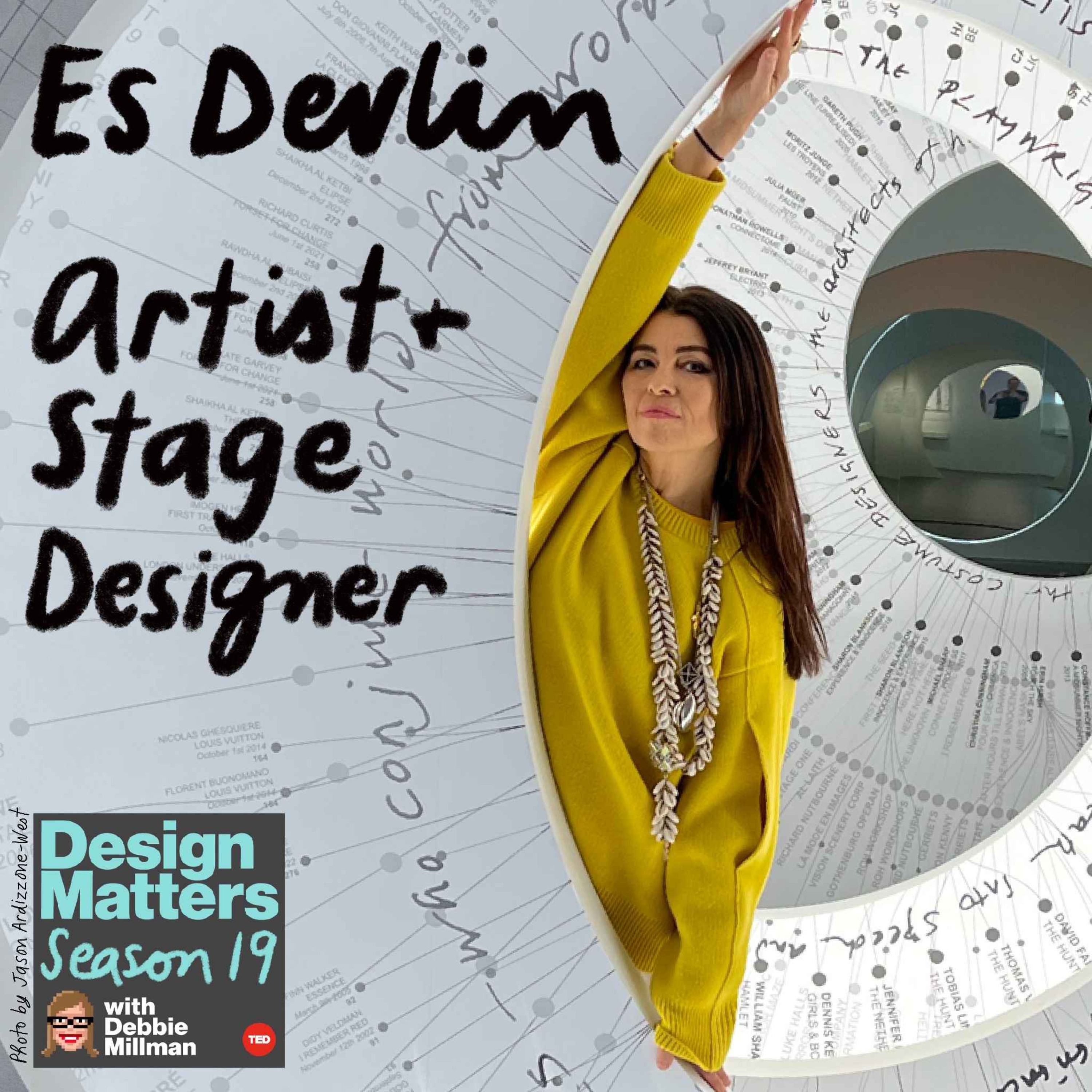
In this episode of Design Matters, host Debbie Millman interviews Es Devlin, a renowned artist and stage designer known for her innovative works in theater, opera, and concert design. The conversation spans Devlin's illustrious career, her creative process, and the impact of shared human experiences in the arts.
Written by AI. May contain mistakes.

Get the gist, explore an idea or ask about something said.
 Claude
On Design Matters with Debbie Millman, what are the key points of this episode?
Searching your listeningAutomatic transcript. May contain errors.
0:00This episode of Design Matters originally dropped in March of 2024. You know, I sort of fell into theatre. But now, after 30 years, I realise, having done many other things, how unique, rare and precious it is for a group of people to gather together. And as my friend Lindsay Turner, the director says, still the ego for the greater good.
0:26From the TED Audio Collective, this is Design Matters with Debbie Millman.
0:34For 19 years, Debbie Millman has been talking with designers and other creative people about what they do, how they got to be who they are, and what they're thinking about and working on. On this episode, S. Devlin talks about the collaboration between performers and their audiences. The fact that we all keep the balloon in the air, we all keep blowing the balloon up together, is a very beautiful, human thing.
1:01In 2003, the artist as Devlin's career took a turn. She'd already made her name as a theater designer, where her conceptual and sculptural stage designs had long impressed the London theater world. But when her work turned some of her attention to concert set design, she pretty much impressed the entire world. She's done concert sets for Beyonce and Jay-Z, for Lady Gaga and Miley Cyrus, for opera festivals, the Olympics, and even the Super Bowl. She also helped launch The Sphere in Las Vegas with her artistry with U2. There is currently an exhibition of her work at the Smithsonian's Cooper Hewitt National Design Museum in New York City.
1:43And she joins me today to talk about her truly extraordinary career. Ez Devlin, welcome to Design Matters. Thank you so much for having me. I love this podcast so much. Thank you. Oh, thank you. Is it true you like to buy your shoes in Terminal 5 at Heathrow Airport? Oh my goodness. Do you know what? I haven't bought a pair of shoes for a long time. I probably said that at a time when I did buy shoes. I reckon I've got enough shoes now. There's a pair of shoes I'm really into which are Converse with a really deep sole. And I just bought like five of them and I wear them on rotation because they make me a bit taller and I don't fall over.
2:21So shoes is sort of, yeah, I don't even buy them anymore. Got enough. Your earliest memory is of a line of light through dark water when you were about two years old and you accidentally fell into the River Thames and remember voices and bright light penetrating a medium other than air. What was that like for you and how were you rescued? Do you know what? I was probably only in there for moments, but the odd thing is that I remember it. I think, you know, I was paddling, I fell in. I think my dad noticed pretty quickly that I was nowhere to be seen and scooped me out. But weirdly, I really remember it.
3:04And I know I was only two. And I remember, I mean, I wasn't aware of what drowning was or anything, but I just remember seeing particles of light from a source of light above me. I remember this deep greenish brownish color of the Thames and rocks and little particles and things. And I just remember I was being observant. I was observing and taking it all in, even though it was obviously a condition of not being able to breathe. But I guess because I didn't understand it, I was just living it and it stayed with me. And that light is something I seek out now, I think, in any form I can find it.
3:44It seems as if this experience contained the five ingredients often found in the process of your work. And you've talked about space, light, darkness, scale and time. Do you know what? I've never heard it put like that before. But you're absolutely right. It probably did include all of those things. and encapsulated in a very brief span of time, but one that I still think about and write about even now, 50 years later. You were born in Kingston, upon Thames in England. Your mom was a teacher. Your dad was a journalist in education at the Times. And you've said they were education obsessives. And I'm wondering if they inspired your work ethic.
4:29I think they did. You know, my mother is from Wales and her father was a physics teacher and his father was a coal miner. Her mum was a hairdresser. And, you know, I think my mum, her story was that through her education at the local school, she managed to go to a university in England, which was unusual from that small mining town. And I think they really impressed upon me the value of practice, the idea that if you were patient and if you played a violin scale every day, it would sound bad on Monday, but on Friday morning, it might get a bit better. In 1977, when you were six years old, your parents went on a romantic weekend to Rye in Sussex on the advice of your Aunt Prue.
5:20and they impulsively bought a house and you all moved. And the house had a history. Apparently, T.S. Eliot played his first game of ping pong there and Henry James lived up the road. Did you feel their ghosts at all? Well, funnily enough, the stories about ghosts were written by a lady called Joan Aiken, who was the daughter of a man called Conrad Aiken, who owned the house for a while. And they were written and staged in the house. So because I was six, and I do think from subsequent reading that something happens in a child's brain when it is six years old, and that certain habits that it's formed start to crystallize into beliefs.
6:02And so I believed that houses were the site of stories and that houses told stories. So to me, I just thought that was what houses did, that stories were written them in and that place, a place could tell a story. One of the landmarks of Rye where you grow up is a handmade one to 100 scale model of the town during Victorian times. And you've written about how Rye had a way of telling its stories.
6:35Oh, I think so. I was six years old when we moved there. And we would go I think the practice was a bit like going to church. So we would go to church on a Sunday and on Saturday we would go to this model. We'd seen it, but because my parents had moved away from the suburbs of London, which is where I was born, their friends were coming to visit. And every time a friend would come to visit, they would be taken next door to see the model and we would go. And it became a little ritual. And I guess in my mind, because I was six, it was more confirmation that buildings told stories because it was little models that spoke.
7:16I think they had little lights in them and little speakers in them and each one would tell its own story. But it was also somewhat conflated, I think, in my mind with going to church where objects also spoke because we were ringing little bells. It was in Latin at our church and there was a little theatre in the church with a little curtain. And then there was a chalice and there were these wafers that were standing in for much bigger things than wafers. And objects were standing in for ideas. And the idea of objects being protagonists in a ritual felt quite normal. That's just what was happening in my weekend, I think.
7:59Isn't that sort of a beautiful way of understanding your origin story and how you've become who you are. I mean, it's amazing how these little vignettes in our histories impact our futures. I think that's so true. And I think through practice of 30 years of doing, you know, various different things from theater to opera to concerts to art installations, I guess what I'm finding now, you know, you ask about shoes, is just I'm beginning now to practice that objects are protagonists in life, you know, not even just in ritual, but just anything we touch. I'm really interested in the etymology of every object, like what went into it, where did it come from, whose hands touched it, where did it travel.
8:45And I think more and more, as we start to question the complex systems that we're all entangled in, I think we are really interested in the stories of our objects and how can we make sure we're aware and that we honour them and notice them and allow them to resonate or not have them in our lives at all as an option, like shoes. Like what do we need? What do we want? What's the story of it? What are we really bringing to our house when we order an object? And what does it say about who we are? And even, I think more interestingly, what do we think or want it to say about who we are to others? What is that telegraphic projection doing?
9:29I read something really interesting, which I really recommend if you have time. It's a book by Peter Frankoban, and it's called The Earth Transformed. And it goes through the history of civilization, East and West, and various forms of civilization across the 4.6 billion year history of the planet. But it takes each chunk of history and views it through the lens of climactic shift. So it says, for example, the first sort of totemic objects that humans made on various sides of the planet independently that were made in honour of cosmic deities may have been made at a time when the sun was particularly busy with solar radial activity like kind of the northern lights.
10:13So it may have been that cultures were observing cosmic deities because they were literally observing great streams of light, of performance art, light coming down from the sun. And I found that a very interesting thing to consider. And I also find it so sort of endlessly fascinating that people were doing this all over the planet without knowing that other people all over the planet were doing it. And the same with religious symbols. You know, we were creating religious symbols almost around the same time about 10 ,000 years ago. And there's really no recorded history of any culture not having some sort of religious symbol that was created around that time.
11:03Another one in that book actually related to what you just said is that around the same time in various sites in the Lascaux Caves in northern Spain or the Blombos Caves in South Africa, these first drawings in caves that we know, especially the ones that are kind of half animal, half human, there's a thesis in this book, the Peter Frankopan book, The Earth Transformed, that possibly this was during a time 40 ,000 years ago when conditions climatically were pretty accurate. hazardous. And the humans that did survive were the ones who were living deep in the caves. And it may have been that in those depths of the caves, there was a diminished level of oxygen.
11:44So if you're deep, deep, deep in a cave and your brain is somewhat deprived of oxygen, the thesis is perhaps this somewhat hallucinogenic state of shamanic sensibility, of recognizing the continuity between human and animal might have been attained because of a diminution in oxygen level, which I find really interesting as well, just looking at that lens. Absolutely. Yes. Do not try this at home, callers. Don't try this at home. Actually, I was imagining thousands of listeners running to kids, experimenting. As you also avidly studied music and learned to play the piano, the violin, the clarinet, were you considering pursuing music professionally?
12:27I loved practicing and I loved playing. I wasn't ever good enough, but I did love being part of an orchestra. So I would sit at the back on my violin. I wasn't actually good enough to get into. I got into a wind band, but not a big orchestra because there's only a few clarinets. but I'd be at the back scratching away and I learned that I could be part of a really beautiful big sound and my small part in it was it was sort of unbelievable to me that this overall sound could be so majestic and yet I was just sort of going with my bow and yet I was part of something way bigger than I could ever do on my own so that was the big teaching of it for me.
13:10I did go to the roller cad of music on a Saturday and take junior lessons. It wasn't like you had to get in, to be honest. You had to just pay. And my granddad paid me. So I don't want anyone to get the idea that I was brilliant. But I did work hard at it and went every Saturday. But I learned there, I saw people who really were gifted way beyond what I was. And I did have this sort of revelation moment that I mention in the book where I was, I guess, even though I was only 11 years old, I was probably thinking, God, there's something about these people who are way beyond me. This is not my league or my tribe.
13:46But when I was walking down the corridor, hearing a lot of very young, very gifted people playing a bit of clarinet, a bit of violin, a bit of jazz over here, I do remember, perhaps not consciously, but something in me holds onto this memory of a corridor and this light coming in and this mixture of music. And something landed in my head going, well, actually, this corridor is kind of cool. The light in here is cool. I really like the way this music is all meeting. And maybe this corridor is itself quite an interesting place to be. Even if I'm not in one of those rooms specializing in one, I learned if you wanted to really excel in music, you had to just make that decision to specialize, specialize, specialize and practice so hard.
14:31So I liked being in the corridor. That's kind of where I still am, I reckon. Yeah, you've talked a lot about the importance of the corridor to your practice, to the way you approach your work. What do you think it is about that space between, you know, a corridor is almost like the space between two separate rooms or environments? Well, there's an essay actually or a conversation in the book with a woman I really admire called Dorothea von Hantelmann. She's a German art historian. And she taught me a lot about sinesthetic ritual. And she made me see something which I hadn't taught before, which is maybe when we look back at this period of time, this last 500 years or so or more, we might look at it as a bit of an aberration.
15:20And that actually up until now, these last five centuries, it would have been normal for humans as their birthright, along with sleeping and eating, to have attended at least weekly a collective ritual and attained a sort of collective flow state and a synesthetic flow state. And it would have been unusual until this chunk of 500 years to break down that ritual into musician, composer, artist, architect. It would have been considered a synesthetic ritual. And you wouldn't really have asked who wrote the music in the church. You would have just said, I am feeling this with every atom of my body.
16:05I'm smelling the insets. I am feeling the light coming through the windows. I'm reading the coloured light through the stained glass. I'm listening to the text of the liturgy. So maybe that fusion of things is me perhaps wanting to try and restore something, perhaps instinctively, that I think the human body and species really responds positively to is that I think I haven't read much Emil Durkheim, but people keep telling me to. And the things I've read about it are that he talks about a sort of effervescent flow state that when humans all sing together or engage and focus together, a state of flow can be attained, which is very positive for the human species.
16:53And I'm finding that in my work, that people really respond well to collective ritual. You considered going to Maidstone Art School for college, but went to Bristol University and studied literature. What made you decide to do that? I didn't feel ready yet to make art, to write my own thesis for the art. I didn't feel I had enough to say. I didn't feel I'd learned enough. And the people at my school who were ready to go and were all ready to form their discourse, I didn't really relate to their discourse. It wasn't at the level that I wanted to speak. It was a different type of engagement. And I wanted to learn a lot more before I tried to form an analysis or a thesis.
17:42in my work. So I really just wanted to read and learn. I felt there were so many lacunae and gaps in my knowledge. So I really relished reading for three years. I really recommend that path to anybody that I can. I also studied English literature in college, And in many ways, it's become the foundation of everything that I do. Not that I teach literature at all, but that it gave me a way of understanding the world in, I think, ways I could not have otherwise been able to experience. And many, many people that I talk to that have that same background seem really grateful that that's what they did, however unpractical it might seem now.
18:35And certainly with the numbers of people majoring in English literature going down so precipitously. But I wouldn't change that for anything in the world. I totally agree. And I think this quality of internal landscape, just the act of reading, again, we talked about practice earlier, but the practice of reading, I think particularly now, you know, I feel really challenged in my reading since the advent of the ubiquitous companion of the telephone. and I got quite worried about it for a while and I made a work of collective reading actually to see if we could gather people to read together because I think that sense of what the brain does when it takes just black and white print on a page and conjures imagery and atmosphere and place, that process that goes on in the brain seems to me so precious to us.
19:34It seems that that's what we've got to fall back on. I went to see a lecture about poetry and the wonderful author and poet Jeanette Winterson was there. And a young 16-year-old girl put her hand up in the audience and she was quite timid. She said, look, this might be a silly question, but what is a poem? And Jeanette Winterson said, it's not a silly question. She said, a poem that you learn by heart is something that nobody can take from you, even if your house burns down and you've lost all your belongings. And I just think that aspect of what is really, what is inside you, what is internal.
20:10And there's a book that I recommend, sorry, I'm full of book recommendations by a guy called Byung-ho Chan called Psychopolitics. and he talks a lot about the internal, that internal landscape that humans can generate and grow, and how resistant it needs to be to this flow, I guess, of stimulation that we now get. So I'm really about cultivating that internal compass landscape, things that we grew ourselves in the brain rather than just imbibed through the eyes, you know. Mm-hmm. Are you worried about our, or humanities, I guess the best word for it would be addiction to our devices? Yeah, I am.
20:57I don't like how I feel when my hand keeps, you know, creeping away to my phone. And I know it's my hand wanting a little rush of dopamine. And it used to come, I remember when we, I'm going to sound like a real old granny now, but I remember when the phone used to ring in my house. It would go, bring, bring. It was the phone. And of course it was attached to its place in the house. And there was a little dopamine rush that the house got because, oh, it might be my friend. It might be my, my grand. You know, that was what the phone meant when I was growing up. And then when I was a young adult and the phone was still attached to the wall and I was first working, it was like, oh, somebody might want me.
21:35I might get a job. That was what the phone meant. It was bring, bring. Maybe there's a project for me. Those little dopamine rushes were few and far between. The phone didn't ring that often during the day. But now suddenly it's just on tap. So I think, am I worried? I guess I think we're in a sort of corridor moment. We're in a liminal moment where we are all as a species having to adjust. And we know that our evolution, the evolution of our bodies is so much slower. Our chemical evolution is so much slower than the evolution of our tools, which is way faster than our chemical makeup can keep up with.
22:12So we've got this torrent of chemical stimulation that we, I mean, if we get through it, we will be more resilient as a species. I guess, you know, I had a choice with my own kids. Do you just take the phone away? Or do you say, no, listen, you're going to have to develop some resistance to this. Otherwise, you're just going to long for it. So I guess me, my kids, my mom, all generations, we're trying to develop strategies and skills to grow our inner selves as a bulwark against the torrent. That's how I feel. Yeah. Dan Formosa, the designer, Dan Formosa, he is one of the world's tech pioneers.
22:54And he said that he doesn't think that people are really addicted to their devices or the technology. They're really addicted to the feeling that they get through the technology. And I try to hold on to that when I'm doom scrolling. And that maybe I just really need better connections with humans than this specific device. And I'm just using it as a stand-in that's not quite as successful as I'd like it to be. Yeah, I think we're in a moment, aren't we? But I'm optimistic that we'll find somewhere good. We just need to keep having conversations like this. We're all talking about it, aren't we?
23:33we're all having the same conversation. And that does lead to change in my experience. In an article that I read about your involvement with the sphere, you talked about the iPhone-ication of the experience of being at the sphere and seeing the unbelievable explosion of art and graphics where you're fully immersed in this environment, it is really transformational. It does feel like either a religious experience or a drug-induced experience. It's really unlike anything that has come before it. I'm wondering how you feel about the throngs of people videotaping while they're watching and experiencing.
24:22I want to break that into two parts, really, Because when I said it's like the iPhoneification of concert design, I sort of meant that when Johnny Ive designed the iPhone, in a way, he'd sort of reached the Neupleau's Ultra of design of that object because it was this infinity pool, this beautiful black thing. And in a way, you know, no one's really gone any further with it because it was like, OK, we arrived. This is what this object needs to be for now until it's in our body. This is as edgeless as it can be, as infinity edged as it can be. before it actually migrates under the skin, probably.
24:58And we had talked with Willie Williams, U2's creative director, 10 years ago when we were first working with U2. We talked about the possibility and the desire that we had for sound and vision to coexist in one piece of technology at a concert because it irritated us that there were two departments, people up ladders and genies putting truss up to hang giant great big speakers in front of, necessarily, other people up other ladders putting up big screens. And we longed for a video screen that was permeable to sound. And we actually commissioned a lot of research on this with our colleagues who made a lot of new video technology, but they couldn't solve it for all the frequencies for an outdoor concert.
25:49It wasn't possible. And that's where I think the sphere has iPhone-ified concert design. It has just simply, in an iPhone-y way, combined the thing you need to do at a concert, which is to hear, and the thing you want to do at a concert, which is to see. And it's done a sort of synesthetic move, where the speakers, and I can't remember how many thousands of them there are, but many are behind the screen and the screen is permeable to sound and that's brand new. So that's one piece. To give you the other answer about how I feel about the fact that certainly on the opening night, I went back again just before the closing and it was somewhat different then, but certainly on the opening night, it really was like being in a film studio in that everybody is holding their phone because this was new, everyone had to film it and listen that's fine making a film everybody becoming a filmmaker is rather beautiful in its way but it does preclude dancing and if there's one thing I think will be put on most of our gravestones certainly mine if I died tomorrow is had a cool life but didn't dance enough um so I think who among us who among us so so so I do think being a filmmaker is cool I don't even mind being a self-portrait filmmaker, although I was at the weekend concert, Abel Tesfaye the weekend in London at the Olympic Stadium.
27:12It was a beautiful night, really beautiful. And the lady in front of me had her camera pointing to me all night. I was like, that's weird. And then I realized, well, it wasn't. It was pointed at herself. And she was filming herself in front of the concert all night long. And you could say that's a heroic and majestic act of sustained self-portraiture in the school of Dura and all the other great self-portraits that have been made. That's an important act. That's a generous way of putting it. I have found life far more interesting when I try to always find an alternative to judging. I thought if I can apply my curiosity rather than my judging bone, life just becomes a bit more interesting.
27:59The sphere is 360 feet tall. It has 580 ,000 square feet of fully programmable LED exterior. And it's a curved 160 ,000 square foot screen inside. How did you approach making this level of artwork for you two and for the sphere? Well, first thing, obviously, to say that this was very much not something I did at all alone, that the project was led by the band and by their very long standing creative director, Willie Williams, who has a wonderful team called Treatment, who are beautiful crafters of video. But that band very broad in their seeking when they come to make a show. And they gathered together a kind of board, creative board.
28:55And we had been working together actually 10 years since the Innocence and Experience tour. So it's that same group. And we spent three days together and just brainstormed ideas. And I think the first thing we knew was there was a concern that this giant object, what would be the reception of it? Should the world have it? Is it a good thing to even be part of? Really, everyone was questioning that. And I think we wanted to declare our awareness of its materiality, that we weren't going to just treat it as a portal to something. We were going to start at the beginning by saying, hey, we know the minerality of this thing.
29:34We know what it took to build it. We know the resources that have gone into it, financial, mineral, human, planetary. We know that there's a commitment to solar power eventually, but that hasn't happened yet. So when you go in, the concretisation of it was sort of very purposeful. And actually, I went back the other day and someone I was with said, oh, how are you going to get rid of all the concrete panels to reveal the LED? And the other person looked up and said, oh, I didn't know it had a hole in the roof. And I said, oh, yeah, you know, the rain sometimes comes in. So it's quite believable when you walk in this concrete interior.
30:12I say when you walk in, that show's now finished, but when you walked in. And then very purposeful, the splitting apart. It's a gesture that's really important to me, that line of light I saw, and obviously important to many other people, including Tadeo Ando and all sorts of people, not just me. So splitting the concrete apart to then reveal the video. And then ultimately, a gesture that Jim Dolan and Bono had been clear on since the very beginning of their conversations was that they wanted to deconstruct the sphere and reveal what you would see if the sphere weren't there. So this reveal of Las Vegas built with such precision by industrial light and magic deconstructs itself.
30:57and the way that they researched that, they unbuilt every building in Las Vegas in the order in which they were built until you just got back to the planet, the place on the planet where we are, that space in the desert. None of the lights, just that. And then we went back ultimately to the species which also call that place home and I think we were clear that we wanted to consecrate the building like a cathedral to make a sort of offering and say, let's dedicate and consecrate this building to the species that call this place home, that don't have any say in whether or not we use them to build a giant dome.
31:37So that's what that final Nevada arc gesture was about. There were two things that I was really struck by regarding this sphere. One is how much it takes its shape and form from a planetarium and how you lose sense of there being any boundaries when you're in it. It just feels as if you're in this infinite space, literally and figuratively. The other thing I was thinking about was how almost impossible it feels to make a film of this show. So many shows turn into films. Hamilton is even a film. And so I was wondering if there was any consideration of that when making this. It's such an interesting thought.
32:30I think we were really focusing on making the show, to be honest, in the medium that it is. But I think there is a version where you could play the show as it is and intercut it with footage of the singers. Because if you think about it, if you're watching the show from the 400s right at the back, which is where frankly you get the best sense of the architectural form of the place then your awareness of the people on the stage you know they take up a very small percentage of your range of vision there so if you were playing recorded sound as well rather than live sound I think you'd have also a lot of different controls over those speakers I think that system can do a whole load of things that we didn't do with it yet because we were working with live sound.
33:17So I personally think there'll be a whole nother level you can take it to when you're working with recorded sound and you would just place footage of the performance within that film. I think it'd be pretty spectacular and hopefully make it far more accessible to a lot of people to come and see that work. You know, even when the band aren't there, I think it's going to be pretty exciting actually for that. Yeah, I really would like to see Darren Aronofsky's film that's playing there now. What gave you the sense after Bristol that you were now ready to be fully immersed in studying art? Well, actually, I wasn't, I was such a slow bloomer.
33:56So anyone who's listening to this podcast who consider themselves to be a slow bloomer, please join a very big club. I didn't have a clue honestly I didn't know what I wanted to do I knew I liked reading and I loved making artwork that's all I knew but what I did do was I listened to advice and somebody said to me when I had just come back from visiting this beautiful room at St Martin's College because I had a place to go and do another I was going to do another three-year degree you know I had done my three years of English. I'd done one year of foundation course, which is very general and lovely course.
34:34And I was about to do another three years. It was only really a phone call from my then boyfriend's dad who said, when are you going to earn some money? Because my son - I still can't believe that he had - My son can't support you anymore. Well, it gave me a bit of a wake up call. Anyway, I did think, oh, I better get a job because I might be out of the house. so I um I was all set to do another three years I was just curious I want to try photography I want to try printmaking I want to keep honing my painting skills I was very privileged you know that I had this boyfriend who was older than me anyway I walked into another room on the advice of several tutors different you know when three different people send you to the same place you okay I better snip this out and I I just walked in and it was a room I felt at home in because it was an extension of that corridor I guess there was a lot of different things happening at once there was people reading poetry and listening to opera and making costumes and making little models with cardboard it had a kind of fug of people who hadn't slept or washed often which Is this the Motley Theatre design course that you did?
35:51That smell definitely defined it for you. Yeah, the old pot noodle. It just felt suitably feral and, you know, that people were so passionate about what they did that they weren't going to leave. And actually, I'll be honest with you, I was still uncertain because it was a theatre design course and I hadn't really been to the theatre very much. It wasn't. To be honest, I'd been a few times, you know, I'd been to Pantomime when I was a kid, a few musicals, Andrew Lloyd Webber in the 80s that I liked. but I didn't go to the theatre much. So I wasn't like, oh, I want to do theatre. I thought it was a bit old-fashioned, to be honest, people shouting and stuff and acting.
36:27So I wasn't obsessed with that. So the thing that swung it for me was that that studio never closed. And I knew that whatever I did, whenever I was making anything, I would work all night at it. And I thought, well, at least this studio, even if I don't like the theatre thing, I'll have an all-night studio. Whereas that Central St. Martins one, they kicked you out at six. because I was like, oh, that's a decision then. But it was literally that arbitrary. And I think that's worth saying as well, that sometimes decisions that you make, even if it feels a bit arbitrary, that you make a decision based on what time the studio is going to close, whether you like the feel and smell of it.
37:02I think trust your instincts on things like that because it adds up to a day-to-day and it adds up to a life and it adds up to your life. So I do think those choices about how you will spend your day are pretty vital in the detail. You designed six pieces at Motley. And at the end of the program, you competed for the Limberry Prize for Stage Design and won. This gave you your first professional commission, Christopher Marlowe's Edward II at the Bolton Octagon Theater in 1996. And you built a giant white bathhouse for the play and wanted the showers to run red with blood. And the plumbers at the Octagon said it couldn't be done.
37:48And I love this story because I feel like it's sort of a wonderful snapshot into your drive and persistence. What was your response to the plumbers? Well, to understand the context of this, I'm from the south of England and I had a privileged upbringing in my way, although it wasn't so much money. There was a sense that, you know, here I was still in education. And here I am arriving in the north of England and I'm being thrust into this position because I've won a bloody competition, you know. And then there's people there who really do know how to do the job. They know how to do set design and they know how to do plumbing.
38:24And there's this little thing showing up knowing nothing, but mighty determined to have the plumbing in the way that I wanted it to look, even though it probably was not the way that it should work. So there was a kind of the beginning of what I guess has persisted throughout the practice of showing up in situations where I really don't know the techniques. You know, I don't know how to build the things that I design and make. I don't know how they work in detail. And I am absolutely more and more humbled and respectful of those people who know the intricacies of how some of the technology works and know how to build things and know how things work.
39:15But yeah, at the very beginning of my career, probably if I look back now and saw that person opening, closing their mouth and going on about plumbing, I would probably slap on myself, to be honest. But anyway, they tolerated me. So thank God. You spent the night, I think, going through plumbing manuals to figure out how it could indeed work. And ultimately you were able to get it to work. Is that correct? Yeah, we found a way. Many people helped. Is it true that you got your first job with the director Trevor Nunn by writing him a letter? Oh my god, I was the arch letter writer. I would write to everybody.
39:52You know, I had done a few little things at the beginning, and I had lovely pictures of them, and I put them in an envelope. And I remember one designer I wrote to saying, please give me a job, anything, anything. And he very sweetly, when he saw me, he said, look, those photocopies must have been quite expensive to make. Do you want them back? You send them to someone else. But yeah, I was just persistent. And I guess I was really longing. I had a taste of what it might be like to make work then. Having not really thought about it, once I started making work, that quality, I can still remember the smell of the angle grinder of the steel in the workshop at the Bolton Octagoner.
40:36So when I smell, if I go into a workshop now and I smell angle grinders and wood saws, the smell of people making stuff, it makes me so happy. And I guess I got quite addicted to that pretty quickly. One of my favorite pieces that you've created is the work that you did for the 1998 production of Harold Pinter's play Betrayal, which has really been one of my favorite plays since I saw the film in 1983 that starred Jeremy Irons and Ben Kingsley, which I think is truly one of the great movies of, I don't know, the last hundred years or so. So I think that it's just a magnificent, magnificent play and movie.
41:25Harold Pinter employs reverse chronology in the play. So time goes backwards. And in every production prior to yours, the sets were very sparse. I saw a production in New York recently with Tom Higgleston where there was just a chair. It was a chair. That was it. A black box and a chair. it is really amazing to see what you did. Harold Pinter said that you didn't pay any attention, any regard to the stage direction and you designed the fuck out of it, which I think is like the best compliment you could get from somebody like Harold Pinter. You use projector images of children between the scenes and conveyor belts.
42:10And you said you were inspired by Rachel White Reed's monumental 1993 Sculpture House. Talk about how you approached that play and sort of the courage that it took to do something that really flew in the face of everything that had come before it in regards to not just betrayal, but just stage design. The thing is, it was all founded on utter instinct and ignorance, honestly. I think it was a convergence of me literally skipping. I skipped when I came out of the meeting with Trevor Nile and realised I was going to do this project. For me it was such a dream having just graduated and done this prize project that really pretty much a couple of projects later was for me the epitome of what I wanted to do at that time was to work at the great National Theatre of Great Britain.
43:01So I was excited beyond belief and I had a sense, and this is very odd when I look back at it now, it's very strange, but weirdly the thing that I thought was most appropriate when I read the play was to perform it at somebody's sculpture, literally. And it's interesting that that was my thought. I just thought, where does this play need to happen? And it was very much in the press at the time because Rachel Whiteread, a phenomenal artist, it was a moment in the 90s where Britain was sort of emerging from 20 years of conservative Thatcherite politics. And there was an emergence of artists. They were called the YBAs, the Young British Artists.
43:49And we felt a real sense of hope, I must say. We felt really that the Tate Modern was being planned. It was to open in 2000. There was a real sense that our country was finally changing, a real sense of positivity. and we all got behind the sculpture that she made. It was so beautiful. It was a monument in the East End. She filled a house with concrete and then she took the house away. This was a condemned house that was about to be knocked down anyway. She took the house away and it was this exquisite sculpture of the volume of time and space inside a building. It was everything that I, what we've been talking about on this podcast, about houses having life and voice.
44:34And it was plangent. It was, you know, sad as well as potent. And to me, the piece that Harold had written, Betrayal, was a series of rooms speaking. It was rooms to me. I think it's quite a particular take on it, but to me it was rooms remembering. Rooms remembering time and humans passing through rooms. and I said to Trevor, why don't we do the play at this installation? And of course we couldn't because it was outdoors and it was about to be knocked down anyway or maybe it already had been knocked down. So I wrote to Rachel and it was an odd thing to do seeing as I was just beginning my practice, one would have thought I might have wanted to make my own mark but I actually didn't.
45:18I just sort of wanted this thing to happen. I said to Rachel, can we make a wall that remembers all of the locations in this play in the style of what you do. And she said, oh, absolutely, you have my blessing. Put it in the programme. So we made a ball of plaster and I went and researched around London and found, and I didn't go to it, I looked at pictures, found exact photoreal references of where we thought the play probably happened. And then I made impressions of them onto this concrete wall. And then we also had the wall remember by projecting onto it. We filmed, we made a film actually.
46:00And remember this was in the 90s. It was very unusual to put projection in a theatre. You know, they weren't departments for that. You had to sort of get an advertising agency to come and, it was very expensive to pay for someone to come and make a film to put in your theatre piece. Projectors were big and noisy. You know, it was all complicated. it and we filmed Trevor Nunn's children and the actor's children so we made a whole kind of family movie out of it and then we had the furniture passing through and actually the floor of the piece because in my mind again because because I was just my instinct was to just associate and because the National Theatre is made out of shuttered concrete the National Theatre bears the imprint of the making of the National Theatre.
46:48It's got that shuttered ply impression on the concrete. So to me, it was already halfway there. So I was conflating the architecture of the building with a piece of concrete that could remember places. And to me, it just seemed like obvious that this is how it had to be done. But obviously, it was probably the last thing that poor play needed. But it sort of survived, I think. Well, I love the fact that after the play, Harold Pinter introduced you to someone on opening night and said, have you met Es Devlin? She wrote the play. It's the best possible compliment I think you could give. I think it was definitely a backhanded one, more of a slap, but anyway, I'll take it.
47:31In The New Yorker, writer Andrew O 'Haganin wrote that each of your designs is an attack on the notion that a set is merely scenery. And when you first started in this industry, set design was not supposed to be its own character, give the story away or turn everything into metaphors that could take the audience out of the play. You don't do that, but your sets are very much of the play and in the play. How are you able to avoid taking the audience out of the play? I think it's really that question as it goes to the essence of the mystery, I guess, or the technique or the practice of what we're trying to do.
48:13And yeah, the way I was taught was definitely don't shout too loud, do less. But equally, I was also taught that the answers will be in a process. So if you read the text, if you research and if you start with nothing and see what you really need. And I guess adding a layer, not just responding to the text and what it needs, but also being cognizant of what the space needs. I walk into a room and treat each space as a patient. You know, my family laugh at me because when I come home, I immediately go around the room and move just a few things that really annoy me or the lights have to be a certain way.
48:54So I think spaces, you know, look for correction or, you know, help, medicine. And so I think you can respond to the space as well as the play and how the play meets the space or the music or the artwork, whatever it is you're putting into space. And I think you respond to a moment. You know, it's not just the moment when the piece was written or the song was written or the artwork was written. It's the moment that you are communicating with a group of people. And I think the more and more, actually, I realize how precious, you know, I sort of fell into theater. But now, after 30 years, I realise, having done many other things, how unique, rare and precious it is for a group of people to gather together.
49:38And as my friend Lindsay Turner, the director, says, still the ego for the greater good. It's so unusual that we, and she puts it like this very brilliantly. She said, we all agree. The actors agree that they'll pretend the audience aren't there. the audience would agree to pretend that they're not there. Everyone agrees to do it at 7.30. We're all still eager for the greater good. And when you are sitting watching a play, or any performance really, the opportunity for things to go wrong at every single second is so multifaceted. The opportunities for humiliation for all concerned and the fact that we all keep the balloon in the air, we all keep blowing the balloon up together is a very beautiful human thing.
50:29I really more and more value that presence, even to be honest, even if I go to a theatre, it's not very good. Sometimes I just, I went to see a play straight after lockdown. I was just so excited to be in a theatre. The play wasn't very good, but the audience was so beautiful. I said, I'm loving this audience, but it doesn't really matter about the play. They were so quiet. They were so connected to one another. that they were all, sometimes an audience is doing something which is just tolerating. Sometimes you can hear the sound and the beauty of an audience tolerating a second rate bit of work from a first class artist.
51:07They know the artist is brilliant. They put faith in them. They believe in them. They've all turned out for them. They know that this light just isn't quite working. But there's a beautiful sound of audiences being patient. And it's so rare. As you've since gone on to design more than 50 theatrical productions that does not include hundreds of other projects in opera, dance, film, and as I mentioned in the intro, ceremonies like the Olympics and the Super Bowl. You've collaborated with Jay-Z and Beyonce, U2, Billie Eilish, Adele, Miley Cyrus, Shakira, The Weeknd, Lenny Kravitz, Dua Lipa, Lady Gaga.
51:43What is it like going from a small black box theater to creating sets for audiences of what can sometimes be 100 ,000 people? Well, the logistics of a touring concert are brutal. because the main thing that has to happen is people have to be able to put it in a truck in a really tight amount of time and get it out of a truck in a really tight amount of time and get it up and get it safe and it has to do a job of broadcasting the music and often an image of the performer so there's quite a lot of constraint to that aspect of my practice that said when you are among a crowd of, you know, up to 100 ,000 people all going off.
52:32I mean, we just did the Bad Bunny concert, opened in Salt Lake City recently and is now touring America. That audience, I must say, I hadn't experienced that particular audience before. Every audience is a different species in itself. And this audience was so joyous, so joyous. You know, it was luminous to be there. And yet, you know, the concentration you get when everybody's focused on a text in a small theatre, you know, like the hunt we have on at the moment, actually, in New York at St. Anne's Warehouse. I think that only seats about 250 or 300 people or something, very small. And the concentration that you can't, you know, no one's breathing barely.
53:09And then actually, there are some plot points in that that are somewhat shocking. I mean, not in a terrible way, but they surprise you. And the audience, you can hear them go, all together. You know, it's very beautiful to be part of an audible gasp, you know, just in a plot point. Yeah. As I want to talk to you about your book, your first monographic museum exhibition at the Cooper Hewitt Smithsonian Design Museum has an accompanying 900 page monograph. Both the show and the book are titled An Atlas of Esdevlin. And it's a survey of the last three decades of your practice. Is it true that the book took nearly seven years to complete and was much harder than you expected to make?
53:56It did. It took seven years. My kids kept saying every day as we got close to the end, they said, have you finished it? Yeah, have you finished it? I mean, it was such an immense undertaking. And it's shocking in a way in that you think of these big stadium things, And this is just one little little book. But it was like an implosion. Well, it's sort of a wonder. It's almost like a show in and of itself. It's in this box. You take it out of the box. There's a wonderful video on your website of some of the making and the gluing and the inserting. And the book was designed by your cousin, Daniel Devlin, and it includes 700 color images.
54:36It documents 120 projects. It includes pullouts, acetates, accordion folds, and even a limited edition print, which was a big surprise and very exciting for me. You've described the book as a sculptural object that required you and your team to get under the bonnet of how a book works. What did you discover in that process? Oh, my God. I mean, every time I feel that humans are out there most vibrant when they don't, you know, they're curious and they don't quite know. You don't quite know enough. You're just a little bit out of your depth. And certainly I was because there are a whole set of rules to making books.
55:17And actually, it's a little bit akin to learning music. Because when you learn music, you have to learn what the bass clef does and the treble clef and a 4-4 time signature. And literally in the books, as you probably know, they're made up of signatures. And it has to be a multiple of 8 or 16 or 4. And so you have to get yourself into this sort of time signature of AIDS. I had a sense seven years ago, I made a mock-up of this book seven years ago, which didn't look that different to what we have. So I knew the kind of sculptural object. But, of course, that was just the sort of shell of a book I needed then to work out how I was going to organise the stuff in the book and how I would make it look like the object I was dreaming of with the stuff that I had.
56:02and every version that I made of it, we made beautiful mock-ups, but they were just sort of exhausting to experience. You would open it and you'd go through it all. And the way we were originally organizing it was for each project, we would show a little bit of text, a little bit of drawing, a little bit of photographs, and then we'd go on to the next one. And it was like going breakfast, lunch, dinner, breakfast, lunch, dinner, breakfast, lunch, dinner, until you want to basically vomit. So I scrapped that. I said, actually, let's treat it like a event, like a day. Let's say you start in the morning and you're in a studio and you're just looking at the drawings.
56:43So you keep a unity of type of material that's in that first part of the book. So it's mainly stuff that I've drawn in the first chunk of the book. And then I became obsessed that I couldn't deal with the white area around the object that I wanted to show in the book. So if I had a drawing, I didn't understand what the white frame was around the drawing. I couldn't figure it out. So I figured out that I needed portrait pages and landscape pages and square pages to accommodate different items. and that there were some drawings that I didn't feel were good enough or made sense on their own, but they were interesting if you could see them in sequence as a sort of storyboard, as a kind of graphic of unfolding of time.
57:35So I wanted to have these unfolding long landscape presentations. And that was, of course, all impossible to do within a book that I was keen to cost. you know at the beginning I wanted it to be 50 pounds which weirdly on Amazon I just checked it was like 88 dollars which isn't far off 50 pounds so I'm pretty pleased about that but just the limited edition print is worth it I think it's a bargain run to Amazon folks run so so then I realized that you know first it was all impossible impossible but then Thames and Hudson and Daniel figured out that we could maybe do the things I wanted as long as they as long as they rigorously stuck to this time code signature of the foldouts could happen as long as they only happened every 16 pages.
58:23But then, of course, the stuff that I had chronologically, you know, I didn't happen to have a project with a beautiful set of storyboard images every 16 pages, you know. So I had to really fiddle with the chronology to make sure it stayed chronological pretty much and fit it into the different rigid chronology of the book. Anyway, you get through the white part, then you get to this kind of hiatus which was the lockdown there's of course mass gatherings which is my practice across any genre is pretty much mass gatherings and as you know they became temporarily extinct for a number of years so that's a sort of chunk of the book like a missing tooth and that's just me talking to colleagues and friends and then you come out the other side and you go into a segment of the book that's all really comes back to the beginning of this conversation, that line of light I saw when I was a kid, just going through different forms, all emerging out of darkness.
59:22And then the final segment is just colour, organisation of works, as if you're finally having been in the studio, you've gone to the theatre or cinema, and now you're finally in the art gallery or on the stage, you're sublimated in colour at the end of the book. So once I got that organising principle at last, you could read it and only be somewhat exhausted, not completely exhausted. Your exhibit at the Cooper Hewitt features many, many project models, a remarkable replica of your studio, which is very interesting to see you in your studio now and have seen you in your studio there. Hundreds of sketches, multiple screens of motion graphics and films.
1:00:11And you and the curators map through lines connecting your teenage paintings to your stage designs to your contemporary installations. And it also features archive material that had been living in storage. Now, is it true that some of the work in the show was discovered in the many garbage bags full of art you got back from your long ago ex-boyfriend whose father told you to go find a job? I love this story. I love this. I know. May he be greatly thanked and remembered Clive Martin, my boyfriend of 13 years. He, when we very amicably parted ways, I moved on and didn't think about stuff, objects.
1:00:52I was moving on to different places and things. And years later, when he sold the house that we had been living in, he came around to my house with two giant garbage bags or more. I mean, three more, like six giant garbage bags. And he said, oh, I was just clearing out the attic and I found this stuff. Do you want it? I said, oh, sure. And I just put it in another storage attic where I was living there. But it was everything that is in that show. Everything that is in that second room with all the kind of stuff I made when I was 13, 14, 15. So the moral of the story is don't chuck your kids' stuff away, parents, and don't chuck your own stuff away.
1:01:33Kids, keep your stuff. When I saw you speak at the Cooper Hewitt when the show first opened, you stated that most everything in the show no longer exists in physical form and that most of what you've created over the last four decades doesn't really exist anymore. How do you hope your work will endure? It's such a good point. And I think that is the great medicinal quality of the book for me. It has had such a positive effect on me personally. I think I'm just calmer having made it because it's a way to gather the threads of myself that I have, I think, quite purposefully threaded in life and time and to view, to actually see really.
1:02:19It's a lens. The book has become a bit of a lens to see what I've been doing. So in many ways, I think the book's most important thing for me that I've made, even though it's very small compared to the big things. The last thing I want to ask you about is something you stated about how we name ourselves. You state, pay a lot of attention to how you name yourself and don't limit the naming of yourself. You can be multi-hyphenate. Anything can be encapsulated between the hyphens of the title that you give yourself and you can change it daily. And I love that. I think it It should be on a T-shirt.
1:02:57How has naming yourself over time helped you form who you are now? I think you're so right to pick up on this. And I think it's not just naming yourself, which I will come back to to answer your question, but it's also a daily practice of naming, learning people's names and of naming projects as well. I'm a real stickler for changing the title of an email. You know, if an email has started to just thread on and on and it's called something that doesn't really honour and express what the endeavour is, then I change the title and give it a name that I consider to be honourable and consider to be communicative of what the endeavour really is.
1:03:46And in terms of one's own name, you feel I think quite nervous about trying to have a bearing on what people call you and how people express what you do so we're sometimes a bit trepidatious about it I know I was when I made a first project in 2016 that really was you know a big mirrored art installation and they put a little sign outside it the commissioners and they said about the artists and I was really flustered. I said, oh, you can't say that. People call me some jumped up set designer. It'll be really embarrassing. You can't do that. And they said, no, no, we've paid for this art and you made us a piece of art and you'll be the bloody, you know, they were like, no, no, we need an artist.
1:04:31So, and they were also very nice about it. They said, no, you should just, and no one batted an eyelid. You know, in such a world where when you do stick your head above the parapet, sometimes quite easy to get shot down, but no one has had a go at me about it. So I just pressed on and it makes you feel different. Es Devlin, thank you for making so much work that matters. And thank you for joining me today on Design Matters. It's been such a pleasure. Thank you. You can see the exhibit, An Atlas of Es Devlin at the Cooper Hewitt through August 11th, 2024. To read more about Es Devlin, you can go to esdevlin.com.
1:05:15This is the 19th year we've been podcasting Design Matters, and I'd like to thank you for listening. And remember, we can talk about making a difference, we can make a difference, or we can do both. I'm Debbie Millman, and I look forward to talking with you again soon. Design Matters is produced for the TED Audio Collective by Curtis Fox Productions. The interviews are usually recorded at the Masters in Branding Program at the School of Visual Arts in New York City, the first and longest running branding program in the world. The Editor-in-Chief of Design Matters Media is Emily Weiland.
From acclaimed pop spectacles to Super Bowl halftime shows to the Closing Ceremony for the London Olympics, artist and stage designer Es Devlin has transformed large-scale performative sculptures and environments transporting audiences. She joins to discuss two decades of design spanning opera, theatre, and stadium extravaganzas.
Hosted on Acast. See acast.com/privacy for more information.


