 Ask ChatGPT


Host: Debbie Millman
The podcast explores how creative individuals design their lives, featuring interviews with designers and other creative personalities.
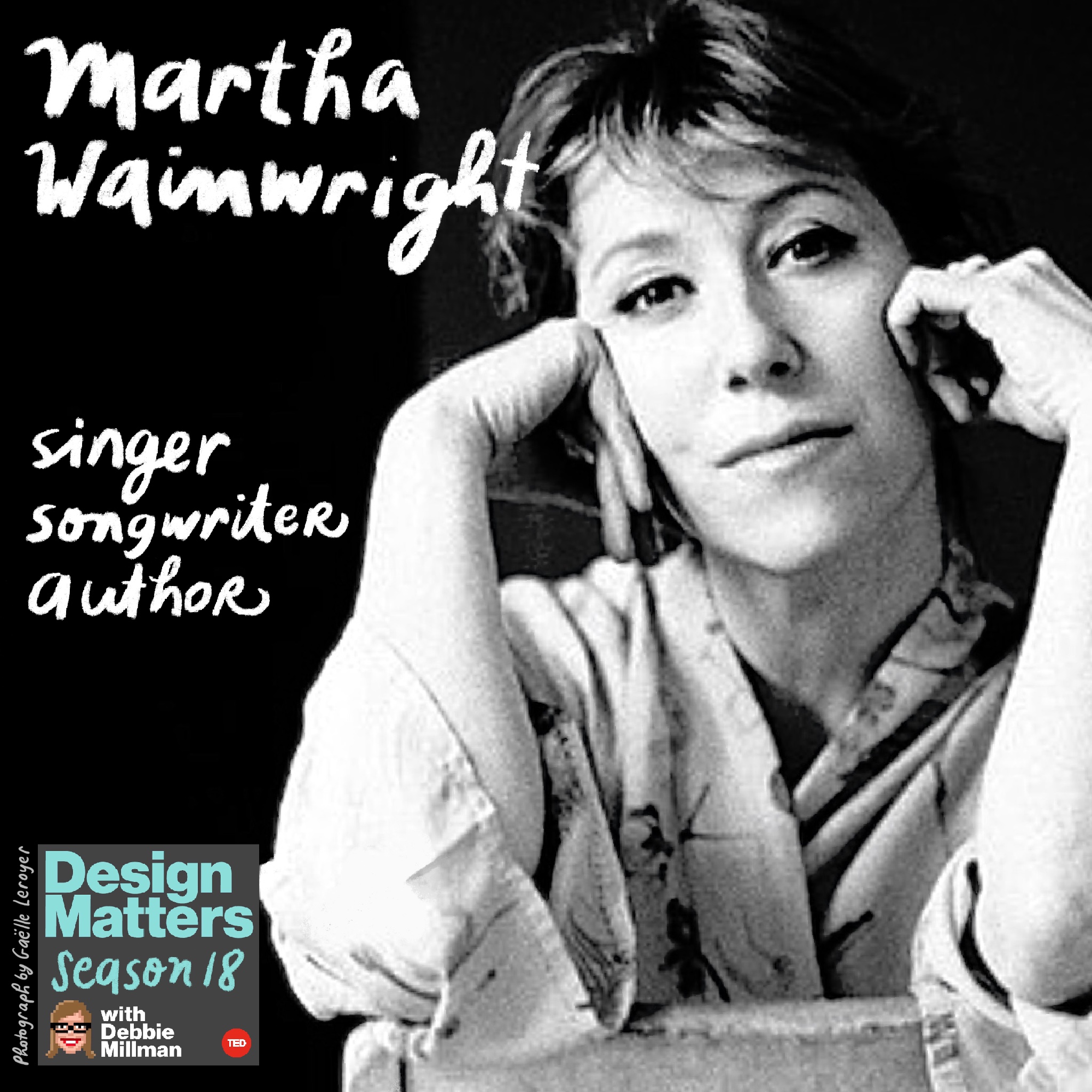
Martha Wainwright, singer-songwriter
Martha discusses her latest album, her memoir, and her experiences growing up in a musical family, dealing with love, loss, and the music industry.
Written by AI. May contain mistakes.

Get the gist, explore an idea or ask about something said.
 Claude
On Design Matters with Debbie Millman, what are the key points of this episode?
Searching your listeningAutomatic transcript. May contain errors.
0:00This archival episode of Design Matters originally dropped in May of 2023. What I think a lot of women in particular do when they get divorced and they don't necessarily have custody of their kids all the time is they throw themselves into work because you're like, well, you know, if I can't be taking care of my kids and I'm not with them, then I have to be doing something else and I have to. So that has afforded me the possibility to work, which has been great.
0:31From the TED Audio Collective, this is Design Matters with Debbie Millman.
0:38For 18 years, Debbie Millman has been talking with designers and other creative people about what they do, how they got to be who they are, and what they're thinking about and working on. On this episode, Martha Wainwright talks about what it's like to keep even a successful musical career going. I will be forgotten. You have to, it's a train, you got to keep it going, you got to keep feeding it.
1:05A good title serves as an invitation, and Martha Wainwright knows not only how to craft that invitation, but how to deliver it in the most persuasive and penetrating manner. One of her most famous songs is titled Bloody Motherfucking Asshole. Now, who wouldn't want to know who that song is about and what wrong they caused? Martha Wainwright's second album was titled, I Know You're Married, But I've Got Feelings Too. That too was enigmatic. Even the title of her memoir, published in 2022, is a bit of a cliffhanger. Stories I Might Regret Telling You. The book is about growing up in a family of rock and roll royalty and how she managed to find her own distinct musical voice.
1:49Martha joins me today from Montreal to talk about her life, her memoir, and her latest album with another irresistible title, Love Will Be Reborn. Martha Wainwright, welcome to Design Matters. Hi.
2:06Martha, is it true you love the way New York City smells? Yes, it is true. That's something that I wrote in the memoir. So I remember as a kid going down three, four times a year to visit my dad. I lived in Montreal, as I do now, when I was a kid. And I just felt that the smell, I think it was the pavement or whatever was happening, whatever was in the air, really hit my olfactory sense in a way that excited me and made it unforgettable. Your memoir, Stories I Might Regret Telling You, came out last year, is now out in paperback. You start the book recounting how your father didn't want your mother to have you and pressured her to have an abortion.
3:00She had you anyway. In his song, That Hospital, your dad sings about the experience and he writes, The little girl that was born there that escaped that scrape with fate. a few months ago in Montreal, I watched her graduate. How did you find out you almost weren't born? Well, my dad told me, which I don't think was the greatest idea. The book opens up with that scene, or it opens up with that truth that I had been told when I was 14 years old about almost not being born. And it's not a judgment on the decision to have an abortion or not have an abortion or, you know, whether that was right or wrong or anything like that.
3:49It was more a comment on having heard that from a parent at 14, which is already a sort of an uncertain age. It's sort of where I start the book in terms of someone who has always felt a little out of place or not sure of herself or not knowing where to go and how to be. And so it would seem to me to be an obvious springboard into the story. It is certainly a bit of a abrupt start, you know. You know, he told me late one night and maybe out of, you know, out of remorse, out of sadness, or out of trying to connect, you know. But one of the things also that I think I talk a little bit about in the book or a realization that I made through writing the book and looking about the relationship with my dad, which has been a distanced one, a loving one, but with a lot of kilometers between us, is that when you don't bring up your kids on a daily basis, you know, where you're not taking care of them daily and understanding that dynamic of parent and child and the responsibility of the parent to sort of protect the child more, where it's not a relationship that is only about sort of honesty and openness and treating them as equals, but there's a dynamic that is learned in that daily care.
5:17I think when you don't have that, it's hard to know how to be with your kids. And that's what I think maybe Loudon didn't recognize. And maybe it's not his fault fully that he didn't recognize that because he didn't really know how to be a dad, if that makes sense. Oh, yeah, absolutely. You were born to rock and roll royalty. For our listeners, I just want to sort of paint the picture of your lineage. Your mother and her sister performed as the legendary folk duo Kate and Anna McGarrickle. Your father is the prolific Grammy Award winning songwriter Loudon Wainwright III. Third, you describe your brother Rufus Wainwright as one of the most famous singers in the world.
6:02Your father's sister Sloan and your half-sister Lucy Wainwright Roach are also singers. Lucy's actually been on Design Matters as well. Your family is as famous for what they write about in their music as the music itself. And as far as I can tell, there's no other family in rock and roll history that has ever written more about each other. And that includes the Jacksons, the Osmonds, the Staplesingers, even the Braxtons. Do you think that the stories you share about each other are unusual? Or do you think that you're all just more honest than the other family groups? Well, you know, you said rock and roll.
6:44I sort of think of it as that kind of folk dynasty more in the sense that it kind of came out of an older type of music. And also, folk should be accessible to people usually through talking about humanity or politics or, you know, the music of the people, the temperature of what is occurring in the community at that time. and the songwriter tells a story of people behind the scenes and much of it behind the walls of it you know in the family life the secrets or the relationships and so I've always found that as songwriters in our family you know I think that that's been something that we all seem to have hooked into and for better for worse we probably would be making more money if we were able to write more, you know, simpler pop songs just in terms of like getting a hook, getting a great line or, you know, whatever.
7:42But I also think in the case of our family specifically, you know, you talk about my parents, but even before that, there was Loudon Wainwright II, Loudon's dad, who he's written. Yeah, exactly. Famous editor and editorialist. He wrote A View from Here, which is a column that was in Life magazine for 50 years. And he wrote often about his own family, and the American family and the dynamic of the family and of course, set in the era that he was in, you know, and in the story of the day. So that already had started a generation before. And there was a struggle between him and his son, my dad, Loudon Wainwright III, you know, so already this sort of father-son competition, which my dad has written about a lot in songs and contemplated that relationship with his dad.
8:43And then, of course, with his son, Rufus, you know, where they had a, they have a competitive element to it, less and less, you know, but certainly at the beginning of Rufus's career, you know, Rufus's career was very illustrious and impressive and exciting, you know, and Loudon has made no, he's been honest in his anxiety around it or whatever it is. But that kind of dynamic that, you know, we seem to see over and over and over again in literature and in people's lives. And And it's just, I guess, this willingness to talk about it that is sort of surprising and not often done in the form of a song and over several generations and in response to a family member's, you know, other song or whatever.
9:37I don't know if it's unprecedented, this thing, you know, of songwriting sort of in response to one another with these intimate relationships. But, you know, the thing that I always find about is that the more personal that we get, the more I think people see themselves and feel connected to the stories because they recognize them as something that is similar or has commonalities with their own lives. Yeah, in many ways, they're Shakespearean stories. You also write quite candidly about your relationship with your mother, sharing both the sublime and the difficult. And you reveal that since you were old enough to understand words, she told you how hardheaded you were, how you had a chip on your shoulder.
10:22She didn't like these qualities in you, and you state that you didn't like these qualities in you either. So I have two questions about this. Did you agree with her about those qualities? And how do you feel about those qualities now? You know, I was able to talk openly about my mother because she's dead. I don't know where our relationship was going and where it would have evolved to, but when she was diagnosed with cancer when she was 60, my relationship with her changed the conflict and the anger that I had towards her. I wanted to really flip that around and have the remaining time that I had with her to be very loving and sort of make up for some of the bad stuff that we had gone through.
11:07Maybe that would have happened over time naturally, but I really knew that our time was limited. So I really wanted to consider all those things that she told me and all those things that affected me, that made me sad or upset, you know, when I was younger, whether it was, as you say, you know, being too hard-headed or being kind of overly earnest and things that she felt were not great qualities. And I think that, you know, they stung because I was afraid that she was right, you know, and maybe that was why she was telling them to me, because she wanted me to face some of those facts about it.
11:49I certainly believed her because she was a very believable person. And because I was, as I said, afraid that she might be right, and I wanted to adjust. Looking back, I don't think that she was right. And she was probably not right to say anything negative or too negative about her kids, you know, because I don't really know if much good can come out of it. But it did form me, and it did propel me to write in a way that was sort of in your face and was confrontational with a lot of emotion and with vulnerability and anger. And so that defined my artistry at a young age, and I did push back. So she created an environment where I was then able to sort of gain confidence through this songwriting style.
12:53And she was really impressed by the first set of songs that I wrote and quickly changed her tune. And as she watched me, though, start my career, which was a very rocky start, and was filled with insecurity and insecurity that she had probably partially caused and also excess and mistakes. And she also was worried about that and those behaviors in me. And she would warn me. And I think in that instance, she was correct. And she was a concerned mother. And so I don't fault her for that at all. and when I went at 30, I discovered that she was sick, you know, or we discovered, you know, I really wanted to turn things around and to show her before she left this earth that, you know, I was going to be okay.
13:52And that was hard to do, but it was a good thing for me to do. And she helped me do it too. While you live with your mom and brother in Montreal, for most of the time, when you were 14, you went to live with your dad for a year when your mom and her sister went on the road. And you've written about how during that year you live with Loudon, you became more like him as if the DNA in you that came from him started to wake up almost like a switch got turned on. Was that when you first considered becoming a musician as well? Um, well, that year, I was attending Friends Seminary in Manhattan, and I had a math teacher who was very frustrated with, you know, my performance, with my homework and my, you know, my work ethic.
14:41And she said, what do you want to do all your life, sing and dance? Of course, the answer was yes. You know, I didn't say anything. I just sort of listened to her. But it was a great realization and helpful to me to think, okay, I don't have to put this pressure on myself to say, what am I going to do? Am I going to become a mathematician? Am I going to become an accountant? Am I going to become a lawyer? Am I going to become, I had, there were so many people around me that were quite high achieving as well. You go to a school like Friends Seminary that has a lot of people who are very upwardly mobile.
15:13My mother was really high achieving. I'd been to some pretty good schools. So there was a pressure to succeed. And so when she said that, I thought, well, that's probably not the worst route for me. That's probably my best bet. So that was a relief. and at first when at 14 I was more interested in theater because I was appalled at the amount of songwriting that was going on around me and and you know Rufus was constantly on the piano banging away so I thought well you know theater could be more for me and I wanted to do very serious plays and be a serious actress. And then, of course, I started writing songs a few years later, and that seemed a lot easier than trying to do a pinter play.
16:08I love the part in the memoir where you audition for the National Theatre School of Canada with a monologue from Antigone. Talk about high bar. How did you learn how to write music? I know your dad gave you a Sigma a guitar when you were 13? Did he teach you how to play? Did you teach yourself how to play? Did Rufus or Kate teach you how to play the piano? Loudon wasn't around. He gave me the guitar, but my mom showed me, you know, three chords. So I got the guitar when I was 12 and didn't touch it much. You know, I was taught an A chord, a D chord, and a G chord, and maybe an E chord. You know, three or four chords, which are all you need to write any masterpiece, really.
16:57Your muscles have to start to be able to play those things because it hurts. So I did not have any guitar lessons or anything like that. And my brother was always on the piano. So I didn't play the piano. I did not have a guitar teacher. I played a little bit of violin, so I knew how to read music. And my fingers could move a little bit on the fretboard. But it was really my mother who taught me those chords. And then she taught me like, you know, a simple picking pattern. And very much by just doing it over and over and over again, you get faster and faster and faster, and it's easier and easier.
17:35So a very simple rhythm guitar style. And I wasn't obsessive about it. I wasn't passionate about it. But once I could play a few chords, then I could accompany myself. And that's where it got exciting for me. And so it generally, I remember it started with learning some Elvis Presley songs, you know, country songs, things like that are really easy. So that's all right now, mama, and things like that, where I could accompany myself and sing. That would have been at around, you know, I don't know, 15 or something like that. And I could perform that, you know, I could play it at a talent show or something.
18:17And that was exciting, because that was like a freedom, where just me and this simple instrument that I don't need to plug in, can sort of create a sound that is independent. That was powerful. And then soon after, you know, I tried writing songs and things came. You say this about your voice in the book, and I'd like to read it verbatim. One person's voice is handed to them like a gift. Another person has to create a voice, literally, in her gut, her heart, her throat. Some people seem to channel someone else's voice, taking it on and welcoming it. Your body is your own, but sometimes it's also a tool for someone else to come through.
19:05Sometimes singing feels like a skill, and sometimes it feels like an art. Singing has saved my life. Sometimes I feel that if it weren't for being able to sing, I would not be here. I would have died by misadventure or taken my own life. But that might be a load of cow shit. I can really sit in sadness, as you might have guessed, but I can get out of it pretty easily too, often, by singing. Martha, over the years, how have you found your own voice? And when did you realize that you're really a fine, original singer? Well, I think that my own voice was always there, but it wasn't appreciated by others.
19:50Or if it was appreciated by others, going back to some personality traits that weren't very useful to me, I either didn't believe them or I didn't want their opinion or recommendation. So there was a hard-headedness. So recently I found some recordings of me singing as a kid. My mother and aunt, Anna McGarrigal, did some music for some kids' movies in the 80s and 90s. And they had me sing a couple of songs for the credits and things like that. And I sound just like I sound today. I sound like I'm eight and I sound like I've been smoking for a bunch of years. but um you know i'm a little pitchy you know it's a little off key um i'm like i'm like twanging i'm like bending the note i'm you know i'm not doing it probably how a director would have wanted me to do it it's the kind of thing where i i would have had trouble at get i would have gotten to the the the callback you know but not gotten the part because because i wasn't willing to bend to what the director needed me to do, you know, and it was a hardheadedness and a sort of unwillingness to, to change.
21:13But in a way, then what happened is that people had to come to me rather than me come to them in some ways, you know, artistically. And when I was writing songs and doing shows and trying to get a record label in my 20s, you know, I was not fitting a mold that was suitable for record labels and producers worked with me and they tried to adjust my songwriting and I was difficult to work with. Not that I wasn't nice, but I just sort of walked out of the situation or turned away from it or sabotaged it in some way. And I guess I just wanted them to like me for who I am and who I was. It took time for that to happen, but I think that it made it set.
22:02When the first record came out, and to the larger public, people remarked on its originality or something. You know, not that musically it wasn't like super original, it wasn't like crazy or anything musically, but I think that the singing voice and the songwriting was different than other people's, and it was remarked on. So that was the way I had to get there. in an old interview i read in believer magazine you stated that to create a rhythm you play the guitar more violently than most women play the guitar um and then in a very in various places throughout the memoir you talk about being intimidated by guitar playing and that you wish that you were better at it um if you were better at it do you think you would be less distinctive your playing is you have a very distinctive style to your playing that's interesting i i think that that is true i i worked for a long time with a piano player who's classically trained and and he would all especially and it was early on and he was always so um surprised at my chord choices and some of the things i did musically because he found it to be kind of quite sophisticated but it wasn't that it was sophisticated it was actually just completely naive, you know, and it was by not knowing what I was playing, that I sort of got went to a different chord that people would normally, let's say, go to or say, okay, well, yeah, after this chord, you can go, you can go here, here, here.
23:33And just but because I had to sort of try out many things, I was not as constrained in a way. And he was really envious of that, you know, because for him, having music been drilled into him, you know, he sort of felt that he was not as creative as maybe he wished he could be in that way. I'm sure he's creative in other ways, and I'm envious of his ability to play. But I thought that that was an interesting, positive thing about not being sure of what you're doing. And yes, I think that because I don't play licks on the guitar or play the melody a lot on the guitar, I play a more rhythm guitar style so my left hand is kind of quite limited to what it's doing I'm not playing lead guitar what that means is that I have to accompany myself and there has to be quite a quite a bit going on in the guitar so it gets has to get loud it has to get quiet it has to sort of be dug in it has to have a kind of a maybe an interesting open chord every once in a while The guitar does have to do a lot with kind of a little, you know, the skills aren't that huge there.
24:48So I think that I'm trying to use the skills that I do have to their fullest. Rufus is a few years older than you, so it's not surprising that he signed a record deal before you did. He started touring the world and you at that time became his backup singer and joined fellow backup singer Joan Wasser, now known as Joan as policewoman on the road. Joan has also been on the show and is a dear friend. And what was that like for you to be a backup singer? And I think it seemed, from what I read, to be a very formative time for you. Yeah, it was really defining for me musically. Before Rufus put out records, I was his backup singer in Montreal.
25:28And he would play weekly shows when he was 19, 20, and I was 17. I probably was 16 when we started when he was first writing his first songs and those first set of songs not all of them but quite a few of them had me on them singing sort of a duet he would write everything, it wasn't my making, you know, he would tell me very specifically what to sing but we practiced for hours and hours a day and performed them a lot around Montreal in particular, sometimes in New York. And this was before he got a record deal. So it was about two or three years of that. And just him showing me, asking me to sing things that were really not in my brain at all, sing really high, sing low, follow his melody and harmony, sustain notes for a really long time, because he has a really impressive voice.
26:32Rufus really put me through my paces. It was kind of quite acrobatic, his parts that he would write. And maybe he was torturing me, you know, maybe he was doing it on purpose, you know, and he would make us practice over and over and over again. And then I would just kind of get angry, like, I'm out of here, you know. But that listening capacity that he created in me, and of course, I think this, my mother loved watching this. Obviously, she had sung her whole life with her sister, more as a duet, but just seeing her two kids singing together and blending and doing that sort of classic family sound thing that happens when families hang together and made her so happy.
27:16I think at first she would have wanted us to do like some type of a duet thing. And then of course, it was really obvious that both of us were really also wanted to do our own thing. And that wasn't going to work as we would end up killing each other. But it was such a huge thing. And then when he did get his record deal, and I I came down and I recorded those songs. And then we went on the road for his first record and then his second record. Just touring with him, he brought me to Japan. He brought me all over Europe, all over the United States. We were opening up for people like Roxy Music and, you know, big, big bands.
27:54Then he would have his shows. And then I became his opening act oftentimes. times. And I had little EPs that I pressed up myself with my own songs on them. And they weren't available in stores. And so I would sell them in his shows. And people were really impressed with me and intrigued. And because they couldn't buy the CD in the store, I would sometimes sell like 100 CDs a night. And I'd have these like wads of cash in my top drawer. And I was able to make a living because of Rufus, starting from the age of like 20 years old, you know, I was selling my CD at his shows, you know, walking away with like a grand a night, you know, and paying my rent.
28:37And it was really, as I say, formative and helpful. And then it was time to move on, you know, it was time to be like, okay, well, now I want to do my own thing. But I don't know if I would have, you know, I just, you know, he's just a huge part of my story, you know, my and my parents are too. There's just like no way around it. You write about how you also had the opportunity to audition as a backup singer for Leonard Cohen. And this was something you had dreamed of since you were a little girl. You had met him when you were very little. In the end, you decided not to take the job. How come?
29:13Well, I didn't audition. So I didn't I can't say that that I think I would have gotten the job or I could have gotten the job so I was a huge and still am uh Leonard fan as a young person as like a 14 15 year old I got obsessed and went to go see him play in Montreal and uh you know just the the dynamic that he had uh with his backup singers always they they played such a huge role which I think was why I felt so comfortable singing with Rufus and playing a big role because it was just they are like really present you know his singers so that was like wow what a great job like that's what I want to do you know that's the job that I want and I knew a lot of the songs and so when he was putting together the band for his comeback world takeover you know which was so amazing I was hanging out with his daughter because we were really close friends and she said oh well and I had met Leonard a bunch of times he had been to my shows we knew each other.
30:14He was a really big fan. She's like, you got to go do the audition. You're totally going to get the part. It's perfect. We'll be on the road together. It's going to be really fun. You know, like we were like, this is a good plan. But right at that time, you know, I had already made, I think, two records. You know, my career was taking off and I realized that that's not what I want to do, even though it's a great, a great job, but it's not what I wanted to do. You state that you don't really hear music in your head and you don't go around jotting down bits of lyrics on scraps of paper. How do you go about writing a song?
30:48God, I can't remember. You're making me nervous because it's been a while. I've been working so hard. I've been touring a lot and promoting the book as well. And I have two kids. And so it's been a busy time. So I haven't sat down to it. We'll talk about the magnificence of Love Will Be Reborn in a few moments and about the most reasoned songs. Yes, I will. I haven't exactly. So I haven't had a chance in the last year and a half to start writing songs. But generally what happens or what has happened in the past over the last almost 30 years is I get sort of so upset and riled up and kind of like buzzing almost, you know, because I haven't been writing or whatever the reason is.
31:30life is stored up in me. And then I start to, just with the guitar on the couch, just start with some chords, usually, and then maybe a line will come or two lines, a phrase, just things that are kind of like a hook phrase that seem poetic, that seem kind of like there's a lot in them where you can go. And that are really a direct reflection of how I'm feeling or what's going on. And so usually I can identify pretty quickly, okay, you know, I'm saying this, or I'm writing this, because this is how I'm feeling, because such and such thing happened last week. And then that helps me to then compose the song, you know, and when I can kind of go deeper into that and use examples of daily life, usually that that to illustrate it, and or people or relationships, you know, a lot of the songs are about love, and, you know, falling in love, falling out of love, being in love with people who aren't in love with you.
32:33And then, of course, that gets transferred to children and to friendships. You state that you write maybe five songs in a good year. Do you write a song until you think it's good? Do you write a lot of rejected songs? What is the way in which the songs end up on an album? Well, I think that most of them are kept. Sometimes I'll combine, you know, if I have some cool chords and a melody that I like, and I'm working on two separate things, and then I realize that they're not fully formed things, I'll say, okay, well, maybe I can use that as a section or something, or maybe I can add to it. Some songs are written quicker than others or easier, and other ones are toiled over for a long time.
33:23And, you know, I write five songs a year or something like that, but I also find that there seems to be three or four or five maybe different ways of doing it. You know, there's certain songs, like all songwriters are like this, I think. You know, they have songs that are similar sounding. You know, they have a, okay, that's a set of songs that sort of sound, and then they have another type of songwriting where those are kind of similar, you know. And it's not that they're writing the same song over and over, but there is an element of that, too. I think that that's also comforting to the listener.
34:00Someone turns on, whether it's Bruce Springsteen or somebody who has a real sound, Neil Young or whatever, they want to hear that sound. You talk about how you've walked away from commercial opportunities because you're hard-headed and want to do things your own way and go on to state that the truth is for the last 25 years, you've made and played music and gotten good at it. The overall goal is to enjoy playing, but also to get to do it in front of millions of people. Most musicians want this, but the reality is more difficult and complicated. Recognition is essential for the ego, but you don't need recognition to play music.
34:39After all, it's a natural expression that has been commodified to produce a financial benefit. Martha, I'm wondering, how hard is it to straddle the continuum of commodification versus poverty versus artistry? in my case the reasons for making music have changed over time which is kind of great because it keeps it fresh there's always a love to make music and obviously it's the only thing that i know how to do at this point so i can't i don't have any other real skills for me to be able to have another profession it would be really hard to start again at something but certainly now you know, having two kids and being the sole moneymaker and the responsibility of that, you know, working becomes really truly a necessity like it is for everybody.
35:32You know, that's not how I felt about it. You know, when I was in my 20s, you know, I enjoyed making money and spending the money. But now the money has taken on another type of importance, which is to, you know, create something that I can leave behind for the kids, mainly, and also where I can work enough and make enough money so that I don't always have to work because then I can be with the kids and take care of them, you know, because they're in school and they can't go on the road and things like that. So that for me at this stage in my life is a really big, big part of it. That being said, you know, I just got back from a tour yesterday.
36:16I was in Norway and Sweden for a week, the week before I was with my kids in Montreal, the week before that, I was in Holland for a week, like I do like week on week off. You know, when I'm there playing to however many people it is, you know, whether it's 100, 100 people or 1000 people, it is the same as it always was in terms of hoping that people come, hoping that people like it, wanting to give them a great 90 minutes, you know, wanting to sing as well as possible, trying to achieve on stage also some magic. Sometimes there's magic, sometimes there isn't magic. But if there is no magic that there has to be, it has to seem like there is.
36:59And that's really important. So that there's kind of a, it's always good. And sometimes you think as a performer, or you think it's magic and it's not as magical as the night before when you thought it was magic. So you're not in control of the same thing. But I guess what I'm saying is that even though the motives have changed a little bit, there's always been the same person there doing this, the same instinct in me to do it. Last year, you released a new album titled Love Will Be Reborn. Critics have declared this album to be the very best of your career to date, which is saying a lot. I read that you wrote the title track in a very dark time, but the positivity and luminosity of Love Will Be Reborn in many ways has predicted your future.
37:52Despite how long it might take you to write songs, is it true that you wrote Love Will Be Reborn in 10 minutes? Pretty much. It was really quick. It just flew out of me. which I'm really hoping that that happens again, because I hadn't written a song in a while either, you know, and there was a lot going on that was really dark. I'd started divorce proceedings, which quickly got really scary. And I was really scared. And I was out on the road without the kids and feeling like, oh, my God, you know, I was promoting the last record, a record called Goodnight City. I'm just really, just really afraid.
38:37And then, as you said, it was, it was so surprising that this thing just flew out of me that was quite kind of, that was very positive. And I just really took it as a almost like a prayer, you know, I'm not, I'm not religious, but it was, it felt like something to hold on to, like, well, maybe, you know, maybe if I keep saying this and saying this good thing and sort of believing this thing that it'll, things will get better. And, and that did happen, you know, and the song is not about a man, but it's about love in general with, with, with everybody, you know, but I loved it, come back into, into my life with a man, which was really surprising.
39:18And then just, just wanting peace and hopefully achieving peace, obviously, with the father of my children would be really the best possible outcome. So it came quickly. And I was really happy to know that that meant that there's things that were not even in control that are just in there. That was a relief. You start the album with a really, really ferocious song, Middle of the Lake, which felt a bit like a departure for you and an arrival in a new place musically. Can you talk a little bit about the way in which you used howling and sort of screaming to amplify that song? It's such a great song.
40:12thank you so much well that was definitely like you know i put that the song first because it's different than a lot of the rest of the record and it was the last song that i actually wrote for that record and it does have a lot of sonic you know i'm singing in these uh different ways and i'm singing high and low and yelling and whispering and i'm singing the backup part so there's a lot of a lot of me in there but it's kind of a different me yeah for the first time I felt like, huh, Martha maybe was influenced a little bit by Kate Bush in this. Yeah, well, I mean, I, of course, I am influenced by Kate Bush, not so obviously, but I've always listened to her music and adored her music.
40:56And she, you know, were, you know, I'm influenced by the McGarrigals, and I know that she was influenced by the McGarrigals, but letting the the voice and the female voice really dance wildly in a way that's just so powerful, which I think that is what the female voice has been doing forever. You know, it's like totally, I don't know if it's witchy. I don't really know what that word really means. But you know, just allowing that kind of total, unbridled, un sort of controlled female self be there. and it's not coquettish or intentionally sexy or for the purpose of sort of attracting men. It seems more sort of just on its own, just more natural and with nature as well.
41:50So interesting. I think it's one of your sexiest songs, actually. Oh, thank you. Yeah, I mean, there's a Kate Bushness to it. There's a Bjorkness to it. There's very much a Martha Wainwrightness to it. It's a real, it felt like listening to that song, especially the opening, that you had reached a whole new level of your artistry. And then you bring in report card after it. And I was like, okay, I need a day off. Yeah, no, that song I think is really intense too. No, look, I'm going to agree with the critics and say that this is my best record. because it, like the first record, it came out of a long time in the making and a lot of things having happened and a lot of pivotal things happening.
42:39And the first record is really about, it's just started, it's like revving up. But this record to me seems about really understanding and taking control, also rejecting some of the things through my past that have been not helpful and difficult and unnecessary. So a real rebirth and sort of a better second half to life than first half possibly. You know, I think that that's sort of the theme of the record and also the book. Yeah, you say that at the end that, you know, you're about hopefully only halfway through. Talk about Report Card. It's a long song for you. It's quiet. It's heartbreaking.
43:23I think it may be the saddest song you've ever written. What motivated it? The saddest thing that I've ever dealt with, sadder than losing a boyfriend or losing my mother or anything that I had ever experienced, which was to not be able to see my kids and know where they are and be with them and have access to them, which was to me the hardest part of my separation and divorce. And that just totally shook me. And it's not that it's unfair. You know, life is not fair, you know, so it's not like unjust, but it just felt, it just was really, it seemed to strike in me a lot of pain. And I think with Report Card, it was hard because I had always, as a songwriter, spoken very openly about my feelings and people and, you know, bloody mother and asshole and fucking, you know, always open, open, open.
44:29But then when you have kids, you can't do that. You know, I can't be like, you're a dad. book, right? You know, a bunch of stuff is off limits, which I learned through writing the book to like, don't, you know, you don't really want to say everything, you know, and especially not when it comes to people that the kids care about. And, you know, it's just not worth it. That being said, I was in so much pain, I needed to say something I needed to be able to express something. But I knew it was pointless to have it be angry, or to have it be blaming or to, And I didn't want to write another song about their dad.
45:07And I just had to find a way to talk about what I was feeling just being alone in the house and being without them and how scary that was and how it really is my Achilles heel. It really got me, that thing. And it still does. So I had to say it. I had to give myself the right to say it. And I was so sad and I get so sad. And the song had to match the sadness. You write in your memoir, when you go back and listen to your older records, you regret that most people will never hear them or know anything about you and your work. As you're back on the road now touring, sharing this new album, sharing your memoir, do you have the same worries?
46:00No, I mean, I do feel like this last year, or two years now that the record is out, I've been able to reconnect with fans and people, you know, and that is the flip side to also, what I think a lot of women in particular do when they get divorced and they don't necessarily have custody of their kids all the time is they throw themselves into work because you're like, well, you know, if I can't be taking care of my kids and I'm not with them, then I have to be doing something else and I have to. So that has afforded me the possibility to work, which has been great and has reminded me of, A, that I got to keep out there working because if I don't go back to Oslo and go back to Amsterdam and go back to all these places, you know, I will be forgotten.
46:54and you have to it's a train you got to keep it going you got to keep feeding it and i need uh to continue for as long as i can there's no pension in the music business you know and also i and i have and i have to i have a healthy competition with other people in my field including my my family my dad's still working for god's sakes he'll never stop working i'm like i when i get off the phone with them i'm like gotta get six shows this week he's 76 years old i'm like i need to book my shows. Martha, I have one last question for you today. You conclude your memoir with the story of meeting a new love and the glorious process of falling in love.
47:34How has that changed you? How has that influenced your music? Well, on the record, we hear at least three, if not four songs about Nico, and they're quite positive and I think exciting and really good songs, too. So that was sort of, you know, really inspiring for songwriting, certainly. And it was great that the whole record was not going to be about difficult divorce and my sadness that all of a sudden, you know, no, that's not what's happening here. What's also happening here is a sort of new beginning, you know, that was really unexpected and really welcome. And I think that also, you know, when you read the book and listen to a lot of my music from the last 20 years, there is this kind of like feeling of I'm not good enough or, you know, I wasn't, you know, this sort of wanting to be loved by men and wanting to be more beautiful and wanting to be more perfect and wanting, you know, men to like me and this sort of insecurity there.
48:38that I have to say for the first time has been completely turned on its head and being loved by a man in a way that is kind and loving and generous. And I'm really glad that that's happened, you know, because it feels good. Martha Wainwright, thank you so much for making so much work that matters. And thank you for joining me today on Design Matters. Thank you. Martha Wainwright's memoir is titled Stories I Might Regret Telling You, and it is out now in both hardcover and paperback. Her latest album is titled Love Will Be Reborn. You can find all her music and see lots more about Martha on her website, marthawainwright.com.
49:26This is the 18th year we've been podcasting Design Matters, and I want to thank you for listening. And remember, we can talk about making a difference, we can make a difference, or we can do both. I'm Debbie Millman, and I look forward to talking with you again soon.
Singer-songwriter Martha Wainwright joins to discuss her latest album and new memoir about growing up in a family of rock ‘n’ roll royalty and her experiences with love, loss, motherhood, divorce, and the music industry.
Hosted on Acast. See acast.com/privacy for more information.