 Ask ChatGPT


Design Matters is an acclaimed podcast hosted by Debbie Millman that focuses on the creative journeys of influential designers and artistic figures. The show has been running independently for over 15 years, making it one of the earliest podcasts in existence.
Written by AI. May contain mistakes.

Get the gist, explore an idea or ask about something said.
 Claude
On Design Matters with Debbie Millman, what are the key points of this episode?
Searching your listeningAutomatic transcript. May contain errors.
0:00This archival episode of Design Matters originally dropped in November of 2022. For a young girl, when they're Googling something like Matisse, my name comes up. Like for me to assert myself within that Western canon is to really try to dismantle and deconstruct the notions that persist.
0:25From the TED Audio Collective, this is Design Matters with Debbie Millman.
0:33For 18 years, Debbie Millman has been talking with designers and other creative people about what they do, how they got to be who they are, and what they're thinking about and working on. On this episode, Mickalene Thomas talks about how black women are depicted in her art, and about her burgeoning career. I want to be in my 80s and my 90s still making art. I'm in this for the long run.
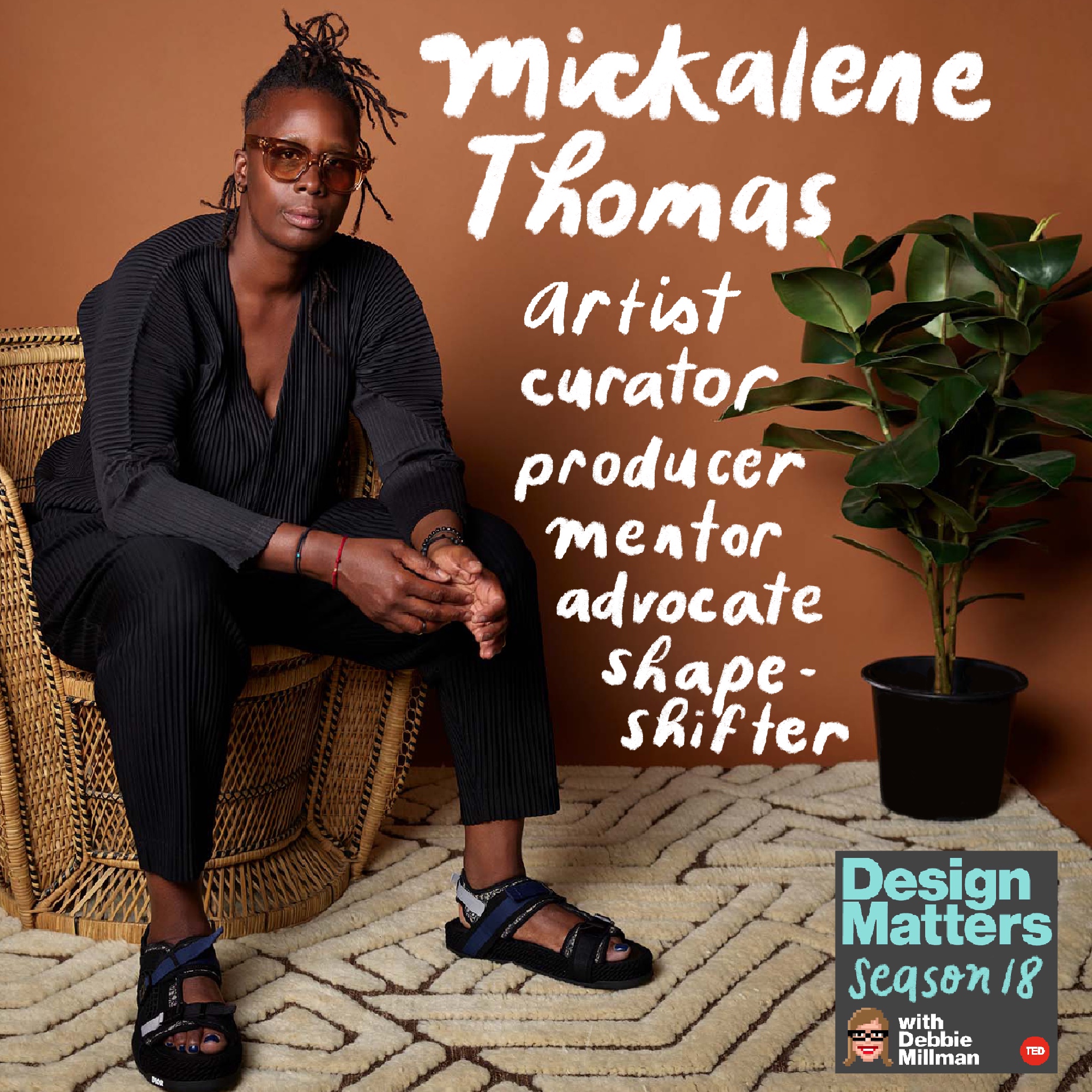
1:00Black women are front and center in the work of Mickalene Thomas. They're lying on couches, sitting on chairs, sometimes nude, other times clothed in brilliant patterns or glittering with rhinestones. And they're almost always looking right at us, eye to eye, demanding to know if we are worth a glance or acknowledgement. Mickalene Thomas is one of the most important artists working today. Her paintings, photographs, films, and installations can be found in the permanent collections of museums all over the world. She joins me today to talk about her powerful art and her extraordinary career. Michaline Thomas, welcome to Design Matters.
1:45Thank you. Thanks for having me. I'm so excited to be here. Michaline, in your monograph, Beyond the Pleasure Principle, Roxane Gay states in the introduction that you have big dick energy. Would you agree? Yes. It's interesting because when I first read that, I got really shy just of the notion of having big dick energy and what that means. I often think so, but to hear it from someone else is to validate me, but it also made me realize it was okay to have my shoulders back and my head held high. You know what I mean? Like, it was like she saw me, but not only did she see me in a physical sense, she saw my energy and recognized it enough to put it in writing, especially coming from someone that I see that has big dick energy.
2:53So for her to welcome me to the club, wow, I felt like I was part of the club suddenly, you know? So it's just like whether the big dick energy is seen by many, I don't really care. I'm just glad that it was seen by Roxane Gay. You know, it's interesting. Many, many years ago, decades ago, Eric Boghossian wrote a short story about a man who had a big dick and this sort of innate quality that he had about his life in that it kind of didn't matter whatever he did because he had this big dick and he carried around this big dick energy. And so I think it's something, I don't even know that it's something that you have to live up to.
3:35I think that part of what it is is something so innate that it creates this sort of inner swagger that is inevitable. Yeah, oftentimes my friends would joke around that I had a swagger. But I think it's also just self-awareness and just reminding myself that you are a badass. Because sometimes there are days when I forget about who I am and my greatness and what I contribute or what I'm just doing for myself. my daughter or just, you know, when I get up in the morning. Like, to be quite honest, I had a really tough time on Saturday. This last week was really difficult. Why? Well, my mother's birthday is October 27th.
4:19Oh. She died 10 years ago. Yes. So celebrating the 10th anniversary of her transition just really hit hard. I'm thinking about her and some of the accomplishments that are happening and just wish that she could, in a physical sense, hug and say how proud she was of me. You know what I mean? So it was just a real tough day. And that carried on because then my grandmother's birthday is November 5th. And so It was just a combination of great women in my life who aren't here to see how I'm evolving. Well, your mom, I mean, aside from being your muse for many decades, when you were little in an effort to get you to see and do things that you weren't otherwise exposed to, she enrolled you and your brother in afterschool programs at the Newark Museum, the Henry Street Settlement in New York City.
5:21what kinds of things were you both making so early on in your lives? Oh my gosh. You know what kids make in afterschool programs, you know, paper mache animals and face, face mask and houses and characters of like, whatever you could think of crazy little trinkets of flowers and things, anything with paper mache. I remember a lot of paper mache. That was fun. You know, a lot of self portraits, a lot of portraits of other kids in the class, a lot of ceramics. Yeah, I had a great experience with art at a younger age, but didn't really understand or was exposed to working artists. It wasn't something that was a way out.
6:16Art wasn't looked as a career as a way out from the life in which you lived in particular urban communities. We didn't grow up dirt poor, but my mother was a single parent. We had financial struggles. And then we had more when she became an addict and I lived with my grandmother. But, you know, my mother always provided the best for my brother and I and exposed us to as much as she could. She was a practicing Buddhist up until she died. And I think that was that faith for her and the community really provided stability in her life and also provided a sense of spirituality for me at a young age and a community of diversity of different groups of people.
7:13Like I grew up with a group of really incredible Asian women that came to the U.S. in the late 40s and 50s and lived in New Jersey. And just they were incredible. And they became like parental figures in my life. And so I grew up with a lot of community of creative people. And the Buddhist group was at the time was called Mitran Shoshu of America. And so they had a kids group, which was a fife and drum group. And so I was able to learn how to play the fife and be around community of other little black and brown and white kids at a very young age and coming to New York to Union Square and 14th Street to the Cultural Center.
8:08So that was a huge part of my foundation and stability and just learning about different types of people and different cultures and ethnicity and people and different financial status. And so even though we didn't have that, I was exposed to it at a very young age. And so even with the hardships that I was dealing with, I knew that there were other things in life because of the exposure. Tell me about your nickname. You had a very specific nickname growing up. So Quanica, yes. So when I would go down to South Jersey, where most of my family lived and still lives, and Camden, New Jersey, because we were one of the only family members who had moved out of Camden, New Jersey.
8:58And my mother, after she escaped from my father and divorced him, she and her girlfriends moved to East Orange. But all of her family were still in Camden or Camden area. So we would go and visit family members quite often. Holidays, summer breaks, weekends, family reunions, birthdays, all of that stuff. My cousin Robin and her siblings were really interested in, some of them were becoming Muslim, and the whole idea of not associating yourself with the slave name. And so they gave me the name of Kwanika. And so a lot of my family members still call me that when I go to South Jersey. They call me Kwani or Nika or something of that sort.
9:59I liked it then, but there was a period in my life that I didn't because it was very heavy and I didn't really understand the notions that they were taking on, like theories of Marcus Garveyism and just really empowering themselves, no longer straightening their hair and just wearing their hair natural. It was like, you know, really sort of this Black Power movement. And so I really started identifying with that not until I went to graduate school when I started photographing my mother and looking at other images. And I saw, I think I saw something on the back was like where I signed Love Kwanika.
10:46And I was like, oh, yes. And it triggered in this memory of my childhood, how we were really interested in Black is Beautiful and just like all things celebrating the great life of Black excellence and the Black experience. And whether it was like through Jet Magazine or Ebony, like it was really exciting moment for us as kids. And so it was a name that I kept and used within my body of work as this other sense of who I am and defining a part of my life that kind of comes through as a conduit in the work or extension of who I am when I do my portraiture. It's oftentimes how I see myself, but then I don't.
11:41So it becomes this mirror image and a redefining of this notion of who I was in a community of my cousins and their siblings and my family and how we would have these associations of empowerment. and sometimes didn't always understand the full scope of what they meant, but we were kind of just like a part of the movement and excited to just like adapt to it in any way that we could, even so much to change your name. Yeah. I want to talk a little bit more about your sort of formative years before we start talking about your work. I know that when you were 17 years old, you dropped out of high school and followed your then girlfriend to Portland, Oregon, and you had met while working at a restaurant.
12:29I think you bussed tables and she was the hostess. What made you decide to up and go like that to another part of the country? Yeah, we worked at this hotel in New Jersey and there was a restaurant called the Jockey's Club. And I was the bus person. She was the hostess and we became friends. She was older than me. and we fell in love. And at that time I was living with my grandmother and I was going through a lot. That was a phase when I wasn't as close to my mother. I had some boyfriends and I always had feelings towards women. I remember like crushing out on, you know, my classmates or my teacher or something like that.
13:26And I had a huge effectuation with Whitney Houston. Who didn't? My locker was like plastered with her images. I even tried to look like her for at some point. And I started modeling a little because I thought, ooh, I can be some attachment and closeness to my mother because she modeled and tried to really have her be a part of who I am because I felt like I was growing apart from her and didn't understand what she was going through in her own personal struggles. And I was just really looking for a way out. Not that where I was living with my grandmother was bad. I just knew I was different. I just knew that I wanted more.
14:20And I just knew at a very young age, I used to always say to my family, when I grow up, I'm going to move to Europe. And they would just go, she keeps talking about moving to Europe. And you know how they dismiss you and they're like, oh my gosh, she is talking about some Europe. She don't know nobody in Europe. She never even been, she doesn't even know anyone who went. And so, but I had this fascination with television and movies and watching Mahogany and Diana Ross and all of these, you know, just the fan is like, remember that yellow dress she draws? Yeah. It's like, just like going somewhere.
14:57It was just the fact that I, people were going other places. And I recognized that very young, that what I was growing up around, that there were other worlds within worlds around me that was doing things. I didn't know what they were. I knew I had a great sense of community. It was a really great way for me to go, oh, I can leave here. And also I was a very different kid. I was a very quirky kid. I stayed under my grandmother a lot. I love listening to her stories. I stayed home a lot. My cousins and my aunts would always try to get me out. I was really into punk music. The kids I hung out were listening to the Dead Milk Man and The Cure and all of that.
15:52I wore Doc Martens. I shaved the side of my head, similar to I have now, looking like Grace Jones. I was fascinated with Grace Jones. I loved the Peshmodhe and all. It was just like all of this. And so while I was listening to that, my cousins and I were listening to crisscross and hip hop and sugar hill and stuff like that. And I listened to that, but there wasn't like what I was really interested in. And I think because I was queer, but I didn't know I was queer. You know what I mean? I was like, really trying to express myself through this other music and other identities because I had this effatuation with women, but I didn't know how to do it because I didn't have any role models.
16:41I didn't see it. So I isolated myself from my family and just wanted out. So when I met this woman, she's Filipina. And when she said she was moving back to Portland to care for her mother, I was in love. And I was like, well, I'm going with you. and I remember going back to my grandmother and telling her that I wanted to leave that I really needed to leave I needed to leave or I I just remember saying that and it wasn't like anything happening in my life but I remember being suffocated and said if I don't leave I'm going to die. That's how I felt. And when I moved to Portland, one of the first experiences I had was at the Oregon Country Fair.
17:35What happened there? Oh my gosh. It was like, what didn't happen? The description of it was kind of like Oregon's Woodstock or something, but it was like the freedom of seeing just all these people just be in themselves, queer people and straight people. And then I started hanging out with a lot of artists when I was living there. I didn't stay in a relationship long with the woman I moved with. We ended up moving with her family. We weren't out. Eventually, they realized that we were a couple and they asked us to leave. So we did. I did get my high school diploma from Marshall High School in Portland and then immediately applied to college.
18:19Well, I read that after high school, you were actually thinking about pursuing a career in law and that you actually worked part time at the law firm Davis Wright and Tremaine for several years. I did. I started out as a file clerk, worked my way up to a document clerk and then became a paralegal's assistant. I worked there for a long time and I just worked my way up, just worked. That was my job. And so I was, when I went to Portland PSU, I was in theater arts and pre-law was my sort of major minor. And you really wanted to be a lawyer? I did. I thought, I mean, I was thinking of security. I was thinking of stability.
19:06It was something that was always in my purview, I guess, as a kid in my mind, as thinking about success. And, you know, oftentimes, you know, in black communities, we're conforming and looking to this respectability politics of what we think is we should be doing and creativity and being an artist was not on that top of the list. You know, if I said I wanted to be in sports, because also in high school, in junior high school, I did track and cross country. And so I did have the opportunity with partial scholarships to go to HBC schools. I didn't because it was I didn't want to be in sports. I think you also worked at a Starbucks.
19:56You started hanging out with a circle of friends that included the artist Patrick Abbey. And I believe it was he who recommended that you attend an art therapy workshop. Yeah, Portland was incredible during that time. It's like the early 90s. There was a lot to unpack with me leaving. But once I got there as a young adult, like living and working on my own, the independence and sense of self, the community. You know, a lot of people say Portland isn't diverse, but I found a real incredible, diverse group of people. One of the jobs that I had before working at Starbucks that I actually worked as a receptionist in North Portland with this midwifery organization that had doulas and midwives and training for them.
20:56And it was a black woman who ran it. It was incredible. So it was, you know, so that was my exposure to like the black community in Portland, Oregon. And so I was like in all these different worlds. I was in a black community, black women world. I was like in the gay world, artist world. And so when I got a job at Starbucks, it was at the Square. It's very different now. There was Thomas Lauderdale, who is with the Pink Martinis, would never come to Starbucks. He would go right across the street from Starbucks was Nordstrom's. and my friend Chris Stark worked at the outdoor cafe at Nordstrom's.
21:41I would sit out on my break and roll my cigarettes and I would watch, I had my view, I would watch from the square in Starbucks Chris Stark, who was this cutie with this sort of curly boppy hair as he would serve people and just full of life, talk to this guy, this kid with blonde hair and who would like scoot around. I've never seen anyone on a scooter. I mean, now scooters are pretty popular. He was doing it well before scooters were popular. He was always ahead of his time. He would scoot around and he would never come into Starbucks. And I'm like, why doesn't he come to Starbucks? And so one day I I just walked over to them and started talking with them.
22:30And then I discovered that Thomas was this incredible genius and talent of a piano player, classical pianist trained since he was like four. And he had just returned home after graduating from Harvard. And so I just started hanging out with him. He would have parties and group of artists. And that's how I met Patrick Abbey, who was an artist. And they all encouraged you to be an artist. They saw something in you and felt that you should. I mean, I think it was Patrick Abbey who saw some of the work you were doing in your art therapy workshops and encouraged you to have a show. Yeah, I did this art therapy workshop with Chris Stark and all this stuff came.
23:21But it was shortly after I saw the Carrie Mae Weems show. Yeah, that was actually going to be my next question. I wasn't sure if it was right before or right after. Yeah, it was after. And I had already seen the show. I had purchased all these postcards and took them with me. And I think I took the postcards. I took some oil pastels. And I took William H. Johnson book that I got from Powell's bookstore. It was a really great experience, even though I was like, Chris and I were like the youngest people at this artist retreat. There was one point we looked around and like, why are we here? Should we be here?
24:03And I just remember I was just laughing, but sharing and present, but laughing, but also feeling out of sorts and thinking like, okay, this is way over us, but we're going to do it. But what it did for me was allow me to tap into a space that I didn't realize I had, which was this creative space, this creative voice. And so after I left that, I immediately went to the art supply store, purchased more oil pastels and paper and just all this stuff poured out. and so when Patrick and I we all lived in northwest Portland and my friend Dan McCall who's an incredible young man and he was a fashion designer he exposed me early on to designers like Comme des Garcons and Yves Saint Laurent and Izzy Miyake and he was always wearing Japanese designers and just would go to Paris and come back and tell these stories about like fashion and what he was doing.
25:10So even though we were in our early twenties, there were people, we were doing things, they were doing things. And Portland at that time, they would have what was called the art walk where all the galleries would open up. And it was just like, you would just go from gallery to gallery, looking at and going to the art shows. So that was my first real exposure to an art market. I didn't know what an art market was. I didn't call it that back then. I just knew I was hanging out with all these artists and musicians and writers who were doing and making things and having great shows. And I was really shy about what I was working on.
25:51I was partying a lot. And Patrick was like, you should have me come see it. And I did. And at this point, I had stopped working at the law firm because I just couldn't. The lifestyle I was living, like hanging out with my friends, I was going to work late. I didn't get fired, but I just knew I had to quit. And so I got a job at this cafe called the Green Room Cafe. I was always cooking anyway, but it was a cafe that was ran by all women. And we always cooked sort of this amazing black bean soup. It was a vegetarian cafe, black bean soup. And just like everything was cooked there. And so I was cooking and serving and waiting and they always threw art in the wall.
26:37And so Patrick, he's like, you should put your art up at the green room cafe. And I was like, I'm not going to put it up there. And I did. And that's when I got a good response from it. And my friend saw that I was doing something, but it was Patrick who encouraged me. And then he also was talking about different schools. And then my friend Chris Stark, who was a photographer, had decided that he wanted to go to school for photography. So he was looking into San Francisco Art Institute and encouraged me to go to the portfolio day with him. So I dragged my drawings on paper, oil pastel drawings down with me and show them to some of the schools that were at the portfolio day.
27:26San Francisco Art Institute, I went there because that's where he went and I got a really positive response. But once I went to San Francisco Art Institute to visit, it was in a campus and I kind of freaked out and I wasn't ready to go. So I deferred. That's when Patrick said, you know, there's a school in Brooklyn called Pratt. And I never heard of Pratt. Pratt wasn't present at the portfolio day. and he's like i was just in new york and a couple of friends lived around there and it seemed like a really good school he said i don't know it's kind of in a like sketchy neighborhood but it might be good and he had just finished his summer program at the time didn't know the uh importance of scowhegan but we threw him a big party because we were very excited that he went to Scalhegan.
28:26It wasn't much later that I really knew what Scalhegan was, but very excited that he got into Scalhegan. And so after Scalhegan, he had came to New York. And so he was in somewhat of an art scene here for a little bit. But he would come back to Portland and report. And he was really good about sharing what was happening here. And at that time, I knew I was about 24 going on 25 that I was ready to leave Portland. Yeah, you returned back to Brooklyn and did go to Pratt. Yeah. I was here for Stonewall 25 with Thomas Lauderdale and Chris Stark. We came and I brought some of my work and I went up to Pratt and applied with the work.
29:19But it was wild. It was an amazing experience to be in New York for Stonewall 25. Yeah. It was beautiful just to walk down the street and be, for me, queer and to be out and be with my friends. And something that was historical was like, I want to be here. I was probably more politically active then than I am in my adult life here. I am, but in a different way, not as vocal about my sort of social political viewpoints. Yeah, but it's embedded in your work. It's embedded my work. And I remember even then, you know, during AIDS, I had a lot of friends who died of AIDS. So going to Stonewall was like great.
30:05After school, after Pratt, you thought you were going to teach, but the faculty at Pratt encouraged you to attend a summer residency for undergrads at Yale. And there you met a whole slew of faculty that really influenced what you were thinking about what you wanted to do next. Can you talk about that transition from Pratt and thinking about teaching to Yale and really sort of embodying your future becoming an artist? Yeah. Peggy Cyphers was teaching at Pratt at the time and she was my teacher. she's an incredible artist and being at Pratt I was an older student so I was really working with a lot of young artists who most of them had just come out of high school and I had lived this life you know I was like I lived on my own and like paid rent and knew how to you know like doing all this stuff, like when I was 17.
31:13And most of them were just going into school at 18, 19. So I was just like, okay. I was in the studio every day. And Peggy Cyphers saw that I was a hard worker. And she told me about Yale School of Art summer program, and that she encouraged that I apply. And so I did and I got in and I was the first one to get in that program from Pratt in many years because I think it was probably like a 10 to 12 year period before anyone had gotten into that program. It was a summer program for undergraduates similar to Scalhegan. You were there for six weeks for an intensive studio practice and mentorship program.
32:04It was phenomenal. I had Laura Lentinski as a photo instructor. You had all of these incredible artists. Valerie Hammond as printmaking instructor. And then you had all incredible visiting artists coming to visit you to talk about your work. And we did workshops and constantly critique. It prepared me for a graduate school, for sure. Even still then, after doing the residency, I was still trying to figure out because while I was at Pratt, I did painting and then interior design. But then that dual degree stopped after my second or third year. So I had to pick another minor. I did my minor's art education.
32:52So I graduated with a minor in art ed and art history with painting as my major. because I still thought even then I need to make sure I have a job. Right. I need to look at being financially stable and didn't think of art as something that I would ever live off of financially. Isn't it incredible now to think how possible it's become? It is, but I still think of like, I need to get a job. Because first of all, I enjoy teaching. even though it takes up a lot of time. I like knowing that I have a different stability other than sort of just this being the only thing that I make money from. It just seems strange.
33:48And also, and I like to encourage and mentor and be around students. And I feel like as an artist, It helps you grow and gives you a great outlook on life and keeps you involved with conversations of what's happening. You know, world changes, people change, ideas change. And so you have to maintain a youthful spirit. And I think one way of doing that for me is immersing myself around education and working with artists. So right now I'm looking and thinking about other institutions to work at, not just as a visiting artist, but as faculty. You entered Yale as an abstract painter inspired by Australian Aboriginal art and late 19th century French pointillism, but started to create representational paintings using found objects, textiles, glitter, rhinestones.
34:48Did your photography classes inspire this transition? Yes. My photography class with David Hilliard, when I entered Yale, I was convinced I was going to be an abstract conceptual painter. I was not interested in the figure at all. So never say never. So I go to Yale and take this photo class, and that's when the transition happened. I photographed my mother. She was the first one that I photographed. Now, I believe one of your photography professors suggested that you do that. What gave him the impetus to kind of figure out that that would be something meaningful for you? Well, I think what the impetus was David Hilliard, from his own conceptual photography and narrative in which he works, he photographs himself and his father.
35:45And it's a way of healing and conversation and discourses that he, as a gay man, realized as a lens of healing and conversation with photography was a way to have conversation with his father about who he was as a queer man. And he encouraged us to photograph at the time the one person we were having challenges with or difficulty with. Oh, wow. I was having some challenges with my mother. And so she was the first one that I asked to photograph. I read that the first time you felt truly comfortable photographing nudity in your work was when you started to photograph her. How did she give you that permission?
36:36I don't know. provided a sense of agency and validation, I guess, because I don't, I never wanted to be the type of artists or photographer that felt are put women in a position that I wouldn't put myself. And I never wanted to come off as exploitative with my work. And so I stayed away from um photographing except for at the time myself and my partner uh Maya any woman in the nude I was just like really not interested in it but when my mother was so comfortable with herself and her own body and wanting to display herself in that way that sense of agency and awareness really solidified for me beauty and sexuality and erotica, Black erotica in a way of being a conversation for celebration of Black women.
37:43And I love that it came through her. And I love that it came through her as sort of her being her own person, but also my mother and me being my own person and her daughter and on this journey and experiencing that together for what I gave her through my creativity, which I didn't realize until I did the documentary, Happy Birthday to a Beautiful Woman, of what my work and what the platform I was creating for her did for her sense of self. Like I didn't recognize that until much later. Well, she became your muse, but she also became sort of the model of the art world, which, you know, she was nearly the first African-American supermodel.
38:33Iman got that role, but she was really a contender. Yeah, she was a contender. She really was. And that is what ate at her. She became self-destructive because of that feeling of knowing that, I don't know what it would have, what it could be like. and I think because she was like that, I became who I was. Like I've never looked at other people and covet that or wanted that. I've always like, okay, this is what I want. This is, you know, because I've seen what it could do to someone. I've seen it. I've seen it. Like I've seen how that destroys someone. When you look outside of yourself and at other people, what they have or what they're doing, and you feel a sense of loss or a place that that was an opportunity for you.
39:20Yeah. You unfulfilled potential. After you graduated Yale, you got residency at the Studio Museum and worked with very closely with Thelma Golden and began to have conversations with curators and writers and museum people. Yet your gallery debut took place at the Rona Hoffman Gallery in Chicago. And I'm wondering, did you have this sense of pacing yourself or of sort of taking your time up the mountain in, in the way that you sort of debuted your artwork? I think so. I think it's an, I mean, I imagine myself like Faith Ringgold and Alison Saar and Pat Steer and Louise Bourgeois. I want to be in my eighties and my 90s still making art.
40:06I'm in this for the long run. So I'm fortunate that what I've done and what I'm doing has provided me some success, but I would be doing this if I didn't have success. So for me, it was no rush up the mountain. I still see myself as an emerging artist because there are still things I want to be doing. Well, especially if you want to be working in your 80s, there's a long road in front of you. There's a long road and journey. And so there are women in the arts that I look to as mentors, whether I know them personally. Some I do. Carrie Me Weems, mentioned Faith Ringgold, Pat Stier. Like these are women who are still working.
40:58And making the best work of their life. It's not like they've peaked and are still just riding the wave. They're making the best work of their life. Exactly. Lorraine O 'Grady, like all of these women that I look at. Nona Hendricks. These are women that, for me, personify who I want to be in the world. You've created work that very intentionally redirects the body politics in old master paintings. certainly your first show back in 2012 at the Brooklyn Museum. The title of the show was a riff on Gustave Colbert's scandalous 1866 painting, The Origin of the World, which was a close-up study of a model's crotch.
41:42And you used your own body as the model for your interpretation, which became The Origin of the Universe. And I kind of love that expansion. But your painting, Sleep de Femmes Noires, is a reprise of Colbert's 1866 sleep, but you replace the white heterosexual sleepers with two powerful black women who are lovers. You use the images from Picasso's Guernica, your take on Edward Mene's 1863 painting Le Déjeuner sur l 'oeuvre, the luncheon on the grass, which is to formally dress men sitting in a park with a nude woman, just, you know, as we all do. you've remade as Le Dugeneur, C 'est l 'Herbe, Les Trois Femmes Noirs, the three Black women.
42:27What do you make of the conversation around this historical relationship now that seems to be sort of positioned as Matisse, Manet, and Mickalene? I mean, I think it's radical and powerful. You know what I mean? Like, that's what excites me. Like, for a young girl, when they're Googling something like Matisse, my name comes up. This is discovery. Like for me to assert myself within that Western canon is to really try to dismantle and deconstruct the notions that persist. So that way when young girls and boys who look and think like me and they're doing these search that it's not all of these white faces that come up through history, it's very important.
43:17And that's a strategic thing that I thought about. It's like, how do you how do you align yourself within this conversation? And then if more people do it enough, then they become minuscule and our images become, you know, the algorithm of that changes. Yeah. I want to talk about the use of gaze in your work. The subjects in your paintings and your work are almost always looking directly at the viewer. Their gaze is unapologetic, proud. I would sort of describe it as kind of fierce. How would you describe it? I guess I would say my work conveys that Black women's existence in this world is revolutionary, radical, innovative, and unapologetic, and her gaze is powerful.
44:14whether i'm incorporating new techniques and bringing western canon ideas and these dimensions i'd like to think that that concept is a thread that runs through that that's what i'm thinking about like okay is this radical am i being innovative how am i expressing my because that's how I see black women at first, the gaze for me really is more about love, love for myself, love for black women, love for women and love as a queer woman who loves women. And it's not always about that. It's about all of that. It's about all of who I am. You know what I mean? My relationships with my friends, my mother, my lovers, like all of that.
45:03It's about love. And how do you convey that? How do you share that? How do you celebrate that? And how am I doing that? And about also love about images that I grew up with. And, you know, when you think of celebrity and mentorship and sort of like printed matter images and how these images shaped me as a black woman, how Jet Magazine has shaped me, like how looking at the beauty of the week and the beauty of the month, how that gave me a sense of self as a young kid and seeing those images and printed matter matters. I'm interested in my work, not necessarily being about trauma. Although I think traumatized people feel a lot of comfort in your work.
45:55Exactly. And that's what I want. Believe me, I had a lot of trauma in my life. And there's a lot of stuff that is not that I don't share or talk about. It's just like, I don't allow it to anchor me in that way. I don't allow it to guide me. I don't allow for so long. The reason why I did the documentary of my mother, because I, the only way I knew how to show who I was or the share of that part of me was not to talk about it in antidotes with friends or podcasts, or when I'm doing lectures, it was through my art. Like I wasn't going to share it with people in a way where it's just like, okay, you know, girlfriend, oh yeah, I've been through that.
46:39Oh yeah. You know, like that's not who I am. That's not how I express myself. That's not how I learned to express myself. So for me, I'm not one of those people that have allowed my obstacles and circumstances and the limitations in which I grew up. I don't let them lead me. But you include them. I think that's sort of the interesting concept about how you use the muse in your work. You include your viewer with their own gaze to participate somehow in that dynamic. And I was really curious, you've had three significant muses in your work, your ex-girlfriend, Maya, she was your first serious muse.
47:27And then your mom, more recently, Raquel Chevremont. And you said that a lot of the women that you use in your work have contributed or have attributes rather that personify a particular prowess that you relate to and you want to put forth into the world. how would you yeah because all of those women i see a little myself in whether it's the strength the femininity the sexuality just the sense of confidence and sense of self i don't always feel like that's portrayed in my daily life although you know you know roxanne saw my you know big dick energy come full circle with that but there's a beauty and the women that i look to that i go i see myself in that i see me in you in some way and i'm trying to using that space of what i'm seeing in them in myself of that energy in between to convey creatively in the work I think I believe that all artists that do portraits and self-portraits really convey a sense of themselves.
48:44You look at all of the paintings they do. Some of the famous paintings of women, they look like men to me, like Modugliani and even some of Ings. A lot of them, they just look like men because they're painting a sense of themselves. You look at John Curran and Lisa Muscavige and Kehinde Wiley. All of these artists are portraying a sense of who they are themselves in extension. Frida Kahlo talks a lot about that. Yeah. Yeah. I love when somebody asked you if you were ever going to paint men and you replied, well, how do you know that I haven't? I love that. I have, you know, it's not something that I put forth.
49:29And I was really looking to sort of notions of beauty through the lens of transgender women before it became a more topic of sort of awareness and conversation. You know, in 2009, my first show, my first show, She Comes Undone, was about transgendered women, how they saw themselves and other women, who they are as women. And one of the reasons for that specific show that I didn't even use the terms of transgendered or transitioning or trans, all of any of those terms, because I looked at them as women. And for me, I don't even care if people know that that's who they are, because to me, they are women.
50:20Absolutely. That's how they identify. So that's why even in a press release, I made them take all of that out. I did not want them seen in any other way than what they see themselves. To me, that's the power. That was a conscientious decision. And also to put my mother at the center. Why? Because most of men and women who are transitioned, they're sort of connecting and they see themselves within their own parental. family, whether it's a male or female. And so how I looked at my mother and so using my mother as this anchor of the show for them. How did that, how did this notion of the muse shift to using archival photos of women sourced from vintage jet pinup calendars?
51:13And so much of your previous work includes women as muses or women you admired, whether it be your mother, your ex-lovers, celebrities like Diane Carroll or Eartha Kitt. Suddenly, it seemed like you were centering women that for most people would feel more anonymous. Yes. And I think it had more to do after like, great success of like, my Aspen show, my AGO show, mentor muses and celebrities. Um, a lot of that work was, um, archival images. Um, I started really thinking about how I was working when I was in graduate school. I worked mostly, even though I was creating my own photographs, a lot of the images that I was working from was archival images.
52:12I really wanted to revisit that. It was very important for me. And I think mostly because of the lockdown, there was a lot of things that were coming to the surface for all of us in various ways because of restriction and limitations. But to me, when you have restriction and limitations, it opens room to new possibilities. I can't do this, but what can I do? And so because I didn't have full access to all of my tools and my studio, I had to revisit and look at things that I was thinking about, looking through old sketchbooks and ideas. And I was already making that work without knowing I was making the work.
53:02You know, I had a stack of my jet magazines that I was collecting from material life in, you know, New Orleans, Carla Williams store, collecting calendars. I was doing that, but it was just kind of like stacking up, but it took the pandemic and a lockdown for me to go, okay, what are you doing with this stuff? And I had started it when I was in graduate school with me as a beauty of a week. I had to photograph myself as a beauty of a week. Yeah. You know, I went just full circle. I just came back to it, those ideas. And I was like, let me revisit this idea. And so because of my limitations, I just started going through all my archive, going through other archive, thinking about what these images meant, thinking of how they really defined me as a young black queer person, because being a queer person and seeing these black women, that sort of did some weird, crazy mind fuck because I'm like, I'm queer, but I don't think those women are queer.
54:10You know what I mean? So maybe there was a sense of desire. And the reason why I liked that beauty of the week was more than because, you know, I saw myself, but there was the sense of sexual desire to, to it, you know what I mean? And so really revisiting all of that. And, um, that's how it really, that was the impetus for it. This really, it was time and space. And I was really excited about that new way of looking and thinking of the gaze of through these anonymous women and giving them a sense of power because the women of the beauty of the week, how they were identified through their attributes, through their desires, through the sort of dreams and things that they wanted in life and their name.
55:02the beauty of the month was just identified as a month. You knew nothing about them. Back in 2011, you participated in an artist residency at Monet's home in Guyverny, France. And most recently you returned to France to mount your first major museum show in France at the Musée de l 'Origerie. And for this exhibit, you created three new large-scale collages, a monumental painting, an immersive site-specific installation. And that installation features your 2016 video sculpture, Me as Muse, which includes you. And I'm wondering what made you decide to include that specific piece? I guess it was just thinking about the threshold of the private and public space.
55:58And that is a gesture. Mia's muse, you know, it's very me in a vulnerable state. But I wanted to also recontextualize that because I had shown it at the new museum. I've shown it at the AGO, and I've shown it in Aspen. And at each time they were very site specific to those particular spaces. I'm interested right now in this body of work of the body in the landscape. And so it gave me this opportunity to transform this particular video to present a different context. context, being inspired by some of the rebellion of my predecessors, like these sort of white men thinking of, okay, what is my rebellion in this?
56:56With these like 12 monitors stacked in this kind of faux landscape, as you kind of like walk up on this elevated sort of garden that was quite intimate with like birds chirping from Monet with this narrative voice of Eartha Kit talking about the abuse and discrimination that she endured as a youth, but also as an adult and describing that with about her own black body, like using that as a statement, a proclamation. and providing these juxtapositions for the viewer of life as being complex. The nuance of that. Some people may just take away that chirping sound, like this sort of peaceful, tranquil, utopiasque sound of Burge.
57:59Reminds them sort of triggering sort of Monet. but then you hear the voice of eartha kit talking about being tied to a tree and being abused and being used as a work mule thinking about what that means to me as an artist sometimes i feel like a work mule yeah sometimes i think in the state of like artists black artists today of being used in all of these situations like what does that mean and and sort of in my body and that in a sense, because earlier I talked about trauma, not wanting to depict that, right? Eartha Kitt talks about trauma, but it's her confidence in the banter of her voice when she's speaking of things that are so horrific, but it's so clear with confidence that she could be just saying anything.
58:58And then me thinking about the notion of how in terms of I see my work creating celebration and Black joy and all of this, thinking of the notion of luxuriating. What does it really mean to recline? What does it really mean to be able to be in such state of relaxation? Like the desire to do that as a Black woman, the desire to be in a state of rest and then be portrayed in a beautiful way. That is a state of privilege. Well, it's also, I think there's a foundation of safety required for that too. safety and a space that is given to you and not often accepted or sort of expected of you. And I'm really interested in that dichotomy of seeing ourselves in elevated positions that we are often told that we shouldn't see ourselves or that we shouldn't desire that as well.
1:00:16You know what I mean? Because we see ourselves in so many other positions that we rarely see ourselves. And like, when you think of like artists, like just to mention Derek Adams, cause he's so close to me of just the notion of black people swimming, or you think of Tyler Mitchell's, the notion of black boys, just lounging, or you think of Nina Chanel Abby's work, just the notion of black people fishing sort of these states aren't often what we known and see ourselves in images right and that's what's so powerful about when you think of what jet magazine was doing because it had all of that and at all of sort of those narratives in it it had that and And then it had on the cover Emmett Till, you know, sort of that giving you sort of the life of black America.
1:01:13And so for me, it's really important to show these kind of elevated states in juxtaposition to sort of the art historical canon of these classical images that we're sort of told in through history and school that these are the ones we should be learning about. And I'm always like, well, where am I at? Like, we're lounging and no, we're not being lazy. We're enjoying ourselves. you know as well and we see each other with desire and beauty and eroticism like why why aren't those images portrayed oftentimes like even today like just the grotesqueness for people wanting to see black bodies abused all the time publicly that's damaging if that's all you see of yourself that you expect that you're supposed to be abused.
1:02:14And so for me, I'm really interested, even I have images that are about resistance, my resist series, and I get that out about the civil rights movement and portraying those images and trying to make sense of what's happening to us today. But it's really important for me to really have my work be about celebration. The work in your current show has been described as representative of the breadth of the visual language that you've developed over the last 20 years, while also revisiting the time you spent as the artist in residence at Claude Monet's home in 2011. So looking back on the last decade from then until now, what is the biggest difference you see in the evolution of your work?
1:03:09that I don't need permission to make what I want to make. That it's okay, just like those artists, Monet, Manet, Corbet. If I want to do a landscape, I make a goddamn landscape. If I want to paint flowers, I'm going to paint flowers. In the same space, I'm going to paint about Black women. In the same space, I'm going to paint about resistance. Or in the same place, if I just want to do portraits, self-portraits. that I can paint whatever the fuck I want to paint. My only thing for me that I want is that it creates some impact. And what I love about showing at the La Ronde Rue is that they allowed the platform for me to put me as muse in that space.
1:04:01You know, it's the first time they've done something like that. Yeah. I'm honored. And I feel very fortunate to be able to do this. And that's why I don't take what I do for granted. And that's why I love what I do, even though it has its challenges and sometimes it's setbacks and stuff. But you know what? I wouldn't trade it for anything. I'm very fortunate because if I think about who I am, this girl from Camden, New Jersey, when I have family who are still there, some of them who've never been out of Camden, New Jersey. Have you been to Camden, New Jersey lately? No, it's heavy, but it's also changing.
1:04:40It's also beautiful. It's also complex. It's also incredible people. There's geniuses, there's talent, there's so much going on there. But what's perceived is like always the trauma. But when you go there, there's all of that. but being from that I'm very really fortunate and I have a really incredible group of friends who are from there as well who are also amazing I really thank my mother and I'm very thankful for her for bringing Buddhism in my life for taking me to the Newark Museum for taking me to the Henry Selim in school for doing all of these things to expose me to a diversity group of people and love me for being a queer woman.
1:05:30When I came, I was afraid to come out to her. And when I did, she was never, ever, I was very fortunate to have the kind of parent that I did who embraced me. And the one thing that she said when she hugged me, she cried and said she was sorry. Because had she knew the signs of raising a queer child, she would have done better. Well, I can't imagine that she could possibly be any prouder of what you've made and created in the world, being exactly who you are. Micheline Thomas, thank you so much for making so much work that matters. And thank you for joining me today on Design Matters. You can find out more about Micheline Thomas at michelinethomas.com.
1:06:21Her current show is at the Musée de Lingerie in France. This is the 18th year we've been podcasting Design Matters. And I'd like to thank you for listening. And remember, we can talk about making a difference, we can make a difference, or we can do both. I'm Debbie Millman, and I look forward to talking with you again soon.
Known for her elaborate paintings composed of rhinestones, acrylic, and enamel, Mickalene Thomas draws on art history and popular culture to create a contemporary vision of female sexuality, beauty, and power.
Hosted on Acast. See acast.com/privacy for more information.