 Ask ChatGPT


Original Air Date: April 2024
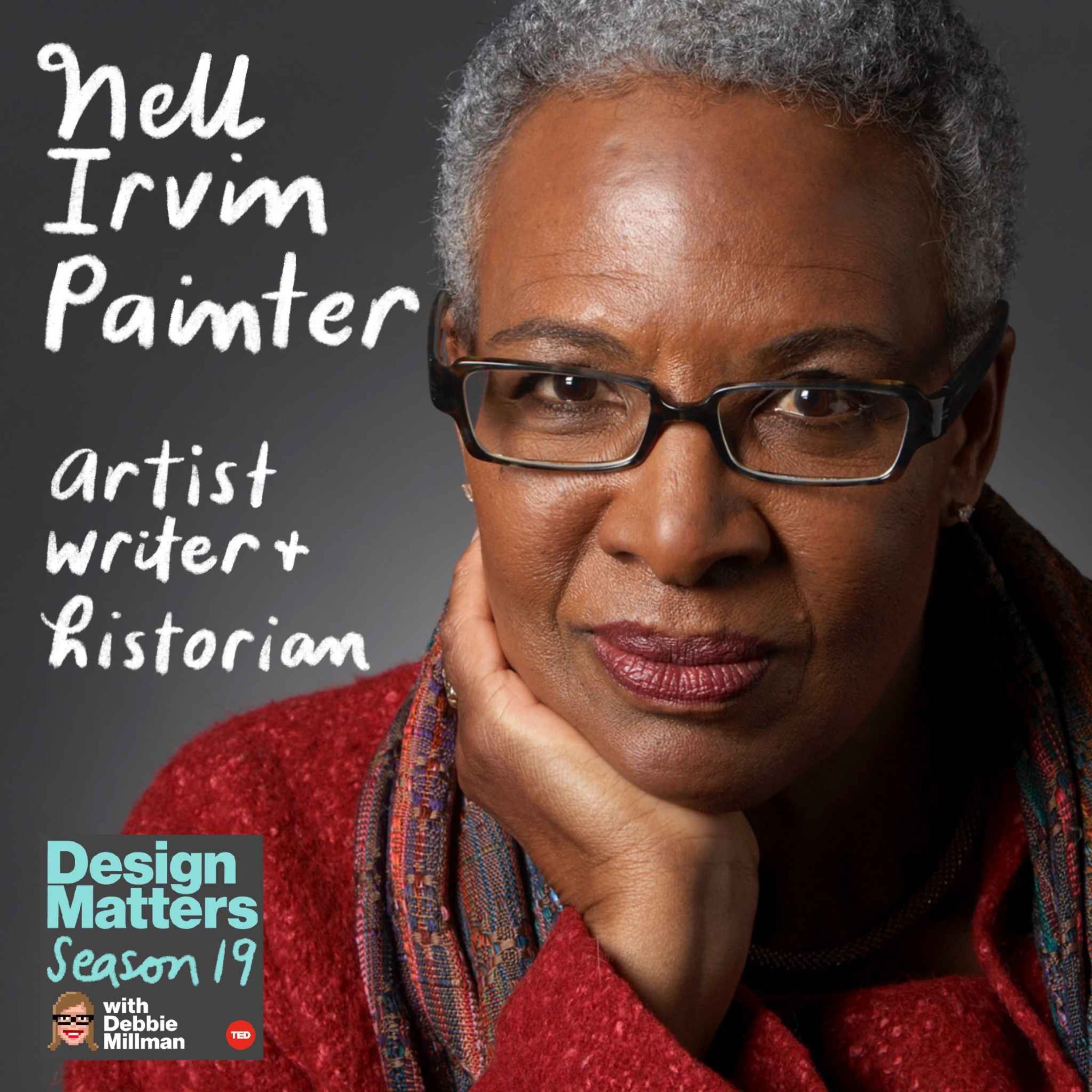
This episode features a conversation with historian, author, and artist Nell Irvin Painter, discussing her career, perspectives on history and art, and her latest book, "I Just Keep Talking: A Life in Essays."
Written by AI. May contain mistakes.

Get the gist, explore an idea or ask about something said.
 Claude
On Design Matters with Debbie Millman, what are the key points of this episode?
Searching your listeningAutomatic transcript. May contain errors.
0:00Believe it or not, it's the 20th anniversary of Design Matters. 20 years. To celebrate this milestone, I'm hosting a special show on April 17th at Symphony Space in New York City. I'll be joined by some of my all-time favorite guests and some new ones. There will be interviews, there will be music, there will be magic, and I'll be giving out copies of my brand new book, Love Letter to a Garden, and a limited edition print of artwork from the book. To purchase tickets, go to symphonyspace.org. Hope to see you there. This episode of Design Matters originally dropped in April of 2024. When I am with other Black women writers and they talk about what made the difference from them, they talk about when they were girls and they read Toni Morrison.
0:54When I was a girl, there was no Toni Morrison.
1:00From the TED Audio Collective, this is Design Matters with Debbie Millman.
1:08For 19 years, Debbie Millman has been talking with designers and other creative people about what they do, how they got to be who they are, and what they're thinking about and working on. On this episode, Nell Irvin Painter talks about history and art. As a historian, I knew what the values and the standards were. In art, I did it.
1:34Sometimes you can tell a lot about writers from the names of their books. Here are three titles by Nell Irvin Painter. Southern History Across the Color Line, Creating Black Americans, African American History and Its Meaning, 1619 to the Present. and The History of White People. Now Irvin Painter is a distinguished, award-winning historian, and she's written a lot about the South in the 19th century and about race. She's also a retired professor emerita from Princeton University, and by all rights, she could be resting comfortably on her laurels, but she is not because she is also an artist. The title of another of her books is Old in Art School, a Memoir of Starting Over.
2:26These two pursuits, history and art, come together beautifully in her brand new book, I Just Keep Talking, A Life in Essays, which is punctuated throughout by images of her paintings. Nell Irvin Painter, welcome to Design Matters. Thank you so much, Debbie. I'm glad to be here. I love the title of your podcast. Thank you. Because design does matter. Yes, it does. Yes, it does. Now, your parents fell in love at first sight in the Houston College Library and got married when they were 19 years old. They were married for 72 years until your mom died at 91. You've said that this made it fated that you'd be a writer.
3:15And I'm wondering how the two are connected. Well, my parents' college was actually called Houston College for Negroes. Yes. This is very much Texas in that time. It was a jerry-built institution. They knew it. But my mother had started at Prairie View, which is where she was the youngest, where her siblings went. But her father died and left her mother too impoverished. The next sibling, her older brother, was at Howard to become a doctor. So he was the favored son. And my mother, Dona, had to come home to Houston. My father's family was not as educated as my mother's family, but my father's family did want him to go to college, so they met in Houston College for Negroes in the library.
4:11So I say I was fated to be a reader, and having lived a long life, I took the next step into writing. What do you attribute to the success of a 72-year marriage? You know, people used to ask my father that. My father was a very beautiful man, very lovable, very charming, with a bit of a wit. And he would say, eat shit. And then my mother would say, no, no, no, no, no, no, no. So I guess it was an older version of Happy Wife, Happy Life. Something like that. Yeah. My father was, you know, the charming face of the marriage for decades. And my mother was very shy, had speech impediment for decades, couldn't talk on the phone until she started getting jobs that were commensurate with her education and her ability.
5:16She was a fantastic organizer. So when she retired at 65, she decided she wanted to do something different. And she started writing books. And her second book is a memoir called I Hope I Look That Good When I'm That Old, because that's what people said to her all the time. And now they're saying it to me. So maybe I should write I Hope I Look That Good When I'm That Old, part two. Absolutely. Absolutely. One of your earliest memories is sitting on the floor with a gathering of your parents and their friends to listen to the presidential election results in 1948. Were your parents rooting for Truman?
6:06No, they were rooting for Wallace. I come from a good lefty family. But I should also add that people like Coretta Scott, she was not yet married to Martin Luther King Jr. She was also rooting for Wallace. And you didn't have to be very far on the left because Wallace, in addition to running a progressive campaign, it was called the Progressive Party. It was also anti-segregation. And he campaigned in the South to desegregated audiences. So it was a very forward-looking campaign. I thank my parents for bringing me up on the left, because it saved me from so many disappointments in my country. You know, I didn't expect things to change radically, as, say, the Civil Rights Act of 1964 and the Voting Rights Act of 1965 and the Equal Housing Act of 1968.
7:15I welcomed all those things, but I didn't think they were going to be the end of the line. So I grew up with people like Paul Robeson and W.E.B. Du Bois. And as I say in one of my HERS columns about living in Ghana in the 60s. So I had an unusual background. And it's one of the reasons that I very much appreciated Roxanne's stepping out and talking about society and culture and work in general, because I do believe my background gave me that, even though I was very conscious of the pressure only to talk about black stuff. So even now, The History of White People, which is my best-selling book, and which I think is my best-known book, it gives people pause.
8:12They say, you know, how should we think about you? And I say, as a historian. You were born in Houston. That's right. But your family's roots reach back into Ascension, Baton Rouge, and St. Landry Parishes, Louisiana, Low Country, South Carolina, around Charleston, Harris County, Texas. How did you all end up in Oakland, California? Well, we were part of the Great Migration. And the easiest way to answer that is by train. so my father's family had moved from Harris County, Texas to the Bay Area in the 20s so they were already there and actually when my parents came in 1942 they sort of looked down on them as southerners This is, you know, the oldest story in the world of groups whose older migrants look down on the more recent migrants.
9:16But at any rate, my father went first and got partially settled, got a job. And then my mother came. I was just an infant in arms. I think you were 10 weeks old when they moved. I was 10 weeks old, yeah. So these trains, this 1942, the trains are full. And my mother with two children, my older sibling who tragically died as a young child, and this babe in arms. And she said that a black soldier gave her his seat and he stood up all the way from Houston to Oakland. Wow. Wow. Your older brother, Frank Jr., as you just mentioned, he died during a routine tonsillectomy. Yes. And you've written how your parents poured all the love they had for one lost child into you.
10:12Yeah. And the sense of safety you experienced through your childhood endowed you with resources that you recognize now as resilience. Why and how did that result in resilience? Because they were always there for me. They were always on my side. I never had any doubts. I was never subject to physical violence or emotional violence. And I remember at Stanford in the 80s, I was at the Center for Advanced Study in Behavioral Sciences. But at the time, I was teaching myself women's history and women's studies. So I would hang out with women in gender studies at Stanford. And I was absolutely amazed to hear so many women talk about their mothers as impediments, their mothers as their enemies.
11:10My mother, myself, my mother in my way, my mother is the source of miseducation. And I always thought of my mother, like my father, as my safe harbors in a hostile world. Your dad is actually the person that first taught you how to draw. That's right. And what kind of things were you drawing? Horses. really why horses i don't know why horses but i know that that's a thing that young girls draw something maybe eatable i don't know i yeah i was drawing houses with bad grass i had trouble with grass i also drew paper dolls because i liked clothes yeah so did i i loved paper dolls So, I mean, these are just every day.
12:02I can't say I did anything spectacular, but I do remember one time I was in class in elementary school, and I drew a walnut. I don't know why. It was a beautiful drawing of a walnut. And I wrote under it, nuts to you, Mr. So-and-so, who was my teacher. I got in so much trouble over that. Why? As if I had threatened him with an AK-15 or something. But my teachers always complain that I talk too much. So I was obviously a really smart kid who did my work. But I was also, I knew too much. Hmm. You applied to Howard University and you were accepted. But at dinner one night with the distinguished Howard University sociologist E.
12:55Franklin Frazier, who's a friend of your dad's, told you this, Nell Irvin, you're too smart and too dark to go to Howard. Absolutely. Why? What happened? Like, why did he feel that way? Because it was true. Howard University, I mean, we're talking 1960 now. So this is in the olden days. And in those days, Howard University, probably like many other black institutions, was a hotbed of colorism. And so if you look at my generation of educated men, black men, every single wife, except my father, married as light-skinned a woman as possible. The lighter skin, the better. And of course, this is the time when women in college were trivialized as only being in college to get married.
13:55so if you know about those assumptions it makes good sense for me not to go to Howard and I heard stories about Howard at that time which were really it was such cruelty and so I told this to a team who were filming me this is when I still lived in Newark I was in my studio in the Ironbound. And they came and we, I forget what we were talking about, but I told them about that. And so this is like, it was before coronavirus, but it was in the 20 teens. And they said, oh, that still holds. And it holds for men as well. Wow. Yeah. So I'm glad I'm not young. I don't know how I would manage this world if I were any younger than I am.
14:55You ended up attending the University of California, Berkeley, where you were active in the student government, in art circles. You illustrated two covers of the Campus Humor magazine. You also took a course in sculpture, and I understand you didn't do particularly well in the class. Tell us about that. Tell us about that experience. My father did not teach me about sculpture, so I had no way into sculpture. And I didn't do any work. I thought that if you were talented, it would just come out. And it was almost kind of like that for me in my regular classes. You know, I didn't have to work terribly hard to get very good grades.
15:41I was an honors student throughout. But I didn't have any handle for sculpture. I didn't know sculpture. I didn't watch sculpture. I didn't know sculptors. So I made a really terrible project, and I got to see. And I thought, well, that just proves I don't have enough talent. Now, how wrong can you be? I mean, I see now that talent is drawing you to something enough to do a lot of it and get good. It's not so much a talent, but an inclination. At that point, what did you want to do professionally? What did I want to do professionally? I don't think I knew. I don't know. But, you know, I was under no pressure.
16:36to make a decision. My parents were with me and taking care of me, so I didn't feel like I had to decide. You graduated with an honors degree in anthropology. I did, yeah. At that point, were you considering becoming an anthropologist, or did you just know you were going to go on to get advanced degrees? It wasn't as hard as that, because my parents had already moved to Ghana, and I was going to join them, so I didn't have to make any decisions at that time. I started graduate school in Ghana in African studies. And then there was the coup d 'etat and the end of African socialism and Kwame Nkrumah's Pan-Africanism and all the reasons that the Irvans had gone there in the first place.
17:21So we came home, and I finished my master's degree, you know, still not exactly knowing what to do at UCLA in African history. I had always liked history. And, you know, my high school class was tested up the wazoo. I mean, and I tested at the like the 99th percentile in interest in history and the 99th percentile in ability in history. But at that point, coming out of high school, the only history that I knew that was recognized as American history was just so Jim Crow. I mean, I knew that it was full of lies, and I didn't want to do it. So anthropology was the place to study other people besides white people.
18:14And I loved anthropology. So I got my MA in African history, and I was actually admitted to the School of Oriental and African Studies at the University of London. And that fell through. Well, it had to do with the then love of my life, which didn't work out. Thank heaven. Right. It's always so heartbreaking when it's happening, and then after it's like, what was I thinking? Yeah, that was not meant to be. So I ended up, finally, in 69, my father said, okay, we're ready to pay for all the schooling you want, but only in the United States. So that's how I got to Harvard. You know, you mentioned being in Ghana with your parents.
19:07You wrote that the people of Ghana impressed you from the moment you stepped off the plane and that your experience there was one of the best things that ever happened to you. Absolutely. And I still say a trillion years later, that if I'm at all sane, it's because I had those two years, not only outside the United States, but also in a majority black country. and people, I have not been back. My father went back to Ghana with some friends and was very attracted to buying a house and staying there. But my father also was a real materialist and he said, I couldn't get clear title. And so he would not buy real estate in a place where his money would not be protected.
19:59But I did not go back. But I hear from people who are coming from Nigeria now or Ghana now, and it's very different. Ghana is much more open to the world in ways that have made it, I think, a little richer, but also mean that some of the bad things like anti-gay legislation and just reactionary stuff and even pressure for women to lighten their skin. You know, all of these things have come with the opening since the 60s, opening in the 21st century. So when I tell people that I was in Nigeria and Ghana in the 20th century, they look back and they say, oh, that was the good old days. I understand when you were first there, you found being a member of the racial majority disorienting.
20:59It was, because even though I never lived in the South, thank heaven, I lived in a racist country in which race was the thing that bore down on me the most. And I used it in ways I didn't realize until I got to Ghana to orient myself in humanity, in politics, even aesthetically. So when all that was withdrawn in Ghana, everybody was black. The smart people were black, and the dumb people were black, and then the hardest of all was the mediocrities were black. Just everybody. So that didn't work. So that in Ghana was where I first started seeing, really seeing issues of development and economics and the tensions in your ideals and the real world.
22:03So I learned so much there that I took into graduate school and I took into my writing. When you were at Harvard, I believe that's where you first met Nellie Y. McKay. Is that correct? That's right. Yeah. I know you had a deep friendship. You exchanged letters to each other for 30 years. That's right. You shared a friendship that sustained you both until her death in 2006. Right. One thing that I thought was really interesting was how she helped you understand why, despite your book, I believe your second or third book, Sojourner Truth, A Life, A Symbol, winning the Black Caucus of the American Library Award, it wasn't reviewed by the Women's Review of Books.
22:51Yeah. When she did that bit of smoothing for you, what did she discover? I couldn't understand why this book, even then, in the 90s, Sojourner Truth was known in women's history and women's studies, for heaven's sakes. I was a recognized scholar. I was well published. W.W. Norton published that book, so why not review it? So I asked Nellie, who was deeper in women's studies, and she sleuthed around, and she found that, I think it was the editor told her that a couple of potential reviewers had trouble with the book. and I gathered that trouble with the book was my insistence, which I'm doubling down on in a project to come, that Sojourner Truth did not say, aren't I a woman or ain't I a woman, as I suppose it was southernized in the 20th century, assuming that Sojourner Truth, having been enslaved, she must have been a southerner, which of course was wrong.
24:04The project I'm working on now is a series of historical essays on Sojourner Truth called Sojourner Truth Was a New Yorker, and she didn't say that. So it turns out that so many people, black women as well as white women, were, are invested in the slogan that a white woman journalist made up 12 years after Sojourner Truth spoke up in Akron, Ohio in 1851. they react i mean people have told me they say why are you tearing down sojourner truth i'm not tearing down sojourner truth i'm asking you to see more of her than a slogan and her arm bearing you know in a show of muscle it was yeah a slogan from somebody else's art francis dana gage produced a very dramatic story, which is much more dramatic than anything we have from Sojourner Truth, because she didn't read and write, so everything we have quoting her comes from other people.
25:17And so she could serve this handy, sloganized purpose without knowing that Sojourner Truth was a New Yorker, that New York was a slave state, that there were other black women who were feminist and abolitionist, and some, like Frances Ellen Watkins Harper, were even more critical of white women as suffrage became a searing issue after the Civil War. So my point is that stopping with a slogan means that you miss out the richness of Sojourner Truth. She's so much more. It really breaks my heart now that I know so much more about this story, that this is what she's been known for, for almost entirely that refrain of a fake speech.
26:18Yeah. So we can keep the meaning, but we should jettison the slogan. After that book, you began to write more visually. And in 2006, you published Creating Black Americans, African American History and Its Meanings, 1619 to the Present, a narrative history whose illustrations are black fine art. What inspired that evolution in your work? Sojourner Truth. And so during her lifetime, Sojourner Truth was rather astute about her own image. She commissioned photographs of herself when the technology was brand new. Yes. She sold cards with the slogan, I sell the shadow to support the substance. How did that inspire you to take that step into more visual art?
27:09Well, there are a couple of steps before that. So not having words from Sojourner Truth. As a biographer, I had to try to find ways to understand her from her. So the answer was her photographs, which she controlled. So one of her favorite photographs, and my favorite photograph, is Sojourner Truth sitting with her knitting on her lap. And one of the chapters, one of the essays in the new book is Sojourner Truth Knitter. I'm a knitter, too. And the story of knitting and black women and white women in knitting is just, it's very enjoyable for me as a knitter. So anyway, I got involved in Sojourner Truth visually, and that is what got me to art school.
28:06And by the time I got to art school, I was also very much involved with art history. And one of the teachers said, I remember this was at RISD at the Rhode Island School of Design, thinking that there was no black art before Basquiat. Oh, God. And I thought, oh, boy, because even when I was a kid, my father's favorite artist was Elizabeth Catlett. And he actually went to Mexico and came back with an autographed print of hers. So I grew up with Elizabeth Catlett and Charles White, you know, the modernists who were deeply invested, actually, in socialist realism, kind of, you would say. But at any rate, I knew that the art was there.
28:59I didn't know all the artists I finally found and included, but I knew the art was there. And I also knew that black artists had said that they wanted to show the unsung beauty of black Americans, and that there were different versions of prominent people, like Frederick Douglass, for instance. So in creating Black Americans, you don't get a picture that says, this is Frederick Douglass. You get more than one rendition, and I tell you who the artist is and what the artist said they wanted to show. And so, of course, that changes over time. So art made my point about various ways of seeing and processing and representing historical figures.
29:57and the artist could put the passion in that I didn't feel that I could as a scholarly historian. I wrote because in a way that I wanted any reader, whether you agreed with me or not, to feel that you were reading solidly researched history. So the artist gave the other side. I really think that that book opened the door to so much of the recognition and popularity of Black modern art today, which is some of the most popular art and certainly the most interesting art that's happening. Good, good. the impetus for your award-winning 2010 New York Times bestselling book, The History of White People.
30:56No, it is not award-winning. The History of White People, it didn't win anything. Nothing? Nothing. Wow. Yeah. Wow. That was such a hard book for people to deal with. Oh my God. People would ask me as I was writing, are you writing it as a black person? I'm writing it as a historian. Well, I'm glad it was a bestseller, but I'm just horrified at the idea that it didn't win any awards. But in any case, it came from a question in your mind. And I'm wondering if you can share what the question was and what you discovered. Yeah. Yeah. That's how my books start. My Sojourner Truth book started with the tension between the verbal and the visual renditions of Sojourner Truth.
31:56You know, it seemed that there was a tension there because as she was quoted, she was kind of the Black Power Sojourner Truth. But as she showed herself, she was a perfectly composed bourgeois. You know, what's going on here? So that's the question that started Sojourner Truth. With the history of white people, you know, it seems like Russia's after its neighbors all the time. And at the turn of the 21st century, Russia was after its neighbors in the Caucasus, which is also a long-standing pursuit. Russian imperialism has turned toward the south as well as toward the east. And so Russia had bombed the bejesus out of Grozny, which is the capital of Chechnya, which is the North Caucasus.
32:49and there was this really arresting photograph in the front page of the Times of bombed-out Grosny and I thought, well, that looks like Berlin in 1945. What is going on here? And then the next question, I could find out what was going on there. I could, you know, read the paper. But then I thought, well, why are white Americans called, in effect, Chechens? You know, white Americans are called Caucasian. And how many Americans even know where the Caucasus exist, where they are? Who are the people? Nobody knew. And I asked a couple of my white friends, you know, why are white people called Caucasians?
33:37And they said, well, we don't know, but we thought we should know, so we never ask anybody. And so it was this big mystery. So I delved in and tried to track it down. And I ended up for that part of the book in Germany. And what did you discover as the way it became socialized? Well, this German story, Göttingen, the university there, the great anthropologist John Friedrich Blumenbach had a collection of skulls, and he is one of the founders of what we consider race science. I still call it race science because it was the science of the times. This is the Enlightenment which invented race for people.
34:29And so Bumenbach decided that there were five varieties of mankind, and he embodied each one in a skull, because he had a big skull collection. And his prettiest skull was from a woman who had been raped to death in Moscow, a woman from the Caucasus, from Georgia, which is the southern Caucasus. But it was a really pretty skull. It didn't have dings. The teeth were good. She had never been pregnant, I assume, a very young woman. And in Blumenbach's scheme, he put the varieties on a horizontal. He didn't rank them vertically. It was all horizontal. And it was physical aesthetics. So the most beautiful variety was the Caucasian.
35:26At the ends were the Asian and the African. In between were the American and the Malay, which is South Sea Islands. So it was a ranking that had to do with beauty and also into a millennia-long slave trade from Ukraine, from the Caucasus, into the Eastern Mediterranean. And that trade actually reached Venice and reached Italy, which was a slave society for many, probably for millennia, yeah, certainly Greece. And the ideal of the beautiful, young, sexually vulnerable girl, woman, is a longstanding ideal, which we recognize in the Odalisque. Now, this is probably a question that you get asked a lot.
36:31You might even hate it. But I do want to ask, as a species, humans are pretty barbaric. Well, sometimes. A lot of times. A lot of times, yeah. More often than not, it feels. Yeah, certainly one feels that now. I was on safari in Tanzania a couple of years ago and learned that the zebra don't hunt prey. Zebras are vegetarians. And while they're hunted, they do not hunt. Why, as a species, are we not more gentle with each other? Why do we seem almost genetically predisposed to want to harm or enslave or create rank as a species? Why is that something that is so deeply ingrained in who we are? Well, obviously, I have no answer to that.
37:45However, I would add that that's not hilarious to it. People are capable of kindness and solidarity. But I also notice, you know, we spend a lot of time up in the Adirondacks, and I see animals there. I see wasps and things like that. And they go at each other with a ferocity that is really scary. And so we're not the only ones in the world who are capable of cruelty. But I don't have an answer of why that is. I do see in human history that I brushed up against in writing the history of white people, that the story of people is moving, is migrating. And can I use the F word here? Oh, yeah, absolutely.
38:44Go right ahead. It's walk around, fuck, walk around, fuck, walk around, fuck, walk around, fuck. So we're always churning our DNA and also bumping up against each other, and that's part of it. But the question you ask doesn't just pertain to people whom groups define as others. people are capable of doing astonishing cruelty to people like their wives their children yeah their pets i mean yeah i just i just from an evolutionary point of view i just don't understand why we just can't be more like the zebra yeah well there would be too many of us for one thing. There already are too many of us. So maybe that, you know, sort of balancing the women's role as creator and the man's role of keeping the population down.
39:44I don't know. I do not know. And I don't know of anybody who does know. Yeah. I just think about this all the time now. I see what we're doing to each other in the world, what we've always been doing. But right now, the amount of cruelty that we're facing, feels unsurmountable. But I'll talk a little bit more about that later when we get to your most recent book. Yeah. Because you talk about it quite a lot. But I will say one thing here, that in order not to lose my mind, I do not spend time on stuff I can't change. I try to focus on the state and local. And there are good things going on. I live in New Jersey.
40:29There are good things going on in the state and local here. And I give money to local causes and local nonprofits. So I try to keep my gaze focused below the national and international levels. A few weeks ago, I was in New Haven talking with the group who foster young people, not foster literally, but ease their way into staying into K -12 and then going on. And in the questions, one man said, what can we do about all this book banning? And he's wringing his hands about stuff that was going on in the South, in Florida and Texas. and so forth. And I said, we can't do anything, because those policies are made on the local level.
41:28If you want to change that policy, you have to run for school board in Florida. So I would say, find a better worry. Yeah, find a better worry. The publication of The History of White People marked a real watershed moment in your life after the book was published, you decided despite already having a PhD from Harvard University, you wanted to go back to school to get another bachelor's degree, but this time in fine art. What inspired that decision? Two things. Sojourner Truth and that stay in the art history library had really reawaken my attraction to images and to imagery. And the other thing was I just wanted to do it.
42:24And I could. My husband takes care of me. I didn't have to worry about I had the money. And art school is, as you know, absurdly expensive. Yes. And the degree you come out with is not going to pay your rent. So luckily, I didn't have to worry about my rent, and I wanted the degrees, plural, because I wanted to be professional. I wanted to be professional in the way I was professional as a historian. That has not been totally smooth, but with I Just Keep Talking, you see where I got to in ways that I could put the two together. It took me 10 years to put my historical self together with my visual artist self.
43:16It was very bumpy. And even now, I cannot go from concentrating on writing to concentrating on drawing without a kind of week or so of just changing gears. You got your BFA from Mason Gross School of the Arts at Rutgers University. And though you originally didn't know if you wanted to go to graduate school, you ultimately realized that you did. And you've written that this was because you wanted to work harder than the kids did. You wanted to be more intense than the kids were. And you thought graduate school would do that for you. Did it? Yeah, it did. It did. It was the hardest thing I've ever done.
43:59I tell people getting a PhD from Harvard in history was a piece of cake in comparison. Why is that now? How is that possible? Well, I guess the easiest way is to say that as a historian, I knew what the values and the standards were. In art, I did it. So some of the art that I looked at when I was an undergraduate just looked like piles of stuff to me. I didn't understand how you use visual archives as opposed to how you use historical archives. And I was too tight and too focused on what I call discursive meaning when I started to what I came to later on in graduate school was a real loosening up.
44:57And that was something I really had to do. You went to the Rhode Island School of Design or RISD. Yeah. What did the students make of an African American woman in her 60s alongside them in class? I think kind of nothing. Really? That is not true of everyone. I mean, we were very small. We were 12. But a couple of them felt old because they were like 31, 32. But I was just this old lady, and my bona fides, which came from academia, counted for nothing. And the thing that really summed it up, at the end of the school year, we were going to take our picture. So everybody assembled at the given time, and nothing happened, and nothing happened, and people weren't there.
45:54And so finally, you know, I'm always on time. But I finally said, look, I have to take care of this thing in my studio. Call me when you're ready to take the picture. And as soon as I left, they took the picture. You know, despite all the accolades you got as an historian, in, you often got what you referred to as stinging criticisms that were one long tearing down, in addition to this other utterly disrespected behavior. One professor even told you that you would never be an artist. I'm assuming that that was a white cis heterosexual man. In any case, Why did he say that to you, and how did you respond, and how did you recover from that?
46:48Yeah. His name was Henry. He was a printmaking teacher. And this was my first semester at RISD, and I was feeling my way. You know, I was not an experienced printmaker by any means, but I tried hard. And he called me dogged. And it wasn't like, oh, you are dogged. You are very hardworking. No, it was you are dogged. So I called him out on it because I knew teaching. And, you know, if you're a good teacher, you don't say things like that, too. So I said, Henry, that's bullshit. He said, you may sell your work. You may have collectors. You may be in museums. You may have a gallery. But you will never be an artist.
47:39and that stung and I would say yeah what saved me was I had friends at Yale they put me back together again you did a fellowship there did you did you after I graduated from Misty yeah you did a lot of research after that experience and discovered how many people have either been told that they'll never be an artist or have known somebody who was told that they would never be an artist, whether it's a fine artist or a poet or a playwright or any field in the arts. Can you talk about this in relation to what you refer to as the talent mystique, the great man mystique and the genius mystique? And I'm wondering if you can talk a little bit about that.
48:22I can talk about that actually more easily through publishing, because because the publishing world right now, people are tearing their hair. Oh, it's terrible, you know, all this consolidation. And in the good old days, an editor could foster a writer, even though the writer was not selling out, and just wait until that writer flourished. And now there's just, oh, it's so terrible, the marketing. Oh. But at the same time, the early reviews came through, I got two really good, strong early reviews from Kirkus and from Publishers Weekly. And another list maker said, these are the 45 best books by women of color this spring.
49:15And I thought, 45? Wow, that's fantastic. So I wonder if my 45 best books by women of color is related to the good old days gone by, when the good old days gone by were white male writers. In the 20th century, there was a tiny sliver of publications by white women. There was almost nothing well known by black women. The breakthrough is with Toni Morrison. And that is like in the 1980s. When I am with other black women writers and they talk about what made the difference from them, they talk about when they were girls and they read Toni Morrison. When I was a girl, there was no Toni Morrison. it's astonishing how often i hear from artists writers designers playwrights musicians how someone along the way in a position of power authority told them that they couldn't be who they ended up becoming and did it anyway whether that be doggedness or resilience or just desperation because you can't do anything else What do you think those teachers and professors make of your success now?
50:55I mean, despite what that teacher said about even if you do this and even if you do that, you would not be an artist. You are an artist. Yeah, I am an artist. And a successful artist. What do you think they make of that now? I don't know what Henry makes of it. He was so pigheaded. He says, I have to say what I know to be true. So he probably still knows that to be true. But I had a teacher, both at RISD and at Mason Gross, who would come into our RISD crits and say, you can't draw and you can't paint. There's nothing on the walls that's interesting. And I was mortified. I believed her. I was so pathetic.
51:41Pathetic because you believed her or pathetic because you felt? No, because I believed her. I believed her. I mean, that's the crucial thing about the arts, because there are no standards. And I finally decided that what counts as value in art, what is good art, it's the market that decides. There are no freestanding standards of quality in the art world. So at any rate, she would say, you can't draw and you can't paint. And I thought, oh, woe is me. But years later, after I published Old in Art School, and she recognized herself, she came up to me with great pleasure. She was so glad to see me.
52:29All right. Okay. Well, you write in Old in Art School, which did win an award. Yes, it did. That one I know for sure. It was a finalist for the National Book Critics Circle Award. But you write about the difference between objective criteria in history, but how art is virtually all subjective. And state this, what I really liked was stepping away from the tyranny of the archive and being able to move into visual fiction and make things up. That's my great pleasure in art. Yeah. I mean, did you find it? It seems like at first it was terrifying and then it became freeing. Yeah. Would that be correct to say?
53:10I don't know if it was terrifying. It was challenging in that I knew that I needed to be better at it. But I also knew the way to be better at it was to do it. And if I were teaching in art school, I would say, make the art only you can make and make a lot of it. Yeah, you say that that's crucial for an artist. make your own art, make art only you could make, and make a lot of it is one of my favorite quotes of yours. It does seem unthinkable to me as a teacher in an art school, although I teach branding, which is an art, but it's not a fine art. I couldn't imagine telling a student that what they were doing had no meaning or value.
53:55It just feels like that's telling a person that they have no meaning or value. And it feels just epically unfair. You are now exhibiting your work all over the world. You've had numerous solo shows. You've been included in a long list of group shows. You're a part of many public collections. So I just want to say congratulations for that. And thank you for showing up all those bigots and assholes. But I do want to talk to you about your brand new book. I just keep talking a life in essays. And you begin the book with a quote by Elizabeth Alexander from her book, The Trayvon Generation. You quote her and state, art and history are the indelibles.
54:41Yes. Why that particular quote? Well, I have been such a long admirer of her as a poet and a writer. So she was my host in 2012 at Yale, for instance. So she moves easily back and forth between the visual and the verbal. So that is what I wanted to capture. The strength of, I mean, she's really well known now. So if I say she said something, yeah, it must be true. And since my book does both the visual and the verbal. I wanted her impromptu saying, yes, that's what we need to do. I Just Keep Talking features your artwork alongside your writing. And in the essay, What 18th and 19th Century Intellectuals Saw in the Time of Trump, you state, for a long time, I assumed that going to an art school and making art separated me from my former vocation as a historian.
55:45But now it seems now that you've fully integrated both of your practices as an artist and as a historian. Do you feel as comfortable in one as another and sort of in that center of the Venn diagram, like comfortably center in that? Good question. And I'm more comfortable as a writer because I'm better known. when I go into art spaces I feel viewed as just a little old black lady because people don't know who I am and even when I was you know a la-di-da historian I could go to history meetings and if I wasn't wearing my badge that had my name with Princeton on it I could you know I was just a little old black lady.
56:33Yeah. Part of my having to flop around and find a place was that my work is sometimes called illustration, which is a bad word. You know, illustration is inferior to painting. It's inferior to fine art. And I felt bad about that for a long time. But in 2022, I was at PAFA, the Pennsylvania Academy of Fine Arts, to make another lithograph. And I fell in with a teacher of illustration, and he taught me about editorial illustration. And so I say, that's what I do now. I do editorial illustration. That makes a lot of sense. That makes a lot of sense. And as somebody who's been in the commercial art world for a very long time, 40 plus years at this point, I can say that if anybody referred to me as an illustrator, I'd be really proud.
57:35Oh, really? Okay. Oh, absolutely. I mean, and the great, you know, some of the greatest illustrators of our time, you know, Christoph Niemann and Barry Blitt and Myra Kelman. I mean, they, I mean, she's also both an illustrator and an artist. Yeah. She was one of our great inspirations. Yeah. Yeah. I think that they're making some of the best work in the world right now. I Just Keep Talking is a collection of both formal and more informal writing, and it offers deep commentary on a variety of subjects from history to visual culture. And I know you talk a bit about this in the coda, but can you tell us more about your methodology for assembling the collection.
58:17And what you're hoping readers will, no pun intended, draw most from it. Yeah. I took probably three weeks or so at MacDowell just trying to assemble it, because there's much that's left out. So there had to be relevance to now. So most of the pieces are 21st century pieces, though there are some older pieces that still ring true, like the one from the 80s about affirmative action. Especially true now. Yeah, exactly. So they had to kind of stand on their own, but also be related to the other things in the book. I depended on my social media people a lot. I would say, like, I'm putting this together, and I have essays on history, but I also have essays on Southern history, and I started my historical career as a Southern historian, so I know Southern history, and I know it's not the same as history, as U.S.
59:29history. So I said to my people, then I was just on Facebook, you know, how should I organize this? Should I put Southern history in history? And some of the people said, no, no, no, it's separate, it's different. They finally ended up by saying, well, there should be a section called history, and then there should also be a section called Southern history. And that's how I finally did it. And then there was the question of the art. And some of the essays needed art that didn't exist. So then at Yaddo, I made a lot of different drawings, not all of which got into the book. So I worked back and forth between the words and the images.
1:00:14I think being in art made a difference in the way I start writing, because I'm very likely now to start writing by hand, which I didn't do before. Does it feel different? It does. It feels slower and a way to get into questions that were not in my mind, questions that may have no answers. You know, like your question about why are people so mean? It has no answer, but it's a really good question. And I think it's important to talk about it because I think we need to find the answer. Yeah, yeah. In your introduction, you talk about W.E.B. Du Bois' idea of two-ness, T-W-O-N-E-S-S, and how you experienced it differently.
1:01:04And I'm wondering if you could talk a little bit more about your understanding and experience of that two-ness. Sure. The quote from 1903 is about the Negro, and I grew up as the Negro, capital N, of course, but it was not a bad word at all. It was the progressive word as opposed to colored, say. So when Du Bois wrote, it was about being the Negro in a situation in which you're in the minority, and how does it feel to be a problem. But I didn't know when I went to art school that my otherness would be as being old. And that made such a difference. So when people talk about black artists, and they mean black artists now in their 20s, 30s, 40s, 50s, and 60s, it's very different.
1:02:08This summer, I'm going to be 82 years old. So I have been around for a long time, and a lot of the people who were young with me are dead or are not in good shape now. So I have rather few book prizes because when I was the age of young and up-and-coming historians, book prizes were not being given to black women. And then by the time I get into the age when black women are getting prizes, they are going to younger artists and younger writers. So I look back at modernists like Margot Humphrey, for instance, a fantastic printmaker, who never got her due because she was flourishing in the time before the country could see her greatness.
1:03:13So in a way, I am in that cohort, but I'm also in a younger cohort that looks at me, if they don't know who I am, as just the old lady. And, you know, it's deadly enough to be an old lady of any sort, but to be an old black woman is to be the picture of impotence, of someone who cannot do anything for you. But the great thing about living in Essex County, New Jersey, particularly living for many, many years in Newark, now we live at the next suburb, which is East Orange. In Newark, there's black power, and there are lots of black people, including black women, including old black women, who are powerful people, and they don't get ignored or swept under the rug.
1:04:08But that has not been my experience through much of my life. Well, I hope that changes with, certainly with this book, which it deserves to be acknowledged. I want to talk to you about a few more essays. Thank you for your careful reading. I really appreciate this. Oh, it was an honor and a pleasure. It's a fantastic book. Thank you. In the 2017 essay, Long Division, you write about the construction of race through the lens of the work and thinking of writers such as Toni Morrison and James Baldwin. And the section on race as a determinant for the othering or belonging of people in American culture felt very pertinent to our current today cultural climate.
1:04:55And I'm curious, how do you see us handling this now in the wake of the possibility of a second Trump term? I see lots of handling, at least two different kinds of handling. One is that we go deeper into Trumpiness. You can't talk about diversity. You can't talk about race. You can't talk about history. You can't, you can't, you can't, you can't, you can't. And we are going to enforce this through the force of arms. That's one way. Okay. I don't think it's going to happen. Really? Yes. That was my next question, especially from the essay, It Shouldn't Be This Close, but there's good news too. Yeah.
1:05:43Close, yes. But when you considered it in the last, what, eight presidential elections, Democrats have won the popular vote. There are more of us than there are of them. We don't often think of it that way, but it's been happening. And I would say that even before Dobbs, even before the in vitro of cultivation, conception? Conception. Alabama, yeah, the Alabama IVF. Yeah, which are going to already have been good for Democrats, as women reject this kind of triage between women and fetuses. I also suspect that Trump is going to self-destruct. There's just too much going on, and he's been incoherent in so many ways.
1:06:48I don't think that is going to end the devilment in our country, which antedated him. I don't know if you can see behind me. Yeah, on this side, on the wall, that's American whiteness since Trump. Yeah, which I made in 2020. and one of the pages says, weren't you paying attention? Here's George Wallace. Here's Buchanan. Here are these people. And they have been telling you about white supremacy. Historians have been telling you about white supremacy. It is a longstanding ideology in this country. And so as I say, I don't think Trump is going to make it. Your next question is, or statement is, oh, I'm so relieved you're optimistic.
1:07:45No, I am not optimistic. I have been black in the United States too long to be optimistic. I just don't think that some of the worst is going to happen. Does it worry you, though, that it's the Electoral College that elects the president as opposed to the many, many more Democrats there are in this country? No, because as I said, I don't worry about things I can't change. If there is a movement, and it would have to come out of Congress, I would support that. I would give my money. I would support whatever Congress people or persons who are pushing for that. But I don't see any reason to worry about things I can't change.
1:08:36At the end of the book, you have a visual essay titled, I Knit Socks for Adrienne. And you said that particular essay is the most personally declarative piece of art you have ever made, more personal even than your self-portrait. This is true. And is that because you sort of come out as a public knitter? It's absolutely that. It's absolutely that. I spoke to you a lot about being othered as an old woman. And I had held on to this fear that if I were, I mean, I do knit in public. I have knitted in public for a long time. I knitted in department meetings. I knit in history meetings. I do knit in public.
1:09:19But to present myself as a knitter, that was, until that time, a step too far. And now that I've done it, I'm really happy because there are so many other women who are so happy that I am out as a knitter. And one of the things that will go into the Sojourner Truth book, the section on knitting, is also about respect for women's work. And the craft that goes into so much of it. Yes. What does knitting give you as an art form that isn't quite satisfied by your other visual practices? Well, for one thing, I can knit while I listen to a book. I can knit on the train. I can knit on an airplane. And I have something to show for it.
1:10:13Now, in terms of the visual satisfaction, that is going to a yarn store. I have, I mean, this is typical of knitters. I have more yarn than I could ever use in three more lifetimes. But the tactile sensation, the textures, the colors, and then the sort of meditative work, all of that is profoundly satisfying in a way I think that feeds my reptilian brain rather than my history brain. It's so interesting. It's so interesting about creators that like that tactile and how I have a craft closet filled with felt and all kinds of fabric and thousands of colored pencils. Yeah, and you open the door and you see all those colors and it makes you happy.
1:11:13Makes me feel happy. Absolutely. Yeah. Absolutely a dopamine rush. Yeah. Now, you said that your next project is a new biography of Sojourner Truth. Yeah. Will that also include your artwork? Absolutely. But I have two projects and then I'm going to retire. The first one is... Sure, sure is what I say to that. Yeah, really. But tell us about the project. Sojourner Truth was a New Yorker and she didn't say that. And so since I and then two other scholarly biographers have published the biographies you need to find out about her life, now I can talk around her life. So Sojourner Truth was a New Yorker.
1:11:54The pivot there is the moment when she goes to court to get her son back who was trafficked. And she couldn't have done that if she were, say, in Harriet Jacobs' North Carolina, because the laws had no provision for preventing human trafficking. So Sojourner Truth, as a New Yorker, I believe that she carries that sense of herself as a citizen into her public life that we know her and appreciate her for. So Sojourner Truth, as a New Yorker, is already contracted with Penguin. The book that I will be thinking about in the fall is about my life as someone who has spent important times overseas, and then making layers of experience and thinking about myself as a black American, as American, as outside the United States.
1:13:02That book doesn't really have a title in it. It shouldn't yet. And it also doesn't have a contract, which it shouldn't yet. But that's the Roxane Gay part of me in a way that says, what I am saying, me, is something that will interest you. and that took a big step. Not because I'm a professor at Princeton, not because I publish with an important press, not because I've had all these books, but because of what I think and what I say will be of interest to you. That was a gigantic step And I'm not just talking about black people or race in America. I'm saying you will be interested in what I say about whatever I say.
1:14:02That was so hard. Nell Irvin Painter, thank you for making so much work that matters. And thank you for joining me today on Design Matters. Well, thank you so much. You did such a beautiful reading of my book. Thank you. Thank you. Thank you. You can read more about all of Nell's books and writing and artwork on her website, nellpainter.com. Her brand new book is titled, I Just Keep Talking, A Life in Essays. This is the 19th year we've been podcasting Design Matters, and I'd like to thank you for listening. And remember, we can talk about making a difference, we can make a difference, or we can do both.
1:14:48I'm Debbie Millman, and I look forward to talking with you again soon. Design Matters is produced for the TED Audio Collective by Curtis Fox Productions. The interviews are usually recorded at the Masters in Branding Program at the School of Visual Arts in New York City, the first and longest running branding program in the world. The Editor-in-Chief of Design Matters Media is Emily Weiland. Oh, oh, oh, oh.
Throughout her prolific writing career, Nell Irvin Painter has published works on such luminaries as Sojourner Truth, Ralph Waldo Emerson, and Malcolm X. Her unique vantage on American history pushes the boundaries of personal narrative and academic authorship and asks readers to reconsider ideas of race, politics, and identity. She joins to discuss her legendary career as a distinguished historian, award-winning author, and artist.
Hosted on Acast. See acast.com/privacy for more information.