 Ask ChatGPT


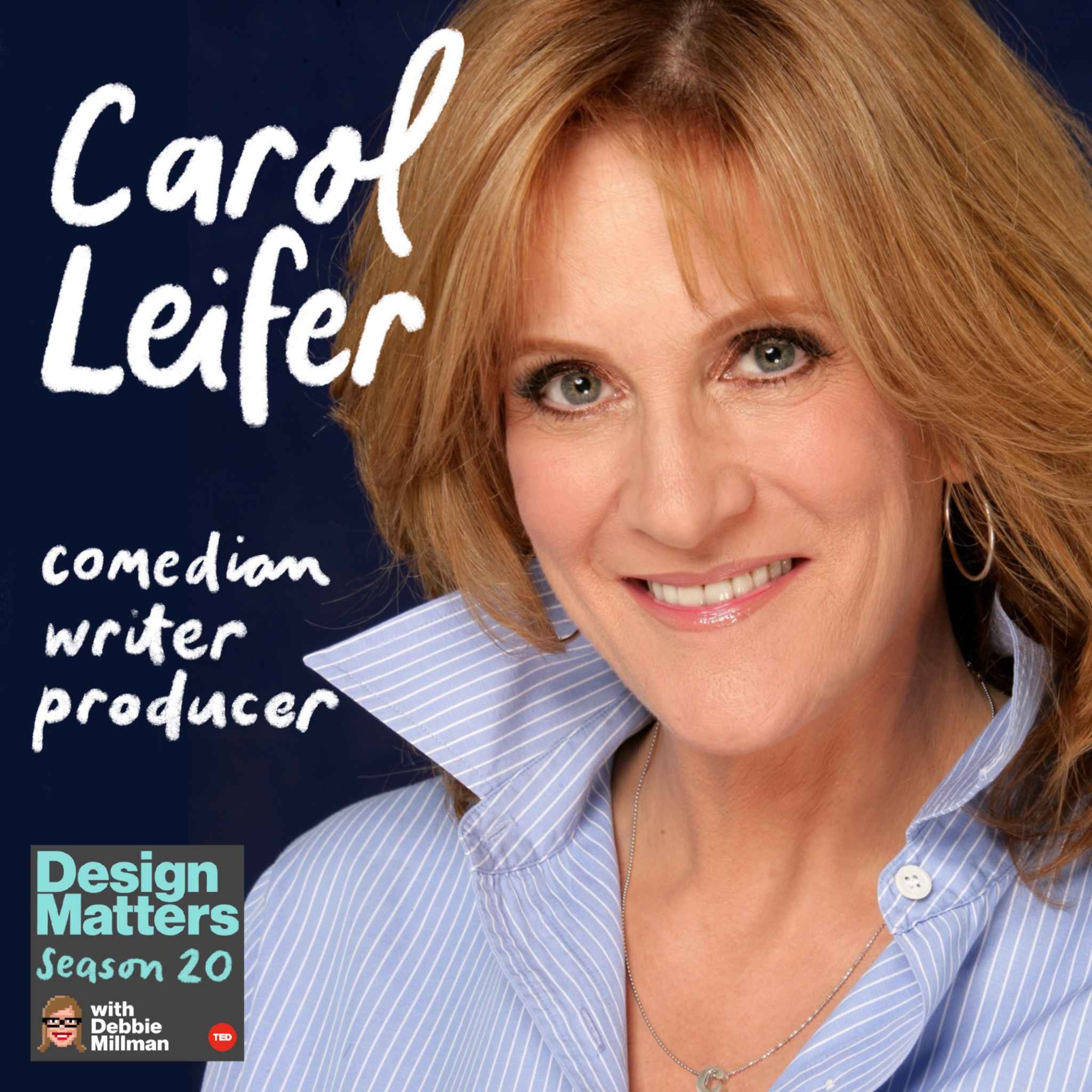
In this episode of Design Matters, host Debbie Millman interviews Carol Leifer, an Emmy-nominated comedian and writer with a prolific career that includes work on iconic television shows such as Seinfeld, Saturday Night Live, and Curb Your Enthusiasm. They discuss Leifer's new book, her experiences in comedy over four decades, and her personal philosophy regarding rejection and resilience in the creative industry.
Written by AI. May contain mistakes.

Get the gist, explore an idea or ask about something said.
 Claude
On Design Matters with Debbie Millman, what are the key points of this episode?
Searching your listeningAutomatic transcript. May contain errors.
0:00You know, there's the saying, don't take no for an answer. My theory, my motto is always take no for an answer because you're going to get a lot of rejection. There is so much rejection along the way.
0:18From the TED Audio Collective, this is Design Matters with Debbie Millman. On Design Matters, Debbie talks with some of the most creative people in the world about what they do, how they got to be who they are, and what they're thinking about and working on. On this episode, Carol Liefer talks about her long career in comedy and about getting work. I'm not thrown off by rejection. I know that it's part of the process.
0:48Can a person learn to be funny? Can someone who has never landed a joke successfully stand up in front of a crowd, tell a funny story, and bring the house down? I'm asking for a friend. Fortunately, my guest this week has some encouraging answers, and she knows of what she speaks. Kara Liefer is a veteran stand-up comedian with a boatload of comedy specials under her belt. She is also an award-winning comedy writer and producer. She's written for Saturday Night Live, Seinfeld, Curb Your Enthusiasm, Modern Family, and she just won an Emmy for her work on Hacks. She's also written several books.
1:31Her latest is How to Write a Funny Speech for a Wedding, Bar Mitzvah, Graduation, and Every Other Event You Didn't Want to Go to in the First Place, which she co-wrote with Rick Bitchell. She's here to talk about her new book, her writing, and about her four decades in comedy. Cara Liefer, welcome to Design Matters. Thank you, Debbie. Oh, I loved your intro. So good. Yes, yes. I was impressed with myself. Good, good. I've been a fan for almost as long as you've been performing. Wow. Thank you. You were one of the first women comics I ever was aware of, and I, in my mind, have set the bar for everyone since.
2:17Oh, thank you. One thing that I read about you that was really surprising was, I understand that your favorite performer growing up was Wayne Newton, who you described as Entertainment with a capital E. What was it about him that captured your imagination at that time? Well, I don't remember saying that, but hey, I know you do your research. You know, Wayne Newton was on the Ed Sullivan show a lot, which was a show people, kids of my generation remember as being a hotspot of entertainment at the time. And I think when I would watch Wayne Newton, you know, he always gave it a thousand percent. That was very clear, even on TV.
3:05me. And that really resonated with me that if you want to be a performer, you got to go out there with a thousand percent. And not only that, but I remember him singing Donka Shane. So do I. Yeah, right. He always sang it with a lot of joy. So the combination of enthusiasm and joy to me was something that I took as a big lesson about show business. I had an acting teacher way back when. It wasn't about stand-up, but she said, you know, if you're having fun, the audience is having fun. So that's a very important element of performing that I've taken with me all these years. You grew up on Long Island, as did I.
3:53I did. You grew up in a household of, we have so much in common. I mean, except for the fan part. What part of Long Island is Northport? I lived there from sixth grade to twelfth grade. Also a young Jewish girl growing up on Long Island. Interesting times back then in the 70s. And in any case, you grew up on Long Island in a household of academics. Your mom was a psychologist. Your dad was an optometrist. But I believe it was your uncle Bernie who was a writer for Let's Make a Deal, who was your first link to show business. And what impact did he have on your understanding of a potential career in entertainment?
4:36My Uncle Bernie. May his memory be a blessing. Well, to my little neck of the woods in Long Island, someone having a job in the entertainment business was a faraway dream. I didn't know anybody who made their living in show business. But my Uncle Bernie, he had been an actor and had had some small roles in New York City. And then he moved to California and he got a job writing for Let's Make a Deal. And people were always like, well, what did he write? Well, you know, he wrote Monty Hall's Patter. He also interviewed the line of people outside. He would kind of suss them out who would be a good contestant.
5:27but basically it was a good job it was a great job that he had for as many years as let's make it's still on with Wayne Brady but it was job not only job security but it also sounded as a kid very exotic to me I mean my grandmother had a photo of his credit you know written by Bernie Gould you know in an eight by ten frame everybody was so proud of my uncle Bernie so I always felt like, well, you know, my Uncle Bernie is in show business, so maybe I could be in show business. And we went out to California right on vacation with my parents, right when I wanted to start being a comedian, I was interested in it.
6:12And he took us to the improv and we saw a show there. And it just became more of a reality than a dream, knowing that here I had this uncle living in California and doing it for a long time and making a very nice living at it. My Uncle Bernie also was the one who, when I decided I wanted to be in show business or be a comedian and I needed a day job, he set me up with someone to meet in the city, a producer. And I was like, oh, great. So I made the appointment with the producer. It was raining that day on Long Island. I was late on the Long Island Railroad. I don't know that I brought an umbrella or not.
7:00I read that you were soaked, actually. Yes, yes. I didn't bring an umbrella. Yeah, I think you remember all the details of this nightmare. And I think I wound up a half an hour late for this meeting. I was drenched, maybe didn't bring a raincoat and then uh proceeded to talk all about myself and what i had done at suny binghamton harper college and i look back now and it's like i i broke every rule of what you do when you want a job uh get it getting there late you know it was no secret it's probably going to rain the next day i could have looked at the forecast plan for that brought an umbrella.
7:46And also while I was there, it's when you're, it's a job interview, you know, you're there to find out what they need, what they're looking for. It's not a time to rattle off your resume and what you think you should be doing. So I thanked Uncle Bernie for the contact, but I did not, I don't think I handled it quite well. You described your parents, Anna and Seymour, as the original comedy enthusiasts and regularly, along with them, listen to comedy albums at home. I also understand your father actually collected jokes. So why did he do that? Well, my dad was king of the joke tellers. As we call them in our community, the tribe of Jewish people, the tummler.
8:40He was always ready with it. He liked being funny. And more than that, as a kid, I saw him tell jokes as a bridge to people. if he didn't know somebody particularly well meeting somebody he you know pretty soon he'd be telling a joke I worked for him at his optometry office I also like to add my father was an optometrist and of course his name was Seymour perfect talk about predetermination but what he would do with jokes is when patients were nervous or had some anxiety for an eye exam. He would tell a joke. And it was literally like, give me a subject. I got a joke on it. My dad really, his dream was to be a comedian or a comedy writer.
9:29So that I got to fulfill his dream was so exciting for him. I always felt sorry that for his generation, people would always ask him, say, Seymour, you're so funny. How come you never pursued it? and he would always say, you know, I had to make a living. And I think for that generation of my parents' generation, really show business was a very far off dream and seemed irresponsible in a way at the time, like you weren't serious about providing for your family. And I look back now and I think my dad could have had a bit of maybe jealousy at my career, but he was there for me a thousand percent.
10:14When I did my first Letterman, Debbie, you know, he wanted to tape it on a VCR. A VCR at that time was like a thousand dollars. I remember. Yep. Yep. And he ran out to Crazy Eddie's or wherever it was. And, you know, he got a VCR to be able to tape me. So I always loved that he had a love of humor. there were comedy albums playing in my house all the time. And what I also love about when I grew up, when we grew up, was there was a community to listening to entertainment. What my parents listened to, everybody in the house listened to. And thank God for me, they had great comedy taste. Now, you know, it's everybody with their own earphones and listening to their own thing.
11:01Back then, it was nice to hear laughter together in the house. So Mel Brooks and Carl Reiner's album, Vaughn Mieter's album. I mean, I'm going way back, but these were the comedy giants of the time. Bill Cosby and Bob Newhart, and besides Wayne Newton on The Ed Sullivan Show, were the great comics. Rodney Dangerfield, whose Young Comedian Special I eventually was pleased to be on, and Jackie Mason and Jackie Vernon. I mean, I know I'm pulling out a lot of names that people may not be familiar with, but to my generation, those were the kings of comedy. I can really relate. My dad wanted to be a football player, but became a pharmacist because he also had to make a living.
11:51And I worked in his pharmacy and did all kinds of fun things with the signage as I was learning to be a designer and whatnot, he introduced me actually to George Carlin, who I was just enthralled by and was enthralled by it for the rest of his life. I thought he was a genius. When did you begin to think you were funny? Did your parents tell you you were funny? Did you believe that you were funny? Talk to me about how you even began to consider a life in or with comedy. Yeah, my parents gave me a lot of feedback as a kid that I was funny. I always loved to perform. I mean, I used to put on shows in our basement.
12:40Yeah. Did you go around the neighborhood and sell tickets? I would. Yes, yes. And I remember one time our across the street neighbor, you know, they were probably like five cents a ticket. You know, he was like, I'll buy them all. You know, thinking that maybe I wasn't getting a lot of business around the block so then I could have free tickets to give to people. So I always got a lot of feedback early on that I was funny. Yeah, especially starting school, being in shows, being in skits at summer camp. That kind of became the thing I was known for, luckily. I know you just won an Emmy Award and a Golden Globe Award and have so many other awards in your arsenal, but I understand that your Hammy Award that you won at summer camp is your prized possession.
13:36That really is. What's a Hammy Award and what did you win it for? Well, the Hammy Award at Sunset Ranch Camp in Orford, New Hampshire, was offered to the camper who had been in the most comedy skits and shows around camp. Of course, hammy, deriving from the word ham, meaning someone who steals a spotlight at a drop of a hat. So to me as a kid, that was a big deal at my summer camp. You know, the proud recipient of, you know, it was akin to winning the Mark Twain Prize at my summer camp. So that was another piece of validation that I needed to pursue my life in comedy. You went to college. You went to Binghamton College, a state school.
14:34I chose Albany, by the way. Oh, I almost went there. Your dad told you that you could go to any college you wanted as long as it was a state school. Same here. You majored in English and theater arts. Were you thinking about going into acting or writing as opposed to, at that point, becoming a comedian? I was thinking about comedy writing. I remember on my dorm floor, there was like a poster for a Norman Lear Award where you could maybe get to write or have an internship on a show. But once I started to do the theater, it really made me feel like I would like to pursue this as a career. I mean, look, I still had a lot of my family ethos in me, which was, could I really make a living as an actor or a comedy performer?
15:29But I knew right away that that's what I wanted to do. I knew then that I definitely wanted to take that route. And I started doing a little bit of kind of what I like to think of now as stand-up in college. One of my friends at school, his name is Jim Matthews, he was a singer and he used to put on these cabaret shows. And he had three gals behind him doing patter and funny things. And I was one of his, he was Matt James and the Hollywood Flames. And I was one of the flames. And then I just started to do in our lounge hall. I remember doing a couple of skits, you know, kind of as stand up. So I was always getting very good positive feedback.
16:20I think as any comedian does, because it's so hard to get up there and be in one and try to make people laugh. If you haven't had a lot of feedback that that's maybe going to work, yeah, that might be the last thing you want to do. I want to talk about some of the feedback that you got in a minute, because I want to introduce some of the characters that began to give you feedback. At Binghamton, you met a person who became a real defining figure and friend in your life, Paul Reiser. Yes. Comedy genius Paul Reiser of All About You fame and so much more. And I understand he was in the Hinman Little Theater, your dorms theater group.
17:01What was your first impression of him? My first impression of Paul was he's the funniest guy I've ever met. And maybe to this day, Debbie, he might still have that title. He is so naturally funny. And so when I was in the Him and Little Theater, I just was stupefied at how funny he was. And not only that, how we connected. He also came from a comedy family. And his family played the 2 ,000-year-old man record over and over. So we could practically together lip sync the whole album. So I love that we shared that same passion for comedy and knew the same comedians. It's so funny. He was just on a podcast yesterday with Jason Alexander, and I saw that he was the guest before me.
17:57And I just burst in. And I was like, I'm sorry to interrupt, but I like to tell the story of how if I hadn't met Paul, maybe I wouldn't have found this exact path into comedy. Because what happened was, Paul just mentioned in my junior year, he was a year older than me. He was like, you know, during the summer, I like to go down to New York City to these comedy clubs that are springing up open mic nights. And anybody can go on. You just get a number during the day. tells you what time you can go on. And I do five minutes of material. He said, I, you know, I think you should try it. It'd be fun.
18:36And that's how I started doing comedy. I went to an open mic night and I got my number. And that's when I knew that I wanted to pursue standup comedy, because as opposed to acting, Debbie, you know, and it's still what I love about standup acting, It's like such a process with the headshots and you got to go to acting school and then you got to audition. And, you know, it's such a rigmarole of avenues that you need to take. Stand up comedy. You go to an open mic night and they tell you when you're on and you're on. And it's just like it was such a direct route into show business that I just loved it.
19:21And it's why I still love it. nobody how far technology goes it's still the same process you go on stage and I forgot is it Malcolm who's Gladwell 10 ,000 hours yes yes yes and you go on and you go on and you go on and that's how you get good and the first time I went on at this audition night I mean I just killed and I thought oh my god this is so amazing and how easy oh this is incredible and it wasn't until the second time that I went back that I completely bombed so badly that I had invited friends from Binghamton to come because the first time I killed and I literally had a tape recorder on the table so I could hear my set where my friends were sitting and playing the tape back you can hear one of my friends from college during my horrific set going oh
20:21just mortified at how badly I was doing. Now, was the material different from the first time you performed and then the second time, or was it the audience, or was it the delivery? It was the thing that you learn about stand-up comedy. It was the same material. It's not just your material. It's when you go on, what kind of audience you're playing to, How much have they been drinking? Do you have what comedians know is called the check spot, where all the checks go down at a certain point and the audience focus there is directed away to getting their credit card out, especially who you follow. if you follow someone who's material is the 180 of yours if it's whatever filthy or aggressive and and you go up after that it's you know it's very hard I don't think people realize how important it is the position you are in a comedy show so it was the same material it was just like I learned the hard way oh it's not always it's not always like that and as a comedian you have to learn how to navigate all those incredibly potentially difficult situations.
21:37I was surprised to read that you wrote or said that Friday is actually the worst day to do a stand-up comic set. Why? It's actually Friday's second show because when you think about it, people have been working all week. So, you know, an eight o 'clock show, that's okay. They can handle that and put their tiredness and their crankiness away. But Friday second show, I almost named my corporation when I incorporated that Friday second show, because it's notoriously the worst show of the week because people are exhausted at, you know, 11 o 'clock at night. They've had it. they've probably been drinking a lot.
22:26And it was always get ready for Friday's second show because it's not Saturday first show, that's for sure. To this day, it's like that. I just performed at the Barnes & Wulf Trap in D.C. And second show Friday is always the toughest one. How do you become funnier? Hmm. Funnier. That's interesting. I don't know if one, well, we'll talk later about my book where Rick and I try to teach people how to be funny. And it's not that hard to be funny in a speech. But I think for comedians, I don't know that you get funnier as opposed to you got to keep writing and writing and writing. And I learned a big lesson from Jerry Seinfeld when I came up.
23:19you know when we were comedians just screwing around all day he would always at some point say you know guys I got to go back and write and he would make himself write for an hour every day he still writes for an hour every day so I don't know if it's funnier but if you keep writing and writing and going on stage and trying to mine this material really work it out you'll find that you can make it funnier just by working on it. I'm sure it's the same with design. The more you work on something, the better it's going to get because of the time you put into it. Yes and no. I mean, you do have to continually be improving your skills.
24:03I came upon, you were interviewed by Howard Stern and he told you, he was talking about just how successful you are and how talented. And he said that you must be an ultra-sensitive human being to be a comedy writer. And in many ways, you also have to be an ultra-sensitive human being to be able to be a designer in order to impart messages to other people that they'll understand and feel something about. But there's a big difference between making something that anonymously goes out into the world and standing up in front of a room full or an audience full, a venue full, a stadium full of people, and have to be able to understand the sort of moment that you're in and share something with them that they all think is funny.
24:53Yeah. Well, it's a lot of trial and error. When I go out to try a new material, and my favorite night to do it is Kevin Nealon has a night at the Laugh Factory here in Los Angeles called New Material Night. And you literally have to, you know, you have to go up with new material, not the tried and true stuff. And it's fantastic because the audience is expecting that. Normally, when you try new material as a comedian, you have to kind of fit it in between tried and true things because you never know how it's going to work. And usually what I think is just fascinating, so many times the thing you think, oh, this is killer.
25:38This is going to be my newest, best joke can die. And then the thing that you thought was maybe a colonel or really not anything becomes the biggest laugh. So I don't think comedians get funnier. It's just working on stuff that you'll hit the sweet spot with enough stuff. Because out of 10 jokes that I normally try that are new, I'm lucky if two or three make the cut. So you and Paul are auditioning. You auditioned for the comic strip and Catch a Rising Star. Turns out that Jerry Seinfeld was the emcee at Comic Strip. Yes. And Larry David was the emcee at Catch a Rising Star. So basically, you've known both of these men for your and their entire careers.
26:26Now, I read that their nickname for you is Mommy. Is that true? Yes. When I hang out with my comedian buddies, they call me Mommy. But the origin of it is it's the Mommy. Do you remember when Reagan used to call Nancy, Mommy. That's what it started from. But still to this point, yeah, all my close comedy friends called me Mommy. Mommy, are you free for dinner this Thursday? You know, it's going to be you, me, Larry, you know, of course, you being their mommy. Yeah, so that is the genesis of my mommy name. But, you know, going back to Jerry and Larry, the night that I passed the audition of the comic ship, Jerry Seinfeld was the emcee who put me through.
27:21He called it the trilogy of new regulars. It was me, Paul Reiser, and a guy named Rich Hall, who I just worked with this past weekend. Most people will remember he used to do Sniglets. So it is amazing that, you know, know, we passed the audition in 1977. I mean, that we go that far back. But putting me through the audition, Jerry, that was a big deal. I mean, he could have said, you know, and the same thing with Larry David. You know, he put me through the audition. So that was a big seal of approval. As time has told us, even bigger seal of approval in terms of what they've accomplished. But But I always think if I didn't meet Paul, if I didn't go to the comic strip that night, Jerry was I'm seeing or Catch Rising Star the night Larry David was there.
28:16Who who knows what would have happened? I mean, I would have pursued a career in comedy, but that route was very step. You knew the steps. And I always liked that about it. Did any of you have a sense as you were all together coming up in the comedy world at the same time, did you have a sense that you were all on the verge? I don't think so. I don't think any of us felt like I feel like the second you feel like you're on the verge, like the verge is not going to happen. just because I think we all knew then you needed to focus on the work. And we were going on every night. And then it became every night a few sets a week.
29:07So I think we all knew that we were getting better. I mean, Larry David, not necessarily, because I always tell this story. He was always Larry David since day one. So as a stand-up, if he had a spot at the improv at like 8.20 and you were going on, your spot was 8.40, you'd get there at 8.20 because at any moment Larry David could walk off because somebody in the audience wasn't laughing or said a snide remark or whatever. He'd be like, you know, that's it. And he'd just walk off. so uh you know uh i'm sure people your audience is not surprised to hear that you know that he was a little sensitive about his stuff and he didn't care if he walked off and they still put him back on because everybody knew uh he had that germ of brilliance but um yeah at that time i mean the tonight show was the big deal to get i think we all wanted to get on The Tonight Show, but it still felt like a big dream to make it, to achieve that kind of status.
30:20I believe that your first ever stand-up gig was as a college sophomore in 1976, and then your big-time gig was opening for Peter Allen in 1980. Yes. But by 1982, you were already performing on the David Letterman show. That's a pretty fast trajectory for anyone, let alone somebody in show business. How did you meet David Letterman? It's kind of a funny story. You know, back, stand-up is so different now with the advent of social media and comedians being able to generate a fan base online. You know, when I was coming up, there wasn't that way to promote yourself. You were really at the mercy of shows and TV shows and showcases.
31:11So in 1980, I got onto this contest called the New York Laugh Off. and it was very popular at the time and it was a big deal to even be one of the five people performing in it and they shot it I mean it was for Showtime at the Copacabana and I love telling the story that you know of the five people I came in fourth and Eddie Murphy came in fifth good company yeah anyway it was on Showtime and as I found out David Letterman saw me on that Showtime special and then recommended me to The Tonight Show. So I spoke to the talent coordinator of The Tonight Show. He told me that David Letterman had seen me and I was going to send him a tape of my standup.
32:00And they passed. I didn't get The Tonight Show. But then two years later, when David Letterman got his late night show, they just called and they booked me out of the shoot. The first time I met him was the first time I did the show. And that led to him giving me an open door policy with the show. After my first time in the show, he said, whenever you're ready with new material, you call us and you come right on. You know, that doesn't happen today. So I'm always very grateful for his support. And it went on for me to do his show 25 times. More than any other female comic in history. Yeah. So it's something that I'm still very grateful for his support.
32:43It took a lot longer for you to actually get onto The Tonight Show. Why? Why is that? Well, there are a couple of reasons. I think The Tonight Show viewed me as a, quote, Letterman act, which stood my way somewhat. But also, I don't know, they were very squirrelly about women comics. And, you know, I auditioned for the show 22 times. I know. I mean, the resilience there, Carol. I mean, I swear, Debbie, I just felt like after, you know, time 14, I felt like, well, this is some kind of practical joke. But if they want to see me, I'm going on anyway. Happy, happy for them to audition me. And every time I always thought, I don't know, maybe this time I'll wear a dress.
33:34Maybe this time I'll do this certain material. It was I just couldn't crack it. And I think by the time I did it, which was actually three months before Johnny retired, I think it felt like enough already. We got to put her on. I mean, after all this time, it's crazy. And I think also what helped me was Jay Leno was guest hosting a lot and had me on. And I think that they saw that I had done well with Jay hosting. So I felt like it was a matter of, yeah, it's about time. We can't say no anymore, which, you know, thank God I did it before Johnny retired, because that had always been one of my big dreams.
34:18As you were coming up, you were one of the very, very few female comics, and comedy cup hecklers were a challenge. But I understand that some of your male comic friends helped you learn how to take control of the room with certain hints that they suggested you share with those hecklers. And I'm wondering if you can share some of those. Well, I always tell people in whatever business you're in, the opposite sex isn't your enemy. They are actually an ally because you have a different filter than the other sex. So, for example, yes, I was getting heckled mercilessly by, at the time, by young men because I was young.
35:16So I'd be standing by the door of audience walking in. And if I saw four, three or four kind of frat boys walking in, haven't had a beer or two, I just could call it, these guys are going to be trouble for me. And nine times out of 10, they were, and they would heckle me. And I had no idea what to say. Also as a young, you know, I didn't have my stripes as a veteran yet of knowing how to handle it. And I couldn't, I couldn't take it. So one night, one of the other comics, male comics, came over to me and said, I see you're having trouble consistently with these young guys. I really think I can help you out.
35:57And I was like, oh, please, I'm dying up there. He said, when guys heckle you, all you need to say is, okay, guys, so where are the dates tonight? Where are they? The gals park in the car? And that shut them up right away because I went to their Achilles heel of being alone. So I certainly didn't know that as a woman. So it took the perspective of a guy to point out where they were going to be weak. And conversely, women see things in the audience that men don't see. So I always tell people, you know, rely on all your colleagues because they can have certain info about situations that you don't have and you have about other situations that they don't.
36:47What gives people in an audience, in a comedian set, the sense that they are allowed to heckle? Like, you don't, people don't do that most. I haven't ever witnessed it in like a musical performance or a Broadway show or why comedy? Why do people feel like they're allowed to do that? Well, it's all because of the alcohol industry, Debbie. people get this liquid courage and they feel like uh for whatever reason they want to participate what is interesting to me as a comedian is you're sort of on equal ground with the heckler oddly the audience doesn't immediately react like hey you shut up they're like okay what's the comic all right now now it's a match what what is the comic going to say about this heckler so So it kind of becomes fair game.
37:48Weirdly, I didn't expect that in stand-up. So you really got to get your, can I curse? No, of course. You really got to get your shit together because it happens. And the audience is also waiting to see how you're going to handle it. You know, Richard Belzer, the late Richard Belzer, gave me a great piece of advice coming up. and I think of it in two specific regards to stand up. He said, when you get up there, you're the pilot of the plane. So however you're reacting is a lot how the audience is going to reacting. So it not only comes in handy that advice with hecklers, you got to look like you're in charge, but also a lot of times you feel as comedian, I'm not really doing well.
38:36This isn't really going over. So instead of kind of freaking out, if you continue your set as if everything is going fine, the audience kind of comes to with that observation as well. So I'm sure even with people in other lines of business, when you're speaking to people, a lot of times they're enjoying it. They might not be that vocal about it, but you know, you're the captain of the ship. So they'll take your cues a lot of times. By the mid-1980s, you had an opportunity to audition to be a performer on Saturday Night Live. And Al Franken came to your stand-up audition with Jim Downey, who was the head writer at the time.
39:22And they loved your stand-up, but offered you a writing job. Did you have any reluctance to taking a writing job versus a performing job? No, no, not at all. I just felt like, look, SNL is its own institution and has been since it's been on. It was also the year that Lorne Michaels was going to come back. You were there during what has been described now in the docuseries on Peacock about SNL. The fourth episode focuses on that time, and it's titled The Weird Year. Would you concur? Absolutely. It was the weirdest year with Lauren coming back after not being there for five years. And the cast of this really melange of odd, great performers in their own right, but a weird mixture.
40:18I mean, Randy Quaid, Robert Downey Jr., Joan Cusack, Dennis Miller. Michael Hall. Michael Hall. Yeah. Anthony Michael Hall. It was just the strangest amalgam of talent. And we just never got our footing that year. We just never were able to find the sweet spot. So it was weird because everybody expected, oh, there's going to be a breeze. SNL is back with Lauren. But it was a strange time. I mean, I'm grateful for the experience because I learned sketch writing. I wrote with some of the best writers around. I mean, the writers' room was filled with a murderous row of talent, you know, Jack Handy and John Schwartzweller, who went to write for The Simpsons.
41:12And on and on. Robert Smigal was a Donald Velo. So it was really terrific to write in that film. So I'll always be grateful that I got the opportunity. And I got a lot of sketches on. So that was also very satisfying, that, quote, weird year. You've written for the Academy Awards, I believe it's 10 times more than any other female writer. You were even nominated for an Emmy for your writing on the Oscars. Yes, yes. Is it a given that you're invited back year after year, or do you still have to keep pitching yourself to get a place at that table? Oh, you definitely have to keep pitching yourself.
41:57That's for sure. It's not ever a done deal. Any particular favorite moments that you've written that still sort of makes you smile? Yes. Well, I wrote for Billy Crystal one year, and it was the year that there was the missing Oscar had been stolen. and Erykah Badu came out with this very tall headpiece. And Billy was like, oh, we have to find some joke for this. So it was backstage. What do you guys got? And I said, maybe that's where the lost Oscars. So, you know, he went out and did it and scored. It was fantastic. How much writing is done on the fly like that when you're in the midst of like one of the biggest nights in Hollywood?
42:52A lot of it, because you want to be in the moment and present. There is so much of that writing that's done on the fly. You know, this year, Conan did the show. I was lucky enough to write for the show. But, you know, he had his own team of writers from mostly from his shows. so he had not only a comfort level with that group but they're some of the best writers around and I was part a lot of times I'm part of the show team where you write around the host the presenter patter things like that so yeah every year the job is up in the air but I've been lucky that I've contributed and they've had me back actually this time was my 11th time.
43:39Awesome I'm I love that you keep doing it, and I'm glad that they keep bringing you back because... Yes, me too. You began writing for Seinfeld in 1993, the television show Seinfeld. Urban Mythology has it that you were not only a writer on the show, but also the real-life inspiration for the character Elaine Bennis. Do you really dance that poorly? No, no. Not at all. I'm quite the dancer. You know, I dated Jerry in the early days. And since then, we stayed friends. So I think people make that comparison because of that connection. But other than that, you know, that's where the connection ends.
44:31And people always ask, oh, did this happen to you? Did this happen to you? You know, with Elaine's stories. I mean, things happen, but, you know, like the episode I did, The Beard, where Elaine thinks there were skinny mirrors. I love that episode, because I agree. I agree. There were skinny mirrors at Barney's. I love that. I love that episode. Yes. You know, that's something that happened to me that became an Elaine story. Also, one of the Elaine stories I had in the lip reader was she pretended she was deaf to a car service driver. you know and that developed because in my stand-up days when a car service guy would bring me to the airport and it was five in the morning I'd have like chatty Kathy as uh the uh you know car service driver so that was the beauty of Seinfeld he always took it one step further like instead of enduring what I did in real life like please in the backseat please shut up thinking this I always wished I could pretend I was deaf and we could do that on the show.
45:42You said that working on the show taught you the importance of pitching ideas. In what way? Well, the germ of any sitcom is really so much in the idea. It's quick and it's succinct. The pitching process at Seinfeld was you'd go into Larry and Jerry's office and they shared an office, I'd bring in hopefully 20 ideas because the odds of them became higher of them liking one or two. And when I went in to pitch, like, for example, Elaine thinks the Korean manicurists are talking about her behind her back in Korea. That became a storyline. And it's pretty quick, and it's pretty simple. You know, you don't pitch it like, so Elaine goes to have a manicure, her nails look horrible.
46:35And she thinks about what color she's going to get today. And, you know, you cut to the chase. And I think that's important in anything you do when you pitch an idea to make it clear and quick. But, you know, I knew that when I pitched something like that, that was going to be, yes, yes, we're going to do that. That became something they immediately loved. And of course, as a writer going into pitch, I was happy about that. Because when you go in to pitch, then you wanted at least one thing to score. So pitching to me still to this day is a very quick and succinct idea that hopefully in telling it, somebody laughs.
47:17I had a friend who was in banking. He's gay. He could not be out at the time in 93. And he said to me, my boss invited me to the Hollywood Bowl. Will you come as my date? And I was like, sure. And that became the episode. The beard. The beard. Yeah. So a lot of, you know, we were always taking real life situations and putting them into the show. But when you pitched it, you know, going quick, because if you didn't, also, it kind of kills the germ of the idea. If you put too much fluff around it. You don't need the fluff. Well, it seems like you were taking all this sort of salesmanship of the pitch out of the pitch and just relying on a good idea.
48:06Yes. And there were always ideas that I think of that I can't even use now. You know, even that curb is over because it was the same process pitching to Larry David with curb. I went to a doctor the other day, a dermatologist who was recommended as the person, and he was very tatted up. And it really made me think about, do I want to eat meat? I don't know. I heard it's the best, but these tats are really throwing me off. That, to me, I was dying to pitch that to Larry David, because that is a very, even more specific than Seinfeld, a very curb Larry David idea. Even, you know, when someone's on their laptop and you go over to them and they close their laptop.
48:57That to me, that is definitely something I would be pitching right now if Curb were still. Absolutely. I loved your performance as the mother of the lemonade children. Was that improvised or was that scripted? No, the show, as they write it, is you go in and you, writers, you pitch ideas and then Larry David would take them along with the showrunner, Jeff Schaefer, and they would develop them into an outline, which is basically what happens in each scene. And then the performers would go and improvise it. I mean, I always called them, you know, the second city of an improv team. The fact that they could riff off these just pure situations, that, you know, that's lightning in a bottle right there with that cast.
49:52And so when I got the part of the Lemonade Mom, yeah, you go out there and yeah, it's the tightrope you gotta walk. You stated that working on Seinfeld was the most brilliant writing experience of your career, but I'm not sure if you said that before you started writing for The Larry Sanders Show or Modern Family or most recently Hacks, for which you just won your Emmy and your Golden Globe Awards. This was actually your seventh Emmy nomination and first win. So congratulations. Long overdue, as Shirley MacLaine might say. Hacks is a show about resilience in comedy. Did you find that that reflected some of your own journey?
50:36Was that why you were invited on the show? It seems like there's an interesting overlap between the characters. Well, I think I was brought on to a large degree because Debra Vance, as we know in the show, has been doing comedy for a long time. I mean, I've been in the comedy business for almost 50 years. So in that way, I could relate to Debra Vance. Also, you know, her storyline, she came up in the 80s. I came up as a stand-up comic in the 80s. But you're so spot on with it is a lot about resilience, her resilience. And the thing that I've always thought about myself is that I share that resilience.
51:21I mean, you can't audition for The Tonight Show 22 times without having some resilience. And I always really made that the backbone of my career, that you can control what you can control and you can't control what you can't control. And so much of stuff is out of your control. And the way that I felt about The Tonight Show and another kind of tip that I have for people for staying in any business for a long time is there's not two things. There's not just one door. And with The Tonight Show, it really became not only, hey, look, if they want to see me for the 21st time, okay, I'm doing stand-up tonight anyway, why not?
52:12So the 22nd time is when the door opened. But if I had had an attitude about it, like, you know what, screw these guys, they've seen me enough, I don't care anymore about The Tonight Show. I still cared about The Tonight Show, and I didn't take that opportunity for granted because I felt like, well, maybe this time it will happen. And another thing that I always kind of attribute to my longevity in show business is, you know, there's the saying, don't take no for an answer. My theory, my motto is always take no for an answer because you're going to get a lot of rejection. There is so much rejection along the way.
52:55And if you take that no, and you can let it roll off your back, there's so many other great opportunities. I'll give you an example. Because I do advocate for myself, and I think like Deborah Vance's character in the show, I'm not thrown off by rejection. I know that it's part of the process. And if you can accept that you're going to be rejected a lot, I feel like you'll fail because people stop because of the rejection. I mean, it's momentary. But like, for example, with Modern Family, I saw Steve Levitan, one of the co-creators of the show, at an industry event. I was a big fan. I went over to him.
53:35I told him what a big fan I was. And then I said, would you consider if I came in and pitched some ideas? And I always say, and if it's not cool, totally fine, no harm, no foul. And it's good to give people an out with that kind of stuff when you're asking basically for something. And he said, yeah, sure. Come in and pitch some stories. And that led to my writing on Modern Family. But if he had said, you know what? I don't know. We're not really looking for new stories at the time. So as much as I appreciate the offer, Carol, I can't do it. I don't leave there dejected or horrified or depressed.
54:16It's like, okay, it's part of the process. And that's one door to someplace which worked out. But I've been rejected a million times on other things. I've been rejected by audiences as a stand-up. It's just the matter of odds. You're always, you're going to do great a lot of the times. And a lot of times you're, you know, you're going to stink up the room. It just happens. But if you don't take it personally and you keep going and you have that tenacity, I think it always serves people well in any business. You've said that stand-up comedy is like giving a speech every night. We know a lot about what audiences respond to and what they don't.
54:57I'm wondering if that is some of what provoked the writing of your newest book, How to Write a Funny Speech for a Wedding Bar Mitzvah Graduation and Every Other Event You Didn't Want to Go to in the First Place. Yes. Well, the genesis of this book came about during the writer's strike when we couldn't work on any TV shows. We were out picketing. And I had lunch with my friend Rick Mitchell, another comedy writer. He wrote for Ellen's talk show for six years, won five Emmys. he had just been to an event where someone stunk up the joint and I had just been to a wedding where the father of the bride gave a horrendous speech and we're just both sitting there saying you know what it's really not that hard for someone who's not in show business to give a good speech you know basics and uh ways to approach it and we thought well this is going to be a good book because we walk people through it step by step.
56:01And beyond that, we give everyone the resources of we give people jokes in the glossary of like any event, you want to steal these jokes. That's what we call the section, steal these jokes that you can pop into your speech. We have templates for people that really want to attempt this the easiest way where they can just fill in the blanks of what will make a good speech. But we do know, and Rick is a stand-up as well, every night that you go on stage, it is basically a speech because you need of a stand-up set, a beginning, middle, and end. And we know from experience as stand-ups what it's like to be up there.
56:45And our hearts go out to normies who get up there and have to give a speech. So we felt like we have so much advice that we felt like as a public service, because we've lived through so many bad speeches, it'd be good for us to get this down in a book. It's very short and compact. It's not like these speech books that you pick up that are like Encyclopedia Britannica, you know, like you don't even want to pick up the book because it looks like a chore and a headache. We made it really short and sweet. Well, that's all you need. And it's really funny. Thank you. Years and years and years ago, I did a speech.
57:28I was asked to do a speech. My brother asked me to do a speech at his wedding. And so I Googled, like, wedding speeches, wedding toasts. And they were just so cumbersome and maudlin and saccharine and fake. And this is what everybody needs if they're asked to do any kind of speech, even a speech at a funeral. which I thought was particularly helpful. Oh, good. One of the things that I learned reading the book that I didn't expect to learn was about the Gettysburg Address. Apparently, the Gettysburg Address was 272 words and lasted two minutes. So you start the book by stating that public speaking remains the number one fear of an average person, and the most common mistake people make in public speaking is it's too long.
58:16Yes. So you say that a speech should time out to five minutes or under. Exactly. Why is brevity so important? Well, brevity is important for a couple of reasons. One is you are at an event where your odds are you're not the only speaker. They've lined up a bunch of people. So if you're long and other people are long, it becomes torturous to the point where I've been to so many events where they're going to serve the food after the speeches. So you're sitting there hangry and listening to these speeches and you want to die. So it's not only important from the event perspective, but a lot of people, it's weird, Debbie, they think, I love this person so much.
59:07I really have to show them how much I love them by how long I'm speaking. And that is so not the case. They want to find out. And look, you're very honored to speak at someone's event. If they've asked you, you certainly have a special relationship with this person. You can summarize it, make it pretty compact in summarizing how you feel about this person. Not only that, but be funny here and there and be heartfelt. Another misstep that people make these days, besides, you know, when you went on the internet and it was tough, you know, you didn't really get much help. So a lot of people look to AI, which is a really big mistake these days.
59:52Because AI not only doesn't have, you know, the personal is the gold in the speech. And you have a relationship with this person that nobody else has. So that's really the stuff to mine in your speech. And like I said, we go through step by step. So it's easy. But AI is not funny. AI does not have a funny bone in its robot body. So if you want to be funny in your speech, don't look to AI because they're a clunker. It's unfortunate that people feel that they need to go that route in writing a speech. But it's not surprising given how scared people are. You know, the one thing that I was thinking about, the common denominator in so many of the templates that you provide, which are so helpful, and I wish I had them decades ago, is the injection of humor.
1:00:47And I was thinking about TED Talks and how popular TED Talks are. And the most popular TED Talks are the talks where the speaker is also a little bit funny. You know, they might be talking about science. They might be talking about vulnerability. They might be talking about longevity. But there's always a sense of levity that's embedded in these speeches. It's hard for me to imagine that somebody that is, you know, a leading astrophysicist also has comedic training. Do you find that that's sort of natural or do you find that that is a learned skill? Look, the naturally funny people know they're naturally funny because they've gotten a lot of feedback over the years from their friends and family that that's in their wheelhouse.
1:01:32So some people are naturally funny. You know, we wrote the book for your average person who doesn't really, not only doesn't want to get up and speak in front of people, but feels like, well, how am I going to make this funny? because the funny in a speech really goes a long way. People can tend to drone on and on about the person. If you don't add some humor, it makes it boring and not fun to listen to. So a lot of times we ask people and show people in the book, a great story is always how you met, how you met the person, because it's usually quirky and offbeat and funny. So not only that, you can be funny.
1:02:17You don't have to be a manufactured funny. It's just funny in the circumstances, the stories of life. Also, we ask people, picture you're sitting at a bar and you're talking to a stranger and they ask you about this person. Oh, tell me about them. You usually come up with one or two funny stories that happen. And you're not going to say, well, they went to this school and then they studied. You're going to reach back in your personal memory to come up with something funny. So through the book, we go step by step about how you can create something, a funny speech about someone if you follow the steps that we outline.
1:02:57And using the jokes in the back of our book that you are free to steal for we have for every occasion. But we really wanted to write the book because we didn't want people to feel like it's so daunting to be funny in a speech. It's really easier than people think. You know, the other thing to think about, Debbie, that people don't realize when they give a speech is the bar is set very low. You know, you're not Jerry Seinfeld. People don't expect you to get up there and break down the house. In fact, most people in the audience are thinking, oh, thank God it wasn't me. So you're playing to a warm room.
1:03:39People want you to do well. So I think also knowing that going in gives people a sense of comfort in giving a speech. It seems like a lot of people start their speeches with a joke or they're told they should start their speeches with a joke. Unless someone is a professional comic, what do you think of that approach? I always find it to be kind of awkward. Yeah, I don't think it's good to start off with a joke. It feels to me a little desperate, like, right, I'm being funny, folks, right? Right off the bat. I don't think it's a good idea. In fact, one of the rookie mistakes that Rick and I go over in our book, which I can't believe just happened at a memorial I went to a week ago, is how many people go up and they'll say their name, like, hi, I'm Carol.
1:04:30And then they start talking about the person and you're trying to figure out what their connection is. Like, is this a college friend? Is this someone they went to camp with? Is this a relative? I mean, it becomes an episode of NCIS trying to figure out who this person is. So it's always good to start with your name and your relationship to the person so people have a context for your speech, because when they don't know how your connection is, I think that's very off-putting. So I don't feel like people, you can work into the humor. I think you don't have to start off with a boffo joke that normally really doesn't land.
1:05:13You also suggest that the speech giver, in addition to introducing themselves, should let people know right away why they are special enough that they were asked to speak in the first place. But I'm wondering, how could somebody do that? Where's the sort of subtlety in doing that that doesn't seem pretentious or humble braggy or I'm special and you're not kind of a vibe? I think usually, again, going back to stories that people have about the person. Recently, I heard a story about a guy who was giving a speech about his mom. And he told this story about how when he was younger, she was going to the market and he asked for shredded wheat.
1:05:58And lo and behold, she came home with three boxes of shredded wheat. And she said to him, well, I didn't know which kind you liked. So that story is not only amusing, but it also points to his mom's character and how she bent over backwards to be accommodating to her son. So I think when someone knows you're most certainly a relative, a sister, brother, mother, father, certainly you don't need to explain why you're important to this person. But usually the stories that you tell, well, somehow instead of bragging about, well, I'm so close to this person because the stories will reveal that. So that's why we tell people, you can't mine enough stuff from your mutual background together.
1:06:53That's why people, it's easy to write a good speech because you're the only person that has that specific relationship with the other person. And to mine that because nobody else is going to tell the stories you are. So to really make your speech unique, go back and think of, you can even have a funny story about putting the wedding together and asking you to speak. There are great stories out there. It's just a matter of pinpointing them. And people really enjoy them. Carol, I have two last questions for you today. The book includes speech templates, as we've mentioned, and advice for wedding, retirement, graduations, bar bat mitzvah, even a do not do list for a speech at a funeral.
1:07:42Is there a piece of advice from the book that readers have responded to most? Or if someone were to ask you for one tidbit that might be across a common denominator across all speeches, is there one bit of advice that you might give to our listeners? I think some of the feedback that I've gotten so far, and you know, it's great. We're number one on Amazon in the public speaking list. People have really responded to, you know, we encourage people at celebrations of life, memorials, to be funny. Because the trick sometimes, people feel like it's respectful to just be serious and talk about this person.
1:08:25Telling a funny story about the person who's passed really is gold at these events because, you know, people do want to celebrate this person. And when you bring up stories or situations that this person was in, what's great is they've lived an entire life. So little quirks that you've noticed about the person everybody else there has. And it's always great to be a little funny at memorials. People are afraid, but people want to celebrate the person. You know, for example, I spoke at my cousin Jay, passed away prematurely of cancer a couple years ago, and I spoke at his memorial. And I told this story about he was the biggest people person.
1:09:15You've never met a social butterfly like this. So we went to the Beach Boys concert together and were invited luckily to the after party. And I kept saying to my cousin, I got to go over to Mike Love because I opened for the Beach Boys and Harris when I was starting out. I got to go over and say hi. And I'm looking for every way to go over to Mike Love, trying to see when the timing is right. I go to the bar to get a drink. I turn around, my cousin Jay is talking with Mike Love like he's known him for 30 years. He was that much of a people person and literally introduces me to Mike Love saying, hey, you know my cousin Carol, she opened for you an hour.
1:09:57And people love that story at his memorial because everybody knew he was a people person and was just that example that everyone could really cling on to that really showed what a mensch he was and what a character he was. So I think the biggest feedback that I've gotten is people going, you know what? I've always been afraid at a memorial to be funny, but your book really showed me how you can use it at an occasion like that to really lighten the load and really celebrate the person who's passed. This is my last question today, Carol. Stephen Wright once gave you the advice to perform every night for three years with no judgment.
1:10:41Yes. What do you tell young comedians and writers today when they ask you for advice about making it in the business? Well, it's going back to Stephen Wright's advice was basically Malcolm Gladwell's, right? 10 ,000 hours to be very good at something you've got to put in the time. And that hasn't changed from day one when I started stand-up to today. You only get good by not only doing it, but by falling on your face a lot. That's where the hours come in where you don't judge yourself. You are going to step in it a lot. And if you know that's part of the process, you won't be afraid of failure.
1:11:25So that's really the key to really getting good. and with the writing jobs, don't be afraid to hear no. You're going to hear a lot of no's before you get a job. Any show I've worked on, when I ask someone, how did you get into the business? They tell this story of where they were rejected and then I wanted to write on this show and they didn't take me. It's the persistence that is so important and I always tell people, you got to be the squeaky wheel, but balance it with not the pain in the ass. Because we all know people who go on and on with bothering you that it becomes such a turnoff. You know, be the squeaky wheel, but be aware that you're not being obnoxious, you know, that you're being appropriate in your ass.
1:12:15And always in your ass. It's so important, I think, to always say, like I've done with my writing jobs that I've applied for, you know, if you can't make it work, I get it. It's no problem because it takes all the pressure off the person. And I think that's important when you advocate for yourself, which people also need to do. I think a big misconception about my career and Debbie, as we talked about, I've been doing it for almost 50 years and almost, you know, just won an Emmy a year ago is you've got to really, people think I just coast. Like the jobs, free-flowing, they all come to me. No, I still advocate for myself and still go after jobs that I want.
1:12:59Because a lot of times, you know, unless you, my mother, my Jewish mother had a great saying, which was, you don't ask, you don't get. So to always be advocating for yourself and going after the things that you want, but not, you know, with an edge that you become such a pain in the ass. People want to avoid you the second they see you. Cara Liefer, thank you for making me laugh so much today. Thank you for making so much work that matters. And thank you for joining me today on Design Matters. Oh, thank you. You know, I don't enjoy a lot of podcasts, but this one, really, it flew by. I really, really loved it, Debbie.
1:13:40So thank you for having me. Cara Liefer's latest book is titled How to Write a Funny Speech for a Wedding Bar Mitzvah graduation, and every other event you didn't want to go to in the first place. You can read more about her on her website, caraleifer.com, and Leifer is spelled L-E-I-F-E-R. There you can find her upcoming gigs with Howard Stern, Susie Essman, and Henry Winkler, and info about her Showtime special, More Funny Women of a Certain Age. This is the 20th year we've been podcasting Design and I'd like to thank you for listening. And remember, we can talk about making a difference, we can make a difference, or we can do both.
1:14:21I'm Debbie Melman, and I look forward to talking with you again soon. Design Matters is produced for the TED Audio Collective by Curtis Fox Productions. The interviews are usually recorded at the Masters in Branding Program at the School of Visual Arts in New York City, the first and longest-running branding program in the world. The editor-in-chief of Design Matters Media is Emily Weiland.
Writer’s Guild Award winner and Emmy-nominated comedian, writer, and producer for television shows such as Seinfeld, The Larry Sanders Show, Saturday Night Live, The Oscars, Modern Family, Curb Your Enthusiasm, and more; Carol Leifer joins to talk about her new book, her writing, and her four-decade career in comedy.
Hosted on Acast. See acast.com/privacy for more information.