 Ask ChatGPT



Craig Elimeliah discusses early internet creativity, the shift from designing interfaces to designing customer experiences and tools, and what AI means for designers—especially authorship, control/guardrails, and the blurring of design vs. art.
Craig Elimeliah (interviewee). Debbie Millman is the host. No other guests appear.
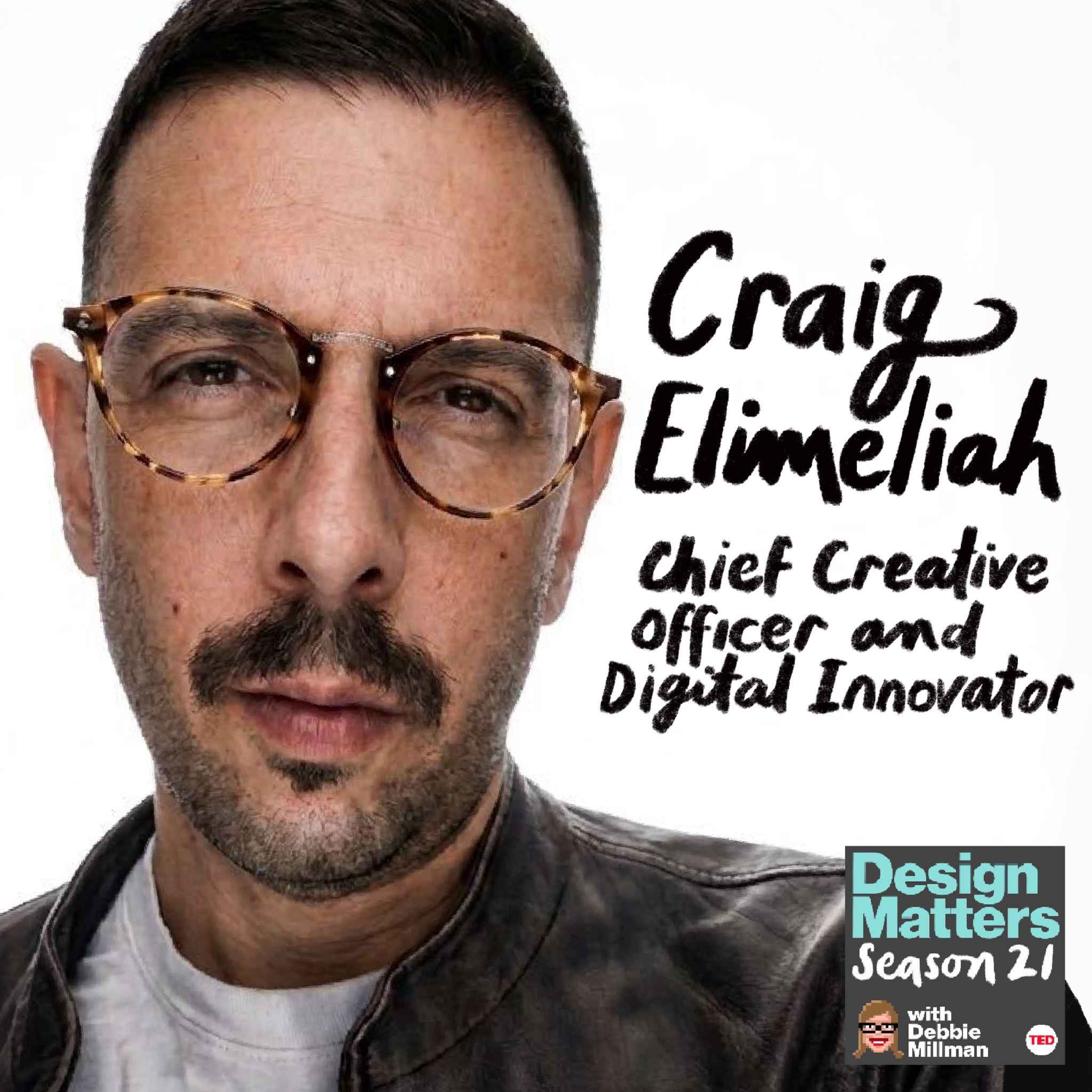
Creative leader and Chief Creative Officer of Code and Theory. Self-taught designer who began shaping early web experiences in the late 1990s; worked with brands including AT&T and BMW. Previously held roles in creative technology (including work tied to PopTech). Wrote the AIGA essay “Art vs. Design” (2006) and later “The Rise of the AI Ad Bot” (2016).
AI flattens the distance between design and technology; human “taste” remains the authoring decision. AI requires control/guardrails due to weaponization and deepfakes/provenance risks. The internet’s lack of rules enabled designers to find their own rules.
Nike/Air Jordan cultural influence; City-as-learning high school internships; early Flash-era brand experimentation; Fila Adato foot-scanning in-store kiosk; PopTag visualized hashtag conversations into branded real-time graphics; AI ad-bot concept for personalized intelligent brand characters.
Written by AI. May contain mistakes.
Explore how authorship is changing in an age of technology.
“We are now becoming a community or a race of authors.”
Craig shares his early fascination with advertisements and branding.
“Craig, is it true that as a kid growing up in Cheap Set Bay, Brooklyn, you memorized television commercials and covered your bedroom walls with advertisements you cut out of magazines?”
Discussing the cultural influence of brands like Nike on Craig's life.
“It was just something that I felt very connected to.”
Craig recounts internships that shaped his understanding of production.
“There you began working inside real companies and organizations while you were still a teenager.”
Discover Craig's unexpected journey into studying to become a rabbi.
“At that point in your life, were you envisioning a creative career or was that not anything?”
Exploring how personal heritage influenced Craig's creative perspective.
“So what inspired that type of momentous decision?”
Craig discusses how the internet ignited his passion for design.
“So yeah, I spent a long time deep, deep in study.”
Learn how the early internet shaped Craig's design philosophy and career.
“And, you know, I would play with the depth of what you can do, which is click in and kind of choose your own adventure and really think about, like, not knowing what might come next.”
Discover the innovative approach at Firstborn and its impact on digital branding.
“So I'm like the market, I'm like, whatever, like the market will fail, but the internet will prevail, you know, and I just stuck with it, you know, and there were a few people around me.”
Understand the influence of Flash on digital design and the subsequent industry changes.
“which is interesting because at the time Flash was the big thing.”
Explore Craig's groundbreaking Fila kiosk project that transformed customer experience.
“Yeah, I can't wait to talk to you about that.”
Explore the evolution of the distinction between art and design through personal anecdotes and insights.
“I did not expect that to get that went viral, viral, essentially, or we really before we knew what viral is.”
Delve into the intersections of AI, branding, and design, reflecting on past predictions and current realities.
“And, you know, we had great clients like Toyota and Humana and Google and like all these great clients and had this idea of, you know, what would visualizing hashtags look like?”
Explore the balance between the benefits and dangers of AI technology.
“I know as humans, we don't like the word control because it's scary.”
Learn about historical fears related to technological advancements.
“lot of bad actors, it is a very persuasive thing.”
Discuss the potential for creativity amidst the rise of AI.
“It's kind of hard to envision how going from a drafting table to working online in Canva or Adobe would create world annihilation.”
Understand how designers can adapt and thrive in a tech-driven world.
“I think that because we have such a strong technical bench, we're not an organization that's necessarily fearful of what's going on in the world right now.”
Explore how data visualization is reshaping design and the need for designers to expand their thinking.
“I say to my team all the time, we are living in a world of data visualization that we've never experienced before.”
Discusses the evolving concept of authorship in design and creativity amidst AI advancements.
“You know, I'm now thinking about composability, right?”
Analyzes how the proliferation of ideas through technology affects what we value in singular concepts.
“It's going to become an increasingly elevated role as well.”
Explores current pursuits in design and creativity with new technologies and mediums.
“So the ability, this abundance, this ability to take an idea and start to really think about what are the editorial iterations that this thing can contain?”
Explores current pursuits in design and creativity with new technologies and mediums.
“It's a philosophy that design changes everything.”

Get the gist, explore an idea or ask about something said.
 Claude
On Design Matters with Debbie Millman, what are the key points of this episode?
Searching your listeningAutomatic transcript. May contain errors.
0:00We are now becoming a community or a race of authors. Authorship becomes the thing we're doing when machines are doing all the grunt work. From the TED Audio Collective, this is Design Matters with Debbie Millman.
0:21On Design Matters, Debbie talks with some of the most creative people in the world about what they do, how they got to be who they are, and what they're thinking about and working on. On this episode, a conversation with Craig El Emilia about the early days of the internet and about what AI might mean for designers. AI has definitely flattened the distance between design and technology.
0:50This episode is brought to you by Capital One. Capital One's tech team isn't just talking about multi-agentic AI. They already deployed one. It's called Chat Concierge and it's simplifying car shopping. Using self-reflection and layered reasoning with live API checks, it doesn't just help buyers find a car they love. It helps schedule a test drive, get pre-approved for financing, and estimate trade in value. Advanced, intuitive, and deployed. That's how they stack. That's technology at Capital One. I've got big news. I switched to Verizon and got the new iPhone 18 Pro. Shh! I can keep my old phone.
1:25Can I also get the latest iPhone every year? Shh, anything else? Verizon, let me choose Apple Watch Series 12 or iPad on them. Everybody listen up. Shh. Switch to Verizon and get the new iPhone 18 Pro now. No trade-in needed. And the latest iPhone every year with Simplicity Plan. Plus, choose Apple Watch Series 12 or iPad on us. Simplicity Plan with Simplicity Pro required. Plan and device payment purchase are separate agreements with separate terms. Service plan for watch or iPad required. Additional terms apply for all offers. This episode is sponsored by Kohler Smart Toilets. The objects we interact with most are often the ones we notice least.
2:01The Kohler Smart Toilet challenges that assumption. What if the most overlooked space in your home could become the most considered? Their Vale Smart Toilet is a sculptural silhouette that isn't just intentional. It's a philosophy that design changes everything. The Kohler Veil Smart Toilet is sleek, with a rounded shape that's more like architecture than just plumbing, and it goes beyond looks. The touchscreen controls and customizable cleansing features offer a level of comfort and cleanliness that exceed expectations. It's all about elevating those ordinary daily rituals into something extraordinary through thoughtful design.
2:44Kohler has been pushing these boundaries for over 150 years, mastering that balance of stunning form and high-performance function. That's a long time to get it right, and it shows in every detail. Experience the difference of Kohler smart toilets. Find out more at Kohler.com. Craig Elimilia is a creative leader whose work has consistently challenged the boundaries between design, technology, advertising, and culture. Over the course of his career, he has helped shape new ways for brands and people to interact, while thinking deeply about how emerging technologies change not only what we make, but how we make it.
3:32Today, he is Chief Creative Officer of Code and Theory, where he continues to explore what creativity can become in a rapidly changing technological landscape. Craig Elamilia, welcome to this very special episode of Design Matters, live at the Clios on Culture in New York City. Thank you, Debbie. Honored to be here. Craig, is it true that as a kid growing up in Cheap Set Bay, Brooklyn, you memorized television commercials and covered your bedroom walls with advertisements you cut out of magazines? This is true. My mother was often very, very angry at me because I would steal all her fashion magazines, her Vogue's and Cosmo, and I'd cut them up and reconfigure them without thinking whether she had a chance to read them or not.
4:26I thought they were there for me. Yeah. And for many years at family gatherings, there was always a moment where everyone would just sit around and I would perform TV commercials. Really? It was just something that I felt very connected to. It was something that I understood kind of the persuasion behind them. And I was just very attracted to just sort of the cultural connection they had to people's lives. And like a moth to a flame, I was just always extremely interested in communications, really. I understand that you singled out the Absolute and Nike campaigns of the 1990s as particularly important to you.
5:14Before you knew words like branding or art direction, what were you noticing in that ads beyond the persuasive quality? You know, looking back, right, we didn't have the Internet and culture needed a language. You needed a common language to be able to speak to other people about culture. And for me, that was that was the common language. My birthday is on February 8th, and it also happens to be every February 8th, Nike would release the new Air Jordan sneakers. And if you're a seven-year-old kid, that's a big deal. And for me, that was sort of how I developed my own culture and design language.
5:53It was through the lens of these things that I felt gave me some kind of connection to what the world saw as culture. You went to City S school in New York, a public high school built around internships and learning through the city itself. There you began working inside real companies and organizations while you were still a teenager. What kind of work were you doing? some really really weird stuff let's hear about it so one so one internship i had for uh almost half a year was i was alec baldwin and kim basinger's like private assistant when they were doing streetcar named desire on broadway so i'd have to run scripts and and like stuff to their house so i get to like see them in the morning it was how does she look in the morning flawless right is she not the most beautiful woman and um i worked on the sally jesse rafael show logging film you know at the time i was designing stuff on my own i didn't yet have a computer and so everything was cut out and and drawn um and hand done but what city of school taught me was sort of the things that would have to go on behind the scenes and so i quickly learned about how to deal with logistics and production and all the things that went into making a thing.
7:21And I think that gave me a tremendous, you know, sense of comfort around creative environments. And I felt myself, you know, some of my friends would go to like Goldman Sachs and some of, you know, and I would have any choices. Yeah, yeah. So every every the beginning of every year, a board the size of this would, I'm pointing to a big board here, the size of this would open up and everyone would run to go find all the internships that they wanted. And I was always drawn to creative ones. And so my high school career was spent, you know, running around New York City in creative environments, learning how to be creative and kind of almost demystifying it a bit so that I can really focus on my craft and not overthink all the other stuff that, you know, when you're young, you just don't know and you kind of get caught up in.
8:12Yeah. At that point in your life, were you envisioning a creative career or was that not anything? Yeah, it was not even a question. I didn't know what. I just knew. Yes. You know, for me, it was definitely something that was connected to culture in some way, shape or form. I don't know that like advertising was definitely like the thing, but it was definitely in the spectrum of things. It didn't really come into clear view until the internet hit. And then I was like, oh, okay, this is it. This is the place I belong. This is where I'm going to do my thing. But you did have quite a dramatic and unexpected detour.
9:00I did. You finished high school a year early and you went to Israel where your father was from. At that point, you were thinking you would travel, explore and figure out what came next. Instead, you spent eight years studying to become a rabbi. I did. I did. A rabbi. Yeah. So what inspired that type of momentous decision? I wasn't incredibly religious in any way, shape or form, but I was incredibly drawn to my own heritage and to my background. And, you know, I felt this need to explore where my family was from and where my people were from. And, you know, I was living in Jerusalem at the time.
9:48It was the 90s and it was kind of tumultuous. It was a lot of… I spent a lot of time in Israel in the 90s also. Yeah. Wonder if we passed by each other at some point, right? And, you know, it was just sort of a tinderbox of so many things. And I think I was drawn to the rigor of the study, but I was also very much involved in the creativity of the region. And, you know, there were I had friends that went to like Bezalel and like these amazing art schools and doing things that I that I had not experienced in New York. So it was just kind of a perfect cacophony of culture and heritage. And it was almost like I was experiencing myself, you know, externally in this, you know, it's where all things me kind of met and came together.
10:39and it wasn't like I was necessarily on a single path, but I felt it was important to explore who I was in order to be able to, and I didn't know it at the time, but in order to really be able to be my authentic self. And in design, it is an expression of who you are. We all have access to the same tools. We all have similar kind of influences that inspire us, but it's ultimately the lens in which we design something that makes it unique. And for me, I needed to know what that lens was. I needed to know what that uniqueness was. So yeah, I spent a long time deep, deep in study. What did that religious and spiritual experience over eight years hold for you?
11:33Um, I think it, it gave me a bit of restraint so that I could really focus on myself, you know, and, and I was living in a bit of a sheltered community for a long time that I didn't have as much exposure to the outside world. which I think was good because it allowed me to grow as an individual and really just kind of not be deterred by trends or being pulled in any one specific direction. I was really focused on myself. And then once I kind of detached myself from that world and reemerged, I was like, oh, wow, this is everything seemed new. Everything, everything seemed so fresh and new again.
12:26I was like a butterfly coming out of a cocoon in a way. Yeah. What ultimately made you decide that becoming a rabbi was not going to be in your past? So I finished my final round of tests, but at the same time, the internet had just started taking foot and I didn't sleep. I stayed up all night literally like what is this thing holy cow this is amazing and i remember i had um a bootleg uh stolen version of photoshop from a mac that who among us from a from a mac that i bought from a private school in like inglewood somewhere and and and i was hooked and i was And I was sitting there and I was looking at this thing, this internet, and everything just seemed like wet clay.
13:21It just seemed like this place where you can really come and put your fingerprints on it in a way that film or print just didn't feel as accessible at the time. And it was interactive. There were just so many aspects to it that fascinated me. So I was studying it and kind of designing experiences just very naturally. I would just sort of like. What kind of experiences? I would look at different navigational elements and I would look at different ways, you know, you can kind of think about what a website or a web experience might look like versus a magazine or a newspaper or out of home. And, you know, I would play with the depth of what you can do, which is click in and kind of choose your own adventure and really think about, like, not knowing what might come next.
14:20You know, it was still the days where many people had never even experienced the website before. So I saw it as almost like this playground. And, you know, as I was finishing my studies, and I was ramping up in this design world, I'm like, this is what I want to do. This is what brings me joy. And I was really fortunate that very early on, I had gotten recognized in the design community as someone who was just kind of doing cool shit, basically. And I was young enough and naive enough to be like, yeah, I can do this. So you're entirely self-taught. Yeah, yeah, entirely self-taught. Yeah. You've described the early internet as a medium with no established patterns, no playbook, and no real boundaries.
15:07You could invent the experience as you built it. What do you think that absence of rules made possible for you? It allowed me to find myself as a designer. I think in other mediums, you sort of have to contort to the rules of those mediums. There are established rules, whether it's journalism, whether it's layout. And I just felt that this was a place I could find myself. and establish my own rules, you know, and there was no one there to tell me that what I was doing was right or wrong, you know, because because I was self-taught, but not good or bad either, not good or bad either. Right. And because I was self-taught, I do think that there was a bit of, you know, kind of imposter syndrome, you know, is like, who am I to say that I'm but I could, you know, there was no one out there that could tell me what I was doing was good or bad or right or wrong.
16:05And so I felt this incredible sense of empowerment where people started coming to me asking questions and how to do things. And all of a sudden, I started working with brands and brands like AT &T and BMW. How were they able to find you so early? So I got recruited by an agency, a digital agency. Is that Firstborn? No, not before First Warren. And this was before the big bubble. It was called TACT. It was the A Consulting Group at the time. It was this agency downtown. I didn't know anything of agencies. And a friend of a friend had connected us. And I went down there and they're like, we want to make you a creative director.
16:53i'm like i'm like i don't know what that is but like sure and i remember it must have been 23 24 i forget i forget exactly and they offered me like 80 000 in the 90s yeah this was uh yeah this is like 99 and uh and i was like holy shit and so yeah and and they and the funny thing is they didn't know what to do they were like we're going to send you to the client and you're going to talk to them and then they're going to tell you what they need and then you're going to figure it out i'm like that's great you know so i did that like they sent me on this trip one you know in my second week they sent me on this trip to bmw american new jersey somewhere and i talk about the deep end I knew nothing.
17:45I'm like, why? Didn't you even have a driver's license? No. And I went, remember black cars? Yeah. You get in a black car? Of course. And I went there and I just asked a whole bunch of really weird, naive questions. And everyone assumed they were valid questions to ask in order to think about what a web experience would entail. And went back and just started playing. So did you make BMWs first? I did some of the very first homepage exploration, navigation exploration. I really started to think about what are the components that would make up this experience and then really start to go deeper on those components.
18:33And, you know, at the time, every site just had like hypertext along the top. And I would, you know, I remember for AT &T, I actually put the navigation around the logo, around the AT &T. And everyone was like, what? You could do that? I'm like, sure. Why not? You know, and so, you know, at a very young age, I just felt a tremendous sense of empowerment over the medium that, you know, you could do everything. or anything. And, you know, shortly after the whole thing came crashing down and the agency, you know, shut down and everyone, everyone was freaking out except me. Why weren't you freaking out?
19:16I don't know. I just felt like this is too big to fail. I, you know, like this is, this is some correction. This is some like, and I didn't know anything about money. So I'm like the market, I'm like, whatever, like the market will fail, but the internet will prevail, you know, and I just stuck with it, you know, and there were a few people around me. I was like, why don't we just keep going? Like, let's just keep going. Let's not stop. And so I went and I got some other like small clients here and there and just kept going. And that's when I, you know, started to get recognized for the kind of work that I was doing.
19:52And I kind of strolled into Firstborn at the time and they were this hot digital shop and, you know really picking up momentum it was like them and rga and razor razorfish it was awesome and agency.com agency.com these were these were like the shops that were really setting the bar and so for me i was like this is it well you joined firstborn when essentially digital firms were inventing their own rules yeah what did firstborn what do you think firstborn and the
20:28that time that most traditional agencies did not? Well, at the time, there was their CCO, their chief creative officer, who I fell in love with. His name was Vass Slachewski. And Vass had, you know, he was from Moscow, and his parents were classically trained designers in furniture design and all kinds of like real design, old school design. And he had very similar point of view. Like he was doing the most remarkable things and he was doing them at a much bigger scale than I was. And, you know, he was working with, you know, big brands and people like Peter Arnell and other folks and like doing some of the most wild things I've ever seen.
21:17I was just so I was drawn to him. And I immediately knew like, this was the guy I was going to follow like this, like whatever he says I'm going to do. And so I think at the time we were, or he was really leading the charge in being able to figure out what a true brand expression was on the medium, you know, and I don't know that brands had yet or agencies, traditional agencies had figured out like, what does it mean to be a brand in a digital world? You know, at the time it was TV, radio and print, and that was it. And, you know, I was thrown in big boardrooms in front of very big executives, having no clue even who they were to explain to them like what it meant to be a brand in this new world, you know, and I'm this kid and like, who am I?
22:15But, you know, I was sort of naive enough to know that no one else knew. And so I just kind of made it up as I went along. And, you know, I followed Vass and he was doing the same thing. And so I think we were just really one of those shops that were helping to set the foundation for what the internet could be, which is interesting because at the time Flash was the big thing. Yeah, Hellman Curtis. Right. Yeah. Hillman was our God. I mean, and Flash was the thing that unlike HTML and kind of the period we're just coming out of, Flash was the thing that let us do whatever we wanted. We were creating physics engines.
22:55We were creating custom typography and all kinds of morphic and kinetic. I mean, breaking the Internet. There were no guidelines. Everything we created was custom to the expression of the brand. That was super exciting because, again, you could do whatever you wanted. And, you know, unfortunately, like when the iPhone came out, Apple decided Flash was not a good, you know, format because it didn't allow for continuity or selling ads. And the party was kind of shut down at that point. It was really hard to break new ground when everything started to look the same. But I think that was a necessary period in the time of the internet where rails and rules and guidelines and governance, which is very important, was established.
23:52And now we're kind of starting to come back into a world where AI is allowing us to do fun stuff again. So I've become reawakened from that past, and I feel so fortunate to be at an age and at a position where I can now take what I learned and reapply it to what's going on today with AI. Yeah, I can't wait to talk to you about that. But I want to talk a little bit more about your origin story so that I think that our listeners can really get a sense of how much you know and how much you've influenced. One of the early projects you worked on was Fila Adato, an in-store kiosk that scanned customers' feet and helped them order customized athletic shoes.
24:47Was that one of the first times you saw technology alter the customer experience rather than simply communicate something about a product? That was the first time I saw a lot of things. Yes, it really, you know, all of a sudden, I was making something that wasn't on a computer screen. It was, you know, it was something else. And when, you know, I was sort of dispatched to the client. Fila at the time, I think, was owned by a private equity firm. And they were looking to reinvent the brand in this really cool way. It was super interesting because Kim Cloisters was their star athlete, and she had won the U.S.
25:32Open that year. And so I hung out with her a lot during this process. How was it you with all your celebrity contacts? I didn't know. I was totally naive. I was very naive at the time. Kim Basinger. And New Yorker. Yes, true. And so I got this brief. the brief was we want to create a custom kiosk in which people can walk in get their foot scanned on this like machine that you're going to design and then they're going to go through this digital experience a touch screen this is touch screen i mean before there was no ipads there was no iphones touch screen you're going to design a touch screen and they gave me these parameters And I was like, oh, my God, I think I hit like my dream project.
26:25This is crazy. And I remember I came back to the agency and everyone's like, what is like, what is this? And essentially, I was left on an island to do it. And it was me. And I had like some technical support from some like some of our developers, a little bit of design support. But for the most part, I was kind of on my own, like literally like I have pictures of my office with all these different components. And believe it or not, the first scanner was like just an HP scanner. It was crazy. And so for the first time, you know, design for me started to really expand way outside of just flash IDE, my screen, and it became this immersive experience.
27:11And we had this flagship store in Midtown, this big store, and I got to install the thing in the store and I got to test and these we built these beautiful beautiful kiosks which we designed to and it was amazing it was physical it was digital it was human a real product came out of it it was personalization it was customization it was everything you know and and so for me you know that helped shape my entire career it helped me understand that there are no boundaries to a customer experience and that the customer is that or the human, you know, this idea of human centricity is at the core of everything we do and everything we need to design around is around behavior and a person, really.
27:59And so for me, I was just blessed that that was like my first real big, big, big kind of like award-winning project. And I was so proud of it. And it was just like such a it was a big hit it was great it was awesome yeah in 2006 while you were doing this type of work you wrote an essay for the american institute of graphic arts aiga called art versus design which hit a real nerve uh you argued that design operates within objective specifications and constraints in a way that art does not was that distinction something you were actively trying to work out for yourself at the time? I was. Yeah, that article went crazy.
28:44I did not expect that to get that went viral, viral, essentially, or we really before we knew what viral is. I remember thinking, like, I keep getting all these emails, and I keep getting all you know, and then all of a sudden, people were writing their own papers on it was just went nuts. funny story. So my wife's father was, he's no longer alive. My wife's father was an art restorer, a classically trained sort of design artist from Moscow. So you can imagine like the rigor. And he and I used to get into these very heated debates. He would say, you're a designer, you're not an artist. We would go back and forth and we would talk about like what the difference between art and design, which have very, very clear rules and governance to it.
29:36I think at the time I started getting, you know, sort of the pangs of wanting to build my own personal brand, of wanting to have a voice. I felt it was important. You know, I was seeing people like Hillman Curtis and other folks like really building their own brands around their points of view. And for me, I felt like it was a good way for me to just kind of put my point of view out there because I felt so strongly about it. And I just sat and I wrote it. And yeah, there's like no AI. There's no like it was just like slow of thought. And I submitted it to AIGA and they were like, this is awesome.
30:20This is great. And they published it. And then, you know, I haven't stopped. I've just been writing ever since. 20 years later, do you still believe that same distinction holds? I do. I do think the distinction holds. But I think technology and culture start to blur those lines a lot more. And I do think that in a world where expression within the constraints of technology, you know, where people are creating art within certain mediums. Yeah, I do think the lines are starting to get blurred, but I also do think that the fundamental premise or the thesis still holds. I do. What's interesting, I think 20 years later is that there seems to be a bit more acceptance for crossover.
31:18Artists can do design work, designers can do artwork. It's better for the artists to do design work in terms of their profitability, but it is an interesting shift, I think. Yeah. And I always wished more artists would do design. And a lot of times when I would start a project or when I would think about a project or when I would get a brief, I would sometimes think about specific artists and how they might interpret that brief, you know? And, you know, we've had some people, you know, we've had folks like Virgil and... You're talking about Virgil. Yeah, yeah, yeah. You know, you've had folks who've crossed over and really have taken their art and turned it into, you know, more formal design.
32:05And I think we're seeing it more and more. Art is a point of view. Design is a point of view. And, you know, similar to how I think we're seeing creators, primarily people who are really good at building audiences, crossing over into creating content and doing their art. So, too, I do think that we're probably going to see more designers that have their own unique audiences because they are, in essence, artists that have a point of view, but feel the need to express within the constraints of something very specific. This episode is sponsored by Kohler Smart Toilets. The objects we interact with most are often the ones we notice least.
32:51The Kohler Smart Toilet challenges that assumption. What if the most overlooked space in your home could become the most considered? Their Vale Smart Toilet is a sculptural silhouette that isn't just intentional, it's a philosophy that design changes everything. The Kohler Vale smart toilet is sleek with a rounded shape that's more like architecture than just plumbing, and it goes beyond looks. The touchscreen controls and customizable cleansing features offer a level of comfort and cleanliness that exceed expectations. It's all about elevating those ordinary daily rituals into something extraordinary through thoughtful design.
33:35Kohler has been pushing these boundaries for over 150 years, mastering that balance of stunning form and high-performance function. That's a long time to get it right, and it shows in every detail. Experience the difference of Kohler smart toilets. Find out more at Kohler.com.
33:59This episode is brought to you by Capital One. Capital One's tech team isn't just talking about multi-agentic AI. They already deployed one. It's called Chat Concierge and it's simplifying car shopping. Using self-reflection and layered reasoning with live API checks, it doesn't just help buyers find a car they love. It helps schedule a test drive, get pre-approved for financing, and estimate trade in value. Advanced, intuitive, and deployed. That's how they stack. That's technology at Capital One. I've got big news. I switched to Verizon and got the new iPhone 18 Pro. Shh. I can keep my old phone.
34:35Can I also get the latest iPhone every year? Shh. Anything else? Verizon let me choose Apple Watch Series 12 or iPad on them. Everybody listen up. Switch to Verizon and get the new iPhone 18 Pro now. No trade in needed. And the latest iPhone every year with Simplicity Plan. Plus, choose Apple Watch Series 12 or iPad on us. Simplicity Plan with Simplicity Pro required. Plan and device payment purchase are separate agreements with separate terms. Service plan for watch or iPad required. additional term supply for all offers. Support comes from WISE, the smart way to manage the currencies you need around the globe.
35:04Fed up with losing out to hidden fees when you send money abroad with your everyday bank? Choose the smart way. WISE. You can count on the exchange rate you'd usually find on Google. No unwelcome surprises. Plus, ditch that where's my money feeling. Most transfers arrive in under 20 seconds. Join millions, saving billions on hidden fees. Be smart. Get wise. Download the Wise app today. T's and C's apply. You went on to become a senior vice president and director of creative technology at RAP. And one of the things you helped develop was PopTech, which could identify social media images through hashtags and transform them with branded graphics and filters.
35:49Real breakthrough in the way in which we can search for information. So people were no longer simply receiving brand messages. They were becoming part of making them. What did that change? Yeah, that was interesting. So I really started to feel this draw into not just designing, but creating tools for design. And back then, AI was called machine learning. And Twitter had sort of taken shape to the degree of becoming the world's town square. You know, this pre-Elon, this is when everybody was on Twitter. And it was really interesting for me to use Twitter as a design tool where hashtags or trending conversations could be represented through something visual.
36:45I had a small team of technologists around me at the time, and I was, again, blessed. I don't know how I managed to do this, but I was given sort of carte blanche to really just explore design and technology. And, you know, we had great clients like Toyota and Humana and Google and like all these great clients and had this idea of, you know, what would visualizing hashtags look like? Because Twitter was this very linear, short, textual platform that really wasn't very visual at the time. I don't even think people were sharing many images at the time. It was mostly, you know, little clever quips with a hashtag that would somehow attach it to something cultural.
37:40And I was fascinated by that. And so, yeah, we built, I worked with a developer who I still work with today till this day. His name is Josh Wolf. We worked together and we built almost an AI platform that would aggregate interesting conversations through hashtags and then apply graphic overlays and images to them in real time. And so one of the first brands we started working with was Bacardi and we set up a pop tag for them and they would throw these parties. And in real time, as people were tweeting about the party, the tweets would automatically become branded. and all of a sudden like something happened in my head i was like holy shit like this is branding this is like people talking and reacting and brands you know being part of the conversation and yeah it was amazing we were we went to south by southwest with with it uh it was entered into can.
38:46And it was just, again, more tinkering, more figuring out how to design within culture. In April of 2016, more than six years before ChatGPT, you published an essay called The Rise of the AI Ad Bot. You imagined intelligent brand characters capable of learning about individual consumers and adapting what they said to them. What were you seeing in 2016 that made that future seem close enough to write about without seeming ridiculous? Yeah. I was obsessed with a lot of things, but I became obsessed with this idea of a chatbot, this idea that there was this sentient intelligence. And at the time, chatbots did nothing, literally.
39:42They did nothing. But I let my imagination go with it. And I really thought about how far can we take this? How far can we take this interface where you can speak to something more naturally and then experience things? Could be video, could be audio, could be interactive, whatever. But to me, it represented a more human way to interact with technology and with design and with the internet. And I became really obsessed with the idea of building an intelligent experience for people because I had felt that everything felt really dumb. You know, like, how many times are you going to fill out the same form?
40:30How many times are you going to click the same button. The information highway felt really stupid. And so I was looking for ways to just make it more intelligent. And at the time, the idea of a chatbot felt like an intelligent solution to my pet peeve at the time, which was the internet was dumb. That along with the fact that I always felt that keyboards were a bottleneck. Why? This is not natural. You know, like typing is not a natural way to design. A mouse is, you know, a pencil is, you know, your hands are, you know, your voice, words. And so, you know, for me, I imagined a world where you talked to your computer.
41:24I also grew up watching the Jetsons, you know, And 2001 Space Odyssey is like top three favorite films of all time. And, you know, so the idea of this chatbot, when I first saw it, I was just like, this is it. I think, you know, and I was inspired to write about it and to continue building things that felt more and more like, like you said, what feels like ChatGPT today. Is there anything you predicted about AI in 2016 that you now believe you got wrong?
41:58I don't think so.
42:24the good, the bad, and the ugly. Tell me what you think. I know as humans, we don't like the word control because it's scary. But I do think that AI requires control. I do think there needs to - What do you mean by control? Well, when you're in a world in which agents are becoming autonomous and they're acting on behalf of people. And, you know, I think we've all seen a little bit of what can happen when things get out of control. I think social media was a good canary in the coal mine, you know, to how hate and toxicity and just kind of the dark side of humanity can start to take foot in a lot of these things when there isn't guardrails around what you can and cannot do.
43:22I think the conversation is necessary. I don't agree with many parts of either side of the conversation. I do think that AI is probably the most powerful tool we've ever been given. And similar to 2001 Space Odyssey, The tool is also a weapon, you know, and we have to be careful not to confuse, you know, a tool for a weapon, right? A hammer is great, not when you're hitting someone with it, right? And, you know, that tension is what makes us human, right? As humans, we're constantly forced to reckon with the tension of good and bad, you know? And so I think that right now we're faced with this incredible force, this incredible power, but also this incredible responsibility to do good with it.
44:19I think when the internet took hold, a lot of bad shit happened, you know? Social media, a lot of bad shit happened. And I really hope fool me once, my fault, fool me twice, you know, like fool me the third time, you know, like, I really hope we get it this time. I really hope as as people, we realize the danger and we realize how important it is to be able to have some sense of control over, you know, I don't think it's going to kill us by 2030. I don't think it's going to be our demise, but it could be, you know. How could it be? I think that, again, when you weaponize something this intelligent and, you know, you are essentially putting a tool into the hands of people that don't always have the best intentions and a lot of bad actors, it is a very persuasive thing.
45:19It makes you think you're right. It makes you think that what you're saying is the truth because it's so good at eloquently spinning your thoughts into something that looks coherent. And so, you know, where social media kind of fooled us into believing everyone's life was perfect, AI kind of believes could potentially make us believe that everything we think is perfect, you know, and that's really dangerous. You know, it's important to have discourse and disagreement and challenge things. And, you know, I think the echo chambers that social media has kind of put us into was really damaging to our culture, to our self-esteem, to our connectedness, to our community.
46:11You know, this could potentially fragment us even more. That's the scary part. I don't consider myself a futurist. I've been working in this field of design and branding and communication for four decades. And I think we're very close in age in the same sort of general generation. So we've seen now at least three major technological transformations just in our field alone. So I grew up with four television channels and maybe five if you included PBS. I learned how to design on a drafting table, and then everything was disrupted when the Mac was introduced. Then everything was disrupted again when the internet was introduced.
46:58And now here we are again. If you look back at time and transformation and technological innovation, you can go as far back as Socrates and Plato and see that Socrates and Plato both thought that writing was bad for us because it would destroy our memories. We'd become so reliant on writing something down that we would no longer feel the need to remember it. And you can go through history and see how that has continued through just about every technological innovation. When the locomotive came out, people thought that if you traveled over 40 miles per hour, your skin would fall off. There was actual documentation that people were afraid that women's uteruses would fall out.
47:47So one of the developers of the radio thought that it would inhabit people's spiritual sense and create a way for us to talk to the devil. This goes on and on and on and on. So there's always been fear of change. Any technological advancement could also result in our demise. It's kind of hard to envision how going from a drafting table to working online in Canva or Adobe would create world annihilation. But here we can actually see that. What are you most afraid of and what kind of regulations do you feel are most prudent for creative people to be thinking about when so many creative people are worried about jobs?
48:42And I'll just do a sidebar for one second. And people have been predicting the end of the design discipline since the Mac came out. And in fact, both the Mac and the Internet actually created hundreds of thousands of jobs. So I'm really curious from a creative perspective. What are you most worried about? What kind of regulations do you think we should invest in? Yeah, look, I think we're heading into a renaissance. I think we're going to see some of the most beautiful and inspired work that we've ever seen. Um, what I'm worried about is, again, like I said before, you know, the weaponization of this stuff and the ability to create worlds that look so real and feel so real.
49:24And, you know, sort of the, the idea of, you know, the uncanny valley is starting to become, you know, harder and harder to distinguish. And I think that as human beings, we are starting to become trained to believe things that are not real. And AI really allows people to butt up right against the edge of that valley and create things that are so hyper real that even if you know they're not real, you feel them, you react to them. And that scares me. The ability to design sort of fail-safes into those things I think is really important. Provenance. Is this real? Is this not real? Right? You and I have been doing this for a long time.
50:13We could look at something and pretty much know, like, yeah, that's not real. But I worry about the everyday person, right? When the internet came out, how many of our grandparents were scammed from email? Still. Still, right? Do I click this? Do I not click this? I mean, I get probably 200 scam phone calls every single day trying to sell me a loan or something, right? How many parties have you invited to where you have to sign in to get the invite? Exactly. Exactly. And so that worries me. The ability to create something that looks so real and so convincing that you don't even think twice, you just do it or you react to it or it convinces you of something.
50:59Yeah, that almost happened to me recently. And I consider myself to be educated and sort of scam proof. No, no one is. Exactly. I also like I try to stay off of social media as long as much as I can. But like sometimes today I'm on Instagram, like, I don't know if something's real or not. I'm like, wait a minute. Is this real? You know, and you have to do a double take. And that double take worries me because I'm pretty advanced and I know how to make this. And like that double take scares the hell out of me. Because if I'm double taking that. If you are, you know, what does that mean for the rest of us?
51:34Right. That's scary. You are now the chief creative officer at Code and Theory. Code and Theory was built around a much more or creating a much more equal relationship between engineering and creativity. And after spending much of your career trying to connect those disciplines, what are you finding there that's structurally different? Well, I think AI has definitely flattened the distance between design and technology, right? And I think where, you know, many of the failures happen in handoffs, right? You design something and you hand it off to, you know, a technologist and all of a sudden, where's my thing?
52:12That's not what I gave you. I gave you something, right? And so the ability to be in an organization where we have close to 3 ,000 people and 50 % of us are designers and 50 % of us are engineers and the distance between us is becoming shorter and shorter, it's just really exciting. I think that because we have such a strong technical bench, we're not an organization that's necessarily fearful of what's going on in the world right now. We're actually tech optimists because we've been doing this for so long and we're really excited about it. You know, I have a lot of friends at other agencies that are really scared.
52:49And, you know, those environments are not like, oh, my God. What happened to the whole career as a coder? Exactly right. And, you know, I have a lot of empathy for those folks. And I just feel very blessed that I'm in an environment where we see the benefit of the future and we're building it. And, you know, it's kind of weird for me, but the shops I grew up with, like the RGAs and the huge, you know, like they've all been divested from, you know, we're sort of kind of the last person standing or the last kind of like true digital shop standing. And what's exciting is we're kind of, you know, like being given the baton to kind of like take us into the future, show us how this is done.
53:33And I think we're really willing to do that because we've all grown up in this similar path. And, you know, we're all now at an age where we we can be mentors and leaders and and responsible. You know, we're not just doing cool shit. We're doing cool shit, but in a way that is part of the infrastructure necessary for design to benefit from the speed and the scale that brands need. Right. Because back in the day, it was speed scale brand pick two. Right. And now it's you get speed, you get scale and you get brand. And, you know, an idea is only as potent as the minute you thought of it. And so it's kind of like a used car.
54:13The second it goes off the lot, it starts depreciating in value. And so the longer it takes an idea to get into the world and the harder it is for it to scale, the less potent it is. Right. And so now you can do that. And so we're not only coming up with ideas, not only coming up with design, but we're building the infrastructure to be able to support the speed and the scale necessary for that to thrive in a world that requires it, which is machines and people. so again going back to the 80s and 90s when we did start working through a lens of technology on the on on max and so forth jobs were lost typesetters production designers pre-pro things like that but then hundreds of thousands of other jobs were developed right now we're in a situation where maybe having the skill of a coder might not be as prescient.
55:12What kind of advice would you give designers that are really looking to potentially future-proof their careers? What would you recommend as a way to stay competitive, as a way to stay on top, if that's even possible, of technology? Yeah, it's becoming more and more part of my job to do that. You got to stay curious and you can't relegate yourself to one thing. You know, design today is world building. You know, it's less about, you know, pushing a pixel, you know, five points this way and five points that way. It is about really understanding what it takes to create a world in which, you know, design now encompasses behavior.
56:01It encompasses context. Vast amounts of data. Vast amounts of data. I say to my team all the time, we are living in a world of data visualization that we've never experienced before. I mean, literally any body of data can now be visualized in the most beautiful artistic way you could ever imagine. I mean, spend an hour on mid-journey and start to poke around or whatever, any of the tools and start to poke around. And all of a sudden, as a designer, you should feel yourself expanding. And I think you need to allow yourself to expand. And I think part of the wiring of a designer sometimes is not to expand.
56:45It's to kind of go deep on one thing. So you almost have to rewire your brain as a designer to really think about the expansiveness of the craft, which is no longer relegated to just like something visually finite. You know, I'm now thinking about composability, right? Taking rules and context and data and all those things. And what does that look like? Right? Well, I have a question for you. When an idea moves through strategists, designers, engineers, data systems, and artificial intelligence before it reaches the world, who is the author? That's a great question. I mean, the author ultimately should be the entity that came up with the idea, the person who came up with the idea.
57:35I do think, you know, we use the term, you know, human in the loop. That's kind of becoming the industry term to make sure that, you know, a human is involved in decisioning. And I do think that decisions are ultimately, you know, a human endeavor, right? Does this have taste? Does this, you know, meet the criteria for what you're trying to do, what you're trying to say, what you're trying to communicate? I don't think AI will ever get to the point where it can make that instinctual gut decision. I think that's where a human will always be the author of the experience. And I do think in everything, that idea of authorship becomes very prevalent, whether you're an entrepreneur, whether you're a designer, whether you're a scientist.
58:24Authorship is an elevated role, right? It's going to become an increasingly elevated role as well. And so that's where I think authorship, we are now becoming a community or a race of authors. Authorship becomes the thing we're doing when machines are doing all the grunt work. So I have two last questions for you. I wish I had another hour because I actually have about 40 more questions, but I'm going to pick the last two. You grew up covering your bedroom walls with advertisements. Yes. Today, machines can generate thousands of advertisements in seconds. How has abundance changed what you value in a single idea?
59:05Well, I think I think the ability to cycle through many, many, many iterations. So what I loved about, you know, the absolute ads of the past, what it it was a template. It really was. I use the example of Absolute, but I also use the example of MTV's logo. It was a fixed box that somehow really creative people were able to editorialize a point of view on the world. And before the internet, the MTV logo was my internet. When that thing flickered on the screen, it changed every single time you looked at it. And you knew what was going on in the world at the time. Sometimes it was patriotic and sometimes it was dark and sometimes it was sexy.
59:55And you just kind of knew. Same thing with the absolute. And now we can do that at scale and at speed. So the ability, this abundance, this ability to take an idea and start to really think about what are the editorial iterations that this thing can contain? Super exciting. I mean, that's really exciting. You know, just five years ago, if you could show three possible iterations, that was like a luxury. That meant you had a lot of people at your disposal. But now one person can come up with an idea and use data and use AI to cycle through potentially an infinite number of instances of that idea to really sort of pressure test the elasticity of the idea.
1:00:49I'm going to push back on this before I ask you my last question. Paul Rand felt like you show one idea. You show one iteration. It's still one idea. It's still one idea. So I love Paul Rand. I actually just did an ad for a client using his. I was super excited. I framed it in my house. Paul Rand, perfect example. It's one idea, but think of all the iterations. Think about I Love New York. That's sort of like the MTV, right? There are many, many iterations of that single idea within a single design construct, right? You change it. It's not the same idea, but the heart you can change and you can cycle through.
1:01:33So it's variations on a theme as opposed to multiple ideas. Exactly. It's the same idea, variations on the theme. Correct. Good push. Good push. My last question, unfortunately. Okay. You've talked about how you've spent most of your career chasing moments when a new medium arrives and the rules haven't been written yet. What are you chasing right now? Yeah. It feels like whales, like giant whales. I mean, AI has been all-consuming. But you're an optimist? Yeah, yeah. All-consuming in a good way. I am an optimist. No, yeah. I am chasing AI at the moment, I think, in a way. I mentioned composability.
1:02:26You know, the idea of designing something that doesn't exist yet, I think is really fascinating. I talk about it a lot. I'm working with a lot of my teams around, you know, design me something that hasn't been composed yet. yet, right? Thinking about, you know, taking a human's context, intent, you know, need, a bunch of other signals, like design, you know, something that hasn't yet existed. That's kind of the frontier I'm at right now. And I kind of stay up at night and think a lot about and tinker with and very fortunate to be surrounded by really smart people who can scratch that itch for me.
1:03:11So when I come to them and I sort of like throw something crazy at them and they're like, yeah, you mean like this? I'm like, wow, yes. Keep going, keep going, keep going. And so I think the idea of composability and designing for a non-deterministic world is super exciting right now. Yeah. Thank you so much for making so much work that matters explaining a lot to me today and being one of the people I want on the good side, protecting us. And thank you for joining me on this very, very special episode of Design Matters Live at the Clios on Culture in New York City. To learn more about Greg, Ella, Amelia, you can go to codeandtheory.com.
1:04:01This is the 21st year we've been podcasting Design Matters, and I'd like to thank you for listening. And remember, we can talk about making a difference, we can make a difference, or we can do both. I'm Debbie Millman, and I look forward to talking with you again soon. Design Matters is produced for the TED Audio Collective by Curtis Fox Productions. The interviews are usually recorded at the Masters in Branding program at the School of Visual Arts in New York City, the first and longest-running branding program in the world. The editor-in-chief of Design Matters Media is Emily Weiland.
1:05:03It isn't just intentional. It's a philosophy that design changes everything. The Kohler Vale smart toilet is sleek with a rounded shape that's more like architecture than just plumbing. And it goes beyond looks. The touchscreen controls and customizable cleansing features offer a level of comfort and cleanliness that exceed expectations. It's all about elevating those ordinary daily rituals into something extraordinary through thoughtful design. Kohler has been pushing these boundaries for over 150 years, mastering that balance of stunning form and high-performance function. That's a long time to get it right, and it shows in every detail.
1:05:49Experience the difference of Kohler Smart Toilets. Find out more at Kohler.com.
1:05:59This episode is brought to you by Capital One. Capital One's tech team isn't just talking about multi-agentic AI. They already deployed one. It's called Chat Concierge and it's simplifying car shopping. Using self-reflection and layered reasoning with live API checks, it doesn't just help buyers find a car they love. It helps schedule a test drive, get pre-approved for financing, and estimate trade in value. Advanced, intuitive, and deployed. That's how they stack. That's technology at Capital One.
1:06:57Your daily supplement routine doesn't need to be managing a handful of different bottles. Onnit's Total Human brings key research-based vitamins, minerals, herbs, and amino acids together in convenient day and night packs. One all-in-one product designed to make supplementation easier. The day pack supports cognition, focus, and cellular energy production. At night, the night pack helps you wind down and supports a calm, relaxed state. Less time managing your supplements, more support for your day and night. Shop Total Human now at onnit.com. Guessing is for game shows, not your business. Workday is the enterprise AI platform for HR, finance, and IT.
1:07:42With AI grounded in your context to get work done and done right. It's a new Workday.
Craig Elimeliah—Chief Creative Officer of the global creative and technology agency Code and Theory—is a creative leader whose work has pushed the boundaries of design, technology, advertising, and culture. He joins to discuss his unconventional path into design, the early days of the internet, and how artificial intelligence is reshaping creativity, authorship, and the future of design.
Hosted on Acast. See acast.com/privacy for more information.