 Ask ChatGPT


Craig Mod (Design Matters with Debbie Millman) discusses self-worth and “belonging,” adoption and shame, emotional scarcity in relationships, and how creativity (writing, drumming, walking, and early internet tools) helps him build value and community. He also connects these themes to technology’s impact on creativity and to his life path from Connecticut to Japan to the U.S. tech/design world.
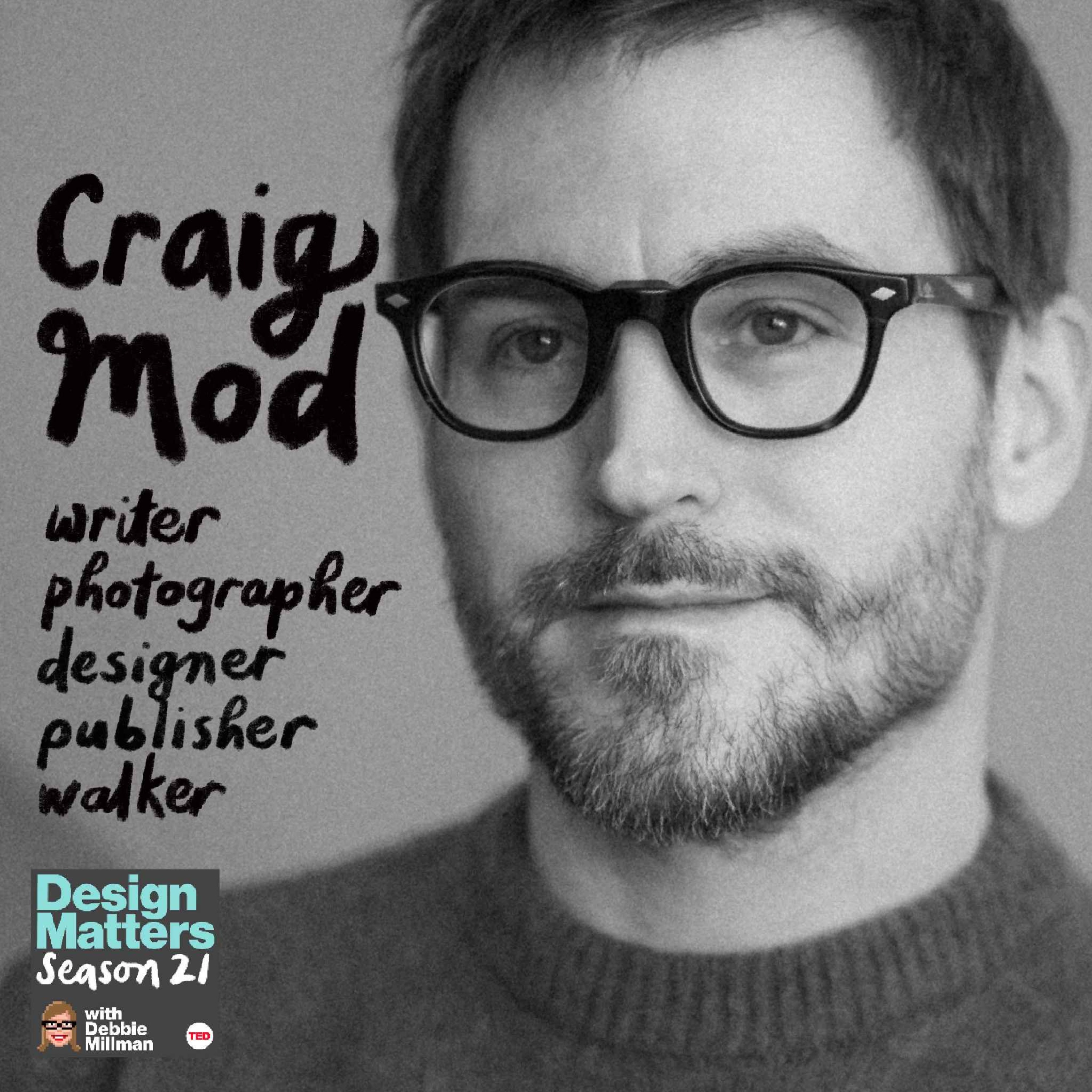
Craig Mod is a writer, photographer, publisher, designer, and long-distance walker. He runs newsletters Rodin and Ridgeline and a membership community focused on books, walks, photography, and thoughtful work outside algorithmic internet culture. Books include Kisa by Kisa, Artspace Tokyo, and the memoir Things Become Other Things (friendship, grief, class, adoption, Japan, and motion/memory).
Adopted kids often need far more explanation than adoptive parents realize; “knowing” adoption doesn’t equal understanding. Shame leads adoptees to fear being discarded, so conflict can feel like expulsion. Scarcity forces “hacks” to escape and build independence; minimalism protects autonomy and self-worth. Technology can both connect people and distract them (phones can drain creativity).
His childhood friendship with Brian (later murdered) shaped his origin-myth thinking. He describes preemptively “weaponizing” adoption shame at school. Japan became a “side door” when U.S. study abroad was too expensive, and night walks in Tokyo taught him to be near others’ lives without needing anything. He recounts being dismissed at Razorfish after showing a “goofiest” portfolio, then later joining Flipboard as a consultant.
Written by AI. May contain mistakes.
Discusses the importance of self-worth and its connection to toxic relationships.
“And you can't belong if you don't feel valuable.”
Debbie introduces Craig Mod and his diverse creative work.
“Craig Mott is a writer, a photographer, a publisher, a designer, and long-distance walker whose work is rooted in attention.”
Craig reflects on his childhood in Connecticut and the significance of a local factory.
“Craig, you grew up in a small industrial town in Connecticut where an airplane engine factory was not just an employer, it was the center of almost everything.”
Discussion of Craig's friendship with Brian and the impact of loss.
“Things Become Other Things, your most recent book, is a memoir.”
Craig shares insights on adoption, identity struggles, and family dynamics.
“And I think it all stems from like a misunderstanding of how family can function, you know, and like, what is a biological kid versus an adopted kid.”
Craig discusses the emotional challenges of feeling discarded and navigating relationships.
“You also had so many fragments from the adoption paperwork.”
Exploring the complexities of emotional responses in relationships.
“there was friction or strangeness in a relationship it was very easy to go okay let's cut this tie before I get discarded I'm going to do the discarding I'm not going to be discarded but with her, I couldn't do that.”
Examining how a scarcity mindset influences self-worth and relationships.
“It's that she was so afraid of losing me, and actually all she wanted it was to repair, but she didn't know how to do the repairing.”
Discussing the origins of shame and how it leads to defensive behaviors.
“As a boy, how did you begin sorting the people around you into models, warnings and mysteries?”
Reflecting on childhood experiences that shaped perspectives on adulthood.
“Well, I think, you know, just video games immediately captured my attention because, you know, it is kind of an escapist thing.”
Exploring how music and creativity served as outlets for connection and escape.
“Japan couldn't put me into a socioeconomic hierarchy.”
Explore how Craig Mod's journey into design and programming began with the advent of the web.
“So with design and programming, with the advent of World Wide Web and then Mosaic comes out and Prodigy and PPPs and dial-ups and all this stuff, as soon as I saw the web, I was just like, OK, this is it.”
Learn about the paradox of scarcity and how it shaped Craig's creative journey.
“That's the only way to to get out or to move forward or to build more of a solid base.”
Discover the lessons and joy Craig found during his night walks in Tokyo.
“You walked around and could hear bags being drawn, children behind doors, cigarettes in kitchens, radios in small rooms.”
Understand how Craig's experiences hitchhiking across Japan shifted his connection to the language.
“Yeah, you talk about in Tim Ferriss' podcast about simplification, you talk about how one of the three main things that you've done to simplify your life is to stop drinking.”
Explore Craig's decision to transfer to UPenn and his early professional experiences.
“That kind of 10 ,000 hours, like brute forcing it through this thing that we didn't know was going to brute force it and then coming out the other side and being like, oh, wow, OK, that skill is just there now.”
Learn about Craig's journey to Silicon Valley and his approach to career opportunities.
“What do you think Sharka Highland saw in you before you fully saw it in yourself?”
Discuss how Craig developed his independence and sense of self-worth through various experiences.
“So talk a little bit about where that resistance to conventional success came from.”
Examine Craig's reflections on corporate culture and maintaining personal values.
“up my hourly rate i remember i started charging more for like design consultancy you know when I was 27, 28.”
Explore how Craig views financial discipline not as deprivation but as a means of protection.
“But at the same time, I remember Mike McHugh was like, hey, we want to give you stock and da da da, but you have to be a full-time employee.”
Exploration of personal motivations behind minimalism and the concept of family in a professional context.
“I think we may have like cracked something here.”
Discussion on the decision to return to Japan, the impact of writing, and experiences at McDowell.
“You know, it's like, that's the new narrative, which I have to admit is very compelling.”
Reflection on the fulfillment of independent work compared to working in large tech companies.
“Again, it's like Kevin Kiley aphorism of, you know, be the only or whatever.”
Insights into how technology has shifted from a tool for creation to a potential hindrance.
“This June for Pride, check out our episodes about some of our culture's biggest queer icons.”
Discussion on the value of newsletters compared to social media and the enduring power of books.
“And then I just so happened this mentor figure in my life, John, the book of John, started inviting me on these big walks.”
Exploration of walking's significance in personal and artistic growth, including processing trauma.
“that survives everything else you produce online.”
Discover how creativity can emerge from personal experiences.
“I remember performing at the Reno Jazz Fest with my college jazz band.”
Learn about the connection between personal grief and societal inequities.
“And in college immediately in my creative writing class, my first impulse was to write short stories about us.”
Explore the Japanese concept of 'yoyu' and its implications on life and creativity.
“I was really impressed by how the social critique was embedded in the narrative rather than slammed on top of it.”
Examine how solitary walks can foster personal insights and creativity.
“You could say, I got the bandwidth for that.”
Uncover how walks can lead to deeper empathy for oneself and others.
“You don't get these other kind of add-ons.”
Learn about the inception of the Special Projects community and its evolution.
“You know, I was never thinking like that about any of the people I grew up with or the town or any of that.”
Discover how Craig Mod created a unique community around his Special Projects.
“And I mean, I know Special Projects is even more generic, but I like it.”
Learn about Craig's journey from special projects to publishing with Random House.
“And so going with Random House, a couple of things.”
Craig shares the impact of receiving recognition from admired authors.
“But doing that Random House Edition was about how do I get the story out to more people?”
Explore Craig's thoughts on authentic representation in writing about Japan.
“And he writes this incredible close read email.”
Craig discusses his journey of discovering his biological family and identity.
“As we talked about earlier, you knew very little about your origin story, your biological origin story.”
Craig reflects on self-worth and its role in belonging and relationships.
“So that was really profound and powerful.”
Craig Mod discusses his journey to self-worth and the complexities of belonging in different cultures.
“And you have to be very conscious of how that relationship's going to play out.”

Get the gist, explore an idea or ask about something said.
 Claude
On Design Matters with Debbie Millman, what are the key points of this episode?
Searching your listeningAutomatic transcript. May contain errors.
0:00So much boils down to self-worth. And you can't belong if you don't feel valuable. I think a lot of toxic relationships, a lot of abusive relationships come from that desire to belong, but not feeling valuable. From the TED Audio Collective, this is Design Matters with Debbie Millman.
0:26on design matters debbie talks with some of the most creative people in the world about what they do how they got to be who they are and what they're thinking about and working on on this episode a wide-ranging conversation with craig mod about adoption about walking in japan and about how technology is affecting creativity the abundance of creativity we are we're losing every single day because of people being sucked into their phones.
1:17workforce, your tech stack, your business. You don't need more tools. You don't even need cilantro. You need one solution. And that is why Paylocity built a single platform to connect HR, finance, and IT with AI-driven insights and automated workflows that simplify the complex and power what's next. Or as we call it, a delicious operational burrito. Yes, we do. Experience a one place for all your HCM needs, besties. So start now at paylocity.com slash one. Paylocity.com slash O-N-E. I'm Kai Wright I'm Emmanuel Jochi and we're the hosts of Big Lives this June for Pride check out our episodes about some of our culture's biggest queer icons like David Bowie whose gender-bending TV performance seduced the world the enduring power of Kylie Minogue and Star Trek legend George Takei on the biggest challenge of his life and don't miss our earlier episodes on George Michael Richard Pryor Liza Minnelli and Little Richard Listen to Big Lives wherever you get your podcasts.
2:43that design changes everything. The Kohler Veil Smart Toilet is sleek with a rounded shape that's more like architecture than just plumbing, and it goes beyond looks. The touchscreen controls and customizable cleansing features offer a level of comfort and cleanliness that exceed expectations. It's all about elevating those ordinary daily rituals into something extraordinary through thoughtful design. Kohler has been pushing these boundaries for over 150 years, mastering that balance of stunning form and high performance function. That's a long time to get it right, and it shows in every detail.
3:25Experience the difference of Kohler smart toilets. Find out more at Kohler.com. Craig Mott is a writer, a photographer, a publisher, a designer, and long-distance walker whose work is rooted in attention. Attention to roads, books, technology, memory, and the lives we pass along the way. Craig writes the acclaimed newsletters Rodin and Ridgeline and runs special projects, an independent publishing and membership community devoted to books, walks, photography, and the making of thoughtful work outside the machinery of the algorithmic internet. He is also the author of several books, including Kisa by Kisa, Artspace Tokyo, and the beautiful memoir, Things Become Other Things, a book about friendship, grief, class, adoption, Japan, and the alchemy by which motion can turn memory into meaning.
4:27Craig Maude, welcome to Design Matters. Thanks for having me. Craig, you grew up in a small industrial town in Connecticut where an airplane engine factory was not just an employer, it was the center of almost everything. Your grandparents met there, your parents met there, and nearly everyone seemed connected to it in some way. What did that factory mean to you as a child before you had a language for class or labor or escape? Yeah, I mean, it was probably most through my grandfather, who I think he kind of identified that, you know, most strongly with being there. And my grandmother, once I think she got married and was pregnant with my mother, she left the factory.
5:11So it was really just my grandfather who was kind of there consistently. And then when my parents got divorced, all these things. So everyone ended up leaving it except for my grandfather. And he took a lot of pride of being there. And actually, you know, the factory is Pratt & Whitney. And it was funny. We'd go to Disney World. This was like our one indulgence as a family is every summer we'd go to, I went to Disney World probably literally 10 times, 10 summers in a row. I could still probably to this day navigate Disney World without a map and know exactly where everything is. I'm like, oh, I know where Space Mountain is and where this is.
5:44And we would always go. And I think at Epcot Center, there was a special Pratt & Whitney sponsored ride or exhibition or something. And he had a little card that would get us into the back like VIP. And he wasn't, he was not a VIP at Pratt & Whitney. He was just a random guy on the floor. His salary was very modest, but we'd be able to go into that space. I just remember that feeling really special and like, oh, wow, this is like an entity that has a certain kind of power and magic to it, which I don't think anyone would be able to say today about, you know, car manufacturers or airplane engineering or things like that.
6:22Things Become Other Things, your most recent book, is a memoir. But it's also a love story between you and your childhood best friend, Brian, who was tragically murdered when he was still a teenager. There's a line in Things Become Other Things where you state the town is nothing to you without him. First grade is where the two of you meet and your friendship infuses almost chemically. What do you remember about the boy he was when you first got to know him? It was just immediately someone I kind of admired. I mean, I think I'm adopted and I think all adopted kids think deeply about their own mythology, where they came from or where they could have come from.
7:07I think we all really crave siblings. And I think Brian was just, we kind of looked enough alike. Yeah, you were mistaken for brothers. Yeah, yeah. And I love that. I remember that being a really important, you know, fiction that as a kid held a lot of meaning. And so I think it was, you know, just a combination of these things that maybe made more potent by being an adoptee. Your adoption was explained to you early. Yeah. But you've said that knowing the word did not mean understanding what it meant. Right. There is that childhood confusion that you had around Hawaii, your mother's honeymoon, the idea that you had somehow been in her belly.
7:45What were you trying to make sense of in those years? Yeah, well, so, okay, look, every adopted kid, I think, carries with them so much confusion. And I think this is something that isn't, I had never heard really spoken about. I hadn't, also hadn't really paid attention to the adoption community or forums or things like that or adoption podcasts until last year, when I started doing some in kind of promotion for this book. and you very quickly realize like adopted kids have you know four or five times chance of becoming addicted to things or committing suicide and like you go what is causing this and you start to look for patterns with other friends families who have adopted kids and the adoptees are often the ones that end up struggling the most in the family for one reason or another and that could be in adoptions where the kid looks like the family or doesn't look like the family you know it's like there's a lot of south korean adoptees that came into america in the 80s i've talked to many of them.
8:38And there's a whole set of complex things that go on there, where if you don't look like your parents, when you're in elementary school, first or second grade, you don't want those people to come to the school, you know, so you don't want them to like walk you into the school, because then it creates this complexity. And I think it all stems from like a misunderstanding of how family can function, you know, and like, what is a biological kid versus an adopted kid. So I think a lot of explanation has to happen. Far more explanation has to happen to adopted kids than any adopted parent understands.
9:08And as I speak to my friends who are kind of having kids through surrogacy or adopting kids, I think there is a bit of stronger awareness of this today. But even then, I think it's a huge misunderstanding to believe that kids, you show them a book about, oh, this is what adoption means, or you talk to them a couple times about it. They do not get it. So for example, my daughter who I've adopted, I've been in her life since she was two, and she doesn't have any connection to her birth father. And, you know, we are not genetically in any way connected or anything like that. But I've always known that I wanted someone to talk to me about these things, to talk about mythology, who the birth parents are.
9:49And I always felt that my adopted parents made that a taboo, whether consciously or unconsciously. I think it's mostly an unconscious thing where you aren't allowed to talk about that because that's somehow robbing them of their true parental position or something like that. You know, it's very, so I very early on in my relationship with my daughter, I made it a point anytime we were alone or we were, you know, and I've always had these deep conversations with her and we actually never spoke English to each other until a year ago. She's 16 now. So all these deep conversations and I always had them in Japanese because I always wanted them to be as deep as possible.
10:25And I would always say, look, you know, if you are ever thinking about your birth father, you know, that's okay. And she'd go, yeah, yeah, you know, I do think, I wonder who you could be. I'm like, yeah, that's totally fine. You know, and that's, you shouldn't feel ashamed about that. And please, if you ever want to talk to me about it, it's completely fine. And even last year, you know, we now have this new kind of relationship in English. She's been studying abroad and kind of learning English and she's fluent now. And I remember saying to her last year, just saying like, look, you are going to be interested in this person.
10:57And I want you to know it'll never, ever make me sad, ever, if you want to go find this guy. And I'm there with you. I'm by your side on this trip. I'm there to support you in any way I can. And I just felt like I really needed that as a kid. And I think most adoptees need that as kids. And so am I in the belly? Am I not in the belly? What does it mean to be adopted? You also had so many fragments from the adoption paperwork. A 13-year-old birth mother and her birth father said to have died after an accident and fight. And those fragments became a kind of origin myth before they became facts to investigate.
11:37What kind of story did you build around yourself from such little scraps? Yeah, I mean, you know, just a broken one. I mean, you know, the parents who adopted me got divorced when I was about two. So that also was sort of, I think adoptees kind of have this internal sense of, oh, you're a thing that can just be discarded. You know, I think that's like part of the core essence of adoption in some way. It's like if it's not really handled delicately and almost to a point, I think that adoptive parents would be uncomfortable with of just, you know, you really have to hammer home that it's okay to think about these things and you weren't discarded and yada, yada, yada, all that stuff.
12:15So that was a big part of it is having that kind of core sense of like, wow, OK, you know, as a human, you can just be cast off from a family. And so then reading the small bits of empirical data we had about my birth parents, it just hammered home like, oh, this I come from a place of pain or suffering, bad guy, you know, all these things. And so, again, without someone to really talk you through that, you know, it's one thing to be like, oh, hey, here's your adoption papers. You know, good luck trying to figure out how to incorporate this into your psyche. And it's another to be like, wow, we really need to talk about this extensively.
12:49One thing that I was really struck by in your writing was the notion of because you felt that you had been discarded, that at any point, any friction in a relationship could also then mean that you'd be cut out of someone's life. You had a disagreement with your daughter that she might shun you. How have you managed to navigate through that type of emotionality? I struggle with that quite a bit. Yeah. Look, I'm bringing this stuff up not to, it's not like a woe is me thing. But I just think it's such a universal experience. I'm just trying to hold space for people that also have felt these things or are feeling these things and wondering if there is a way to get out the other side.
13:34So the discarding feeling, the way I kind of have pushed through it, I mean, it's several things. One, I think was moving to Japan. That's a way to like be in a position where you're already discarded, so you can't be discarded more. and then I think with my daughter she ended up being kind of unexpectedly like a I don't want to say tool but like our relationship became this training ground because I couldn't turn away from it because I had this sort of parental position and I felt an obligation and so up until then if there was friction or strangeness in a relationship it was very easy to go okay let's cut this tie before I get discarded I'm going to do the discarding I'm not going to be discarded but with her, I couldn't do that.
14:14And we would get in these silly fights, you know, about her not going to school or getting up in the morning or something. And then I would find myself spiraling in this really irrational way. It's a scarcity mindset way where everything is going to be taken away. You're going to lose everything. I had this feeling with money for most of my life. It's sort of why I lived in a very tiny apartment. And, you know, I didn't own any furniture except for one low table until I was 35. I mean, it's like there's you look back and go, wow, there's a lot going on there. But the scarcity mindset sense of people and your position with people holds no value or has very low value.
14:50And so with her, you know, we'd get into these fights. I'd be like, oh, my God, she's never gonna talk to her. She wouldn't talk to me for three or four days. I'd be like, oh, my, that's it. You know, she's done with me, which is an insane thing. It's just like a pathologically crazy thing to think. Well, I don't know if I'd go quite that far, given I struggle with it all the time. I'd like to think it's just sort of a normal reflex from feeling like that happens to you over and over again as a child? Yeah, but it's just, I think once you understand the objective context of a relationship like you have in this with the younger kid, and so she'd be eight or nine when we're getting these little fights, I'd quickly realized after this happened maybe four or five times that it wasn't that she wanted to discard me at all.
15:30It's that she was so afraid of losing me, and actually all she wanted it was to repair, but she didn't know how to do the repairing. And also like little kids' brains are nuts. The chemicals are bonkers. And it's like, again, this is like the position of a parent is to be able to hold all of this for the kid and know what to do and guide them through these kinds of emotional experiences as well. So it became this thing very quickly that I realized like, wow, okay, I have all this autonomy and I have all of this agency over repairing these things. And over and over again, it became a self-reinforcing sense of like value for myself.
16:06Now I've just more and more believed that. So that sense of scarcity or being thrown away or being lost, dissipated naturally just through these interactions. You know, you talk about preemptively ending things so that you're not the one that gets hurt. Yeah. You experienced quite a lot of childhood cruelty and that private information that you were worried about people finding out, you actually turned into a bit of a weapon and preemptively weaponized your own adoption with your schoolmates before anyone else could. How early did you learn that the safest thing to do with shame was to strike first?
16:46It just felt so intuitive. I saw other kids around me being attacked. Everyone was kind of always being attacked to a certain degree. And it was like, okay, you've either got to, you know, sort of like you get to prison and you've got to shank someone really fast. Establish your power. Yeah, yeah. You got to kill the leader, you know, or else you're going to be, you know, in this tormented state for the rest of your time there. And I guess to a certain degree, growing up in certain kinds of towns can feel like that, where there's such an abundance of scarcity. Like everyone is kind of suffering from the same scarcity.
17:18And so your rubric for kind of hierarchy becomes perverted and demented. And so I just think early on, I got the sense of like, okay, if I don't basically self-attack preemptively, and then in doing that show that I'm kind of invincible, it's going to be a painful 15 years or 16 more years of being in the school system. You mentioned your adoptive parents divorcing when you were very young. I believe you were about two years old. You were largely raised by your mother and your grandparents. Your adoptive father becomes in your book and in interviews a sort of anti-archetype. A man who taught you very little except what not to become.
17:57He also farted quite a bit, which operates in the book almost as a metaphor for who he is and how he behaves. As a boy, how did you begin sorting the people around you into models, warnings and mysteries? So it was mostly warnings, I'd say, almost entirely through. I'm trying to think back on who was a model. I mean, of course, as a kid, you're always going to idolize your father, no matter how broken he might be. And even if you're not connected by blood or whatever. So there was a part of me that really wanted, you know, obviously my father to be my father and love me and like, you know, teach me things and do those sorts of things.
18:40But he, at the end, was never able to step up to that position. Looking back on it now, I just see it sad. What a bereft position to be in, you know, and he was taught that through his parents. You look at these cycles and you go like these people just don't aren't aren't born. There's this whole systemic thing that's happening around them that creates them being as they are. But like my neighbor across the street was an alcoholic and he tried to kill himself by, you know, turning the car on in the garage and like leaving the door open. That was like that happened very early on. or, you know, another neighbor, he had a whole wall just covered in guns.
19:14You know, it's like you go to his house and it's like all guns and his like son would always have a switchblade or like a handgun on him, you know. So I think very quickly I realized don't idolize any of the things you're seeing, but it wasn't until middle school and it was sort of through gifted program things. Without this gifted program, I would have been lost. That was where I learned programming. We were using Logo. Once a week for, I think it was like two or three hours, we'd just be in this separate kind of bubble. And the teachers who were involved with that, I remember being the first ones to kind of like really model for me a different way of being.
19:51And then in middle school, there was, again, this sort of gifted program teacher who taught me how to work on projects and kind of be performative in a way that I don't think anyone around me or anyone else in the town kind of knew how to do. And then in high school, I had a couple of teachers that really blew open the barn doors on, you know, OK, there is a world out there beyond what you can see here. And I have faith that you can operate in it. And I want to try to help you get there. A neighbor with a computer, I believe, also changed your life by letting you come over. He eventually gave you a key and even got you a phone line.
20:24Yeah, exactly. And in the book, I don't talk about this, but like, you know, that was also very weird. He was always smoking weed. He always had like, he always had weird girlfriends around. Like the computer room I was in, I opened, I opened one of the drawers on the desk and there was like a pair of soiled women's underwear in there. It's just like, so at one hand, it was like really nice that this guy gave me access to this computer and this phone line, but it came with all of these like landmines, you know, and I look back on it. I'm like, I'm glad he wasn't a pedophile. I'm glad, you know, it's like there could have been so many other layers that, again, You look back and you go, this shouldn't be the experience of a kid.
20:58Like there shouldn't be this many landmines of everything that they're kind of involved with or touching. Nintendo and Zelda seem to have been almost like a portal for you. Oh, yeah. You write about them as a golden cartilage with a sticker that states made in Japan. Oh, yeah. And that seems to contain a wider world for you. What did that object open in your imagination before Japan was a real place that you could go to? Well, I think, you know, just video games immediately captured my attention because, you know, it is kind of an escapist thing. I think one of the reasons video games today are so popular is that we really want to not be here in this bizarre, you know, kind of complicated world that's like more and more complicated.
21:42And so Zelda, it was a couple of things. One, it was just like a cool game. It was fun, cool music. but also it was the first time i realized i had kind of video games in general i was just really good at them and i would sit on the bus on the way to school and i would hold like conference sessions with kids so i'd have my zelda maps and i would like teach people where the this bomb here this is where this thing is you know kids would come and they'd be like how do i get through this i'd be like oh you got to do this and so it was the first time i kind of had this sort of hierarchical authority of knowledge that that was pretty cool.
22:16You said that much of your early programming was in service of writing. And by 1997, you were already building rudimentary blogging software before blogging was even a mainstream form. You also had the early internet gave you access to text-based communities, ANSI art, designers, coders, people far outside your local world. What are those online spaces teach you about finding your people before you could physically leave? It was mainly just, oh, there are people. People are out there. It was more just like, wow, all right, there are talented people doing interesting things. And the complicated aspect of that, though, was once I could leave and start to kind of engage with these folks, immediately I felt the deficits that I was carrying relative to them.
23:07And I think one of the reasons why you don't see a lot of people from difficult places make it is because you leave, you come to like New York, you go to San Francisco. I remember going to the Razorfish office. So I was very lucky, right? Tell the Razorfish story, because that I think is a really indicative moment of what you had to contend with, given your upbringing. Yeah. And so I was very lucky. I met a guy who started a little design agency, and he brought me out for the summer when I was 18. I drove across America in a Honda Civic with no power anything or air conditioning. It was, that was incredible too.
23:43So being able to see America at that scale that, that early and kind of going to jazz clubs and having a fake ID and sneaking in to go like see jazz in New Orleans or, you know, over here, over there in Colorado. And that summer, you know, when I was, when I was in San Francisco, I was thinking about the next summer and I was like, oh, I'd really love to work for a bigger agency. And I was really into K10K. And I was really into sort of like the smaller, you know, indie, non-traditional design universe online that was kind of emerging. Kyoken, K10K, you know, those folks. And I built the world's goofiest portfolio.
24:19And I went to Kinko's and I printed it out in the goofiest possible binder. And I remember going around to a few of these agencies. And so I go into the Razorfish office and I kind of hand in this terrible portfolio. And the guy, I remember this really just pompous guy being like, who's your favorite designers? And I was like, the K10K guys. And he was just like, who are they? You know, it's just like completely dismissing and be like, come back when you've actually studied design and you actually know something about design. Yeah, that story. And so that was so... I wish we knew who it was. I know, I know.
24:55Who was there? Well, who was there in 1998? And they were doing such beautiful work then. Oh, my God. The razorfish work that they did, that timeline of typography that went on forever. Oh, my God. This was, I mean, that was why I was there. I was like, this is where I want to be. You know, I remember meeting Adam Greenfield a few years later, and he was working with Razorfish. I just remember being like, oh my God, I'm meeting someone that works with Razorfish. That's so cool. In Tokyo. uh so anyway i was i was doing things like that and i was trying to find my way out um and but that sense of like you go you take this risk you do this thing and they just someone just slaps you down and you don't have a community or a family that knows how to talk you through that because this is all foreign to them so i think this is why most people that come from places like i come from don't leave or they try to leave and then they run back because you just go wow this is this This is a lot.
25:49And so for me, the hack was to go to Japan because Japan couldn't throw me away. Japan couldn't put me into a socioeconomic hierarchy. And it allowed me to kind of try to work through this stuff on my own. I have a couple more questions I want to ask you about life before Japan, if you don't mind. Sure. You play drums obsessively. Jazz, classical, big band. And music later became a big part of how you entered Japanese social life. What did drumming give you as a teenager that words or computers or friendship didn't? yeah i mean i think it's all it all comes back to that sense of mastery of a thing and the power that comes from that i was just a good drummer you know i was always kind of the best drummer in school i was even good enough to get into kind of the all-state orchestra and you know i remember doing a snare solo to get in and that was you know a really big deal uh you know people always say do the thing that you love and you're really good you know if you can find that like focus on that so i you know i had these impulses like oh should i study piano or should i you know do bass or you know but i was always like no just stick with the drumming because you're good at it and you enjoy it too it's just really fun there's something kind of powerful about it but it also was the way i was able to connect start making these connections outside of my town so i played in a band when i was 16 17 and we'd play in clubs all over new england i was a 16 year old i would just call up clubs in rhode island and massachusetts and new hampshire and vermont and new york and just be like, hey, we're a band.
27:17Can we play? When can we play? Like, who can you put us on with? We'll play, you know, just pay for our gas to get there. So it really was this tool in the same way that the computer and programming and design felt like, again, these like ladders or extensions outside of the small island that I felt like we were stuck on. These bridges that were starting to be built using creativity, music, rhythm. And I kind of see writing and drumming as being, you know, intrinsically connected as well. At that point, what did you want to do professionally? Did you have a sense? I mean, the writing was always the thing.
27:49It was always, I want to write more. I want to do more writing. But being in a place where you feel like you don't know how to get out of that place and you feel like you need to get out of that place, you start to gravitate towards the things that are maybe more obvious to get you out of there. So with design and programming, with the advent of World Wide Web and then Mosaic comes out and Prodigy and PPPs and dial-ups and all this stuff, as soon as I saw the web, I was just like, OK, this is it. This is how I get out of here. And also the sense of I could make more money than my parents at 17, which was very weird.
28:19That felt almost like a break in the space-time continuum. You know, and you go, this is a strange thing to be able to step through. I can do that. Okay, great. Let's do it. I think if I wasn't trying to find those escapes so readily, the focus would have been almost entirely on writing. You applied to go to school in Japan, mostly for practical reasons. The school provided you with a scholarship, a homestay, a price that made more sense than the American study abroad machinery. Yeah. How much of your life has been shaped by noticing the side door when the front door was too expensive? I mean, all of it, basically.
28:56I mean, this is the paradox of scarcity or coming from is it forces you to become a hacker, you know, and you've got to find these hacks. This is how if you don't come from a place of abundance, if you carry with you all these bizarre deficits, it's like you have to find hacks. That's the only way to to get out or to move forward or to build more of a solid base. and so I'd say you know almost everything I've done has been that and it's it's always been even you know I sort of got my design footing you know I feel like we are sitting here today in some part because I would do these weird design experiments online and like Jessica Helfland and Design Observer would pick up on them when I was you know 21 22 and they would say this is cool here's a guy who's making print books and he's doing this online design experiments if I was just doing print books I don't think they would have picked up on me if I was just doing online stuff.
29:47So I was always looking for these strange intersections. Where's the Venn diagram where, you know, Kevin Kelly always says, don't be the best, be the only. I was like, where is my only on the Venn diagram of all these things I love, which is music and rhythm and publishing and writing and making objects and design. And it just kind of I was able to kind of find that hack of that intersection and use that to connect to people like Liz Danzigo. You know, I met her when I was 26, I think. I would come to New York in my 20s and I'd always have a new thing I made and I would make a list of all the designers I loved.
30:20And I would just email them all and say, hey, I'm from Tokyo and I have a thing. And again, using Tokyo as a hack because it's like, oh, here's a guy from Tokyo. That's cool. I don't people from Tokyo don't email me normally. Well, design provenance in Tokyo is quite strong. For sure. For sure. So very, very consciously using that, you know, as yet another tool to make these connections to start to feel this greater sense of abundance. And then all of this being in service to your sense of value for yourself. I mean, that's kind of what it boils down to. Tokyo at night became one of your first great walking teachers.
30:52You walked around and could hear bags being drawn, children behind doors, cigarettes in kitchens, radios in small rooms. What did those night walks teach you about being near other people's lives without needing anything from them? Well, I think in a lot of way it functioned as art and music functioned for me as well, and as well as, you know, the internet kind of functioned. It's a sense of archetypical creation of what's possible out there. Those night walks evoked in me a very similar feeling I get when I'm moved by a great piece of music or when I'm performing. I remember the first time I did a performance, it was at Trinity College in Hartford with my goofy band, and it was our first big performance.
31:36What was the name of your band? I'm not going to say. I didn't find that online. It's so goofy. But I remember finishing that gig, driving home in that Honda Civic. The saxophonist was next to me in the car. We were on the highway, I-85 doing like 30 miles an hour because I did not want the night to end so badly. that feeling of, oh my God, that high you get when you connect with a beautiful thing or you participate in a beautiful bit of music or art or writing or whatever. But those night walks in Tokyo, I felt like we're eliciting the same feelings. And often I was a little bit drunk when I was doing these walks, but I remember I would just be filled almost like with this orchestral swell of joy and possibility.
32:21That's what kept me coming back to them. That first year in Japan included a lot of alcohol, heartbreak, language challenges. First 10 years. First 10 years. Yeah, you talk about in Tim Ferriss' podcast about simplification, you talk about how one of the three main things that you've done to simplify your life is to stop drinking. Yeah. Was that a very conscious decision or was that more of an organic sort of place you moved into? It sort of was forced on me just because so much was being hurt by the drinking. The question was, do I want to be able to have meaningful relationships with people and do the work I feel compelled to do?
32:59Or do I want to drink myself into the ground all the time? It was like that was kind of the trade. And I think to stop those kinds of patterns, you need to replace it with something else. And so for me, the work, there's a direct connection between trying to remove alcohol from my life and all these amazing things beginning to happen with work and what I was producing and who I was connecting with. So I don't think that's a coincidence. You learn Japanese through a homestay, through your classes, and a university music circle. Yeah. And the music circle gave you, you write about rhythm, slang, friendship, and the casual speech of people at your own age.
33:37When was the first moment when Japanese stopped feeling like a subject and started feeling like life? Yeah, well, I got to Tokyo in August. And then for spring break, a friend and I hitchhiked across the country. We don't have any money. We can do this for free, I guess. And we'll see how it goes. And every day you had the same conversation. Who are you? What kind of music do you like? Where do you go to school? Where are you from? And I did that for, you know, 35 days in a row. and I remember feeling at the end of that just so exhausted we were in Okinawa we finished in Okinawa on this weird little island we were like staying in a tree house and I remember just like being sitting outside the tree house smoking and just talking to my friend going I never want to speak Japanese again I'm like so tired I'm so sick of this language because we had just sort of OD'd on it you know every day someone new is picking you up I remember going back to Tokyo and about like four days later after I had a rest, it was like suddenly it was just there.
34:36Wow. And I thought that was interesting. That kind of 10 ,000 hours, like brute forcing it through this thing that we didn't know was going to brute force it and then coming out the other side and being like, oh, wow, OK, that skill is just there now. What made you decide to transfer to the University of Pennsylvania? The dot-com bubble collapsed. So my kind of plan was to go to Silicon Valley after Japan. I didn't have a clear path to stay in Tokyo at that point. So it was like, okay, I've got to do something. And if I'm not going to go to Silicon Valley, why don't I apply to a few schools in the States and see if I can get in, see if they can give me some money.
35:12And so I applied to Stanford, NYU, UPenn, but UPenn in particular, because they had the DMD program, the digital media design program. At that time, I really wanted to go to the MIT Media Lab. It was only a grad program. So there's no undergrad for that. And DMD was sort of the only undergrad fine arts computer science program in America, I think, at that time, really. DMD and UPenn was really leaning into that. Yeah, it was totally unusual at the time. It was the program that combined computer science and fine art. And it was really a hybrid that was unusual. You had professors Joshua Mosley and Sharka Highland.
35:50What do you think Sharka Highland saw in you before you fully saw it in yourself? I mean, I guess maybe a little bit of aesthetic sensibility. I don't know. She just, I love professors that you really have to work to make them like you. And Charco was like absolutely not a pushover. And she just had this otherworldly Eastern European sort of etherealness. Like she was like this apparition that appeared of like the ghost of rigid design rules, you know. And I was just in awe of her and I loved it. I was like, I want to be around people like this. These are my people. And okay, give me a higher hurdle to hit than I would do on my own.
36:28It was powerful. And then you went to Silicon Valley. Many, many years later. Yeah. So I just want to make sure I understand the timeline. This is a little confusing to me. So after Penn, you then did a magazine internship. Is that correct? Yeah. In between years at Penn, I did a magazine internship in Tokyo. And then as soon as I graduated, everyone else was like trying to find jobs. The editor at the magazine was like, hey, I want to start a small independent publishing company. Do you want to be the art director? I was like, yes. Can I live in Tokyo? He's like, yeah, sure. He was living in Tokyo.
36:58But then he moved to Seattle. And then I applied to grad school at the same time to be able to get a visa to be there. And so after Penn, I went right back to Japan. So it was sort of, I was in Japan, I came back for a year at Penn, summer in Tokyo, back for a year at Penn, graduated, and then straight back to Japan for grad school and then running this publishing company. When you did work in Silicon Valley, was it Flipboard? Yeah, Flipboard. And that was basically seven years after all this. But that's really when I think you made some very specific decisions about how you wanted to live your life.
37:32Yeah. Talk about what that was like, Because from what I understand, in those years when many people around you were chasing scale and status, you seemed increasingly drawn to smaller rooms, self-directed work, and real independence. So talk a little bit about where that resistance to conventional success came from. I think it started in that razorfish room. It's like, it's really like, hey, screw you guys. Okay, I don't need you. I'm going to build, I'll build my own razorfish. that I like I really think that was like seated there and I think I spent my 20s building up a kind of independence a fierce ability to to not need conventional systems to not need to be in New York yeah I want to connect with everybody but I don't need you but you know but I love your work I'm inspired by it let's connect and so I think going to Silicon Valley was sort of in part there's a bunch of reasons one is like Tokyo Tokyo is actually very provincial even today It's like it is kind of like a tiny village.
38:34It does not think on a global scale. Most startups in Tokyo are not thinking about the world outside of Tokyo. I mean, in a lot of ways, it's because the Japanese addressable market is big enough where you don't really have to do that. and in the design and art world when i was in my 20s and it was in you know 2000s i just saw the rest of the internet kind of taking off and i was like i kind of want to participate in that more and i was looking for a way to do that as i was building up my own kind of collection of projects and tools and you know output and doing art space tokyo and things like that it was also going to silicon valley dovetailed with me sort of dropping alcohol and ratcheting up my hourly rate i remember i started charging more for like design consultancy you know when I was 27, 28.
39:17And then finally, when I was 29, I Marcos Westcamp, who was the first, you know, he was employee number four at Flipboard and he's the lead designer. He and I were friends because he had lived in Tokyo and he'd always loved my work and we had coffee and he's like, dude, you got to come out, like come out and work with us. I can't tell you what we're building, but it's cool. Like you, you want to be here. And I was like, all right, I think I do need to leave Tokyo. You know, I think I do need to be around people thinking in a bigger way. And so I went out and I joined initially as a consultant, making more money in a month than I had made in like two years, uh, doing everything else.
39:52So, and part of that, part of that was, uh, you know, when we were negotiating the contract, uh, you know, doing mock negotiations with friends and like just building up the courage to be able to say bigger numbers and then doing it and having them be like, yeah, sure. And I was like, damn, I should have said bigger numbers. But, uh, but it's like the, all these little ratchets of self-worth. Oh, I am valuable. I am worth that much an hour. Oh, you know, it's really strange. A lot of kids are born into great circumstances where they don't have to do this. And then a lot of kids aren't. And you've got to find all these hacks.
40:23How do you as an adult make yourself believe in your value? And so that was a big part of it. And going out and living with Enrique Allen and Ben Henretig, who are my roommates in Palo Alto. I live two blocks from Steve Jobs. That was like really interesting to just be two blocks from Steve Jobs. See him walking around. I'd walk by his house every day, you know, on the way to work. Feeling like I was able to hold my own in that universe with those players as like a team, as like a, you know, as an orchestra, that meant a lot to me. That was really powerful. But at the same time, I remember Mike McHugh was like, hey, we want to give you stock and da da da, but you have to be a full-time employee.
40:56And I remember that was like, there's this voice inside of me like, don't do it. That's not our thing. We're here to, you know, to build our own thing, to look beyond just a single company to, I don't know, think, I don't know, more expansively than just a single company. It was really complicated. I remember the day I signed, I didn't want. So you did sign. I did because I didn't feel necessarily bullied into it, but I just felt like I don't know. It was also like, I actually told him, I said, don't pay me a salary. Just give me all stock. Thank God I didn't do that because I ended up, stock ended up being, but I was like, what is the bigger bet I can take here?
41:35You know, and like, also, you've just paid me for six months. Like, I can literally live off what you just paid me for six months for the next, like, six years. So it's like, I don't need a salary right now. That's how ascetic my life had been and how rigorous I was at creating a fixed cost of living that was low where I could say no to anything. That was really important. Well, you frame financial discipline, not as deprivation, but as protection. Yeah. And I really, really understand that. I think a lot of people do. Yeah. What do you think you were protecting yourself from when you kept your life so minimal?
42:05Maybe the razorfish guy. Always back to the razorfish guy. I think we may have like cracked something here. Yeah, just that ability to, I think, build my own universe, my own family, which I think a lot of adopted kids feel drawn towards. And not be dependent on a larger entity granting you permission. And yeah, I think that was when you boil it down, that's mainly it. How did you convince yourself it was time to go back to Japan? I ended up staying at Flipboard in total with the consulting time for about 15 months. And that felt like a really long time for me. It did not for the people in the company.
42:45It felt like I was letting down my family. People came up to me and said, I'm so disappointed in you. That sort of thing. It's like that level. It's so much worse than somebody being mad. I know. disappointed disappointed in you you know let me down and and i after that i remember telling everyone like never join a company if you think it's gonna be family because it's not this is not family this is a business sort of contract that you're entering into here like don't forget that don't because there is this narrative oh you be part of the family and we're going to support you and take it my wife always says the job is never going to love you back no no and i think in 2010 2011 there was this hyper utopian optimism around tech as well and so it's easier to kind of fall into that.
43:25Maybe today it's a little less. Although, you know, with AI and Anthropic, it's like, hey, do you want to come and build God with us? You know, it's like, that's the new narrative, which I have to admit is very compelling. I would totally, by the way, go and work with Anthropic for six months right now just to get that front row seat of what is happening in these places. I think it is really fascinating. So when I left, I ended up spending about three years out there and it was 2013. A couple of things happened. One, Liz Danzigo told me about McDowell. She's always been so supportive of my writing.
43:53And my writing is really what got me that job at Flipboard. My writing is what connected me with a lot of people. And so when I look back at my life, writing is always the thing that has had the biggest impact. All the people I love in my life that I'm closest to, all the greatest opportunities I've had have all kind of come out of writing. And so Liz was like, hey, you should do McDowell. I was like, what's McDowell? And so I applied on a whim to get into McDowell and I got in, which was wild. And getting into McDowell was my formal way of being able to get out of Flipboard. So I was able to say, hey, I've got this fellowship.
44:25I've got to go do this thing. Peace out, guys. Good luck. And so that was really good. But also going to McDowell and being around these National Book Award winners. Was it Lynn Tillman there when you came here? Lynn Tillman. Yeah. Lynn Tillman became a super good friend right away. I mean, Susan Choi was there. She's had a number of like mega bestseller hits now, you know. And so being surrounded by that, again, how do you ratchet up self-worth? You know, how do you surround yourself with people who are doing the work that you wish you could do or operating a level you wish you could operate at.
44:54And so I was so grateful to be there and feel that. And then I came back and it was always about the writing. I'm living in Silicon Valley. I'm kind of consulting and I'm doing a little investing now. And my roommate started a fund and I kind of started helping out with that. But it was always writing, writing, writing was the thing. And I remember getting these job offers. Ev Williams gave me a job offer. I got a job offer from Matt Mullenweg to lead design at Automatic. I had all these really incredible opportunities. And I kind of looked at them all and I thought, you know, someone else can do that job.
45:25What's the thing that only I can do? Again, it's like Kevin Kiley aphorism of, you know, be the only or whatever. It's, I think throughout my twenties, I built up enough of a belief that a certain kind of independent work nourishes the soul in a way that scale can't. The iPhone version of Flipboard launched and suddenly it had 80 million users. And I kind of didn't feel anything. Whereas, you know, I was putting out books that would have 1 ,000 readers or 2 ,000 readers in my 20s. And that made me feel everything. I remember being at a party, I was like 24, 25. Someone asked, what do you do? And I said, oh, I make beautiful books.
45:57And it just felt so good to be able to say that. Whereas, you know, I helped build software that sells ads, which fundamentally, not to be reductive, but in 2010, 2011, 2012, that's all anything was. It was software to sell ads. That was what everything was predicated on. And that's why I say now I think the Anthropic and OpenAI and all this stuff, it's a different ads might be part of it but ads are not the whole picture now and and that's a whole different discussion but back then it was easier to step away from a silicon valley that was so ad focused and this is also pre-crypto and and things like that monday ai agents took over my work and i absolutely love it chasing deadlines writing status reports updating stakeholders agents handle the daily grind now they live inside monday.com so they see the full picture My work, my team, the whole company.
46:48And I don't have to worry about the data. It's safe, which means I'm free to focus on the big stuff, knowing everything runs smoothly in the background. It's completely shifted the way we work. Create your own AI agent in minutes on Monday.com. Pros, save more on what you need to get the job done right. Right now, at Lowe's. Get 15 % off select custom entry and interior doors. Plus, save$80 on the DeWalt 20-volt Max 2-Tool Combo Kit. Now just$169. And at the Lowe's Pro Desk, bring us your materials list and get a quote in minutes. Handwritten, a photo, or even a sticky note is all you need. Keep your jobs moving faster and on budget at Lowe's.
47:30Valid through 7-8 while supplies last. Selection varies by location. This episode is brought to you by Progressive Insurance. Do you ever think about switching insurance companies to see if you could save some cash? Progressive makes it easy. Just drop in some details about yourself and see if you're eligible to save money when you bundle your home and auto policies. The process only takes minutes, and it could mean hundreds more in your pocket. Visit Progressive.com after this episode to see if you could save. Progressive Casualty Insurance Company and Affiliates. Potential savings will vary.
48:00Not available in all states. I'm Kai Wright. I'm Emmanuel Jochi. And we're the hosts of Big Lives. This June for Pride, check out our episodes about some of our culture's biggest queer icons. Like David Bowie, whose gender-bending TV performance seduced the world. The enduring power of Kylie Minogue. And Star Trek legend George Takei on the biggest challenge of his life. And don't miss our earlier episodes on George Michael, Richard Pryor, Liza Minnelli, and Little Richard. Listen to Big Lives wherever you get your podcasts. You have worked deeply in technology, yet most of your life now argues for slower attention, physical books, walking, and the removal of the phone from the room.
48:48When did technology begin to feel both like a tool and hindrance or a threat? Yeah, I mean, I think with the phones, I think really phones and social media, you know, in the early 90s, when I first started programming and using my neighbor's computer, and then even the mid 90s and late 90s, when the internet was starting, web was starting to come online, the dopaminergic algorithmic sucking in of it, it was a different kind of being sucked in because you were building all the time. You know, I was using the computer 10 hours a day because I was writing songs using S3M trackers. You know, I was doing ANSI art.
49:25I was trying to figure out HTML and build web pages. I was trying to build software to write, to blog. And when the technology felt like it wasn't, I wasn't participating as a creator anymore, I think is when things started to go sideways. And Twitter, as soon as Twitter launched, I kind of bounced off. It felt to me really superficial. and then the more algorithmic it became, which we forget didn't really happen until like 2015, 2016, around the first Trump election, things like that. In 2010, 2011, it was still this like, the company could barely hold itself together technologically. It was down all the time.
50:01You know, God forbid you. Yeah. Remember the little... Fail whale. Yeah, exactly. You know, but that was sort of, in a way, it made it better. I feel a little guilty being on Twitter at that time because I built up my audience. I was able to connect to great people at that time. But I do think it is when you have that in your pocket and it is the casino model. Obviously, people have talked about this ad nauseum now and the way social media functions. And again, you're building things for ads. And what are the incentives of the ads? It's like more eyeballs. How do you get more eyeballs in here?
50:28And it's not about being participant. It's about being consumptive. And I think when all those shifts began to happen is when I thought, OK, yeah, I want to step away from Silicon Valley. And then I just so happened this mentor figure in my life, John, the book of John, started inviting me on these big walks. And I thought, OK, this is interesting for a whole bunch of reasons that I get into my book, but also as a way to respond to this toxic technological push that seems to be happening. Yeah, you've written about how the algorithmic timeline makes you feel like the worst version of yourself.
51:00You stated, Twitter for mints neurosis, Facebook sadness, Google News, a sense of foreboding. Instagram turns me covetous. All of them make me want to do it, whatever it may be, for the likes, the comments. Yeah. Your newsletters, Rodin and Ridgeline, have become long-running containers for photography, literature, technology, film, walking Japan. What does the newsletter form allow that social media doesn't? Well, I think it's been changing a little bit. So I think 10 years ago, it was just a slower place. You know, the inbox, yeah, you had a bunch of junk in there, but also it wasn't algorithmically ordered and people weren't competing to get likes in your inbox.
51:44You know, it was kind of a quieter private space. And so, you know, it's sort of almost like the book, as close to a book or a magazine article as you could get online. I think with Substack, I think people are really tired because there's so much newslettering happening now. And so I think this is a real problem. Has that affected your newsletter? Yeah, I mean, engagement wise, I guess a little bit. But it's affected it more for me motivation wise, because I feel and I don't know if I'm projecting or if it's real, but I just feel less of an interest out there. This is why I like my pop up newsletters.
52:14So I'll do these newsletters that run for, say, a week or three weeks or a month. And I think when you do that and you set this intentionality about, hey, this is only going to be a limited time. You don't have you're not going to have to subscribe to this for infinity. I think it's a lot easier for readers to engage fully with it and I found that to be really really great for me so I've probably run 10 or 15 pop-up newsletters in the last six or seven years but yeah the newsletter to me feels like as close as you can get to kind of a quieter space a quieter thing but for me the book is always the quietest thing and I think the fact that 25 years after I've really felt the pull to start making books it's still to me is the ultimate thing you can produce.
52:55It's the ultimate immutable. It's going to be the thing that survives everything else you produce online. I think of everything I do online, no matter what it is, is being disposable at this point. And newsletters are sort of the least disposable of all the disposable things, but still a disposable thing. And it's that taking the time to collimate your thinking, your thoughts, to put it into a book form and all the attendant stress of doing that where, you know, you hit print, there's going to be 10 ,000 copies of this thing 20 000 copies whatever 100 000 you got to get it right and that pressure of getting it right i think is really powerful for again making your thoughts as clean and fully formed as possible in a way that you know even the newsletters it's kind of i see those as kind of rough drafts like almost sketching improv jazz so you know improv performances but always coming back to and i say this when i run my board meetings for my special projects members i say i list out our goals number one, we're making books.
53:50Everything is to make books. And number two, educate. That's kind of the corollary. In your most recent book, In Things Become Other Things, you take a walk that begins in 2021. But you had already been long form walking for quite some time. What first motivated you to walk 30, 40, 50 kilometers at a time? Well, it was with John, who in the book becomes is Book of John sort of character. And this is John McBride, who is your mentor, friend, historian. And John and I connected through art because John's deeply involved in the art world, but also a connection with Japan. And so, again, it's like you think about what are you putting out in the world that connects you with the most powerful in terms of archetypical, incredible, loving, abundant people.
54:36And, you know, John is absolutely the most abundant, loving, incredible person I've met in my life. You know, and it was doing Art Space Tokyo. It was writing about the art world in Tokyo. It was creating these objects. And so John began to invite me on walks. And it was also at the time I was trying to figure out what is my relationship to Japan? Why am I here? I don't work for a Japanese company. I'm not, I'm never going to work for a Japanese company. I've tried, tried consulting for a few. It is, it is really not fun. It is just not fun. And he started inviting me on these walks and I watched him engage.
55:08And also he would kind of make the walk shorter than I wanted. I always wanted more. And that was sort of what motivated me to start doing them on my own. because I was like, we do a 10K day or 12K day. And I was like, I kind of want a 20K day. Or like we'd start like halfway up the mountain. I'd be like, why are we starting halfway up the mountain? I want to start at the bottom of the mountain. And so I just felt this natural pull to do more physical things. And also watching him interact with all the people in the countryside provided again this archetype of how I could do it. And also I had this set of language skills.
55:39And it's like, I'm not really using them for work. I could use it for this and start to do this kind of anthropological thing. And it was, it was all accidental, sort of like, again, following these feelings. Those night walks in Tokyo was about following that feeling, playing, playing jazz, playing music, playing with people. What is that feeling? Why does this feel so good? Oh my God, what if we did it, you know, at this venue? What if we did it at this venue? I remember performing at the Reno Jazz Fest with my college jazz band. And I remember the crazy high from that. And it's like, what is that?
56:09Why does that feel so good? That act of creation, that spontaneous act of creation. And so, again, with John, I think I spent my 20s honing this radar for these feelings. And with John, it was just like, OK, this is another one of those things. And it's a brand new thing. Let's follow that thread and see how it feels. You began walking during Japan's pandemic era closure. Yeah. The world's closure. Busyness had been stripped away and the deep-seated trauma of Brian's murder started to resurface. when did you understand that the walk was also a conversation with him so i've been trying to process his murder i remember hearing about it you know um you know we were sort of on this like high school graduation trip and it was sort of again this split of like haves and have-nots and not that anyone really had anything but there was like a small cohort cohort of people who had a little bit more enough to go on a really cheap graduation trip and i remember you know hearing about it while we were off on this trip and being like, wow, what do I do with that?
57:16Because it was always a sense of I'm going to be able to reconnect with this kid and we're going to be able to talk about everything that happened as kids. You know, it was like this second half of my brain. And in college immediately in my creative writing class, my first impulse was to write short stories about us. And I remember doing that for a couple of years and then kind of putting it away. And I think I had to build up the chops of seeing creative projects through fully. I think that's also a really difficult thing for people, again, coming from scarcity, deficits, things like that, to understand what it really means to finish something.
57:50If you aren't seeing your parents do that kind of work or people around you do that kind of work, it's really hard to understand what does it take to finish a book in a real way. It's really hard. Unthinkable. Yeah. It's like, you don't know this mountain that you're about to climb. And so I think I had to kind of go through all my 20s, 30s and work with more people and see how projects kind of came together to be able to think, OK, maybe I can do a book that involves Brian. And, you know, I built up this archetype of creativity of the pop-up walks and the long walks and writing every day and this kind of crazy asceticism of I'd get up in the morning and write.
58:24I'd walk 30 kilometers. I'd spend eight hours walking, interviewing, photographing. And I'd spend four or five hours at night writing, synthesizing, editing and then publishing. And I think it was in doing all that, I felt like I had built up enough jobs to then turn towards Brian and maybe reconsider what that relationship was. Also, to just think about the structural inequities implicit in kind of the American systems of for people who come from places that don't have as much and why in Japan they don't have those inequities. And so it's like, yes, you can come from this place that socioeconomically was like identical to where we came from.
58:58But you didn't feel any of the violence or pain or any of the compromise that I felt like we at all we had entered. Yeah, I was really struck by how you sort of refused to separate private grief from the public systems around the conditions that caused this grief. The factory towns, health care, school funding, violence, scarcity, the failure of adults in raising their children. I was really impressed by how the social critique was embedded in the narrative rather than slammed on top of it. Well, yeah, and I deliberately didn't want it to be a critique of the place. You know, and it isn't the place.
59:41No, you don't even actually mention the name of the town. I don't name the town very deliberately. And I've gotten emails from people all over America who are like, thank you for writing about my town. You know, they're from the Pacific Northwest. They're from the South. They're from the Midwest. I was even questioning whether or not I should mention the town you were raised in because of that. Yeah, it's not about that. I mean, it's really critical that I don't hold the town accountable at all because it isn't accountable. I think it's really critical to recognize that no one had any agency in this.
1:00:10And to be in the richest state in America, the richest country in the world, and to have these kind of inequities is a crime. And I mean, that was also what drove me away from America. It was the sense of, OK, not only because I went to college and saw the abundance. I went to Silicon Valley and saw the abundance of everyone else. And I just couldn't process that. How could this place be so bereft? How could there be such a deficit when these other people have such an abundance? I just mean in terms of like being able to write an essay or like clearly just having, you know, more than one great teacher.
1:00:43Yeah, well, now we're looking at that microcosm being replicated all over the country. Yeah. But you do write about yoyu. Yeah. It's a Japanese word. Yoyu. Yoyu. Yeah. Thank you. Tell us about yoyu because it's a beautiful, beautiful concept and there really isn't the sort of appropriate word in English. Yeah. And there should be one. Well, I mean, it's kind of being affected right now by over-tourism. It's sort of being killed, which is sort of interesting to think about. But yoyu is like this concept of bandwidth. You could say, I got the bandwidth for that. You know, do you have bandwidth for this?
1:01:16Like you can kind of use it. very superficially for that. But it also contains within the sense of like space in your heart to accept or deal with change or accept a stranger or be able to take a moment or be to help someone or be present for something. So just the sense that you aren't pushed between a rock and a hard place, which I think, looking back at my town, it was a town bereft of yoyo. Like no one had that space because everyone's thinking about money. Everyone's thinking about how do I make ends meet? How do we we make rent how do i kill myself you know my neighbors or whatever it's like there was this profound lack of yoyo and then as i'm walking in the japanese countryside and even living in tokyo to a certain degree you feel this abundance that people have this this extra space that they can stop for you and i do think you know yoyo exists in america in interesting ways i think new york city also has its own kind of like crazy paradox of nobody has any yoyo and yet everyone kind of does in a weird way.
1:02:15It's like the chaos here. I've said very optimistically. I, you know, I've been on this trip. I've been here for a month now. I'm going to be here for a month more. And I have actually been so inspired by the creativity and the craziness of it. And I think there is a kind of there are multiple levels of yoyu. Anyway, in Japan, there's kind of a peaceful yoyu. And for me, kind of feeling that was part of, I think, my healing process for, again, like believing in archetypes for different ways of being in the world different ways that cities and places can be and how you don't need to have this nonsensical dichotomy of the haves and have nots to such an extreme degree that we have in america and so japan doesn't have that and it turns out you get this yo-yo abundance thing and it actually feels kind of cool to move through these places that in america would be quite scary or i think less welcoming because of the because of the attendant violence that comes with drug abuse, that's where people end up going towards, right?
1:03:13It's like you don't have the OU, so you look for ways to be palliative to kind of take you away from where you are. So fentanyl, meth, all that stuff is like a great OU sort of disintegrator. If you don't have that in you, okay, great, let me do some fentanyl and that'll take me away from thinking about my lack of OU. And with that comes a strange kind of violence and, you know, crime and all this other stuff that sort of trickles out from that. Whereas in Japan, you just have the OU and people don't reach for the drugs. And so you don't get the violence. You don't get these other kind of add-ons.
1:03:42You've written about how you can only truly see the road when you walk alone. Yeah, absolutely. Why is that? Well, because it's so fun to talk to someone else. It's like, even just one other person. Yeah, I don't see anything. again it connects with like the social media it connects with the dopaminergic loops when you have this thing that distracts you that can always pull you away when you aren't allowed to be bored is when you stop seeing i was just reading a great ursula leguin essay yesterday about how she kind of comes to her characters that she writes in fiction and how they never come when she wants them to come she never they never appear when she's ready for them they always appear in these moments, these interstitial moments of kind of boredom and expanse.
1:04:30And I just think, God, we are missing so much creativity. That's the thing I mourn is this thing you can't see of today. You can't see the negative. You can't prove the negative of a thing, right? So the abundance of creativity, we are losing every single day because of people being sucked into their phones. And when I do these big walks, I'm reminded of how full a single day can be when you push all that aside and you are just with yourself and you are moving through the world, you're doing something physical that I think also activates a set of chemical, positive chemical interactions in your mind.
1:05:01I think we're really programmed to reward ourselves for movement. And walking is sort of like the ultimate self-rewarding system. And so when you combine that with boredom, when you're not looking at your phone, you can't look at social media, you're not reading the news, of moving through these spaces that you aren't familiar with, your attention just kind of goes off the charts. Because, you know, you're just looking for things to fill the boredom. And you said to be bored is to be free of distraction. Yeah. And that you want to experience time. Yeah. It seems like the ultimate goals. And people and your levels of empathy kind of go through the roof and your kind of curiosity for people goes through the roof.
1:05:34I mourn the loss of this globally every single day because we keep touching the casinos. So you add one person to that and you've kind of already lost the ability to go there. So, you know, Kevin Kelly and I run these walks around all over the world. And I always joke with Kevin. I say, we could do these on treadmills, kind of, you know, because it's sort of you're so, you know, kind of wrapped up and sconced in these great conversations. You almost don't see where you are. How does one get invited to those? Is it something you apply for or do you have a waiting list? We just have a list of people we like.
1:06:09And it's, you know, just big lists. And we just kind of keep going through it. That's pretty much it. You said that one of the shocks of the walk that you did in your book was that your heart opened toward people you once judged or feared. That included your adoptive father. I'm wondering, did that include yourself? Ooh, yeah, that's a good one. Probably. Probably because I think part of things become other things is contending with this guilt that you feel like I felt like, oh, my God, because I had access to the gifted program and Brian didn't. I was probably carrying a certain kind of guilt, even though you don't have any control over these things.
1:06:48But it's like, why was I allowed on this very, just one millimeter difference of a degree of path that allowed me to kind of get out in a way that he could never? And so I do think part of these walks, part of ratcheting up my self-worth, you can't forgive yourself if you don't think you're valuable. I think I had to get to that place of value. And my relationship with My daughter is kind of part of that. All these things kind of combined to allow me to, I think, turn back towards Brian. And yeah, and forgiving. I don't want to say forgive because I don't really, I wouldn't say I was ever carrying kind of like, oh, these people are.
1:07:25You know, I was never thinking like that about any of the people I grew up with or the town or any of that. I actually think it's more insidious when you barely notice it. Yeah. It's there. Yeah. But being able to empathize with my father, who passed away 15 years ago, I think did come out of, let me say, it wasn't a specific empathy for him. It was a general growing of empathy for all of humankind, that sort of thing. And these people got wrapped, included in that. And I guess myself as well. So things become other things began as a special projects fine art edition. Yeah. So talk about special projects.
1:07:59This is your community. It's an art community. It's a camaraderie community. What first inspired you to start it? And what does it mean to you now? Well, it's an anti-Razorfish community, first and foremost. This is the Anti-Razorfish podcast. Does it exist anymore, Razorfish? Yeah. It does. They do. Yeah, because I feel like it's been through so many iterations. But yeah, no, everything is to get back at Razorfish for not giving me a design internship. Razorfish becomes other things. Yes, Razorfish becomes everything. Yeah, this is my life. But no, it was actually a response to The Atlantic. The Atlantic had been like, hey, let's do this big article about walking.
1:08:43And I worked really hard on it for a long time and then just got ghosted by them. like truly just straight up ghosted after all this communication just go and that again triggering this um i'm someone who can be ghosted i can be thrown away blah blah blah blah all this crap so i was i was actually writing a piece for wired uh nick thompson saw me tweet something and was like hey can you write a piece about that and it was about basically how digital books didn't become what we wanted them to be it's a wonderful article thank you and uh and part of that was saying yeah you know digital books kind of got frozen and they're they're boring and kindle sucks and blah, blah, blah.
1:09:17But it turns out subscription services are kind of a thing now. And that was right when Substack started and Memberful existed and Patreon was a thing and Kickstarter was sort of the Genesis stone of it all. And I wrote that article in December. And then after I wrote it, I was like, hmm, maybe I should just do that. Maybe I should, you know, try this. And I did a bunch of calls with editors at magazines. And, you know, should I move to New York? Should I move to Washington? Should I work for, you know, New Yorker or whatever? Should I do that? And everyone was sort of like, well, you have your audience, you know what you want to write about, like, do the other thing that everyone in the newsroom kind of wants to be in your position.
1:09:51And so I launched it. I launched Special Projects. It was called Explorers Club when it started. And isn't that a net geo thing? It's sort of a bunch of things. And that's why I was like, I was like, let me get rid of this. And I mean, I know Special Projects is even more generic, but I like it. I'm going to own it. And it just felt right. Because I was doing a thing called Explorers Club Special Projects. I was like, you know what, I just like the Special Projects thing. all of these are special projects and uh 40 50 000 members right well so that's for all my newsletters okay uh no well 40 special projects had 50 000 subscribers i would have uh we'd be doing this podcast on my yacht no we wouldn't we'd be doing it in japan in a little hut we'd be doing it in a hut because all of my money would be squirreled away and gold gold underneath my mattress um no if i 40 000 paying subscribers oh my god we'd be in a different universe um No, no, no.
1:10:4340, 50 ,000 newsletter subscribers and those translated to certain thousands of special projects members. And it's great. It was my membership program that I just kind of homegrown built, built on top of Memberful, and have now built all of my own membership software around it. And actually rebuilt Twitter for my members. And it's this thing called The Good Place. It's actually incredible. You can only post twice a day. All the posts disappear in a week. Like all the images appear first as one bit black and white photos. And it's become this like really beautiful community that people are so supportive and loving and they share amazing projects.
1:11:21And there's TGP, the Good Place Meetups now happening in Amsterdam, London, Tokyo. It's pretty cool. So that has come out of it as well. And when you build your own infrastructure, you can do experiments like that. This is why I didn't want to do Substack, because I wanted to have control over the shape of the work I was doing. and again this pathology of ownership and independence but it's allowed me to do my pop-up walks and archive things in a special way and i do members only board board meetings and i archive all those board meetings i have you know 120 hours of live streams and board meetings and i've indexed them all through their transcripts and you can search and it'll bring up all of the responses and you click on it and it loads the video to that moment it's cool it's a really i built up this corp this really interesting membership corpus i'm pretty proud of things become other things began as a special project but yeah it became last year a much expanded random house book what changed when work made for sort of an intimate community became a book for strangers yeah so we always joke that the books i make for special projects people or people in that periphery it's for the craig mod cinematic universe so it's like everyone just kind of knows enough that I don't have to explain things.
1:12:35And so going with Random House, a couple of things. One is I was allowed to keep fine art rights so I could do my book on my own terms. Again, this like crazy ownership pathology. And then two, I thought, great, now I can do this very different version for an audience where I assume they don't know anything about me. And I'd never written like that. And so working with Molly Turpin, my editor at But Random House was amazing because she just went through the doc and asked like 600 questions. And a big part of the Random House edition was responding and answering those questions and building out the book around those questions.
1:13:09And it turned out that answering those questions was a lot of fun and great. And I think it made the book, I mean, just objectively, it's double the length of the fine art edition in terms of text. And I was able to be looser with it because I felt like I'd already done the performance. Now, this was the, in some ways, this is the Broadway, but it was kind of the off-Broadway in a weird way. So I could be looser. Like, I feel like the book, the shoulders are less tense in the writing of the Random House edition. And I really like it. And I love that both exist in the world. And also, it's kind of like an educational thing where you can put them side by side and see how the book changed.
1:13:44I think that's actually really instructive if you're a writer and thinking about doing books like this. But doing that Random House Edition was about how do I get the story out to more people? I wanted to honor Brian on a larger scale. And so it allowed me to do that. For someone who has built so much outside traditional literary approval systems, what has the really remarkable reviews of this book and this recognition now meant to you? it's good uh i like to believe that i have no ego and uh i'm not seeking um uh approval from anybody but uh actually the the two coolest things that came out of this were william gibson who i've always admired and you know obviously writing about japan he's got so many seminal books and him blurbing it and responding and and really taking to it was powerful that was kind of cool to just feel that.
1:14:41And then David Mitchell, again, who I've been reading since Number Nine Dream, since, you know, he was writing, he was living in Hiroshima when he started his career as a novelist, reading his books for 20 plus years, and then having him write a blurb, but also this like 3 ,000 word email to me in like the morning, the twilight of his morning, you know, like the dawn's breaking in Ireland or wherever he lives. And he writes this incredible close read email. And I was just like, okay, good. You know, great. I don't need anyone else to read this. I got, you know, these two people that feels pretty powerful.
1:15:20So that was cool. And then, you know, just all of the readers writing in, you know, these like hundreds or thousands of messages I've gotten from people and continue to get, you know, who talk about Brian and again, say, I have someone, thank you for writing about this person. I have someone like that in my life, or thank you for writing about my town, even though they're completely wrong, or thank you for writing about Japan this way, or thank you for not othering Japan. You know, this is something I really try to be cognizant of. I'm overly probably sensitive to the way people like me, white Westerners, have written about Asia in the 1800s and, you know, the 20th century.
1:15:56And, you know, going back to even write, you know, Donald Ritchie, you know, the Inland Sea, This is like a seminal book about Japan. It's a really, really fraught book. There's so much wrong with it. The fact that these are guiding lights for the Western, you know, gaze of looking upon Japan. So I've always been hypersensitized to that. And even with like the language of it, I wanted to try to bring the language of the people to the page in a way that was authentic. And so I've kind of translated them all into like North Carolinian English, because that's the vibe of the language in the mountains there and not trying to be academic, overly academic about it, but trying to be as empathetic as possible to the people and how they are.
1:16:38The last thing I want to talk to you about is your adoption story. As we talked about earlier, you knew very little about your origin story, your biological origin story. Your biological mother recently found you on Ancestry.com. After meeting her and hearing the Fuller story in her own words, what part of the story you'd been telling yourself finally had to fall away? Yeah, all of it. It was sort of like, you know, it was just all of the pain and suffering that I had projected onto it based on that little bit of data I had. You know, 13 year old, yada, yada, all this stuff. It turned out to, according to her, not be true.
1:17:20She comes from a family with four siblings. And her father, my grandfather, passed away when she was nine. And so it was just like this tough environment. And so for a 13-year-old to get pregnant, she was sent to live with her aunt and uncle to kind of take care of her. And I always thought, oh, God, that would have been full of shame and terrible. And no, it turns out it was lovely. And it was full of it was they were totally loving and they totally supported her. And she, you know, gave birth to me and didn't want to give me up. It was this really sad moment for her. but how could she raise me in this environment where economically they were struggling as a family and she's 13 you know it's like you're 14 and uh you know you just you just can't take the kid on but you know she wrote me a letter uh which i didn't never got i think probably adoption agencies have young mothers do that it's kind of a cathartic thing um maybe it's at the agency somewhere in some drawer i'd like to i should probably go look for it so hearing all of that from her and then also i mean the real you know powerful thing sitting down with her for the first time and the first thing she does is take a baby photo of me out of her wallet she's been carrying it all time her whole life and she goes i every year on your birthday i think of you and i wish that you have a beautiful family and i hope you're happy and healthy i always pictured it as oh she's something i'm something she wants to forget and push away and pretend never happened and for her It was like every year she was returning to me in this kind of shocking way.
1:18:46And then listening to her describe her life, which has involved a ton of hacking. And she never went to college. She ended up becoming a computer programmer. She's like a consultant. She's like everything she's done, the way she's described everything, all the decisions she's made in her life. For the first time in my life, I'm sitting there, I'm hearing her tell this story. And I go, thank you for illuminating where my brain comes from. Like, finally, I get it. Okay, great. This is why I do what I do. Thank you. It's genetic. I can put that away because literally no one in my town, no one in my family provided the archetype for these impulses that have driven me all throughout my life.
1:19:23What was it like to sit across from someone and recognize the architecture of your own brain? It's just overwhelming. The whole thing. I'm still processing it. You know, that lunch was like almost two years ago now, and I'm still trying to figure it all out. So that was really profound and powerful. And again, this hammering home your value. But also, like, the surrealness of genetic influence, you know? I think as adoptees don't understand that in the same way kids who come from standard birth families experience. or maybe, you know, in these situations where we do meet our birth parents later in life, it's a more profound sense of, wow, nature and nurture are very separate.
1:20:02And nature, it turns out, is really immutably powerful. Like, wow. Like, I have a clone. Like, your brain is my brain. It's so wild. You also discovered you have quite a large extended biological family, including a younger half-sister. Yeah, yeah. What has that been like for you? That's been awesome. So she didn't want to connect. When I heard about her, I was like, oh, immediately, that's who I'm here for. I was an only child, adopted. You always crave a sibling. Did she know about you? No, no, no, not at all. And so, and also like I empathize with everyone involved in these situations where it's complicated and weird and like maybe you don't want to meet.
1:20:44And she didn't want to meet. And she was like, nope, I don't want to meet this guy. I was like, great, that's fine. If you ever do, you know how to get a hold of me. and then like six seven months later her aunt our aunt um reached out and was like hey we've kind of thought about it and we're sort of interested in meeting you and so then we set up a call and it was me and the aunt and her and immediately the aunt sort of dropped away and uh it was just her and me and um like within i'd say like two minutes we were just like oh my god i love you i love you it was just like you just felt like goodness of the person you can you know it's almost like pheromonal like is this person gonna work or not what's what's kind of like in their soul what's in their heart and i think just immediately we're like okay wow yeah we can trust this person like immediate trust and she's an only child and so i think it's kind of cool for her to you know she's like 15 years younger than me 16 years younger than me to at this you know later stage in life be like oh you have a sibling that's cool i feel like i've i have a lot of wisdom.
1:21:45So I'm happy to be an older brother who can kind of help out, navigate complex life stuff and give advice on jobs and, you know, how to think about moving through the world. She just had a kid. So I'm an uncle now. It's been very, very cool. And a lot of yo-yo. Yeah. Except for birth dad, who everyone's like, don't meet him. Don't meet him. So I haven't met him yet, but I'm trying to because I think you know why not let's go meet him but we'll see but it's it's been I would say as good as you could hope for in this reconnecting with a birth family everyone has exhibited a lot of emotional intelligence there's a lot of boundary respect happening for everyone I don't think anyone feels overwhelmed and that's been really cool to feel modeled as well.
1:22:39Just this, okay, yeah, we have this connection and let's be grateful for it, but, you know, take it at whatever pace we need to take this at. Craig, this is my last question for today. Sure. So much of your work is about walking back through old terrain until it becomes legible, your hometown, your best friend's life, Japan, your adoptive father, your younger self, and now your biological family you once only knew as absence. Yeah. After all this returning. Yeah. What do you understand now about belonging that you didn't understand before? I mean, I think not to be reductive, but so much boils down to self-worth.
1:23:23It really does. And you can't belong if you don't feel valuable. I think a lot of toxic relationships, a lot of abusive relationships come from that desire to belong, but not feeling valuable. And so you allow that to override sanity because belonging is such a powerful need. and I think for me I look around at the people who are close to me in my life now and I just feel really grateful you know it's like I get to spend time with all of these people who are inspiring thoughtful grounded enthusiastic optimistic successful at all different scales people it's taken me 25 years of building to get to this place but i believe in the durability of things now i believe in my own sense of self-worth in a way that was impossible to even conceive of in my 20s and in the moment you don't realize how low you value yourself you know that's that's the difficult thing is like you need to have this almost like third disembodied experience um Maybe 5-MeO-DMT or something could help out with that.
1:24:37But how do you accelerate the disembodiment to understand what abundance feels like or what a lot of value feels like and then be able to come back to that place where you are and go, all right, now I know how to work through that or I know how to build this. so i just feel i feel really grateful for all these things and i think what's also important is to not need i think a lot of people conflate belonging with needing to feel embraced by a thing and so i think japan can be complicated for this because you're never going to belong there or you're never going to be embraced by japan but you can find your own little niche you can find your nook to kind of exist in.
1:25:20And you have to be very conscious of how that relationship's going to play out. And you can't demand Japan embrace you because it won't. It doesn't know how to. It's like asking a robot to sing opera if all it is is a typewriter. You know, it's like, it's just not going to work. And so I think understanding those parameters of relationships also is critical. I don't feel like I'm embraced by Japan and I don't feel like I'll ever be Japanese, for example, but I do feel like I belong in my own self-concocted corner of it. And I feel like I feel very, very good about that. But then also like this trip to New York has been really powerful to me because I come here and I feel immediately this sense of belonging in a way that contrasts with Japan.
1:26:07And I think being able to move between those worlds is really powerful. And I think this is to kind of tie it all together too. This is the first time I've been in New York with a fully realized sense of value. And I think that's what's been making this trip so exciting for me and why I feel like so inspired walking around the city. I've never been able to be here and embody that feeling before. And now I am. And that's exciting. It took a long time to get here though. Well, we're glad you're here. Thank you. Craig Maude, thank you so much for making so much work that matters. And thank you for joining me today on Design Matters.
1:26:41Thanks for having me. To learn more about Craig Maude, you can go to his website, craigmaud.com, subscribe to his newsletters, Roden and Ridgeline, and read his beautiful book, Things Become Other Things. This is the 21st year we've been podcasting Design Matters, and I'd like to thank you for listening. And remember, we can talk about making a difference, we can make a difference, or we can do both. I'm Debbie Millman, and I look forward to talking with you again soon. Design Matters is produced for the TED Audio Collective by Curtis Fox Productions. The interviews are usually recorded at the Masters in Branding Program at the School of Visual Arts in New York City, the first and longest-running branding program in the world.
1:27:22The editor-in-chief of Design Matters Media is Emily Weiland.
1:27:32This Monday.com ad was created by a team of people and AI agents. Reese, our content agent, wrote the copy based on our best practices, like mentioning Monday.com three times. That was the second. Johnny, our coordination agent, built the timeline and kept everyone aligned. Olivia, our human creative director, stayed in the loop because agents are great, but they don't always know when a joke lands. She had one note. Tell listeners it only takes minutes to build an agent. So, minutes. Create your own AI agent today on Monday.com. Proves, save more on what you need to get the job done right. Right now at Lowe's.
1:28:09Get 15 % off select custom entry and interior doors. Plus, save$80 on the DeWalt 20-volt max two-tool combo kit. Now just$169. And at the Lowe's Pro Desk, bring us your materials list and get a quote in minutes. Handwritten, a photo, or even a sticky note is all you need. Keep your jobs moving faster and on budget at Lowe's. Valid through 7-8. All supplies last. Selection varies by location. We've all heard that social media is taking away kids' childhoods, giving them social anxiety, and increasing rates of teen depression. Social media has been labeled the culprit. But what if it's not? What has been really shocking to me as I've stood here and kind of watched this debate unfold and seen how things are translated to the broader public is that there's just this massive gap between what evidence has been generated to date and rigorous studies have found and expert panels have concluded, which is essentially that there's very tiny correlations between social media and mental health.
1:29:09That was developmental psychologist Candice Ogers, who joined us for a special interview to unearth the research that debunks social media as the cause of the mental health decline for our teens. What else is causing it? And what are the solutions for a path forward? Find out in the full episode of TED Talks Daily, wherever you listen to podcasts.
Craig Mod is a writer, photographer, designer, and publisher whose work is rooted in attention—to the roads he walks, the books he creates, and the ways technology shapes our experience of the world. He joins to discuss his memoir Things Become Other Things and how memory, loss, and the paths we travel, both literal and emotional, shape the stories we tell.
Hosted on Acast. See acast.com/privacy for more information.