 Ask ChatGPT


Written by AI. May contain mistakes.

Get the gist, explore an idea or ask about something said.
 Claude
On Design Matters with Debbie Millman, what are the key points of this episode?
Searching your listeningAutomatic transcript. May contain errors.
0:00Suddenly the lightbulb turned on for me. that I could take my two worlds, my two passions, puzzles and magic, and I could cross-pollinate them to make something new.
0:15From the TED Audio Collective, this is Design Matters with Debbie Millman.
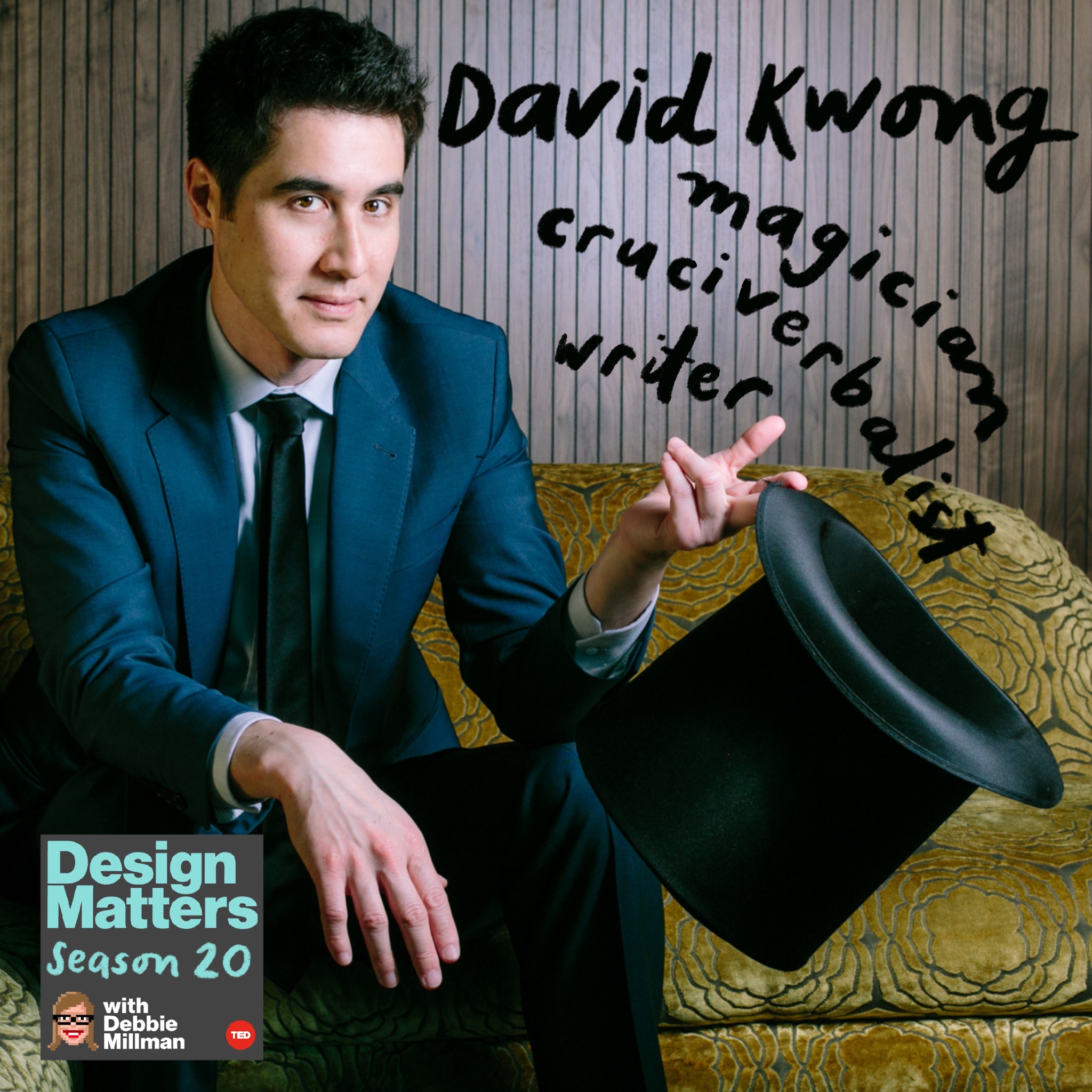
0:23For 19 years, Debbie Millman has been talking with designers and other creative people about what they do, how they got to be who they are, and what they're thinking about and working on. On this episode, David Kwong talks about how he found his place as a magician. I had finally figured out my approach to magic, pulling back the curtain. My guest today is a puzzling guy, yet he's also kind of magical. His stage show is truly enigmatic, and his career as a TV producer is all of the above. Puzzling, magical, and enigmatic. I'm talking about David Kwong, the magician, puzzle creator, and producer.
1:07As if that weren't enough, he's also a writer. His first book, Spellbound, was written for rational adults, and it's about applying the principles of magic to our projects of persuasion. His second book, which just came out, is for kids, sort of. It's titled, How to Fool Your Parents, 25 Brain-Breaking Magic Tricks. David Kwong, welcome to Design Matters. Thank you so much. It's great to be here. David, is it true you were hoping to have your first child on April Fool's Day? That's very well researched. Yes, indeed. She was born the day before. She was born on March 30th. Oh, that was my next question.
1:54Did she make it? Yeah, but it would have been great. But she just turned a year and a half. So it's so exciting. You were born in upstate New York. You grew up in Brighton to parents who were both professors at the University of Rochester. Would it be safe to say you had a rather intellectual childhood? Yes, doing your homework was the number one rule. And you could say that they weren't exactly thrilled when I decided to become a magician, but we'll get into that just a little bit. Yeah, absolutely. Well, speaking of magic, you were seven years old and you went pumpkin picking with your dad at Bauman's Farm Markets and encountered your very first magician.
2:37And you described him as bald, wearing big brown glasses, sporting the warmest, friendliest smile and carrying a bunny rabbit. it. He then went on to perform a trick that would change your life forever. And if you can share that trick with us, I would love to share that with our audience. This trick is still considered one of the greatest sleight of hand tricks of all time. It is the little sponge ball trick. And what the magician does is he puts a sponge ball in the kid's hand. He holds up a second one, makes it disappear. And then with a magical wave, the kid opens his hand and he suddenly has two.
3:16But, of course, my mind was blown. But what really transformed everything for me was that he did the trick again. And this time he did it to my father. And as you mentioned, my father is an academic, a biochemist. To me, he's the smartest man in the world. And once again, the magician put the little sponge ball in his hand, made the second one disappear. My father opened his hand and he had two. And I turned to my father and I said, how did that work? And he flashed me this sheepish grin and shrugged his shoulders and said, I had no idea. And I'm telling you, that's when I knew I had to be a magician.
3:54And that magician was Bob Bauman, who kept professionally doing magic well into his elderly years. Yes. And in fact, just two weeks ago, I did my first hometown show at the Rochester Fringe Festival. and it took years, but I finally got in touch with Bob and invited him to the show. And he came. He said, I taught you well. He jokingly took credit for everything. But what a thrill it was. Every magician remembers the first magician they ever saw. And it was really special to have him see what my career has turned into. Magic became your childhood hobby. And I read that you and your brother would send secret coded messages to each other right under the noses of your parents.
4:42How were they coded and what kinds of messages were you sending each other? Well, my first code that I loved and is in the book is the pig pen cipher. And that involves making a grid and assigning different parts of that tic-tac-toe grid to letters. So if you just put down the lines and the angles of that tic-tac-toe grid, you can communicate furtively with your sibling and do it right under the noses of your parents. Were your parents ever able to crack the codes? No, no. We kept changing the rules. I mean, we had all sorts of codes we would do at the dinner table where we're flashing each other different symbols and numbers of fingers and tapping the fork a certain number of times.
5:28And if we thought they were catching on, we would just change it up. Now, you also began playing Scrabble and solving crosswords with your mother when you were 10 years old. So I have a lot of questions about this because I played Scrabble as well as a kid, but was not in any way competitive. Not only was I not competitive, I didn't really understand beyond just putting letters on a board and making little words. Like there was no strategy. There was no competitive sense of how to really play the game until I was much, much older and read Word Freak and started to really try to ultimately get on the circuit, which I never did.
6:11My wife did, but I did not. So how competitive was your mother? Was she a particularly good player? Like talk about the dynamic between the two of you playing when she's an adult and you're 10 years old. My mother is the original word nerd. So she's a history professor at the University of Rochester and always encouraged this kind of activity, solving puzzles, playing games. We're still, to this day, every single day, getting on the phone and solving the New York Times spelling bee puzzle together. And we don't stop until we get genius, of course. So this was something that she instilled in me at a very young age.
6:51And perhaps where our personalities diverge is that I suppose I am very competitive. And when I realized that there were lists and lists and lists of obscure words that you could memorize to give yourself a leg up, again, get one over on your parents, I decided, you know, I mailed away, I mailed off a membership application to the National Scrabble Association, and they send you back a packet full of the two-letter words and the three - letter words and the four-letter words and the... Oh, yeah. Now you can find them online, but yes, absolutely. So I had a membership card from them, and so there I was memorizing all those words.
7:39But she fostered this wonderful environment of learning and creativity. And around the same time we're playing Scrabble, she takes me to the Wellfleet Public Library in Cape Cod one summer to hear a lecture by Will Shorts. I mean, this is the activity we're doing, right? we're not going to tell this this is such a great story we're not going to a cape cod baseball game we're going to hear will short speak at a library and i was 16 years old and i brought my puzzle book to have him sign it and he divided the audience in half well first he told wonderful stories about the new york times crossword and people proposing to their better halves in the crossword and all sorts of fun tales.
8:29And then he divides the audience up and he plays games with them. And I did particularly well in one category. And he signed my puzzle book to a puzzle champ. And truly that changed my whole life. And jumping forward decades, I think I really channel a lot of that spirit of dividing the audience in half and making people feel smart and playing games with them. It really all goes back to Will. Didn't he also ask the audience to figure something out that you were able to figure out? I think it had to do with the word skeptical. Very good. Yes, it was skeptical. And I think if you remove a letter from that, you get a serial and it was special K.
9:13Does that track? Yes. Yeah, it was something like that. Yes, I think it was. He asked for an anagram of special K and T and you got skeptical. And you said that was the proudest moment of your childhood. It absolutely was. And to get to meet him and for him to recognize that burgeoning talent was really an important milestone. There's such an interesting history of crossword puzzles, and I've learned so much from reading both of your books and just following so much of your work. But I learned from you that the editors of The New York Times first considered crossword puzzles a primitive sort of mental exercise.
9:54They considered it frivolous and a sinful waste of time. Can you talk a little bit about what changed their minds? Yes. Well, the first crossword puzzle was 1913, I think, in the New York world. And they became all the rage. And there were crossword parties and musicals. But the New York Times really dismissed them. And it wasn't until World War II when suddenly everyone had to retreat indoors and there was this worry of bombings coming and blackout hours, I believe, is what the Times called them. So the quote, I'm going to butcher it, but it's something like, in light of these blackout hours, we should proceed with the puzzle, especially in view of the fact there will now be bleak blackout hours.
10:47Something like that. Yeah, I read that the founding crossword editor, Margaret Farrar, said that you can't think of your troubles when solving a puzzle. I love that. Yeah, that's absolutely correct. And she was the giant. And she was the assistant to the man who created the puzzle back in 1913, Arthur Wynn. But then she got to take up the mantle and become the Times' first editor. And she revolutionized the puzzle. She created the rules, the symmetry, the word count, and the balance there. and we're still obeying those rules today and I'm sure we'll get into that. Oh yeah, I want to continue a little bit more with your origin story before we get to some of those specifics, but I have a lot of questions about that too.
11:29When did you actually start making your own original puzzles? The first New York Times crossword I submitted was probably in 2003. But just for yourself, like as entertainment or practice before, I'm assuming that the first puzzle you made wasn't like good to go with the New York Times, but I could be wrong because you are pretty much a genius. Oh, I had many, many rejections, many rejections from the Times. Before that, I started by making word searches and other easier types of puzzles. And then I had a friend from college, Kevin Choset, who had gotten a number of puzzles in the Times and he showed me how to do it and I started submitting and I had them rejected and rejected and rejected but we got a puzzle in together uh we had a joint puzzle in 2006 I think it was 2006 yes and it was such a funny thing that happened because it was this diabolical puzzle that basically the idea was that the central answer was outside the box it was how you must think to solve this puzzle outside the box was the answer.
12:38There was no app at this point. It's all in the newspaper, right? So the letters of think, T-H-I-N-K, were literally outside of the box, outside of the grid of the puzzle spilling into the margins of the newspaper. And Will found this so diabolically tricky that he said it had to be on April Fool's Day. And it happened to be a Saturday that year. So it was both the tough day and the tricky day. And boy, is that a nerdy trophy that lives on for us. You ended up going to Harvard University, where you actually convinced the history department to let you get your degree in magic studies. So how on earth did you do that?
13:26Had anybody ever done that before? I wish the diploma actually said that. It says history department, history concentrator. So I, but I did, what a wonderfully open department to encourage students to study what they're passionate about. So it was, it was history, I think specifically intellectual history was my concentration, but I meandered away from that. And I really fell in love with the cultural history, the entertainment history of American vaudeville and theater and the golden age of magic, at the turn of the last century, these enormous touring shows of Thurston and Keller and, of course, the great Houdini.
14:11And I was fascinated by Ching Ling Fu, the first great Chinese Asian superstar, and the imitators like Chung Ling Su. And shall I tell that story, Debbie? Absolutely. I mean, I'm here for all of your stories. They're so good. And I learned so much in such a joyful way. Oh, thank you. I was fascinated by this when I was 19 years old, and I'm fascinated by it now as I'm still working on a one-man show about this. Qing Ling Fu came over in the late 19th century to the U.S., and he was performing at the World's Fairs, and he sparked this craze for Chinese magic. And we're talking about firecrackers and rice bowls and producing enormous bowls of water full of goldfish.
15:06People couldn't get enough of it. And Qingling Fu, he was the master, and he called himself the official court conjurer to the Empress Dowager of China. And then the imitators came along. So everybody's doing Chinese magic now. And one of them was Chengling Su. and Chung Ling Su starts claiming that he's the official court conjurer to the Empress Dowager of China and they have this magic fight in the press about who's the real Chinese magician and they challenge each other to this duel and they're going to meet up and see who can do tricks better than the other person and then Ching Ling Fu the original Chinese magician says you know what this is beneath me I'm not going to come and he doesn't show up and Chung Ling Su the great marketer parades down the strand in London and declares himself the winner.
15:56And he goes on to great fame and fortune. Qingling Fu basically goes back to China and does not have the incredibly successful world touring career that Chung Ling Su has. Now, it gets very interesting with Chung Ling Su because his most famous trick was called condemned to death by the Boxer Rebellion. and this was a trick where he would catch a bullet on stage. Now, Chung Ling Su, he spoke Chinese on stage and it was translated by a translator to English for the audience. Now, in 1918, he's performing the bullet catch trick and something goes terribly wrong and the rifle fires, the shot rings out and he clutches his lung and he collapses on the stage and he says for the first time in perfect English something to the effect of something's gone terribly wrong bring the curtain down I don't remember exactly what the quote is but in perfect English and he dies that night and this is when the public largely realizes that he was a white man pretending to be Chinese and his name was William Robinson and he was a brilliant illusion designer, and he had an incredible magic show.
17:13But there was a very deep case of appropriation going on at that time. And it's a fascinating period. I don't think a lot of people knew what an actual Chinese Asian person looked like. I think people didn't care. It's really hard to know what was going on. Well, that story, from what I understand, really set the stage for your honors thesis, which examined Asian impersonation in magic shows. Yes, I've been fascinated by it for a long time. And what's most interesting to me is that there is this really delicious tension between revering these, I'm talking about the impersonators here, They're revering the mystic oriental east for the magic that comes out of there.
18:09The mysticism is enhancing their magic shows. But at the same time, they are scorning these immigrants for coming to the west. And they are mocking them. And you get both at the same time. You get these people dressing up like the great bumbling Chinese Buddha. so they're kind of waddling about the stage and bumping into things and dropping things and then at the same time they're producing beautiful fans and silks and bowls of goldfish and they're the celestial beings all of a sudden so you get both at the same time it's it's fascinated me for decades and i'm working on a show right now that tells these stories but also I am reflecting on being both white and Asian at the same time and how I've struggled with that and how that's shaped who I am.
19:02How have you struggled in that way? Well, everybody wants to fit in. And I think that I had a very accepting childhood. There have been moments where I haven't felt included. Harvard was tough. as progressive as a campus as it is. There are also like elite clubs where it's hard to be a awkward half Chinese Jewish kid, you know? So it's like, it's not like it was in the 1950s, but it's still, you know, it's still not easy. Is it true that you started the Magic Club with Adam Grant? Yes, I did. Yeah, that's our dual claim to fame. He's a very talented magician. We actually were competitive at one point.
19:46We had these like two different warring magic clubs, but then we fused them together. How did all of your research on race or how has all of your research on race influenced your ideas about magic? Well, I think that magic is something universal and we see the practice of illusion springing up all over the world independently. So we see magic spring up out of India, the home of mystery, but that's largely through the lens of the West, I think. We're seeing it spring up out of Japan as well. And there are more experts in manipulation and sleight of hand for the stage. Yeah, I'm still working on how that all shakes out in terms of what's an acceptable way to appropriate those other cultures and to have those themes.
20:45I think some of it's warranted. I think full impersonation is not good. But at times it's okay to portray a mythical story about something that's come out of Egypt or, you know, an ancient Egyptian trick. I don't know. It's delicate. It's delicate. Okay. You graduated from Harvard in 2002, but rather than pursue a career in magic at that time, you actually considered going to law school? Really? Well, looking back now, it's hard to imagine that. But yeah, I was a humanities major. I have these two academic parents. Okay, let me put it this way. I did not want to be just a kid's birthday party magician.
21:33So I've always loved the performance art of it. But I did not myself think that there was a professional career in being a magician other than becoming the next David Copperfield or Penn and Teller or Lance Burton was another guy who was big in the 90s. I just I didn't think that that was attainable and I didn't want to be what I thought was the rest of the field doing the bar mitzvah circuit. And by the way, there's nothing wrong with that. I've done plenty of bar mitzvah parties. But anyway, that's who among us. Yeah. So I didn't think there was a career path worth pursuing there. So I first went into working in media.
22:18I've always been drawn to the world of entertainment. And my mother always jokes, did I not give you enough attention when you were a kid? So, yeah, I took a job at HBO. I took a job at DreamWorks Animation. I was all over television and film. I've kind of had little forays into becoming a professional magician. And eventually it kind of exploded. And you can't ignore your childhood passion forever. I read that you performed a particularly bewildering trick for the CEO of DreamWorks at the time, Jeffrey Katzenberg. But I couldn't find what the actual trick was. He had a very specific directive for you after seeing the trick.
22:57So I'm wondering if you can share more fully about that story. So that trick is my signature trick at the time. Is that the kiwi trick? No, no. Oh, well, okay. Oh, my God. Yeah, the kiwi trick is very good. I did not invent the kiwi trick, which is someone signs a dollar bill and they cut open the kiwi and it's inside. It's an amazing trick. And Debbie, what's so funny is that I do this performance called The Enigmatist, which I'm sure we'll touch. Yes, I've been there. Yes, I know. I've seen it. I was the recipient of the Kiwi. I have just trolled the internet trying to find the answer to that.
23:37Yeah, that to me is absolute transformative magic. It is. Like, I can't. It's crazy. Well, let me underscore that point further, because the enigmatist is mental gymnastics. I am doing math on the fly. I'm building crosswords on the fly. It is this nerd fest of cerebral juggling with one Kiwi trick in the middle, which is the only physical impossibility that I do in the show. And it just shows you how impactful that is. People remember that signed dollar bill to that impossible location. That's what we call that type of trick, to an impossible location. So for those that have not seen it, and I don't think anyone's life is complete until they see this trick because there is just no way to figure it out.
24:33But you ask somebody to sign a dollar bill and then somehow it goes into a lockbox somewhere and then it ends up with the – a kiwi ends up with the dollar bill inside the kiwi without the kiwi having one mark on it. Without the kiwi, it literally has teleported into the kiwi. I held the kiwi. I looked at the kiwi. There was no way for that dollar bill to get into the kiwi. and I still can't figure it out. Yes, you've accurately described that trick. Good memory. I told you it was transformative. I believe in magic. I'm like the lion in The Wizard of Oz. I do believe in ghosts. I do believe in ghosts.
25:19I do, I do, I do. And that's the way I feel about magic. I feel like there's magic everywhere. So when you see tangible evidence, it's like, okay, there's more to the world than I can ever perceive. That's great. Yeah, the trick that I did for Jeffrey was my signature trick. It's become the trick that anchors my entire show. And that is my crossword puzzle trick. And it wasn't long before that, at my 30th birthday, that I unveiled it. And I threw a party for myself. And I did it at the Magic Castle. And I invited all my friends. And I thought it would be fun to entertain all of them. And I came up with this effect where I have somebody choose a playing card.
26:05I tell everybody I'm going to build a crossword puzzle as quickly as possible. There's a blank crossword puzzle grid. They're yelling up words and phrases to me. And I'm drawing on my decades of experience making these things. And I build one as quickly as possible. And when I finish, I reveal that the playing card is hidden in the crossword, that I have threaded it throughout the crossword. I'll never forget that applause and bringing down the house that night for my friends. And I knew I had something special. And it's transformed my entire career. It's suddenly the light bulb turned on for me that I could take my two worlds, my two passions, puzzles and magic, and I could cross pollinate them to make something new.
26:51So this cerebral character, which is just myself, to be honest, I have a lot of fun just being myself on stage. But this presentation of Cerebral Magic was born. And I was still working at DreamWorks Animation at the time in development, story development. And I had the opportunity to perform it for Jeffrey at a retreat. I knew it was a big moment. I'm thinking, I'm going to impress the CEO here. I'm going to move up as a producer. This is great. and when I finish when I circle the last letter in that hidden playing card he goes what are you doing here and you know what my boss felt the same way so when I asked for a leave of absence to go work on the magic movie now you see me my boss at the time Damon Ross he like kicked me out of the nest and he's like get out of here you're not coming back and that's what happened so and that was a big hit that movie so fun if you've never seen it it's uh oh it's a wonderful great popcorn movie where magicians are robbing banks and and you came up with all of those illusions i didn't come up with all of them but i was the effects yeah i was in charge i was the head magic consultant but it draws on a lot of stuff from david copperfield that draws on uh there were a lot of wonderful contributors to that movie.
28:20It did so great that it propelled me and coupled with I had finally figured out my approach to magic, pulling back the curtain. That's what all of these things have in common, right? Now you see me teaches the audience about a lot of these principles of illusion. And that's what I really wanted to imbue into the story. And I worked a lot and collaborated with the screenwriters. Ed Solomon delivered this incredible script about these magicians robbing banks, and they are teaching the audience along the way how misdirection works, how the illusion of free choice works, and pulling back the curtain has become really a lot of what I've been known for.
29:06Hence the book Spellbound, The Seven Principles of Illusion, hence the kids book with 25 tricks that I'm teaching. And I'm part of the 1 % of magicians that don't pretend to have superpowers in any way. Darren Brown's another one. Penn and Teller have been doing it for decades. But most other magicians, and there's nothing wrong with it, it's just their approach, is that they convince you that they have a mind reading ability or some sort of supernatural talent. See, I think that you and Darren are both faking. I think you both have supernatural ability, but you're just trying to sort of mislead us or misdirect us, as you would say, into thinking that you're just a mortal human.
29:51But that's another conversation for another day. You worked on a whole slew of movies since. You consulted on Tom Cruise's Mission Impossible, Rogue Nation. You worked on The Imitation Game with Benedict Cumberbatch. How do you feel about cryptology? Is that something that you're also quite good at? I'm not that good at it. I respect it. I've dabbled in it. There are people that are incredible experts of it, and they are usually employed by our government. But it's all in the same world that I play in. And in The Enigmatist, I'm standing in front of a bookshelf that has 16 hidden codes in it. More important is that I am telling the story in The Enigmatist of America's first codebreakers.
30:40So the narrative that I weave throughout my own personal journey is of William and Elizabeth Friedman, who were the first cryptographers. And it's really like a nerdy love story how they find each other. Yeah, I love it. I started trying to crack crypto quotes in Long Island Newsday when I was in seventh grade. And I would stare at them for hours trying to figure out what it meant that one letter stands for another. And then one day I saw it and I realized at that moment that most words that start – most four-letter words that start and end with the same letter is the word that. Occasionally it's dead, but usually it's that.
31:28Wow. Wow. So are you talking about cryptograms, right? Cryptograms, yeah. Yes, where any letter or any symbol represents another. Is replaced by another. Yes, is replaced every single time by the same corresponding letter. Same, yes. Yes. Yes. And I was so proud of myself, David. I cut it out. And to this day, 50 years later, I still have that cryptogram that I cut out from Long Island Newsday in the 1970s. Wonderful. That's, you know, we did not expect to share that story. No, that's great. That's why, you know, we walk around with the first playing card we ever picked in our wallets. And, you know, these these things are part of who we are.
32:14How did you first establish your career as a magician making a living? Well, Now You See Me was what got me out of the desk job, so to speak. And then it was a leap of faith at that point. And I'm gigging around Los Angeles and trying to make a living, trying to earn as much as I made as an assistant at DreamWorks. So my bar was pretty low. I told myself if I can make the same amount as someone who was answering the phones at DreamWorks, then I should keep going. And I have to say, and this is how one of the many ways that we run into each other, the TED Talk stage made a huge difference. They asked me to give a talk.
33:07They saw what I was doing with puzzles. and I had this enormous opportunity in 2014, so it's been 10 years, to speak and perform on the main stage. And I asked Will Shorts if I could hide a message in that morning's crossword puzzle to correspond with the day I was giving a talk. And he agreed. And he said I could do it as long as it didn't compromise the integrity of the actual puzzle. So this was a bonus message if you knew where to look for it. And of course, I told the whole TED Talk stage where to look for it. That was a pivotal, pivotal moment for me because it solidified me as a thought leader and it put me on the speaker's market.
33:53and the speakers market as many people know is it's that corporate market and suddenly I realized I'm not going to be the birthday party kids magician I can do big corporate ballrooms and and I honestly Debbie I still love doing it so much I could be just last year I spoke at Davos and this was in January. I spoke at Davos and a couple of days later, I was in Omaha, Nebraska doing a show for a food distribution company and audiences love it equally all over the world. Everybody loves magic. It's just, and I can be on a stage in a hotel ballroom in the middle of somewhere in Florida. I'm always in Florida where companies do their retreats.
34:43I'm on stage doing a corporate magic show And I cannot believe that I get to support myself doing magic. It's a dream come true. It's awesome. Every single time. You've said this on the record. There's no magic in magic. So what is magic? Oh, that is it. You're throwing it back on me. I like it. I start the show with there's no magic in magic. And I have a slide up behind me at that exact moment, which is the Saw Lady in Half illusion from 1921. And I reveal how it's done. I show, at least in that version, that there are two ladies that fit in a single box there. And I'm pulling back the curtain right away, and I'm saying to the audience, none of this is real.
35:38It's all tricks. They're all puzzles. I'm trying to fool your brain. And please go ahead and see if you can crack these puzzles while I'm performing. Feel free to let me know if you've figured something out. Okay, so that's my irreverent approach. So what is magic? Magic is the unexplainable. And magicians, perhaps unfortunately, are the great skeptics. And it's hard to find something unexplainable for us. We're always looking for that rational explanation. I'm hopeful. I'm hopeful there's something out there that'll just knock me to the ground. You can bet I'm going to go try to find the explanation immediately, but I've yet to really, oh, I don't know.
36:29It seems kind of sad in a way, right? But that's what drives me is I'll see someone do something. and for a moment or longer than that, it'll fool me and I'll think, oh my God, how did that happen? And you feel it. Magicians call that getting burned. When a magician performs something and another magician doesn't know how it's done, oh, you got burned by that guy. That's because we feel it like, oh my God, what did that guy just do? But you can bet I am immediately on the phone calling my friends trying to figure out, what did that guy do? I gotta be able to do that myself. So you could go see Darren Brown perform and you can figure out how he does things.
37:11Can you see more than we do because you know what to look for? Yes, we all speak the same language and we have all the same tools. I might not know exactly what a magician has done in that specific moment. And Darren, boy, his illusions are very layered and very deceptive. He's one of the greats. I think he's incredible. So I always say we might not know what they did exactly, but we know how we would do it. I would know how I would do it in my own way. And what I mean by that is in a magic trick, there is an effect, which is what the audience experiences. And then there are multiple methods or there's the method on how you pull it off.
37:55And usually there are multiple methods. There are many different ways that you could arrive at the same effect. so I'm holding up my coffee cup if I'm going to make it disappear it's just gonna I'm gonna snap and it's going to be gone that's the effect the method could be I have a string that pulls it into my jacket the method could be that it's not a porcelain mug but it's actually made of paper and it can quickly be crumpled into a ball and and go up my sleeve or maybe it's a fake table with a hole in it it goes into the table right there are a lot of different methods so usually I know what somebody's doing, but not always.
38:33But I usually have a pretty good idea. And if I go home and think about it, I can recreate how I might do it. You've stated that illusion works because the brain is wired to fill the gap between seeing and believing. Why is that? Well, our brains are imperfect and we are bombarded by stimuli in any given moment. There are just all these things hitting our brains. We can't possibly process them all. So we jump to conclusions and we jump these gaps and we correlate A to B. And it's the only way we can function and block out certain stimuli and make associations with others. And magicians play around in that space.
39:22And magicians will force you to correlate a given A with a given B, even though they might not directly relate to each other. So if we, once again, another Wizard of Oz reference, there's good magic and bad magic, good witches and bad witches. How are con artists sort of perceived by magicians? Because a lot of the principles that they use, and I was very, when I was much, much younger, 30 years ago, I was the victim of a con. And so I'm super, super intrigued by the work of Maria Konnikova, for example. So how do you see cons in relation to magic? They're not far apart. We're playing around in the same sandbox.
40:09Obviously, con artists are predatory but con artists are using your assumptions against you but the most salient thing that a con does and the way it succeeds is it is preying on your emotions and the mark so wants to believe that something is going to be possible yeah magicians like all storytellers if they can get you to engage emotionally, you'll believe more what you're seeing. Now, it is very delicate. When does a magician cross the line and go into something that is in the con artist space? There's a wonderful documentary that addresses this, and it's called An Honest Liar. It's about the late, great magician turned skeptic James Randi.
41:08And James Randi says, a magician is the most honest person because he'll tell you he's going to lie to you and then he does. So there's this contract with the audience that we have this license to fool you and this license to lie to you on stage. But it gets murky. It gets murky when you start preying on people's emotions. Obviously, the end of the spectrum where I am, we're saying that none of it's real. So we're not getting into that. But as you get more and more toward manipulation of people, you have mind readers and mentalists, which are still magicians performing, but they're skating pretty close to getting you to believe that they are contacting your deceased relatives, right?
42:00Yeah, we could all be Whoopi Goldberg in Ghost. But there's still a contract there that it's for entertainment, right? Darren Brown is very clear about that. But then you get into the tarot card readers and the fortune tellers and the spiritualists. And that's the category. Spiritualism is the term that encompasses everything here. they are using the same tricks as magicians to prey on your emotions when you're going into a fortune teller a psychic they are using cold reading which is making uh determinations on the fly about who you are or they're hot reading you they are looking you up based on your name based on your credit card they're coming to the table with all sorts of information just like a magician might if they wanted to convince you that they were a mind reader so again this is why magicians are the great skeptics as i mentioned and even houdini in 1921 i think maybe it's 26 i'm bad but dates i'm sorry he testified in congress to get spiritualism banned from washington dc and he was a big debunker that houdini big old debunker uh saying that none of it's real and and spiritualism i guess people want it to be real they really do they really do most people want to be able to know most people do and in an honest liar they talk about how james randy debunks uh i think it's peter popoff and the other televangelists and the big big evangelists who are who are saying they're calling people up on stage they're you know they're doing harm because they're saying you're healed your cancer's gone you don't have to go to the hospital anymore right they're they're they're people so want to believe that this is true so even though james randy debunks all these people and exposes that they're wearing a wire and they're getting information ahead of time or in the moment about the people coming on stage guess what the whole room is filled the next night.
44:12Nobody cares. Nobody cares. They want to believe in something. It's such an interesting part of who we are as humans. That's sort of why I love your new book so much. Now, your first book, Spellbound, Seven Principles of Illusion to Captivate Audiences and Unlock the Secrets of Success, that came out in 2016. And it's very much an adult book for deep thinkers. and this new book, in many ways, I sort of feel like it should be called the beginner's book to creating magic. It's like the Peanuts. It's a book that appeals to children and children will fundamentally understand, but adults reading it will also know.
44:54It's like a you know that I know that you know that I know that there's so many layers here. And I think it's for everybody listening, it's a wonderful gift to give a kid, but it's a wonderful gift to give yourself. I'm so glad you said that. It says 8 to 12 on the jacket, but I think it's 8 to 100. It's really, because the tricks are good. Like there are, I picked really good stuff to reveal. And I had to, by the way, I had to figure out what was okay to reveal. You can't do everything. That's my next question. It took a lot of time and research and calling other magicians to say, this is really good.
45:31Is it kosher? Am I allowed to do this? So I believe that I found the right balance with all the tricks in the book. Were the other magicians that you spoke to okay? I mean, is anything that's in the book against the magician's oath? You include an oath in the book for people to take. But the fact that it is all now available to people, how do other magicians feel about this opening the door to understanding how some really, really good tricks and illusions and codes are created and solved? We are in a very complicated time right now. First of all, I would have answered this differently 10 years ago.
46:14There is magic exposure all over TikTok and Instagram right now in a way that is just, oh, it hurts my heart. I still think that magicians as performers are going to be just fine. Don't worry, everybody. We're going to be fine because there's a lot of audience out there. And I think that even if you learn in a quick video how something is done, if you go to a live magic show, you're not really going to be armed to decipher what's going on on stage. I guess what I'm saying is the book is the tricks that I'm reviewing there are safe. I think the rules are as follows. You can reveal anything that you've come up with yourself.
46:57If I've invented it, I can reveal it. Because the cardinal rule is you don't want to ruin someone's magic show. If someone is doing something right now and it's a signature trick, like stay away from that. And there are not a lot of professional magicians, so we're aware of what people are doing. The other rule is, and it's in concert with that one, is if something is like 100 years old or more, If it's an old trick that you've dusted off that no one's been doing for a while, you can also talk about how that. That's why I feel comfortable exposing the 1921 version of Saw a Lady in Half. Right.
47:35Yeah. Although I learned I didn't know that. And it was like, wow, of course. Yeah. But there are more deceptive ways that people are doing it now. And so I would stay away from that. And then, of course, if someone has dusted off something from 100 years ago and they're doing it now in their show, then you need to stay away from that. So there were a few tricks that I was circling that I asked my friends about and they said, you probably shouldn't do that because this person does it in their show. So these have all been vetted. 25 tricks. There's so much I learned about the language of magic.
48:09And I'm wondering if I can ask you about some of my favorites. What is the difference between forcing and free choice? Forcing. Okay, so don't call the magic police on me. Now, forcing is when you make someone choose something, right? So that could be a playing card. That could be a coin. It could be a number. But forcing only works because your audience is believing in that moment that they have free choice. So they work hand in hand. It is the illusion of free choice. And there's a word for the magician's choice, right? It rhymes with artichoke. I can't pronounce it myself because it's too hard.
48:50Equivoke. Yes, that is a specific technique for forcing one object from three. You got to pick up the book to learn that one. Yeah, you learn all of this in the book. That's why it's so amazing. So the way that and the way Equivoke works is it's important in a magic trick that you never tell your audience what the end of the story is going to be. Right. So you pivot the trick based on what choices they may have freely made. But because you're in control of where the trick goes, they believe that this is what was intended the entire time. So that's sort of related to one ahead, right? One ahead, the term one ahead?
49:37No, one ahead is a little bit different. One ahead is, and by the way, you can mix and match all these things for a very confusing and deceptive multilayered illusion. But one ahead is the idea that, let's say I have the cups and balls as a classic trick in magic. It's one of the oldest tricks in magic. and usually the way it's done is there are three cups and three balls but you have a fourth ball that is secretly underneath one of the cups already and i mentioned penn and teller before who are the great irreverent magicians who pull back the curtain they famously did the cups and balls with clear plastic cups so you can go on youtube and watch them do it with clear plastic cups.
50:22What makes that such an entertaining routine is they do it at lightning speed. So you can't really track what's going on. And Penn's a juggler, right? He, he's just, he does it so fast and you're like, okay, I get there's a fourth ball, but what the heck is happening? So one ahead is the idea that there's a ball underneath the cup already that you don't know about. So if I'm holding a second ball in my hand and I make it vanish, then I do a magical gesture that it's kind of filtering through the air and getting transported to underneath that cup, you were one ahead with that ball that they think is the same.
50:58And if you go back to the story I told before about the sponge ball in my hand, that's a one ahead trick. Yeah. What is an out? Oh, an out is a backup plan for a magician. You know, for every trick that I do in my live show, I probably have three outs prepped and you learn the hard way you learn by screwing up so that kiwi trick that you love so much I have a second kiwi in the drawer of the desk on the stage because I have learned that people take a bite out of that kiwi they'll throw it up to me and it'll splatter against the wall all these things have happened so I have an out I have a second kiwi there.
51:44Now that's kind of a mundane example of an out. An out on the fly using improvised technique would be if you chose a playing card and you put it back in the deck. Let's say you chose the four of diamonds and I triumphantly pull out the seven of clubs and I genuinely make a mistake. I say, what did you have? You say four of diamonds. I go, oops, I didn't mean to do that. then I can very quickly because I'm deft with the deck of playing cards I can find your four of diamonds and I can use some sleight of hand to change that seven of clubs to the four of diamonds and it's as if I wanted to screw up on purpose and setting myself up for this moment when I get to do a transformation of one card to the other again this works with what I mentioned before is you don't know what the story was supposed to be So then you shape everything around that moment that just happened and you make it seem like, see, I messed up on purpose so that I could change the card.
52:51How often do you really ever mess up? All the time. All the time. Really? At least a couple times a night. And that's what makes the show so fun for me as a performer, is you never know what curveballs you're going to get from the audience. You never know when, I don't know, your hand's a little sticky and something's going to just not, the sleight of hand moves, it's going to get screwed up. Teller, I keep referencing these great magicians, he has famously said when something goes wrong, right? You didn't know about this. It was behind the scenes. But a piece of tape would come loose and it would cover up the hole that is needed to hide something in.
53:31So you can't jam it in there because it's blocked. Right. And Teller would say, well, now we know that can happen. And it's like these things go wrong. And then but the show must go on. And the stakes are so much higher for Magician because we need to preserve this illusion of control. And you're this marvelous character that can't ever screw up that you have these superpowers. Right. So it's fun to figure out ways around these unpredictable screw-ups. Talk about a stooge. A stooge is a magician's secret helper. How often are they actually used? They're used all the time. There's a great debate about whether or not stooges are considered artful or not, right?
54:15A stooge is a plant in the audience. and you can pull off some really incredible miracles if you say somebody yell out uh their favorite animal and someone says the amazon river dolphin and you happen to have that written down on a card because you've stooge them why not i it's you know i say why not uh i i don't i don't use any stooges in my show but they can come in handy two last questions which is the favorite magic trick included in your book? What is your favorite magic trick of those 25? There's a trick that I love that's called It's News to Me. I can describe this, and all of you can try it.
54:58In fact, I think I'm going to put it on my website. So I'm going to put it on howtofoolyourparents.com. I'm going to do this trick, or actually I'm going to do it with a young magician on the Today Show on the 18th of October. So after we do that, it's going to go on the website and you can do it yourself. And basically you have a strip of newspaper, you're holding an article, you're running your scissors up and down it vertically. Tell me where to snip anywhere. They have free choice, right? They tell you where to cut and you cut and that piece of article falls to the table and you pick it up and you say, read the top line and they read the top line.
55:36And then before the trick, you've pointed out, There's an envelope, a prediction envelope, and they open it up, and inside is a piece of paper with that exact line written on it. And you have forced that line. And the way you've forced it is because, see if you can picture this, the article is actually upside down. Now, the headline, you have cut out the headline separate from the article, so the headline is right side up. But you've taped beneath that headline an upside down column. And because people don't look closely and you don't give them the chance to, they can't see that all of those letters are upside down.
56:17It's just a blur of text, of black text on newsprint. So wherever you cut, it's actually the bottom of that strip of newspaper is always going to be the bottom, which then becomes the top. it's hard to yeah it's hard to describe but it's and well there are pictures throughout the book that really do help articulate the instructions which was helpful to me because i'm more of a visual learner yeah and what i love about that trick and all the tricks in the book is that they are all clever and this book is a celebration of being smart and brainy and clever and that's what I really try to impart to everybody that reads it.
57:04And creating wonder. Yeah. It seems as if we're in a bit of a, I guess, golden age of word games. Wordle was so popular. The New York Times bought it from Josh Wordle in 2022. I don't know if you're familiar with a new game that seems to have come out called Alpha Guess, where you have to guess a word. You type in any word, You start with any word and then the website will tell you whether the selected word of the day is either before that word alphabetically or after that word. Okay. So you're homing in on what it is. Okay. On one word. So I've been doing it now for a couple of days and I think the best that I've gotten is 12 words before I get it.
57:52I read about it on Jason Kotke's website, kotke.org. And so I've been doing it every day. But it's wonderful. Why do you think that word games are so appealing right now to more than just folks like us? Well, the social sharing is what made Wordle really go, really spread like wildfire. That I got it in two or I got it in three. And it's so accessible. Everybody can do it. Can I recommend my favorite game? And it's hard. Yeah, please. It's called Quintumble, Q-U-I-N-T-U-M-B-L-E, Quintumble. I do it every morning. Sometimes it takes me 30 seconds. Other days it takes me seven minutes if it's really tough.
58:39And there are basically four dials of letters that you're turning to make five words. And it's tough. And I love it. I love it. Oh, I can't wait to try it. David, thank you so much for making so much work that matters. And thank you for writing this wonderful book and joining me today on Design Talks. Well, thank you for having me. And I'm glad you loved it so much. It's really... I did. I really did. David Kwong's brand new book is titled How to Fool Your Parents, 25 Brain Breaking Magic Tricks. But it could also be called How to Fool Just About Anyone. To read lots more about David, you can go to davidquangmagic.com.
59:22There, you can also sign up for his awesome newsletter, Enigmatic. You can sign up for his awesome newsletter, which David is going to tell us how to pronounce. Enigmatology. Famously, that was Will Shortz's major in college, enigmatology. So I've borrowed that word from him. And then you can solve an original crossword every issue. This is the 19th year we've been podcasting Design Matters, and I'd like to thank you for listening. And remember, we can talk about making a difference, we can make a difference, or we can do both. I'm Debbie Millman, and I look forward to talking with you again soon.
1:00:02Design Matters is produced for the TED Audio Collective by Curtis Fox Productions. The interviews are usually recorded at the Masters in Branding Program at the School of Visual Arts in New York City, the first and longest running branding program in the world. The editor-in-chief of Design Matters Media is Emily Weiland.
With his expertise in enigmas and illusions, David Kwong delights and challenges audiences around the world with his intellectual brand of magic. He joins to discuss his one-man show, The Enigmatist, and his career as a magician, crossword puzzle constructor, and writer.
Hosted on Acast. See acast.com/privacy for more information.