 Ask ChatGPT


Françoise Mouly discusses how images “develop in time,” her path from architecture to comics and printing, and her role as art editor of The New Yorker—especially how New Yorker covers are conceived, edited, and chosen. She argues “print is dead, long live print,” claiming printed covers create a commemorative, first-impression experience that digital flux can’t replicate.
Françoise Mouly is an art editor and comics publisher. She co-founded the comics magazine Raw (1980) with Art Spiegelman, then became art director of The New Yorker in 1993, overseeing nearly 1,600 covers. She has a long career in image-making and printing, including vocational printing training after a disastrous Raw-related printing experience. Honors include France’s Order of Arts and Letters and the Legion of Honor, plus Will Eisner Hall of Fame induction.
Comics and print can carry serious literary weight; trust with artists requires privacy and respect for their unpublished material; New Yorker covers rely on visual communication before text; printed covers fuel collector demand and cultural “events,” unlike online carousel turnover.
Raw’s physical interventions (tipped-in pieces, altered paper, torn covers); Mouly’s early cigarette-selling job at Grand Central; the complex printing failure that pushed her to learn printing; Barry Blitt’s censored drawing restored for publication; New Yorker Knicks covers that sparked lines for the physical magazine.
Written by AI. May contain mistakes.
Françoise Mouly discusses her career, influences, and the evolution of her artistic vision.
“It's called Chat Concierge, and it's simplifying car shopping.”
Art director Françoise Mouly is introduced and recalls growing up in Paris during 1968, her father's plan for her to become a doctor, and her disillusionment with architecture school.
“Francois Mouly has spent more than four decades expanding what images can do.”
Françoise reflects on her move to the United States and her experience in architecture.
“and you would have to support a team of a minimum of eight people to 12 people.”
Françoise shares her experiences moving to New York and adjusting to life there.
“And it's almost impossible to keep track of what you're trying to do when you are ceaselessly confronting it to reality.”
Françoise discusses her experience with language barriers and the role comics played in her adaptation.
“I understood not a word of what he was saying.”
Françoise describes her complex feelings about falling in love with Art Spiegelman and what it meant for her identity.
“I had all the curiosity in the world, but I knew nothing about Windsor McKay or many other topics.”
Françoise recounts her experiences with the printing process of Art's work and the lessons learned from it.
“So I fell in love with him, with his work, and it also gave me a path of what I could contribute.”
Discover the challenges and motivations behind the journey into printing.
“I believe that the book that you're talking about is Breakdowns, which, if anyone is lucky enough to have a copy, was a very complicated printing process.”
Learn about the difficulties faced while creating a neighborhood map and selling listings.
“Of all the things you've done, the map was the hardest?”
Explore the motivations behind the creation of RAW Magazine and its significance.
“While you're doing all of this, you're also starting RAW, RAW Magazine.”
Understand the profound influence of RAW magazine on the comics and publishing industry.
“But also, it only took me two and a half months of the year.”
Explore the revolutionary influence of RAW and Maus on the comics industry.
“And now every issue of RAW is considered a collector's item.”
Françoise Mouly discusses her transition and vision for The New Yorker.
“In 1992, the editor of The New Yorker at the time, Tina Brown, came to the Raw office to meet Art.”
Learn how trust is established in the editorial process for artists submitting covers.
“It's both an archive of extraordinary image making and a look inside the editorial process that has shaped how the magazine reflects its time.”
Discover how technology has influenced magazine covers and the future of print.
“It leads me right to the point of my book.”
Understand the unique value print holds amid a growing digital landscape.
“And I'm very proud of being part of an organism.”
Explore why printed images become collector's items compared to digital versions.
Explore why print media remains vital despite the rise of digital platforms.
“It's because once the New Yorker commits to the image and gets it printed and the press turns, it becomes a commemorative event.”
Delve into the changing portrayal of women in art over the decades.
“They provide that engraved version of the moment.”
Discuss the narrative techniques used by artists in their covers.
“Yeah, no, there's so many of the things that we call perennials that are like inflected differently.”
Examine how art can reflect societal contradictions without taking sides.
“the things that is exciting to me is that images are not didactic in the way a text is.”
Françoise Mouly reflects on her artistic journey and the nature of creativity.
“I mean, my curiosity hasn't abated, and I find it just as interesting because, again, I wasn't looking for a career or I wasn't looking for, you know, an area of expertise or I wasn't looking for answers.”
Françoise Mouly reflects on her artistic journey and the nature of creativity.
“Design Matters is produced for the TED Audio Collective by Curtis Fox Productions.”

Get the gist, explore an idea or ask about something said.
 Claude
On Design Matters with Debbie Millman, what are the key points of this episode?
Searching your listeningAutomatic transcript. May contain errors.
0:00The best images develop in time, and in time I mean in split seconds, so that at first you see the topic, you see what it's an image of, and then you get it.
0:18Debbie Millman: From the TED Audio Collective, this is Design Matters with Debbie Millman.
0:26Debbie Millman: On Design Matters, Debbie talks with some of the most creative people in the world about what they do, how they got to be who they are, and what they're thinking about and working on. On this episode, a conversation with art editor Françoise Mouly about her life and about her new book of covers from The New Yorker magazine. My book is a collection of images, and it has a point. Print is dead, long live print.
0:54Debbie Millman: This episode is brought to you by Capital One. Capital One's tech team isn't just talking about multi-agentic AI. They already deployed one. It's called Chat Concierge, and it's simplifying car shopping. Using self-reflection and layered reasoning with live API checks, it doesn't just help buyers find a car they love. It helps schedule a test drive, get pre-approved for financing, and estimate trade-in value. Advanced, intuitive, and deployed. That's how they stack. That's technology at Capital One.
1:51Debbie Millman: Insurance. Sessions average$21 with insurance and some pay as little as$0 depending on their plan. There are no subscriptions, no long-term commitments. You just pay per session. Grow connects you with thousands of high-quality licensed therapists across the U.S. offering both virtual and in-person sessions nights and weekends. You can search by what matters, like insurance, specialty, identity, or availability. And you can book a therapy session in minutes and begin in as little as two days, not the national 48-day average. See if you could pay as little as$0 for therapy in seconds at growtherapy.com slash ACAST.
2:31Debbie Millman: That's growtherapy.com slash ACAST. growtherapy.com slash ACAST. Availability and coverage vary by state and insurance plan. This episode is sponsored by Kohler Smart Toilets. The objects we interact with most are often the ones we notice least. The Kohler Smart Toilet challenges that assumption. What if the most overlooked space in your home could become the most considered? Their Vale Smart Toilet is a sculptural silhouette that isn't just intentional. It's a philosophy that design changes everything. The Kohler Veil Smart Toilet is sleek with a rounded shape that's more like architecture than just plumbing, and it goes beyond looks.
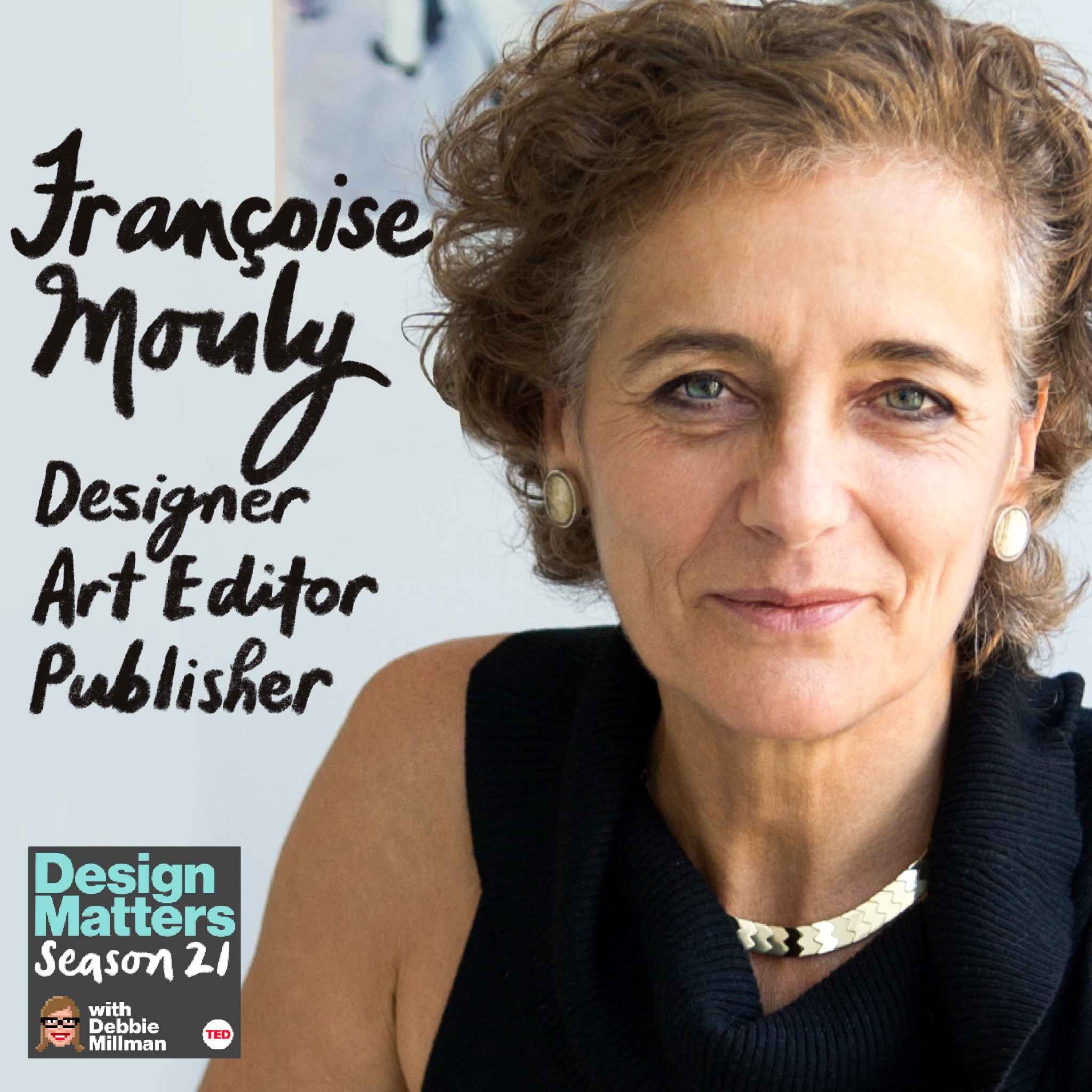
3:20Debbie Millman: The touchscreen controls and customizable cleansing features offer a level of comfort and cleanliness that exceed expectations. It's all about elevating those ordinary daily rituals into something extraordinary through thoughtful design. Kohler has been pushing these boundaries for over 150 years, mastering that balance of stunning form and high-performance function. That's a long time to get it right, and it shows in every detail. Experience the difference of Kohler smart toilets. Find out more at Kohler.com. Francois Mouly has spent more than four decades expanding what images can do. In 1980, she co-founded the groundbreaking comics magazine Raw with Art Spiegelman, which established comics as a form capable of extraordinary literary and visual depth.
4:19Debbie Millman: Since 1993, she has been the art director of The New Yorker, where she has overseen nearly 1 ,600 covers and helped shape one of the most recognizable visual identities in publishing. Her many honors include France's Order of Arts and Letters and the Legion of Honor, the Society of Illustrators Richard Gangle Art Director Award, the Smithsonian American Ingenuity Award, and induction into the Will Eisner Comic Awards Hall of Fame. Her newest book, The New Yorker, From Cover to Cover, looks across a century of the magazine's extraordinary cover art and at the artists, ideas, and decisions that have made those images endure.
5:06Debbie Millman: Françoise Mouly, welcome to Design Matters. Thanks so much for having me, Debbie. Françoise, is it true that when you were growing up, you wanted to be Joan of Arc? Well, in a broad sense, I mean, I wanted to choose a British out of France, yes, like many of my compatriots. I don't remember saying this, but it does fit with I grew up being like 13 in 1968 and lived through the takeover of Paris by the students. And I was really lucky because everybody else evacuated Paris, including my mother and sisters. But my father was a surgeon and stayed behind. And I lived through this city under siege with General de Gaulle that actually arranged for tanks to cut off all entry or exit of any kind of food.
6:15I mean, it's medieval, but that's what happened. And my dad was excited, and we would go to the Cartier L 'Etat. I remember restaurants that were there were cooking and serving everything they had because they cut off the electricity as well. So we were just feasting and going from like one Assemblée Générale. And it made revolution seem very attractive and generative and lively. That spontaneous generation, yes, was something I kept for a long time.
6:59Debbie Millman: At that time, you described the streets where you lived filled with slogans, poetry, drawings, and flyers. And I'm wondering, what did that public language begin to ignite in you? at that age, at 12 or 13? Well, it was really a contrast with the Paris that I had grown up in, because the Paris I'd grown up in was stultified and empty, had no color and no posters, no life. Everybody had evacuated. I lived in the equivalent of the upper east or west side with my parents. But arriving in the Gartier Latin was where you saw speech on all the walls and graffiti and publications and public speech. And it was night and day from what I knew.
7:59I didn't even know anything about Paris. So what a way to discover it.
8:06Debbie Millman: Your father, as you mentioned, was a plastic surgeon. He was a very visible plastic surgeon, very pioneering. And you were one of three daughters, and your father decided that you would be the child that followed him into medicine. And you said that when you were young, you first liked the idea. Before you began to question it, what did being chosen for that role mean to you? Part of it had to do with autonomy and also the fact that the question was never in front of us as to what will we do when we grow up, because it was still anchored in my mother's generation. What you do is that you get married and have children.
8:51That's all. So the idea is that there was even a profession felt special. and I was receiving, in retrospect, a decent education in the French lycée. I liked the fact I was in an old girl lycée. It was segregated by gender. I worked and I worked hard, but my heart was toward literary. I liked French, I liked drama, I liked being in plays. and because I was supposed to be groomed for med school, I also had high-level math, physics, and biology. So I had quite a range of education and that has served me well. And also I wasn't exposed to any prejudice about girls are not good at math or girls are not good at this or at that.
9:53It's something that I encountered only when I came to America, that culturally, my perception of gender discrimination, I don't ever remember growing up with that.
10:10Debbie Millman: As you got older, you had a boyfriend who was studying architecture, and that brought you to the Ecole des Beaux-Arts. And much of your education there consisted of working for older students. You were cutting pieces for models, filling in architectural renderings, learning by physically making things. At that point, did you think you wanted to become an architect? Yes, that was the point of it. there were other schools I could have gone to. This is now 1970. And the one that I went to still taught in the old-fashioned way where we drew. And I'm very glad that I jumped on the one where like you were making models.
10:56But I discovered a dilemma, which is I was really happy in school. Like we had a lot of cafes and it was a whole group of people. But often we would find people who had graduated and would come back to school and would join us at parties. We're called pass-fests, pinch-ass. Why were they called that? Because that's what you did. or what was done to you. But so the graduated cohort, almost all of which were male, would come back and basically they're all miserable as functioning architects. And it seems that the only options were either you were going to work for a big studio of architecture and then you would be one of the, whatever, 20 to 50 minions that would do a very small part of the job.
12:02Or if you're really, really lucky and really good at that, maybe you could have your own studio and create your own vision. But all commissions would be rich people wanting some fancy house. and second, you basically became a salesperson for yourself and your ideas and you would have to support a team of a minimum of eight people to 12 people. So you had to bring in commissions all the time whether you felt like it or not. And for me, it was really frustrating because we all could see it's an eight-year course of study that after eight years, the fun stopped. And then you had a pretty dreadful life to pay for it.
13:01Sounds like a lot of the design business still.
13:03Debbie Millman: Well, you've written that architecture left you frustrated by the distance between what could be imagined on paper and what an architect might ever actually see built. What did you begin wanting from making things that architecture was not giving you? I also felt that architecture was a fantastic discipline to learn. Everybody should learn architecture. maybe not for eight years, and then they should drop out. Because in real life, even if you have a fantastic concept for a building, you meet reality in terms of the means to accomplish what you want, which are unattainable by a person, and then what it costs, and also what the community feedback will be, and the zoning and the rules.
14:02And it's almost impossible to keep track of what you're trying to do when you are ceaselessly confronting it to reality. And when I discovered graphic art, I just thought, like, oh, my God, like, you can have the same vast approach in your thinking, but a pen and a piece of paper is all it needs to, you sketch it out, you're pretty much on your way. There are actually quite a few would-be architects who are cartoonists.
14:46Debbie Millman: You traveled to the United States and arrived in New York on September 2nd, 1974. You had very little money. I have some accounts that say you had only$40. I have others that say$200, but still not a lot. Very limited English and no intention of permanently abandoning architecture at that point. Your first accommodations included the YMCA and the Salvation Army. At that point, what were you hoping to do in New York? I had$200, and that was supposed to last a year in 1974. And I needed to step away and very far away from Paris. I never left New York. I couldn't. I just fell in love with the city and the range of possibilities.
15:33if I felt constrained in Paris, and I did, in New York, you could do whatever you wanted. So I worked for an architectural firm, but they were Japanese, and they liked me and I liked them because I never chatted, and neither did they. And I just worked. And one day I worked, I talked to no one. And there was no coffee cooler. And the French and the Japanese agreed on this. I could do a lot, but I couldn't do chit-chat. That was the most impossible thing for me, to speak, to say nothing. I just didn't know how to do it. And I was in a Richard Foreman play, but again, saying nothing. Were you also a cigarette girl?
16:24I threw my roommate at the Salvation Army. She set me up with a fantastic job for me, which was selling cigarettes in a kiosk. The kiosk was outside of Grand Central. and again I didn't have to say anything to anyone but they said to me like people lined up and then they would say like Winston and Parliament and Packard Camel. So I just watched people and then little by little I learned sociological markers of what the people could be. So I made it a game. I was facing the people coming and the cigarettes were behind me to have my hand on the packs that I predicted they were going to ask for. And some were easier than others, like they were cigarettes called Moore, which were long and very narrow, only smoked by women and mostly smoked by women who had long made up nails.
17:31It was most difficult for me was to distinguish between Winston and Marlborough at the time. They were very close. Yeah, yeah. And it was fantastic. I mean, I would get up at six o 'clock in the morning and bicycle to Grand Central. By then, I had already graduated from the Salvation Army into a rental on 13th Street. And then I found a loft in Soho. So I had my own space. And you still have that loft now, right? Yes. That same loft. It's incredible. And from being homeless, I actually haven't moved in, whatever, 52 years. But after the cigarettes, I would go to the Japanese architectural agency.
18:28And then I would get downtown and I would go to Richard Foreman's play. And then I would go home and I would, you know, fix my loft to the distress of my neighbors because I was hammering like a new floor.
18:44Debbie Millman: In the fall of 1976, you met Art Spiegelman at a dinner party, but you weren't particularly impressed. He talked a mile a minute. I understood not a word of what he was saying. Everybody was laughing, but I didn't have any kind of special connection. then the language problem was becoming something where I knew I needed to. All my jobs, I spoke to no one, so I wasn't progressing. And I sought out comics because of that context, that point of entry that it would give me into not just the language, but into the spoken language. and I just thought like, okay, that's going to work well. And as a result of asking, I was given a copy of a comic book that Art had done that had Prisoner on Hell Planet, which is a comic strip that he did about his mother's suicide.
19:54It's only four pages. I was able to read that. I didn't know anything else about Art, But I was so shocked by the impact that it had on me and how raw and intimate I had somehow been given an aperçu of someone's most intimate and private thought. It was truly like the first thing I read that actually like reached me in a way. and I wanted to talk to him. And I couldn't speak with anyone and I certainly couldn't speak on the phone because the phone you're missing facial expressions and you're missing again like lips moving and so many contextual clues. And I spent like eight hours on the phone with him.
20:54I just, you know, he spoke a little slower and just found it so interesting. I kept asking questions. He kept answering them. He never evaded any of my questions. I'd never met someone so articulate and so available. And that's one of the things that I relished about being in New York was how it was okay not to know. I realized that being in New York in the first year or two or three, when I first arrived, didn't teach me that much about Americans or about New Yorkers, but it taught me a lot about being French. And I realized that I was spending my life pretending to know things I didn't know and how forbidden it was to be naive and to not know.
21:51And all of a sudden I had license to know nothing and ask and people answered me. And that was exhilarating. And I tried when I went back to Paris, thinking that I was going to continue my studies, to try to find something like this must exist in Paris. And I just didn't know where to look. Not at all. Like, it's all very closed off. Everything is very proper, but it is also not okay. If you don't know and you are asking somebody who does, then they will shut you down because you're not an expert and you're not worth discussing this topic. Art was the epitome of someone whose mind was just mind-blowing and talked when asked.
22:57So I started seeing him and he was giving me like all of the things that then later on became like lectures at SVAs and so on and so forth. I had all the curiosity in the world, but I knew nothing about Windsor McKay or many other topics. It wasn't just comics. For me, that was a turning point because it's all of the things that I had loved about being in New York. And then the passions that art had for his chosen field.
23:37Debbie Millman: You've said that before you met Art, you had deliberately been keeping your distance from men because you didn't want to fall under anyone else's sway. And that when you fell in love with him, you fought it tooth and nail. Why did falling in love with him feel like something you needed to resist? I wanted to find my own thing, not just find another man to tell me what the path for me would be. So I was very lucky because I was doing construction at the time with a friend of mine, so painting and plastering and carpentry. So my hours were pretty, my days and hours were pretty erratic. And his, he had one day a week where he went to the bubblegum factory.
24:29And what he was working on is putting together an anthology of his comic strip. And he had a vision for the book. So it's the first time that I saw a dummy and photostats, color separations. and he had put together a page of introduction where he had cut photostats and now the next step was to cut the hands up. So what that meant at the time is that for all cartoonists, the coloring was done in black and white. On an acetate, you put zip tone for the yellow and zip tone for the magenta, zip tone for the cyan. First, you did a color sketch and with watercolors or with dyes, and then you labeled it with a percentage of each of the other colors.
25:23It was applying Zipton and cutting it with an X-Acto knife, which I knew how to do from architectural school because we also worked on tracing paper. So it wasn't acetated with tracing paper, but it was very similar tools. And, you know, there's some technical things where you have to apply the magenta at a 30 % angle and the cyan at the converse angle and the yellow up and down and so on. Like, the principle of it was pretty simple, but I liked how abstract it was. I always liked the deconstructive approach and a lot of arts work had that in strips where you deconstruct jokes, an asshole detective story in Don't Get Around Much Anymore, the strips that I loved the work in there.
26:22To me, that was reminiscent of everything I was steeped into in literature when I was in Paris, which was the Georges Perrec and the Oulipo. So he gave me the basic principle and I did it. I just, you know, I was in his apartment, so I cut all the acetates. And when he came back that night. I showed him that I had done it, but you can't. This is like days of work. So he was really happy, and I found a point of entry because as exciting as it was to listen to art and read and discover all of the, you know, George McManus and just extraordinary work in old newsprint and also like Plastic Man and the way he was able to articulate what each one of those artists and the way it was vast.
27:21I mean, it wasn't like he liked superhero, which he didn't, but it wasn't one field that he liked. It was so many different artists. I liked the the production part, the part where I could bring something that was technical and done with my hands. I always enjoyed doing things with my hands. It was one of my pleasures as a kid that wasn't fulfilled in a lot of my academic studies. So I fell in love with him, with his work, and it also gave me a path of what I could contribute.
28:01Debbie Millman: I believe that the book that you're talking about is Breakdowns, which, if anyone is lucky enough to have a copy, was a very complicated printing process. There's a lot of different inks, fluorescent inks, there's a tip-in. It's really quite a glorious book. I believe after that you enrolled in vocational printing classes. Well, partly because of the fiasco that the printing of Bring Down was. I had helped with more of the separation and I was on press with art and I saw the book die on press. I saw the pressman not paying attention, not regulating the ink, and I spent all the sum with art pulling out the sheets to try to salvage.
28:51It was only going to be like, you know, 3 ,000 to 5 ,000 copies, but basically like only like 2 ,200 or 2 ,500 were salvageable, but we had to sort them one at a time. and I knew what had gone into printing that book. And then finally it was Bond. It had a sticker for Belier Press, for Jeff's Press, and it got no reviews, nothing, not a mention, and it just died. And that's when I decided I want to learn how to print and I want my own press because at the time in 1976, instant printing was a new magical thing with small offset presses. I mean, literally like the size of this room, but not a gigantic web press and not a terribly expensive press.
29:54And I disregarded the fact that I was an illegal alien, so I borrowed a green card from a friend of mine and registered for a vocational school in Bed-Stuy where they taught vending machine repair and fridge repair and printing. But they had the shop. And of course, I was the only woman. And I loved the process of it. This was heaven. Like, I love the smell of ink. It's very oily. I love the process. I like machines. And you could understand, like, oil and water don't mix. And you had rollers. You were able to, like, practice on those machines. And then after that, I had already gone into publishing by doing a map of Soho, which I didn't print.
30:56But that's probably the hardest thing I ever did in my life. Really? Of all the things you've done, the map was the hardest? Yeah, because I had to go sell it. Yes. And since there was no other publisher and art, you know, encouraged me to do it. Actually, it was our friend Jim Durgis who had the bookstore on Spring Street. And so people get lost around here. You have a background in architecture. You should do a map. And art had the business model, which is, oh, you should sell listings on the map for$25 a listing. And if you get enough places, then you can get it printed and put it in those stores that are listed.
31:45So I had to walk into, you know, Paula Cooper Gallery and Leo Castelli's. They were mostly galleries and a few restaurants and say, hi, I am making a map of the neighborhood. It sounds like your worst nightmare. I had gone to the library and I read books about selling.
32:15And it was so antithetical to anything that I wanted to do. I remember walking into maybe Susan Caldwell, one of those galleries. She was upstairs on a medsine and I asked to talk to her. I said, like, I'm doing a map and I'd love you to take a listing and it's whatever,$25. And she snapped at me and said, like, why should I pay for this? Like, you should pay me to be on your map because people come to see the galleries. And fortunately, my instinct was right. I snapped right back at her with all the other employees, like, looking terrified that I was talking back to their boss. I said, well, you should be on it because you are leading light of the neighborhood and this is a community project and then you can't get a free ride and expect the smaller co-op galleries.
33:15And she took a listing. And that was fantastic. That was really exhilarating. A lot of the people were kind enough because it was a small community and they did see it as a community project. But it was a scrooge. shooting to have to like do hard sell. Also, one of the things that I learned from the books in the library is that do not ask a question where the answer can be no. Always ask an answer where is do you want it in blue or do you want it in yellow and so on and so forth. So, yes, that is by far the hardest thing I ever did in my life. While you're doing all of this, you're also starting RAW, RAW Magazine.
34:11I mean, a few months passed. Yes. I did the first map, I think, in 1970. It's called the 1978 map, and I did it in 1977. So within a year or two of having met art, I think I founded Roe Books and Graphics in 1977, so within a year. And then I printed little booklets. Postcards. Postcards that I could then bring because I love that part where I could bring it to Soho's Art or to Spring Street Books or to the various card stores and bookstores. Card stores were a big deal at the time, and that if people liked it, they would buy it. And if they didn't like it, it was on consignment. I would take it back so I didn't have to push for it.
35:06And that introduced me to the notion, the beauty of publishing, which is you meet the public. Oh, you don't. But it's not the same as writing a grant proposal or having to try to sell yourself up front. You can let the answer come organically, and some things are more in demand than others. So I really then appreciated the fact that I had given myself the means of production, and everything that I have done, I ended up after that pretty much being the publisher as well, And controlling the business aspect of it is what gives me the autonomy and independence.
35:57Debbie Millman: The first issue of Raw was subtitled The Graphics Magazine of Postponed Suicides, after Emile Chiaran's idea that every book is a suicide postponed. And you've said that that line expressed exactly where you were then, emerging from a long period of depression into a whole world I passionately wanted to build. At that time, what did that entail? It was a response to my newfound ability to create something, especially in the printed world, because it was comparatively so accessible. and art didn't especially he had been burnt doing a magazine with Bill Griffiths called Arcade and he really did not last long enough to have distribution.
36:52I didn't want to make a magazine on newsstand. I didn't want to be at the mercy of a distributor or having to define my audience or whatever. I wanted to make an object that That would be the incarnation of all those possibilities, all those different approaches and styles. So I wanted to put all of this together. Like for me, it was things that I've just discovered thanks to art. But I think also discovered my newfound ability to make something that I wanted to be the showcase. And I also wanted to be the publisher. It went kind of against what Art wanted to do because in 1978, he had a few projects that he wanted to do.
37:50One of them was Mouse. It's not the one he was most eager for. He kept putting it off because Art is a royal procrastinator when there's something he doesn't like. He wanted to do something that took advantage of my press, which would be a version of a package that would have all those different artifacts from different time and would tell a story of cartoonists who lived through first in Paris in 1880 and then would go through the turn of the century and would come through the yellow papers and so on. I was really excited about it. It's part of the reason why I took the press. But his father was getting older, and it was not practical to wait much longer.
38:41His father's wife, second wife, left him, and he was all alone. we had to spend more time with Vladek. The only way Art knew to spend time with his father was to pull out the tape recorder and make him tell the stories. Of being in the Holocaust. Of spending his life with his wife until they get into the camp and into the camp and then after the war as war refugees because both his parents had survived. the Shoah. And he knew the outlines, the broad outline, but not that much. And as is often the case with memory, they fossilized into the stories that he had told at one point or another. But the goal for art was to try to dig into like what happened between this time and that time, and all the stories that had never been told.
39:45Meanwhile, I was left with my press. I did the map every year. I did it for 13 years and I sold it. And it brought me the infrastructure of being a publisher. But also, it only took me two and a half months of the year. I had the ability to publish, but it wasn't going to be Art's Other Project. And ultimately, that's why I wanted to make Roe. And I did convince Art by simply doing that of, like, basically making a dummy and he jumped on the chance of, like, organizing. What he had discovered relatively recently, which was work from Europe and America and so on and so forth, it is extremely exciting to have a destination that you can control.
40:43where, again, you're not trying to satisfy any, but just to clarify his love of comics. And we agreed right away on certain things which had to do with whatever role was going to be. First of all, Art chose the name because he wanted to have something I couldn't pronounce.
41:07Debbie Millman: Fritz Ware thinks it's because it's his name backwards. It's probably true in some way, but I like the idea of the opposite of slick. You know, that's how he explained it to me. Plus, he had done the dirty trick of sending me and giving me the name Crass Publication without explaining what Crass meant. That's just mean. That was mean, made him laugh. and at least raw I could understand. I funded, of course, the first issue, but then I took the profit of the second issue and grew it to create the second and the third and the fourth and the fifth. And the circulation grew from less than 5 ,000 to 18 ,000.
42:03I can't begin to even try to overestimate the influence of RAW on the comics industry, on the publishing industry, on even though you might say that it was not really consumed
42:19Debbie Millman: as art, art, fine art. It is. And now every issue of RAW is considered a collector's item. You brought together artists from Europe and the United States whose styles were radically different. You helped develop new voices and introduce them to the world. Every issue of Raw incorporated some physical intervention, tipped in pieces, cards, altered paper, even a deliberately torn cover. Raw changed the world. And Maus, Art Spiegelman's comic strip, began appearing in Raw while he was still building it chapter by chapter. Mouse received a special Pulitzer Prize in 1992, and the recognition I read exceeded anything either of you had expected.
43:09Debbie Millman: Is that really true? Did you not realize how much it would shake up everything? It wasn't our intention. We had a goal, and we were very lucky, is that there were so many possibilities for what comics could do, And we were, luckily for us, mired in a cultural climate that dismissed all of it. So, yes, we wanted to change the perception of comics. And we did, which is, you know, fantastic and great. Raw had its own impact. But mouse, we encountered just absolute horror at the idea of mouse. Why? Because it was comics and it was about a serious topic. The way that people associated comics. The way it was associated.
44:08It was not just not interesting, but it was horrifying that he would use that medium for that topic, which is ironic because now there's entire walls of bookstores about all the graphic novels, as they are called, about not just the Shoah, but like every horrible tragedy needs to have a book. have a graphic novel. So now it's a world upside down, and that we didn't see coming.
44:44Debbie Millman: Did the recognition of the Pulitzer change what was available to you and what was available to make? The Pulitzer came in 1992, but in 1987, the first book was published. There was a signing at the B. Dalton that was on the corner of 6th Avenue and A Street. And it was a rainy day, and we were walking up from the Lofton Canal up to the B. Dalton, and we saw this long, long, long line of people waiting in the rain. And we thought, like, what's going on? A rock concert or something? And then we walked into the B. Dalton. That was a line of people. I was on that line. You were? I was. I was on that line.
45:34That's amazing. And that's the first time that we had any inkling of the possible impact of mouse. And that had been reviewed after breakdowns, which was reviewed nowhere. It was on the front page as a work in progress before it even came out by Ken Tucker as a revolutionary work. So by the time the Pulitzer Prize arrived, we were aware of the intensity of the response and the magnitude and also the things that we had been trying to achieve, taking comics seriously, was happening single-handedly. So by the time the second volume was published, he was actually able to incorporate in the first few pages of the second volume his reaction to the reception on the first book, which includes throwing himself at a drawing table on a pile of corpses.
46:44Yes.
46:46Debbie Millman: This episode is sponsored by Kohler Smart Toilets. The objects we interact with most are often the ones we notice least. The Kohler Smart Toilet challenges that assumption. What if the most overlooked space in your home could become the most considered? Their Vail Smart Toilet is a sculptural silhouette that isn't just intentional. It's a philosophy that design changes everything. The Kohler Vail Smart Toilet is sleek, with a rounded shape that's more like architecture than just plumbing. and it goes beyond looks. The touchscreen controls and customizable cleansing features offer a level of comfort and cleanliness that exceed expectations.
47:31Debbie Millman: It's all about elevating those ordinary daily rituals into something extraordinary through thoughtful design. Kohler has been pushing these boundaries for over 150 years, mastering that balance of stunning form and high-performance function. That's a long time to get it right, and it shows in every detail. Experience the difference of Kohler smart toilets. Find out more at Kohler.com.
48:03Debbie Millman: This episode is brought to you by Capital One. Capital One's tech team isn't just talking about multi-agentic AI. They already deployed one. It's called Chat Concierge, and it's simplifying car shopping. Using self-reflection and layered reasoning with live API checks, it doesn't just help buyers find a car they love. It helps schedule a test drive, get pre-approved for financing, and estimate trade-in value. Advanced, intuitive, and deployed. That's how they stack. That's technology at Capital One. Some days, getting the work done isn't the problem. Staying locked in is. AlphaBrain is Onnit's daily nootropic formula for cognitive support, designed to support memory, focus, attention, and mental clarity.
48:46Debbie Millman: Its formula with science-driven ingredients include theanine and huperzine A to support focus and memory. And it's caffeine-free. So when you're deep in the work, AlphaBrain helps support enhanced productivity and tune-out distractions. Get focused on what matters. Shop AlphaBrain now at onnit.com. If you've got a teenager, it's time to have the talk. You know, about investing. With the new Schwab Teen Investor account, teens can gain hands-on investing experience and build positive money habits. It's an account co-owned by you and your teen, so you can monitor and engage with the account while your teen learns how to invest and manage money.
49:23Debbie Millman: Learn more at schwab.com slash teen.
49:31Debbie Millman: In 1992, the editor of The New Yorker at the time, Tina Brown, came to the Raw office to meet Art. And while she was there, you also met her and showed her the magazines and the artists that you'd been publishing. But before Tina Brown approached you about The New Yorker, you said the magazine meant almost nothing to you except as the place you sent artists you considered to stayed for Raw. That's true. But you joined The New Yorker in April 1993 as an art editor. What changed your mind? The short answer is I heard on the grapevine that Tina was considering me. She had already published a cover by Art, which was a Valentine's Day cover.
50:25It had been explosive.
50:27Debbie Millman: Very controversial at the time. It detonated a lot of assumptions about what a New Yorker could do. So it opened a lot of doors, and Tina was putting out the words that she was looking for a new art editor, wanting to refresh the art. And it was said to me by somebody at the New Yorkers that we knew that Tina had asked him, why didn't Art suggest his wife? And when I first heard about it, I rejected the idea, thinking that I don't want to be Tina's secretary. You know, like she probably knows what she wants. Why would I go from having done my own magazine to working for somebody else? The trajectory makes more sense the other way around.
51:27Right. And then the recommendations that Art gave me, which was an excellent recommendation, was, well, think about it and make a proposal. And then I went to the New Yorker's archives and library and I discovered the old magazine, the pre-William Shahn magazine. And at that point, the whole proposition changed because it wasn't so much like come and implement Tina's vision, but what is your vision? What would you do with this? And all I knew about Tina is that she knew the importance of artists to a magazine, that she was a visual editor and that she loved. She had had a cover by Ed Sorrell and she loves the attention being given to the images.
52:27And then I realized also in looking at the old New Yorker that the cover was always given to the artist, that it was the artist's idea, the artist's signature, and that it was a general interest magazine. It didn't have a beat. It was whatever the artist wanted to make of it. It wasn't related to the content, that there was a way to actually do not just one or two covers, but to totally transform what the magazine could be by putting the artist at the center of it, the way it had been when it started. I took the time to write out proposals, not just for the covers, but also for visual pieces inside, which used to be much more part of the older New Yorker.
53:24And that became exciting. I put it all together in a three or four page proposal. So Tina invited me to lunch at the Royalton, and she didn't lose any time asking me, like, practical questions for us to, like, as far as she was concerned, I was starting that day. And you've been there? Which I did, actually. I went to the office, and I didn't even have a place to sit. And Chris Curry, who was the illustration person, just let me sit in a corner. that first day and was very kind. And then eventually I had to meet with Lee Lawrence, whose job I was taking, and he showed me how to do the work. So he said, like, you know, you open the envelope of the preferred.
54:21That was like the artist's name we knew and published. and then you make a pile of it and then you bring the pile to Tina's office and then if she says yes, you put it on the right. If she says no, you put it on the left and then you publish the pile on the right. That was it. Yeah, that's the job. How has it changed? Somewhat.
54:50Well, first of all, I never had the list of preferred. I mean, I have made it mine by opening every envelope, every email and looking at everything. I don't answer everything necessarily, but I try to balance artists who have already contributed and who I have a relationship with with an appetite for always discovering new artists. It's not an annoying thing to ignore, but it's actually like the forward movement comes.
55:30Debbie Millman: Since becoming art editor of The New Yorker, you've overseen nearly 1 ,600. That's 1 ,600 covers. Published covers. Yes, yes, yes. Many of them recognized by the American Society of Magazine Editors. You've produced three major book projects devoted to New Yorker cover art. Blown Covers, which are covers that didn't make it to publishing, Postcards from the New Yorker, and now the brand new book, The New Yorker from Cover to Cover. Congratulations. Thank you. It's a beautiful book. The book traces a century of New Yorker covers from the magazine's earliest years through the artists and images that have defined its contemporary voice, while revealing how those covers are conceived, debated, refined, and ultimately chosen.
56:20Debbie Millman: It's both an archive of extraordinary image making and a look inside the editorial process that has shaped how the magazine reflects its time. In one of the stories you share in Cover to Cover, one of my favorite artists, who's also been on Design Matters, Barry Blitt, brings you a drawing for the producers in which he has literally covered up the version he assumes you cannot publish. You restore the version he censored and write that you want artists to show you the material they are afraid to show anyone else. How do you create the trust that makes that possible? Well, thank you for being such a close reader.
57:06I think the trust has to do with I am entirely dependent on artists for their ideas, for it investing a considerable amount of time and maybe may not be published in the work. I can't pay sketch fees. You couldn't even pay money. It's an investment that it takes. So I go out of my way to be respectful. Rejection is the hardest part of my job by a long shot. It's very easy to call somebody and say, hey, you got an okay, and discuss the logistics of when the finish should come in. It's very hard to break somebody's heart.
58:02Debbie Millman: Especially when they think it's going to run and then it either gets cut or it gets postponed. That happens all the time. But if it's postponed, that's not so bad. But I work with them as an editor. I love being an editor. I think it's such a privilege. It's such a creative position not to impose my ideas on the artist, but on making suggestions that bring out the ideas so that it's read instantly. When it comes to me, it often has way too much information. I like thumbnails. I like sketches. I don't like fully rendered images in color because you bury the leads there. But I like seeing the idea, and I don't read the text that comes with it.
58:59Like, what I meant to do was blah, blah, blah, because it is a works. It's a very demanding medium. You may have a title, but you see the image before you get to read the title. So it's not an illustration of a sentence. And illustrators are very trained to illustrate an article about AI or whatever. So there's a headline, there's a topic, and it will not be seen by itself. It will be seen in the context of a text that will tell you what you're looking at. The New Yorker cover, there is no cover line. And the drawings, visual communication at its purest. So I don't want the artists to edit themselves to the point that Barry was with that image with the producer.
59:58And I don't want them to think, I don't want Barry, I don't want Anita Kunz, I don't want Myra Kahneman to think, what will they publish? What will work? What will be accepted? Because if we go that route, we will lose the idiosyncratic connection. It has to remain an image that makes sense to them. I mean, I could mention a topic. I send a calendar that says, like, Halloween and this special issue and then this Christmas, Valentine's Day. It's easy enough to guess. I have systematized what was an implicit hallmark type set of, because you need some skeleton and some structure. And I send that to artists, but otherwise you can just look in any calendar and see, you know, fall is one of the topics right now.
1:00:57And then will be Halloween. But it is important that the artists toe the line between an image they want to make and then don't fall into like an image they want to sell. It has to remain something that's meaningful to them. And that's where I try to establish the trust, by keeping my interaction with them private. And often, more often than I would want, David Remnick would try to come into my office and to see over my shoulder. I don't want him to see things that are in progress. A very simple reason is that visual communication is all about first impression. I'm a trained art director, so I can pre-visualize, I can anticipate, I can see something that's not clear and imagine how it could be more clear.
1:02:03But then if David has seen it at the stage where it wasn't, and then I show him the corrected version, to him it's the same image. If he didn't get it the first time, that's it. So I'm entirely dependent on his first impression being almost immediate, by which I mean timing is essential. If you see it too quickly, if it's all there, then there's not that much as a reader to take in. And the best images develop in time. And in time, I mean in split seconds, so that at first you see the topic, you see what it's an image of, and then you get it. And when you get it, you laugh or you don't laugh, but you have completed the circle.
1:03:00It can't be too obscure, neither can it be too plain or didactic. So it's a subtle dance, and I try to not show things that I don't think can work, because I don't want negative impression of the artist to taint the first reading. Like inevitably, there's artists who are easier to extrapolate from sketch to finish that David knows, trusts. So Barry certainly is one of them. He can hand in extremely rough sketches. But it's not true for many, many artists. So I need privacy. But when something is not working, I would rather just talk to the artist and say, sorry, this is just not going to go anywhere.
1:04:07Debbie Millman: What has technology changed about covers in general? What has maybe failed to change? And how are you feeling about AI? It's a long question. I'll try to give it a short answer. It leads me right to the point of my book. My book is a collection of images, but it also is a thesis and it has a point. And it says, print is dead, long live print. And I've had this argument with David Dremnick for a long time because he says, but don't say that. You know, you're wrong. and he sees magazines moving toward further and further digital iterations, videos and podcasts. We exist in a number of formats, which is ironic for me because it's a news thing that you're not supposed to say a magazine, you're supposed to say a brand.
1:05:22The New Yorker is not a magazine, the New Yorker is a brand.
1:05:25Debbie Millman: Well, it might be a brand, and I can say this as somebody who's spent a lot of years working in branding, but it is still and will always be a magazine. That's my point, is that it is a brand second. It is a magazine at the core of its identity. And I'm all for other iterations and the New Yorker Radio Hour and other versions of it. But I recently lived through a version of this where I was in that conversation with David and he was telling me, but if you extrapolate, you can see that there's more and more digital and less and less rent. To which I said, yes, because you increase the differential between the two.
1:06:18When you kept it much smaller, it wasn't as marked. But I have been around long enough so that I remember the day where we had to make an edition on the iPad. And the iPad was going to replace old print because it was so much more convenient. And of course, from a business point of view, if you can print it out as a PDF, it saves you a lot of money and charges the same thing as if it was printed and mailed and so on and so forth. So I understand all those arguments. And I'm very proud of being part of an organism. I have the best colleagues in the world. We do extraordinary content, and I'm glad we have all those iterations and all those ways of displaying the talent of our contributors.
1:07:19But there was a moment where David came into my office and asked me, like, oh, what are we going to do about the Knicks? And I'm like, well, the Knicks for what? Because I, you know, I knew nothing. You did two great covers. Well, I didn't. When he walked into my office, he knows, and I relish my ignorance. I think it's actually one of my secret weapons because, again, the artists have to explain things to me, and it has to make sense, even to someone who is not in the know. And David, who is an ardent Knicks fan, suggested that we work with Mark Halvickson. And, you know, he can name all of the players that are on this great image.
1:08:10I was more than a little skeptical because it wasn't the first time that he had asked for Knicks covers. And they never run because they didn't make it. Because the Knicks didn't make it. They can break your heart, that team. Yes. Yes. So, you know, I wasn't certain that, okay. But of course, I was really glad that we had this image at the ready. And when it was published, it was also amazing because not only they made it into the, whatever, the series of, whatever, like, but there was an appetite for the physical object. object for the magazine because the magazine did a display. There were people lined up for hours, even though they were sold out, to put their names saying, just in case you find a copy, and so on and so forth.
1:09:09I called everybody I could at Conde saying, could we please make a printout that we would give to those people? No, too complicated.
1:09:19Debbie Millman: Oh, that's too bad. Well, I'm glad I have my two. But both of them are really wonderful because you have one that's really about the excitement about what's to come while celebrating what's been achieved. And then, of course, Janelin on the cover, which was the sort of king of New York. We did another one when they actually won. But no matter what, those images have become collector's item. And it would never be the case if it hadn't been printed. If it had just been appearing that day, that week on the website, and it's an interesting, what's the difference? I mean, people would have seen it.
1:10:03It's because once the New Yorker commits to the image and gets it printed and the press turns, it becomes a commemorative event. That's why, you know, you have commemorative coins. I actually was with my daughter and her friends when the next one. I am so glad this image is there. It wouldn't have worked if it was just online. It has to be printed. Why? Because print is such a devotion of resources. And everything that happens online is a flux. It just appeared on the digital carousel and it's replaced the next moment. So as we move toward more and more digital media that we consume, you don't need less print.
1:11:03You need more print. You actually are fueling the appetite for something to hold that commemorative aspect of it. And that's why I'm so grateful to the artists who are trying to capture what is happening around them. They provide that engraved version of the moment.
1:11:32Debbie Millman: You mentioned earlier about the abstract calendar that you have Halloween or fall. And one of the great pleasures of the book is seeing some of the same subjects return across generations, New York, graduation, holidays, politics, technology, celebrations. and they acquire completely different meanings based on the artists. Was there a subject whose evolution across the century surprised you? Women. In what way? It's so rich as the evolution of the way women are seen, and it's actually echoed in women artists, in their work, in portraying kids. It is shocking how vastly different it was. I'm looking at a lot of images from the 30s and 40s, partly because the images of the 60s and 70s are more diluted in terms of giving you those characters and those stories.
1:12:42There's a lot of pretty sunset and poetic flowerpots, but not. What I love about the old covers is not just that they show you how people dressed or what the cars look like, but what it felt like. Conversely, I'm trying to get artists to do that for how we feel now. and it's been really interesting in all topics, in all areas. Even tennis is something that evolved, you know, between early covers and later ones or reading or... Marriage. Marriage, yes.
1:13:29Debbie Millman: Yeah, Chris Ware's marriage cover and the cover with Bert and Ernie. Yeah, it's... His Mother's Day's cover, that's what it was. Yeah. Yeah, no, there's so many of the things that we call perennials that are like inflected differently. Yes, they recur at around the same time of year, but it feels very differently. One of the things that I learned when I was in the library was how an artist like Mary Petty can have narrative across covers. something that Chris Ware was very much inspired. The hers tell a story. Yes. It's incredible how she did that. Yeah. And so does Chris, who not every cover is always on the same topic, but he shows in the book a number of his covers that are inspired by being a father.
1:14:29Kikawa Johnson was a great artist, also a narrative cartoonist, became a father last year. And there was a cover about nannies that he did that is very rich in the way it portrays working mothers, the ones that take care of the kids, of the ones that go to work. And all of those like heart-wrenching dilemmas without taking side or condemning, that's another the things that is exciting to me is that images are not didactic in the way a text is. A text unfolds its argument, starts from a beginning, reaches a conclusion. An image can juxtapose elements, and you can travel it from every angle that you want.
1:15:26For example, There's covers that Carter Goodrich, another great narrative artist, did of two women sitting on a park bench. And one is a very loving mother, kids climbing all over her and sitting next to her is a very skinny working woman clad in black. and they look at each other. And we got tons of letters saying, how dare you, the New Yorker, say that women should stay home and have children and not work? And how dare you, New Yorkers, say that women should go to work and not have children? It was equal numbers of outraged readers, but the cover doesn't say what you should do with your life and whether or not you should have kids.
1:16:19It actually simply displays a contradiction in the ways that you can think about it.
1:16:28Debbie Millman: Yeah. You once said that when you tell the story of your life backward, it can look as though there was a logical path from Paris to New York, from selling cigarettes to operating a printing press, from Raw to The New Yorker. But living it, you said, was nothing like that. You closed your eyes, jumped, and then learned how to swim. Looking back now, what surprises you most about the person who kept jumping? I feel incredibly lucky. I mean, including by what we were talking about earlier. I didn't know it at the time. We were lucky that nobody else thought that comics were interesting because it gave us a cause.
1:17:16It's more disconcerting now that everybody wants to be a cartoonist and there are shelf upon shelf upon shelves of, you know, rather indifferent to me books. I was lucky that I landed where I did. I mean, my curiosity hasn't abated, and I find it just as interesting because, again, I wasn't looking for a career or I wasn't looking for, you know, an area of expertise or I wasn't looking for answers. I was looking for questions, and there's still just as many questions now. I have a short answer to the AI question, which is, of course, it will not replace artists. All that AI can do is we ask what it's been fed and just move the domino pieces around in a different configuration.
1:18:26That's not what artists do. Yes, artists use cliches, you know, the essence of their language is made of symbols and have to be understood. But they make new appreciation, new understanding come from using those very few pieces. And it's not by pressing the button and the roulette stops there. It has to come from a lived experience. So it will only come from people who are emotionally alive, not people who have been trained to look like the parrot emotion. So I'm actually very excited at the fact that even though I have functioned in my field for 50 years, it's just as new. It's just as much to explore.
1:19:33It's just new possibilities. as long as we understand the finished drawing is not that interesting, but the thinking on paper is.
1:19:47Debbie Millman: Francoise Mouly, thank you so much for making so much work that matters, and thank you for joining me today on Design Matters. Oh, thank you, Debbie. It's such a pleasure to be with you. You can see more of Francoise Mouly's work every week on the cover of The New Yorker, and you could read all about how that work was created in her new book, The New Yorker, From Cover to Cover. This is the 21st year we've been podcasting Design Matters, and I'd like to thank you for listening. And remember, we can talk about making a difference, we can make a difference, or we can do both. I'm Debbie Millman, and I look forward to talking with you again soon.
1:20:29Debbie Millman: Design Matters is produced for the TED Audio Collective by Curtis Fox Productions. The interviews are usually recorded at the Masters in Branding Program at the School of Visual Arts in New York City, the first and longest running branding program in the world. The editor-in-chief of Design Matters Media is Emily Weiland.
1:20:56Debbie Millman: This episode is brought to you by Capital One. Capital One's tech team isn't just talking about multi-agentic AI. They already deployed one. It's called Chat Concierge and it's simplifying car shopping. Using self-reflection and layered reasoning with live API checks, it doesn't just help buyers find a car they love. It helps schedule a test drive, get pre-approved for financing, and estimate trade-in value. Advanced, intuitive, and deployed. That's how they stack. That's technology at Capital One. Some days, getting the work done isn't the problem. Staying locked in is. AlphaBrain is Onnit's daily nootropic formula for cognitive support, designed to support memory, focus, attention, and mental clarity.
1:21:39Debbie Millman: Its formula with science-driven ingredients include theanine and huperzine A to support focus and memory. And it's caffeine-free. So when you're deep in the work, AlphaBrain helps support enhanced productivity and tune-out distractions. Get focused on what matters. Shop AlphaBrain now at onnit.com. Self-directed investing, trading, full-service wealth management, automated investing, financial planning, thematic investing, retirement planning. And to think, that's just a small taste of what Schwab offers. Because Schwab knows that when it comes to your finances, choice matters. No matter your goals, investing style, life stage, or experience, Schwab has everything you need all in one place.
1:22:20Debbie Millman: So you can invest your way. Visit schwab.com to learn more. Hi there, it's Adam Grant from Ted's Rethinking Podcast, and this episode is brought to you by ServiceNow. I get to spend my days studying how people think and what it actually takes to change our minds. It's work I find deeply meaningful. But even in meaningful work, there's still busy work. The admin, the repetitive processes, the invisible load that pulls attention away from what really matters. That's where ServiceNow's AI specialists come in. They don't just tell you what you should do about your busy work. They actually do it. Start to finish.
1:22:54Debbie Millman: Cases closed. Requests handled. No extra work for you. To learn how to put AI to work for people, visit servicenow.com. This summer, JBL is on a mission to help you tune into what you love. audiobooks podcasts and everything in between with jbl's live headphones these headphones are perfect because of their high-res sound making your fave stories and voices come alive with so much detail exactly the way they were made to be heard plus they have 80 hours of battery life so you can binge without pressing pause all summer long find your pair at jbl.com
Françoise Mouly—legendary longtime art editor of The New Yorker and co-founder of the groundbreaking comics magazine RAW—has helped transform the possibilities of comics, illustration, and visual storytelling. She joins to discuss her career shaping more than three decades of New Yorker covers, why the future of art still depends on human curiosity and lived experience, and her new book, The New Yorker: From Cover to Cover.
Hosted on Acast. See acast.com/privacy for more information.