 Ask ChatGPT


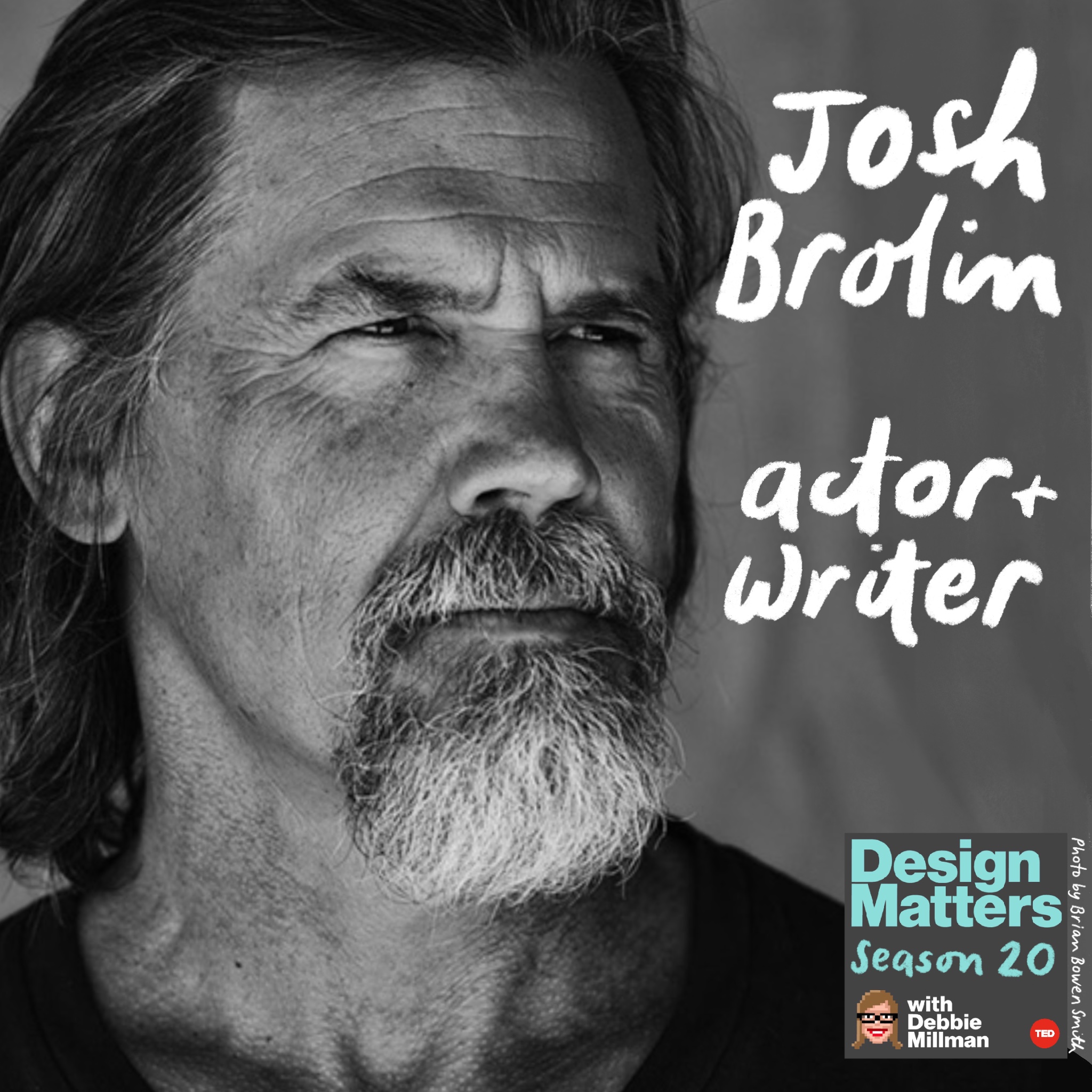
In this episode, acclaimed actor Josh Brolin discusses his life on and offscreen, as well as his new memoir, From Under the Truck. He shares stories from his career, personal challenges, and insights into his creative process.
Written by AI. May contain mistakes.

Get the gist, explore an idea or ask about something said.
 Claude
On Design Matters with Debbie Millman, what are the key points of this episode?
Searching your listeningAutomatic transcript. May contain errors.
0:00It comes back to this very simple thing of what makes people tick. I am forever fascinated and thrown by what makes people do what they do and also amazed.
0:17From the TED Audio Collective, this is Design Matters with Debbie Millman.
0:24On Design Matters, Debbie talks with designers and other creative people about what they do, how they got to be who they are, and what they're thinking about and working on. On this episode, Josh Brolin talks about the ups and downs of his life and his career. I just think I was a guy in their minds that should have hit and didn't. So I was like, you know, I was rotting fruit.
0:51Josh Brolin has led a wild life, and I'm not just referring to his acting career. In his just-released memoir, From Under the Truck, we learn that he started stealing cigarettes at nine, got stabbed in the belly button in Costa Rica, and had a stint in prison. From Under the Rock is a book about Josh Brolin's trajectory as an artist and an actor. But it's also about what it was like to grow up on a ranch with a mercurial mother, hit it big in a movie as a teenager, become a day trader in his 20s, and be nominated for an Academy Award at 40. Josh Brolin, welcome to Design Matters. Thank you, Debbie.
1:34Thank you so much for having me on. Josh, I understand you do a wildly impressive Richard Burton impersonation. From who? Who said that? I read that somewhere in my research. You know, I don't know. You know who does the greatest Richard Burton impression? who's from the same area as Tony Hopkins. There's nobody that does a better Richard Burton impression than Tony Hopkins, but mine's okay. I'll throw it in there somewhere along the line. But I feel moved. Well, congratulations on the publication of your memoir, From Under the Truck. Thank you. You've said that writing the book was perhaps the most humbling experience of your life and definitely the hardest you've ever worked on anything.
2:24And I'm wondering why so humbling and why so hard? I don't know. I don't know if that's true, if it's the hardest I've ever worked on anything because the work ethic, you know, aspect of my life I think is set and has always been set. I remember when my dad said at one point, I remember when you went to war and I don't know when that was. I think it was sometime in my 20s. It was, you know, meant as a positive, as an affirmation, you know, that I finally said, I'm not going to play with this. I'm not going to just kind of dip my finger in this. I'm going to give myself entirely to it. And it was the same thing with the book, you know, I've always written.
3:02And I think when I, when I finally decided to stop writing books and putting them in a dark corner to start disintegrating and, and tell nobody about it, I said, you know, put it out there. There's something that happens in your 50s, you know, where you just kind of say, the fear is a different type. My relationship with fear has changed. I don't care as much anymore. Or even if I do, I care about slightly different things. And there's going to be negative connotations to everything that I do. Maybe that's being in this acting business for 40 years. So, you know, my version of fuck it finally came to fruition.
3:41And I just wrote it, but I cared. So I care about sentence structure and I care about writing a literarily viable book. It's not just about, hey, guys, look at my life. I was four years old and they knew I was going to be a performer. They knew it from the start. Then I met famous people and life just got great. You know, I'm not interested in that. If only it were that easy. If only it were that easy. Now, I understand it was your dad who first encouraged you to write down or draw what you were thinking on a piece of paper as a little boy. And I believe you have I read that you have something like 90 journals.
4:21I do. Yeah. I don't know if it was my dad. You know, interviews are great because you guys end up finding out things that I don't even know or I haven't thought about in 40 years or 50 years. Um, I don't, maybe he did. There's a book that he used to read called Cyber Cybernetics and say it was going to change your life. He like, he still mentions it. He's 84 years old and he's still talking about the same book. But I think that there's something in that book and the art of dramatic writing. God, I haven't thought of that book forever. I think it's Lejos Egri or something like that. And he mentioned that book to me at a very young age.
5:01I think I was in my teens. And I read it. For some reason, for me, the expression of writing was the one place I could be completely honest. Why do you think that is? I don't know. And when I look back at those journals, you know, some are very angry, some are very contracted, some are, you know, and then there's things that are very poetical about them. And in the way I was looking at things that I didn't feel like I could express to my little ruffian buddies, you know, because I thought I would get slammed for it. So it was the one place of solace and liberation I found myself was in journals.
5:42You described from Under the Truck as unconventional nonfiction. Can you talk a little bit more about that? I would probably describe me as non-conventional, non-fiction, or a bit fictional. You know, Jennifer, a mutual friend, passed a law. She sent me something this morning. Somebody had asked a child about writing in their journal, have you written your journal yet? And the child responded, no, the words are still stuck in the pencil. And I said, I want to think on that plane all the time. Like you just hit the nail on the head of it. And whether it's absurd, whether it's considered absurd or not, there's something about that leap of the imagination that I want to live in all the time.
6:34And I don't think it's wrong to live in that all the time. It doesn't negate the practicalities of life, you know. So I think that when I was, I think I was around, I was in ninth grade in high school and there was a guy named Mr. Visser and I was writing. It was an English class. It was a lit class. And he came by and he was reading my stuff and he said, technically you're all over the place. He didn't say that. He used other words, the F word. but he said all you need to do is write just keep writing so there was something about my writing that he felt was going to flourish at some time you know so there was always some focus on it from the outside of people who took the time to and I say this emotionally see me you know I had my outer layers you know surfer tough fighting drinking and all that stuff and then there was this softer, more imaginative person that didn't feel like he had the space to live that outwardly.
7:39So journals were that for me. Early on in the book, you state that you have made your life harder than it needed to be. For sure. I learned from the best. Yeah. Well, let's talk a little bit about your upbringing. You grew up on a 230 acre ranch in California. You were primarily raised by your mother, who in many ways is the centerpiece of this book. And you describe her in the book in this way, and I'm going to quote you. She was armored with a character so unique and memorable that to die would be an insult to her mythology. She'd be leaving behind an easy breeze, a cloudless sky, no music on the radio.
8:24She was the zap in every electrical current we had felt. She was the alcohol in a mixed drink. She was the wildness in a sunset just after a horrible storm had passed. It's a really vivid, vivid description. I'm wondering if you would describe her as happy. No, but I too don't think that's the goal. There's something that I mention in my book and not to insult my father at all, but I think that there was this idea, this status quo idea of waking up in the morning and saying, good morning, are you happy? And I'm like, why is that the goal all the time? So I think that my mother and what I got from my mother is maybe a little too much.
9:15You embrace whatever's going on. Life is a potpourri and And sometimes you're angry and sometimes you're sad and sometimes you can't explain it. And sometimes you're ashamed for no particular reason that maybe you can pull from your past. And, you know, it's this kind of therapeutic idea that if you just go to the right therapy, you can exercise that thing that will finally set you free. in what I've learned in doing a lot of therapy and just curious from a very, very early age. 13 years old, I was paying for my own therapy. Really? Yeah. There was a guy who used to go to sleep on me. That was therapeutic.
9:57You know, literally. But that's what I mean by making it tough. I wanted to experience everything. I wanted to know. I was curious. You know, coming from, And I don't say this from a victimized place. I was coming from the chaos that I came from. I became insatiably curious about why do people do what they do? Why are they reacting like they're reacting? But I found later on in life that it's my relationship with it that makes the difference. Tony Hopkins had said something to me once. He said, sober. He said, how great is it that we're like this? And I was like, what does that mean? Like what?
10:38And he said, we're just angry. We're edgy. I go, why is that a good thing? Is that a good thing? And he's been sober 40-something years and one of the greatest human beings I know. And he said, yeah, because alcoholics, given this thing, this engine that seems to live in us, that never quite idles properly. Left to its own devices can be the most hurtful, destructive thing imaginable, but directed in the right way, given the right tools, can be the most productive, enlivening thing imaginable. So that was a moment in my life where I was like, oh, it's my relationship with it as opposed to having to change and be somebody else and get rid of something that is innate in me.
11:29You became sober at 29, two years after your mother died. What provoked you to try and stop living with the anger in such a destructive way? I think there was another level of drinking and using, I think, I went to to try and get closer to my mother. You know, it was almost like I was writing a true crime novel, you know, and I was at the epicenter of it. The night my mother died, she had pulled a.22 on her boyfriend that she that was saying, I'm out of here. And he was trying to leave. And she said, you're not going anywhere. And then she was chasing him in the car. And she ended up turning a corner that I know very well because we still have that ranch.
12:20and then hit the tree at 70 miles an hour or whatever. And everything was heightened. So I think I just heightened what was already stratospheric. And it scared me. And I didn't choose. You know, there was an intervention with some friends. I always liked sober people because they were more honest and I could count on them. And people said, I think it's time. And I tried it. And I stayed sober for a while, but I didn't stay sober forever. I never wanted to stay sober because I felt like sober was invisible. What does that mean? It means that I didn't feel like I had a personality on my own. I felt what drinking did for me, and it absolutely did do it for me for a while.
13:06It gave me a personality. It gave me a voice. You know, I didn't have the fear filter, the massive fear filter that everything had to be pushed through. I'm scared. I'm sober. I go talk to a girl. She's not interested in me. I'm polite. I'm this. I'm drunk. I put out my hand. A girl grabs it, and we're together for the next three months or three years. I don't know why that works that way. I don't like that it works that way. I don't know if it has to do with confidence or false confidence or whatever it is. But it seems that when I drank, it all went more smoothly until it didn't, until it bit me in the ass.
13:48And it always eventually bit me in the ass. And now sober, I think, you know, to cut to years and decades later, there is a form of sobriety that I feel that I've found that deals with the fear as well as and much less self-destructively or destructively than alcohol did. But alcohol was a great friend for a while. Well, you said that your childhood, and this is a quote from the book, your childhood was on a leash of the whims of your mother and your world revolved around country, Western, outlaw, 18-wheeler culture. Great line. This included drugs, a lot of drinking, performing in a punk band, surfing with a group named the Clio Rats, several rents, this stint in juvenile detention and prison.
14:39Now, you said that if you weren't in prison at the time that you were, you'd have been dead. Why is that? Well, it's the Cito Rats, C-I-T-O. Oh, sorry about that. No, no, no, that's okay. It's because I'll have a couple of guys call me for sure. Why would I be dead? because a lot of us died, a ton of us, not a few, 36. So there were a lot of guys that I grew up with because there was the heroin epidemic, there was punk rock, there was just normal self-destruct. Everything that we're talking about that was heightened and more vivid living from my mother was also a culture that I was in the nucleus of in Santa Barbara.
15:26And you can't even tell that story because it's freaking Montecito. So you mentioned Montecito and self-destruction and people go, you know, oh, Silver Spoon self-destruction. I get it. You know what I mean? And back then it wasn't like that. It was a very, I've never seen anything before it or since. It was all kind of instigated by this Sid Vicious mentality, sex pistols mentality. And it doesn't exist anymore. I'm in Santa Barbara again. It's lovely here. I'm more geriatric. And I've found a flow. But we moved back to Santa Barbara fairly recently, and I contracted a mild case of Bell's palsy.
16:07I was so scared of moving back. I was telling my wife, you don't understand. Like you're not supposed to understand. But if we move there, our little girls are going to end up in prison. Like, do you understand this place is paradise in disguise? There is an underbelly. And it's not. It was, but it's not. There was something about that time and place and that group of kids and how parents were in the 80s that all lent itself to a lot of destroying a lot of really brilliant people who I miss dearly. Josh, you talk about your brother in your memoir. And I want to read a line that was one of the most moving and really sad.
16:57Your mother hired a woman named Ramona to help her, and you describe her in the book as your mother for seven years. But she left to raise her own children, and you include the date. You remember the date, September 4th, 1981. You were 13 years old, and you describe your brother in the following way. Anyway, Jess was nine, and that was the last I saw him, for it was at that moment when he drove his personality inside the garage of his brain and closed the door. Did he ever come out?
17:35No. Yes. He came out in his own way, in a way that he could control, in a way that made him comfortable, just like I did. I think how he dealt with his surroundings was very different because he's a different person. And younger. And younger. But I think he got, he, the irritation toward my brother was more than what I got. I got the normal, severe, albeit severe, impatience. But my brother didn't have fight in him. He had violence in him, but he didn't have fight. He didn't have wherewithal. I just think he was more sensitive. He was more affected. You know, I protected him as much as I could.
18:27And then I kind of went off and did my own thing once that Cito rap deal started to happen. But I think my dad describes it now. He said, you were very protective. You were always kind of shaming us for the bad parents that we were toward Jess. You know, I talk to my brother all the time now. So he's doing very well. I mean, I called him about writing that stuff. And I said, are you okay with this? I wanted to check. Are you okay? You know, and there's some things that I read to my brother. He's like, yeah, I don't think that's how it went. Which is always going to be the case. Because his perception and my perception of it.
19:05But I think we're a pretty open family now. And we kind of look at it through the lens of absurdity. And I think pleased that we survived it. There's a lot of humor in my family. There's a lot of compensatory humor in my family. So we exist on that plane most of the time. you got your first movie role a starring part in the 1985 steven spielberg story the goonies you were 17 years i just re-watched it by the way it still holds up still holds up you you stated that to prepare for the part you were reading stanislavski and you asked steven spielberg if the tunnel in the film was a metaphor for your mother's womb i'll never i can remember it like it was yesterday.
19:57I remember his face being very patient and nodding while I was talking. And then he looked down and then he looked up and he said, you know what? Why don't you just say the words that are on the page? And I was like, okay, that's what I'll do. I want it to be good. I want it to be good. I was reading Stanislavski. I was reading Grotowski. I was reading Antonin Artaud. I was reading about the theater of cruelty. I was in it. I was in it. I just wanted to be better. I think that's probably one of the themes of your whole life, if you want an outsider's perspective now that I read your memoir. Your next two movies were Thrashing in 1986 and Finish Line in 1989.
20:43And you didn't make another movie for another five years. And you said the problem back then was that you were a C-minus actor who had no nuance, no depth, and no innate natural skill. you began to supplement your income as a landscape artist and then day trading. What made you decide to play the stock market? You know, I had met a friend, Brett Markinson, who's still a close friend, and I had met him. I did something called Into the West. It was like a miniseries. It was a Western miniseries, and I had done an episode of that, and they flew us to New York to promote it, and they were flying us back, And it was a friend of a friend, Skeet Ulrich, who introduced me to Brett Markinson.
21:29And we just laughed for six hours on the plane back. And I asked him what he did. And he said he trades stocks. And I said I was always a math guy. I was always very good at math. I was always the guy who was actually looking for extra credit from the math teacher because I just enjoyed doing that. And he said, yeah, well, it's all about reading graphs. And then I just started asking question after question after question. And I liked him. And he liked talking. He liked teaching. So I wasn't making a lot of money. I was working once every 12 months, 14 months or something like that. I never was in a position for two decades to know while I was doing a job what the next job was going to be.
22:09You know, I always went this long span of time auditioning and seeing the normal people in the hallways. And, you know, thank you for coming in, Josh. That was a wonderful lie. And knowing that I wouldn't hear from them again. popping up from behind the couch and pretending like I have a gun with my thing and I'm in the black forest in Germany, whatever it is. You know what I mean? It's all so ridiculous and just shame spiraling my way through this career. And when I would finally get a job, it was great, but trading just brought, I don't know, it allowed me to utilize a part of my brain and find my way through this labyrinth of discipline that I really enjoyed.
22:53Because he said, any instinct that you have in trading is meaningless. I have a feeling this is going to happen should not exist in your vocabulary. Look at the graph. It's all practical. And once you really learn how to start reading the graphs, all you'll see is fear and greed. And you're playing off that. You're playing off momentum stocks. you're playing off the foundation of a company. You're not looking for the big win. You're just looking for little breaths on an upward trajectory. And I did. And I got it. And I made a lot of money. And I would never do that today because I don't have the time.
23:30You know, when I have a bunch of young kids. I remember when I was trading, my older kids were, they'd be like, we have to go to school. Please, God, get in the car. And I'd be like, one more. I'll be right there. I'll be right there. I'll be right there. You know, and it wasn't, it's not gambling. It was really a design and I had a lot of fun doing it, you know, so I won more than I lost. And that was the point. And I was able to survive a little bit longer and still call myself an actor. At that time, you described it being one when no one wanted to hire you. You were then cast as, and this is actually one of my favorite roles of yours, as the bisexual ATF agent in David O.
24:16Russell's brilliant 1996 film, Flirting with Disaster, which co-starred Ben Stiller, Lily Tomlin. Oh, she's amazing in that film. Amazing. Patricia Arquette. Now, I read that you actually improvised the scene where you lick Patricia Arquette's armpit. Yeah. True? Yeah, that was just supposed to be a kiss. We filmed it. It was supposed to be a peck. And David O. Russell, very smartly, said, this is boring. It's not working. I said, what about, like, I don't know, what if I suck on her toe? Or what about something like that? And we're thinking about it. Suck on her toe. I don't know. And then Patricia said, what about licking the armpit?
24:55And she had grown out her hair for that role. You know, it was more like a hippie mom. And I was like, nah, I don't know about that idea. And David goes, oh, that's great. So we did it. We'd have wet wipes on the side to wipe off my tongue. And then David says, I don't know, the armpit hair is really getting in the way for me. So then we did it a third time with no armpit hair. And that was the one. Your role in that movie, I don't know. I feel like that's the movie where you became an actor. You were so good in that movie. You were unrecognizable in that movie. Thank you. In so many ways. I think, you know, I had done a lot of theater before that with Anthony Zerbe and I felt like I had done roles like that in the past.
25:43I had just never, I was still stuck, I think, in people's minds in a certain way. You know, I was a jock or they didn't know what to do with me or that, you know. So Miramax did not want me to do that film. They actively tried to get David to get somebody else to do the film. because I think at that point, what was I, 27? My mom had just passed during the rehearsals of that film. And I just think I was a guy in their minds that should have hit and didn't. So I was like damaged goods. I was rotting fruit. I think that role was like Mark Wong or something. I wasn't even right for the role, the way it was written.
26:27Wong was not me, but I came in and I auditioned. They let me audition. And I kind of improvised through some things. And he really liked me. So he forced me down their throats. And then I ended up being like a Miramax guy after that. And he used me for several roles until I turned down a role. And then I was blacklisted for 10 years. At that point, did you feel like your acting had improved? Because I forgot that you were in that movie. I forgot that it was you in that movie. It was such a departure from all of your previous roles. When I was looking at your filmography, I'm like, oh, my God. He's in one of my favorite movies, and I didn't even realize it.
27:03I really love that movie. I love that experience. And I was such a fish out of water because, like I said, I had done roles like that on stage. And I was a Harley guy, and I was riding my Harley to work. So there was some rebellious thing that I was playing out, some idea of that. And then you see Alan Alda, Lily Tomlin, Richard Jenkins, Mary Tyler Moore, George Segal. And I'm like, you've got to be kidding. I so don't belong here. I don't blame Miramax for not wanting me. Why am I here? And we developed that character. He was just, you know, a bisexual ATF agent. And we did the tattoos. We did the armpit licking thing.
27:45We did the scene in the back of the car where we're talking about proper blowjobs and all that kind of stuff. And it was really fun because I felt like, was I a better actor? No, but I felt like it was more along the lines of my sensibilities. It was character. It was what interested me. What are people about? What's behind the cosmetic presentation? It's like when I researched Wall Street 2. You know, when you take a bunch of billionaires out, they're going to present a certain type. get them drunk and then you get to find out some real stuff and i found out some real stuff two movies figure prominently in your memoir goonies and the 2007 film no country for old men which was the first movie you made with the coen brothers what made you decide to focus on these specific films?
28:44There's something about my, like even saying I enjoy being an actor was tough for me for a very long time. There was something kind of emasculating, emotionally emasculating about the idea of saying, yes, I'm an actor. That's what I do. Why is that? I don't know. I don't know if it's the celebrity that I experienced my dad kind of endure. There was never a celebration in it. There was always a massive discomfort in it. And I think this idea that, you know, this confusion of, are you an actor or are you a celebrity? Do you know what I mean? And I've always said that like with any kind of success in this industry, people immediately resort to this idea that you are walking through a life on a red carpet, just waving at people.
29:37And you go, and this is part of the memoirs in reaction to that. You go, listen, it's all dirty. It's all messy. We're all trying to find our way through the muck and the molasses and find our value and what that means and that changes and all that. And that's, to me, what becomes kind of this celebrated communal experience is when we all go, oh, we're all going through different versions of the same thing. How great. Cool. Let's lean on each other. Let's share with each other. And so I think if there's any intention, it's that. So I kind of lean away from this idea of like, and then I was nominated and there was Michael Shannon and there was Robert Downey and we're looking at each other and we're going, I hope it's me.
30:24I hope it's me. Of course, it's going to be Heath because Heath had just died and it just would have been horrible had it not been Heath and he deserved it anyway. But who really deserves it? And what is the Academy anyway? I mean, I could go through all that, but it's super boring to me. Well, during the filming of No Country for Old Men, you met the writer, Cormac McCarthy, and you became friendly with him. And you write in the memoir about a conversation you had with him about your careers and the realization that there is the work. I'm going to quote you. There is the work. Then there are those who respond to the work.
31:02That's it. You're a genius and you're a disaster of an artist, our close cousins. Yes. Yes. I don't know who wrote that, but that's cool. Well, you quoted it. No, I know. I think that was you, Josh. I think that was you. I don't think that was Cormac. I'm proud of that. No, it wasn't Cormac. And the funny thing and why I think Cormac liked me and why I loved him was there was me trying to find out, you know, what writers inspired him. And, you know, that moment in the memoir where I tried to get him to sign a typewriter and he just would have none of it. He just wasn't interested. He was interested in talking about the Santa Fe Institute and the scientists around him.
31:44And he was much more interested in the alchemy of things than he was in the status of things. So, you know, he did give me that one moment where he was like, Hemingway's short stories were pretty damn good. He was like, thank you. But I'm sure it's like Brando talking about acting. There is just an innate talent. I mean, Cormac said it to me. He says, I don't know what I do. I just sit down and it comes. And I think that was probably the most astute, honest thing that I had ever heard anybody say professionally, where some people just have a talent and a gift. And whatever they're working out and set in structure in their head, they refuse to take anything less than what they know is the best of what they can do.
32:37But it's all a very quiet, silent process. But it's also about sitting down and doing it. Like every day. And he did it every day. I mean, I was with Cormac the night before he died. It was me, his ex-wife, and his son, and that's it. Helping him drink little sips of Diet Coke, and he was starting to go. And yet he was telling amazing stories about him drinking wine in Paris with Andre the Giant, and these crazy stories that were so fun that he was telling that night. but he still had on a little tiny piece of wood that typewriter that he'd written 25 years of books on that was right at the foot of his bed right up until the moment he died so he did he just did and I like the idea of doing and going back to what you were saying just quickly about the most humbling process of my life because the most inspiring people men man or woman to me in my lifetime has been writers.
33:42That is what has inspired my life more than anything. It's what freed me from my family. When I read Ray Bradbury for the first time, when I read Martian Chronicles, I was like, I had no idea you could go to these places. And then suddenly I got turned on to all these writers. And then I got turned on to, you know, George Saunders just wrote this book that I just read for the second time. And that's how I met Jen. And now I've been talking with him. And I was like, dude, when I was 18 years, no, 20 years, 1920 and 21, reading Gogol, reading Tolstoy, reading Turgenev, reading on the floors of these bookstores in Los Feliz.
34:27I mean, my whole life opened up. I mean, it was fanfare. That was great. What was it about the Russian literature that compelled you so much? Was it that sort of Slavic sense of doom? It was Slavic sense of doom, but there was always a sense of humor in it. There was always a sense of almost making fun of the weight of their cloud, their storm, which I loved that contrast because I felt the same way. I mean, obviously, I identified with it. It was like, if you write Diary of a Madman or you write Notes from the Underground, Dostoevsky, you're like, oh, my God. But even in the story about, you know, little Johnny, who obviously is me and told in a kind of Dr.
35:18Seussian cadence, when he's looking around and he's, you know, the mother's screaming and she's throwing these massive, you know, mugs through the window at the father who's coming home late. because you know he's been somewhere where he shouldn't have been. And, you know, it's all so black cloud. It's so full of black cloud. But at the same time, and why I wanted to have that Dr. Seussian cadence is because it is ridiculous. It is surreal. It is absurd. What the fuck are we doing to each other? It's amazing what us little weak humans do to each other. Yeah, especially now. Especially now. And I go, what is that idea?
36:08Even with my neighbor, who is a far right-wing belief system and all that. And I go, listen, we don't have the same beliefs, but in that very primitive, primal country way, I know that my kids are safe with him and his kids are safe with me. And when it all comes down to it, I want to know those people still exist. Even if I hate your belief system, I want to know you have my back on a very, very human level. Well, I think it's fine to have different points of view and disagree as long as it doesn't come to fisticuffs and killing. That's what I mean, killing. And you're like, why would you? Oh, you believe that?
36:52Well, I don't believe that. You're bad. I'm good. Bam. I just did something good. You know what I mean? And we can go off on a whole tangent. But again, it comes back to this very simple thing of what makes people tick. I am forever fascinated and thrown by what makes people do what they do. And also amazed. Yeah, that's sort of why I do the show. I'm endlessly fascinated by how people become who they are and how they do what they do. But speaking of violence, you played a character, you played a villain. Actually, Thanos has been voted the greatest villain of all time, even besting Darth Vader in the Avengers film franchise.
37:41And Avengers Endgame is the highest grossing film of all time. You've said that you were eventually able to find Thanos within you, but you had to go looking first. What did you have to find? The humanity in him. It's the same thing that I did with Dan White. Dan White as a human being disgusted me. You know, big fish in a small pond, went into a big pond, realized he was a small fish, was being bested by a gay man. And I mean, the ego just dying on the vine. And there's something that I find, even though it hurts, very enlivening about my ego being lacerated. Because I know a great lesson is around the corner.
38:29And I think that that's come with age and that's come with tools and all that kind of stuff. But Dan White, I did the same thing where I was like, I don't have to like this guy. I just have to know. I did the same thing with W. you it's like yeah we can watch cnn and find out how much we hate george bush you know and and but what is the trajectory why did he stop drinking he was the black sheep of his family he wasn't the golden child how did this happen how did you know that's interesting to me so when i was doing it when you know here comes the richard burton when i showed up with the russos and i was like you know i had had this you know in my craft or selling art, exercise in the still night when only the moon rages and the lovers lie in bed with all the great, you know, I had this kind of presentation of this kind of Shakespearean presentation and they were like, yeah, I don't think so, you know, and they started referencing movies that I loved, Apocalypse Now, and they're like, it's okay if you scratch your nose, if you have an itch, if you want to fix your hair, if you want to feel your muscle, if you want to, Whatever it is.
39:39And we just humanized him and we played and played and played and improvised and improvised and improvised. And I think that's what people responded to. I was very proud of that, strangely enough. I never thought I would be proud of a mocap character, but I really am. There's a scene when you are annihilating Gamora's planet and you take her, you adopt her, and you hold her hand, her tiny, tiny, tiny little hand in that giant hand of yours, the character's. That, for me, felt like the character had a heart. You write about in your memoir how at one point you were positive that something in you was broken and that it is the brokenness in a character that you're most drawn to.
40:34Is that still the case? No, I don't think so. I don't think I'm broken. I think I'm cracked. but it's like I remember reading the agony and the ecstasy about Michelangelo and this idea of getting rid of what's no longer needed you know that the sculpture already exists inside kind of like what we said about the child and the pencil and the words living inside the pencil that just haven't come out yet and I think that I've adopted this idea that I'm just continuing to let go of things that I thought were necessary that don't feel to be as necessary anymore. So as opposed to what am I made of foundationally, I think I'm made of some pretty good stuff.
41:19I think whatever God put together in what I was intended to be and was when I was first born, I'm slowly tapping into now. It's just taken me 56 years. In the Avengers movies and game and in Infinity War, you talk about your behavior and motivation being inevitable. You use that word again in your most recent appearance hosting Saturday Night Live, and you use the word three times in the book. Is that your word or was it the writer's word in the script that you fell in love with? There's something so weighted about the word, inevitable, you know, and I like the idea of playing with maybe, I mean, I'm just thinking about it now, this idea that you can't change something.
42:19And I go, yeah, but why not? Yeah. Why not? Again, it's another status quo word. That instead of discarding it immediately, I choose to have a massive relationship with it. And then I'll discard it at some point. But yeah, I do like the word, in all honesty. It's a good word. It is a good word. It is a good word. And it's a challenging word. You know, destiny is another challenging word. You know, what does that mean? It's all predetermined. Do I have any control over it? What do I feel about control? What do I feel about all that stuff? But I do like the lessons. I do very much like the lessons.
43:06They hurt, but I do like them. Josh, you're also starring in the Dune franchise. The second installment was recently released to great reviews, great box office. And while on the set, you began writing verse about the experience, which was recently made into a book titled Dune Exposures, which features your words alongside photographs taken by Greg Frazier. Can you talk a little bit about how that book came about? That was really Tanya Lapointe, who is Denis Villeneuve's partner and producing partner, partner in life and producing partner, said she had read some things that I had posted and that she knew because I've known them for a long time.
43:49And she said, you know, you and Greg was taking pictures on the set just here and there. Film pictures, all film. And she said, why don't you guys try and put something together? It'd be fun to have something for the movie afterwards. And we put together an initial book that cost way too much money. And we used paper that was too good. And we did, you know, whatever it was and nobody bought it. And then we did for the second movie, we used stuff that we had written and photographed from the first movie and the second movie, put it together. and it became a bestseller. But it was nice. I felt good and I felt able in the memoir.
44:27I took out a lot of poems in the memoir. I mean, I took out probably 20 poems. And at the suggestion - Why, why, why? I mean, you played with format so beautifully in the memoir. Why did you take it? Because I didn't want to saturate it with that. And it's really, truly my first love. I mean, I said recently, I said, did I write the first poem? because I don't remember reading a poem, but I do remember writing a poem when I was eight years old and showed my mother this circular kind of poem about death. And she's like, what is this? She found it. What is this? What does it mean? Should I be worried?
45:03I don't ever remember reading a poem. So obviously that was something in me needed to express in that way. Maybe I just, maybe because it was mathematical, I needed to pattern things mathematically in order to feel closer to it. I don't know. I don't know. But my relationship with poetry has always been very intimate. And I think I got a little scared. I think I got, you know, doing a Dune book is one thing. It's celebrating something together that we did that is, the focus is on the movie. It's not necessarily on the book. It's celebrating something that is already accomplished and praised and all that.
45:43Whereas a memoir is just, I didn't realize, you know, I've talked about it in this way. Like nobody understands when you're actually doing a scene, how naked it feels because you're all just kind of juggling ideas and emotions and vulnerabilities and all this. Nobody actually knows what's going to turn out well ever. You know, they go, how did it feel during no country? I go like any other time. I mean, we were laughing. We were worried. We were, we weren't sure if things were going to work when you hire Javier to play Chigurh. And you know, he has a Spanish accent. Is that going to be seen as ridiculous?
46:20Is it going to be seen, you know? So it's all, it's all a big question. And, and when you're writing a memoir, I now have realized you're in that all the time. It's the dream where you're naked in the playground all the time, which, you know, I know now I'm, I, I've never, I'm not one to spiral. I've been spiraling. because I go and I created it you know I you want to be honest you want to be naked you want to put it out there you care about this you care about you know putting putting out an unconventional memoir because you're into prose or poetry or whatever it is and and okay then do it and suffer the consequences, pal.
47:13So, and I don't mean that in a negative way. I mean it in the most enlivening way, potentially enlivening. Well, if you are afraid of it, you won't be able to do it. You just have to, as you said in the intro, your monologue on Saturday Night Live, you just have to take the cold plunge. You just got to do it. And I remember even when I was doing that, you know, Lauren was like, yeah, it's not funny. And I go, I'm not trying to be funny. I'm just trying to be me. I think that there's something that will be accepted during that monologue if they realize I'm not trying to be SNL funny. I'm just trying to say, hey, I'm here doing this thing.
47:53They've asked me to do it. And here I am. Half naked, taking the cold plunge. Half naked, taking the cold plunge. I'll do it. Why not? I have one last question for you, Josh. Yes. At the very end of From Under the Truck, you state, I am right where I'm supposed to be, fully aware, and shame no longer follows me like a reticent dog being belly dragged on a leash. For anyone that's still being belly dragged around on a leash, what is the first thing you'd suggest that they do to break free? Oh, don't believe the lie that fear is helping you survive. Hmm. I think survival mechanisms are absolutely, like alcohol was for me and a lot of other things, were absolutely necessary.
48:43So that's why I don't shame myself for it. Even though I don't, I feel bad and I've confronted the idea of hurting people and hurting myself even. But it was needed. I don't know if I would have survived without it. And I don't know that I would have survived without that fear that kept me in check. But I love my relationship with fear now. I love it. I love my relationship with challenge. And I don't think I'm trying to turn myself into mincemeat now. I think that I'm trying to grow. Whatever that means. I don't love that word. How about germinate? Germinate into ultimate innocence. Josh Brolin, thank you so much for making so much work that matters.
49:33and thank you for joining me today on Design Matters. Thank you. I was so excited to do this today. Thank you very much for this morning. Thank you. Okay. Josh Brolin's just released memoir is titled From Under the Truck. You can also see him on the big screen in Dune 2. I'd like to thank everyone for listening. And remember, we can talk about making a difference, we can make a difference, or we can do both. I'm Debbie Millman, and I look forward to talking with you again soon. Design Matters is produced for the TED Audio Collective by Curtis Fox Productions. The interviews are usually recorded at the Masters in Branding program at the School of Visual Arts in New York City, the first and longest running branding program in the world.
50:18The editor-in-chief of Design Matters Media is Emily Weiland.
From his breakout role in The Goonies to No Country for Old Men to his recent appearances in the Dune films, acclaimed actor Josh Brolin brings unmistakable gravity and grit to all his films. He joins to talk about his life on and offscreen and his new memoir, From Under the Truck.
Hosted on Acast. See acast.com/privacy for more information.