 Ask ChatGPT


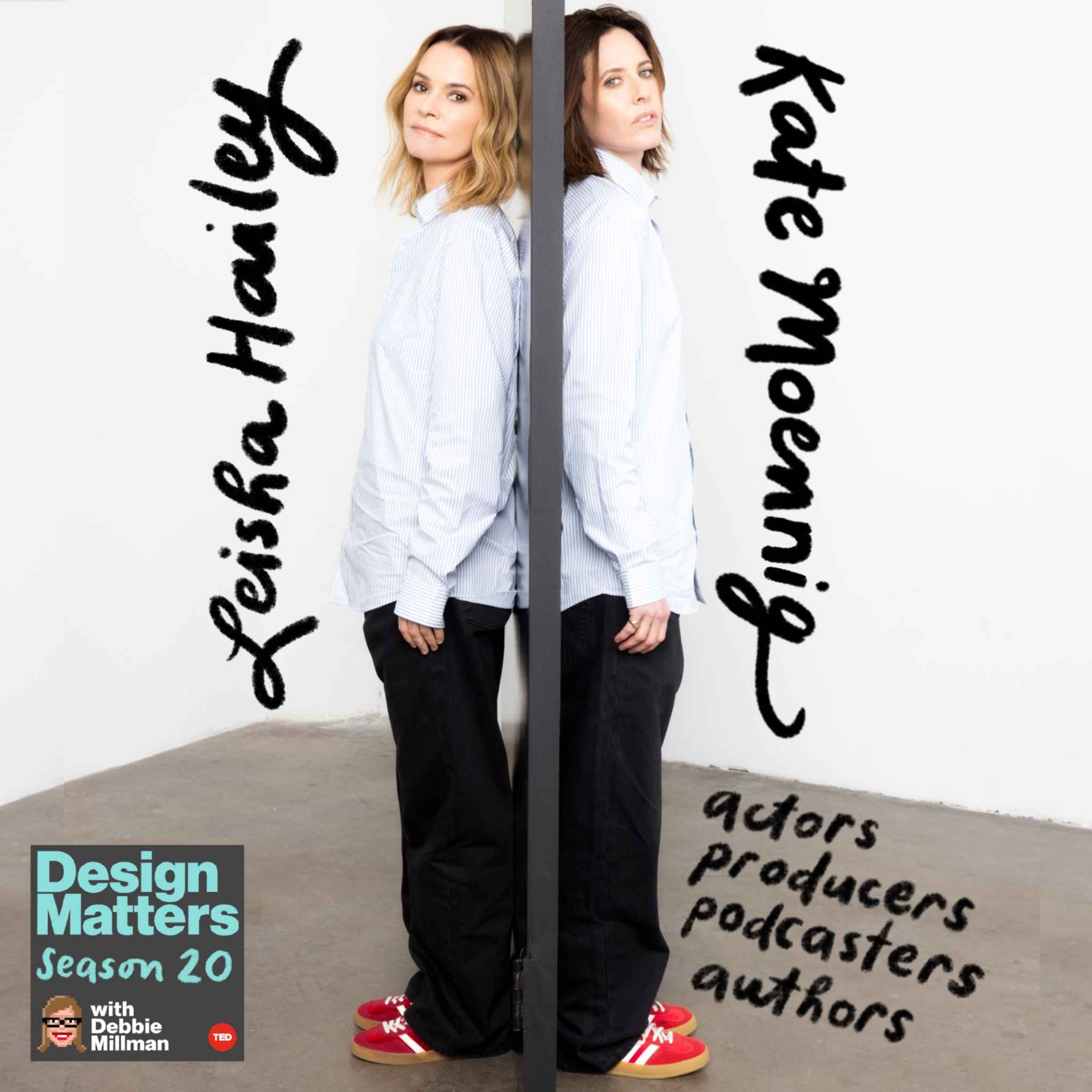
This episode of "Design Matters" features hosts Debbie Millman interviewing actors Leisha Hailey and Kate Moennig, both known for their iconic roles as Alice and Shane in The L Word and its reboot, The L Word: Generation Q. They discuss topics such as queer representation, their personal and professional journeys, and the evolution of their friendship, including their experiences in the entertainment industry.
Written by AI. May contain mistakes.

Get the gist, explore an idea or ask about something said.
 Claude
On Design Matters with Debbie Millman, what are the key points of this episode?
Searching your listeningAutomatic transcript. May contain errors.
0:00It was just, it was like watching a moving yearbook of high school and all of your awkward moments on television. And we both, maybe we got through two episodes and we're like, turn it off, turn it off. I can't do it anymore. Stop, stop.
0:18From the TED Audio Collective, this is Design Matters with Debbie Millman.
0:25On Design Matters, Debbie talks with some of the most creative people in the world about what they do, how they got to be who they are, and what they're thinking about and working on. On this episode, Catherine Minnig and Leisha Haley of The L Word talk about their long friendship and how they've persevered in the business of show business. I mean, that's the crux of how you survive in this business or not. I mean, we still battle it today.
0:57Shane and Alice. Alice and Shane. If you watched The L Word back in the day, you know which characters I'm talking about. Shane McCutcheon and Alice Piazeki. Best friends, edgy haircuts, both funny and even funnier when together. They became legendary lesbian icons and their chemistry was on display again in the recent reboot, The L Word Generation Q. In real life, Kate Menig, Shane, and Leisha Haley, Alice, are real-life best friends. They met at an audition for the same role on The L Word more than 20 years ago, and their friendship has flourished through their careers in music, television, and films.
1:44During the pandemic, they started a podcast, which survived the pandemic and is still going strong. Now they've co-written a book, So Gay for You, Friendship Found Family and the Show That Started It All. Kate Menig and Leisha Haley, welcome to Design Matters. Oh, goodness. Thank you so much for having us today. Debbie, we are so excited to be here. I am beyond thrilled. I'm beaming. Leisha, I want to start with you. In junior high school, you won best... You went right for the throat.
2:18You know me well. My best ears. Aren't they, everyone? Right. In junior high school, you won Best Design in an All-American Soapbox Derby competition. And you won not because you were the fastest, but because you cared about the paint job. What made you so focused on how the soapbox actually looked? I am so excited you asked me this question. I've been waiting for someone to ask me this question. So I was in Soapbox Derby for four years. I raced in both the junior division and senior division, which have very different cars and different layouts, and you race them different. You sit in them very differently.
3:02I built them every summer with my dad and had this obsession with what it looked like. And when I looked around to all, I was the only girl racing and all the boys sort of slapped their local sponsors on the side, very haphazardly and, you know, but their cars were fast. And I just really thought I needed to make an impact on the racetrack and on the hill, really, because you just roll down the hill. I found like a local car painting place and designed it with my father and we went and got the fiberglass professionally painted to my design. I was obsessed with Ms. Pac-Man. And then later the car was shaped like, to me, it looked like a high top sneaker.
3:48So I decided to paint it as a Nike high top and ended up getting a letter all the way to the president of Nike. Cause I thought I could be sponsored by a major corporation, I I guess, at 12 years old. Yeah, I don't know. I just I was aesthetically drawn to the way the car looked. I just thought that was very important. My favorite part of the story is actually that you wrote to the president of Nike. And he responded, I believe. Yes. And they let you use the Nike logo on your soapbox. Yes. So I made a little model like a, you know, about a 10 inch model of the design I was thinking about. And I guess it made it all the way to him and he put it in his office and wrote me a very sweet letter back and sent me a bunch of Nike swag.
4:38I got no money from them, but that was fine because like it was the biggest moment of my life at the time because they said I could paint it like the sneaker. This is so on brand for you. I know. There's a certain fearlessness to it that I just love. Kate, you've been immortalized in fan tattoos. I've seen some really interesting ones online. Yeah, they're creative, aren't they? Oh my God, they're good. Halloween costumes. You've inspired characters in fan fiction. You've been name-dropped in songs. And you even had a bar in Berlin named for you. No. Wow, Kate. There's a bar in Berlin called Shane's.
5:16No. Do you happen to remember the sort of moment you realized that the L word had transcended television? That's a hard one to answer because so much was happening in my life when that show was taking hold of pop culture. I suppose one thing I noticed, a friend of mine used to work at Showtime, and she was in charge of all of the behind-the-scenes content that networks used to do for promotions of new seasons. She was really creative. She would always find creative ways of doing interviews. And I guess the network had asked her to compile some sort of mini-documentary about how the show has impacted the community.
5:59And so she had gone around and done a bunch of on-the-street interviews with people. And then they made that into like a five-minute thing on maybe a DVD thing or something. And she showed it to me. And one of the questions was, what characters are you gravitating towards? And you had your bets and your team is and they named all of them. And then I thought, oh, okay, well, maybe, you know, Shane like hit a little pocket of people. But it turned out that like Shane had her own category. And that's where she refocused to haircuts and ties and studded belts or whatever odd thing I wore back then.
6:35And I think it was from that moment I thought, oh, maybe she is making a bit of a difference. I'm having a moment where I'm forgetting. She's very shamed today, I believe. That was the phrase or one of the phrases. She's very shamed today. You're looking very shamed today. That's what it was. You're looking very shamed today. Yes, that was, I think, from an underwear ad. I don't think that there could be a bigger compliment. Yeah, and to think that little storyline turned into some sort of iconic phrase. I know, and you're still saying it in 2021. Absolutely, 20 years later, more than 20 years later.
7:10So I want to go back in time a little bit. Leisha, you wrote in your new book that on the outside, the Haley's, your family, who hailed from Bellevue, Nebraska, looked like your typical 70s Midwest family. Your dad, Robert, was a navigator at the neighboring Air Force Base. Your mom, Jane, was a nurse. And you state that both you and your older sister, Kadra, looked like poster children for the 4-H Club. How were you not a typical 70s Midwestern family? Well, my parents were massive liberals. My dad was an atheist or is an atheist. They were the house that everybody stopped over to feel better.
7:55It was an open door policy. My mom, because she was a nurse and at one point in her career was a school nurse, had a sort of an outreach to students that were maybe looking for guidance or maybe they were troubled. My dad was a guitar playing chess player. He was very quiet and sweet and What ended up happening that I didn't really realize at the time But they were sort of a home to most of the gay people in bellevue because it was a small town So my mother's best friend maureen who's basically my aunt and my parents best friends jay and tim Jay was the local drama teacher who I ended up doing a lot of musicals with.
8:41Those two are like my uncles. They're still my family. And I grew up watching them have these relationships inside my home and very comfortably. Maureen would have rotating girlfriends and they would always be around. I'd go stay at their house. They'd take me to baseball games or soccer games. And it was just a loving, warm environment and safe. Really, I look at it like my parents had this safety for our community. And I didn't know it at the time because it just was normal. And so when I was growing up later and I started to understand, I watched these people hide in the community. And that's when the mixed messaging started to happen for me personally.
9:27And I was confused. There was a part in the book that really broke my heart about how Aunt Maureen had an extra bedroom in her house. Yes. So people would think that there was some separation. That they were roommates. Yes, some separation. Reminds me of If These Walls Could Talk, the first episode, which is also just incredibly heartbreaking. You mentioned musicals. I believe that one of your first lead roles was in a high school production of Oliver, and you played Oliver. I did. It was, I think to this day, probably the best part I've ever played. I really locked into that role. Yeah, they were looking for a kid that was young enough to play Oliver, and I had already been in a high school musical playing Gretel.
10:18So this was Jay, the man I was just speaking about. And I ended up getting that part. So I was able to be around all these high school kids. And was it Oliver the Play or Oliver the Musical? The Musical. So you got to do all the songs. Oh, this is, yeah, this was my breakout. This was where it all started. Aside from Cinderella, Oliver on television was the first musical I'd ever seen. So it's very dear to me. Yes, it's a good musical. You describe yourself in the book as a tomboy who felt you could do anything. How long did that feeling last? Until I was about 13, just when my body started changing and peer pressure started to kick in.
11:02And I lost that sight of me or I didn't think I could have it anymore. And I had to sort of mold into what all the other girls were doing. Also a very confusing time in my life. I'm sure a lot of people can identify with this moment. But yeah, it was, I felt like I couldn't play anymore or be creative or really be myself. I had to conform. When did you stop feeling like you had to conform? Debbie's going deep today. When I moved out of Nebraska and I moved to New York City, that's where I really started to find myself and all the things I loved about myself because I'd lost them. And I was embraced by like the drag queen community.
11:49And I found music and I started a band and I went to acting school and it was just, I was able to be an artist and a freak and play around with my image and my sexuality. And it was just so freeing to move there. It was the perfect place to move in 1989. Kate, you write that you always looked at your childhood as an inconvenience. I want to know so much about that. I just wanted to be independent. I've always had an independent streak, and I just wanted to make my own rules and control my destiny. And I had an issue with authority, and just being a kid didn't fit with me. I wanted to grow up fast.
12:37How did your parents respond to the speed in which you wanted to be independent? Well, I don't think they had much of a choice. I grew up in Philly, like right in the heart of the city. And so you kind of go off and do your own thing. It's not that I need my parents to drive me to a friend's house. I just would take the bus or I'd walk. And so I kind of went by the beat of my own drum just naturally because I could get around to wherever I wanted to go on my own. And they were all cool with that? That was still of the time where it was okay to be by yourself outside? Yeah. Yeah. I mean, I did get mugged a few times, I won't lie.
13:15You did? Of course, yeah. Yeah. Oh, Kate, I'm a native New Yorker. I've lived in New York my entire life, six decades plus, and I've never been mugged. Really? Yeah, I've been burgled. Burgled once. Burgled once? Oh, yeah. I've been mugged with a friend of mine. We got mugged twice on separate occasions. In Manhattan? No, in Philly when I was a kid. Wow. You grew up in a city in the 80s or 90s. What are you going to do? It happens. And then you brush it off and you just keep walking down the street. So my parents, I suppose they were okay with it. I think they liked that I was independent. I think my father kind of got a kick out of it.
13:53Your father was a legendary violin maker. Isaac Stern and Itzcock Perlman were loyal customers. As you were growing up, did you understand the artistic significance of what he did for a living? No. It was just what my dad did. Friends would say, what does your dad do? And I'd say, he's a violin maker. And they wouldn't really understand what that meant. And I don't think I understood the significance. It was just what my family did. I grew up around it and I don't think when you're a kid and you're around something you appreciate it until it's gone. And now that it's gone, I can certainly look back and think that's certainly a unique profession.
14:30And also the technique involved is just mind blowing and people spend years and years and years traveling all over the world to perfect it. And I, it was just another day in the life for me. Yeah, it's a real, real craft. And there are so few people that are masters at it. It's a dying art form is what it is. Yeah. I understand you took ballet and had a leotard with a Superman logo on the front. Sure did. If your mother's a dancer, she wants to put you in dance class. How'd you get the Superman logo on it? And just being a huge Superman fan as a kid, that was, I think Superman was my first big, big hero.
15:12And so anything I had, it had to have the Superman logo. And I believe that was probably a compromise. So ballet class for a Superman leotard. I don't know where it came about. I don't know how she found it, but I had it and I wore it proudly for the minimal classes I could survive in ballet school. Would you also have considered yourself a tomboy at that point? Oh, I was a tomboy from Jump. You both were drawn to the performing arts when you were kids. When did you each think you wanted to pursue acting professionally more seriously? I dreamt about it in high school and knew that not only did I want to leave Nebraska, but I wanted to move somewhere where I could make that happen.
16:05And I just started to look. I knew I wouldn't get into university. My grades weren't good enough. So I started looking at specific acting schools, and that's when I found the American Academy of Dramatic Arts and basically set my life on a course that was going to get me there no matter what. I – it kind of dawned on me at a young age. I just watched movies my entire childhood, and my dad would show me things. Like I think I said in the book, the first film I saw when I was five was Alien. Yes. Because that just seemed to make sense in his brain. And he was like, it's a great film. It's a piece of art.
16:42We should watch it. It always fascinated me. And I thought, that looks like fun to do. And I believe at one point, my father was like, that's what your aunt does. And I said, oh, okay. I didn't think of it. And then, like Leisha, I also didn't have the grades to get into a university. And I didn't want to go to one because my school was a college prep school. And I was flailing there. So when it was time to figure out where to go after high school, my mom was like, why don't you try a conservatory and do something you want to do? You've done your time with what was required. And that's how Alicia and I wound up at the same school, but at different, like maybe five years apart.
17:22You mentioned your aunt. I'm wondering if you can share this story about thinking that someone you were watching in a movie looked like your aunt. Yeah, freshman year. I was in guidance class and Miss Gallagher wheels in the TV cart to watch something. And you're like, yes, this is a good day. And she said, all right, we're going to watch this movie. She says the name. It doesn't ring a bell. And she puts it on, turns off the lights. And I'm sitting there and I'm watching this film. And I'm looking at the woman who's playing the wife of the lead actor who was played by Robert Duvall. And the whole time I'm like, she looks familiar.
18:01It's like, why do I know that face? and then at certain angles I think to myself she kind of looks like my dad but I don't know why that is and I just sat there sort of flummoxed for like the hour just not getting it and then later that night at the dinner table my my dad said how was your day and I said it was great we watched this movie but this woman looks so familiar to me and I just I just sort of took me out of it and I just I don't know why but I feel like I've seen the movie before I don't know something familiar about it and he said what was it called and uh I remember trying to think of the name because the name wasn't sticking to me.
18:34And it finally landed. And I said, it's a movie called The Great Santini. And that's when my dad just looked at me and he goes, that's your Aunt Blythe. She just was like, what is your problem? But there's so many angles to that story that I love. I love the fact that you didn't know that it was her. But I also love the fact that apparently or clearly, she wasn't walking around all highfalutin, despite the fact that she was one of the great, great actresses of her generation, and that you didn't know. I think that's such a wonderful sort of appraisal of her in a lot of ways. Yeah. To me, she was just my Auntie B, who held my head when I was little from getting car sick and going on car rides and would bring me backstage on her plays and just be always so warm and loving.
19:28She was just my aunt. I never looked at her as an actor. She was my dad's sister, who he adored, by the way. She seems like she should be. I saw her once in a restaurant from afar, and I caught her glance. And I don't know if it was the lighting. I have no idea because I've never seen her since, but she had the most spectacular blue eyes I had ever seen. And this was from across a restaurant. Yeah, they're striking. Her blue eyes are absolutely striking. Yes, yes. Oh, good. I'm glad that memory is an accurate one. So you both attended the Academy of Dramatic Arts, as you mentioned, in different years.
20:12And Leisha, you described your transformation at school as one right out of a movie montage. You cut your hair off. You put on oversized Levi's. You were feeling yourself. You also discovered, as you mentioned, the drag scene in New York City and found the original cubbyhole. The cubbyhole. How did these discoveries begin to reshape your sense of self? you know i talked to my friend heather a lot about this moment because she i met her that my first band first bandmate best friend for a million years um and she talks about the day i came in with my short haircut and how everybody in school was like because i literally cut it into a short pixie and i had very long hair when i got to school was it an alternative haircut or just a pixie cut yes i found a gap ad she had just a short it wasn't edgy it was just like more like a pixie like get rid of it kind of thing um i remember that ad you do yeah she had short brown hair i was gonna say she had short brown dark hair oh like jenny jenny in season one was very much like hers was more spiky i think no no no it was more like jenny yes this was this was the moment, I locked into who I thought I wanted to be.
21:29And it was a very private feeling, although I was doing everything on the outside with the hair and the big jeans and the combat boots and trying to be edgy and sort of wink to my community like, I'm here, I'm with you, like I'm one of you. On the inside, I didn't tell anybody about this. I'd say goodbye to my friends at school and I'd grab my backpack and go walk down to the cubbyhole and sneak in with my sister's ID and sit at the bar and just take it all in and have an Amstel Light or whatever I was rolling rockers, whatever I was drinking at the time and sit there for hours and just observe.
22:12I guess it was just my own moment. It's kind of like what Kate talks about in coming out, how she took her time. And it was a personal journey. I guess I would call that my personal journey because once I came out, it felt very a part of everybody. Like I was, I belonged to the community. I was involved in it. And it's like I was off to the races. But this moment, this year probably that I had where I just go by myself and didn't tell anybody was It's just a sort of private discovery. Kate, you had a very different experience at school. You wrote that your childhood was a bit of an inconvenience.
22:54I got the sense that so was school. A little bit, a little bit. In what way? Give us some details. For the first time when I got to the academy, once I got the initial, I just moved to New York and I got all of that excitement. out of my system and the proper school year started, I was really excited to finally be enrolled in a program that I was curious about. So I love that. And I loved being a theater nerd. I loved reading the plays. And I loved sitting in Samuel French, just finding random plays by playwrights I had never heard of and just reading their work. I loved all of that. But the school itself sometimes drove me nuts because I didn't understand the casting choices.
23:44In what way? Well, I was cast as Anna Karenina. And I read the book. To prep it, I actually read the entire book, which is a big mother of a book. And it was a great book. And I thought, I'm not right for this part. But I can't exactly go to the Dean of Students and say that. And I understand it's there to like stretch your muscle and do your thing. But even then I was playing casting director. I was like, I would never be cast as this. I don't know. When you wrote about that, I was thinking, well, maybe the casting director was trying to break out of some sort of existing trope about who or how Anna Karenita should be played.
24:23Possibly, but no, because it was a very by the book, classical approach to the work and to the there was nothing out of the box about that production. What did you each envision as actors for your future? What were you aspiring to be or hoping to achieve? I honestly never had a goal in mind minus Broadway. Like that just seemed like the big win for me to get on stage. But once I was in school, I lost that a little bit because there's sort of a commercial push. you know like oh when you leave we're gonna you gotta go get your headshots and you gotta go find an agent i this was just like a foreign language to me i really was interested in learning how to act and to sort of get rid of all the things i had learned growing up and i really liked the craft part of it like the which is similar to what i like today i hate the i hate trying to get the job but i love having it and i love going to work and playing i i thought i just because film was so important to me growing up.
25:32I thought, I want to play roles I grew up watching. I thought Sigourney Weaver was one of my people that I just idolized. And so when I thought about it as a kid, I thought, I would love to play someone like Ripley. I'd love to play someone like Cool Hand Luke. Like, why can't there be a female version of that? I was always drawn to the strong female characters and also to the male characters like someone like Lucas Jackson from Cool Hand Luke, because I would watch the female roles and I'd be like, oh, you're just in the kitchen. I wouldn't want to do that. I want to be active. Yeah, you want to be in a film that passes the Bechdel test, right?
26:14Right. You have said that you learned more from a summer apprenticeship at the Williamstown Theater Festival than anywhere else. what does one do during a theater apprenticeship everything and anything that's what's great about it they just it's you just enter the lion's den of the theater and you just they're like okay you're an apprentice you're available at any time to do absolutely anything and and you work in different departments so to think about what you know how does a play take shape like what are all the departments, whether it's lighting or costumes or set design, box office. I mean, all of the little departments, being an apprentice would be basically assisting each and every one of those departments at any given time for what they need help with.
27:03That job led to you being considered for the lead in the film, Boys Don't Cry. And that's huge. I mean, to go from an apprenticeship to a potential starring role, the foundation of a film, what was that experience like for you? It was certainly a jump. But yeah, it was, the experience was really quick. And I was very naive. And I didn't understand how anything worked, any sort of politics or process. So I was, I feel like I was just going along for the ride. I was very flattered that my friend Matt even said my name to the people running that film. And I was just all about, yes, sure, I'll be there.
27:45What time? Yes, absolutely. I'm interested. And I just kind of faked it. Because that's all I knew how to do. Because I hadn't had any experience. As I was reading your book and envisioning the various ways in which you navigated to your success, I couldn't help but wonder what sustains you through the process. And you both became very successful at a fairly young age, but you also had numerous obstacles and rejections and so forth. How do you have the resilience to manage through those obstacles and those rejections? How do you hold on to hope? I mean, that's the crux of how you survive in this business or not.
28:41I mean, we still battle it today. I mean, we obviously have each other to call and say, this happened. And I mean, I just lost a role two weeks ago and I had to talk to Kate about it. It was for a gay role. I got very close. I was in the mix, as they say. And I lost it to a straight Trump loving married woman with I was like how I'm not I wasn't even gay enough to play gay. Like there are just times you're like you don't understand why things happen. It's hard, though. It's it's it's like that's the million dollar question. How do you sustain hope in something that's so inconsistent? and sometimes it rolls off your back easier.
29:22And then there's other times where there's something that you think you're just so close to touching, and then it gets out of your grasp. And it's soul crushing. Leisha had that recently. I had it earlier this year. And it's, the way I see it is that I have to have some level of blind faith. Even if there's no basis to have that, I need it. because it's what sustained me up until now, which is everything not only happens for a reason, but it's happened before it'll happen again. And I just can't predict when that is. So I just have to sort of relax into it and trust that it's going to take care of me in some way or another.
30:03I'm opposite. I'm opposite. Well, no, I rely on myself and go into what can I control and what do I love to do? What can I create on my own? How can I have ownership in something and not rely on someone else telling me whether I can do something or not? Those are the times I've been the happiest in my life because you're not waiting. It's a thing that can really depress you if you just wait around for someone else to say you're good enough for this or we like you for these reasons, we don't like it. It's like I go into my creativity, basically, and that's where I can just get through the day in a much happier and fulfilling way.
30:46I mean, it's very much like why Kate and I have been doing so many things together over the last five years is because we did need ownership finally over things we love to do. And we basically created a lot of businesses together because of that. Yeah, that was one of the main reasons I started the podcast when I did 20 years ago. I was just so sick of being rejected or not being good enough. And felt like my creative spirit was just being extinguished day by day. It was a bit of a Hail Mary to my creativity at the time. Yeah. So you understand. Yeah. Yeah. Yeah. After getting beaten down enough and realizing what you don't want to do, I think Leisha and I were just like, let's take some ownership of something for once instead of being told what to do.
31:37And it led into the podcast. It's led into other things. And it certainly led into this book. And there's like a level of autonomy that feels very satisfying. And peaceful. And peaceful. Yeah. Like we're just around the people that we want to be around. And that's so incredibly important to create and to conjure up ideas. Right. And it helps those moments, like casting moments where we're still in the same, you know, muckety-muck that we're like. Yeah, because we'll still get calls like, hey, we're going to send you some sides. Did you put yourself on tape? And you're like. But it makes the hits hurt less, you know?
32:15It makes the hits hurt less, yeah. Leisha, I want to talk a little bit about your music as well. Sure. Rather than pursuing acting full-time after school, you actually started a band with Heather Grody, who you mentioned earlier, the band The Murmurs. And after a bidding war, you signed with MCA. I love this, mostly because they'd signed Madonna a decade before. Yes. Going back and forth between music and acting has been one of the through lines in your career. What made you decide to pursue music before acting at that time? Again, I think I just, I'm a girl who follows her heart. And I don't know if it's necessarily landed me in the best places or I guess career, I don't know, improving places.
33:03I love being in a band. I love writing music. I love, I used to love touring. I don't know if I love it so much anymore. You're about to find out. I was going to say, you're going on a pretty big book tour. I know. I keep telling Kate, I'm like, get ready. No, I just love, again, I love the freedom. And I've never really been a career goal girl. Like, I kind of just go with what I'm feeling in the moment. And music was one of those things that took me on a completely different course. After several world tours, four acclaimed albums, you found yourself at a barbecue being told about a television pilot titled Earthlings.
33:46Kate, while Leisha was touring with her band, you were modeling, you were building your acting career, you were cast in the WB show Young Americans, you were in several notable episodes in the Law & Order franchise, and then you were sent the same script for Earthlings. So you were both sent the same script for the same part on the same show. Yes. That's right. And actually, we weren't sent the script, just the sides. I was sent the script. Oh, I wasn't. I wasn't that important. I got the script. You actually came face to face. You were face to face during the audition process as you were competing for the same role.
34:26Yeah. What was your first impression of each other? I said, that's the yogurt girl. Right. Alice was in a commercial. Yeah. Leisha, really. There she is, the queen of probiotics. That's her. And I was like, oh, that's what she looks like in person. Because the commercial was on all the time, Leisha. It was just, I mean, every show. It's like you couldn't get away from it. It was always there. So you must have done pretty well financially for a minute. So that was my thought. And she also had a prop, right? And she had a prop. And I thought, oh, so that's the only other person testing. because I'd been told there's only one other girl going to be testing for this part.
35:02Tell us the prop, Leisha. Well, I watched Happy Days growing up, and the Fonz was the thing that I thought had that swagger that maybe I could bring to a female. And I was like, I'm going to have a comb just like the Fonz had. And I thought, oh, she's a hairdresser. And I used it in the two auditions before this moment where we were both testing, which is the last phase of getting a part. And so I had had this thing with me the whole time. But when Kate sat down next to me and I saw this incredibly beautiful woman with these big red lips and rocker hair all in black, and I was like, well, it's never going to happen.
35:42But it was a good idea. And maybe if I don't get it, I could tell her she can have it. Kate, you won the role of Shady Cutchin. I did, but I didn't think so. I didn't think I got it. I actually thought I lost it. I really didn't believe that I had a chance. I thought I simplified it too much when I saw the prop that she had in her back pocket. Yeah, that psyched you out. Yeah, a little bit. But Leisha, Eileen Chaikin, the creator of The L Word, which thankfully the name from Earthlings was changed to The L Word, created the role of Alice Piazekie for you because she wanted you in the show so badly.
36:22That's what we heard later. She told us that story, which kind of blew both of our minds. But I thought it must have been in the script. And again, I didn't have the script. So I guess once they gave Kate the role, they were still interested in me in some sort of capacity. And I don't know if they rewrote one or wrote one. I don't know how this part came about. But all of a sudden, a week something later, I was getting faxed these new sides for this new character, Alice. And that actually, when I read them, I was like, oh, this is it. Like, I got, this feels right. Yeah, the two roles couldn't be more different.
37:00Kate, Shane was initially described as a womanizing serial monogamist. That's right. Yes, she was. I don't even know what that means. Thank you. Neither do I. You're the only other person who's agreed with me so far, outwardly about that. No, Roxanne didn't either. I'm like, what's a womanizing serial monogamist? It's confounding, isn't it? It's confounding, right? It's sort of. Absolutely. Bewildering. Yes. So how did you know how to first inhabit that character? Well, after I overanalyzed just that one little description to death, I just thought, I don't even know how on earth I would play that.
37:39So I'll just play the scene. I think my biggest concern was that she would be really corny. Really? Yeah, because you see that, like, the way she was described, and maybe it was the, because I had gotten the script. So maybe it's what I had read in the script, or maybe it was in the dummy sides we were given, because the sides we were given were never a part of the actual show. So there was something about her because she's this, you know, womanizing, very confident Lothario. And I thought that could kind of veer on cheesy. And I think maybe my brain was going towards 80s movies, stereotypes of like the smarmy cool guy.
38:19And I thought, okay, well, I'm gonna, I need to steer away from that because I don't know how to do it. And I'll gross myself out if I try. so I'll just underplay everything and make them come to me and have them lean in as opposed to me leaning forward and that's how I approached it and I guess it worked. And you made the girls cry. I guess I made some girls cry apparently off camera but yeah I made the girls cry. Leisha you were the only out cast member when the L Word first aired and I found that somewhat ironic given that you were playing somebody bisexual but i believe you were initially outed when you were in the murmurs by a journalist am i am i getting that right yeah rick ricky rackman on um oh god what channel was he i was something in la uh radio show there was a radio show and heather and i were on it and it was a quick moment we just didn't expect it and he's like you like guys or girls and we're like and he's like you like girls right you guys both like girls you like it was like very sexist and strange and we were i don't even remember how we reacted but i know that the record company lost their minds and freaked out because all of a sudden it was back then which would have been mid 90s you know maybe 90 or early maybe like 94 93 it was unheard of it was like ruining for people um and i gotta tell you it did it it automatically right away got we got boxed in and all of a sudden we were like the gay band the gay band the two you know and it's it just where we were opening for big bands like bush or you know we were very like alternative radio at the time that started to change you could feel like the guys that would that used to be into us were all of a sudden turning on us i don't know it was it was it's pretty wild kate you said that you only realized you were queer while filming the l word What did it feel like to discover that the character you were portraying was also helping you become yourself?
40:29I wouldn't say I necessarily discovered it when I was doing the show. I think it solidified it, more importantly. And it felt like a wild twist of fate. Yeah. And it felt incredibly safe because I had a support system. And I wasn't just trying to figure it out on my own in New York City. Yeah, it was a very fortunate environment to have that, solidifying that discovery in yourself. I understand you both had to take a four-hour lesbian sex class on set to prepare for the show. What was that like and what kinds of things were you taught? Alicia remembers it better than I do. I know that it was held at our hotel in a conference room and they had a sex expert.
41:17and we all sat on the other side of this very, very long table and she had brought all of her props and some very large briefcase. And I think she had a dry board up and she was pointing to things. And then I think Rose Troche... And there were sex toys like splayed all across the table. Displayed across the table that we could like, you know, it was like the Please Touch Museum. You know, you could touch things and be like, oh, okay, what's this do? And then I believe Rose Troche had compiled a montage of all of the best lesbian sex scenes from cinema's history and use that as like, hey, I just want you guys to put this in your brain just to understand in case you don't, because the show really sort of was the first of its kind and the majority of the cast was straight.
42:02I don't remember specifics outside of that entire day intensive seminar. Well, it was a lot of, like you said, holding props and sex toys and how does this work and where do you put this and how does this attach to that and how many fingers go in this and what what's the proper way to point your finger and do you know what does a girl look like when she does this and who sits on what yeah what's the best position is there a good position like is there a better position like what's this and then maybe rose would chime in and say well you know for camera maybe it's best if we do this it was uh and then a lot of people would look my way and I'd be like, sure.
42:43Here's a comb. Here's a comb. Let me show you what you can do with a comb. Yeah. The L Word launched on January 18th, 2004 to critical acclaim, instant popularity. And Alison Glock wrote this about the show in the New York Times. Before the L Word, female gay characters barely existed on television. Interested viewers had a search and second guests playing parlor games to suss out a character's sexuality. Cagney and Lacey, Joe on Facts of Life, Zena and Gabrielle. Showtime's decision in January 2004 to air The L Word, which follows the lives of a group of fashionable Los Angeles gays, was akin to ending a drought with a monsoon.
43:31Women who had rarely seen themselves on the small screen were suddenly able to watch gay characters not only living complex, exciting lives, but also making love in restaurant bathrooms and in swimming pools. There was no tentative audience courtship. Instead, there was sex, raw and unbridled in that my goodness way that only cable allows. Wow. That's perfect. How's that for a time capsule? I love it. Wow. I remember that. Oh, did I? I just couldn't wait for that show to be on every Sunday. Were you surprised by the public response to the show when it first aired? Surprised is an understatement.
44:15I always thought this show was going to be this seedy underground, like indie show that no one saw, but a few people would know about. I even thought when I went up to shoot the show, it would feel that way, like a janky little production. So the whole experience from front to back was just jaw-dropping. I think I felt like this could actually be pretty good because during that first season, we had Kelly Lynch and Rosanna Arquette agreeing to come on and maybe a few other people that I'm missing at the moment, but Lolita Davidovich was another one. I thought like this could be really good. Like there's something outside of the box that this show is doing that no one's seen yet, but it's so hard to predict exactly what's going to happen.
44:59I do remember people were getting kind of nervous about the reviews coming out. Well, and it was more than just the sex. It was the fashion. It was the representation, the normalization, and the sexiness as much as the sex. Yes. Yes. Exactly. And Kate, Shane, we talked about this a little bit, but Shane really became an iconic archetype, part swagger, part sensitivity. She's now one of the most revered characters in television history. And it wasn't just gay women that loved you. Straight women talked about Shane, fell in love with her. She became referred to, I love this, as a gateway lesbian.
45:37Yep. Like bacon. Yes. Gay bacon. Yeah. Gay bacon is my favorite, Kate. You've never said that.
45:51And Leisha, you stated that the writers started writing you, you, Leisha. Yes. into Alice, the character. And this is a question for both of you. What qualities of your real selves do you think shaped your characters on television? I know I'm quite a bubbly person, very optimistic. I'm pretty experimental in life. I can speak for myself. A lot of me went into Alice and Alice started coming into me as well. I was learning from her as much as maybe she was learning from me. I think it was probably a pretty even combo deal in the end. Yeah, we all sort of morphed into our characters at a certain point.
46:36Well, like I had said, I never wanted to approach Shane as some smarmy pickup artist. So maybe I probably put my own shyness on display and use that to my advantage instead of trying to be this otherworldly thing that I don't think I could have done because it would have read so incorrectly and false. And then eventually they start to bleed in together. Yeah. I mean, there was no question, even from the pilot, that Shane had soul. Right. Right. I say shyness. I'll take soul. It sounds better. But yeah, I'll take it. A little peace sign. Yeah. Yeah, exactly. Like those things, I think, just came from me naturally, just making sense of it, especially during the pilot and during first season, because Because you're like, what am I doing?
47:22Am I doing this right? Is this is this OK? Like, we're still trying to figure this out. And, you know, Leisha and I, our roles, they were not really developed that first season. I think towards the end there, we started to get some storylines. But for at least the first half of that season, we were sort of the Greek chorus comic relief bit. But yeah, it's odd. It's a strange experience to play a character for that many years. I found myself missing Alice in those 10 years between and thinking about what she'd be doing or how she ended up. And I wanted the show to come back. I never thought in my wildest dreams it would.
47:56But it was sort of part of why we started talking about how to get it back on the air. You miss these people you play. They become a part of you. Yeah. Yeah. The L Word ended its run in 2009, sadly. Kate, you went on to star in the Showtime hit Ray Donovan for six years. Lisha, you continued performing in a new band, Uh-huh Her. Yep. In 2019, Showtime rebooted the L Word in the form of L Word Generation Q. You both reprised your roles and signed on as executive producers. but in the book you state that in re-watching parts of the original series as you were preparing to reboot the show you you said it gave you the flu yeah yeah why is why is that you're just well maybe it was partially the hairstyles the outfits the obviously we're trying to like figure out how to play these characters that i think towards the end felt more natural but back then the very beginning it's like trying to squeeze your foot into a shoe to see if it fits right And it was just, it was just, it was like watching like a moving yearbook of high school and all of your awkward moments on television.
49:10And we both, maybe we got through two episodes and we're like, turn it off, turn it off. I can't do it anymore. Stop, stop. Did you feel a responsibility in Generation Q to correct or expand some of the original tropes in the show around representation? Yeah, we had a lot of very high hopes when this show got picked up. I wouldn't say we were going to right the wrongs. I mean, it's just like we wanted to have a voice in the room. This time it felt like we could maybe do some things differently. Yeah. Are you disappointed with the way the reboot turned out? Yeah. Yeah. I got that sense in the book and I was really sad about it.
49:55So are we. Yeah, it's interesting because I read that The X-Files might be rebooted and Gillian Anderson might come back to reprise her role of Dana Scully. And I was thinking these iconic television shows that really represented a very specific moment in culture. I love when they can come back and then remake what is possible as culture evolves. And I was thinking because it was, I think, not quite the show we would have wanted to have as both the performers and the audience speaking for both here. It would be nice to see where Alice, Bette, Tina and Shane ended up in another 10 years. It would have been great.
50:50Oh, you mean from now? From now. Oh, from now. Oh, goodness. So like Elward Hospice. yeah no we the golden l yeah um or the l word meadow creek assisted living well you know i mean they're doing it with sex in the city and and just like that yeah it's true but i think that there's the show suffers from some of the things that l word generation q suffered from which was sort of force-fitting yes some of the box checking i do think that the network missed something and there's when it comes to ip people think you can lean on that and just use the words and cast it how you want or recreate it in such a way that the audience is smarter than that and the audience has a stake in this right and we assumed when we uh we had big dreams that we were good that everyone that we all love including ourselves was coming back Yeah, we thought even Eileen at one point said, season six can be a fever dream.
51:55It never existed. Get Jenny back. Get everyone back. Everybody. Like, we even thought of it. Marina. Sure. Anyone and everyone. It's like, let's get them back if they want to in some form. And so we had really, really, really high hopes. And unfortunately, the powers that be thought, oh, no, what's most important is the name, not the substance underneath it. And that's actually the wrong way to approach it. And maybe just maybe Gen Q would have had found a life of its own. But the moment you put that L word title on it, there is an expectation. And that expectation, if it's not met, everyone's going to know it really quick.
52:34Yeah, Generation Q should have been a spinoff. It should have just been its own thing. It's without the L word attached. And that was a mistake. Do you think it might come back again with just the four of you or more of the original cast? Or would you even want it to? I say in the book, I'm always happy to slap on my suit, my Alice suit and get going. I think this time, let me answer it this way. We would have to have a lot more say and feel a lot safer in the situation as far as what we're getting ourselves into. Yeah, you can never say never, but I completely agree. It would have to be a very specific and very thought out situation to even entertain it.
53:22But to play the characters again? But to play the characters again? Absolutely. Are an absolute blast to play, and they're actually a part of us at this point. They are a part of all of us. They're a part of, I don't think that there's a gay woman living in this world that doesn't feel like their family with Shane and Alice and Tina and Bette. And that's a beautiful compliment to hear. Yes, it is. Yeah. We're podcasting, so let's talk about your podcast. Let's go. Your podcast Pants began as a phone call between the two of you during COVID. And the name Pants actually comes from the original storyline of Pants as a nickname came from, I believe it was Mia Jenny.
54:11Because of how close you were. So talk about a little bit about the metaphor of Pants. I mean, Mia nailed it back then before we even realized that we were always together. She was like, I never see one of you without the other. That's where it came from. But it is so true. And now here we are, 20-something years later, those two legs walking through the world together. Yeah, we had to think of a name. And we were tossing out some ideas. And then Leisha remembered what Mia called us. And she goes, pants. and now I think it's like honestly like the word makes me laugh if anytime I hear it it just makes me laugh and uh it was sort of like the answer was right in front of us the whole time are either one of you particularly territorial about which leg you are no I've we've never even I mean I'm I'm right I've never had that conversation I think we're both right-handed so uh we'd have to I'll take either side Kate whatever whatever ambidextrous okay yeah I'm cool I'm right dominated.
55:11So, okay. Part of the charm of the podcast is a lot of the charm that you first shared with the world on The L Word. There's a very deep, soulful, witty, cheeky relationship that you are extremely generous in revealing and sharing with us. How has the show impacted how you think about your friendship. I see. You mean the show is in the L word? No. No, the show is in pants. We're talking about pants now. Yeah. Sorry. L word is in our rear. Bye L word. Sorry. Forgive me. Impact. Well, we became, our friendship turned into a business and then other ideas started to spawn and now we're working on a few things and a lot of our conversations are around work.
56:04And so sometimes it takes a minute to say, oh, I also want to talk to my friend. So it can be a challenge at times to even just find like a sliver of the day where both of us are free just to have a friendly chit chat without going through a to-do list. Yes. Or an email that involves seven other people. We also had to stop talking a lot because it was a weekly episode. We'd say save it for the pod. Save it for the pod. Save it for the pod. And then that became kind of sad. but I want to tell you I don't want to wait and then distance happens and then also it was the sort of thing where okay I have to save this for the next four days until we record again but by the time you sit down to record you lost the gumption to even talk about it and you forgot and so then you didn't get to share that point and so oddly it can if you're not careful it actually can create a difference and so it's a matter of being mindful to to bridge that distance and I believe it can happen.
57:00It just takes a level of always being conscious of it, not taking the friendship for granted and not always like driving in like the fast lane of business. And it takes compromise. And we had to, we had to talk about that a lot through the last five years, you know, things would come up around that. We had to talk a lot about it this year, I think. Yeah. Like this year, a lot of it came to the head to a head and I think we're on the other side of it now. Yeah. Is it because of the extension into the book? Well, the book was coming out and there was just like a number of things that were happening and everything felt like it was moving at 50 miles an hour and everything involved people outside of the two of us as long as well as the two of us.
57:39And it's also very important. All these things are very important to us that we're building together. So you don't want to let it go and slough it off. So it was like a priority game, you know? Yeah. Like I want to just go hang out with Kate and go, I don't know, to a batting cage. Not that we did that, but just something stupid with my friend. But I also need to make sure we get this list done and return these emails or these things aren't going to happen. You know, it was a lot to juggle. Your brand new book, So Gay for You, is a continuation of your friendship in the form of a dual memoir. And I was looking this up.
58:16I don't know if I've ever read a dual memoir before. What was it like writing something together? Well, we actually didn't write it together, but we mapped it together with our editor and came up with thematic chapters and then either allowed ourselves to go off and write separately or some of the chapters regarding the L word we had to sort of split up. Like, okay, you talk about the day at work and I'll talk about what happened when we got home that night. Right. So because we have the same shared experience, we had to find it. You didn't want to just read as two perspectives on the same thing.
58:54We wanted to actually talk about different circumstances. So it's a lot about that's what we did together. But the other stuff we just sat on our respective couches and wrote. Yeah. And also themes as well, because there were we were writing this book also gave us finally an opportunity to maybe reflect or talk about things. that had never been discussed and one of them was pay parity. So it was a question of like, okay, who wants to talk about pay parity? Who wants to talk about this? Who wants to talk about that? And so we pretty much like split that to-do list down the middle and we each got a side and expanded on it.
59:30Yeah. When I told Roxanne that you each got$15 ,000 for the pilot, she gasped. That was before taxes and commissions. Yeah. Right. I mean, basically you did it for free. Yeah. Well, but not ourselves. Not in our soul. But yeah, our bank accounts, it didn't make a dent in our bank accounts. It was more money than either one of us had seen. But, you know, when you think about the financial burden that happens when you're off a show, you know, I wouldn't say that it really built us up to. I think people think we're a lot different than what we are or we should be living somewhere a lot differently.
1:00:09Or, you know, there's an expectation to this career. um people project a lot of ideas onto you and i think that that was part of what we wanted to crack open was like we're actually not what you think um we're more a lot more human and and we've had a lot a lot of difficult times that we've we've gone through together yeah and that was one of them yeah it was yeah you've said that writing the memoir made you more vulnerable than you ever expected. Guess in what way? There's nowhere to, there's no place to hide, I suppose, with writing a memoir. We don't, you don't get to hide behind someone else's writing like you would on a TV show and say, I don't know, I just played the character.
1:00:50I didn't create it. It's yours. Everything, flaws and all. And it's, and that, that is probably the most exposing I know that I've ever been. I know Alicia as well. It's cracking a shell open, but hopefully people see themselves in it or can at least relate or see that, oh, that happened to me too. Well, it's also a wonderful portrait of who you are as people. Thank you. Thank you. And it's beautifully written. What was interesting to me as a reader was that you could tell beyond looking at the titles of each chapter who was writing what, and you both wrote it in a way that becomes complimentary.
1:01:32It's not so stylistically jarring that you feel like you're in two different worlds. This is your world together. You created this dual world that you both inhabit equally. And I really loved that about the book. Oh, thank you, Debbie, so much for saying that. Thank you. It really means a lot because that was one of our concerns. Are people are going to, first of all, are they going to care? And secondly, is it too seesaw-y in terms of perspective and tone? And thank you so much. I love that. And I love the way that you had different perspectives that you shared and memories that were ever so slightly different or similar.
1:02:06I have two last questions for you. Leisha, at the end of So Gay For You, you state, through all these conversations, through this book, through these many revolutions around the sun, our friendship grows every day. So does my understanding of just how important friendship is. And so this is really a question for both of you about that statement. What would you say is the most important component to nurturing a multi-decade long-term friendship? Great question. I think one of the things that I've prioritized a lot in my life with Kate in this relationship is communication. Because I think in friendships it can be a very uncomfortable thing to talk about an intimacy that we share that isn't sexual or romantic.
1:02:53But we can hurt each other and we can disappoint each other. And what I want most of all in life is to look at Kate, you know, at 90 something years old. I mean, maybe I won't be able to do that because I'll be way older, but you know what I mean? I want to grow old with Kate. And it's going to take a lot of work in that I will change as a person. Kate will change as a person. Our hopes and dreams might change. We share a lot right now, but we might not always share the same things down the road. And I just think it's so important to focus in on that as friends. I don't think people talk about it enough and how important that is.
1:03:33I watched my mom, being an only child, have really profoundly close, intimate relationships with her friends. And so much so that they were all my aunts and uncles. And one thing that I always took from her was consistency and how friendship, long form, there's a level of consistency in that you're consistently showing up for the other person. That just makes sense to me. Nothing is more of a turnoff than not being able to rely on something that means so much, especially in regards to something that holds my heart in such a big way. So I think consistency, whatever that means, is invaluable. My last question is about the future.
1:04:18Tell us about your tour. This is pretty spectacular. Well, I'm so excited. I guess Leisha's going to teach me the ropes of how to go on tour. Listen, I didn't fly airplanes all around, so this will be new. We're going to start off. We're really excited that the tour is starting when the book comes out. So it sort of feels like a giant celebration and like a freedom to this book. Like we're the only ones who have it right now, minus, you know, people like you who have been able to read it. But we get to finally share it with everybody. And it feels like we'll be face to face when that happens. And that's exciting.
1:04:57Like it's not a week later. It's like right when it happens, we're going to be together with people that care. And not only that, but also this was always planned since we agreed to do this book, that it would be coming out in June of 2025. But June of 2025 feels so much bigger now than it did in 2022 or three, whatever it was that, you know, Alicia and I started this journey. So that holds so much weight. And it's like, no, we're going to stand up. We're going to use our voice. We're going to be loud. You're not going to push us down. And hopefully this book will be a stepping stone for that.
1:05:28Yeah, and it's so much about community and that we actually get to be together to release it. Well, Kate Menig and Leisha Haley, thank you, thank you, thank you for making so much work that matters, so much work that is so important. And thank you for joining me today on Design Matters. Thank you very much, Debbie. It was a pleasure. We loved it. Thank you so much. Yes, thank you again. To know more about Kate and Leisha, listen to their podcast, The Pants Podcast, wherever you love your podcasts. And you can read more about their brand new book at SoGay4You.com. This is the 20th year we've been podcasting Design Matters, and I'd like to thank you for listening.
1:06:12And remember, we can talk about making a difference, we can make a difference, or we can do both. I'm Debbie Millman, and I look forward to talking with you again soon. Design Matters is produced for the TED Audio Collective by Curtis Fox Productions. The interviews are usually recorded at the Masters in Branding Program at the School of Visual Arts in New York City, the first and longest-running branding program in the world. The editor-in-chief of Design Matters Media is Emily Weiland.
Leisha Hailey and Kate Moennig—actors known for their iconic roles as Shane and Alice on The L Word, the reboot The L Word: Generation Q and co-hosts of the beloved podcast PANTS—join to discuss queer representation, their creative collaborations, and navigating the business of show business.
Hosted on Acast. See acast.com/privacy for more information.