
 Ask ChatGPT



Host: Debbie Millman
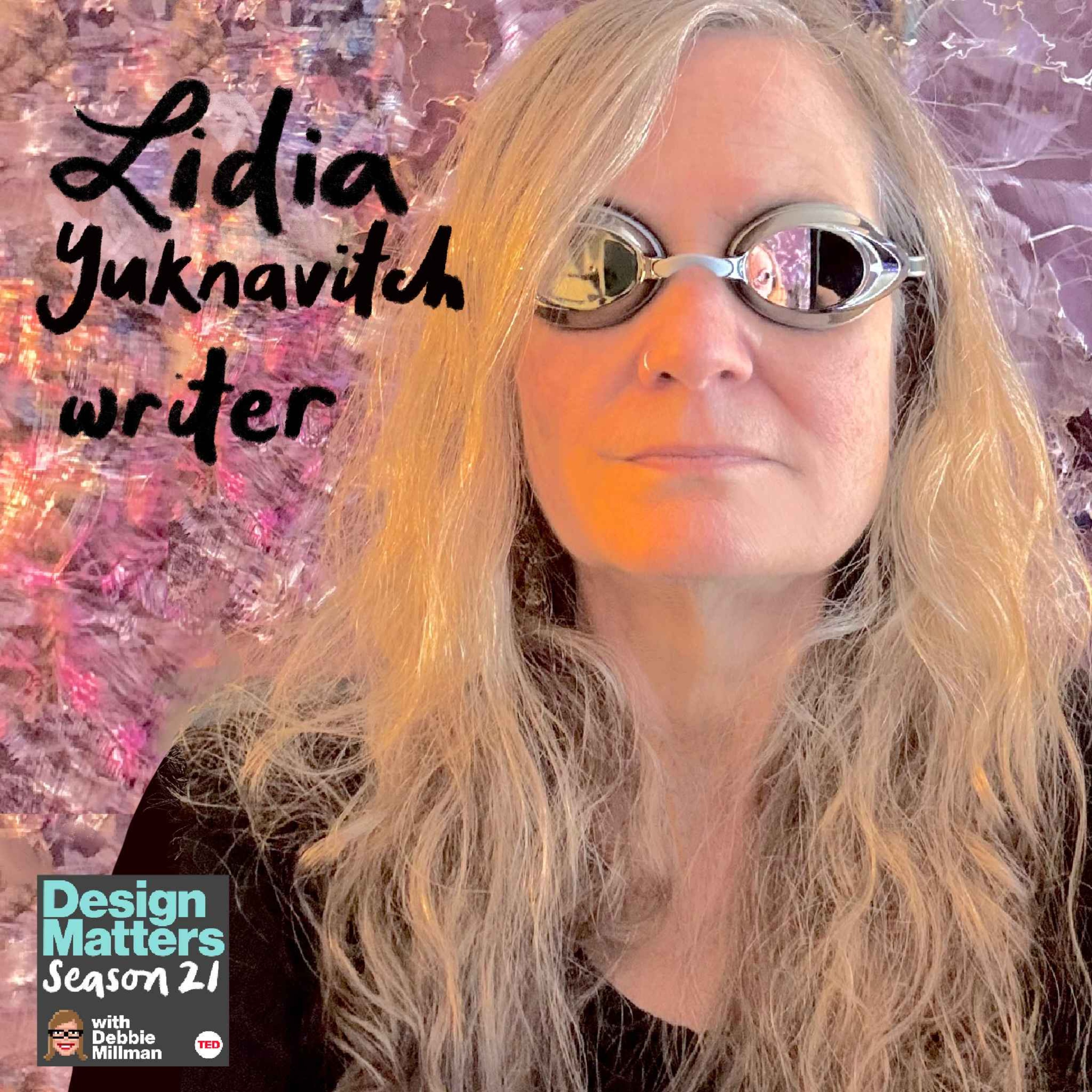
Lidia Yuknavitch
This episode features a conversation with bestselling author Lidia Yuknavitch, known for her works that explore themes of memory, embodiment, grief, and transformation. The discussion covers her childhood, her experiences as a competitive swimmer, the film adaptation of her memoir The Chronology of Water, and how storytelling can reshape personal narratives.
Written by AI. May contain mistakes.
Lydia shares her experience of being ambidextrous and its implications.
“Lydia, I understand I recently learned that you're ambidextrous.”
Lydia discusses her earliest memories and their sensory nature.
“When you reach for your earliest memory, what flashes first?”
Debbie and Lydia explore the relationship between memory and narrative through Lydia's work.
“So I was wondering, I'd like to start first with an excerpt from the preface of Reading the Waves.”
Lydia discusses her trust in memories and their complex nature.
“Thank you for opening the show in this way.”
Debbie and Lydia delve into how perspectives change our storytelling and understanding.
“But when I write about myself from 1975 or 83 or 89 or 92, those are the only things that I feel are actual tangible evidence.”
Explore how different perspectives shape storytelling and personal narratives.
“So they have to create the story of what happened from sharing their pieces.”
Delve into Lidia's early writing experiences and familial influences.
“So you just were thrown in and as if you were welcome home.”
Discuss Lidia's complex relationship with her parents and its effects on her life.
“And he was unhappy in his childhood and unfulfilled.”
Explore Lidia's early experiences with trauma and how it shaped her reactions.
“We took the two paths to how you might respond to trauma and survival.”
Lidia shares the journey of reconciling and bonding with her sister after years apart.
“And I remember thinking too young, like so many children.”
Discover Lidia's early passion for art and how it was shaped by her childhood.
“So our survival together kind of started later, and we just, we spoke the same language.”
Lidia reflects on her struggles with receiving kindness and its implications.
“Back when you were first doing this with such exuberance and energy, when your father corrected one of your drawings as a young girl, did that change something in how you thought about being an artist?”
Lidia recounts her chaotic college years and the balance between self-destruction and self-expression.
“Your father leaves with your older sister into the woods and they're gone for hours.”
Explore Lidia's reflections on her first marriage and the complexity of deserving kindness.
“And when I look back, I can see that was such an intense place to be because it was the edge between self-destruction and self-expression.”
Explore Lidia's reflections on relationships and her tumultuous past.
“I want to talk to you about some of them.”
Lidia discusses her journey through grief, writing, and personal growth.
“And I'm wondering if you learned anything in that survey.”
Lidia reflects on her writing journey and the courage to embrace her voice.
“I'm a native New Yorker, but I didn't live in Manhattan until I graduated college.”
Explore how personal struggles can lead to profound creative insights.
“how or why something that profoundly, profoundly crushes you might be the very best thing that you ever did.”
Learn about the journey of building confidence as a writer.
“And I knew it because when I read it aloud in a class and a couple of the workshop people criticized it, my first thought was, you're an idiot and I don't ever have to talk to you again.”
Discuss the impact of two significant literary figures on Lidia's work.
“You've written about two artists who were enormously influential in your life.”
Experience a powerful reading from Lidia's memoir that evokes strong imagery.
“Flannel shirts in Oregon are as old as Oregon.”
Discover how eroticism enhances literary expression beyond intellect.
“I feel like I'm hiding behind a dune watching, which makes me very happy.”
Understand how writing about the body can be a means of survival.
“That makes an assumption that you don't think I'm hanging on every word.”
Explore the paradox of freedom and fear in the writing process.
“I've chosen to spend my life creating literature as resistance.”
Delve into the complexities of memory and identity shaped by trauma.
“Yeah, and I feel like I'm lucky, believe it or not, that I'm good at swimming in this ocean I'm talking about because that means I can help other people.”
Discuss the nature of evil and the complexities of human memory.
“Well, that's what's so interesting to me about the notion of memory.”
Learn about the film adaptation of Lidia's memoir and its artistic vision.
“Speaking of memories, actually, in the film version, I discovered this last night and I got really excited.”
Explore Lidia's thoughts on the film adaptation of her book and her reaction to the casting.
“And in the book, The Chronology of Water, when describing the man who would become your second husband, you say, this man was gorgeous.”
Lidia discusses how watching the film felt distinct from a traditional biopic experience.
“thing you just said, which is this is not a biopic at all.”
Lidia introduces her book and emphasizes the importance of discussing menopause openly.
“Why is it culturally necessary to even point out that we need to be unapologetic about this topic?”
Lidia shares her insights on the transformative power of women over 48 and their cultural invisibility.
“And that culturally, this is the point in the story where there's any form of lessening or silencing or minimizing or pushing to the edges is just, I won't have it.”
Lidia explains her process of selecting contributors for her book on menopause.
“But this is a paradigm that from the moment of birth restricts and violently represses girl children.”
Lidia reflects on her current creative process and newfound freedom in her work.
“Oof, you caught me at a threshold moment because my creativity is being hampered by my personal situation confines.”
Lidia discusses her relationship with art and how it has emerged from her life experiences.
“And is there anything else I have experienced left to express in the hopes that it will inspire somebody else to light their pilot light?”
Lidia shares a meaningful excerpt from her book that reflects on her tattoo and personal journey.
“I'll say quickly, too, that my mother had a scar running up her leg from ankle to hip.”
Explore the transformative power of personal rituals amidst life's challenges.
“But the pain I endured was nothing compared to the true difficulties I have faced in my life.”
Hear about the heartfelt gratitude expressed by Lydia Yuknavitch for her experiences.
“Lydia Yuknovich, thank you so much for making so much work that matters.”
Discover Lydia's artistic contributions and recent works, including her new book.
“It feels like my heart's about to come out my nose.”

Get the gist, explore an idea or ask about something said.
 Claude
On Design Matters with Debbie Millman, what are the key points of this episode?
Searching your listeningAutomatic transcript. May contain errors.
0:01I'm a good swimmer, and I mean that both in actual water and in the waters of art and writing. And that means I can help other people, and that's a reason to stick around.
0:15From the TED Audio Collective, this is Design Matters with Debbie Millman.
0:22On Design Matters, Debbie talks with some of the most creative people in the world about what they do, how they got to be who they are, and what they're thinking about and working on. On this episode, a conversation with writer and artist Lydia Yuknovich about trauma, writing, sex, and the centrality of one's body. To speak the body is an act of saving one's own life, I think.
0:51This episode is brought to you by Georgetown University. Are you ready to achieve more? Find your path at Georgetown University's School of Continuing Studies. We know more can mean a lot of things. That's why we give you plenty of options. We offer a wide variety of master's degrees and certificates, part-time, full-time, online, and at our brand new Capitol campus in downtown DC. Gain the skills and experience to open new doors, whether you're hoping to advance in your current role, make a career shift, or explore your passions. With a local presence spanning centuries, expert faculty, and a worldwide alumni network, it's not just a degree.
1:30It's Georgetown and then some. Explore our programs and add to your story at Georgetown. Visit scs.georgetown.edu slash advance. When everything is moving all at once, your workforce, your tech stack, your business. You don't need more tools. You need one solution. That's why Paylocity built a single platform to connect HR, finance, and IT with AI-driven insights and automated workflows that simplify the complex and power what's next. Because when everything comes together in one place, growth comes easy. Experience one place for all your HCM needs. Start now at paylocity.com slash one. History shows women keep showing up for everyone, every day.
2:18But who's showing up for you? Grow Therapy helps you put your mental health first with therapy that's covered by insurance and built to support you. Whether it's your first time in therapy or your 50th, Grow makes it easier to find a therapist who fits you, not the other way around. You can search by what matters, like insurance, specialty, identity, or availability, and get started in as little as two days. There are no subscriptions, no long-term commitments. You just pay per session. Grow helps you find therapy on your time. Whatever challenges you're facing, Grow Therapy is here to help. Grow accepts over 100 insurance plans, including Medicaid in some states.
3:00Sessions average about$21 with insurance, and some pay as little as$0, depending on their plan. Visit growtherapy.com slash ACAST to get started. That's growtherapy.com slash ACAST. growtherapy.com slash ACAST. Availability and coverage vary by state and insurance plan.
3:25Lydia Yuknovich is the best-selling author of books which have blurred boundaries and genres and refuse the safety of neat categories in favor of something more luminous. Her 2011 memoir, The Chronology of Water, is now a contemporary classic and has recently been adapted into a feature film directed by Kristen Stewart. The movie has extended this remarkable story and structure into an entirely new artistic medium. Lydia's 2025 memoir, Reading the Waves, continues her inquiry into memory, embodiment, grief, and transformation. And her latest book, The Big M, is an unflinching collection of essays reclaiming menopause as a site of power, story, and freedom now.
4:15For decades, Lydia has been building a body of work that asks what it means not just to survive a life, but to redesign and remake it. Lydia Yuknovich, welcome to Design Matters. My complete pleasure. I'm really excited to be here. I am really excited you're here too. Lydia, I understand I recently learned that you're ambidextrous. I am. I got my hand thwacked by nuns early on when I was young in Catholic school. So I learned to, like most things in my life, I learned to kind of hide something that I was told was wrong with me. but as a person who's 62, I can do whatever I want with my hands, so I do.
4:59Were they whacking you because you were using your left hand and forcing you to use your right? Yes, yes. Oh, interesting. So conceivably, you really are a lefty, but you're also, do you write with the same ease or do you depend on one hand more than another? It really was trained out of me, so I just sort of tucked my left hand under for years and years and years. And so I guess my right hand is my dominant hand. But it's interesting when I'm painting or drawing, I switch more often. And with writing, in terms of typing, you're using both hands all the time anyway. So it's less of an issue. But I'm bringing my left hand back to life.
5:40I love that. I love that. I have to say it's one of the things I'm proudest of about myself, even though I had really no control over which hand was going to be my dominant hand. But I I love being a lefty. I love it about you. You've written that you don't see your life in order, that it comes in retinal flashes. When you reach for your earliest memory, what flashes first? Ordinarily sensory things like colors and sounds. If I had to name one single thing, it would be water, which would surprise no one. this point, but I had some kind of strange pull or attraction to or obsession with water. So the color blue and silver and the sound water makes and just this entity that's water that pulls you, those are my earliest memories.
6:40So they're not of, you know, a family or friends or doing something that a kid would do. They're located around senses. As I was preparing for our interview, I watched your film a second time and reread The Chronology of Water, which I had read many years ago, and felt that my usual organization of inquiry didn't feel right. And so I tried to structure this interview almost as retinal flashes as well. And so I'd like to share some of what you've written. And I'd also like to ask you to read some of what you've written of your own work and then conduct sort of mini interviews about your writing and things that have really, really sort of buried themselves now deep into my skin.
7:38Are you okay with that? I love this idea. It's very playful. So I was wondering, I'd like to start first with an excerpt from the preface of Reading the Waves. What if we could read our own past, our memories, even our bodies, as if they too were books open to endless interpretation, endlessly generating and reforming and showing us new insights? What if the patterns and arrangements, the images and poetics in literature, become part of us as we carry the burdens of our own lives? What if we could stand in different relation to our experiences? Could the stories we carry about our experiences loosen, fall away and become sediment, rearrange themselves, change form?
8:33Could I read my own past the way I read the books I love, with the same compassion, irritation, resistance, desire, playful transgression, erotics, joy, curiosity, and wonder that I bring to the books I love? Could I read my own body and life that way too? What do we carry? How do we lay down what we carry too long? While this is not a memoir, it is a space of narrative transmography, like the body of a frog in a fairy tale. Narrative is a shape-shifting place. Story space, if you will, carries with it the possibility of arrangement and de-arrangement and rearrangement, as does language itself.
9:24If I step back into a story I've been carrying in my body about my experiences, is it possible to change the point of view? Is it possible to curate the elements of the story differently, bring different themes or images forward, or let them recede? I'm not talking about facts. I'm talking about what we do with events in our lives. We story them and try to learn to live with them. Anything that can be put to story can be storied differently. Thank you. Thank you for opening the show in this way. Lydia, how much do you trust your memories? Well, one kind of answer is not at all. And the reason I say that as one kind of answer is that I've spent decades studying the kind of biochemistry and neuroscience of memory and what it is and isn't.
10:27And that really put me down a path of, you know, this idea that memory isn't what we wish it was. It doesn't hold still the way we wish it did. It's not perfectly lodged in amber the way we wish it was. That it's a biological and neurological process. And that it involves synaptic firings in the body and curations of the mind and body. And that it's patterns and designs. And so when it goes through our bodies, that's one part of the process. When we recollect it, or we think we're recollecting it, that's another process. Then we go to say it to someone else, that's yet another process. So the word trust gets a little wobbly somewhere in this series of processes.
11:22It's not that I don't trust my memory. It's that I think my memory is a series of processes, perceptions, impressions, narrativizations, and I'm fascinated by those processes. That's a hell of a long answer to it. Well, this type of conversation about memory is one that I'm endlessly fascinated by and I'm constantly thinking about. I'm just a tad bit older than you are, so I have that sense of looking back at more than what is likely to be forward. The only memories I really feel that I can trust are ones that I've somehow frozen in time in journals. Yes, the interpretation might be a little bit off in terms of what other people were doing, But when I write about myself from 1975 or 83 or 89 or 92, those are the only things that I feel are actual tangible evidence.
12:26So it's tricky, though, isn't it? Because there's the event, you know, a thing that happened to you. And maybe we could call that a fact, you know. And there was sun that day or something. But what we do when we activate this thing called remembering is a more slippery territory. And that's why I use the word shape-shifting and story space, because something happens in there. Because if we say, I do this all the time in writing on myself and collaboratively with students. If I say the concept of cold, and then I say sixth grade, and everybody writes about that. Everybody plucks a memory they're positive about from sixth grade associated with word cold.
13:22And then I say, okay, now you are 20 years old, thinking about sixth grade and cold. And suddenly the story begins to change and Bob and we. So it's memory itself as it is in relationship to storytelling that makes things so fascinating to me and complex. Now, I believe that the very first story you wrote was in high school, after your mother talked you into entering a citywide contest. And the story was about a blind man and a child who both witness a crime, but neither has the full means to understand it. So they have to create the story of what happened from sharing their pieces. I was struck by this, given how so much of what you talk about when talking about your writing is about that sort of retinal shift and point of view and interpretation.
14:24So even then, that was something that was building and growing in you. Totally. I think in some ways that's the story I've written my entire writing life, is this idea that something happens and we move around it. And if five people are standing around a small event, they would tell five completely different stories. And that idea, you know, I'm not the person who thought of that. It's why I love writers like Virginia Woolf or Toni Morrison, because they move the point of view around. And in that motion, you see there's no one story without some kind of collective. Given your mother convinced you to write the story, when did she become aware that you had talent as a writer?
15:12I know your swimming talent came out real fast, real early. But how did she become aware that you were also a good writer or the beginning of a good writer? I think she probably had an awareness from the time I was very young from watching me lie. Why? Because I would start lying, and my father would get angry, and my mother would start laughing. And she took this weird delight in the quality of my lies, because they were so fanciful, and like, no one would believe them. And my father was the punitive, abusive element in the household, and she just, it tickled her, because I would, you know, they'd get more and more elaborate.
15:58So she probably knew far earlier than I had any clue. And in high school, I think she may have seen an opportunity coming in front of me that I didn't recognize as such. I was just like, she talked me into it. She really did. Well, when you were 11, though, you wrote a poem in what was a red notebook. I guess that was your journal. Yeah. And this was the poem. In the house, alone in my bed, my arms ache. My sister is gone. My mother is gone. My father designs buildings in the room next to mine. He is smoking. I wait for 5 a.m. I pray to leave the house. I pray to swim. That's it. That's my life.
16:46Good talking with you, Lydia.
16:51Is it true? Did I make this up, but did your father throw you into the water to teach you how to swim? He did. He threw me into the, he carried me bodily to the freezing cold waters of Lake Washington in Washington State and threw me in. And the swimming lessons were happening there. I don't know why he couldn't just let me go with the other kids to my swimming lesson group. But he did that and I did not sink. Did you know to doggy paddle or were you already teaching yourself? I mean, you were younger than five years old because by five, I know you were already able to compete. I did not have any training.
17:34I didn't know what dog paddle was. The way I would answer that question is I moved my body in a way that looked like I was accustomed to water. Like I didn't have this awareness at that point, but it was probably something like treading water and a little bit of flapping but not thrashing. But I quote unquote learned to swim in the swim lessons in two days. Were you ever scared of the water? No. So you just were thrown in and as if you were welcome home. I was scared to be back in the car with my father. What I was afraid of was back in the car or at home, the water was instantly, not necessarily consciously, but subconsciously, a release.
18:28How did you become such a good swimmer by the time you were five? I have no idea. I mean, I'm not making that up. I was accidentally good at it. I didn't know what it was. I didn't know what competitive swimming was, except that my neighborhood girls took me with them to the pool where they were on a swim team. I didn't know what to do the first day on swim team. I just stood against the wall and watched everybody and observed and started doing what they were doing. I noticed they were going back and forth rapidly. I noticed they didn't stop till the coach told them to stop. So like pretty much everything in my life, I was an observer and a witness, and I paid really close attention, and then I mimicked them.
19:18Yeah, I actually wanted to ask you about that because you've described yourself as someone who could mimic and twin and echo others. I know that a lot of young people that have gone through horrific trauma are able to do that. They're able to turn that switch on in an effort to sort of weigh the milliseconds in decision making to try to keep yourself safe. Was that where that came from? I suspect, yeah, it's trauma-borne. I mean, I have to look back and I can see the moments where I got good at things were very closely tied to the moments of having to protect yourself or survive or fight back for someone else.
20:06But the swimming thing, nothing about my life has ever really been perfect evidence about why I was good. Like, you just dipped me in water and suddenly I was good to go. I have no idea. Although I think because my imagination is so overactive and I make art and write novels, the story may go back further than my being born. There's something older. The water imprint. Yeah. I think it's remarkable and magical that humans could have some type of latent natural ability that you then have to discover as you're living. Yeah. Yeah, I do too. It's beautiful. And I love that it could come at any time and be anywhere in your body and your life.
21:00And it's really a phenomenal, profound thing about all of us. You talk about coming out of the water after swim practice, and you wrote this line in the chronology of water. At home, the weight and rage of father took the air out of the rooms. Where did your father's rage come from? Well, when I track back through his life and his childhood, My paternal line, if you want to call it that, goes Baltic back to Lithuania. And the country itself is one that has suffered fracture and trauma and different oppressions and invasions and transgressions and conflicts. So there's this sort of Lithuanian trauma, Baltic trauma that's very old.
21:57Then his parents were not happy people. His father was stern and mean and abusive, and his mother was—she had a good sense of humor, but she was stern and mean. You know, they were cold weather Lithuanian folk, so they were tough but kind of mean. And he was unhappy in his childhood and unfulfilled. He was good at things. He was very good at sports. He got a tryout with the Cleveland Indians in baseball. He was good in basketball. He was good in boxing. But he was thwarted. They didn't have much money. He was punished a lot. I would say he was thwarted. That word seems very accurate. And somewhere along the line, I guess all that artistic ability, he was also an artist, got so blocked and twisted up in him that something went wrong.
23:02And the impulse for men to take out their anger and repressions and what's gone wrong in them on their families is a story that's quite common. and to take it out on women and children is a phenomenon, as we all know, that is connected to both personal families, but also the state and the nation and a patriarchal order. So these are thoughts I cast backwards toward what happened to this guy, you know? And I write in Chronology of water, I never have gotten to a point where I forgive him. I have complex thoughts about the cult of sin and redemption and forgiveness. But what I could give him was that once he was a boy, and I have a son now, and I can understand, once there was this story of a boy who was, he was just a boy, and he was small, and he had something growing in him that could have been beautiful.
24:13And that's not how his storyline played out. Your mother was born with one leg six inches shorter than the other and had many, many surgeries and was in pain most of her life. And I was really thinking about your parents. And I was wondering, again, having read the book and now seen the movie both twice, I was wondering, what was their origin story? Did they fall in love? What did he see? He seemed to be such a perfectionist and so hard-assed. What made him pick her as a possible spouse? Yeah, I've written that story many times where I try and imagine it and it comes out different every time I try to conjure it.
25:04You know, There are some things I know about them. I have pictures of them when they're like 17, 18, 19. And he's got a white t-shirt on with his cigarettes rolled up in the sleeve and Levi's jeans and a kind of pompadourish. He's like a good-looking son of a gun. And she's got, you know, a 50s poodle skirt on and black cat eye sunglasses. And from the waist up, you can't see her disability. And the thing about my mother was, apparently, she loved to dance. She was great at it. You write very movingly about that, very vividly. And so the kind of dancing they would have been doing in the 50s, you have to picture that.
25:53And she was cutting a rug with her just major lymph of a leg. And so when I picture them like that, I picture him as a borderline hellraiser and her as a, you can't tell me I'm disabled. And I see these two feisty hearts. And when people would pick on her, he would defend her, like he would threaten to fight them. and then she would start swearing and saying she didn't need anyone to protect her. So, you know, these spirited, feisty people before everything goes to shit. Yeah. I always wonder, when is it somebody crosses into monsterhood? Yeah. And I'd like to think at some point in their origin story, they had a happy marriage.
26:42But it's really hard to know. I don't know the answer to that. And I do know, having lived to the ages you and I are right now, there's a big difference between the heart that we give our own storylines and the sad reality that they don't turn out how we wish they would, our storylines. Yeah. And sometimes there's not a lot you can do about that. For several years, your sister, who is eight years older than you, kept razor blades in her backpack. Upon first reading, I thought, oh, at any moment she knew she could take control of her own life and take it. But then I was thinking, oh, was it for protection?
27:32Was she looking to use it as a way to defend herself? What did you think when you came upon them and cut yourself in her back? I thought what you did. I thought this is, at any point, I could do whatever I want with my own life. That's what I thought. Of the two of us, she had more of a tendency to internalize trauma. And I came out punching. We took the two paths to how you might respond to trauma and survival. I went outward and she went inward. So that was the interpretation I had of the razor plates, too. When did you get the sense that your father was abusing your sister? Or did that not fully comprehend?
28:24Well, you're not fully able to comprehend that until he started to abuse you? Oh, I knew when I was around four or five, because there was a house we lived in in Bellevue, Washington where I could hear him hitting her with a belt. So the sound imprinted on me very deeply and I knew what it was and I knew it was wrong and I knew it was excessive. I never heard her cry though. So I became determined to cry as loudly and as long as humanly possible. Your sister left home when she was 16. At the time, did you feel abandoned? I'm not sure I had a conscious thought like, I feel abandoned. No. But the seed of that thought grew in me.
29:11And the more and more conscious I became, I do think I dealt with, I have a lot of my life dealt with abandonment hurt. not that she did that to me but that I grew up with an issue around someone leaving but I didn't think that at the time I was just deeply scared and sad that the one person I cared about was gone how were you able to make sense of what your father started doing to you particularly after your sister left? I remember not being surprised. And I remember thinking too young, like so many children. I was having this thought far too young. If you don't get out of here, you're going to die.
30:02And so I kind of set my jaw with this being a competitive swimmer. This is your way out. this is how you're going to get out. I didn't really care about being a swimmer other than that. Honestly. Siblings who survive abusive households often cleave back together later. Yeah. Yeah. What did you and your sister have to relearn and reclaim about each other as you were coming out of that deeply traumatic period. We hooked back up when I flunked out of college and she was teaching in Boston at Tufts. So I was around 21 and she was around 29. We hooked back up and we bonded because we got food poisoning together.
30:56And we were so sick and she was staying in this apartment that had a very narrow ladder-like stair to the only bathroom. So for a week, we were crawling up and down this stair together. And when I look back on it, it's like we were crawling up and down this kind of rebirthing place, only this time we were coming out together. she remembers it too if all I have to say is Boston she will remember that we had this terrible bout of food poisoning and what we rebonded over really was that we were both intellectual people with deep creativity we understood each other's language you know it was like finding a twin in whose language you understood, whose past journey you understood, and you weren't alone in the world anymore.
31:53So our survival together kind of started later, and we just, we spoke the same language. As a child, I read that you wanted to be a painter, and you include an assessment of your skill from an elementary school teacher in their second memoir. Lydia is an eager, enthusiastic class member. She displays interested, cooperative attitude in most activities. She begins work promptly and continues systematically until completed. Her work is usually very neat and well illustrated. Sometimes she draws pictures over her words. What kind of pictures were you creating? They were kind of like little animals, sometimes not real animals, and plants that didn't really exist.
32:46Not cartoons exactly, but these sort of fantastical creatures is what I would call them. And I couldn't help it. Like, I wasn't trying to illustrate anything. I couldn't stop myself. And when they said I finished things prompt, like I had that, oh, at the time it was presented to me as an affliction. But once I started making a pattern of some sort, if I was made to stop, I would have some kind of meltdown. So that's why I finished things. And you also write, what I did mostly alone in my bed was draw. I love drawing. I think I love drawing more than any of the art majors I met. While I was filling drawing tablets with illustrations, I remembered that when I was five, I did not want to become a swimmer or a writer or a wife or a mother or a teacher.
33:38All things I would become later in life. When I was five, I wanted to be a painter. You, at the time, were in bed with a broken ankle and you could feel your desire to be an artist in your fingers. And now you're making art. I can see some beautiful art behind you. I see lots of beautiful art on your Instagram feed. Back when you were first doing this with such exuberance and energy, when your father corrected one of your drawings as a young girl, did that change something in how you thought about being an artist? It did. It made me immediately clear that I should hide it away because this person was dangerous and they would kill it.
34:22and I'm not saying that was the correct response but my response was to swallow it, hide it, make it so he can't touch it this is mine, I shall put it away and the hard part is for those of us who do that is sometimes it takes a long time to get it back or to go get it and bring it back out and some people never do it's hard to excavate yeah, to this day I'm producing a lot of visual art And most of it is under the bed or in the closet. And I could go get it at any time. It's fine. But that impulse to put it under the bed or in the closet is very much from childhood. Like, hide it. Make sure it's in a safe place.
35:07Years later, you mentioned moving to Boston to be with your sister. You moved into a blood-colored Somerville house of a poet named Olga. She was dying of lupus. She cooked you elaborate meals, harbored strays. and seemed to see straight through you. When you did leave, she gave you a box of oil paints that belonged to her husband. You ultimately didn't keep them. Why? I hadn't yet learned how to receive kindness or love or a gesture of nourishment. I think some people will identify with this idea that before you're able to successfully have connections with people, it hurts when someone's kind to you.
35:57You don't know what to do with it. You can't trust it. Yeah, you can't trust it. And if someone's doing something that would be nourishing to your very soul, that's terrifying. because then you'd have to admit you actually have a soul and that you have desires and that you want to be something or do something. And so it was simply too painful. There's a devastating scene in the movie version of The Chronology of Water that is a lot more explicit than the way it was written in the book, Although you write between the lines and describe it in the movie, it's very, very specific where you and your family are going ostensibly Christmas tree hunting.
36:48Your father leaves with your older sister into the woods and they're gone for hours. They come back without a tree. In the book, it's much more traumatic as you and your mother are making your way back to the car. But in that scene, she offers you candy. as sustenance. This is sustenance. Take the sustenance. And you didn't even want to take that. You didn't even want to take that. Yeah, these people were suspect, Debbie. Yeah. I mean, she did take her coat off and give it to me because we had made our way through the snow and I was all wet. And I was willing to take the coat. But I was suspicious of all their gestures because I couldn't trust them.
37:35I did adore my mother, though, so it was always painful, me trying to figure out, well, could I just want and receive this one thing? Would that be okay? You know, it was tricky. Did you ever feel that your mother didn't deserve your love after putting you in a position where she was so neglectful that you ended up being abused by your father? Oh, I think I went through some rage years in my late teens and 20s, probably, where I was composting that rage of how dare she. But I punched through that rage at her pretty quick and built it back up around him. Well, it's interesting because I was trying to make sense of her.
38:27And it's hard because we know she took you to swim practice every morning at 5.30 a.m. And she did sign the papers that allowed you to get your scholarship and go to school. But then there was also the drinking and the neglect. And it's still something I am trying to figure out how to work through with members of my own family. But you were finally able to get away from home when you got your full swimming scholarship to Texas Tech University. And this is when you first began to embody that rage, express the rage. And I'm wondering if you can share a short excerpt from The Chronology of Water about what you were experiencing.
39:12Sure. When I say we partied, I mean an epic poem. About halfway through the year, my days became swim practice at 5.30 a.m., big melon-headed hangover, and skip godforsaken cafeteria, shitty instant eggs breakfast at 7 a.m., and skip classes at 10 a.m., 11 a.m., 12 noon, drink hair-of-the-dog beer, eat cold pizza and Haagen-Dazs ice cream, and listen to Zeppelin, and get high, take a test once every week or so, and weight training at 3.30 p.m., and swim practice at 4.30 p.m., and fuck dorm dinners. They taste like shit, and you have to sit with a bunch of West Texan fuckwatery. Let's go out early and drink.
39:56Let's hit the Roxy and dance and dance and dance and drink and barf and screw every day, every night. I lost my scholarship the second year. I flunked out the third. Did you have a conscious sense of what you were doing to your life at that point? I don't think it was a conscious sense, no. I did, however, get a very thrilling feeling, like danger feeling, that I was on a cliff edge or at a threshold or precipice. And it did kind of make my atoms very excitable that I was on this edge or threshold. And when I look back, I can see that was such an intense place to be because it was the edge between self-destruction and self-expression.
40:57And in the film, Kristen did a really good job with those edge moments. Yeah. Because when I was watching it, I could see Imogen Poots, like, seven emotions going across her face where she's trying to decide whether to rage or cry or laugh or kill herself or take the plunge, you know. And so that, I wasn't exactly conscious of it, but I was definitely feeling, you know, the coming back to life of your life is a choice. As I was watching, I was wondering if you were consciously trying to end the future or demolish the past. And I kind of came out to thinking that it was probably both. Yeah, both.
41:49You know, like, if this is my fucked up story, I'm going to ravage it. But then along the way, some interesting things happened. Oh, yeah. I want to talk to you about some of them. While you were in college, you met a man who would become your first husband. He was beautiful and musical and artistic. And you wrote this about the beginning of the relationship. This is something I know. Damaged women, we don't think we deserve kindness. In fact, when kindness happens to us, we go a little berserk. Oh, can I relate? Yeah, yeah. So I'm wondering, did you intentionally create havoc to try to relive the rage of your father in an effort to remedy it?
42:34Yeah, that word intentional is hard for me because, I mean, partly I want to say probably yes, but at the time I wasn't sitting there thinking I'm going to intentionally wreak havoc. Right, right. I was just like looking for the fire because that's all I knew. And so I was the thing combustible. But of course, I hooked up with the world's most beautiful, gentle musician, painter, also a painter, like a really amazing painter. Do you still have contact with him? Is he in your life at all? He is not. I have tried for many years to find him. It's probably good that I can't find him. He probably doesn't want to see me.
43:25This episode is brought to you by Georgetown University. Are you ready to achieve more? Find your path at Georgetown University's School of Continuing Studies. We know more can mean a lot of things. That's why we give you plenty of options. We offer a wide variety of master's degrees and certificates, part-time, full-time, online, and at our brand new Capitol campus in downtown D.C. Gain the skills and experience to open new doors, whether you're hoping to advance in your current role, make a career shift, or explore your passions. With a local presence spanning centuries, expert faculty, and a worldwide alumni network, It's not just a degree.
44:05It's Georgetown and then some. Explore our programs and add to your story at Georgetown. Visit scs.georgetown.edu slash advance. Hi, who here loves when their nails are perfectly done? Me, I'm Sarah Gibson Tuttle, and I started Olive in June because let's be real, we all deserve to have gorgeous nails, but who wants to spend a fortune or half their day at the salon? And that's why I created the Manny System, so you can have that salon perfect manicure right at home. And guess what? The best part? Each mani only costs$2. Yep, you heard me,$2. No more$30,$40,$50 salon trips that eat up your day.
44:47Now you can paint your nails whenever you want, wherever you want. And trust me, you're going to be obsessed with your nails and everyone is going to ask you, where did you get your nails done? And here's a little something extra. Head over to oliveandjune.com and get 20 % off your first mani system with code PERFECTMANI20 at oliveandjune.com slash perfectmani20. That's code PERFECTMANI20 for 20 % off at oliveandjune.com slash perfectmani20. You're all set for a nail glow up. Let's get those nails looking fabulous, shall we? Hey, this is Adam Grant, host of Ted's podcast, Rethinking with Adam Grant.
45:20Have you heard of Bill? It's the intelligent finance platform that uses AI to help you avoid costly errors and optimize cash flow. In fact, Bill reports that over 90 of the top 100 U.S. accounting firms trust them to manage, move, and maximize money, proven by over a trillion dollars in secure transactions. Eliminate the friction and start scaling with the proven choice. Visit Bill.com slash proven to talk with an expert about automating your business finances and get a$250 gift card as a thank you. That's Bill.com slash proven. Terms and conditions apply. See offer page for details. Okay, Peloton.
45:54Let's go. that's the new peloton cross-training tread plus powered by peloton iq built for breakthroughs with real-time insights and endless ways to move keep your chest lifted that's peloton iq helping you lift smarter train safer and move with confidence with strength yoga pilates and personalized guidance this is the future of fitness let yourself run lift flow and go head to onepeloton.com to learn more about the cross-training tread plus terms apply You've written how you've taken an informal poll of all the incredibly intelligent, intriguing, beautiful women you know on the question of why we find ourselves driven like moths to fire toward men who fuck us up.
46:39And I'm wondering if you learned anything in that survey.
46:46Take the men out of the equation is a conclusion I keep coming to. Every decade I come to it another way and it's like I'm stubborn or something. And I'm only half kidding about that. It's just been complicated by the fact that I have a son. Or I could just hate men or I could, you know, remove myself from male communities entirely easily. Or, you know, just be done with the world of men. But my son is profoundly unlike any creature I've ever met in my life. So I've had to reinvent ways to be near and around men, and I'm learning a lot from that. I'm terrible at relationships with men, but I'm learning a lot from the mother-son space that has been revelatory and allowed me to experience some transformation.
47:44At the time you ended up getting pregnant, you married this man, but your daughter Lily died the day she was born. After she died, you spent a long time homeless, living under an overpass in a kind of profound state of zombie grief and loss. How were you able to come out of that? I suspect the answer goes more than one place. One place the answer goes is that I started writing, scribbling, madly, incoherent stories into a notebook. So you're writing your way to sanity? Yeah. Or out of the insanity? Yeah. And even though they're gibberish, they had pieces inside them that were not gibberish. And so that, I believe, was a kind of life-saving effort.
48:45It may have been one of my first life-saving efforts. And my sister being nearby probably kept me alive. Just like knowing she was near may have drawn me back toward the world. And then the third thing is I clawed my way back into college. And I love books more than I love people. And they seduced me. they brought me back. You wrote this about that time. I didn't know yet how wanting to die could be a blood song in your body that lives with you your whole life. When do you discover that? And how do you live with that knowledge? That's heavy knowledge to be carrying around on your back. It is. And I think it's a lot of people.
49:42So I don't feel bad about talking about it because It's so many of us. I think I probably, it got born in me in my teens, but I didn't get a solid conscious relationship with it till my 20s and even 30s. And there's been plenty of psychology and philosophy and anthropology around the idea that humans carry death drive in us. But I think individuals have different relationships to discovering that about themselves. So, you know, the adrenaline junkie takes it out that way. The drug addict or the alcoholic gets lost on that path. The artist finds a way to express and give form and shape. So, like, noticing that it's there isn't your doom.
50:40stopping the journey there can be harmful the beauty of noticing that it lives in you as a thought as a feeling as a reality and that you carry it the beauty opportunity is can you make a relationship with it that helps someone else that brings you in connection to the world. And so art for me is that. In your 2016 TED Talk, you described an opportunity that came your way around this time. You were in your early 30s. Can you share another short excerpt with us from that speech? Absolutely. Somewhere in my early 30s, the dream of becoming a writer came right to my doorstep. Actually, it came to my mailbox in the form of a letter that said I'd won a giant literary prize for a short story I'd written.
51:38The short story was about my life as a competitive swimmer and about my crappy home life, and a little bit about how grief and loss can make you insane. The prize was a trip to New York City to meet big-time editors and agents and other authors. So kind of it was the wannabe writer's dream, right? You know what I did the day the letter came to my house? Because I'm me, I put the letter on my kitchen table, I poured myself a giant glass of vodka with ice and lime, and I sat there in my underwear for an entire day, just staring at the letter. I was thinking about all the ways I'd already screwed my life up.
52:23Who the hell was I to go to New York City and pretend to be a writer? Who was I? I love the visual that I can conjure up of you sitting at a table in your kitchen with the lights off in your underwear with that giant glass of vodka. Yeah. You did go to New York City. You met quite a lot of very fancy people, posh people. but you went back home without an agent or a book deal, which was not because you weren't offered any, but because you didn't accept any. What kept you at that point from accepting the opportunities that were right in front of you that were just like, here, Lydia, take this? Yeah, yeah.
53:14It's kind of like that candy my mom tried to give me. I didn't know how to accept it. And I write about how the yes that was required was stuck in my throat, like a little stone. And for about 30 years, I wore a necklace with three stones on it to remind me of that experience. I wanted to in my chest and kind of my hips, but I couldn't figure out how to get the articulation up and out of my face and throat and mouth. And I couldn't figure out how to be the person who would have a life where that would be true because I'd been too busy being the person who had this other reckless life, self-destructive life.
54:06So the downside is I couldn't say yes and, you know, lunge at it like an ambitious person would. My ambition was buried and hidden like my art was from my dad. The upside of the story is I never forgot the feeling. And I kind of watered it like a seed and grew it in myself. And there was a day where I became ready. It just wasn't that day. In thinking back to that time in your life, if you had somehow mustered the courage and said yes to Farrar, Strauss and Giroux about a book, do you think you could have handled that? No. Yeah. I've answered this question for myself in my mind and body my whole life.
54:59I would have fucked it up. I would have been destroyed by any level of success or attention. I did not have what it takes to navigate what would have come at all. And if what I made did not do anything in the world, I would have absorbed that into my own self-loathing, and that would have been disastrous at that time. Yeah. Yeah. I look back on, I had a very early experience when I first got to New York City. I'm a native New Yorker, but I didn't live in Manhattan until I graduated college. And I dropped my portfolio as one did back in the day at Condé Nast. And I got a call back from Vanity Fair.
55:42And I didn't get the job. And at the time, it was soul crushing. but I think it would have been harder for me to have gotten the job than not get the job given what I now know about Conde Nast and especially in the 80s. So you don't always know how or why something that profoundly, profoundly crushes you might be the very best thing that you ever did. I know. I mean, I hesitate to move into that trope of suffering makes you stronger because I'm on record as hating that troll. I love it. But I am 100 % positive that would have been the end of me. When did the courage in your own writing allow you to take those first tentative steps to find yourself, your heart?
56:37Well, I wrote a short story called The Chronology of Water, and that was a baby step. And I knew it because when I read it aloud in a class and a couple of the workshop people criticized it, my first thought was, you're an idiot and I don't ever have to talk to you again. So that was a baby step. But it was probably after I wrote the book, The Chronology of Water, that my real confidence kicked in. Before that, I just had stubbornness, spite, and a will toward danger. You've written about two artists who were enormously influential in your life. The writer Ken Kesey, who wrote the book One Flew Over the Cuckoo's Nest, and more.
57:27And the writer, poet, and performance artist Kathy Acker. And there's a very steamy scene in Reading the Waves, which I think is one of the sexiest scenes I've ever read in a memoir. And notice how I'm saying scenes because it's that vivid. I can actually see it. This excerpt that I've chosen may or may not be about Kathy. And I'm wondering, would you be okay sharing it with us here? I would be delighted to read this. Listeners, it's juicy.
58:29stuff and blonde organic matter. She unbuttoned my red flannel shirt. Flannel shirts in Oregon are as old as Oregon. I tried to inhabit a lesbian body, a lesbian story. She pulled my shirt off and then pulled off my black t-shirt that read Frankenstein, my favorite novel. She put her mouth to each of my nipples so that they shot up like they were screaming for the stars to take them back. She licked her way down the terrain of my ribs and then my belly with its topography of scars to the waist of my pants and unbutton my jeans. I was not sure my ribs could contain the heave of my breathing. My jaw ached.
59:11I halfway wanted someone to pull my legs apart so hard I snapped like a wishbone. She tugged my jeans down to my knees. My ass ground down into the sand. I spread my arms out like a femascular Jesus. She raised up for a moment, dripping from the mouth with everything about me, and then she placed an ocean rock inside me, a rock about the size of a fist. She pushed two fingers into my asshole, and while she pressed back down like prayer and ate me alive, every mouth of my body convulsed and shivered, anemone. To this day, I can smell the salt of that night.
59:53It's a very good memory.
59:58I feel it's so vivid. I feel like I'm hiding behind a dune watching, which makes me very happy. Pleases me a great deal. Thank you for sharing that. Lydia, what does the erotic make possible on the page that intellect alone can't? The predominancy of sensory experience. I mean, I remember in graduate school, I loved reading literary theory. I loved reading philosophy. I loved reading political ideology matter from different points in history. But I'd read them and I'd get all frothy intellectually. And then I just have this question every time, where are their bodies? I can't feel anything. And so that is the barrier for me.
1:00:57Eros, the erotic, even thanatos, bring the body forth in all its contradictions and drives and expulsions and receptions. You know, it's like the site of meaning-making for human experience, and it requires no intellect. It's animal and beautiful and unstoppable and unrepresentable. You shouldn't have asked me about erotics. Why? That makes an assumption that you don't think I'm hanging on every word. Fill that maybe with two hours of like things that stop being sentences and turn into something else. Well, in your work, the body is never abstract. It sweats, it aches, it bleeds, it desires. What does writing about sex or with sex allow you to say better than any other form?
1:01:56It's there very intentionally. It's not about titillation. It's about kind of an intellectual mutuality. Yeah, it makes total sense because I was impacted early on in my own art and writing by Alain Cixou. One of her quotes is, censor the body and you censor speech. Like, writing the body is how I have brought myself back to life. and showing other people who feel near death or near numb or near giving up that the body speaks itself, that breath is life, that eros is life, and bringing that close to language and story space. It's like a resuscitation, and it doesn't require that you make a certain amount of money or that you have a certain degree or that you're from a certain class or a certain culture.
1:02:51That poem that you read that I wrote when I was a kid was me trying to speak a body. And so it came out in non-sentences. It came out in these little fragments. To speak the body is an act of saving one's own life, I think. You've written this. I've chosen to spend my life creating literature as resistance. It's where I want to put my energy alongside legions of others who have given their lives to storytelling. It's the ocean I want to swim in, which means I'm in the waters of grief and imagination, of laughter and rage, of bodies that do whatever they want in the face of all, of not apologizing for writing through it all.
1:03:35How hard was it for you to, if it was hard at all, I'm making an assumption here, how were you able to find the freedom and the ease to write about these types of experiences in such a proud, fully formed way? It's such a great question, and it tracks back for me, though, to you asking me about when my father threw me in the water. Was I scared? And my answer is so similar, so that fascinates me. It's an exciting question because once I was in the ocean of story space and writing, none of my fear is there. My fear is, can I get out of bed? Can I make it out of the house today? Can I move around in the world with other people like they do?
1:04:34Can I have a fucking conversation like other people? Those are my fears. So my joy and my freedom and my release is in writing, and I need not be brave there. It's where I come to life. Do you see what I'm saying? I absolutely do. And I think in many ways it's how people often respond to trauma. They can go and be fearless in any number of ways, bordering on or if not inhabiting self-destruction. But then also go to the other extreme where you're afraid of doing anything that requires any real risk, though you will work your ass off to get something you know that you can actually get. It's really, really interesting ways in which humans try to make up for their damage.
1:05:25Yeah, and I feel like I'm lucky, believe it or not, that I'm good at swimming in this ocean I'm talking about because that means I can help other people. So it's not just about me staying alive and surviving. I'm a good swimmer. And I mean that both in actual water and in the waters of art and writing. And that means I can help other people. And that's a reason to stick around. Your father nearly drowned, which you couldn't have written that if it weren't true, because it would seem so too much on the nose. Yeah. You saved his life by giving him CPR. But because he lost so much oxygen in his brain, he ended up having hypoxia and didn't remember anything.
1:06:23What did this do to your understanding of big eye identity and your father's identity? It was a mindfuck. I'm not going to lie to you. I mean, a true mindfuck, because he also came out very sweet and docile and kind. And I was like, who the hell is this guy? And what am I supposed to do with that? And what am I supposed to do with everything he did our whole lives? Where do I put that? Did you ever talk? I know that there was a beautiful scene in both the movie and the book where he comes to visit you after he's lost all of his memories and he's living nearby and he comes over to your house and he sees your book, The Chronology of Water, and he's like, oh, I read that.
1:07:24It wasn't very flattering to me, was it? So because it was in both the book and the movie, I can't help but wonder, was there still a piece of him that had caught up with him? And he knew deep, deep, deep, deep, deep down that he had been a monster. I don't know the right answer to that question. But my experience of him is that he did not, again, ever touch what he'd been. And even that moment where he said that, well, it's not very flattering about me, is it? It was a kind of surface understanding. and yet I would catch myself looking at him like staring at him thinking I know you're in there like I couldn't help it I think a lot of people who deal with aging parents and dementia and memory loss when you're in relation to the person you wonder is this person I knew still in there and I don't think he was in there anymore but what I've learned over and over again is that One has no choice but to get into the matter of story space and move it around or it'll eat you alive.
1:08:37Yeah. Well, that's what's so interesting to me about the notion of memory. Because memory is also something that requires a judgment about what it is you're remembering. And so I've been thinking a lot about a lot of the evil that we're experiencing in the world now. And, you know, something that I think people say a lot is, how can they sleep? How can they live with themselves? And there's a particular kind of evil which makes me wonder if those people cannot remember the evil they do, because if they did, they'd have some sort of psychotic break. This overlapped with just a lot of my thinking about the nature and banality of evil, so to speak.
1:09:23Yeah, the banality of evil, that's a very expansive phrase. And the lengths that humans will go to to keep their singular existence less wobbly, less scary, less fractured. The expense of anything around them is not our best trait as a species. Speaking of memories, actually, in the film version, I discovered this last night and I got really excited. In the film version of The Chronology of Water, it was this beautiful movie that's been recently released. Christian Stewart directed it. And in the book, The Chronology of Water, when describing the man who would become your second husband, you say, this man was gorgeous.
1:10:15I'm mentioning this because women live their lives secretly waiting for their lives to become movies.
1:10:23So when you were writing The Chronology of Water, did you ever fantasize what the film version would be? Oh, God, no. Even when friends of mine, close friends of mine, like Cheryl Strayed, I still would never have thought. And it took a very particular person in Kristen Stewart, who's kind of like a punk rock poet minx. yeah her her direction of this film it's resulted in more than a movie in my opinion it's more like an epic visual poem okay you agree 100 % agree it is an epic visual poem that's a beautiful way to put it it moves association by association and that's so close to the book structure yeah I cannot say enough praise and admiration and respect for this other piece of art that she made.
1:11:20We've seen wonderful actresses embody authors in their lives. You just mentioned Cheryl Strayed. We watched Reese Witherspoon embody Cheryl in Wilde and Julia Roberts as Elizabeth Gilbert in Eat, Pray, Love. What was it like seeing Imogen Poots as Lydia Yuknovich? You know what? I didn't experience Imogen Poots as Lydia Yuknovich hardly at all because of this thing you just said, which is this is not a biopic at all. It's a full sensory experience, almost like an art installation. So, I wasn't sitting there going like, oh, Imogene is Lydia at all. There was one moment when I was watching little kid Lydia that all the hairs on my body stood up.
1:12:08And so, I had an identification moment there. And then there's one moment where Imogen is looking at Earl Cave, and they're in a car, and Earl's asleep, and she's looking at him. And you can tell from her face that she thinks he's extraordinarily beautiful. And then pretty quickly, she gets really mad and yells at him and acts like a banshee. In that car moment, I had a flash of like, oh, it was exactly like that. But mostly I wasn't having strong Lydia is on screen reactions at all. I just thought Imogen Poots is one of the most amazing actresses I've ever seen in my life. I wish something could happen to her that is profound and reflects back to her that this thing she did is out of this world.
1:12:57So mostly I just thought of her as her. I thought she was breathtaking. Your most recent book is titled The Big M, 13 Writers Take Back the Story of Menopause. And you start the book by stating, make no mistake, we are here to unapologetically share our Big M stories. Why is it culturally necessary to even point out that we need to be unapologetic about this topic? Because the stories of our roles and our bodies and who we are as humans has preceded us in a way that has oppressed and repressed us since we arrived on the scene. Enter stage left. Exactly. So the resistance started before you and I were born.
1:13:47It's going to go on after we're gone. And it's this core and vital need to speak a self, a full self, and we're not there yet. And in the case of menopause, you know, when I hit it and I went around and collected information and tried to learn about it, it was a bunch of bullshit. It pissed me off. I just couldn't let it lie. A lot of people talk about as they age, they feel, especially if they were particularly good looking when they were younger, they feel that they've become invisible and that there's a sense of there not being anything to appreciate when you're looking at someone that's older.
1:14:33But in the Big M, you describe menopause as a sort of power portal. And I'm wondering if you can talk a little bit about how you arrived at that specific space. Well, it's all the women I know who are 48 and up are the most incredible creatures I've ever met in my life. And that culturally, this is the point in the story where there's any form of lessening or silencing or minimizing or pushing to the edges is just, I won't have it. This is the most extraordinary witnessing of the creature we call woman that I've ever seen. So I want to be on the side of people who are amplifying and sharing and spreading and restoring this story of everything we have learned and everything we have to give and everything that we're holding the keys to.
1:15:39Yeah. It seems like in the United States in particular, we are culturally terrified of an older woman's body. I was thinking as I was reading the essays, I was thinking about Madonna and how she's just not allowed to look younger than she is anymore. Like, people are so appalled by the idea of an older woman trying to look younger. And I'm not exactly sure why that matters so much. I mean, I'm endlessly fascinated by it, too. But these stories that precede us, it's like, it's your turn to step into this story we wrote for you. Now go be that character. And if you deviate, then you're somehow terribly sinning against or transgressing this code of woman has to go virgin mating crone, and like a crone, you fade off and go take naps.
1:16:43But this is a paradigm that from the moment of birth restricts and violently represses girl children. So why should we pay any attention to it ever again? Which the book doesn't solve anything. But one thing I'm proudest of about this collection is that the women in it don't agree with each other. Yeah. I mean, there's a lot of, I mean, it's an incredible book. I mean, the essays are so perfect. Yeah. They're telling the story of what it's like and it doesn't, there's no like through line. There's no one way to experience it. There's no single kind of body. That's what we need, not the mono story we're all supposed to march into.
1:17:28The book features 13 essays from writers including Cheryl Strayed, Roxanne Gay, Joey Soloway, Monica Drake. How did you choose who to invite? It feels very personal. It is very personal, although when they first said I could do this collection, I gave them a list of 100 writers that I just, off the top of my head, I'm like, it has to be these people. And they're like, you can't have 100 writers in here. You're not, like, famous enough to pull that off. You're not fancy enough. So then I had to distill and distill and distill. And it was in the distillation process that certain, so, you know, people dear to me, people I trust, people whose work I admire and respect.
1:18:18And then also, not all white, not all American, not all the same age, you know. So, a diversity fan, a heart and art fan. But originally, I wanted this sort of huge cast of 100 people. Lydia, at this stage of your life, what does creative freedom mean to you? Oof, you caught me at a threshold moment because my creativity is being hampered by my personal situation confines. Not that it's stopping me. It's just a challenge right now. But I think what's happened quite recently for me is that I'm no longer as interested in navigating the market or even fully participating in the market. When you say market, do you mean the art market and the writing market, or do you just mean like the world market?
1:19:21I mean the literary industry. Okay. For example. Okay. As I have moved through it thus far. And so creative freedom to me is like, I've been told at this age and where I am in my career, that a plateauing is to be expected. And I have all kind of thoughts and feelings about that, but I'm getting that message coming toward me. So instead of thinking, oh, I should just be a plateau, what I'm having is the opposite reaction is, oh, cool, I can write whatever the fuck I want. I can make whatever the fuck I want. Great. That means I have achieved not success in terms of the literary industry. I have achieved closer and closer to full freedom.
1:20:11Cool, I'm in. So would you say that your ambition is different? Entirely. My ambition is not to get somewhere ever again. My ambition is how can I keep my foot jammed in the door so that others can get through? And is there anything else I have experienced left to express in the hopes that it will inspire somebody else to light their pilot light? I have two last questions for you and a request. My first question is about art. I am looking at all of the beautiful art behind you as I can see you face to face. And I've seen your work on your Instagram feed. Are you fully reengaged with the artistic side of yourself, the painter, the young painter who wanted to paint more than swim?
1:21:08I'm certainly hanging out with her in an erotic scene on the beach with rocks, for sure. I'm very intimate with her. This has emerged, this series of paintings over the last year, from a place of trauma, which interests me. Now that I'm not crawling around on the floor in pain, it interests me that it came out at a fracture point, at a fault line in my personal life. I would say I'm developing an intimacy with the painter that I hid away, for sure. Absolutely. Well, it's good to see her back. Thank you. My last question before my request. If you could speak to that little 11-year-old girl writing in her red notebook today, what would you tell her?
1:22:01It's okay to draw all over the words. Keep that shit up. That's a really good impulse. You're strong enough to get to where you can get out. And your imagination is extraordinarily trusted. My last request is wondering if we can close out the show today with your sharing an excerpt from The Big M about your mermaid tattoo. I'd be delighted to share that. I'll say quickly, too, that my mother had a scar running up her leg from ankle to hip. And so this sequence, I think, is a little bit of an homage to that scar on her leg, which I loved dearly. To enter the story of how I shapeshifted, I must turn away from feeling like humans are the most important beings on the planet.
1:22:58Turn away from the story of a heteronormative, biologically determined body, one whose chief value is reproductive. and turn towards stories of animals, mythological figures, and the transmography of fairy tales. For me, story space is a collective creativity ocean. My own transmography is a kind of reverse mermaid story. First, you must picture my body. I don't want to scare you by talking about how hard I am trying to grow a mermaid tail. So just imagine a tattoo. Black lines forming mermaid scales running from my heel up the side of my leg, past my hip, up my torso, all the way to my armpit.
1:23:44Can you see them? Yes, there was some difficulty to endure. The markings on my body took six hours. The tattooing overrode all the other woes in my life at the time because pain that is willingly entered through ceremony is a transformational space. But the pain I endured was nothing compared to the true difficulties I have faced in my life. That's the thing about chosen rituals. They carry with them the possibility of liberation and transformation. The tattoo marked the decade of my 50s. That decade was the third time in my life I entered a cavernous woe cave. The first was surviving my father's abuse as a child.
1:24:33The second was surviving the death of my daughter. The woe that came during my 50s, the body crucibles of menopause and the heaviness of spirit, felt like some kind of spell from nowhere that landed on my body, my heart. I didn't think at the time, go get a tattoo to ease your menopause journey, woman. But I do believe from this distance, I can say that my intuition was way ahead of me. Hopefully some of our shared stories here will give you a leg up. Lydia Yuknovich, thank you so much for making so much work that matters. and thank you for joining me today on Design Matters. I've wanted to have you on the show for so long and you exceeded my expectations of what was going to be possible.
1:25:29Thank you, thank you, thank you. Debbie, I'm so filled with gratitude. It feels like my heart's about to come out my nose.
1:25:40To read more about Lydia's work, you can go to lydiajuknovich.net and to see her art, you can go to her Instagram feed at Lydia Miles. Lydia's most recent book is titled The Big M and the film adaptation of her book, The Chronology of Water, directed by Kristen Stewart, is out now. This is the 21st year we've been podcasting Design Matters and I'd like to thank you for listening. And remember, we can talk about making a difference, we can make a difference, and we can do both. I'm Debbie Millman and I look forward to talking with you again soon. Design Matters is produced for the TED Audio Collective by Curtis Fox Productions.
1:26:21The interviews are usually recorded at the Masters in Branding program at the School of Visual Arts in New York City, the first and longest-running branding program in the world. The editor-in-chief of Design Matters Media is Emily Weiland.
1:26:45AI is only as powerful as the platform it's built into. That's why it's no surprise that more than 85 % of the Fortune 500 companies use the ServiceNow AI platform. While other platforms duct tape tools together, ServiceNow seamlessly unifies people, data, workflows, and AI, connecting every corner of your business. And with AI agents working together autonomously, anyone in any department can focus on the work that matters most. Learn how ServiceNow puts AI to work for people at ServiceNow.com.
1:27:41like Up a Baby, Nuna, Baby Bjorn, Nespresso, Breville, Wilson, Dyson, Carraway, and more. But every listing is one of a kind. So if you see something you love, you have to move fast. Why pay full price when you don't have to? From baby gear to tech to self-care staples, Rebel helps you save big on brands you know and love. Shop now at FromRebel.com. with its two juicy beef patties three slices of melted cheese and tangy Big Arch sauce the Big Arch is what happens when you start making a McDonald's burger and never stop. The Big Arch, the most McDonald's McDonald's burger yet for a limited time.
1:28:20Okay Peloton let's go That's the new Peloton Cross Training Tread Plus, powered by Peloton IQ built for breakthroughs with real time insights and endless ways to move Keep your chest lifted. That's Peloton IQ you, helping you lift smarter, train safer, and move with confidence. With strength, yoga, Pilates, and personalized guidance, this is the future of fitness. Let yourself run, lift, flow, and go. Head to OnePeloton.com to learn more about the cross-training Tread Plus. Terms apply. Hey y 'all, it's Kelly Clarkson with Wayfair, where delivery and setup are as easy as a few taps on your phone.
1:28:57Picture this. You're relaxing in an old hammock, scrolling Wayfair's app when you spot it. A brand new patio set. Next thing you know, Wayfair delivers it right to your patio and sets it up. Oh, you need a new grill too? All right, Wayfair's got you covered. With Wayfair's room of choice delivery and fast experts set up on qualifying orders, life gets a little easier. Visit Wayfair.com or the Wayfair app. Wayfair, every style, every home.
Lidia Yuknavitch is the bestselling author of The Chronology of Water, Reading the Waves, and The Big M, and a writer whose work blurs genre to explore themes of memory, embodiment, grief, and transformation. She joins to discuss her childhood, her early life as a competitive swimmer, the film adaptation of The Chronology of Water directed by Kristen Stewart, and how storytelling can reshape the narratives we carry.
Learn more about our flagship conference happening this April at attend.ted.com/podcast
Hosted on Acast. See acast.com/privacy for more information.


