
 Ask ChatGPT



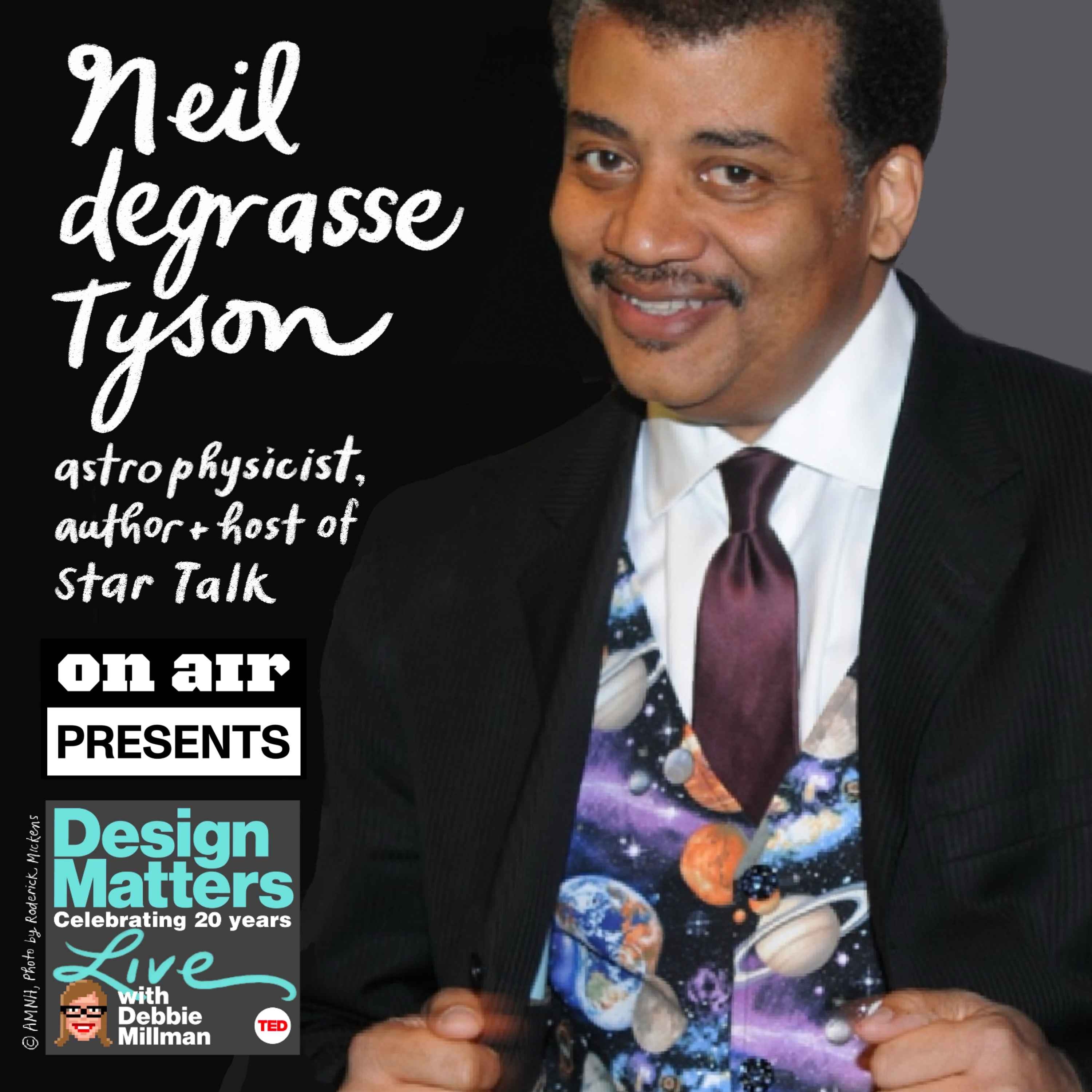
In this episode of Design Matters, host Debbie Millman interviews celebrated astrophysicist Neil deGrasse Tyson. The conversation covers critical topics surrounding science education, the importance of defending science in contemporary society, and insights drawn from Tyson's latest book. The discussion is delivered in front of a live audience, reflecting on the ever-evolving landscape of knowledge and public perception of science.
Written by AI. May contain mistakes.

Get the gist, explore an idea or ask about something said.
 Claude
On Design Matters with Debbie Millman, what are the key points of this episode?
Searching your listeningAutomatic transcript. May contain errors.
0:00survival is a highly tribal phenomenon. So your tribe stays together and you fight against other tribes. The more intricate the rituals are, the more embedded you are in those rituals. Does that mean you're a tighter tribe? Perhaps. But it means we can tribalize on anything.
0:29From the TED Audio Collective, this is Design Matters with Debbie Millman.
0:36On Design Matters, Debbie talks with some of the most creative people in the world about what they do, how they got to be who they are, and what they're thinking about and working on. On this episode, Neil deGrasse Tyson talks about science education in a time when science is under attack. As an educator, you can't ever give up. Then you're not really an educator, you're just an opportunist.
1:03Neil deGrasse Tyson is an astrophysicist, author, and science communicator. Debbie spoke with him in front of a live audience on September 22, 2025, at an event organized by On Air Presents. So there is a lot to talk about. I want to talk about the state of the world. I want to talk about the state of the cosmos. Cosmos is fine. It's Earth that's messed up, okay? Yes. Just saying. And I also want to talk about your brand new book that's about to launch. Well, thank you. Yeah, it comes out in like two weeks. Yeah. Yeah, yeah. So let's talk first about the state of the world. I've been watching a little video of you quite a lot on repeat, wherein you were asked about longevity and how people, humans, have been able to extend their lifespan over the last millennia.
2:02And you had a really interesting answer. You talked about how many millennia ago our age span, our longevity, was about 25 years. No, it's closer to 30. 30, 30. So the right way to say that, because there's a lot of infant mortality. So for example, if you survive to age 20, there's probably a good chance you'd reach 40, for example. But so many humans died at or near childbirth that that pulled down the average. So the mathematically accurate way to say that is half of everyone born was dead before the age of 30. and that's no kind of life to have but that's all that it was so the elders in the cave were the 30 year olds you know and that's a we take so much for granted today and you talked about how those people that were living they were eating organic yes yes that the waters ran pure the air was clean.
3:09The animals were free range. They were free range and all their food was organic. So what's changed? Why are we now living to 100? In a word? In a word. Science! By the way, it's more stunning than that. So the life expectancy of humans in the world thousands of years ago was 30 by this metric that I described. Half of everyone was dead before they're 30. By 1830, 1840, from caveman to 1840, the life expectancy increased to 35. Big bump. And everybody throughout that time was eating organic. Free range. Free range, animals. So the biggest forces operating there are advances in our understanding of human physiology, vitamins, sanitation, vaccines.
4:19Sorry, I didn't mean to say it at you. Little sound check. And science, the medical advances that came about, not only from investments in medicine, but consider that every machine in a hospital that has an on-off switch that's brought into the service of diagnosing your condition without cutting you open is based on a principle of physics discovered by a physicist who had no interest in medicine. And it's true for x-rays, PET scans. Actually, the ultrasound came from the military, actually, but it was a technology frontier. How do you discover what's in the water that isn't water and make an image of it and do that in a reliable way where you can ID what you're looking at?
5:12So you just add it all up. So you can't just fund one branch of science and expect that to take you anywhere. The cross-pollination is what really is responsible for so much of what we see, know, and appreciate. And so there's everyone saying, oh, eat this or do that, and that'll increase your life expectancy, when in the end of the day, it's really the science that's doing it. And the other thing can help maybe on the edges, but I don't want to downplay the role of not eating poison. as one does as one would have to uh so the country with the lowest life expectancy today it's in central africa i it might be chad i might be wrong but it's there's a country in africa with the lowest life expectancy that life expectancy is higher than the country with the highest life expectancy in the year 1912.
6:18So while there's still this great divide, oh my gosh, this is an extraordinary accomplishment in the 20th century for what we have done with, so not that any of that has anything to do with astrophysics, but it's science as a general point. And what you're quoting here is a short little ditty I posted called science in health, wealth, and war. Okay? These are three things that geopolitics care is greatly about. And we owe our longevity. We owe our wealth to innovative invocations of science. And to the extent that budgets are reduced or cut, constrained, impeded, that's going to come back and bite us on the ass.
7:12And we'll just recede on a world stage where we won't even be offered a seat at the table because we'll have nothing to offer. We'll just wait until the other technologically proficient and advanced countries invent the next things. and then we say, oh, can we have some of that? And then they set the price and they control it. And that's not the America that I grew up in. And so I'd like to think that it's a pendulum swing. And when it gets lower, we're farther away from what I remember, that people will then regain a sense of the causes and effects of things and bring back the science leadership that defined what it was to be American from the second half of the 20th century.
8:12But at that point, don't you think that there's a chance that we'll be too far behind to catch up? So many of the leading thinkers, minds, people doing this cutting-edge science, math, medicine, are immigrants. And so if we are going to become far more contained, and we have less funding of the things that do help us live longer and healthier and happier, do you think that we run the risk of never ever being able to catch up? I mean, there have been a lot of empires over the course of history that never were able to regain their superiority or their leadership on the planet once they lost it? We had a good run.
8:59I think of myself as a realistic optimist. Does that make sense? Cautiously optimistic, maybe? Yeah, yeah. That's the phrase. Cautiously optimistic. So the United States is pretty good at catching up. So let me say that more starkly. We like to think of ourselves as proactive innovators, but really what we are are reactive innovators. Okay? There's a force that we're responding to. So defensive rebounds. Sure. Thank you. I appreciate that. so we think of ourselves as pioneers in this in space exploration but we weren't the first satellite was russia the soviet union of course was sputnik october 4th 1957 oh my gosh wait a minute you every country can control its airspace that's deemed sovereign but how about the space space the space above the air nothing controlled that so russia the godless commie sworn enemies of ours sent a satellite over our country and it had a radio transmitter that went beep beep so you knew where it was anybody with a ham radio ham it was an amateur radio community in the day, they could listen in as this thing flew over.
10:41Listen in to the radio signals it was sending. And you'd say, well, that seems innocent enough. Why would we lose our shit? Oh, because Sputnik was inserted into a hollowed out intercontinental ballistic missile shell. So if a satellite that went beep, beep can go over our head and be delivered by their rocket launch system, so too could a missile. And no longer would wars be fought about who's on one, you know, on the, you know, take the hill, advance a line. It would then happen intercontinentally. Hence, I see intercontinental ballistic missile. So the military freaked, okay, because it was a shot across our bow, literal and figurative shot across our bow.
11:35Within a year, we invented NASA. We were still behind. Russia then launched the first human, Yuri Gagarin. That was now four years later, 1961. We didn't yet have a rocket that wouldn't blow up on the launch pad that was qualified to carry humans yet. So we quickly sent up our first satellite, not in 57, but, you know, within a couple of years. But the human? Now the whole world is looking at Russia, the godless communists. How about us? So, 1961, six weeks after Yuri Gagarin comes out of orbit, President Kennedy hosts a joint session of Congress. This is May 25th, 1961, six weeks after Yuri Gagarin successfully is launched and is returned to Earth and is not only a Russian hero, He's a hero to all humans.
12:36And Kennedy gives the following speech. Well, we know the parts that resonate. We will put a man on the moon. You can hear his Brookline accent as he recites this. Put a man on the moon and return him safely to earth before the decade is out. So he's stirring words and he had charisma and vision. No. That's our retelling of that moment. Let's go back to the moment. There's a paragraph. Oh, by the way, that quote that I just said, that is chiseled in the granite in the front entryway of Kennedy Space Center, Florida. You read that, oh, yeah, of course we're going, yeah, yeah, yeah. We're Merk, Merk, yeah, yeah.
13:24Let's go earlier in that same speech. A few paragraphs. laughs. I quote, this is a mild paraphrase, but it's a mostly quote. Is that a kind of a thing? Is that a thing? It's a thing tonight. It's a thing tonight. If the events of, I'm quoting, if the events of recent weeks would not even utter the man's name, just the events of recent weeks, if the events of recent weeks are any indication of the impact of this adventure on the minds of men everywhere, then we need to show the world the path of freedom over the path of tyranny. It was a battle cry against communism. That's what wrote the checks.
14:08Not, we're explorers, it's in our DNA. No. No. We reacted and we leapfrogged. We said, forget this, just satellite, like let's go to the moon and we went to the moon before the decade was out went to the moon in 1968 december 1968 we didn't make a liar out of kennedy go before the decade is out then we get there and we have six missions that land there were nine missions that went to the moon six missions landed yes we actually landed on the moon if you think we didn't land on the moon you'll have to explain how it is that we didn't land nine times apollo 17 1972 this is four years after we first get to the moon.
15:14Apollo 18 is ready and waiting. But we looked over our shoulder and the Russians weren't there. And so what are we doing? So the Apollo program was canceled. We didn't stay on the moon. Do you know how many scientists went to the moon? One. And he was on the last mission to the moon. He was a geologist. So, the moon wasn't about science. It wasn't about exploration, though some of that did happen. It wasn't about any. That's not what wrote the checks. What wrote the checks is that we were scared witless about being bested in this world by a sworn enemy on every front. Because, like I said, they had the first satellite, the first non-human animal, the first human animal, Yuri Gagarin.
16:09They had the first female. They had the first dark-skinned person from Cuba. Remember, Cuba was on their side back then. They had the first space station. We land on the moon and we say, we win. It's a game of one because I don't think they're counting any of it. And just now that you're set up for what I'm about to say, it'll just roll cleanly and clearly. We're going back to the moon right now in the Artemis program. Artemis, this is brilliantly woke. Artemis is the twin sister of Apollo. So that's some woke mission naming right there. Okay? So that was woke before woke was considered bad. And so why are we going back to the moon?
17:02We could have stayed in 1972. Could have gone back in 1980, 1990, 2000, 2010. No. We decide in the late teens under Trump one that we're going back to the moon. Isn't it because we're going to Mars after that? That's not relevant. They want you to think it's relevant. Really? Geopolitical. I'm telling you like it is. I'm just telling you. Go on. Okay. So why are we going back to the moon now? Because you know what happened in the late 20 teens? China says they're going to put taikonauts on the moon. All of a sudden, you know, it would be a good idea to go back to the moon, we tell ourselves. And there it is.
17:48We are reacting to a threat. I was on CNN and said all of this, but in much tighter sound bites.
17:59We're lucky to hear the full story. Let's face it. and the next day I got name checked by Marco Rubio, got name checked. He saw me say this, that we are being reactive responding to China. I said this, and then he accused me of being a shill for China. I had to like look up what that meant. Shill. I never used that word, and I said, oh wow. So then I thought, do I get in the trenches with him? No, but I did compose, a response, this is on Twitter, I composed a response that is in my forbidden Twitter file. These are tweets that I've never sent just because they would be too upsetting to people.
18:44Can you share what was in that? Oh yeah, definitely. You're right. Black men from the Bronx make excellent spies for China. Just to think that through, right? I'm being honest on television about what motivates Americans and I'm accused of being a shill for China. So that's kind of the state of the politics today. So I think it will be reactive. As other countries, China just invented a flag that's going to go on the moon. By the way, all of our flags, the dye, the blue and red dye has faded from cosmic rays and from ultraviolet light. Or they've been blown over by the exhaust from the ascent stage.
19:28and China sent a rover to the moon with a flag. And what color is their flag? Red, one of the most susceptible colors to fading of any color. As you know from artwork that might have been left in the sunlight or anything, they invented a new kind of fiber from basalt, which is volcanic rock common on the surface of the moon. and there's a thread and they created a Chinese flag out of that thread and so that flag that's on the moon will be there for a billion years. And that's why we're going back to the moon.
20:12So I think we'll recover. The brain loss is sad but if they don't come here and they bring their intellectual capital to their home country, you know we've been brain draining other countries for 60 years half of my fellow graduate students in school were foreign nationals and they came and stayed you know i don't say half but a large percentage of silicon valley it was just that so we did so even our space program was launched by werner von braun we didn't have the intellectual capital to launch a space program i so we we got But the Germans, who had already invented the V2 rocket, the rocket, oh my gosh, the V2 rocket did not prove to be as strategically valuable in warfare as intended by the Nazis.
21:04But what it did was it opened up an entire understanding of how you would launch from Earth and go someplace other than Earth. Well, speaking of flags, I couldn't, before we got on stage, Neil and I were talking about the origins of the word brand and how it was used and so forth. And while you were talking about the flag that the Chinese are leaving on the moon, I was thinking about how before there was the ability to send rockets over another country, when wars were fought, flags were used on the battlefield to designate which side you belong to. long, Don, because most of the, there weren't any mass manufactured uniforms.
21:45And so you needed to know where your friends or your foes were. Yes, but that wasn't the most important application of flags. In the history of the U.S. military and around the world, there's something called the Signal Corps. The Signal Corps were people who had flags and it was the flags that they would raise. You've seen, you know, when they do this with the flags, this is enabling the entire front line to know what commands are being offered by the commanding officer, the general, whoever it is with them. So is it hold for an hour? We launch in 30 minutes. And this is basically secret code that would change depending on how much they believed the enemy knew what these signals were.
22:29Then when the telescope was invented and brought into battle, you could be much farther away from the flags and still see what the symbols were. so the signal core still exists today and they work on uh encryption and other communication elements uh in the military and why do i even know about this because i wrote this i co-wrote a 600 page book that don't get that book confused with a separate book i wrote called astrophysics for people in a hurry, okay? This book, for people not in a hurry, it's titled, Accessory to War, The Unspoken Alliance Between Astrophysics and the Military. And in there, there's an entire chapter on the role of the telescope in enabling warfare across much wider stretches of a battlefield.
23:25Yeah, and flags are even used in sports, football games. Oh, yeah, yeah, it carries over. Because football is basically war. So branding uses the language of war in every way, target market, strategy. It's all using a lot of that same language. You mentioned before about the people that are disbelieving in the proof of our moon landing or the shape of the planet. I can't even say it. I can't even say the words. There are people that really, truly believe this. I know that it feels absurd to say. However, we're living in a time now where there does seem to be this giant delta, this abyss between what one group of people believe and what another group of people believe.
24:22is that abyss ever going to be something that is surmountable so there are two separable variables there one of them is the denial of science its integrity and its role in shaping modern civilization another one is people just believe in stuff okay
24:50and we live in a free country frankly i don't care what you believe but if you think earth is flat i would just rather you not for example become head of nasa okay that's a bad combination but there are plenty of professions that would support you if you thought earth was flat There was a famous basketball player, Kyrie Irving, a big flat earther. And a basketball court is flat. So that's okay. I don't have a problem with that. Okay? And not to drop a bomb in the conversation, but you uttered that with disbelief that anyone could walk around, be an educated adult and believe that, but you didn't also say we have fully educated adults who are certain that the creator of the universe impregnated a virgin in the Middle East who gave birth to the son of God.
25:56That itself requires an extraordinary leap of belief and faith beyond any standard of evidence. Yes, I agree 100%. The fact that we don't know where the helium and the hydrogen came from could create ways for which people to envision or imagine or make up. That's one thing. It's quite another thing when all you need to do is get into an airplane and look at this globe underneath and see that it is not flat. But the other question I want to add to that is you mentioned if a flat earther, what harm could they have as long as they weren't head of NASA? I don't have to really throw a stone very far to get to the health department and vaccines and now the potential stock decline of Tylenol.
26:52So help me understand that. Yeah, if the stock drops, I'd be surprised because most people at any given time are not pregnant. But, again, there's separable variables here. You're describing not simply a belief system of which there are many that permeate a free society. You're referring to objectively verified experiments with evidence-driven conclusions. and I hate to sound like the you know the easy scapegoat answer here but the way science is taught in school it's thought of as this book of information and you learn it you spew it out for the test and then you move on to some other book and at no time is it really taught as a means of querying nature to establish what is objectively true and what is objectively false.
27:53If to all of us science is that's a science-y fact and that's a science-y fact and it's not a way of thinking about the world, we are all left susceptible to getting our medical advice from the White House press secretary. There's this middle zone where, all right, if you don't follow this science advice and you do something else, you'll live. Here's what didn't happen. But had it happened, that's a whole other path of recent history that was not taken. If COVID were 70 % lethal, you think people were saying, oh, let's not trust the doctors or Big Pharma. They don't have our interest in mind. Meanwhile, we're standing there with a vaccine.
28:45Really? Really? And so an interesting fact in epidemiology is often the more lethal a pathogen, the fewer people ultimately die from it. there are cases where that can be where that can unfold because first you get it and you die so you're not you don't continue to spread it okay you don't think you're okay but you're not and then you contaminate a whole room you're dead on the street corner so that's one way that stops the spread another one is everyone else freaks out and will do anything they possibly can to to not die and a doctor says, I have a vaccine, it is 90 % effective, you're taking the vaccine, it is nipped in the bud.
29:33So if you have a disease that is mildly lethal, it is at risk of people inventing their own cures and coming up with their own explanations and charlatans rising up, selling snake oil or whatever it is, and the disease sort of works its way through, kills some people, not others, and then everyone at the end has to blame somebody for the disease existing at all. How am I even coming at this? I was an academic advisor to a documentary called A Shot in the Arm. It was a sensitive look at people who are vaccine hesitant. and i'm an executive producer of this documentary people are vaccine hesitant well why because someone came up to them and showed them pictures and talked them out of it well who was that person relative to the person who was then influenced the person who's then influenced doesn't carry this shouldn't carry the same accountability as the person who's peddling it so this is an exploration of this force as it operated through society.
30:49And it was originally conceived to explore measles because there were measles outbreaks on a disease that the World Health Organization said was licked by the year 2000. Then all of a sudden we get one in Bed-Stuy, we get one in California, and these are liberal outposts with people who are anti-pharma. The fact that you have a Republican administration who has an entire anti-vax community with them with rfk jr who's birthed in the left side of the aisle meeting together in this sort of unholy alliance anti-vaxxers have become purple blending the blue and the red why because the liberals were the og anti-vaxxers they were the og anti-vaxxers The right-wing people only became anti-vaxxers not because they're anti-pharma.
31:44They love pharma. Okay, they have nothing against big business and pharma. They don't want you telling them they have to get vaccinated. So it became a freedom issue in a free country. So the freedom issue got convolved with the, I don't trust big pharma, and they're not tested and whatever. And then you have this whole community crossing the aisle who are anti-vax. so what you're telling me because all this failure of people's appreciation of science is that I suck at my job well all that being said no I didn't totally what she said because I'm trying to enlighten people and so it's a challenge I don't mind the challenge as an educator you can't ever give up then you're not really an educator you're just an opportunist you have to be there even when it feels hopeless.
32:40And I'm reminded of the story Don Quixote where he's got his lance and he wants to attack the windmill. That's like a crazy, what? What do you even, who wrote that? Who thought that up? Cervantes. I know. I'm just, it was a rhetorical. Who wrote that? there's no way he's going to stop the windmill with his lance he continues and when that story made it to broadway in a broadway musical man of la mancha the single most memorable song from that musical was to dream the impossible dream and if you look at the words composed for that oh my gosh it's you know i want to fight the unbeatable foe. I want to march into hell for a heavenly cause.
33:40You hear the accounting of things you might do that would otherwise be hopeless, yet you still do it. And anytime I'm in front of an audience who thinks earth is flat or no vaccines or anything, I think of stanzas from that song. And I persist. We, for the last 10 ,000 years... You're supposed to applaud there.
34:12It doesn't count if I forced it out of you. Right, okay. For the last 10 ,000 years, our species has been creating a relationship with some sort of higher power that we believe is looking down on us or is within us or is controlling us. And different tribes have— Not only us, but the environment. Yeah, they aspire to different beliefs. Those beliefs are so steadfast in them that they're willing to die for them without any evidential, evidentiary proof that any of this—
34:57the more likely people are to fight to the death in defense of them. It's a curious fact. You will find a front line of scientists charging a hill against other scientists. That's not how that works. So what is it in our DNA, in our instincts, why do we do this? There is evidence of tribes all over the planet when they couldn't even communicate with each other that had symbols, that had logos, that had flags, that were creating rules in which we had to live in order to please this higher power. The way we ate food, the way we got married, the way we handled our genitalia, the way we handled our hair.
35:47Where does this instinct come from? So there are many books written on this. I think the way to best compress it or digest it is simply to say survival is a highly tribal phenomenon. And anything that enables you to survive works evolutionarily in the survival of the fittest. And by the way, they've done experiments on this where, let's say we have 40 people and 50 people in the room. They give half of you one color shirt and the other half a different color shirt. And that's all they do. They don't say anything else after that. And then there's socializing afterwards. The shirts gather according to what color they have, even though you're complete strangers.
36:40And even though you're no more of a stranger to someone else with your color shirt than others were, people naturally segregated by shirt color. And so it's still in us today to do so. Point is, if you have a tribe that predates you because you're born into a tribe, whatever are their rituals, whether or not they fully scientifically analyze them, they're rituals that have kept them together. It's a binding force. And binding forces mattered. Oh, now here's someone comes up from the other hill. They have different rituals from yours. Plus, they might want to take your water. Okay? That's bad. So your tribe stays together, and you fight against other tribes.
37:26The more intricate the rituals are, the more embedded you are in those rituals. It's that simple. Does that mean you're a tighter tribe? I mean, perhaps. But it means we can tribalize on anything. You can look at the hatred between people of different skin color, for example, over recent centuries. And then, but you look at Europe in the First and Second World War. What were those but tribal warfare of people with light skin killing other people with light skin? Christians with light skin killing different varieties of other Christians with light skin. Okay, by the way, Hitler was Catholic, by the way.
38:09I don't know if you knew that. So if people can kill each other because of what side of a line in the sand they were born on, or what language they speak or what other rituals they perform, you've got argument for a war. So I'm amazed we have survived ourselves in this enterprise. The linguist Steven Pinker wrote a book, The Better Angels of Our Nature, where he studied the, he made a case that I find convincing. Other people had some issues with it, but I found it convincing that with whatever are the fits and starts of the violence we commit against one another, that the overall trend from 10 ,000 years ago to today is one where we are much milder and much more gentle to our neighbors than ever before.
39:00and you can measure that by when you fight a war what fraction of your tribe dies and there's a day when half the men of a tribe would be dead half then they would like give up half or more okay and all the men would die and then they all the women would get taken okay and so that doesn't happen today as bloody as the second world war was with 50 million people who died. By the way, I did the math on this. From 1939 to 1945, the interval of the Second World War. Of course, we were only involved from Pearl Harbor to the end, 1941. But, of course, it had been going on for a couple of years. 1939 to 1945, 1 ,000 humans were killed per hour.
39:56in the service of that war from 1939 to 1945. That's inconceivable today. If a car barrels into protesters and kills six people, that's national headlines for a week. We were killing 1 ,000 people per hour because violence wasn't reported by deaths. It was important. Did we take the hill? Did we take the thing? Move the troops back? Where is Hitler? Where is Mussolini? Where is Japan? The Japanese Empire? So the language was different. But even so, at a million people per hour, a thousand people per hour, you could rank the countries by what fraction of their population died in the Second World War.
40:50The worst cases were like 10%. There was a 30%. There was one country. Most were 10, 5%. We lost half a million, mostly men. What percentage of 150 million people is half a million? That's a vanishingly small percent. We are tribes fighting, and because it is state-run, this is the point I'm trying to make here, I forgot to say it at the beginning. When it's state-sanctioned war instead of tribe-sanctioned war, the state has its own survival as a priority. And so the state will surrender on terms before they would completely get wiped out by their enemy. And so that is a force operating against the tribal urge to just have everybody go out and kill everybody they find who does not look like you or sound like you or perform the same rituals as you.
41:47Is that something that you think is embedded in our DNA or is that just something that we've been socialized? I have no other way to think about it. Oh, so I'm grouping religion as just another way to tribalize. Period. Right. That's all it is. But is that something in our DNA? Is that something that... It appears to be so because, like I said, originally it was in the interest of the survival of the tribe. There's another thing. For example, have you ever smelled throw up? Okay. What does it make you want to do? It makes you want to throw up. Okay. that's completely natural someone in your tribe you're all eating the same foods you're all sleeping in the same place eating the same foods someone throws up you smell it your reaction is to throw up as well so that's an autonomic reaction before you physiologically had to your brain said looking at a tribal member this is bad let's get it out of our system as well if there are any tribes where they ate poison and only one person throws up from it and the others don't, all of the rest of you die because it killed you some other way.
43:05The poison didn't make them throw up. The body said, I don't like this, I'm getting rid of it. If your body doesn't tell you to get rid of it and it's still poison, you end up dying and you get removed from the gene pool. So there are so many forces operating that will have us do the same thing in the interest of our own survival. Given how science is built on truth, why is it facing so much mistrust at this time? Because we're not trained to learn what science is, nor are we trained to communicate science. So here's what should have happened. And this is not just 2020 hindsight. This is not Monday morning quarterback.
43:47I knew this while it was happening. Okay. COVID hits. So the CDC issues recommendations. Fauci, at no time should he have said, here's what everyone needs to do to protect themselves. Wrong answer. It's the latest evidence as of this week tells us this. It's an airborne virus. It might survive on surfaces that are wet. So rinse off your groceries when they come in. As we learn more about the behavior of this virus in its airborne state, we will update you weekly. And there's a huge army, forgive me for using that word, of scientists studying this novel virus. Novel meant that we don't have prior data on it.
44:46And so he should have played it as, not played it, he should have reported it as a work in progress, because that's how science goes. But everyone's saying, we need the definitive answer, and he gives a definitive answer, and we find out later that it's not true, then no one believes anything that comes out of his mouth. That's the problem. So science is in the business of establishing, I'll tell you what the scientific method is in the simplest terms. Do whatever it takes to not fool yourself into thinking that something is true that is not or that something is not true that is. Did I say that right?
45:30I meant them to be the opposite of each other, even if they didn't come out that way. Whatever it takes. Because often when you do an experiment, you could have a bias. Scientists are human. We could have biases. So we have checks and balances. Peer review. That's what all that's about. It doesn't mean you can't publish something that's wrong. It means that's on the frontier and we don't know what's right yet. That's what that means. So, had it been presented that way, I don't think people would have felt like they were betrayed. Oh, now we should wear a mask or we shouldn't. Do we keep children home?
46:06It's a work in progress when you're on the frontier. It's pretty messy. But once we establish an objective truth, we're good. We are good. One of the most irresponsible things, I would say, was when the New York Times had a big article on a research paper that said that wearing masks did not prevent the spread of of covid it's like what the fuck what excuse me what what what so i went to the original paper and it was people who reported that they were wearing masks was their sample of who was wearing wearing masks. Now we've all were on the subway during the coming out of COVID, half the people, how they're wearing their mask.
47:02It's either on their chin, then they're not wearing at all, or below their nose, half of them. And if you ask them, did you wear your mask in the morning? Yes, I did. Yeah, you can't use people's own testimonies as evidence for policy. That's not how you want to do it, do the right experiment. Here's how you do that. This is what they should have done. This is what the New York Times should have looked for. Here's what you do. How big is the virus when it's on an aerosol? Because when you sneeze, viruses can get through anything. They're really small. The first virus was seen in 1932 after we invented the scanning electron microscope.
47:39We needed quantum physics to get there. Anyhow, how big is the size of one of these aerosol particles in a sneeze thing, okay? and here's what you do. You take the material that a mask is made of, so it's a membrane, and you put it in the middle of this container. You infuse one side of it with the COVID-infected aerosols, and the other side, you change the pressure on the other side of the mask. You have low pressure, then high pressure, and low pressure. When it's under low pressure, air will move through the mask to the other side. You just keep doing that. Do that for hours and hours. Then you check the other side of that mask to see if any COVID got through.
48:22If no COVID got through, you keep wearing the mask. If COVID got through, you say we need a better mask. And a mask had no efficacy. Surgeons would not be wearing it when they operate on you. OK, so so that's an example of bad science reporting in a newspaper that's supposed to really think this through. My last question about science, and in some ways I think it's bringing us full circle. If you could design a curriculum to build scientific immunity against misinformation, what would that first class be? Yeah. So I like you use the word immunity. I would say how can you inoculate people against – by the way, my two kids, they're in their 20s now.
49:14My wife and I are both scientists. She has a PhD in mathematical physics. So we made sure our kids were scientifically literate. So by the time they were 13, certified scientifically literate, I had no worries about anything that would ever happen to them for the rest of their lives. I didn't care what grades they got. I knew that at that level of science literacy, they would not be victim of someone else exploiting their ignorance of the operations of nature. Not because of what they knew, but because of how they asked questions. I had a dinner party and someone, an adult, they're in their 13, 14, an adult was there and said, oh, I had such bad luck today.
50:00It must be because Mercury was in retrograde.
50:07and and my daughter said politely uh
50:15what is it about mercury that you think is affecting you is it it's light because are you sitting in front of an open window facing the planet mercury while this happened She knew how to think this through. And so, by the way, just believing something outright is equally as intellectually lazy as rejecting something outright. Outright, yeah. So if this is the first you've heard of Mercury in retrograde, but you are scientifically trained, you would ask questions. If someone comes up to you and said, these crystals will heal you, buy them from me, and you don't know anything about it, you say, well, what is it about the crystals?
50:57Let's say it's crystal energy. And you say, you realize the crystalline state of any molecule is the lowest energy state it possibly can have. It cannot become something else from that state, which is why diamonds are forever. Diamonds are a crystal. You know what else is forever? Salt. We dig salt out of mines that's been there for millions of years. No one is putting salt on their ring saying, oh, it's all crystals are forever. No. It was a currency for a long time. Yes, it was. Indeed. The word salary comes from the word for salt. And Roman soldiers were paid in salt. Salt was an important preservative.
51:43Salami was preserved meat with salt. So, why are you talking about salt? I interjected and mentioned that it was a currency. You were talking about diamonds before that and the evidence. So you start asking them about these crystals, then the person runs away in tears because they don't have answers to them because you just were simply curious scientifically. So the curriculum is not what you learn. It's you train your mind how to think. What do you do when you're confronted with something that's mysterious, interesting, amazing, odd? What do you do? Do you just believe it? No. Do you reject it?
52:24No. You ask questions. And some questions are better than others. Not, what kind of cheese is the moon made out of? That's not as good a question as, what is the moon made out of? Just go a little earlier in that chain. If you find out it's made of cheese, then you can ask, what kind of cheese is it made of? Do you know Wallace and Gromit, some of you? One of them, they're on the moon, and they're sitting there in these beach chairs. And if you don't pay close enough attention, you'll miss the fact that they have crackers, and they're just carving parts of the moon off and putting it on their crackers and eating it.
53:07And they don't make a big deal of it. That's just what they're doing. It was hilarious. So that's what, if I were Pope of Curricula, that's what I would do. And then we are immune to charlatans. for the rest of our lives. Wouldn't that be nice? And one other thing about, you mentioned religions and gods, almost every deeply religious person is an atheist to all other religions in the world. If you're a devout Protestant, it is absurd to you that there could be another prophet after Jesus where the mountain goes to him and not the other way. So all the claims of Islam are just absurd to you. They're just absurd.
53:53By the way, the claims of the Catholic Church are also absurd to you. That there are all these saints and the this and the rituals and that there's a pope who talks to God. That's all, all of that's preposterous to you. Most religious people believe that their religion is the one true religion. So that means they're atheists to everybody else. Why can't they just leave it at that though? So why do they have to... So the full-up atheist just simply adds your religion to that same list. They're just as atheistic to the other religions as you are, but they're also atheistic to your religion. Why do we have to fight over who's right?
54:34Why do people... So many of the wars, especially today, are because one religion is another. You are correct. Why do we have to prove that others are wrong? That's the only way a religion... So you can think about that as the natural selection of religions. Why are there so many Christians in the world relative to Jews? It's not really in Jewish tradition to proselytize, to have missions, to go on ships to other countries and convert them all to your religion. Christianity did that. As a result, all of South America is Christian, mostly Catholic, because of this. By sheer numbers, the natural selection of who is in your religion is either supported, it either rises or falls by the rules surrounding that religion.
55:28Why are there so many members of Islam? It is a lethal offense to be in Islam and then leave Islam. That's a pretty good reason to stay Muslim. Okay? That's good reason. What else? Oh, the Catholics say we outlaw birth control because God said so. Well, now you have as many babies as you can. More Catholics. So if you are right, you get to claim your rightness on others to grow the size of your religion. But it seems that we're very selective about what it is we're willing to believe and what we're willing to. That's the cherry picking. Yes. Yeah. That's the modern cherry picking of religion. It's very dishonest in a way because what you're doing, you're using secular values to judge what in your holy book should be enacted in modern times versus not.
56:26Right. There was that great scene in the West Wing where the president talks to some religious evangelical person and says, should I be slaughtering my brother because he's wearing an outfit of different threads? Should I be a federal? Threads don't match. Correct. from the Old Testament, Leviticus. Yes. Well done. Wow. Science man knows his Bible.
56:54May I tell you why? Sure. As long as everybody's cool with it. Okay, good. So, you know, I'm just a scientist. And before I was, like, recognized, you go on the airplane and you say, oh, what do you do? And what do you do? You know, the stranger next to you. So I'm an architect. I said, I'm an astrophysicist. Oh, and then out come the 20 questions. Every time. Oh, you know, tell me about Pluto and about black holes and wormholes and aliens. The fifth or sixth question in lands on God. And I used to give answers that were kind of perfunctory, kind of philosophically thin. and then I thought to myself, I owe the person a better answer than that.
57:45My answers were things like, well, religion is faith and science is empirical, so never the twain will meet and that's it. I thought I could give them a more nuanced answer. So I started buying religious texts, reading many of them, skimming all of them and I would receive all of the literature, I receive all the writings that would come to you from the Jehovah's Witness that come to the door. You know, they give out the pamphlets. There's the Christian scientists and you have the, what's the one with Tom Cruise in it? Scientology. Scientologists. So all of these. So I have the literature on all of this.
58:26So now we can have a conversation and I can engage you on your terms. and at the end, my easy out is, I'm quite certain I own more religious books than you own science books. I'll give an example. I'm in Vegas. I have a driver. I'm there for a speaking commitment, and the driver recognizes me. This is recent. Recognizes me. Very friendly, and he says, what do scientists believe in? I said, well, it's evidence-based, and then he said well if evidence matters to you then what about the evidence of the resurrection of jesus and i said well what evidence are you talking about and he said oh well the rock was pushed aside from the burial crypt and you know there were two guards there and i said oh okay Okay, eyewitness testimony, however high a form of evidence it is in court, it is the lowest form of evidence in the court of science.
59:44In fact, it's not even there. You don't walk into a conference and say, this is true because I saw it. It's like, go home. Get a chart recorder reading or something. All right? Okay. So I led with that. And at this point I learned that he only drives part-time. He's also a preacher. So, oh, you're a preacher, so you should know the Bible. He said, yeah. And I said, well, did you know that the rock was moved while the guards were asleep? He didn't know that. I knew that. So, it's kind of odd that if God wants to take Jesus' body out, that he has to have the guards sleep for this to happen. He's God, right?
1:00:29That shouldn't be necessary. You can just freeze him in place. and have them watch it, and then they'd be witness to it. That's even more profound. But they weren't witness to it because they were asleep. It says it clear as day in the Gospels. And so this surprised him that I could even engage him in that way. Well, I'm not religious fluent to play gotcha. I'm just religious fluent so that I can absorb themes and ideas that I know you care about in my answer when we have the conversation. and that's why. You know what else is in Leviticus? It's the verse that was 40 % at least of why they killed Joan of Arc.
1:01:13Okay? If you ask anybody why they killed Joan of Arc, why? She was burned at the stake in the 1400s. Not for witchery, not for heresy because she was quite religious. She was leading French troops against the British in British-occupied France. Burgundy, which is my favorite wine, so it saddens me to say this, they were British sympathizers, and the French handed her over to the Burgundians, which was also the French, but they were British sympathizers, so the results of that court case would be in the favor of the Brits. And the Brits did not want her because she was leading armies against them.
1:01:55Okay, so if you read the transcripts, because the Catholic Church keeps really good records. There it is, citing Leviticus. A man shall not don the clothes of a woman, nor the woman, a woman the clothes of a man, lest this be an abomination unto the Lord thy God. They got her on cross-dressing. And you can't lead soldiers into battle wearing a skirt, okay? So for that alone, you know, what do you expect out of her? But basically she was an early tomboy. And that's half the reason why they burned her at the stake. It's interesting knowing this, I think, because religion has been such a force operating on civilization that I can't just be a scientist ignoring and immune to what those forces are.
1:02:51I would not be a genuine participant in the unfolding of what people care about in this world. Neil, last time we talked, you joined me on the pod and we talked about Starry Messenger and how science literacy can help reshape the world. And now you've reimagined your 1998 book, Just Visiting This Planet. So why bring this book back now in 2025? And can you share with the audience some of what you're trying to communicate in the book? It's a beautiful book. Thanks for the shout out on that. It's not out yet. We don't have it to show. November, right? October? It's October 20th, something. Time to pre-order.
1:03:34Yeah, yeah, pre-order. They love pre-orders. They love pre-orders. Everybody right now, take out.
1:03:43So while I was in graduate school, I wrote a column just to make extra money for a local science newsletter. and it was called Merlin's Tour of the Universe. It was just called Merlin. It was just called Merlin. And it's not the Merlin of Arthurian legend. I developed this character to live for all of Earth human history. And people asked Merlin questions. People played along. It was fun. You know, full-grown adults are playing along. Dear Merlin, I don't quite understand gravity. Explain. So Merlin, because Merlin's been around, would recall conversations with Isaac Newton. had in Isaac Newton's backyard.
1:04:23And so then there's a conversation between the two of them, and in that conversation is the answer to that question. It's in one example. Merlin is kind of quirky, fun, terse. Okay, Merlin, there's no run-on. If there are, it needed to be, not because that's just because there were too many words available. And so it's a question and answer book. It's got 240 questions and answers on the universe. asked by regular people just sitting at home, looking up, wondering. How hot is the sun? What happens if someone removed the sun from the solar system? By the way, these questions are not things you can just Google because they're a little more engaged than that.
1:05:08What happens if you pluck the sun out of the middle of the solar system? One of my favorites was, could the Earth exist without the moon? Yeah, what happens if the moon exploded? Now, you can ask that at ChatGPT, and you know what ChatGPT will do? It will reference things I've written to answer for you. Do you think that's fair or not?
1:05:41Consider, this is my 17th book, all of them nonfiction. I'm everywhere on the freaking internet. speaking nonfiction things, and ChatGPT ingests the world of nonfiction to then give you an answer. And so, yeah, I'm not officially part of that lawsuit, but I verified that my books are in the ingested database of that. I gotta tell you a quick thing before I say a couple more things about the book. I'm at a dinner party, and there's a guy, you know, your age, plus or minus, and he's active in the computer world and AI even. And he's a little geeky. You know, geeky people are my people, by the way.
1:06:27I went to the Bronx High School of Science. This is the hilltop of geekitude. Even the jocks are geeks, right, just so you know. So he's there and he asked me, so Neil, what are your thoughts on aliens? I said, could you be more specific? Well, do you think we have visited us? So I started giving him an answer. and he's not paying attention to me. He's looking down at his smartphone. And I'm looking, I said, this is rude. I just met the guy. It's a dinner party. I don't want to create a scene. And I said, what are you doing? He said, I asked ChatGPT how you would answer that question.
1:07:10So I said, how am I doing? And he says, yeah, this is exactly what you just said. Wow. So I have mixed feelings. I taught for 15 years in college and graduate school. If someone took my ideas and what they learned from me and then went and started a business and made a zillion dollars, I'm not going to come after them if they learned it from me. I'm an educator. That's kind of my job, is to have you become more of whatever you were going to be because your path through life intersected mine in my classroom. So I'm on the fence about the fact that there's a tool that can use what I've written and help people learn things.
1:08:01Yeah, I'm still thinking that through. My gut tells me there should be some compensation,
1:08:11but that's my gut talking, but my educator hat says, No, we all become educated and enlightened for it. So this book, so the first of these two books, Merlin's Tour of the Universe, came out back when I was coming out of graduate school. And then it's been like 30 years. I thought, okay, it's time to bring this into the 21st century. So I took both books and brought them into the 20th century, 21st century, and they've been updated and everything. And so the second, so the first one is Merlin's Tour of the Universe. Merlin was born in the Andromeda galaxy, by the way, and visited Earth because Merlin was curious about Earth beings.
1:08:51And the next one is called Just Visiting This Planet because that's what Merlin is doing. So I think it's a fun book. There's sort of wit and wisdom in there that you're not going to get from a wiki page or from a thing. So it's just a fun thing. And my brother, who is an artist, illustrated it. So they're fun, quippy parts. Yeah, it's a wonderful, wonderful book. Where there's a very gentle cartoony illustrations sprinkled throughout that every time I look at them, I just have to smile because they're so insightful and so brilliantly conceived. So anyhow, it just comes out in a couple of weeks.
1:09:28If you need an escape, it would totally serve that role. Neil deGrasse Tyson. Thank you. Thank you, Neil.
1:09:44Thank you, everyone.
Neil deGrasse Tyson—world-renowned astrophysicist, Emmy-nominated host, science communicator, and author—is one of the most influential voices in modern science. In this live conversation, recorded at On Air Presents, he joins Debbie Millman to explore the role of science education and why defending science has never been more vital.
Hosted on Acast. See acast.com/privacy for more information.


