 Ask ChatGPT


Description: A pioneering podcast focused on how creative individuals shape their lives and careers, hosted by Debbie Millman.
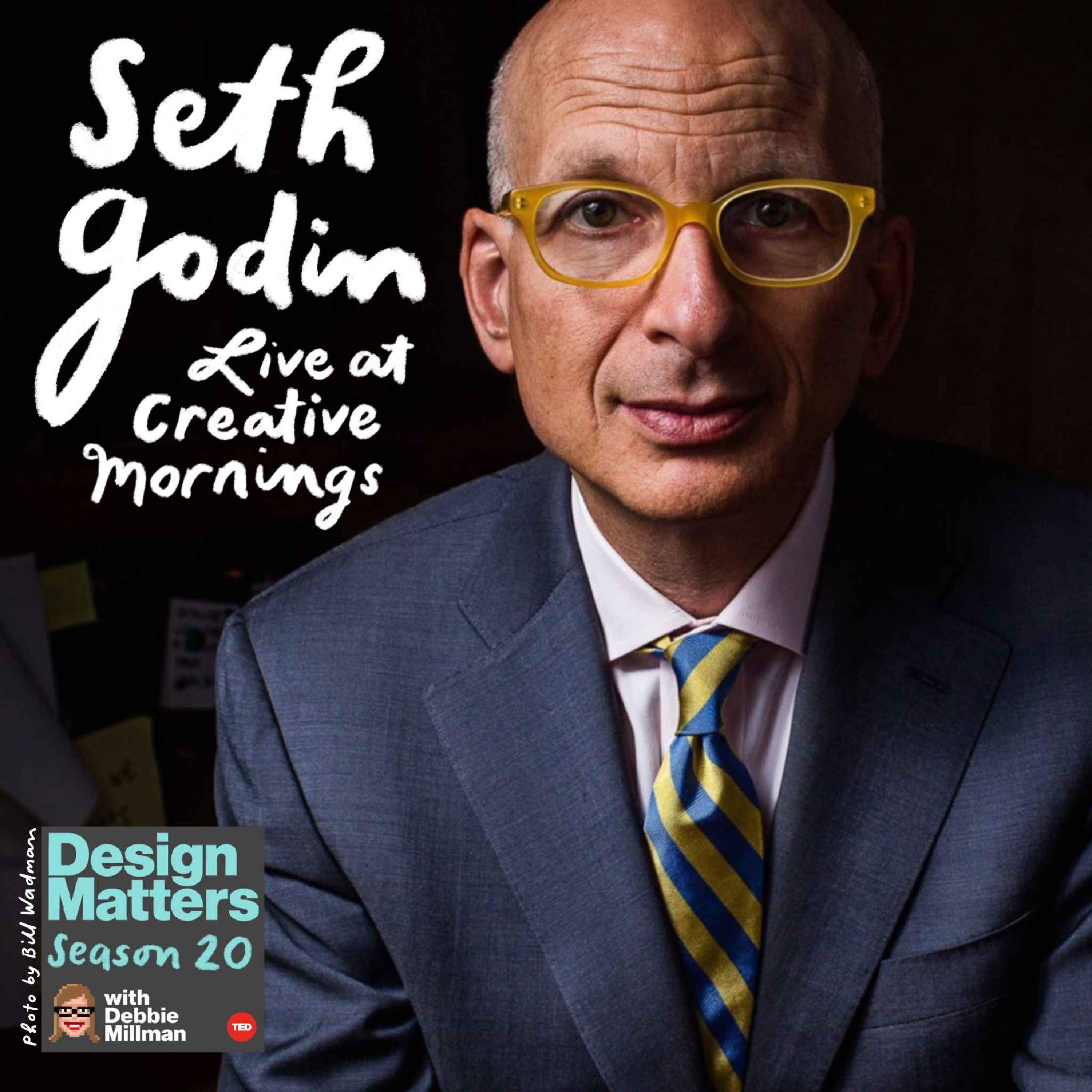
In this episode, renowned author and entrepreneur Seth Godin discusses his latest book, This Is Strategy: Make Better Plans, and shares insights on the importance of creative planning for the future.
Written by AI. May contain mistakes.

Get the gist, explore an idea or ask about something said.
 Claude
On Design Matters with Debbie Millman, what are the key points of this episode?
Searching your listeningAutomatic transcript. May contain errors.
0:00The failures, the things I forgot to do, the people I didn't see who I should have respected, the ways I wasted time and money. if I didn't have those, I wouldn't be who I am. And I'm okay with who I am.
0:17From the TED Audio Collective, this is Design Matters with Debbie Millman.
0:25On Design Matters, Debbie talks with some of the most creative people in the world about what they do, how they got to be who they are, and what they're thinking about and working on. On this episode, Seth Godin talks about the importance of planning for a creative future. We can't get to edit the past. We get to edit the future.
0:46Seth Godin is familiar to longtime listeners of Design Matters, since Debbie has interviewed him on several different occasions over the years. Seth Godin is an entrepreneur, a marketer, a blogger, a teacher, and a best-selling author. His many books include The Practice, Shipping Creative Work, and This is Marketing. You can't be seen until you learn to see. His latest is This is Strategy, Make Better Plans. Debbie spoke to him about it in December in front of a live audience at the School of Visual Arts in New York City. The interview was arranged by Creative Mornings, the monthly breakfast lecture series for creative communities throughout the world, founded by Tina Roth Eisenberg.
1:30Welcome, my dear friend. You know, I am so lucky to be able to do this. And it just makes me, reminds me of why this work is worth doing, but it also makes me better because then I go back to my office and think, how can I possibly repay the generosity of the people in this room and of you and of Tina? It's just such a highlight. Thank you. My absolute honor. The first thing I want to ask you about is what is behind us? What are we looking at? Well, so the idea was we could put something in the background. We don't want it to be distracting, but we want it to possibly be inspiring or metaphorical.
2:12It turns out it's against the law to fly a drone in Algonquin Park, north of Toronto, Canada. And I have this phobia of being arrested in a foreign country. Really? But here I am. I do. Yeah, I am flying a drone at six o 'clock in the morning and paddling the canoe at the same time. This is a 70-year-old chestnut canoe that my mom gave me, and I'm in the middle of a 3 ,000-square-mile park. And I've taught many, many people how to paddle a canoe. But the metaphor here is this is double ultra-slow down, but it's still moving. And it's a lot like our careers. It's a lot like the creative process.
2:53which is you never get across the lake all at once. You get across the lake one stroke at a time, and it takes a long time, but you make progress. The other thing that I remind myself all the time is when you paddle a boat, it feels like you're moving the water behind you. But physically, that's impossible, because if you move that water, it has to move the next water and the next water. It's a million pounds of water. What you're actually doing is using this thing that feels liquid but is actually almost solid to propel you forward. And when we think about the culture around us, everything we do touches the culture, changes the culture a little bit, but mostly it's a lever that allows us to do our work.
3:38There is no first of anything. There's just our next iteration of it day by day. Yeah, that combinatorial creativity. Yeah. I love that metaphor. And having been in a boat of yours, I can say that there's something really wonderful about sharing the water with someone and sort of feeling the time go by. And we're going to talk a lot about time today. Listeners of my show know that I like to take a long journey into a person's life. This is my fourth interview with you. We talked very much about how you have created your life and become who you are in my previous interviews with you, 2014 and 2017.
4:29In 2020, we talked about your brilliant book, The Practice, Shipping Creative Work, and how we were managing through COVID. We did that online. It was a Zoom conversation. And today I get the great good fortune of a deep dive into your brand new book, which you've generously given everyone here today. This is strategy. Make better plans. Easy first question for me. Maybe not so easy to answer, but why this book now? A long time ago, if you talked to my grandparents and you said, what are you going to do tomorrow? The answer would be obvious. I'm going to do what I did yesterday. That's my job.
5:14And there's still some people that's true for, but not many of us. What we do tomorrow is largely up to us. And there are all these tools, a trillion dollars worth of tools that have been built for us, a connection of billions of people. What will you do tomorrow? And if you don't think about that question, you've surrendered. You've given up agency to a system that doesn't have your best interests at heart. And I'm surrounded by people who I care about, who do great work, who put love and heart into it. But they aren't taking the understanding that is available to them of strategy. Strategy is not tactics.
5:56Strategy is not, what should I do right now to get what I want? It's, what do I want? And how is the system going to help me get it or keep me from getting it? and is what I want achievable. And as far as I'm concerned, there are no books about strategy. There are books about tactics. There are books about MBAs or whatever. I needed to write something and it's a lot of work to publish a book to bring to people who I care about to say, here's 400 questions. Don't answer all of them, but at least ask them and maybe it will help you make the impact you want to make. You start This is Strategy by stating that most books on strategy are for corporate MBAs or West Point generals.
6:40And I kind of love the fact that so much, well, I don't know that I love it, but I find it quite interesting that so much of the vernacular around strategy is military based. Yeah. Why do you think that these books are catering to that specific demographic? So a scarcity mindset is essential if real estate is what you're playing with. Each acre of land can only be owned by one person at a time. So scarcity drove the way people with power thought for a very long time. But now, as creativity becomes more important, abundance is actually the key. Connection is actually the key. That if I have an idea and I share it with everyone here, I don't lose it.
7:30They get it. And it benefits all of us. So strategy has to shift from how do I take what's yours to how do I create the conditions for all of us? I took a class with Milton Glaser almost 20 years ago, and he was the first person that really introduced me to the idea of scarcity versus abundance. And until that point, I realized without actually knowing consciously that I was operating out of a mindset of scarcity, that if I don't hold on tight to what I have, I'm going to lose it. I'm going to somehow be threatened with abandonment of anything, ideas, finances, love. And he really challenged us to think about the idea that there is really enough to go around in this universe if we share.
8:26And the more we hold on to things, the more likely we are to actually crush them. And I thought that was really profound. It's taken me a long time. I understood it intellectually, but to actually feel that it was possible. It's much easier to talk about than it is to do. And for fans of your podcast, if you go back to the episode you and I did 10 years ago, you can hear about when Milton Glaser threw me out of his class. Because it's totally related to this. Oh, then tell us. I mean, I won't tell the whole long story, but the short version is Milton decided there wasn't enough room in his class for both of us.
9:01It was his class, so I had to go. It's sort of un-Milton-like, though. I'm surprised. Every time I hear that, I think, really? He must have been in a bad mood that day. Your book contains a really beautiful narrative arc and includes 294 strategy maxims. What made you decide to create the book in this way? It's a really unusual way of organizing a book. I'm surprised at how many people, not you, but how many people were very unsettled by this. Unsettled? Yes. But what I discovered is a few things. First of all, I had a lot to cover because I'm trying to articulate a whole philosophy that I couldn't riff on other people's version of because I was articulating that there are four things involved in strategy.
9:53But if I had to do it in order, if I had to talk nothing but systems without talking about games till later, it all fell apart. So how do we learn something new? Like when we're three years old, our mom doesn't sit us down and say, here's asparagus, here's zucchini, and here are all the vegetables in between. We're going to do vegetables today. That's not what happens, right? You bump into a vegetable and then later on, a couple of weeks later, there's another vegetable. So this idea that we could layer things, I think that's how people actually learn. And I think that's how we think about the world.
10:25So as soon as I gave myself the freedom to tell the story the way I would teach it to someone sitting next to me, the book flowed. And forcing it into a traditional organization didn't help. So I didn't. Do you think that people were unsettled because they want specific instructions and a menu of how to do something? Yeah. I mean, TLDR, which people are too busy to understand what it stands for. It stands for too long, didn't read, we're pushed to say, I'll just read the first three pages and then pretend I read the book. So if the first three pages don't tell you the joke and the answer, you're frustrated.
11:05But I couldn't do that this time. Also, the number of people who buy and read a book has gone down by a factor of 10, not just my books, but all books. And there are more and more books, but per book, it's way lower. So if you're going to read the book, here's the book. If you don't want to read the book, read the blog post. Either one is fine with me. So what I want to do, which is very unusual for the way I sort of construct my interviews, I actually want to take some of the 294 maxims and talk a little bit about some of them, particularly the ones that really moved me. So I want to share some of my favorite descriptions of strategy from your book and discuss them, at least at the beginning.
11:51And so first you state that strategy is not what most people think it is. Right. Most people think, if you look through some Google searching, here's my strategy to get more Twitter followers. Here's my strategy to do this. No, those are your tactics. Tactics are steps, instructions, bullet points. there was a strategy long before you decided to do that at all. Strategy is a philosophy of becoming. It's what will the me of two years from now be glad I did today? And if the world didn't change, strategy and tactics would be very simple and very similar, but the world changes not just when you do things, but when other people do things.
12:39So we cannot predict the future. and so if you think about a surfer we think someone's a good surfer when they have good waves and we watch someone struggle and they're not a good surfer when in fact they just didn't pick good waves so a big part of what we're talking about here is making the decision to be a surfer making the decision to go to which beach on which month of the year and then picking which waves to let go by and which waves to surf those are things we skip over all the time because we got to go to work. But if you do those parts right, everything else about your work gets easier.
13:16I was really struck by how the surfers in the Olympics over the summer were waiting for the waves. And what's interesting about the way that the Olympics manages the surfing competition is that there's a certain amount of time you're given. And then you wait for your waves and you decide which waves you want to surf. And I learned so much of the barrel of a wave and how people go through the waves. But it's so interesting that this is something you have to choose once you have the option of participating with the wave, which was something I'd never thought about before. But one of the sentences in the book is, don't play games you can't win.
13:59But if we did a census of everyone here, I'm going to assert that 20 % of you are playing a game you can't win. What does that mean? A game you can't win. So how many people are trying to make a living by having 30 million followers on YouTube? A lot. Really? Yeah. How many people will have 30 million followers on YouTube? Essentially zero to a rounding error. The chances that your work will pay off if that's what you're chasing are vanishingly close to zero. If you still want to do it knowing that, that's cool. You have the freedom to do that. But we've been seduced into thinking that there's a certain kind of practice we should sign up for because we will get a prize at the end without analyzing one of the actual odds.
14:46Someone's going to win the lottery, but it's probably not going to be you. And so your recommendation is to not play the lottery. Correct. Playing the lottery is a bad decision. You only get today once to invest. Why not to invest it in a place with a strategy that is more likely to help you get where you're seeking to go and help the people you serve get to where they seek to go. You also state that strategy is a flexible plan that guides us as we seek to create a change. It's scary and it takes time. Why is it scary? Well, part of the reason it's scary is because it takes time. so you don't know until later if that forest is going to have been worth planting.
15:32The other reason it's scary is it might work and then you'll be responsible or it might not work and then you'll be responsible. And it's so much easier to just do your job because then you're not responsible. And the biggest difference between someone who has a job and someone who is a freelancer or an entrepreneur is the person who has a job gets to say, I'm just doing my job. And everybody else had to say, I decided to do this today. And that's the leap that the kind of person who comes to Creative Mornings is either making or wants to make, is to be able to say, I made this. Not, I did it because my boss told me to.
16:11I made this. That is such a thrilling way to be a human. In terms of being a human, there's a lot of different ways in which people think they're being a strategic thinker or developing strategic planning. Roger Martin has pointed out that companies really like strategic thinking. I'm sorry, strategic planning. Correct. Strategic planning. But it has nothing to do with strategy. Right. So can you talk a little bit about that? I found that so fascinating. is brilliant here. Strategic plans mean if we do all the steps, we will get the result. And the reason that corporations like that is they are managers.
16:54Managers order people to do all the steps. So therefore, all you need is a strategic plan. Now we do all the steps, we get what we said we were going to get. But that's not what strategy is. Strategy is all of the complicated thinking we have to do before we decide we come up with the list of the steps. And corporations don't like that because it's muddy and murky and it doesn't come with a guarantee. And it's easy to look after the fact and say, oh, yeah, NVIDIA was brilliant. Well, yeah, but you weren't, you had everything you needed to do that intel, but you didn't. Because you didn't think through strategy, you were busy doing your plan.
17:39You write that a goal might be part of a strategy, but strategy is not a goal. Why not? And how do you differentiate between the two? Okay, so this would be a good time to talk about the four threads. The four threads are systems, games, empathy, and time. And very few of those threads need to have a goal associated with them. So the one that I keep coming to over and over again, is systems followed by time. Systems are these invisible things that everyone takes for granted that are there to reinforce themselves. We have a system anytime humans come together repeatedly to get something done. So a simple cultural system is in the Western world, if you meet someone, you shake their right hand, right?
18:30You don't do the hokey pokey, or you don't even reach out your left hand, your right hand. It's so much easier than having every single time to start over. That makes sense. It's super simple. But another system is the college industrial complex. So from the time you're seven years old, your parents want you to get good grades. Why? So you can get into a famous college. Why? So that they can feel like they did a good job raising you. And it goes deeper. And then you've got people with tenure, and you've got football teams, and you've got campuses and tour guides, all of this stuff, a quarter million dollars in debt, invented because the system built around it from 400 years ago with Harvard.
19:12And we can look at the elements of that system and understand it, which we better do before a 17-year-old decides to apply. Where are they applying? Why are they applying? See the system. It's all pushing you in a certain direction, right? There is the system of New York freelance creative work. And there's a way we're expected to have our portfolio. and there's a way we're expected to show up and a checklist of things. There's the system. I talked to a guy yesterday who desperately wants to be picked by a famous art gallery like Gagosian to show his work. Well, that system's only 75 years old, but that system isn't there for him.
19:53They want him to be there for them, but it's not there for him. So you got to think, oh, what am I doing here? Do I even see the system before you announce you have a goal? I love the fact that you have designated the solar system as the biggest system that exists. It's certainly the easiest one to talk about, right? Because we can argue about Pluto and that whole planet thing, but in general, there are very few solar system deniers that the Earth goes around the sun. And it doesn't go around the sun because it wants to. It goes around the sun because of gravity. Gravity is invisible. Gravity is this force that keeps things working the way that they do.
20:40So we can all acknowledge that there's this solar system and there's the sun and there's the rotation. Well, exactly the same thing is going on at your company and exactly the same thing is going on in politics and the same thing is going on in our food system, right? The food system has gravitational forces. Why is it that 25 to 30 % of all food is wasted? It's not because five-year-olds aren't clearing their plate. It's because there's a system in place that rewards farmers for leaving stuff on the vine or in the truck rather than putting in the effort to do something else, and we can keep going down the list.
21:16When someone sees the system, they can change it. So most people here don't know who Duncan Hines was. He was a real person. Great name. Duncan Hines was a print salesperson. And he used to drive around the northeast of the United States selling printing. This is in the 20s. And there were no health departments then. That's a system. I want to ask you about that. He would eat out. And the chances that you would get sick as a salesperson on the road without knowing where to eat were pretty good. because the good restaurants you didn't know about and the diners, you know, you could get food poisoning.
21:52So he was pretty cheap. And one year for Christmas, instead of sending people a gift, he made a directory of a bunch of restaurants that you could eat in safely, printed it up and mailed it to people. And people loved the Duncan Hines directory. So the next year he did it again. And then he said, why don't I just do this? So he started making a living selling the first restaurant directory in the United States. And it did well, so well that the restaurants that were listed in it paid him money to have a sign in front of the restaurant saying, Duncan Hines says it's safe to eat here. So he was basically the health department for the country.
22:30And only after that did he get a phone call from people. Some people said, we see that you're into safe food. Can we put your name on canned goods? And only after that did we end up with a cake mix. So the arc of the story is Duncan was able to do all of those things and his business is now, he's long gone, billions of dollars of value because he saw the system and a defect in the system. McDonald's saw the system that cars were creating and realized the world needed a restaurant chain that would be everywhere. Walt Disney saw the system that was going to move from movies to TV and invented the TV show.
23:10And so you can see when someone shows up and sees the system under stress, they're able to walk in. So what's the biggest system change we're seeing right now, most of the people in this room, is AI. You can say, oh, AI is a threat. It's going to take away the livelihood of people who do illustration like me. And the answer is, yes, it will. But you're not going to stop it. But you are going to see all the things it's going to change. And it's going to create all these opportunities. Because when the system is under stress and changes, it needs people to show up. and do something in that spa. And so if I can help people see systems, that will be a useful tool.
23:48You've said that you believe that AI is the biggest shift in our culture since electricity. Why that comparison? Okay, so here's an interesting thing about electricity. When they first brought electricity to people's homes, they didn't have electrical outlets. They hadn't been invented yet. They just had the thing you screwed a light bulb into. It's called an Edison mount. And then they invented the first real home appliance, which was the washing machine. And you would unscrew the light bulbs, you'd have to do it during the day, and then screw in your washing machine so you could get electricity.
24:21And washing machines are notoriously difficult to balance because they're spinning, right? And dozens of people died because the washing machine would move itself around and then the thing would get around your neck. Like, that had happened that Not slowly, but still, people died from washing machine strangulation. Who knew? So there were only two kinds of businesses in those days, businesses that adopted electricity or businesses that were going to go away. And that is the shift that we're seeing now, that there's a huge swath of jobs where people are pushed to do average work. And average work is easy for an AI to begin to do, whether that's reading a rudimentary x-ray or writing mediocre copy for an ad campaign.
25:09We don't need to pay someone to do that and to wait for them because they can do it instantly and for free. And it will be distributed in lots and lots and lots of places. So the devices, your watch, your toilet, whatever, will tell you things that we couldn't afford to tell you before. And as a result, since we live in an information world and information is now going to be completely transformed, I think it's that big a shift. You live long enough, you begin to hear some of the same fears over and over again with different content. The fear is the same, but the thing that people are fearing is different.
25:51Yep. So I came of age as a designer in the 1980s. 80s. Letraset. Oh, I still love Letraset. In any case, I hear some OGs in there too. And some people say, what the hell is that? Letraset is a type format where you have these sheets of letters and literally you press down one at a time. Back in the 80s, type was very, very expensive. And so I had certain clients where I had to, because the budgets were so small, I had to typeset everything with Letroset. So you really learn a lot about kerning, like very much in the kerning. In the 1980s, you know, we had the famous Apple ad 1984, but computers really didn't start making an impact in the design community until the late 80s.
26:44which at the time, a lot of the OG designers of that era were vehemently, vehemently opposed to using the computer. They were certain that we were going to lose jobs. It was going to take all the creativity out of the process, out of the way in which we created. It was going to create soulless work. Yep. Sound familiar? Mm-hmm. In fact, the computer provided a way for hundreds of thousands of people to get new jobs. When I was a little girl, I wasn't thinking, when I grow up, I want to be a podcaster. I doubt that when most of the people here, if not everyone, thought when they were growing up, I can't wait to get on Instagram.
27:36And so I think that there's so much in your book that has an undercurrent of what we're afraid to do because we don't have a system and because we don't have a strategy. How would you recommend that people start thinking about overcoming or leaning into or doing something as if they're not afraid or if fear weren't part of the equation? And I'm asking for myself too. It's a lovely question. I want to just highlight one thing. I'm not arguing that everything is going to be fantastic. Oh, I know. And just to use your example of desktop publishing and stuff, there's more bad design in the world than ever before.
28:24That when you give people all these tools, the average probably goes down. And there's also more great design in the world than there's ever been before because the tools are there. But to answer your question, the key is the smallest viable audience and the smallest useful contribution. that it's so tempting to believe the media and think that you're going to be discovered by an agent, that you're going to have a breakthrough, that your startup is going to change everything. That's never what happens. And the question is, can you change five people? Can you be of service to one community? Can you do any work that we would miss if it were gone, that anyone would miss who wasn't related to you?
29:13If you can do that just a little, the risks are really low because if it doesn't work, no one will know. And if it does work, you can do it again. And traction is the opportunity here. So when I'm playing with Claude and when I'm playing with various AI tools, I am under no illusion that I'm about to have a breakthrough, nor am I believing I'm going to make Picasso-level work. But you know who also didn't make Picasso-level work? Picasso. Right? He did 10 ,000 paintings and only 100 of them were Picasso-level work. So what we get to do, not have to do, get to do, is these small private failures for small groups.
30:00And then we can seduce ourselves into something that looks like bravery. and you know Herbie Hancock's autobiography is so worth reading and he opens with a story of he's 20 something, 21, 22 years old dream come true, playing for Miles Davis Miles Davis right after Kind of Blue, the most important famous jazz musician in the history of the world and Herbie's on stage and it's the quartet and they're in Germany and they're playing and his job is to end this solo in a way that sets Miles up for the key solo of the show. And the last measure, he blows it. He plays two clunkers. Miles is trapped.
30:46It doesn't lead to what Miles needs to play next. And Miles plays a totally different solo. And after the show, Herbie goes backstage, ready to be fired. He apologized to Miles. And Miles says, look, this is jazz. This is what we do. You didn't set me up for the solo I expected. You set me up for the solo I played. And that's why you're here. Now, if Herbie had done it again, he probably wouldn't have been able to keep performing. But the point was that the process of doing it, of working that out, that's why we're here. And afterwards, you're the Herbie Hancock. But in that moment, that's how you become Herbie Hancock, by realizing it's not fatal to play the wrong note?
31:31I think it's really important for people that are looking to understand mastery to look at the work of Picasso. Because I recently went to a Picasso museum, and I was familiar with the hundred best Picasso paintings. And suddenly, I was looking at several hundred Picasso paintings. Now, there was something really interesting about that. First of all, you begin to see that not every painting was Picasso-level painting. But what you see that is so fascinating is the process or the system that he went through to get to each stage of his long career. So the 100 great paintings aren't all the same style of painting.
32:25So what you begin to see, which I thought was incredibly fascinating, were the breakthrough moments, were the breakthrough paintings that sort of led to this magnificent new way of looking at the world, which was really mind-blowing. And it also gave me a little bit of hope because if Picasso makes a shitty painting, you know, like maybe there's some hope for some of the other people in the world, self-included, to maybe make a not-so-bad painting. Yeah, I mean, the problem with the Doobie Brothers Greatest Hits Volume 1 is it makes us think that our work is this curated Greatest Hits thing. It's not.
33:06But after the fact, someone might make a Greatest Hits album of yours. But you don't make songs for the Greatest Hits album. You just make the next song, and then sometimes it becomes the greatest hit. There's so many things that I want to talk to you about, and I think we could go for hours, and I'm really concerned about how much I want to talk to you about and how much time we have. What did you say, I'm sorry? I'll talk less. No, no, no, no, no, no, no, no, please. I'm talking about time. Of the four pillars, time was my favorite. I mean, systems really helps me understand frameworks and it challenges my own ways of thinking about strategy.
33:46And I've worked in strategy for 30 years now. But the time section was revelatory. In the late 1880s, H.G. Wells started writing about time machines. And I learned from your book that there is no record of anyone ever talking about going back in time before that. Not Aristotle, not Plato, not Copernicus, not Newton. I was like, wow. Yeah, he invented time travel. How could that be? Right? Yeah. So in 1750, I'm quoting you here, if you said to someone, if you can go back in time and change one thing, what would you change? they would not understand the question. I remember asking you, there was a period of time, a couple of years ago, maybe 10 years ago, where everybody was saying, what would you tell your younger self?
34:41What would you tell your 30 year self? And I asked you that. And I might've asked you that in a podcast interview and you said nothing. And I asked you why. Maybe you can just tell people what you said. Because the failures, the things I forgot to do, the people I didn't see who I should have respected, the ways I wasted time and money. If I didn't have those, I wouldn't be who I am. And I'm okay with who I am. So we can't get to edit the past. We get to edit the future. And that's a question that people don't usually want to talk about. Why? Because you're on the hook again. Because you actually can edit the future.
35:23and what James Glick's beautiful book about time travel, which is where the H.G. Wells story comes from, helped me see we don't even have vocabulary to talk about time. Like right now is right now, but yesterday was right now. Yesterday. So this idea of right now is this moving thing. So most organizations only focus on right now. I can give you a hundred examples of this. if there's a customer service problem and the parking garage next door is full. I pull in, the guy says it's full and now I have to drive a block out of my way. I said, why don't you have a sign? He said, we don't have a sign.
36:02Because today they don't have a sign and they don't have a method to fix tomorrow. Because they should put up a sign. We're full. It would save him the hassle, save everyone else the hassle. When we see that whatever we do now is going to change something for tomorrow, it changes not just tomorrow, but what we're going to do now. But as a creative person or an organization, we usually ignore that. We just focus on the urgency of this moment. That's not mindfulness. It's just the urgency of this moment. It's reactionary, really. Yeah. And so strategy has to be, what is me or the customer of five months from now going to say thank you to me today for?
36:46Because I'm here today. Five months from now, they're going to be touching what I just did. What am I doing that they're going to be grateful for? We, as a culture, live so much thinking about the future. When I'm this age, when I get this much money, when I'm thinner. What is the role of time and strategy? Well, when I'm thinner could just be then a miracle happens, right? Or it could be I have a goal. Okay, so let's say I have a goal. No one ever lost, without surgery, 40 pounds in one day. You lose a little bit at a time. That idea of committing to a little bit at a time makes sense if you're on a diet.
37:32We don't really understand if it makes sense when we're talking about, am I a good writer? Am I a good illustrator? Do I understand how to compose differently? Because most of us are so desperate to hang on to what little talent we believe we have that we don't want to examine it and we don't want to add to it. Or abandon it. Or abandon it. But if we incrementally explore, as the cowbell sketch goes, the space, we can't help but improve. But so many of the people I know who are on a creative journey are looking backwards or have this goal of a miracle occurring without saying, who do I need to become to be the kind of creative that could make that.
38:19And it's not going to happen because the Gagosian Gallery calls me. It's going to happen because I become the kind of creative that they want to call. The role of time in our work, in our culture, in our psyche and consciousness is fundamentally changing. You can go to AI and get information, answers to questions, questions to ask in milliseconds. However, there then becomes an expectation that mastery and success come as quickly. And I was in a situation a little while ago where I was talking to someone about their building, their community, their little tribe. And she was really feeling quite dejected in that she was having trouble building the community in the speed at which she wanted.
39:21And I said, well, how long have you been doing this? And she said, six weeks. I'm like, try six years. How can we best create a way for people to understand without sounding too much like a Rolling Stone song, that time is really on our side when we want to make change. Oh. So everyone has an origin story, you know, Peter Parker and the radioactive spider or Superman and Krypton. But the origin story is a story we tell ourselves because lots of things happen to lots of people, but the one we rehearse for ourselves over and over again becomes our origin story. And I have a bunch of origin stories, but one of them is my first year in book publishing.
40:12So my first book with Chip Conley, The First Day for$5 ,000, he got half, I got half. I thought, well, if I do this every two weeks, I'll be okay. Six weeks, maybe. And then I got 800 rejection letters in a row. 800 times someone in New York book publishing bought a stamp, put it on an envelope, wrote me a letter and said, we don't like you. And the thing is that if I had gotten the same rejection letter that many times in a row, I would have been a spammer and a hustler and I would have been annoying. But that's not what was happening. What was happening is the rejection letters were getting better.
40:50They were getting better because they were teaching me something and showing that I was learning something, that as that year went on, I had traction. The traction wasn't the traction of, here's a check, please go write the book. But it was the traction of, I read the whole thing, and this part doesn't really work for us, versus no. And that interaction, which was socially acceptable on both sides, I wasn't sending book proposals to people who didn't want to get them, and they were responding to me as professionals, that traction is still available to all of us. The difference now is it tends to be seen, we think, by everyone, not true, and it happens much quicker.
41:41So my mom, who passed away way too young, was the first woman on the board of the Albright-Knox in Buffalo, a really important art museum. and she wanted to bring members of the community in Buffalo who didn't come to the museum to try the museum. This was before the Antiques Roadshow with the Sotheby's and all that stuff. So I don't know what made her think of it, but she reached out to the people at Sotheby's and said, would you send two appraisers to Buffalo and we'll do a day where people can bring stuff from their attic and Sotheby's appraisers will tell them if it's worth anything. And she did a little bit of PR for it and it was going to be on Saturday.
42:19and I remember that Friday she got home from work and I must have been 13 and she said, I'm a little nervous. What if no one comes? What if I've done this and I'm embarrassed? And then, typical for her, she brightened up and she said, well, if no one comes no one will know that no one came.
42:41When no one comes, no one will know that no one came. And the next morning there were 5 ,000 people waiting in line. So let's talk about that moment for a second, because if no one comes, no one will know that no one came except you. Right. So you've learned one more thing. You've learned one more thing if you're open to learning one more thing, if you're open to the idea that failure doesn't mean forever. Right. But for a lot of people, and for me, when I was going through what was decades of what I now call failure, experiments in failure and rejection, it becomes something that I think a lot of people feel shame about.
43:33Yeah. And that shame does a couple of things. First, I think that it makes you feel like nothing is possible. Mm-hmm. It makes you feel or it allows you or causes you to feel powerless. Yeah. And it also is something that a lot of people hide. Yes. Yes. So, you know, when I was back in the 80s again, I was rejected back to back from the Columbia School of Journalism for a master's degree and a master's program in independent art from the Whitney. It was a program that they had just launched. I spent a lot of time hoping, hoping that I would get accepted. And when I didn't, rather than share my sorrow, disappointment, heartbreak with anyone that would listen the way I might now, I hid it.
44:37I was like, oh, I didn't really know if I wanted to go anyway. How do we, and I think that's just, you know, I used to beat myself up for that. I can't believe that I was so duplicitous. Now I just look back and I think, oh, I was just really sad and didn't want to share that with anybody. And now I feel better about sharing my sadness for good and for bad for my wife. So many good things in this. And your generosity in the way you've talked about shame over the years is so important. I mean, I just feel that that is one of the biggest system barriers. I mean, shame is a system. Yeah. It's a dream killer and it's a life snuffer.
45:22And it's not a choice, though sometimes it feels like it. But we can build a system to diminish the feeling. Because if we can build a practice that helps us see that we are playing a game, You were not rejected. Your application was rejected. Those are two totally different things. And so we get back to traction and we get back to who is this for. So if you're busy trying to please your in-laws by bringing them back some trophy that proves that you're onto something, you're making a mistake. It's none of their business. We need to leave them out of the circle. Here you are in this room surrounded by people in a similar setting.
46:05You, before you leave here, should find two or three strangers and start a circle where you can tell each other the truth because they're the people who can help you see where you are building a system that feels too personal. So one of the four things is games. I just want to bring it up briefly. I launched a game two weeks ago called Bongo. I love it. It's really hard. It's so much fun. It's not hard. That's my point. That's my point. Okay, so... I set that up really well. You can find it at bongo.fun or pusmo.com. If you go to pusmo.com, you can play this game. It's free. It's not hard because there's no right answer.
46:44There's just a better answer. And what I have discovered watching people play it is some people say, I put down five words, I didn't do very well. As opposed to saying, I put down five words, how could I move some letters around to make it better? It is a game about traction. That unlike Wordle, there is no right answer. You can just ask a friend, how do I make this better? The same thing is true for an oil painting or a symphony. How can I make this better? Better for who? Better by what standards? Where is the traction? The leap of I got picked, I got in, I got certified, that's a trap. Don't look for the leap.
47:25look for the stepwise game process of, I made a move, it didn't work, no one showed up. What move could I make differently tomorrow? This system is looking for this kind of game strategy. Oh, when I do this, I learn that. I can do it this way tomorrow. So when we realize the strategy is about playing a game that dances with the system over time, now our work will be more productive. How does a game help us better understand time? Well, no one makes all the moves in a game at once. So your eighth move in a game of chess is different than your first move because the word has changed. The same thing is true with your work as a creative.
48:13The same thing is true in your work in social media. If you decided to try to make a meme out of Rick and Rick rolling people, it wouldn't work today because we already have it. whereas if you had done that earlier it would have made a difference so all of this keeps unfolding we make moves over time and that means we have to forgive the old moves, those are sunk costs it doesn't matter if you have a law degree you needed that before, you don't need it now forgive yourself, you don't have to accept that law degree from the former you you can go do the thing you need to do now but it all comes down to service to empathy, who is this for?
48:53they're not going to like it because it's important to me. They're going to like it because it's important to them. So given the world as it is today, with the assets you have today, with the world as you see it today, what moves will you make that over time you'll be glad you did? That does seem like an apropos time to stop for now. For now. But I am going to ask one last question. because it's something I really want to know. After those 800 rejection letters or during the process of the time that it took to get 800 rejection letters, what kept you going? What gave you the sense that it was worth it not to give up?
49:51it's a little complicated but here we go okay i first of all continue to encourage people don't quit your day job so i had no day job but i had enough side things that i was able to do that i wasn't indigent i don't see you that you don't get any points as far as i'm concerned living in an attic somewhere. You should adjust your standard of living to match your approach so that you can be resilient at it. It was a struggle because I was very close to bankruptcy for 10 years, but close because I got to the point where I had enough resources to try the next thing. But the second thing I did was I invented in my head that if I didn't do this, I would have to be a bank teller.
50:44Because I knew I could get a job as a bank teller. And a bank teller felt like something that I would hate so much that I would, emotionally it would feel like such a failure, but also I would be so bad at it that it made it easier to go get rejected again than to do that. Thank you, Seth. It is always such a joy and an honor to talk with you. And I want to thank you so much for being here, for your generosity in sharing your book with the entire audience here, and for being a friend. Thank you, Seth Godin. Thank you, Debbie. Design Matters is produced for the TED Audio Collective by Curtis Fox Productions.
51:35The interviews are usually recorded at the Masters in Branding program at the School of Visual Arts in New York City, the first and longest-running branding program in the world. The editor-in-chief of Design Matters Media is Emily Weiland.
Seth Godin—renowned author, entrepreneur, and speaker known for launching one of the most popular blogs in the world and writing 22 best-selling books—joins live at Creative Mornings to talk about his new book, This Is Strategy: Make Better Plans.
Hosted on Acast. See acast.com/privacy for more information.